3 894 résultats
1950384132-UE8Paris : Musée national d'art moderne 1950. Softcover. Fair. Paperback numerous illustrations in colour and b/w text in French unpaged 8vo.; Spine discoloured front and rear cover discoloured along the edges and lightly spotted several small creases to front and rear cover spine lightly damaged at top end foxed on cut. Paris : Musée national d'art moderne paperback
195653796Lige Editions Dynamo, Pie 1956 Plaquette in-12 assemble par une cordelette, couverture imprime.Edition originale de ce texte crit par Jean Cocteau la mmoire de la chanteuse et actrice Mistinguett. Elle est illustre de ravissants ornements in texte. Tirage limit 51 exemplaires numrots. Un des 40 exemplaires sur vlin blanc.
198955785Chteauroux Indiffrences 1989 In-8, en feuilles, couverture imprime.Cette dition publie loccasion du 100e anniversaire de la naissance de Jean Cocteau et dont le texte voque l'un des personnages favoris du pote et ses facults traverser les miroirs. Elle est orne de 6 films hors texte en polyester transparent, dcoups par Ren Bonargent, des polyester-vitres aux reflets du lecteur-ange avec des perces qui proposent un possible passage [extrait du catalogue de Bonargent]. Tirage unique limit 199 exemplaires numrots sur vlin d'Arches. Exemplaire hors commerce monogramm par lartiste. 30e ouvrage de la collection Indiffrences cre en 1980 par Ren Bonargent, peintre et dessinateur, et dans laquelle il publia pendant vingt ans 60 titres quil illustra de compositions originales obtenues partir de dcoupages ou dempreintes de contreplaqu travaill.
196053791Lige Editions Dynamo, Pie 1960 Plaquette in-12 assemble par une cordelette, couverture illustre.Edition originale. Tirage limit 51 exemplaires numrots. Un des 40 exemplaires sur vlin Astra blanc, comportant une signature reproduite de l'auteur.
218461 Paris, La Sirène, 1918-19, volume relié à la Bradel in-12 papier or frappé d'un semis floral bleu, non paginé.
195620603Paris, Gallimard, 1956. In-12 broché de 55-[5] pages.
195740803Sous étui de protection. Sous couverture illustrée à rabats. Intérieur très propre. Nombreuses illustrations.
19963112343Paris: Marval. Fine in Fine dust jacket. 1996. First Edition; First Printing. Hardcover. INSCRIBED & dated in 1998 by Lucien Clergue over the entire half-title page. Fine in dust jacket. unpaginated 9" X 9" Text in French. Black & white images. ; 8vo 9" - 9" tall; Signed by Photographer . Marval. hardcover
1924251553Paris: Librairie Stock 1924. First trade edition . Troisième édition. 130 plates by Cocteau. 272 pp. 4to. Half brown morocco with original yellow printec wrappers bound in head chipped joints rubbed . Bookplates of Alice Lee and Richard Myers and Louis Auchincloss. First trade edition . Troisième édition. 130 plates by Cocteau. 272 pp. 4to. Librairie Stock unknown
1924251553Paris: Librairie Stock 1924. First trade edition . Troisième édition. 130 plates by Cocteau. 272 pp. 4to. Half brown morocco with original yellow printec wrappers bound in head chipped joints rubbed . Bookplates of Alice Lee and Richard Myers and Louis Auchincloss. First trade edition . Troisième édition. 130 plates by Cocteau. 272 pp. 4to. Librairie Stock unknown books
1959302484Milano: Vanni Scheiwiller 1959. Hardcover. Fine/Near Fine. First edition. 12mo. 60pp. Flexible cloth fine in near fine dustwrapper. Number 129 of 2000 copies. Vanni Scheiwiller hardcover
193512142Paris: Editions Bernard Grasset 1935. Limited Edition. Three-quarter leather. Fine. 8vo. Pp. 249. Top edge gilt. Text in French. Illustrations by the author. Stamped number 343 of 660 copies on Alfax Navarre. Bound in three-quarter brown leather over marbled boards spine lettered in gilt spine slightly dulled. Original wraps bound in. A beautiful copy. Cocteau looks back at the Belle Époque capturing the faces and personalities of the artists aristocrats dancers and eccentrics who shaped his early life. Editions Bernard Grasset unknown
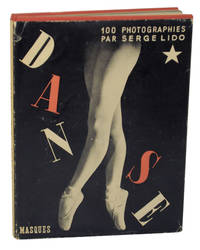
1947169356Paris: Revue Internationale D'Art Dramatique 1947. First edition. Hardcover. Text in English French and Spanish with contributions by Jean Cocteau Roger Lannes and D'Irene Lidova. Includes 100 black and white images by Serge Lido. A clean near fine copy in red boards in a very good plus dust jacket with some small edge tears minor edge wear and an archival tape repair to the top of the spine and price correction on the rear panel. A nicely printed book that is fairly uncommon in the hardcover format. Revue Internationale D'Art Dramatique unknown books
1947169356Paris: Revue Internationale D'Art Dramatique 1947. First edition. Hardcover. Text in English French and Spanish with contributions by Jean Cocteau Roger Lannes and D'Irene Lidova. Includes 100 black and white images by Serge Lido. A clean near fine copy in red boards in a very good plus dust jacket with some small edge tears minor edge wear and an archival tape repair to the top of the spine and price correction on the rear panel. A nicely printed book that is fairly uncommon in the hardcover format. Revue Internationale D'Art Dramatique unknown
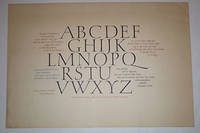
16-4939Frankfurt/M: 1959. Letterpress on card stock. 35.5 x52 cm.14" x 19 7/8" broadside. Philip Hofer. Broadside of an Alphabet with quotes by Douglas C McMurtrie Jean Cocteau and Emanuel Geibel about letters and the alphabet in a variety of languages. Calligraphed by Hermann Zapf and commissioned by Philip Hofer. Printed in 7 colors. The colophon line is in German and can be translated as "For Philip Hofer in Cambridge written by Hermann Zapf Frankfurt am Main 1959". Hermann Zapf pronounced “tsáff†born November 8 1918 was a German typeface designer who lived in Darmstadt Germany and was married to calligrapher and typeface designer Gudrun Zapf von Hesse.Zapf’s work which includes Palatino 1948 named after 16th century Italian writing master Giambattista Palatino and Optima 1952 a flared sans-serif released by Stempel in 1958. Zapf disliked its name which was invented by Stempel’s marketers has been widely copied often against his will. The best known example may be Monotype’s Book Antiqua which shipped with Microsoft Office and was widely considered a “knockoff†of Palatino. In 1993 Zapf resigned from ATypI Association Typographique Internationale over what he viewed as its hypocritical attitude toward unauthorized copying by prominent ATypI members.In 1935 Zapf attended an exhibition in Nuremberg in honor of the late typographer Rudolf Koch. This exhibition gave him his first interest in lettering. Zapf bought two books there using them to teach himself calligraphy. He also studied examples of calligraphy in the Nuremberg city library. In 1938 Zapf designed his first printed typeface for D. Stempel AG and Linotype GmbH of Frankfurt a fraktur type called Gilgengart.In 1976 the Rochester Institute of Technology offered Zapf a professorship in typographic computer programming the first of its kind in the world. He taught there from 1977 to 1987 flying between Darmstadt and Rochester. There he developed his ideas on digital typography further with the help of his connections in companies such as IBM and Xerox and his discussions with the computer specialists at RIT. Zapf used his experience to begin development of a typesetting program called the “hz-program†which Adobe Systems acquired and later incorporated in their InDesign program.Expertise by: Dominique COURVOISIERExpert de la Bibliothèque nationale de France. Membre du Syndicat Français des Experts Professionnels en œuvres d’art5 rue de Miromesnil 75008 Paris.Provenance: from the estate of Raymond Gid who died Sunday November 12 2000 in Paris. Born on November 25 1905 Raymond Gid became first known through his posters after having studied at les Beaux-Arts. As a film enthusiast he designed many movie posters for example Vampyr de Dreyer photomontage 1932 Le Silence de la mer by Melville 1949 Les Diaboliques by Clouzot 1955. But a meeting with Guy Levis Mano editions GLM editor and typographer soon directed Gid towards the book. In 1935 he publishes together with the photographer Pierre Jahan Devot Christ de Perpignan and Chats Chiens by Ylla. It is an intensive period of his life period: he meets Dufy Corbusier Hake Lurcat and receives the gold medal for a poster at the International exhibition of Paris 1937. He reacts to the Civil War in Spain with a poster " Help to the civil populations ". Together With Father Carre « bete-a-bon-Dieu » of the Resistance Raymond Gid began to design liturgical texts. Apocalypse Six an extract of the biblical text of Saint John appeard after the war. It is one of his major works composed in the Peignot typeface which was designed by Cassandre in 1937. He designs several post-war period posters for example Week of absent a simple Lorraine cross surrounded by barbed wire on a dark background. Right from the beginning of the symposiums in Lure Provence in 1954 Raymond Gid participates in discussions on typography particularly with Maximilen Vox Charles Peignot Roger Excoffon. Raymond Gid puts on page and illustrates the Dialogues of the Carmelite nuns by Bernanos 1954 then some pages in Caractere Noel 1955 dedicated to his friend Jan van Krimpen the creator of dutch type faces. He plays with the breathing of the text in the manner of Mallarme as in his Book of hours 1959 or his Apocalypse 1964 adapting medieval text to present day tastes. He also designs posters like those for the Club Mediterranee 1961 Bally 1976 or heavier fare like that of Amnesty International 1973. During his whole life Raymond Gid remained attached to the typographical arts. He liked to try out new characters in his compositions mixing them with his very free drawings as for example in Messidor published by the Imprimerie nationale 1989. Jean-Francois Porchez type designer; translated from french by Babelfish and cleaned up a bit. Links Art and Poster Bally posters Chicago Center for the Print Bally posters Poster Auctions International New York Catalogue from the personal exhibition at the Bibliotheque Forney Paris in 1992. Frankfurt/M: 1959 unknown
121652aafA Paris, chez Bernard Grasset, 1953, in-8vo, (19 x 12 cm), 234 p. + 2 ff. (table), envoi ms. de l’auteur en 1953 : ‘à Georges, son ami Jean, Cannes 1953’, brochure originale.
1919CLL-736Paris, La Sirène, 1919 In-16 carré de (144) pp., broché sous couverture imprimée rempliée.
12996Paru dans le n° 16 d'Intentions, mars 1923. Texte critique très élogieux malgré une introduction acide qui embrase toute l'activité antérieure de Cocteau: "Tout chemin peut mener jusqu'à soi-même, sauf quand on est bête. De travesti en travesti, de gageure en gageure, animé d'un étonnant désir de convaincre, Jean Cocteau, qui pense à tout mais qui a oublié d'être bête, arrive au bout d'un vaste périple d'expériences et d'avatars..." "Il a aimé la gloire. Il l'a tant aimée qu'il sera probablement tout à fait dégouté quand elle sera à lui tout à fait. Ces choses-là arrivent. Cette fois-ci déjà, ce n'est plus par souci de forcer la gloire que Jean Cocteau a mis dans le Grand écart ce qui en fait un livre de premier rang. Déjà il n'écrit plus pour; il écrit parce que".
492921Editions Du Rocher Monaco 1953 In-8 carré ( 190 X 145 mm ) de 106 pages, broché. Portrait de l'auteur par MODIGLIANI et un dessin de Hans BELLMER hors-texte. EDITION ORIGINALE au tirage limité à 1000 exemplaires, celui-ci un des 150 numérotés en chiffres romains sur vergé de Lana. Très bel exemplaire en parfait état, non coupé.
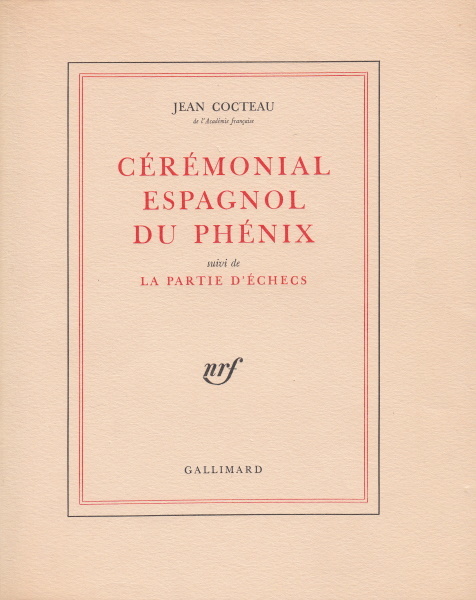
196114503Paris Gallimard 1961 1 vol. Broché plaquette in-4, brochée, 32 pp. Édition originale de ce long poème où l'évocation de l'Espagne se mêle aux thèmes de la mort et de la renaissance. Un des 25 exemplaires de tête numérotés sur Hollande van Gelder. En parfait état.
196114503Paris Gallimard 1961 1 vol. Broché plaquette in-4, brochée, 32 pp. Édition originale de ce long poème où l'évocation de l'Espagne se mêle aux thèmes de la mort et de la renaissance. Un des 25 exemplaires de tête numérotés sur Hollande van Gelder. En parfait état.
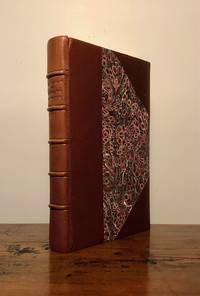
16006Paris, Librairie Stock, Delamain, Boutelleau et Cie, 1924. In-4, 272 pp., parchemin écru, titre et auteur au dos, couverture conservée (taches à la couverture).
68771 S.l., s.n. [Jacques Fournier], Imprimerie Studium, s.d. [1947], in-8° carré broché de 45 pages, couverture crème rempliée, imprimée en rouge.
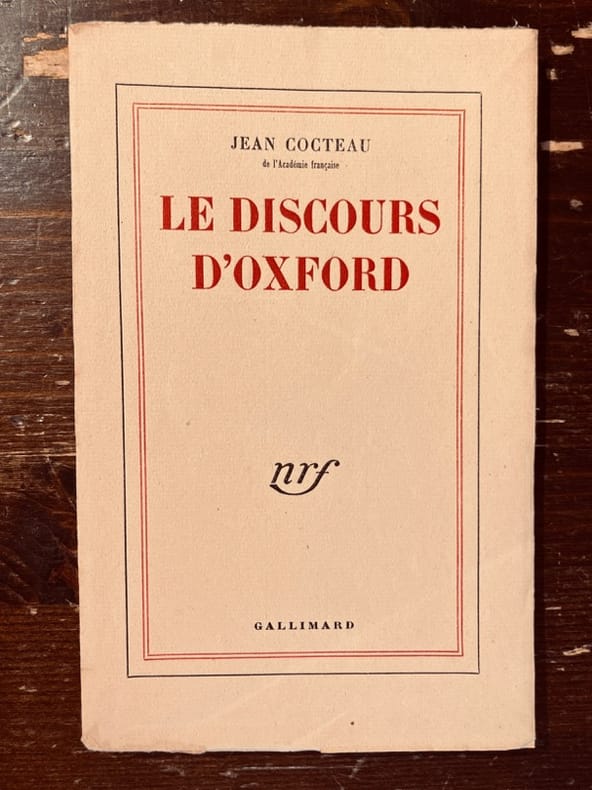
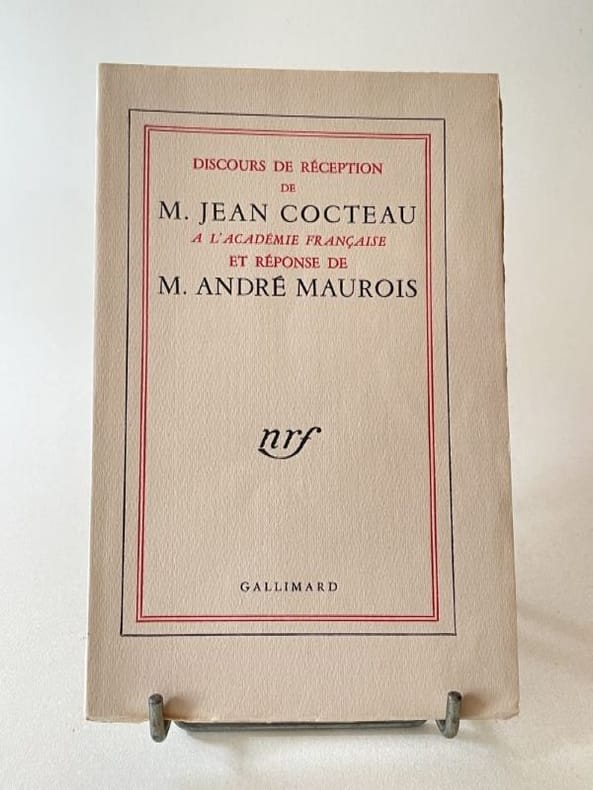
195595663Paris Gallimard 1955 1 vol. broché in-12, broché, 117 pp. Première édition publique de cet hommage à Jérôme Tharaud, suivi de la réponse d'André Maurois. Un des 38 exemplaires de tête numérotés sur vélin de Hollande. Excellent état.
195595663Paris Gallimard 1955 1 vol. broché in-12, broché, 117 pp. Première édition publique de cet hommage à Jérôme Tharaud, suivi de la réponse d'André Maurois. Un des 38 exemplaires de tête numérotés sur vélin de Hollande. Excellent état.