7 770 résultats
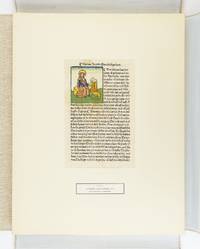
1929ST17493München: Weiss & Co. Antiquariat 1929. No. 21 OF 50 SETS issued with accompanying German text; there were also 50 with accompanying English text. 480 x 375 mm. 19 x 14 3/4". With an 87-pp. volume of commentary in German. <br/> Loose as issued in a linen-covered chemise titling in black on front cover. Commentary volume in original paper wrapper. WITH 55 LEAVES FROM INCUNABULA issued by German Swiss Dutch Czech and Italian presses ALL WITH ONE OR MORE WOODCUTS 32 OF THESE HAND-COLORED. ◆Front cover of commentary volume with thin six-inch brown stain along head edge but the volume otherwise clean and fresh the leaves with occasional browning or minor staining but excellent specimens overall the hand coloring often quite attractive.<br/> <br/> Arranged according to the city in which they were printed this is a wonderful collection of 55 incunabular leaves all illustrated with woodcuts. The group includes important early images large and small with 32 of them hand painted often with brilliant memorable color. Although every leaf here is of interest there are some leaves that deserve special mention: the 1471 Zainer printing of "Heiligenleben" the earliest leaf included; a number of leaves from herbals Bibles and lives of the saints; leaves representing two different editions of Brant's "Stultifera Navis" a Basel 1500 edition of Aesop and the celebrated 1499 Aldine "Hypnerotomachia Poliphili." A full-page woodcut from Koberger's "Schatzbehalter" "Treasure Book" 1491 shows Korah Dathan and Abiram being swallowed up by the Earth for their rebellion against God while Moses and Aaron pray as God sends fire to destroy the rebels. <br /> <br /> Among the hand-painted woodcuts are several that are outstanding both for the composition of large complex images and for exuberant coloring. These include Pharoah's daughter rescuing the baby Moses as well as the adult Moses with the burning bush both from the German Bible printed by Koberger in 1483; a view of the city of Perugia in Schedel's "Weltchronik" 1493; and another Schedel leaf depicting the martyrdoms of the Apostles Andrew and Thomas. The 55 specimens included here would serve very well either as a final capstone in an advanced collection or else an outstanding nucleus for a beginning collector of illustrated incunabular leaves. Several of the books represented are difficult to obtain and most of the ones that can be procured are very expensive. Weiss & Co. Antiquariat unknown
Folio (224 x 318 mm). 255 unnumbered ff. (last blank). Gothic type, 2 cols., 46 lines. Rubricated throughout. With title border painted in red and orange, large initial "S" in several colours with pretty flower and tenril designs, red colophone border and numerous red and blue initials. Contemp. blindstamped pigskin over wooden boards with 2 metal clasps (wants fittings). Ms. spine label. Probably the editio princeps of this collection of homiletic samples by Martin von Troppau (d. after 22 June 1278), rubricated and with pretty initials throughout. The alleged earlier edition cited by Hain, supposedly printed in Strasbourg in 1480 (H 10853), appears to be a ghost. - Martinus Polonus (also known as Martin von Troppau or Martinus Oppaviensis) is regarded as one of the most respected chroniclers of the Middle Ages. - Some 6 ff. remargined at bottom, 2 more leaves show loss to corners. Somewhat browned and brownstained; several contemporary marginalia. Worming to beginning and end (touching text in final third). Binding rubbed and bumped; defect to back cover and numerous wormholes. The pretty Gothic blindstamping shows hunting scenes, floral designs, and the Agnus Dei (not recorded in Schunke, Schwenke collection). Splendid hand-painted armorial bookplate of Wolfgang Crener von Sulzbach (fl. c. 1510), a scholar of canon law; several later ownership entries, stamps, bookplate. Hain 10854. Goff M-329. GW M 21433. ISTC im00329000. Pellechet 7628. IGI 6245. Proctor 591. BMC I, 132. Walsh 221. CIBN M-184. BSB M-238. Wierzbowski III, 2013. Estreicher XXII, 201.
Folio. 136 leaves. 17th century calf (rebacked). Latin translation of an Arabic treatise on simple drugs, traditionally attributed to "Pseudo-Serapion" (or Serapion the Younger), but recently identified as the "Kitab al-adwiya almufrada" (Book on Simple Drugs) by Ibn Wafid (d. 1067), a pharmacologist and physician from Toledo. Ibn Al-Wafid was a man of immense knowledge in all medical matters and therapeutics, with the skills to treat grave and insidious diseases and affliction. He preferred dietetic measures; if drugs were needed, he gave precedence to the simplest ones over compound drugs, and among these, he recommended the least complex, to be used only sparingly and in the lowest dosage possible. While the original Arabic version of the book is considered lost, a manuscript written in Hebrew-Arabic as well as partial translations in Latin and Catalan are preserved. This translation was prepared around 1290 by Simon Januensis (Simon of Genoa) and Abraham ben Shem-Tob of Tortosa. Very rare: a single copy in postwar auction records (Sotheby's, 1977: £1500). HC 14692*. Goff S468. GW M41691. Proctor 4433. BMC V 255. BSB-Ink S-300. GAL S I, 887. P. Dilg, "The Liber aggregatus in medicinis simplicibus of Pseudo Serapion: An Influential Work of Medical Arabism", in: Islam and the Italian Renaissance, ed. by C. Burnett and A. Contadini, Warburg Institute Colloquia 5 (London, 1999), pp. 221-231. P. E. Pormann, "Yuhanna ibn Sarabiyun: Further Studies into the Transmission of his Works", in: Arabic Sciences and Philosophy 14 (2004), 233-262.
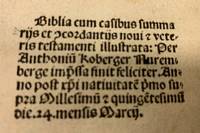
150146178Nuremberg: Anton Koberger 1501. Cf. Proctor 10958; ISTC ib00605000. A modern full calf binding executed in period style with brass bosses at each corner & center boss in each board. Modern leather strap clasp. Red edgestain. Binding - Fine. Imperfect textblock lacking the initial gathering and two leaves Zz1 & Zz6. Extensive period annotations throughout/some marginal paper restoration to numerous leaves especially H3 no loss & lower portion of 8. Some annotations affected by trimming. 1 cm closed tear to bottom edge of S2 T1; top of Qq5; bit of paper loss to Tt5 & Xx1 lower margin no text affected. Texblock overall with a nod to the missing leaves Very Good. Folio: a8 b - z6 A - Zz6 8. R4 missigned Q4. Text block trimmed at some juncture not us with current leaf size: ~ 28.6 cm x 18.8 cm. Rubricated / modest illumination of initial paragraph letters. Binding: 11-1/2" x 8" <br/><br/>"Anton Koberger was the German goldsmith printer and publisher who printed and published the Nuremberg Chronicle a landmark of incunabula and was a successful bookseller of works from other printers. He established in 1470 the first printing house in Nuremberg" from which sprang a number of editions of the Biblia Latina first appearing in 1475 with this reputedly the last with the Koberger name. Anton Koberger hardcover books
4to. 162 pp., fol. 163-164, (2) pp. (a-s4 t6 u6, without the 'Epigrammata' announced on the title). With woodcut title border and a border in the text by Hans Holbein the younger, 2 woodcuts in the text (1 full-page) by Ambrosius Holbein, and 6 woodcut initials; printer's device on final page. Modern giltstamped full calf. Rare third, revised edition (the first one printed in Basel) of the famous "ideal state" novel that gave its name to a whole literary genre. Edited by Erasmus of Rotterdam, whom More had sent the manuscript in 1516. The second part, about the ideal constitution for a state, was written first, while More was an envoy in Flanders in 1515, while part one was written only in 1516, after his return to England. The two woodcuts by Ambrosius Holbein, Hans's elder brother, include the famous bird's-eye view of the island of Utopia (a full-page illustration) and the charming scene showing the story's fictional traveller, Raphael Hythlodaeus, in discussion with More himself and his Antwerpian friend Peter Gilles (Aegidius), with More's young assistant John Clement (later to become a Royal Physician and More's son-in-law) approaching them. Like 'Gulliver's Travels', Utopia was written "as a tract for the times, to rub in the lesson of Erasmus; it inveighs against the new statesmanship of all-powerful autocracy and the new economics [...], just as it pleads for religious tolerance and universal education [...] More had all Swift's gift for utterly convincing romance: the beginning, when Rafael Hythlodaye recounts his voyages, has a vividness which draws the reader on into the political theory. [More] is a saint to the Catholic, and a predecessor of Marx to the Communist. His manifesto is and will be required reading for both, and for all shades of opinion between" (PMM). - Insignificant browning; endpapers somewhat fingerstained, but a beautiful, clean copy. Handwritten ownership of Gerard van Assendelft, dated 1603, at the top edge of the title-page. VD 16, M 6299. Adams M 1756. Panzer VI, 205, 222. Isaac 14177. Heckethorn 100, 90. Bezzel (Erasmusdrucke) 912. Hieronymus 260. Kat. Basel 1960, 343, 341, 120f. Gibson 3. Van der Haeghen III, 41. Cf. PMM 47.
5759Haguenau, Henri Gran, pour Jean Rynman, 1500. In-folio gothique à deux colonnes de (264) ff., le dernier blanc [Collation: cahier signé de chiffres 8, a-g8, h6, i-k8, l6, m-n8, o6, p-q8, r6, s8, t6, cahier signé de chiffres 6, v-x8, y6, z8, A-B8, C6, D-K8]. Relié à la suite : PELBARTUS DE THEMESWAR. Sermões quadragesimales pomerii fratris Pelbarti de Themeswar diui ordinis sancti Francisci incipiut feliciter. Haguenau, Henri Gran, pour Jean Rynman, 10 juillet 1500. In-folio gothique à deux colonnes de (110) ff. [Collation: a-b8, c6, d-e8, f6, g-h8, c6, k-l8, m6, n10, o6, p6]. 2 ouvrages en 1 fort vol. in-folio, aies de bois recouverts de peau de truie estampée à froid de motifs de Vierge à l'Enfant, de lion, d'oiseau et de fleur, dans de grands croisillons, dos à quatre nerfs, fermoirs de cuirs avec attaches en laiton (reliure de l'époque).
THE ONLY COPY PRINTED ON VELLUM OF ANY BOOK ISSUED BY POULET-MALASSIS. In this monograph, Langlois (1829-1869), a leading Orientalist of his time (despite his short life), ingeniously uses archeological, historical, and scriptural evidence to prove the true location of Jesus' tomb. 48 pp. PRINTED ENTIRELY ON FINE VELLUM BY JOUAUST, ONE OF THE GREAT PRINTERS OF THE SECOND HALF OF THE 19TH CENTURY. to. Attractively bound in contemporary quarter morocco and decorated boards. Spine in five compartments with fleurons and raised bands. Tiny traces of wear to binding, else FINE AND BRIGHT. Launay 152; Contades, p. 39; OberlÈ 594 (this copy: "PrÈcieux exemplaire imprimÈ sur peau de vÈlin. Il est probablement unique. C'est le seul volume publiÈ par notre Èditeur qui ait ÈtÈ tirÈ sur peau de vÈlin.") Copies of this book on paper are very rare; this unique copy on vellum is A PIECE OF PUBLISHING HISTORY. Provenance: Jean-Jacques Launay, the comprehensive bibliographer of Poulet-Malassis, acquired this book after compiling his bibliography, and thus while he cites the book in his bibliography, he does not describe it (obviously because he was unable to locate any copy at all.) From him it passed to Gerard OberlÈ.
4to (158 x 198 mm). (106) ff. Title-page with large woodcut vignette of St. Francis receiving the stigmata, 57 woodcuts in total (including duplicates) by Wolf Traut, 5 of which full-page, all with fine contemporary hand-coloring. Contemporary full pigskin over wooden boards with bevelled edges, panelled and decorated in blind. Spine with raised bands in four compartments. Remains of clasps. Edges stained blue. The rare first German edition of Bonaventura's life of St Francis ("Legenda major beati Francisci"), printed by Höltzel on behalf and at the expense of the Tyrolean benefactor of the Franciscan church in Schwaz, Caspar Rosenthaler. - This volume, a remarkable copy in contemporary colour, is also the first to incorporate Wolf Traut's striking woodcuts, ranking among the artist's masterpieces (while some are dated, none are signed). The Nuremberg artist, a student of Albrecht Dürer's, completed 51 woodcuts for this work, which would prove to be his greatest contribution to illustrated books. Traut was in Dürer's workshop from 1505, or possibly earlier, when he produced woodcuts for Pinder's "Der beschlossen Gart des Rosenkrantz Marie". - Binding somewhat rubbed and bumped. F3 and V1 with marginal repairs, L1, O1, and T4 torn and restored with loss of text. Some minor spotting or staining, one or two instances of marginal worming. - Provenance: Paul Kramer (contemporary ink signature and motto, "Omnia cum deo", to front free endpaper). Virtue and Cahill Library of Portsmouth Cathedral (oversized bookplate to front pastedown, with number 8363), dispersed in 1941 after German bombing and subsequently preserved in the Presbytery at Winchester; deaccessioned by the Bishop and Cathedral Chapter "for better care and to the advantage of scholars" in 1967 (stamped over bookplate). - A masterpiece of German book illustration, rarely encountered complete even in an uncoloured state. VD 16, B 6559. BM-STC German 140. Dodgson I, 502f., 1. Not in Adams. Cf. Einhorn, "Die Holzschnitte des Wolf Traut zur 'Legend des heyligen vatters Francisci' nach Bonaventura, Nürnberg 1512", in: Franziskanische Studien 60 (1978), pp. 1-24.
4to (155 x 217 mm). (72) ff. With woodcut printer's device to title-page. Contemporary blindstamped full calf on 5 raised bands. All edges faded red. First edition of this Latin translation, from the original Arabic, of books II, VI, and VII of the collection of medical texts referred to under the title of "Colliget" (from its Arabic title "Kulliyyât"), written by the great Muslim physician Ibn Rushd (1126-98, Averroes in the Latin tradition). - This translation is important not only for being the first Averroes version given by a French translator, namely the physician and humanist Jean-Baptiste Bruyerin Champier, but also for containing one of the first defences of the part taken by Al-Andalus Arab intellectuals in the transmission of Greek philosophy in Europe. In his introduction, Champier writes: "When the great flourishing of learning collapsed in Athens, and Gothic barbarity invaded the Roman empire, some Greek books of both the philosophers and the physicians migrated to the Arabs, including the Moors and the Spanish ... especially the books of Aristotle and Galen ... Then it happened that the Arabs translated many volumes of both authors from Greek into their own language. For it is known that the Arabs were most zealous in the study of the humanities, with the result that Averroes, Alfarabi, Avicenna and innumerable others of the same period philosophized on the basis of these books ... and they wholly concentrated on this effort and poured all the force of their intellect into writing interpretations and explanations of both authors. But when Spain was ruled by Alfonso, who had a great thirst for texts, especially in mathematics, since the Moors still held Andalusia, it was easy ... for the books of Averroes and others ... to be brought to Northern Spain where they were put into Latin" (fol. A3v, transl. C. Burnett). - The first part contains the description of the human body's functions and organs (with chapters dedicated to the brain and the spinal cord). The second part deals with the rules of healthy life, while the third exposes the principles of curing diseases. - Some foxing and wrinkling. First leaves slightly loosened. A good, appealingly bound copy of a rarely seen book, last offered at auction in 1984. Adams A 2312. Durling 373. Wellcome I, 568 (lacking last leaf). Baudrier VIII, 101. Gültlingen, Bibliographie des livres imprimés à Lyon V, 74. Atkinson, Medical Bibliography (1834), p. 67. Not in Osler, Cushing, or Waller. For the role of Arabs in the transmission of Greek philosophy see Charles Burnett, "Mont Saint-Michel or Toledo: Greek or Arabic Sources for Medieval European Culture?" (2009).
Folio (215 x 310 mm). (2), XXXII, (2) ff. With a fine full-page title woodcut (210 x 185 mm) by Hans Burgkmair (repeated on verso), incorporating a xylographic title showing the 'Sancta Mater Ecclesia' enthroned with a complex allegory depicted below her, both woodcuts boldly and skilfully highlighted in red. Initials, underlining and rubrication throughout in red. 20th century binding using older vellum. First edition of Stamler's dramatic dialogue comparing the religions of the Tartars, Turks, Saracens and Jews, superbly illustrated by Hans Burgkmair. A prefatory letter contains a very early reference to Columbus and Vespucci. - Hans Burgkmair's magnificent woodcut is an ambitious attempt to reproduce the ideas of the author graphically: it shows a seated female figure representing the Church with the globe as a footstool; she sits before a tent, surrounded by the banners of the Papacy and the Empire. The Pope and Emperor kneel before her, and on a lower step sit four queens representing the four non-Christian religions, each bearing a banner with a broken staff. Below them are the figures of the disputants who take part in the dialogue: Dr. Oliverius, theologian; Balbus, historian; Rudolphus, a layman; Arnestes, an apostate; Samuel, a Jew; and Triphon, natural philosopher. - Burgkmair (1473-1531) was the foremost woodcut designer of the early 16th century in Augsburg and became the chief designer for most of Emperor Maximilian's print projects. "With the year 1508, which shows him at the full height of his power in separate woodcuts, Burgkmair's real period as an illustrator of books begins [...] The frontispiece of Stamler's 'Dialogus' shows an unusual delicacy of feeling in the rhythmical articulation and distribution of the masses and the way in which the difficult allegorical subject is controlled and visualized" (Rupe, "Hans Burgkmair as an Illustrator of Books", Print Quarterly 10.2 [1923], p. 177). - In a letter to Jacob Locher dated 1506 on fol. a3v, Stamler refers to the New World discoveries: "I do not make any mention of the newly discovered islands, but of Christopher Colom, their discoverer, and of Albericus Vespucius; on the discovery of the New World (to whom our age is chiefly indebted) behold what treatise I send you" (transl. from Latin). - Later 16th century ownership inscriptions on otherwise blank last verso. A scattering of small wormholes affecting one or two letters, else very well preserved. VD 16, S 8527. Alden/Landis 508/19. Sabin 90127. Harrisse 51. Church 26. JCB I, 47-48. Burgkmair: Hollstein V, 68.81. Dodgson II, 57.1; 70.7. Muther 858.
Small folio (209 x 291 mm). 248 unnumbered leaves (without the first and last blank, as usual). Gothic type, 2 cols., 51 lines. With a woodcut in the text on fol. a2r and printer's device at the end. A single ink initial on p. a2 supplied by the owner. 18th century full calf with panelled boards and giltstamped spine label. Marbled endpapers. All edges red. Rare edition; a single copy in Great Britain. The "Fortalitatium fidei", the principal work (written ca. 1458) of the baptized Spanish Jew de Spina, is considered the "methodical and ideological foundation of the Inquisition. The book, divided into five chapters, targets chiefly Jews and Muslims" (cf. LMA I, 408f.). Of the five books, "the first [is] directed against those who deny the Divinity of Christ, the second against heretics, the third against the Jews, and the fourth against Islam and the Muslims, while the fifth book treats of the battle to be waged against the Gates of Hell. In this last book the author dwells at length upon the demons and their hatred of men; the powers they have over men and the diminution of these powers, owing to the victory of Christ on the Cross, the final condition of the demons, etc." (Catholic Encyclopaedia). "Ouvrage fort curieux de ce théologien espagnol [...] il était dit-on d'origine juive, c'est pour cela que son 'Fortalicium' pèut ètre classé dans une bibliothèque kabbalistique" (Caillet). Part 3, on the iniquities of the Jews, is a veritable encyclopaedia of mediaeval antisemitic libel, containing numbered lists of Jewish "cruelties" and refutations of the Jews' supposed anti-Christian arguments. The section on Islam lists the numerous Saracen wars, while the fifth book is devoted to the battle to be waged against the Gates of Hell and its resident demons, whose population the author calculates at over 133 million; this is one of the earliest printed discussions of witchcraft and a precursor to the "Malleus maleficarum", the first edition of which appeared in the same year as this present edition. - Occasional contemporary ink marginalia (some touched by the binder's knife); some slight worming, confined to blank margins. Some even browning and a weak waterstain, but a very good, wide-margined copy with an 18th century noble collection stamp (crowned Gothic letter G; not in Lugt) on the first leaf. HC 874*. Goff A-542. GW 1577. Proctor 8575. BMC VIII, 277. Polain 159. Pellechet 564. Coumont (Witchcraft) S84.4. Caillet 10305.
4to. 146 (instead of 164) ff., wanting fols. 1, 9, 15, 51, 56-58, 81-82, 96-97, the four unnumbered leaves after 144, 157-159, and the final blank. With 108 (instead of 117) woodcuts in the text and printer's device at the end. Early 19th century half calf over papered boards with giltstamped spine label. Edges sprinkled. Early, if incomplete Latin edition of the famous "Narrenschiff", originally published in German verse in 1494 - also by Bergmann - and translated by the author's student Jacob Locher. One of literature's most famous satires and a milestone in the history of book illustration: many of the woodcuts depicting human foibles (here printed from the original blocks) are now attributed to the young Albrecht Dürer. Before Goethe's "Werther" arrived on the scene, this work was the most successful book ever published in Germany, immensely popular and read until it fell to pieces, and complete copies of the incunabular Basel editions are nearly unobtainable. - In his "Ship of Fools", Brant describes the voyage of a ship bearing one hundred fools, to the fools' paradise of Narragonia, thereby satirizing the follies of his time including representatives of every human and social type. "[T]he first original work by a German which passed into world literature [... it] helped to blaze the trail that leads from medieval allegory to modern satire, drama and novel of character" (PMM). Erwin Panofsky called the book "a remarkably complete mirror of human life", based upon the "universality of Brant's self-righteous surliness [...] and the picturesqueness of his metaphors" (Panofsky, p. 30). Incidentally, the book also contains the earliest literary reference to the discovery of America: "Hesperie occidue rex Ferdinandus: in alto Aequore nunc gentes repperit innumeras" ("Ferdinand, King of the West, recently discovered innumerable peoples across the high seas", fol. 76v). Tellingly, the humanist-printer Bergmann had published the famous "Columbus letter" in 1493. - Some browning and brownstaining; occasional underlinings by a near-contemporary hand (more frequent in the beginning and within the chapter on women). Folio b2 is loosened. Rebound in the 18th century (edges trimmed fairly closely). Small hole in the spine, otherwise well-preserved copy from the collection of the Swedish statesman and diplomat Lars von Engeström (1751-1826) with his engraved armorial bookplate (motto "speravit infestis", "hopeful in adversity") to pastedown. Hain 3751*. Goff B-1091; GW 5062. Bod-inc B-513. Sheppard 2560. Proctor 7778. BSB-Ink B-821. Hieronymus, Buchillus. 195. Cf. PMM 37. Harrise, BAV, Additions, no. 21.
Folio (240 x 354 mm). (18), 191 ff. (without final blank). Printer's device on title page and, in a different version, on the last page. Contemporary cardboard binding with marbled spine and ms. label. Stored in custom-made cloth-and-paper slipcase. First issue under this title, previously released as "Expositio in primam fen quarti canonis Avicennae" (1506). A commentary (with the text, in the version of Gerardus Cremonensis) of book four, part (fen) one of Avicenna's systematic "Canon of Medicine", written in Arabic but widely translated throughout the Middle Ages and the basis of medical training in the West as late as the mid-17th century. It continues in use to this day in parts of the Arab world. Through this encyclopedic work, the author exerted "perhaps a wider influence in the eastern and western hemispheres than any other Islamic thinker" (PMM). "The 'Qanun' [...] contains some of the most illuminating thoughts pertaining to distinction of mediastinitis from pleurisy; contagious nature of phthisis; distribution of diseases by water and soil; careful description of skin troubles; of sexual diseases and perversions; of nervous ailments" (Sarton, Introduction to the History of Science). The present part is dedicated to a discussion of feverish illnesses. - 18th century ownership "Manhem" on title page. Some brownstaining throughout, as common; some waterstains near end; occasional inkstains and marginal annotations. An untrimmed, comparatively wide-margined copy. Edit 16, CNCE 2345. Adams A 1541. Durling 245. Cf. Wellcome I, 387 (only the Venice reprint). PMM 11.
8vo. 256, (6) pp. With the title and imprint set in type in the cartouches of an elaborate woodcut architectural frame including atlantes, grotesque faces, garlands of fruit, etc., and Rouille's woodcut eagle and snake device in an oval window in a pendant hanging from the title-cartouche; 210 emblems (200 with woodcuts); nearly every page (with or without an emblem woodcut) in one of about 34 different richly decorated woodcut frames (generally in four pieces made for use together). There are 6 additional small woodcuts (plus many repeats), usually used as tailpieces, and 5 woodcut decorated initials (3 series of roman capitals in white on a pictorial background). Set in roman and italic types (some by Robert Granjon) including several of the earliest italics to use sloped capitals. Early 18th-century (Spanish?) sheepskin parchment, sewn on 2 supports, with a hollow back, with the title in manuscript across the head of the spine. Rouille issue of the first Spanish edition of the first emblem book, by the legal scholar Andrea Alciato (1492-1550) in Milan, first published in Latin at Augsburg in 1531 with only 104 emblems (97 with woodcuts), but greatly expanded up to the author's death. The present edition has more emblems and more woodcuts than any earlier edition, also more than the French and Italian editions by the same publishers in the same year and more than the competing editions by De Tournes. It brings the work nearly to its definitive form. The Macé issue of the present edition is identical except for the imprint and device on the title-page. Alciato not only produced a work that was to continue through hundreds of editions over the centuries, he invented a whole new genre, the emblem book, which combines allegorical images with a brief motto that aims to give the core of the idea and explanatory text (here in verse), the combination of text and image intended to give more meaning to both and to encourage contemplation by the reader. - The first authorized edition, published by Wechel at Paris in 1534, expanded the first edition and included 113 emblems. Aldo Manutio published a second volume at Venice in 1546, but it was in Lyon that the two volumes were first published together, by two competing firms: De Tournes produced an edition in 1547 with 113 + 86 = 199 emblems, but the 86 in the second volume have no woodcuts; Rouille (publisher) and Bonhomme (printer) produced an edition in 1548 with 201 emblems (128 with woodcuts). On 9 August 1548 they also received a privilege for translations into French, Italian and Spanish, and as these appeared they continued to expand the work. The present first Spanish edition of 1549 (one year before the author's death) therefore contains 210 emblems (200 with woodcuts). Ten emblems (all with woodcuts) therefore make their first appearance as emblems in the present edition, and it omits only 2 emblems published earlier: one that was considered obscene and another omitted for unclear reasons. These 212 emblems were to remain the definitive set for future editions. In most respects, the present Spanish edition follows the 1548 Latin edition but Bernardino Daza who translated it into Spanish claimed to have followed a printed copy with corrections in Alciato's hand, making the present Spanish text an essential source for the author's intentions, rather than just a translation. - Most of the emblems are based on episodes in classical literature, so that their woodcuts depict those scenes, but one shows a map and 14 show quite detailed botanical illustrations of different species of trees: these were cut for the great botanist Leonard Fuchs, De historia stirpum commentarii insignes, which also appeared in 1549. - Except for these trees, the emblem woodblocks are believed to have been cut by Pierre Eskrich. Many appeared in Bonhomme and Rouille's 1548 Latin edition and were based primarily on those cut by Bernard Salomon for Jean de Tournes's 1547 edition, but Eskrich made revisions and additions of his own and as the editions expanded he cut further blocks not based on Salomon. Of the 34 woodcut frames, at least 12 are signed, all with the initials "PV", identified as Pierre Vase, another name used by Eskrich. These present a tremendous wealth of grotesque faces, atlantes, caryatids, fantastic beasts, plants and various kinds of abstract ornament. Some show a single scene interrupted by the space left for the emblem and text (one shows a large ship, two show landscapes, etc.). - With several early owners' inscriptions, some struck through; a ca. 1815 bookseller's engraved label of Théophile Barrois, fils, libraire, Quai Voltaire, n°. 11, Paris, on salmon-coloured paper (35 x 54 mm); and an engraved armorial bookplate of the Dublin-born physician in Paris, Sir Robert Alexander Chermside MD (1787-1860). Lacking the final blank leaf R4. As in many copies, the descender of the 9 in the imprint date "1549" has not printed, so that the date looks like "1540" (this has lead to frequent references to a ghost edition of "1540"). A fraction of a millimetre has been shaved off the head of the woodcut frame on the title-page, there is a long tear along the gutter fold of bifolium O1.8, a couple corners of leaves torn off (not approaching the text or woodcuts), a tiny hole in the title-page, occasional and mostly marginal stains and a few marginal reinforcements. In spite of these defects, most leaves are in good or very good condition. Macé's presswork is somewhat inconsistent, but this has more effect on the woodcut frames than the emblem woodcuts (and since the frames repeat, one can generally find an example that has printed well). Adams, Rawles & Saunders F029. Baudrier IX, 167. Fairfax Murray (French) 9. Green, Andrea Alciati 36. Iberian books 63018. Landwehr, Romanic emblem books, 40. USTC 342602. Cf. Adams A614 (Bonhomme issue); Jammes, Emblèmes 5 (Bonhomme issue); Mortimer (French) 15 (1549 French ed.); Palau 6061 (Bonhomme issue); Praz, p. 250 (1548 & 1550 Latin eds.).
8vo. 272, (8) pp. With 6 full-page engravings of birds of prey (125 x 85 mm) plus 3 (of 5) repeats, all on integral leaves. Red goatskin morocco, gilt edges, signed in the foot of the front turn-in by M[arcel] Godillot (active as bookbinder 1938-1975), with wide gold-tooled turn-ins and gold fillets on board edge. Very rare second edition, one year after the equally rare first edition, of one of the earliest French treatises on falconry and hawking, by Charles d'Arcussia (1554-1628), falconer to King Henri IV (and later to Louis XIII), who dedicates it to the king. "The work is much esteemed on account of its originality and the amount of information it contains" (Harting), "the outcome of long practice and an astonishing amount of research work in every subject connected with [Arcussia's] favourite sport [hawking]" (Schwerdt). - Jean Tholosan published the first edition at Aix-en-Provence in 1598, but the USTC records only 3 copies of each, all in French libraries except for a copy of the present edition at the Wellcome Library in London. - The six birds of prey illustrated are described as: De l'espece du faucon premier de noz oyseaux, Du Lanier Nyais, Du sacre, Du Gerfaut, De l'Emerillon and De l'Autour Nyais. USTC oddly notes that D8 is cancelled, but it is certainly present here, with one of the 11 engravings. The book went through about a dozen editions before 1650. - With an 18th century endleaf, a monogram stamp (ca. 1800) on the title-page, and a modern armorial bookplate of the Verne d'Orcet family, whose great library on the subject of hunting was begun ca. 1900. Washed and lacking F8 (supplied in a lithographic [?] facsimile on 18th century [?] paper), but that leaf contains only repeats of 2 engravings plus their captions and a 4-line verse, with no other text. Three other plates are slightly shaved, affecting the tip of one bird's tail (present in the repeat plate), the beak of another and a small bit of foliage in a third plate, a corner torn off 1 leaf (affecting one shoulder note), a small hole in another, a worm hole in the foot margin of the last few leaves and a faint water stain in the fore-edge margin of a few leaves. Still generally in good condition, the binding fine. Very rare classic of falconry and hawking. Harting 153 (note). Nissen, IVB 35. Ronsil 3120. Schwerdt 41. Souhart 16. Thiébaud 28 & Suppl. col. 1050. Wellcome I, 388. French vernacular books 1653 (3 copies). USTC 20901 (same 3 copies). Cf. Lindner 11.0077.01 (1617 ed.); Sotheby's (Marcel Jeanson coll.) 28 Feb. to 1 March 1987, lot 31 (1598 ed.). Not in Adams. For the binder see Godillot: Fléty, p. 82.
Folio. (12), 157, (2), (1 blank) ff. With the title within a decorative metal-cut (?) panel. Set in roman types. Contemporary limp sheepskin parchment; rebacked in calf, with new endpapers, but preserving the original paste-downs. First edition of Jean Ruel's translation into Latin of Dioscorides's standard work on pharmacology, "De materia medica" (books 1-5), the most important botanical book up on to the 16th century, followed by four books on poison "De venenis" and "De venenatis animalibus" (books 6-9). - Dioscorides (ca. 40-90 AD), a Greek in the service of the Roman Empire, assembled all that was then known concerning the medicinal uses of plants, animals and minerals, adding information from his own experience accompanying the Roman army to Spain, the Middle East, North Africa and elsewhere, where he came to know many Persian, Indian and other exotic medicines. Though his work appeared in Latin from 1478 and in the original Greek from 1499, the present translation by Jean Ruel was first published here. "Often considered a herbal, [it] deals with all three natural kingdoms: plant, mineral and animal. It describes all the substances known to Dioscorides that were used as primary ingredients for medicines, and constitutes an encyclopedia on the topic. ... [It] contains just over one thousand chapters [each dealing with another medicine] and features 794 plants, 104 animals and 105 minerals. Most of the chapters contain the following information: the most common name of the drug and its possible synonyms; a description of the natural element producing the drug (for a vegetal drug, the whole plant); the part used as a drug, possibly with its preparation; the therapeutic properties of the drug; the diseases for which the drug was used, including the preparation and administration of the medicine; when appropriate, the falsifications and methods of authentication of the drug; and other uses of the drug, such as in cosmetics, veterinary medicine, of handicraft" (Glick). - "While Hippocratic and Galenic medical theory and practice were readily adopted by the physicians of the Islamic era-a system that has persisted down to our time in traditional and folk medicine throughout the Near and Middle East, it was the Ketâb al-haoaes (Book of the herbs), a translation of Dioscorides' famed treatise on materia medica by Estefan b. Basîl and his master the celebrated physician-translator Honayn b. Eshaq (b. 192/808 at Hira), that constituted the original source of knowledge and inspiration for medical and pharmacological writers … in the lands of Islam in the Middle Ages and afterwards. Dioscorides described approximately 600 plants, mainly of the Mediterranean area, providing for every item equivalent names in some other languages, its provenience, a short morphological description, and then a statement of its medicinal properties and uses. Dioscorides was held in great esteem by all the physicians and scholars in the Islamic period" (Encyclopaedia Iranica). - With embossed initials on leaf d5. Title-page slightly thumbed, a waterstain at the foot of the last few leaves, but otherwise internally in very good condition. Binding soiled. Durling 1139. USTC 144550. Wellcome I, 1782. Cf. T. Glick, Medieval science, technology and medicine: an encyclopedia, p. 152.
8vo. (28), 186, (10) pp. Woodcut initials. 19th century marbled boards. All edges red. The Norman copy of the first edition thus, very rare, containing "most of [Paracelsus's] innovations in chemical therapeutics" (Garrison/M.). Paracelsus (ca. 1493-1541) was a key member of the German Renaissance and a pioneer of the medical revolution. He was interested in chemistry, hermeticism, and toxicology alongside and in conjunction with his medical theories, and overturned much of the accepted wisdom of medicine in the West. In doing so, he "rebelled against ancient humoral pathology, which held that all disease resulted from an imbalance of bodily humors, by stating that each disease was a specific entity caused by an agent outside the body" (Norman). The "Septem libri de gradibus", first published in slightly different form in 1562, is one of his most essential works. - Covers lightly rubbed, otherwise in good condition. Provenance: from the Wellcome Library (withdrawn stamp on title verso) and the Norman collection with Haskell F. Norman's printed bookplate. VD 16, P 450. Sudhoff 98. Durling 3480. Wellcome I, 4765. Pagel, Paracelsus, pp. 134-146. Norman 1636 (this copy). Cf. Garrison/M. 1818.
8vo. 260 (instead of 268) pp. (lacking 4 leaves: J8, K1, 4-5), 2 blank ff. With woodcut device in contemporary colour on title-page. Illustrated throughout with woodcut diagrams and spheres, 2 with movable parts, nearly all in stark contemporary colour. - (Bound with) II: Beyer, Hartmann. Quaestiones novae in libellum de sphaera Ioannis de Sacro Bosco, in gratiam studiosae iuventutis collectae ab Ariele Bicardo [...]. Wittenberg, Peter Seitz, 1550. (4), 80 (instead of 84) ff. (lacking 4 leaves: 52-55). With two folding tables, woodcut device on titile-page, an initial and a diagram in the text, all woodcuts in contemp. colour. - (Bound with) III: Honter, Johannes. Rudimentorum cosmographicorum libri III cum tabellis geographicis elegantissimis. De variarum rerum nomenclaturis per classes, liber I. Zürich, Christoph Froschauer, 1552. (30) ff., 2 blank ff., (14) ff., 1 blank f. With woodcut device on title-page. Final 14 leaves comprise the atlas "Circuli sphaerae cum V zonis" with half-title woodcut, 2 smaller woodcuts in the text, and 13 woodcut maps (12 double-page, 1 full-page), all in stark contemporary colour. Contemporary blindstamped pigskin (wanting clasps). Fine sammelband of astronomical and geographical works, annotated and brilliantly coloured throughout by a contemporary owner. - I: Rare edition of the most important astronomical work of the Middle Ages: a reissue of the 1545 edition with only the colophon changed (the earlier year of publication is preserved on the separate title of part two, "De anni ratione" [J3r]). Includes Melanchthon's 1531 preface as well as his 1538 dedication, in the name of Rheticus, to Achilles Gasser. Among the woodcuts are not only two volvelles (the movable part of a third woodcut appears lost) but also a globe map of Europe, Africa, and part of Asia on leaf F5v (apparently an improved version of the "Globus Mundi" map mentioned by Shirley on p. 33). Occasional annotations in brown ink; rubricated throughout, with penwork decorations to initials in blue and red ink; nearly all woodcuts are hand-coloured in surprisingly vivid hues. The four missing leaves have been supplied in facsimile. - II: Early Wittenberg reissue of this popular instructional manual on astronomy, first published in Frankfurt the previous year. "Some new features from the standpoint of presentations and pedagogy, but its astronomy remains Ptolemaic and Sacroboscan" (Thorndike). Heavily annotated throughout in brown and bright red ink by a 16th-century hand. Lower corner of leaf L1 torn off (no loss to text). Missing 4 leaves of text, but includes the two frequently lacking folding tables. - III: Fourth Zurich edition of Honter's atlas with the maps reproduced from the first Froschauer edition published in 1546 (the work had originally appeared in Cracow in 1530 without illustrations). The fine maps, showing the widely used heart-shaped world map (cut by Heinrich Vogtherr the Elder, a specially commissioned reduced version of Waldseemüller's), Spain, France, Germany, Eastern Europe, the Balkans, Greece, Italy, Palestine, Turkey, Asia, Africa, and Sicily (all but the latter printed as double-page spreads), are in good contemporary hand colour, as are the spherical globe, the diagram of the planetary orbits (with the earth at centre), and the globe surrounded by the four winds. - A well-preserved collection in its first binding. I: VD 16, 727. Zinner 1971. BNHCat J 140. NUC 513, p. 474. Cf. Adams H 725. Burmeister, Rhetikus II, p. 56f., nos 6. & 7 (1538 & 1550). - II: VD 16, ZV 1449. Zinner 1978. IA 118.456. Houzeau/Lancaster 2527. This edition not in Adams or BM-STC German. - III: VD 16, H 4781. Adams H 833. Shirley 86 (and fig. 73). Sabin 32796. Alden/L. 552/25. Borsa (Ausg. d. Cosmographia) 96. Cf. Nordenskiöld p. 111 & plate 44. Not in BM-STC German.
Folio (217 x 297 mm). 36 (instead of 40) ff. [a-d10], wanting the first and final blanks (as common) and leaves [a]5-6, missing text supplied in near-contemporary manuscript (but omitting initials). 38 lines, 2 columns, 3- and 4-line Lombardic initials supplied in red, red initial strokes and paraphs. 19th century unsophisticated boards. One of the earliest editions of Vegetius's famous military manual. The book gives an account of the Roman military institutions, organization and science, and includes a discussion of naval warfare. Writing under Emperor Theodosius the Great around 400 AD, Vegetius aimed to counter what he perceived as a progressive decay of the Roman military strength. "The printing of this edition is not clean and somewhat rough in general. Exceedingly rare" (cf. Schweiger). Ebert and Schweiger both date this to "between 1474 and 1478". - Annotated throughout in a contemporary hand. The two missing leaves of text have been supplied in different handwriting, no later than the early sixteenth century (watermark of inserted leaves: couronne à diadème, 138 mm high, not identified but similar to Briquet 4900ff., 4950ff., Piccard I.VI, 27-29: various locations, but mainly 1490s to 1520s). Blanks lacking (as from the Bodleian copy); the BSB copy wants the final two leaves (including [d]9, the last leaf of text). Only 19 copies listed in public collections; no sale records for this edition. Provenance: 1) William O'Brien (1832-99), Irish bibliophile and judge who presided over the 1882 "Phoenix Park Murders" (his handwritten pencil acquisition date "6 March 1868" on pastedown); 2) bequeathed as part of his enormous collection, which included 100 incunabula, to Milltown Park Jesuit Library (Dublin) in 1899 (their bookplates, with bequest plate). Hain 15911. Goff V-106. GW M49487. Proctor 1126. BSB-Ink V-61. Bod-inc V-050. Grosjean & O'Connell 117. Schweiger II.2, 1121. Ebert 23435.
(4), CXXV, (1) Bll. With two-part armorial woodcut on title-page and 27 woodcuts in the text (8 by H. Schäufelein, 15 (?) by H. Weiditz). Modern marbled boards. Folio (212 x 304 mm). First German edition of "the first systematic study to address explicitly and exclusively the universal education of women", at the same time a fine and rare woodcut book. Commissioned by the wife of Henry VIII, Catherine of Aragon, who was at the time rearing her own daughter, Mary Tudor, Vives' treatise was translated and adapted by numerous followers (here by the Bavarian Humanist Christopher Bruno) and thus was read in almost every European vernacular, often by women themselves. The present translation is dedicated to Maria Jacobaea of Baden-Sponheim (1507-80), duchess consort of Bavaria, and to her daughter Mechthild of Bavaria (1532–65). - Vives' work consists of 3 books, one for each stage of woman's life: maidenhood, marriage, and widowhood. Although the author specifically adapted his prose style for a female readership, the treatise is hardly pro-woman: "the 'Education' is determined to be both a reference book for men on how to control their women, as well as an edifying treatise for women to absorb as a source of proper behaviour" (Kolsky). Nevertheless, Vives' praise of women's intellectual capacity and his advocation of some form of universal learning for females are viewed as landmarks for modern historians of women and gender. According to Pollie Bromilow, the dozens of vernacular translations were partly aimed at women themselves, who had no knowledge of Latin; and thus a large segment of its readership during the 16th century was in fact female. - Even browning and brownstaining throughout due to paper stock; some light waterstains. A few leaves show repairs in the lower margin and occasionally beyond, and a single leaf has a larger part torn out from the outer margin (no loss to text). - A fundamental document for the role of women in Early Modern society; only two copies in the trade since 1935. VD 16, V 1867. BM-STC German 899. Hayn/G. VIII, 135. Muther 1126. Musper L 181. Oldenbourg L 215. Not in Adams. Cf. Kolsky, Making Examples of Women: Juan Luis Vives' The Education of a Christian Woman. Bromilow, "An Emerging Female Readership of Print in Sixteenth-Century France?", French Studies (2013) Vol. 67, pp. 155-169.
In-folio (28,8 x 20,5 cm.); 10 cc.nn., 59 cc., 1 bl., 14 cc.nn, 1 bl.; with two woodcuts (15,8 x 12,9 cm) and 30 full-page calligrams in red and black, poems arranged in such a way that it forms a thematically related image. Bound in XVIII century half-leather.
19512091202133203574Published by Sonkeikaku Series Published by Maeda Ikutoku Zaien 1951. Soft Cover. Fine. Number of books: 3 volumes Published by Sonkeikaku Series Published by Maeda Ikutoku Zaien paperback
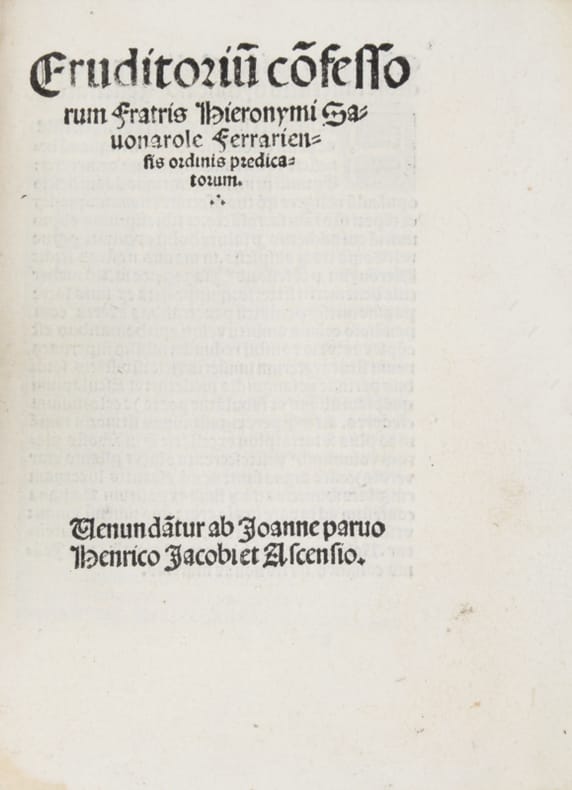
151315517Paris, [Thomas Kees], 1513. In-8 de (32) ff. (sign. a-d8).Deuxième édition en caractères gothiques ornée de lettrines, publiée trois ans après l'originale, sortie des presses parisiennes de Thomas Kees, identifiables au matériel typographique employé. Colophon : Impressum Parisius Anno. MCCCCCXIII die XXIII mensis novembris. Traduction du "Sermo in vigilia Nativitatis Domini" par Bartolomeo Meduna, suivie de "Devotissima expositio sancti Thome super salutatione angelica". Brunet V, 160 ; Moreau, II, Inventaire, 716.SAVONAROLA (Girolamo). Fratris Hieronymi Savonarole de Ferrariis ordinis predicatorum Expositio in psalmos Miserere mei Deus. Qui regis Israel, et tris versus psalmi. In te Domine speravi. S.l.n.d. (Paris, Josse Bade, circa 1508). In-8 de (40) ff. (Sig. a-e8).Second tirage des Psaumes sorti des presses de Josse Bade vers 1508 avec sa marque au titre qui porte la devise "Prelum Ascensianum". Brunet V, 159 ; Moreau I, Inventaire, 176 ; Renouard, Josse Badius, III, p.248, E-2.SAVONAROLA (Girolamo). Eruditorium confessorum Fratris Hieronymi Savonarole Ferrariensis ordinis predicatorum. Venundantur ab Joanne Parvo, Henrico Jacobi et Ascensio (Paris, Jean Petit, Henri Jacobi et Josse Bade), 1510. In-8 de (56) ff. (sig. a-g8).Deuxième édition publiée l'année de l'originale augmentée de l'Épître de Jodocus Guido à Malignus Papa, maître de la jeunesse studieuse. Colophon : Finem cepit in edibus ascensianis ad XIIII calendas octobres anno MDX ad calculum romanum (18 septembre 1510). Moreau, Inventaire, I, 189 ; Brunet V, 165 ; Panzer VII, 545, 386 ; Renouard, Josse Badius, III, p. 246, C-1.PARENTINIS (Bernardus de). Lilium misse in quo omnes difficultates || officij misse sacrique canonis secundum sanctum Thomam summopere enodantur. Venundatur vero Parisius a Johanne Paruo in vico diui Jacobi sub lilio aureo sedente (Paris, Philippe Pigouchet pour Jean Petit, 1510). In-8 de (7) ff. 1 f.bl., CXLIX ff. (1) f. (sig. A8 a-t8).Belle impression en caractères gothiques sur deux colonnes ornée de lettrines, sortie des presses de Jehan Petit avec sa marque typographique sur le titre et la grande marque gravée pleine-page de Philippe Pigouchet au verso de l'ultime feuillet. Colophon : Nouissime autem exaratum Parisius per Philippum Pigouchet pro Johanne Paruo Anno christiane salutis M.v.c.x. solExceptioe vero Decembris claudente vicesimam. Quelques notes manuscrites marginales à l'encre du temps. Panzer VII, 546, 393 ; Moreau, Inventaire, I, 22.4 pièces reliées en 1 vol. in-8 (145 x 105 mm), peau de truie sur ais de bois estampée à froid, dos à trois nerfs, titre et cote manuscrits postérieurs sur le dos, deux fermoirs, parchemin de réemploi sur les gardes (reliure de l'époque).
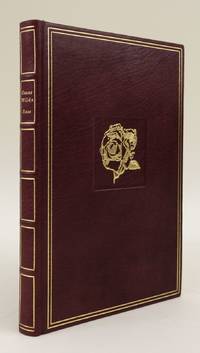
1982ST16482Bayreuth: Printed by Chr. Scheufele Offizin Stuttgart for Bear Press 1982. No. 1 OF 10 COPIES ON VELLUM plus a "special" edition of 25 copies and 185 copies on Kochi Japanese paper. 223 x 148 mm. 8 7/8 x 5 3/4". 50 pp. 2 leaves.Translated and with an afterword by Wolfram Benda. <br/> Publisher's fine burgundy morocco by Erwin Lehr upper cover with gilt rose in recessed square flat spine with gilt titling turn-ins with gilt fillet frame pale yellow silk pastedowns. In the original burgundy suede slipcase. With three large initials in burnished gold and four signed and numbered original etchings by Peter Klitsch. Printed in red and black. Signed in the colophon by the artist the binder and the publisher/translator. In mint condition.<br/> <br/> This is the splendid deluxe version of a finely crafted private press edition of Wilde's fairy tales "The Nightingale and the Rose" "The Happy Prince" and "The Selfish Giant." It is the third work issued by the Bear Press founded in 1979 by literary scholar Wolfram Benda and still in operation. According to the firm's website "at a time when the craftsmanship and ethos of the artisan in bookmaking have been damaged by ever-increasing industrialization and neglect . . . The Bear Press . . . tries to achieve the highest possible degree of technical and artistic perfection in its printed works." The font used to print the text and the artist chosen to illustrate each work are carefully selected to express "the individual author's personality and intention." Even the discriminating aesthete Wilde 1854-1900 would be pleased with the choices here especially for the luxurious vellum printing: the type is set in refined Walbaum Antiqua and shown off with special effect by the creamy leaves; the etchings by Austrian artist Peter Klitsch b. 1934 are meticulous detailed and reminiscent of the work of Wilde's friend Aubrey Beardsley; and the binding is the epitome of tasteful restraint flawlessly executed with premium materials. <br /> <br /> The three tales here first appeared in 1888 and are bittersweet in their themes of love and self-sacrifice. His stories for children were one of Wilde's early successes and DNB notes "Their permanent place in child affections refutes the vulgarism that Wilde's literary reputation arose from his legal notoriety. In all cases the fairy tales are on the child's side celebrating the courage and generosity of the poor and vulnerable while their satire mocks the kind of pomposity and hypocrisy children can recognize." We have been able to trace just two other copies of the vellum printing at auction in ABPC and RBH. [Printed by Chr. Scheufele Offizin, Stuttgart, for] Bear Press unknown
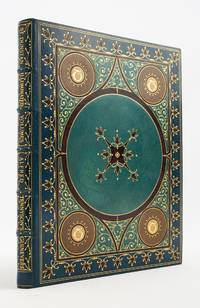
1902ST20771New Rochelle: Printed by the University Press for George D. Sproul 1902. No. 23 OF 30 COPIES 18 for America 12 for Europe; this copy illuminated for Herman A. Metz of the "St. Dunstan Edition" all of them PRINTED ON VELLUM. 270 x 210 mm. 10 5/8 x 8 3/8". 50 leaves last blank. <br/> SUMPTUOUS COBALT BLUE MOROCCO GILT AND INLAID TO AN ARABESQUE DESIGN BY TRAUTZ-BAUZONNET stamp-signed on front doublure covers framed in gilt and inlaid brown morocco blossoms central panel of azure blue morocco outlined in brown morocco large central medallion enclosed in brown morocco and inlaid with an eight-pointed inlaid and gilt fleuron each corner with tan and ivory morocco medallion with gilt "T" at center outlined in brown morocco the spaces between the medallions with curling gilt flourishes raised bands spine compartments with gilt lettering framed by sprays of gilt berries SKY BLUE MOROCCO DOUBLURES inlaid with darker blue squares containing an ivory morocco polygon these forming a frame around a central taupe morocco panel with inlaid blue morocco flowers at corners vellum free endleaves painted with a simple blue frame small flowers at each corner all edges gilt. BEAUTIFULLY ILLUMINATED BY ROSS TURNER the title page and final page with heraldic emblems and WITH 51 LOVELY INITIALS in a range of hues 22 with delicate extensions. Printed entirely in majuscules on rectos only. A couple of small faint water spots to upper board with slight dulling where someone tried to fix these naturally occurring variations in the grain and color of the vellum otherwise A FINE COPY--the vellum creamy and smooth the colors and gilt bright and the binding lustrous.<br/> <br/> A bookmaking tour-de-force this item is part of the remarkable St. Dunstan series of famous works of literature produced at the turn of the century in very strictly limited and particularly luxurious editions by publisher George Sproul. Named for the English bishop Dunstan 909-88 who was known for his skills as an illuminator the St. Dunstan volumes were printed on vellum illuminated by different artists and then put into bindings of striking design executed by Trautz-Bauzonnet one of the premier French binders of the period. While the physical properties of this volume announce themselves more emphatically than the text the narrative here is from Tennyson's "Idylls of the King" a work Day tells us in which the legend of King Arthur is used "to establish the Victorian virtues of marital faithfulness fair play gentlemanly conduct and useful action for self and society." "Guinevere" sets forth the consequences of marital infidelity presenting a penitent queen now withdrawn to a convent groveling for Arthur to pardon her affair with Lancelot. Although the injured king grants her forgiveness he does so with little grace appearing to modern readers as "insufferably self-righteous." Day Reminiscent of the designs used in 15th century illuminated books the painted initials in our volume are well executed and attractive combining fluid shapes and consonant combinations of colors and the binding is a singularly elaborate achievement. German-born binder Georges Trautz 1807-79 apprenticed in Heidelberg Stuttgart and Witemberg before arriving in Paris in 1803. There he trained in “dorure†with the skilled gilder Debès learning to create intricate gilt designs on bindings. In 1833 he was hired as a doreur by Bauzonnet the successor to the celebrated Purgold and soon achieved acclaim for his beautifully gilded bindings. According to Michon he was "the uncontested master of the luxury binding" in 19th century France celebrated for his "sumptuous moroccos" and "dazzling gilt." His bindings were so sought after that the term "Trautzolâtrie" was coined to describe the craze for his work. In 1869 he became the first bookbinder to be named a chevalier of the Legion of Honor. The culmination and termination of the St. Dunstan books was a planned edition of 15 sets of the complete works of Dickens projected to contain 130 large folio volumes—surely the most ambitious undertaking in the history of modern American fine printing. Five volumes only comprising most of "Pickwick" were produced before the grandeur of the project overwhelmed its sponsors. Potter says that in addition to the Dickens edition the St. Dunstan series comprised a dozen volumes of the works of various authors one of them the present Tennyson issued to subscribers at the spectacular amount of $12000 per set. One of the subscribers was our original owner New York chemical manufacturer and U.S. Congressman Herman A. Metz 1867-1934. Not surprisingly this strictly limited "Guinevere" is quite rare: We could trace just two copies at auction since 1975 one of them ours sold in 1998.  . [Printed by the University Press for] George D. Sproul unknown