7 770 résultats
Folio (210 x 294 mm). (48), 421 pp., 1 leaf of errata, plus 2-leaf illustrated insert after p. 354 as called for. With 10 full-page woodcuts in text. Bound in contemporary vellum with endpapers skillfully renewed. Stored in custom-made half calf clamshell box. Rare first edition, and the only folio printing, of the author's chef d'oeuvre, published in the same year as "De corporis humani fabrica", the similarly grand production of his most famous pupil, Andreas Vesalius. Although lesser-known as a text than his student's groundbreaking masterpiece, Tagault's "De chirurgica institutione" provides an essential piece of the puzzle in understanding the context in which Vesalius came to break new ground. The book's publishing history uncannily mirrors that of "De fabrica", and several of its anatomical diagrams were in fact plagiarized from the "Tabulae sex" through a chain of events yet to be elucidated. - Although he cannot be held in the same light as his eminent pupil, Tagault was an important figure on the cusp of the Vesalian revolution. O'Malley calls him "one of the few members of the faculty actively interested in anatomical studies" (p. 425) and notes that he was performing public dissections as early as 1535, during the period in which Vesalius studied under him (cf. p. 58). O'Malley also notes a story to the effect that the anatomist Jacobus Sylvius - a successful instructor at the University of Paris, but also terribly jealous of Vesalius's rising star - was responsible for advising Tagault on stylistic changes to improve the presentation of his "De chirurgica institutione". - The five books of Tagault's treatise elaborate the writings of Guy de Chauliac (1300-68) on the surgical aspects of tumors, wounds, hernias, ulcers, fractures, and dislocations. 2 full-page woodcut figures ultimately based on Gersdorff show the wound-man and the extraction of an arrow on the battlefield; a further three, in fact plagiarized from the "Tabulae sex", are found on the two leaves inserted at p. 354 following Tagault's treatise, accompanied by numbered legends in Latin and Greek. The precise circumstances surrounding their appearance in this work are intriguing; their position suggests a late addition, perhaps in a nod to the growing popularity of his former student. According to Cushing, the four chief suspects in the transfer of the woodcuts are the anatomist Louis Vassé, the printers Charles Estienne and Christian Wechel, and Tagault himself. Moritz Roth (Andreas Vesalius Bruxellensis, 1892) indeed traced in detail the extent of the plagiarism and cross-flow of the woodblocks between successive editions of Tagault and Vesalius. - The sixth book contains the first appearance in print of Jacques Houiller's "De materia chirurgica", discussing and illustrating the tools of surgery in use during Vesalian times before Pare and Wurtz. - Like "De fabrica", later editions of "De chirurgica institutione" were issued only in reduced format to make the work more widely accessible; the present first edition is the only printing in folio, presenting its marvellous full-page woodcuts to full effect. The large number of editions which Tagault's text enjoyed during the 16th century certainly rivals that of Vesalius and perhaps suggests that the two texts might have competed on the European stage. - Unlike the first edition of "De fabrica", which is readily obtainable in commerce, we have not traced any copy of the first edition of "De chirurgica institutione" at Anglo-American or German auctions in the last 50 years. It is one of just two editions edited by Tagault himself and published during his lifetime; the second edition (1544) was a much less impressive (and far more commonly-encountered) octavo. - A very good copy, fresh and charming despite a very light dampstain to the upper blank margin of a few leaves. Cushing 27. Waller 9444 (lacking index). Not in the Wellcome. Heirs of Hippocrates 190 (the earliest edition noted being 1560).
Royal folio (273 x 398 mm). Gothic type. 248 ff. (incl. final blank). 49 lines. 2 columns. Contemporary south German decoration: each of 4 books opening with an illuminated initial with extensions; rubricated throughout in red and blue. Modern calf, early index tabs. Editio princeps. Magnificent copy of the rare first edition of one of St. Thomas Aquinas's two masterpieces which systematized Latin theology. The printer is commonly referred to as "the printer of Henricus Ariminensis"; the ISTC suggests the Eichstädt printer Georg Reyser (active until 1503; cf. ADB 28, 368f.) known for his characteristic type, or, following Pellechet, Heinrich Eggestein. - "The combination of theology and philosophy which was the basis of scholasticism found its finest expression in [St. Thomas's] writings. Aquinas held that knowledge came from two sources: the truths of Christian faith and the truths of human reason. Each is a distinct source, but the revelation which comes from faith is the greater of the two, and its chief characteristic is that it consists of mysteries to be believed rather than understood" (PMM 30 for the editio princeps of the 'Summa Theologiae' published in 1485). The 'Summa de veritate catholicae fidei contra gentiles' (Treatise on the Truth of the Catholic Faith, against Unbelievers), written in Rome, 1261-64, was composed at the request of St. Raymond of Pennafort, who desired to have a philosophical exposition and defence of the Christian Faith, to be used against the Jews and Moors in Spain. It is a perfect model of patient and sound apologetics, showing that no demonstrated truth (science) is opposed to revealed truth (faith). It is worthy of remark that the Fathers of the Vatican Council, treating the necessity of revelation (Coast. "Dei Filius", c. 2), employed almost the very words used by St. Thomas in treating that subject in this work (I, cc. iv, V). - First leaf a little defective and repaired, minor marginal repairs in first 4 leaves, small stain at a few extreme upper margins, decoration just shaved. A stamp erased from fol. 4/10r. Hain 1385*. Goff T-190. GW M46563. BMC I 77. ISTC it00190000. CIBN T-162. Collijn, Uppsala 1420. IBP 5291. IDL 4382. IGI 9568. Madsen 3951. Aquilon 644. Michelitsch, Thomasschriften 60. Ohly (Gutenberg-Jahrbuch 1956) 6. Ohly-Sack 2729. Pellechet 986. Polain, Belgique 4761. Proctor 322. Rhodes, Oxford Colleges 1697. Sack, Freiburg 3437. Sajó-Soltész 3256. Schüling 816. Sheppard 233. Voulliéme, Berlin 2179. Walsh S-110B.
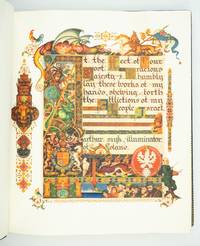
1939ST20331London: Beaconsfield Press 1939. No. 72 OF 125 COPIES SIGNED BY THE ARTIST AND THE EDITOR for sale in the British Empire. 292 x 248 mm. 11 1/2 x 9 3/4". xxvi pp. 46 leaves all leaves French fold. Edited by Cecil Roth. <br/> Elegant original blue crushed morocco by Sangorski & Sutcliffe signed on front turn-in covers with gilt French fillet border and large intricate central figure designed by Szyk of a patriarch holding a goblet and book raised bands spine gilt in double ruled compartments with ornate crown centerpiece gilt titling turn-ins with double gilt-ruled and scalloped border surrounding an illustrated silk doublure featuring a Szyk portrait of Moses with the Ten Commandments done in shades of gray within a frame of elaborate design. In an excellent velvet-lined box of blue half morocco over lighter blue cloth upper cover with central lion's head in gilt on blue morocco spine like that of the book. WITH 14 FULL-PAGE AND 32 SMALLER COLOR REPRODUCTIONS OF DESIGNS BY SZYK. English translation printed in black commentary printed in red. Front flyleaf inscribed in ink: "To Mr. and Mrs. Solomon Brachman / very cordially / Arthur Szyk / New York. April 1945." Very faint naturally occurring variations in the grain of the vellum otherwise a pristine copy.<br/> <br/> With an important Holocaust-related authorial inscription this is a very fine copy of what the London Times described as "a book worthy to be placed among the most beautiful of books that the hand of man has produced." Arthur Szyk 1894-1951 a Polish Jew is considered by scholars to be the greatest 20th century illuminator. Using the style of the Medieval illuminated manuscript artists he has here created a Haggadah for Passover that is at once a beautiful book of devotion a political protest against the rise of Nazism and a plea for England's help for the Jews of Europe. By 1939 Szyk's anti-Nazi cartoons had caused Hitler to put a price on his head forcing him to flee to England. His original illustrations for his "Haggadah" featuring the villains of the Exodus with the heads of Hitler Goebbels and other leading Nazis had to be toned down before publication. All 46 pages of the Hebrew text are illustrated with scenes from the Passover story as well as vignettes of Jewish life in modern Europe—sometimes Szyk mixes the two to great effect. Perhaps the most moving illustration in the book is the elaborately illustrated dedication to King George VI of England appealing for his mercy to European Jews. The great symbols of the British Empire—the lion and unicorn St. George defeating the dragon—surround Szyk's plea to the king: "At the feet of your most gracious majesty I humbly lay these works of my hands shewing forth the affliction of my people Israel." In the lower right corner of the painting we see Jewish refugees beside one of the ships which were usually turned away from British shores while Szyk depicts himself leaning against the painting his brush and easel in hand. The text here is enriched by the historical introduction and the commentary contributed by Cecil Roth 1899-1970 the preeminent British expert on Jewish history. This crowning achievement of Szyk's life was four years in the making and has proved to be an enduring treasure. Szyk presented this copy to Texas oilfield supply magnate Solomon "Sol" Brachman 1896-1974 and his wife Etta. The son of a Latvian Jew Brachman was the founding president of the Jewish Federation of Fort Worth in 1936 and helped arrange an emergency $100000 bank loan for Israel on the eve of statehood in 1948. His wife who served as president of the National Council of Jewish Women was known as "the mother of Hadassah." Szyk's 1945 inscription was no doubt especially meaningful to this devout family whose Latvian relatives were among the 90 percent of that country's Jews who perished in the Holocaust. Beaconsfield Press unknown
Folio (196 x 305 mm). (8), 587, (1) pp. With woodcut printer’s device on title and final verso, ornamental woodcut capitals and diagrams. Latin text with Greek letters used for designating points on geometric diagrams. Contemporary Parisian full calf, panelled in blind with gilt fleur-de-lys at corners and enclosing gilt fleuron centrepiece, spine with raised bands with small rosettes in compartments. First Latin edition of the "Elements" published by Hervagius. Remarkably, this copy clearly was in the hands of an Arabic speaker in France soon after printing, as it bears notes in Arabic and Latin on title and last leaf ("Euclid the Philosopher ... there is no God but God", "The book of Euclid the philospher on geometry in the Latin language ... There is no God but God Amen", and "In the city of Paris centre of the peoples of the earth" etc.). - This edition is joined for the first time in print by Euclid's only work on mechanics, "De levi et ponderosa", not hitherto known in any Greek manuscript. "According to Arabic sources, [Euclid] wrote a Book on the Heavy and Light, and when Hervagius was about to publish his 1537 edition there was brought to him a mutilated fragment [...] it is the most precise exposition that we possess of the Aristotelian dynamics of freely moving bodies" (DSB IV, 431). The edition also contains several of his smaller tracts on spherical geometry ("Phaenomena"), optics ("Perspectiva"), geometrical exercises ("Data"), which had joined previous editions, and commentaries of both Campanus and Zamberti, as well as the "Protheoria" by Marinus of Sichem. This copy is complete with the preface by Melanchthon often censored in other copies (cf. Thomas-S.). Herwagen was responsible for publishing the Greek editio princeps in 1533. - Ink underlinings and marginalia in Greek to preface. Corners of binding repaired, as are the upper joint and head and foot of lower joint. Blank corner of m5 torn away, tiny marginal hole in o5, occasional insignificant spotting and browning. Various pen trials and scoring of front free endpaper into geometric circles. - Provenance: 1) Nicolas Marchant (ink inscriptions on title and front free endpaper, one dated 1632). 2) Claude Simone (ownership inscriptions on title in Latin and Greek). VD 16, E 4154 (M 1009). Adams E 974. BM-STC German 288. Thomas-Stanford, p. 25, no. 9. Riccardi, p. 414/16. Schweiger I, 111. Hoffmann II, 42.
4to (193 x 252 mm). (8), X-LXXIII, (46 [instead of 49]) ff. With 9 full-page (instead of 11 full-page and 1 double-page-sized) woodcuts (2 by Albrecht Dürer) and small printer's device, all in contemporary hand colour. Later brown leather over wooden boards, using parts of the original blind-and gold-tooled binding. Upper cover has giltstamped title "Conrad Cel. Amores / Norimb. Scrip.". Rare first edition of one of the finest and most interesting German woodcut books of its age. "Als Frucht der Erlebnisse während der zehnjährigen Wanderungen 1487/97 durch Deutschland erschien 1502 das Kaiser Maximilian I. gewidmete lyrische Hauptwerk des Celtis, 'Quatuor libri Amorum secundum quattuor latera Germaniae': vier kleine in sich geschlossene lyrische Liebesromane, zyklisch verbunden in architektonisch-gesetzmäßigem Aufbau, bebildert mit Holzschnitten Dürers und aus der Schule Michael Wolgemuts [...] Celtis gilt als der deutsche Erzhumanist. Er war die stärkste poetische Begabung der humanistischen Bewegung um 1500" (NDB III, 182f.). - The "Amores" are the second of only two verified products of the "Sodalitas Celtica", the society founded by Celtis with the support of Willibald Pirckheimer (the printer remains unidentified). Two of the woodcuts are by Dürer: an allegory of Philosophy and the dedication (showng Celtis presenting the book to the emperor). "Die Seltenheit erhaltener Exemplare wie das Fehlen eines Faksimiles erklären, warum die 'Amores' als herausragendes Werk der Buchkunst im Sinne der Dürerschen 'Wiedererwachung' erst in neuerer Zeit wirklich gewürdigt worden sind" (Schoch/M./Sch.). Occasionally even the title woodcut has been ascribed to Dürer; the remaining, somewhat less delicate but no less impressive woodcuts are variously attributed to the workshops of Wolgemut, both Peter Vischers, Hans Süss von Kulmbach, or simply a "Celtis master". - Wants fol. IX (b1) with the Elegia prima (replaced by a blank leaf), the unnumbered bifolium between m2 and m3 with a view of Nuremberg after Schedel and the city's three coats of arms on the reverse, and the final leaf r6 with a full-page woodcut of Daphne and Apollo (replaced by a blank leaf). The contained woodcuts are all in especially fine contemporary colour, as are the colophon and printer's device. Printed on strong, very wide-margined laid paper. A few leaves near the end show light waterstains in the margins, otherwise a nearly spotless copy. Title has old stamp "EB"; lower corner remargined with slight loss to woodcut; fols. p8r and r5v also stamped in the blank margin. Insignificant worming to gutter of final gatherings. - The present variant of the first quire departs in several details from the copy of Hartmann Schedel kept at the BSB in Munich: a3r, headline "Ad Maxmil. Regem" (BSB: "Ad Maxmyl. Regem:"); a4v, headline: "Panegyri: Pars Prima" (BSB: "Panegyr. Prima Pars"); a5v, first line: "interuisse carmia & quae castas inoce[n]tu[m] adolesce[n]tiu[m]" (BSB: "centuadolesce[n]tiu[m] aures ledat & iebriet. Fatebimur"), etc. The present variant corresponds to the copy in the SSB Augsburg, formerly owned by Daniel Carnerius. - Provenance: Hartung & Karl, sale 53 (1986), lot 617. VD 16, C 1911. IA 135.114. Brunet I, 1730 & Suppl. I, 231. Dodgson I, 264 & 279ff. Ebert 3903. Graesse II, 101. Meder 244f. Murray 106. Muther 459 & 835. Panzer VII, 441, 17. Proctor 11029. Reske/Benzing 660. Schoch/M./Sch. 269. Strauss 66-68. Not in Adams.
Folio (196 x 275 mm). (10), 306 ff. With about 320 mostly botanical woodcuts in the text, coloured throughout in green, yellow, blue, red and pink in a strictly contemporary hand (3 botanical illustrations repeated on the title-page and a few of the non-botanical illustrations including repeats in the text), about 70 woodcut-decorated initials plus a few repeats (4 series, the largest pictorial and the others white on black, often with multiple blocks for the same letter), many cut by Sebald Beham. Set in roman types with Greek and Schwabacher for the Greek and German names. Restored 18th century calf covers, modern spine rebacked with lighter leather in six compartments with gilt floral ornamentation and giltstamped red morocco label. Marbled endpapers (free endpapers renewed). All edges red. First edition of Theodor Dorsten's Latin adaptation of Eucharius Rösslin's extensive and beautifully illustrated German herbal, "Kreutterbuch", first published (also by Egenolff) in 1535. It includes about 284 botanical illustrations originally cut for the Rösslin edition, many based on the pioneering naturalistic illustrations cut by Hans Weiditz for Otto Brunfels's "Herbarium vivae eicones" (1530-36). Most show complete plants including roots, some show fruits or other parts of plants, and about 36 mostly smaller woodcuts (including a few repeats) show containers for the medicines or other relevant objects. - Egenolff clearly saw the importance of the new and more accurate style of illustration, and engaged the best woodblock cutters to produce his blocks. While Brunfels's "Herbarium" had no text beyond the names of the plants, Egenolff saw the importance of combining the images with detailed botanical medical texts, first in German by Rösslin and here in Latin by Theodor Dorsten (1492-1552), a physician and professor in Marburg, Germany. The book therefore played a considerable role in bringing botanical medical knowledge to a wider public, both in Germany and abroad. Dorsten's adaptation was also further developed in German for Adam Lonitzer's "Kreutterbuch" in 1557. The present first edition of Dorsten is an appealing piece of book production: the roman type (following the "Venetian" style of Nicolaus Jenson, but in the variant form prevalent north of the Alps) perfectly complements the woodcuts, and the presswork is excellent. The present edition appeared in two simultaneous issues, the present issue repeating three of the botanical illustrations on the title-page and the other instead showing Egenolff's woodcut burning heart device (USTC 616902 & VD 16, D2443): most catalogues do not distinguish the two. - Edges of title reinforced with old paper on verso. 17th century ownerships "Andreae Biscontis" and "Miguel Burilly" to lower edge of title-page. Some damp- and brownstaining throughout, several near-contemporary annotations, mostly trimmed at rebinding. First edition of one of the earliest herbals to provide scientifically accurate botanical images. VD 16, D 2442. Adams D 589. BM-STC German 253. Anderson, Herbals, p. 156. Durling 1203. Nissen, BBI 522. Pritzel 2378. Plesch, p. 206. USTC 616903. Wellcome I, 1861. Not in Hunt.
4to (198 x 145mm). 53, (1) ff. Historiated woodcut border on title-page, one white on black woodcut initial, some Greek type. Modern vellum, red edges. Rare early edition of Erasmus's "Praise of Folly", which was first published in Paris in 1511. Conceived by Erasmus on his journey from Italy to England, it was written in a little over a week during his stay at the house of Thomas More in London in 1509 (to whom the work is also dedicated). - More than a mere distraction or trifle, this work is an acerbic, humorous attack on the foolishness that ruled church and state in the period. "It satirizes the old learning, the old medieval world, the monks and friars, the pilgrimages and processions, the cult of saints, in a style of biting humour. Erasmus was a great humourist, subtly ironical and elusive" (F. A. Yates, Ideas and Ideals in the North European Renaissance [1984], 155). It was extremely popular, said to be enjoyed even by Pope Leo X; 35 editions followed its first printing in Paris. While its author remained steadfastly within the Roman Catholic Church throughout his life, this satire and the critiques it contained played a crucial role in the beginnings of the Protestant Reformation. Early versions of this work are hard to find. - In a letter written in May 1515, Erasmus himself described the book as light relief from the kidney-stone by which he was afflicted: "my library had not yet arrived ... so, for want of employment, I began to amuse myself with Praise of Folly, not with the intention of publishing the result, but to relieve the discomfort of sickness by this sort of distraction" (Praise of Folly [Oxford, 1913], Introduction, p. XIV). He had earlier, in a letter to More, described it as a "trifling thing" (Letter 222, June 1511, Correspondence of Erasmus Vol. II). - Attractive textual annotation in margins, in red ink in the same humanist hand (some lost to trimming of pages) that appears to have dated the title-page 1518, four years after publication. There is also sparser annotation in a second, later hand, in darker ink. - Worming to lower blank margins with loss of a few letters, repaired in gatherings E and F; staining throughout, some loss to title due to trimming. VD 16, E 3182. BM-STC German 282.
Small folio (202 x 279 mm). (6), LXXX (but: 84), (1) pp. (collation: A6; B-N4 [N4 blank], O-P4 Q2, R-X4, x2, Y-Z4). Title page printed in red and black surrounded by a border of 10 armorial woodcuts. With full-page woodcut portrait of Emperor Ferdinand I by Donat Hübschmann on verso, large emblematic etching by Johann Schlutpacher von Rauris (A6v), full-page woodcut by Hans Lautensack of the standard-bearer Heinrich the younger, Burgrave of Meissen (E1r), 45 woodcut coat-of-arms in quire x, on Z1r woodcut device incorporating the arms of the printer, a Polish nobleman. 7 large folded etched plates, including two by Hanns Lautensack (at G4 and N4), one attributed to Francesco Terzi (at H2), one by the monogrammist FA (at I3), one attributed to Giovanni Guerra (at Q2), one unsigned (at X3), and one attributed to Johann Thwenger. Early 19th century half calf. First German edition of the finest early printed book on tournaments. It describes in detail and spectacularly illustrates the tournaments, staged battles (including an elaborate naval scene), balls and banquets, held at Vienna to honour the visit of Albrecht V Duke of Bavaria (1528-79), son-in-law of Emperor Ferdinand I and brother-in-law of King Maximilian of Bohemia (Emperor Maximilian II from 1564 onwards). According to Graesse (II, 629), the Latin edition of the same year has different illustrations, which he describes as "moins bonnes", and the same is true for Feyerabend's Frankfurt edition appended to Rüxner's "Thurnier Buch" (1566). The author served as herald to John II Sigismund, King of Hungary. - In complete condition with the full complement of etched plates, the book is of the utmost rarity; both Ruggieri copies were imperfect, and Bartsch describes only three of the etchings. - Fine impressions throughout. Some light browning and marginal fingerstaining; a few tears or flaws to the plates reinforced or rebacked. Rebound in the early 18th century for the Austrian infantry captain and secretary to the military court Franz von Grössing (his handwritten ownership at the bottom of title-page and colophon), preserving the upper third of the original flyleaf with handwritten ownerships dating from the 1560s (Rosina and H. V. Bastrig[o] 1561; gifted to Bernhard Kulmer by his sister Barbara Poltus, but returned to Bastrig in 1563 "as he will not allow the gift, and has a better right to the book"). Latterly in the library of the Viennese collector Werner Habel (1939-2015) with his handwritten and stamped ownership to the new flyleaf. VD 16, F 2207. Ruggieri 827. Brunet Suppl. II, 767. BNHCat F 406. Mayer I, 88f. Watanabe 21.
4to (22 × 16.5 cm). With engraved title-page, folding woodcut plate, 3 woodcut volvelles with moving parts, and numerous woodcut illustrations in text. Including a world map in two hemispheres (incl. America and a scattering of islands at the location of Australia) on two facing pages, they reappear with volvelle attachments on both sides of leaf 149 and leaf 153. Contemporary limp sheepskin parchment. First edition of a well-illustrated encyclopaedia of astronomical and surveying instruments available since classical history, by the Italian astronomer Giovanni Paolo Gallucci (1538-ca. 1621), a well-known private teacher to the Venetian nobility and founding member of the Second Venetian Academy. It gives a comprehensive summary of the knowledge of astronomy, cosmography and mathematics at the time of Galileo. "It describes instruments designed by others (Finé, Apian, Gemma Frisius, etc.) and gives credit to the original inventors. The one exception to this is the Visorio, which Gallucci claims as his own, but an identical instrument by Waldseemüller can be found illustrated in the 1512 edition of Margarita Philosophica by Gregor Reisch. Other instruments, such as the Hemispherical Uranico (a complicated device used for computations dealing with the moon, sun and stars), appear to be of Gallucci's invention. Besides the usual portable instruments, he also includes a simple quadrant and a two-ringed armillary built into the church of Santa Maria Novella in Florence" (Erwin Tomash). For some of the instruments this is the only description available. The present second issue of the first edition appeared a year after the first. With the owner's label of the Capuchin friar and astronomer Agostino da Piacenza (1747-1839) and the relating library stamp "Bibliotheca Capucinorum Placentiae" on the engraved title-page. A few marginal water stains and some occasional spots, otherwise in very good condition. Adams G 167. Burden 96. Cantamessa 1688. Crone 98. Erwin Tomash 23. Shirley 199. for Gallucci: G. Ernst, "Gallucci, Giovanni Paolo" in: Treccani LI (1998).
4to. (8), 115, (1) pp. With armorial title woodcut, several initials and numerous music notes in the text. Contemporary limp vellum with manuscript spine title. Wants ties. Extremely rare first edition of one of the most important of all classic works of musical theory, a book that enjoyed a high reputation even during the author's lifetime. In contrast to his first treatise, the 1532 "Musicae stoicheiosis" which treats exclusively "musica figurata", or polyphony, his present, second work is more comprehensive and more clearly written, though limited "to matters concerning musical compositions withount discussion of purely theoretical matters. This publication was outstanding for its many examples, drawn, according to the author's prefatory statement, from the works of the best and most renowned composers - Josquin, Obrecht, La Rue, Isaac, Brumel, Ghiselin - not only as the most useful examples but also as demonstrations of great music. The examples are presented mostly without texts or with incipits only" (New Grove). "Heyden s'est fait particulièrement connaître d'une manière avantageuse par un livre [...] ce livre est précieux pour l'histoire de l'art et de la science au seizieme siècle. Dans aucun livre de ce temps, les principes des nuances et de la notation ne sont exposés avec autant de clarté et de concision que dans celui-ci. Les nombreux exemples de Josquin, d'Obrecht, de Senfel, de Henri Isaac, de Ghiselin et d'autres, qui s'y trouvent, avec les résolutions de cas embarassants de l'ancien système de proportions, ajoutent encore au prix de cet ouvrage, qui est malheureusement d'une rareté excessive" (Fétis). All of Petreius's "printed music is of exquisite beauty [...] The printer's glory days began in 1537, with Heyden's highly respected work about choral music" (Cohen, Nürnberger Musikdrucker im 16. Jh., p. 25f.). - Occasional insignificant waterstaining to margins, but altogether a splendidly crisp, wide-margined copy with contemporary handwritten ownership of one "Anastasius de Verona" (erased) on the title page. Of the utmost rarity: a single copy in auction records of the past decades (1968, Hauswedell 158, no. 1246), and a single copy of the 1540 second edition (1942: Schab, cat. 5, no. 113; which is also the only edition kept at Cambridge). BM-STC German 404. Eitner V, 137. RISM (Écrits impr.) 412. Hirsch I, 246. Wolffheim I, 705. Teramoto (Petreius) passim. New Grove VIII, 28.
Folio (234 x 351 mm). 90 ff. (first and last blank). Gothic type, 2 columns, 81 lines, headings printed in red. One pink, white, and gilt initial painted on the first text page; red and blue Lombardic initials, rubricated throughout. Brown full calf by Théodore Hagué on bevelled wood boards, covers decorated with interlacing bands painted black and white and a network of gilt tendril designs with green leaves; central cartouches stamped "Io. Grolierii et amicorum" (upper cover) and "Portio mea domine sit in terra viventium" (lower cover). Spine on five raised bands, compartments decorated with gilt rules and floral designs coloured in white, green and black. Edges goffered, painted, and gilt. Stored in custom-made brown cloth case lined with white velvet, signed by Sangorski & Sutcliffe. Fine Koberger edition of the Institutes of Justinian, the students' textbook that forms part of the sixth-century codification of Roman law known as the Corpus Juris Civilis. Printed in red and black Gothic typeface with the gloss of Accursius, this rare edition from the press of Dürer's godfather is sought after for the high quality of its printing. - The present copy was bound, sometime in the 1880s, in a superb faux Grolier binding by the notorious forger Théodore Hagué (1823-91). Hagué had been trained at Reims by the master Jean-Baptiste Tinot whose speciality was, according to his advertisement, the "reproduction of antique bindings of all periods". In 1858 he relocated to London, where he worked in the workshop of Joseph Zaehnsdorf (1816-86), bookbinder to the King of Hanover, who produced bindings "in the Monastic, Grolier, Maioli and Illuminated styles". It was there that Hagué met the famous bookseller Bernard Quaritch as well as Guillaume Libri, who guided him in the restoration of authentic Renaissance bindings. - On his return to France at the end of the 1860s, Hagué began restoring old books and making fake bindings. His clients at that time included Joseph Renard and Ambroise-Firmin Didot. After the Franco-Prussian War he escaped his creditors to Brussels, where he set up his workshop under the name of "J. Caulin" and made many bindings in the 16th century style, which he offered to Quaritch as authentic. Indeed, towards the end of the 1880s Quaritch became doubtful of their authenticity and returned an exemplar with the arms of Catherine de' Medici that seemed recent to him. Hagué passed away in Normandy in 1891 (cf. Fontaine). - In the 1880s Quaritch sold several of Hagué's bindings to Charles Fairfax Murray, but after 1885 the businessman John Blacker (1823-96) became his sole customer for these bindings. In all, Blacker acquired 109 Hagué-bound books; their supposedly prestigious provenances included Jean Grolier, Thomas Mahieu, Anne de Montmorency, François I, Henri II, and Diane de Poitiers. - This specimen is one of those acquired by Blacker, described as no. 59 of his 1897 sales catalogue. One of no fewer than eleven fake Grolier bindings in his collection, it reproduces a painted interlacing decoration typical of those made in the 1550s by the royal binder Gomar Estienne. In the centre of the upper cover is Grolier's supralibros "Io Grolierii et amicorum" (usually placed near the bottom edge in authentic bindings); the lower cover bears Grolier's motto, "Portio mea Domine sit in terra viventium" ("Be Thou my portion, o Lord, in the land of the living", quoted from Psalms 142, verse 5). - A 16th century woodcut pasted to the blank space above the text on the first text leaf. First and final gathering very slightly misaligned, but altogether a complete and very well preserved copy in a splendidly notorious binding. - Provenance: 1) 18th century handwritten ownership "Teige" on first blank, obscured by a black stamp; 2) John Blacker (Sotheby's, Catalogue of a Remarkable Collection of Books in Magnificent Modern Bindings, 11 Nov. 1897, no. 59); 3) the library of the French numismatist Jean-Baptiste Colbert de Beaulieu (1905-95, his bookplate); 4) collection of Jean Marcel Stefgen (1927-2017, his bookplate). HC 9519. Goff J-529. GW 7614. BMC II, 430f. Proctor 2055. BSB-Ink C-651. Cf. J. P. Fontaine, Nouvelles découvertes sur le relieur Théodore Hagué (2013).
4to. (20) pp. With a title woodcut and 4 woodcuts in the text (repeating the title cut). Later quarter vellum over marbled boards. The rarer of two Latin editions of the "Judenbeichte", both published in 1508, after the "Judenspiegel" the second treatise by the fanatical convert Johann Pfefferkorn (1469-1522/23), in which he discusses his former brothers in the Jewish faith and their celebrations, asserting that the Jews were more corrupting than the devil himself and petitioning the Christian authorities to force all Jews to convert or emigrate. The woodcut illustrations in Pfefferkorn's work are the earliest prints depicting Jewish customs and ceremonies. They include a Kapparot scene, ritual bath, matzo preparation, jumbled together with imaginary representations of Jews telling their sins to crows and a Tashlich service during Rosh Hashanah when sins are cast into water. - Pfefferkorn was a German Catholic theologian and writer. Born Jewish, possibly in Nuremberg, he moved to Cologne after many years of wandering. After committing a burglary, he was imprisoned and released in 1504. He converted and was baptized together with his family. Pfefferkorn became an assistant to the prior of the Dominicans at Cologne, Jacob van Hoogstraaten, and under their auspices published several libellous pamphlets in which he tried to demonstrate that Jewish religious writings were hostile to Christianity, and argued for the destruction of all copies of the Talmud. As late as 1509, Emperor Maximilian empowered Pfefferkorn to confiscate all Hebrew writings in Jewish hands and destroy any he found dangerous. After wide-scale protests, the humanist scholar Johannes Reuchlin was commissioned to give an expert opinion on Jewish writings, which led to a long-running battle of pamphlets between Reuchlin and Pfefferkorn, who was defended by the Dominicans. - A single red pencil annotation to the colophon, otherwise entirely unmarked. VD 16, P 2311. Panzer VII, 447, 53. Goedeke I, 452. Freimann 263. BNHCat P 429. Cf. Graesse V, 248. Fürst III, 82. Not in Adams or BM-STC German (only the Cologne edition).
Small folio (308 x 220 mm). (6),158 ff. With full-page woodcut title, 6 full-page woodcut illustrations, 142 smaller woodcuts, and numerous woodcut initials, all in attractive near-contemporary hand colour throughout. 17th c. blindstamped full vellum. The third Grüninger edition, the first to include the numerous specially made smaller woodcuts that adorn the text, hand-coloured throughout in this copy. The full-page illustrations are repeated from the 1496 and 1499 incunabular editions. The woodcuts showcase Grüninger's method of using a large number of separate blocks in ever-changing combinations to create new images: "En 1503, Grüninger publie une édition de Térence avec 745 gravures de l'édition de 1496, dont 86 différentes et 19 nouvelles" (Ritter, Histoire de l'imprimerie alsacienne, p. 92 and cf. 88). The anonymous artist, soon to become Grüninger's favoured illustrator, went on to be known as the "Terenz-Meister" for the lively and attractive illustrations he created for this book. With the commentary by Aelius Donatus and Calphurnius. - First and final quires show numerous small wormholes. Two text leaves with a tear in the blank margin; leaf Z2 with a few tears within the text (no loss). Upper margin trimmed fairly closely, occasionally just touching the headline. Covers slightly buckled; joints starting at spine-ends; upper cover shows a tiny hole in the vellum near the front edge. - Provenance: Two 17th c. manuscript ownerships "S. de Bucquoy" and "A. Avador (?)" on title-page. Later by tradition in the library of the Fraeylemaborg chateau at Slochteren, Netherlands. 19th century engraved armorial bookplate of the Six van Hillegom family of Amsterdam; sold from the estate of the art historian Jan Six (1857-1926). 20th century bookplates of the Amsterdam physician and bibliophile Bob Luza (1893-1980), whose library was sold by Van Gendt & Co. in 1981, and of the musician and Holocaust survivor Helge Loewenberg-Domp (1915-2021). Old catalogue clipping and typed description to front pastedown. No other hand-coloured copies of this edition traced in the trade. BM-STC German 852. Adams T 304. Ritter 2284. Muller II, p. 24, no. 22. Schmidt 61. Fairfax Murray, Early German Books 407. Proctor 9889. Schweiger II, 1054.
4to (142 x 196 mm). 119 ff. (of 122, without initial blank and two final blanks). 38 lines, single column, roman type. With 38 woodcut illustrations in the text showing constellations. Modern full calf with double blind rules to covers, spine on five raised bands with gilt title "Aratus". All edges red. First edition of Avienus's translation of this influential astronomical poem, rarely found complete, pre-dating the editio princeps of the Greek text by 11 years. Based on Eudoxus of Cnidus, Aratus's didactic poem about celestical phenomena (written soon after 276 BC, probably at the Macedonian court) enjoyed immense success and was frequently translated in Roman times - an interest occasioned by the increasing degree to which men viewed their fates tied to astrology and the stars. Avienus's 4th-century Latin text, informed by the Neoplatonic tradition, is expanded considerably from the original. The volume includes additional translations of Aratus by Cicero and by Germanicus Caesar, who offer earlier viewpoints. The latter version is accompanied by 38 zodiacal woodcuts, almost all of which were designed and executed for this volume and thus are present in brilliant early proofs. Four beautiful cuts in the Venetian manner are especially remarkable (cf. Essling, 431). - The "Ora maritima", on the other hand, is a short poetic account of early sea routes used by Greek and Carthaginian traders along the coasts of the Mediterranean, Caspian, and Black Seas. A few scholars have speculated that one of Avienus's sources for his work was the now-lost Massiliote Periplus, a conjectural sailing guide from the 6th century BC, although this idea is controversial. The final text in the volume constitutes the first dated edition of the most popular Roman medical work (by Serenus Samonicus), likewise couched as a didactic poem. The collective volume is thus of the greatest interest for the history of science. The editor, Vettore Pisani, was a pupil of Giorgio Valla. - Folio a4 remargined at foot and p6 (the final leaf present) repaired at head (both barely touching text). A few contemporary manicules. A very clean copy (entirely complete save for 3 blank leaves) of an edition usually encountered only in parts or even fragments, even in institutional collections. - Provenance: from the library of the surgeon, meteorologist, and antiquarian Charles Leeson Prince (1821-99) of Crowborough, Sussex, with his large bookplate (dated 1882) to front pastedown. Later in the collection of the meteorologist George James Symons (1838-1900); bequeathed to the Royal Meteorological Society with the Symons bequest bookplate (dated 1900) on lower pastedown. HC 2224* (= H 2223). Goff A-1432. GW 3131. Proctor 4593. Klebs 137.1. Sander 718. Essling 431. Pellechet 1673. Bod-inc A-639. Sheppard 3709-3711. BMC V 294. BSB-Ink A-969. Stillwell A 1277. ISTC ia01432000.
4to. (16), 265, (1) pp. With a large woodcut on the title-page showing a gardener at work with his tools, and about 800 woodcut illustrations in the text. About 700 show trees, fruit, edible and medicinal plants, while the rest show insects, a tick, coral, shells, various sea and land animals and a view of a pond with plants and birds. It includes a two-headed snake, dragon, griffin, and a few other mythical creatures. With all woodcuts coloured by a contemporary hand. Contemporary pigskin over wooden boards, richly blind-tooled in a panel design with two rolls (one alternating heads and coats of arms, the other with standing figures), a large acorn and other stamps; brass clasps and catch-plates with engraved decoration. Rare first dated edition of an extensively illustrated early herbal in contemporary hand-colour, with the title and most of the plant and animal names in Latin and German. The title-page is followed by a 13-page index of the Latin and German names. About 200 of the woodcuts are about half-page, while the last six pages show 16 small animal woodcuts per page. The Folger Library notes that F. W. E. Roth attributes this herbal to Adam Lonicer (1528-86) of Marburg and Frankfurt, who married Egenolph's daughter and became a partner in the firm after Egenolph died in 1555. The firm published herbals and related works under his name beginning in 1551. Egenolph published all three editions of the present herbal. VD 16 lists the undated one as ca. 1545 (citing only the Wellcome Library copy), which would make the present 1546 edition the second. Another appeared in 1552. Egenolph's successors were to become famous not only as printers but also as one of the largest and most important early typefoundries. The present book uses Roman and Italic for the Latin, but Fraktur and Schwabacher for the German, giving a good overview of the firm's stock of type at this early date. - This copy has early owner's inscriptions by the Nuremberg pharmacist Georg Volland (d. 1631) in Latin at the foot of the title-page and in Greek on the facing endleaf. - Binding worn; some browning and stains to interior, especially to the first and last leaves. VD 16, H 2193 (4 copies). Adams H 294 (1 copy). Nissen, BBI 2345. Cf. Klebs, Early Herbals 71 (undated Egenolph ed.). Wellcome I, 1983 (same undated Egenolph ed.). Not in Stiftung Botanik.
Small folio (278 x 185 mm). 3 vols. (8), 294, (16) ff. (1), 308 (but: 310), (8) ff. (2), CXVII ff. 19th century full calf with giltstamped spine (but spine of 3rd volume rebacked). Marbled endpapers. Extremely rare first edition of this important 16th century description of Muslim Africa, complete with the frequently missing third volume, printed at Malaga. "Ouvrage toujours fort recherché" (Brunet). A native of Granada, Luis Marmol Carvajal (1520-1600) took part in the 1535 Tunis campaign of King Charles V against the Ottoman Empire's Mediterranean forces. He was taken prisoner and spent more than 22 years in North Africa, including seven or eight years as a captive in Morocco, Fez and Tunis, where he learned Arabic. In his work, he gives an historical account of Christian-Muslim conflict, as well as of inter-Muslim strife, from the time of Muhammad until 1571, when Pope Pius V created the "Holy League" to drive Ottoman forces from the eastern Mediterranean. However, Marmol discusses not only military aspects, but also and more specifically Muslim North Africa, the Moorish militias, institutions, and customs, paying particular attention to Spanish commercial interests in these territories. He provides descriptions of many Maghreb cities as well of their various sieges and sacks by the Spanish, Portuguese, Genoese, and the Ottomans. - Corners slightly bumped; the first sheets of the third volume have been washed and pressed. A good copy splendidly rebound in the 19th century, with fine provenance: from the library of the great Spanish historian Emilio Lafuente y Alcántara (1825-68), with his signature in vols. 1 and 2. Later in the library of Feliciano Ramirez de Arellano, Marqués de la Fuensanta del Valle (1826-96), founder of the Society of Spanish Libraries, with his armorial bookplate to all pastedowns; additional bookplate of the bibliographer Antonio Moreno Martin of Almería (d. 1990) to the third volume. Auction records list only two appearances of the present work, both copies lacking the third volume (present here). Ibrahim-Hilmy II, 18. Brunet III, 1439f. Heredia 3294. Palau 152.431, 152.432 & 152.433. Salvá 3356. For Acuña cf. Ticknor, History of Spanish Literature I, 497; S. Cory, Reviving the Islamic Caliphate in Early Modern Morocco, p. 6; D. Thomas, Christian-Muslim Relations. A Bibliographical History VI, 284.
Folio (220 x 328 mm). (24), 474, (4), 475-476 pp, 477-480 ff., 481-608 pp., 609-612 ff., 613-1162, (2) pp. (complete thus). With woodcut title border, Münster's portrait on the verso, printer’s device on the final page by Urs Graf, 14 maps (11 double-page and 3 triple-page) as well as 37 double-page views and approximately 970 woodcuts in the text (including repeats). Contemporary full calf on six raised double bands with gilt central oval ornaments and corner fleurons to both covers; spine sparsely gilt. An early edition of Münster’s monumental work. The Cosmographia by Sebastian Münster (1488-1552), the German cartographer and cosmographer, was one of the most successful and popular books of the 16th century. The most highly valued of all cosmographies, it passed through 24 editions within 100 years and was of principal importance for reviving the interest in geography in 16th century Europe. In spite of its numerous maps, Münster's Cosmography is largely a work of historical geography and history, and it was thus that it soon became the most popular work of its kind throughout Europe - not only in Germany, but also in France (where it saw several editions), Italy, and Bohemia. "The Latin edition, more scientific in many respects, was intended for the scholars in all of Europe" (cf. Burmeister, p. 14). - In good condition, with some frequent but slight waterstaining. A few near-contemporary underlinings and annotations, some in red ink. Binding rubbed, chafed and bumped. Provenance: handwritten ownership of Carl Isaak Rothovius, dated 1649 (possibly related to Isaacus Rothovius [1572-1652], the bishop of Turku, who oversaw the first complete translation of the Bible into Finnish). Late 18th century engraved armorial bookplate of the naturalist and Swedish civil servant Mathias Benzelstierna (1713-91), who studied with Carl Linné and became a member of the Royal Swedish Academy of Sciences in 1786. VD 16, M 6718. Burmeister 90. Hantzsch 77.33. Adams M 1911. Sabin 51382. Graesse IV, 622. Cf. Borba de Moraes II, 90f. Not in BM-STC German.
42926Paris, Thielman Kerver, 1498. In-8 gothique sur peau de vélin (115 x 175 mm) de (112) ff. (sig. A-O8), 25 lignes à la page, veau brun sur ais à large décor estampé à froid, dos orné à nerfs, tranches dorées, fermoirs (reliure de l’époque).
Folio (275 x 175 mm). 2 ff., 12 ff. Recently bound using an old musical manuscript on vellum. Extremely rare account of Cornelis de Houtman's voyage to the East Indies, undertaken in 1595-97: a pioneering enterprise that initiated Dutch presence in the East Indies and set the standard for Dutch exploration, being organized by the "Company of Distant Lands", the immediate predecessor to the more famous Dutch East India Company (VOC), established in 1602. - This anonymous, first-hand journal, originally published in Dutch as "Verhael vande Reyse de Hollandtsche schepen ghedaen naer Oost Indien" (Middelburg, Barent Langenes, 1597), was the first printed account of the voyage. Two versions of the text appeared, of which the "Verhael" was the shorter, but also the earlier (cf. Rouffaer). Two editions of the German translation, by Conrad Löw, were printed in Cologne in 1598. No priority has been established, but both are now extremely rare: four copies of the edition published by Peter Reschedt are listed in USTC, while none of this Bertram Buchholtz imprint are recorded in USTC or elsewhere. - Houtman's voyage was motivated by the precariousness of Dutch access, as a result of the Dutch Revolt, to the largely Iberian-controlled spice and bullion markets. The Dutch therefore examined the possibility of sailing directly to the East in their own ships, and Houtman was first sent to Portugal in 1592 to investigate the spice trade. He returned two years later, urging direct voyages to the East, and in 1595 led the first such venture. - Houtman's fleet crossed the Atlantic to Brazil before rounding the Cape of Good Hope on 7 February 1595, then sailing across the Indian Ocean from Madagascar to the Sunda Straits. En route they touched on Sumatra, traded for a time in Bantam, a famously wealthy spice port, and made several other stops on the north coast of Java and on Bali. On the homeward journey, the fleet sailed along the south of Java. Houtman's brother Frederick, a talented astronomer who also participated in the voyage, greatly contributed (along with the Dutch navigator Pieter Dirkszoon Keyser) to mapping the southern skies, recording a great number of new constellations. "The voyage was not a financial success, and barely recovered its expenses. The nearly empty holds held only 245 bags of pepper, 45 tons of nutmeg, 30 bales of mace, and a selection of Chinese porcelain. The backers were aghast at the terrible loss of life [only 87 out of 249 men returned, and those who survived were too weakened even to bring their ships into anchorage]. But the voyage was, in another sense, a resounding success in that it showed to the Dutch that they might successfully reach the Indies. In the following year no fewer than 22 ships distributed over six expeditions ventured out, and the rush to the East had begun" (F. Swart, "Lambert Biesman (1573-1601) of the Company of Trader-Adventurers, the Dutch Route to the East Indies, and Olivier van Noort's Circumnavigation of the Globe", Journal of the Hakluyt Society, Dec. 2007). The Compagnie van Verre, which Houtman helped create, merged to form the Dutch East India Company. Houtman's voyage is now known for providing the initial impetus for the Dutch spice trade and colonization of Indonesia. - Lach notes that "firsthand reports of insular Southeast Asia arrived in the Netherlands with Cornelis de Houtman's fleet in August 1597. An anonymous 'Verhael vande reyse' was published [...] in 1597; it went through six editions in that year and the next, including translations into French, German, English and Latin". The published journals of the voyage "provided European readers with the most detailed descriptions of Java to date and with the first continuous description of Bali in any language. By sailing around Java, De Houtman's men were able to ascertain its true size and shape. They discovered that it was not nearly as wide from north to south as it appeared on Portuguese maps, and this was reported in the 'Verhael vande reyse'. This work also contains a detailed description of Bantam, its harbor, fortifications, buildings, people, and trade, the prices of products, and the foreigners who traded there" (Lach). The author of this account is an unidentified shipmate of Houtman's who describes in his own words what was the first incursion into the spice trade by the Dutch. - "The failure of the Barents expedition to open up a route to the East by way of the North East Passage led the Dutch to attempt reaching the East by way of the Cape Route. The Expedition consisting of 4 ships under the command of Cornelis Houtman arrived at Bantam in Java in 1596, where they tried to get a cargo of spices. But hostilities with the Portuguese arose and the fleet was compelled to sail on. The circumnavigation of Java was the first recorded attempt of this kind by any European vessel. Much knowledge of the regions later to become the exclusive territory of the Dutch resulted from the voyage" (Cox I, 262). - Rare institutionally, no copy of this edition is listed in any institution. Of the Reschedt edition, there are four copies, according to USTC (Staatsbibliothek Berlin; BSB Munich; Austrian National Library; New York Public Library). - A tall copy with light toning. In excellent condition. Tiele 122. G. P. Rouffaer, ed., De eerste schipvaart der Nederlanders naar Oost-Indië onder Cornelis de Houtman ('s-Gravenhage, 1915-29) II, pp. [xix-xx], 106-109. D. F. Lach, "Asia in the Making of Europe" (Chicago, 1993) II.1, p. 437f.
Folio. [10], 306 ff. With about 320 mostly botanical woodcuts in the text (3 botanical illustrations repeated on the title-page and a few of the non-botanical illustrations including repeats in the text), about 70 woodcut decorated initials plus a few repeats (4 series, the largest pictorial and the others white on black, often with multiple blocks for the same letter), many cut by Sebald Beham. Set in roman types with Greek and Schwabacher for the Greek and German names. 16th-century sheepskin parchment (extensively reworked), sewn on 5 supports. First edition of Theodor Dorsten's Latin adaptation of Eucharius Rösslin's extensive and beautifully illustrated German herbal, Kreutterbuch, first published (also by Egenolff) in 1535. It includes about 284 botanical illustrations originally cut for the Rösslin edition, many based on the pioneering naturalistic illustrations cut by Hans Weiditz for Otto Brunfels's Herbarium vivae eicones (1530-1536). Most show complete plants including roots, some show fruits or other parts of plants, and about 36 mostly smaller woodcuts (including a few repeats) show containers for the medicines or other relevant objects. Egenolff clearly saw the importance of the new and more accurate style of illustration, and engaged the best woodblock cutters to produce his blocks. While Brunfels's Herbarium had no text beyond the names of the plants, Egenolff saw the importance of combining the images with detailed botanical medical texts, first in German by Rösslin and here in Latin by Theodor Dorsten (1492-1552), a physician and professor in Marburg, Germany. The book therefore played a considerable role in bringing botanical medical knowledge to a wider public, both in Germany and abroad. Dorsten's adaptation was also further developed in German for Adam Lonitzer's Kreutterbuch in 1557. The present first edition of Dorsten is a nice piece of book production, the roman type (following the "Venetian" style of Nicolaus Jenson, but in the variant form prevalent north of the Alps) perfectly complements the woodcuts, and the presswork is excellent. The present edition appeared in two simultaneous issues, the present issue repeating three of the botanical illustrations on the title-page and the other instead showing Egenolff's woodcut burning heart device (USTC 616902 & VD16 D2443): most catalogues do not distinguish the two. - Signed above the colophon by "Remigius Ruffius" (Rémy Roussel), a French humanist active 1517-40. He is said to have come from Loudun and been active in Paris; we suppose he is the canon of that name recorded at Tours, near Loudun, in 1539. With the title-page somewhat worn and with a small hole restored, a few small worm holes in the first few leaves (1 in the head margin continuing through the first third of the book), but still in very good condition. The binding has been extensively restored but is now structurally sound. First edition of one of the earliest herbals to provide scientifically accurate botanical images. VD 16, D 2442. Adams D 589. BM-STC German 253. Anderson, Herbals, p. 156. Durling 1203. Nissen, BBI 522. Pritzel 2378. Plesch, p. 206. USTC 616903. Wellcome I, 1861. Not in Hunt.
4to (164 x 208 mm). XCVI ff. (fol. Z4 blank). With numerous woodcut initials, many hand-coloured. Gothic type. 19th century full armorial calf, rebacked, with giltstamped red morocco spine label. First collected Latin edition of the astrological works of Abraham Ibn Ezra. "A versatile genius with a charming Hebrew style, Ibn Ezra disseminated rationalistic and scientific Arabic learning in France, England and Italy [... He] wrote a number of astrological works (Steinschneider lists more than fifty) that were very popular and were translated into many languages. Two were printed in Latin in 1482 and 1485, respectively; and all of them appeared in Latin in 1507 [...] They are rich in original ideas and in the history of scientific subjects" (DSB). "Of an eclectic bent, he inclined towards Neoplatonism and does not entirely disavow astrology [...] Ezra had considerable knowledge of astronomy, and he produced numerous horoscopes and chronological calculations" (cf. Jüdisches Lexikon II, 526f.). - Born in Tudela, in Moorish Spain, Ibn Ezra traveled extensively throughout the Middle East, and had a great outpouring of written works after about 1140, comprising poetry, commentary on the Torah, works on Hebrew grammar, philosophy, and science. His scientific works on astrology were written when he lived in Beziers, France, between 1147 and 1148. - Extensive early ink marginalia, underlinings and manicules throughout. Light dampstaining to outside lower corners, light scattered browning and spotting. - Provenance: Bound in the later 19th century for Robert Loyd-Lindsay, 1st Baron Wantage (1832-1901), co-founder of the British Red Cross, with his arms stamped in gilt to both covers. Subsequently acquired by the Danish-born astronomer Johan Ludvig Emil Dreyer (1852-1926), long established as an historian of science in Ireland and later at Oxford (his bookplate to the front pastedown). Latterly in the library of the noted Russian-American photographer and biologist Roman Vishniac (1897-1990). Adams A 38. BM-STC Italian 2. Steinschneider I, col. 687f., no. 77. Fürst I, 256. DSB IV, 502. Isaac 12998. OCLC 233860948.
252, (12); 125, (1) ff. With a woodcut caduceus device on title-page and several woodcut initials. Set in roman types. With: (2) [Thorer, Alban]. [De re medica]. (Basel, Andreas Cratander, 1528). With the first leaf of the main text in a 4-piece woodcut border (3 initalled I.F.), Cratander's woodcut device on the last otherwise blank leaf, showing Occasio, the goddess of chance, and dozens of charming woodcut initials. Set in roman types. 2 works in 1 volume. Small folio (300 x 220 mm). 20th-century half parchment. (1): First edition of an ancient compendium of pharmacological preparations by the Gallo-Roman physician Marcellus Empiricus, originally composed ca. 410 AD. "An extraordinary mixture of traditional knowledge, popular (Celtic) medicine, and rank superstition. Interesting also for the historian of botany, because of the great number of plants mentioned" (Sarton). Marcellus was born in Bordeaux and magister officiorum under Theodosius I (379-395). - (2): First edition of a collection of four medical works, compiled by the Swiss physician Albanus Torinus (1489-1550). The main part of the work consists of "De re medica", also known as Medicina Pliniana, a very popular medical text during the Middle Ages. Compiled in the fourth century by an anonymous author, it is generally ascribed to Plinius Valerianus, also called pseudo-Plinius, since it mainly derived from Pliny the Elder's "Historia naturalis". Consisting of five books, it gives various medicines and treatments for different diseases, ailments, wounds, tumours etc. - The work also contains three other medical works from different authors. "The contents are all either spurious works or later compilations from genuine works of the authors to whom they are attributed" (Durling). It starts with an introduction to "the art of healing", ascribed to Soranus of Ephesus. The second text is by Oribasius, a Greek medical writer from the fourth century BC. According to Durling, the text is an extract from the first chapter of his Euporista ad Eunapium. The work closes with a botanical text, De virtutibus herbarum, ascribed to Lucius Apuleius Madaurensis, but written by an anonymous author from the fourth century, known as Pseudo-Apuleius. In one of the manuscripts Torinus used, the text was ascribed to the famous Italian physician Antonio Musa Brassavola (1500-55), an expert on the works of Galen and heavily influenced by his work. - The editor of the work, Torinus, was appointed professor of practical medicine at the University of Basel after receiving the degree of doctor in medicine in Montpellier. He translated many Greek texts into Latin, or Latin works into the vernacular, including Vesalius's De humani corporis fabrica. - With a bookseller's ticket on pastedown and many sentences marked in pencil in the fore-edge margins. The Marcellus Empiricus was originally published together with a work by Galen, here replaced by Thorer's De re medica, lacking the first 12 leaves (title-page and preliminaries). With a minor water stain at the head of the first 25 leaves and the title-page of (1) slightly browned. (1): Durling 2951. USTC 604332. Wellcome I, 4043. Cf. Sarton, Introduction to the hist. of science I, p. 391. - (2): Durling 4351. Parkinson 2410. USTC 605590. Not in Wellcome.
151514800Imprimé à Paris, par la veufve feu Jehan Trepperel et Jehan Jehannot, [1515 ca]. In-4 gothique à deux colonnes (180 x 120 mm) de 101 ff. mal chiffrés CVII et (1) f. de table (sign. A8 B4 C8 D4 E4 F8 G4 H8 I4 K4 L8 M4 N8 O4 P8 Q4 R4 S6), maroquin janséniste olive, dos à nerfs orné à froid, coupes filetées, frise intérieure, tranches dorées sur marbrure (reliure du XIXe siècle).
4to. 3 parts in one vol. (8), 358, (2), (56) pp. (= 28 double-page maps of the ancient world); (56), (72) pp. (= 36 double-page maps of the modern world); 47, (49) pp. A total of 64 double-page engraved maps. Contemporary limp vellum with hand-lettered blue spine label; wants ties. First edition of Girolamo Ruscelli's Italian translation of Ptolemy's "Geography": "a new and important edition in Italian, with a new series of maps" (Stevens). Apart from the 27 traditional Ptolemaic maps, this edition boasts 37 new ones, including three maps of the world, showing the earth according to the description of Ptolemy ("tutta la terra conosciuta fin' à tempi di Tolomeo") and as it was viewed after the discovery of America ("Tavola universal nuova", in two hemispheres - "the first time that such a representation had been used in an atlas", Shirley 110), with a separate navigation map ("carta marina nuova tavola"). Among the "new" maps, the most remarkable ones are those of India, South-East Asia and of America, offering some of the earliest depictions of the newly-discovered continent; other maps include Arabia, Asia Minor, Greece, Italy, Germany, France, Spain, and North and South Africa. Ten of the old Ptolemaic series show Europe, four show Africa, and twelve Asia. Most of the maps are based on the Gastaldi maps from the 1548 Venice edition made by Giulio and Livio Sanuto, but maps not found there include Scandinavia (after Jacob Ziegler, 1532); Brasil (after Ramusio); the Arctic regions; South Africa; and the navigational chart of the World (Shirley 111). - Title-page a little stained and remargined in the lower corner. A few insignificant lower edge flaws to the first quires. Printed on strong paper, all maps in stark, excellent impressions. A fine copy in its first binding. Edit 16, CNCE 38126. BM-STC Italian 543. Adams P 2235. Shirley 110f. Alden/Landis 561/42. Burden 29-31. Norderskiöld Collection 2:216. Stevens p. 50. Phillips (Atlases) 371. Le Gear 5915. Sabin 66503.
4to. (24) pp. With armorial woodcut to title page and printer's device to verso of final leaf. Modern half vellum with handwritten spine title and marbled covers using old material. Exceptionally rare first publication of the libretto of the first opera in musical history, also the first opera libretto ever printed. The music by Jules Caccini and Jacopoto Peri, composed for the first performance on the occasion of a carnival soirée at the Palazzo Corsi in Florence in 1598, is lost. Ottavio Rinuccini (1562-1621), who also wrote the textbook for "Euridice", was not an occasional librettist, but a court poet among who also composed sonnets and verse drama (cf. Honolka, Geschichte des Librettos, p. 22). The present libretto was probably published for a later performance at the Corsis' in August 1600 (for the history of genesis and performance history cf. the extensive account in Sonneck I, p. 339-345). Rinuccini's "Dafne" was again performed, with new music by Marco da Gagliano (1582-1643), in 1608: this score is preserved to this day, and the opera has been performed repeatedly on European stages throughout the 20th century. - Marescotti's fine woodcut device on the final page shows a naval emblem with the motto "Et vult et potest". Very occasional slight browning. On leaf C2v the setting error "DEL" has been corrected by "AL" pasted over the erroneous word. A fine copy. Edit 16, CNCE 29328. BM-STC Italian 556. Sartori 7015. Sonneck 339. Wotquenne 47. Wolffheim II, 1083. Fuld 61.