7 766 résultats
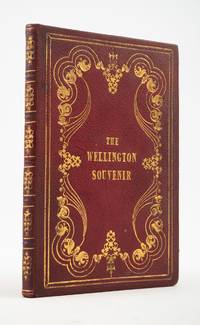
1852ST20768London: Simpkin & Marshall 1852. FIRST EDITION. 153 x 102 mm. 6 x 4". 64 pp. <br/> Publisher's deluxe red pebble-grain morocco gilt covers with graceful Romantic-style frame central panel of upper cover with gilt lettering that of lower cover with gilt ornament spine blind-stamped to resemble raised bands panels with gilt ornament gilt turn-ins pale yellow endpapers all edges gilt. With title page vignette frontispiece portrait of Wellington and three full-page engravings of battles. Printed entirely in gilt on "enamel" gloss paper. Front free endpaper with faint pencilled signature. Binding very slightly soiled joints and extremities a little rubbed trivial soiling to front endpapers otherwise quite a fine copy the text entirely clean fresh and bright with sparkling gold.<br/> <br/> This now-scarce luxuriously produced little volume celebrates the life and military achievements of Arthur Wellesley Field Marshall and 1st Duke of Wellington perhaps the most widely admired Briton of the 19th century--and does so in glittering fashion. The key facts of Wellington's life and the decisive battles of his storied career are related here in sparkling gold text and images on alabaster white pages. Poet laureate Tennyson's funerary ode described Wellington 1769-1852 as "the last great Englishman" and his death evoked great mourning in response to his life of public service. DNB notes that his defeat of Napoleon at Waterloo crushing the emperor's ambition for European dominance put him in a class of his own: "No man certainly no Briton had ever been in such a situation before in Europe the object of universal hero-worship and gratitude." Wellington was particularly notable among senior military officers for his determination to lead his troops on the frontline in battle. The three battles depicted in the illustrations here attest to this: in "The Battle of Assaye" we see him on horseback two horses were shot from under him during the conflict wielding his sword as he bears down on enemy cannon. At the "Battle of Vittoria" he is shown leading the infantry to face the enemy with bayonet fixed. And in the decisive "Battle of Waterloo" scene he is once again with the cavalry wheeling to attack the advancing French. The frontispiece shows Wellington astride his famed horse Copenhagen who was his mount at Waterloo. Our volume concludes with a chronology of principal events in the duke's life. It is notable that such a handsome memorial work was produced so quickly after Wellington's sudden death on 14 September 1852: a contemporary ad in Bent's Literary Advertiser notes our title was published on 15 November three days before Wellington's state funeral on the 18th. Copies of this work are rare: we could trace no auction sales and OCLC records only seven copies just one in North America. Simpkin & Marshall unknown
114727Série de cinq volumes in-12 de 90 x 150 mm environ comportant 40 textes. Demi-chagrin bleu, dos à quatre nerfs portant titres et tomaisons dorés, gardes marbrées. Intérieur frais et ensemble en bon état malgré les défauts à signaler : un dos insolé, de discrets frottements sur les coins et les coiffes.
4to. (16) pp. Early 20th century coloured paper wrappers. Ordinance issued 4 August 1586 by Robert Dudley, Earl of Leicester, Governor-General of the United Provinces, to regulate the coinage. With privilege on the final page. EHB 1997. TB 6503.
4 nicht numerierte Bll. Mit einer Holzschnittvignette und 18 kalligraphischen Holzschnittinitialen. Roter Pappband. Folio. Einzige Ausgabe dieser Sammlung von Verordnungen der niederösterreichischen Stände, u.a. die Abgabenregelung für fahrendes Volk ("Spielleut, Pheiffer, Geyger, Singer, Leyrer, Sackppheiffer, Schalmeyer [...] Gaugkler und Springer") betreffend. VD 16, N 1666. Nicht in Hohenemser (Slg. Freytag). Nicht in Halle u. Gilhofer (Newe Zeytungen).
4to. (4) ff. With the woodcut Papal arms on the title-page. Modern half vellum over marbled boards. One of two issues of this pamphlet in defence of Pope Julius II against the anti-papist "consilium" of the important jurist Filippo Decio (1454-1535), who had argued for the legitimacy of the second Council of Pisa. The jurist and abbot Angelus Anachorita Vallombrosa (1455-1530) authored a number of polemics, including several against Savonarola. - Year of printing supplied from the date of the preface ("X Kal. Dec. 1511" = 22 Nov. 1511); the copy in the Bavarian State Library (4 Conc. 81) is patently misdated "1509". Printer from A. Tinto, Gli annali tipografici di Eucario e Marcello Silber (1968). - Some brownstaining to title-page with old shelfmark in brown ink; date on verso annotated in sanguine. Very rare. Edit 16, CNCE 1851. OCLC 54337177. Not in Adams or BM-STC Italian.
4to. (4) ff. With the woodcut Papal arms on the title-page. Modern half vellum over marbled boards. Probably only edition of these five missives to Pope Julius II and his antagonists, the deposed cardinal Bernardino Carvajal and Louis XII of France. The jurist and abbot Angelus Anachorita Vallombrosa (1455-1530) authored a number of polemics, including several against Savonarola. - Year of printing taken from the date of the last letter ("VIII Kal. Nov. 1511" = 25 October 1511). Printer supplied from A. Tinto, Gli annali tipografici di Eucario e Marcello Silber (1968); Edit 16 (CNCE 1854) and British Museum state Giacomo Mazzocchi in Rome and G. S. di Carlo da Pavia in Florence as other possible printers. - A slight waterstain in the margin throughout with slight edge damage. Old shelfmark in brown ink to title-page; date at the end annotated in sanguine. Very rare. Edit 16, CNCE 1855. BM-STC Italian 29. Halle (Newe Zeitungen) 66. Not in Adams.
4to. (6) ff. With the woodcut Papal arms on the title-page. Modern half vellum over marbled boards. Only edition of this speech for the convocation of the Fifth Lateran Council and against the convocation of the schismatic Second Council of Pisa. The jurist and abbot Angelus Anachorita Vallombrosa (1455-1530) authored a number of polemics, including several against Savonarola. - Year of printing supplied from the date of the preface ("Sexto Idus Sept. 1511" = 8 Sept. 1511); printer from A. Tinto, Gli annali tipografici di Eucario e Marcello Silber (1968). - Noticeable waterstaining throughout with old shelfmark in brown ink to title-page; date on verso annotated in sanguine. Very rare. Edit 16, CNCE 1857. BM-STC Italian 29. Not in Adams.
(16), 759, (1) SS. [Dabei:] Aurea postilla evangeliorum, quae festivis diebus per totius anni cursum in ecclesia Dei leguntur. Ebd., 1573. 332, (4) SS. Blindgepr. Schweinslederband der Zeit über Holzdeckeln mit abgeschrägten Deckelkanten auf 3 Doppelbünden mit zeitgenöss. hs. Rückenschildchen. 2 intakte Schließen. 8vo. Erste Ausgabe des berühmten Predigtenwerks. Der Stuttgarter Theologe Martin Eisengrein (1535-78), 1558 unter dem Einfluß seines Onkels Jakob Jonas zum Katholizismus konvertiert, wurde 1560 Priester und Domprediger in Wien und folgte 1562 einem Ruf als Prof. der Theologie nach Ingolstadt, wo er mehrmals als Rektor wirkte und auch die dortige Universitätsbibliothek gründete. "1571 erhielt er als erster Propst von Altötting die bischöflichen Insignien. Eisengrein führte zahlreiche kirchenpolitische Aufträge Herzog Albrechts V. von Bayern aus, u. a. trat er 1563/64 in Wien für Laienkelch und Priesterehe ein. Als kaiserlicher Hofprediger in Wien (1568/69) war er für seine volkstümlichen Predigten bekannt. Eisengrein hatte entscheidend Anteil an der katholischen Restauration in Bayern" (DBE). - Der bemerkenswert schön erhaltene Einband zeigt außen eine schmale Rankenwerksrolle, die ihrerseits eine Figurenrolle umschließt; darin im Mittelfeld, oben und unten von kurzen, leeren Querriegeln begrenzt, ein knapper Bogenfries. VD 16, ZV 5580. BM-STC German 117. Nicht bei Adams.
(16) 183 (recte: 181), (10) SS. Mit Holzschnittdruckermarke am Titel. Pappband um 1850. Dreiseitiger Rotschnitt. 8vo. Erste Ausgabe dieser Sammlung von 17 textkritischen Aufsätzen. Der französische Philologe und Rechtsgelehrte D. Hérauld (1575-1649) war seit 1598 Professor für Gräzistik an der protestantischen Akademie in Sedan. - Zahlreiche längere Passagen in griechischer Sprache. Der Titel verso mit Exlibris der Dillenburger Bibliothek der Fürsten von Oranien-Nassau. Titel gestempelt. Papierbedingt durchgehend gleichmäßig gebräunt. BM-STC French 222. Adams H 291. Hoefer XXIV, 268.
17864986DBA Vevey, Chez l'auteur, 1786. 4°. (1) Bl., VIII S., (488) S. Pappband der Zeit. + Wichtig: Für unsere Kunden in der EU erfolgt der Versand alle 14 Tage verzollt ab Deutschland / Postbank-Konto in Deutschland vorhanden +
200866031CBLeipziger Bibliophilen-Abend, 2008-2010. 4°. 31 x 21 cm. 6 Hefte im Original-Papierschuber mit Deckeltitel und 2 magnetischen Schließen. [12 Warenabbildungen]
16 SS. Mit figürlicher Holzschnitt-Initiale. Marmorbroschur. 4to. Seltene erste Ausgabe dieser Papst Paul III. gewidmeten Abhandlung, angeregt vom Fall eines deutschen Mädchens namens Margarete Weiss, das zwei Jahre lang ohne Essen und Trinken auskam. Über denselben Gegenstand hatte bereits 1542 Gerard Bucold in Paris eine Schrift veröffentlicht. - Der auch als Verfasser medizinischer Schriften in Erscheinung getretene Philosoph Simone Porzio (1497-1554), ein Schüler Pietro Pompanazzis, wirkte als Lehrer der Philosophie in Pisa und Neapel. Er vertrat gegen die Widerstände des Klerus die Sterblichkeit der individuellen Seele (vgl. Ziegenfuß II, 304). - Schöner, eleganter Antiquadruck, teils leicht braunfleckig. Aus der Bibliothek des Medizinhistorikers Walter Pagel (1898-1983). Edit 16, CNCE 34589. BM-STC Italian 537. Durling 3746. Wellcome I, 5222. Bird 1990. Brunet IV, 830. Graesse V, 419. Hirsch/H. V, 660. Osler 3726. Vgl. Adams P 1963. Nicht bei Eales (Cole Library), Ebert, Lesky oder Waller; nicht in Wolfenbüttel.
(8) SS. Papierner Heftstreifenrücken. 4to. Seltene humanistische Elegie auf Christi Himmelfahrt; eine von zwei Druckvarianten im selben Jahr. - Minimal braunfleckig; kl. Wurmspur. Wohl einem altem Sammelband entnommen; am Titel alte hs. Numerierung "18". VD 16, S 9121.
302, (34) SS. Mit Holzschnittdruckermarke am Titel und einigen ornamentalen Initialen in Holzschnitt sowie einer schematischen Holzschnittillustration. Pergamentband der Zeit auf 3 durchzogenen Bünden mit schöner Deckelblindprägung und hs. Rückenschildchen. 8vo. Eines der am häufigsten gedruckten Schulbücher; erstmals 1539 in Paris gedruckt; Estelrich zählt bis ins 18. Jh. über 200 Ausgaben. "25 Schülergespräche, die an Auflagenzahl, Kommentierungen und Übersetzungen gemessen, sich in ganz Westeuropa größter Beliebtheit erfreuten. [...] Das Werk ist Philipp II. gewidmet und soll Knaben zum Erlernen der lateinischen Sprache dienen, deren Kenntnis erst den Zugang zur Wissenschaft eröffne, wie es im Widmungsbrief des Verfassers heißt" (Brüggemann). Juan Luis Vives (1492-1540) war einer der berühmtesten spanischen Humanisten und Pädagogen; mit Erasmus und Budaeus bildete er das literarische Triumvirat seiner Zeit. 1523-28 war er Erzieher am Hof Heinrich VIII. von England und seit 1528 bis zu seinem Tode schriftstellerisch in Brügge tätig. "Seine Hauptbedeutung liegt in seinen pädagogischen Schriften. Im Allgemeinen lassen sich fast alle leitenden Principien der neuen Pädagogik auf Vives zurückführen, aber hoch überragt dieser die meisten Pädagogen durch die Betonung der Einheit von Unterricht und Erziehung" (Wetzer/W. XII, 1024ff.). - Die vorliegende Bearbeitung ist mit einem Kommentar und Worterklärungen (teils mit deutschen Übersetzungen) zu jedem Schülergespräch versehen von Johann Thomas Freige (1543-83), einem Philosophen und Anhänger des Ramus, geboren in Freiburg und längere Zeit in Basel tätig (vgl. ADB VII, 341ff.). Solche Kommentierungen waren für Vives' "Exercitatio" typisch: "Vives beabsichtigte mit seinem Werke, den Schülern für den gesamten Bereich des täglichen Lebens in Schule und Haus bis in die kleinsten Teile hinein mit den richtigen lateinischen Bezeichnungen an die Hand zu gehen, und er zog deshalb mit peinlicher Sorgfalt alle nur denkbaren Dinge und Verhältnisse in die Gespräche hinein. Wenn der Sprachschatz seiner Zeit erschöpft war, holte er neues Material aus den technischen Schriften der Alten; genügte das Lateinische nicht, so wurde das Griechische herangezogen und, wo auch dieses nicht ausreichte, zu neuen Bildungen nach der Analogie geschritten. Diese wohlanzuerkennende Absicht des Humanisten, eine möglichst weitgehende praktische Verwendung der lateinischen Sprache zu ermöglichen, brachte aber auch einen Vives nicht ohne Grund zum Vorwurf gemachten Uebelstand mit sich, dass nämlich die Lektüre der Schrift durch die fast erdrückende Fülle des Materials zu sehr erschwert wird. Um das Verständnis zu erleichtern, [...] schrieb [man] Erklärungen der schwierigen Worte und Stellen, oder man setzte neben den lateinischen Text eine Uebersetzung in der Sprache seines Landes" (Bömer, 163ff.). - Neuausgabe der 1582 bei Gerlach gedruckten Ausgabe durch Paul Kauffmann (1568-1632), der die Berg-Gerlachsche Offizin 1594 übernahm (vgl. Benzing 363). - Mit der Holzschnittillustration zum "Zwölfstein"-Brettspiel in Freiges Glosse zum sechsten Dialog. Einband etwas wellig; der Rücken alt mit dekoriertem Papier überzogen. Kl. Wurmspur in den ersten 3 Bll. (kein Textverlust). Alter hs. Besitzvermerk am Titel (gelöscht). Gutes, sauberes Exemplar. Selten; Nachweise über VD 16 nur in Göttingen und Jena. VD 16, ZV 19482. Bömer, Schülergespräche II, S. 166, Nr. 59. Vgl. Adams V 969 (Nbg., Gerlach, 1582). Vgl. Brüggemann I, 1221, 428 (Ausg. Basel, 1539).
(26), 811, (23) SS., 2 l. w. Bll. Mit 2 versch. Druckermarken am Titel und am letzten Textblatt verso. Rot eingefärbter flexibler Pergamentband der Zeit auf 3 durchzogenen Bünden. Verblaßter dreiseitiger gesprenkelter Rotschnitt. Reste von Bindebändern. 8vo. Erste in Deutschland gedruckte, insgesamt zweite Ausgabe (EA Cambridge 1588). Der englische Theologe William Whitaker (1548-95), ein Vertreter der calvinistischen Prädestinationslehre, tat sich als Gegner des Katholizismus hervor, insbesondere von Robert Bellarmin. Ebendieser Gegner jedoch bewunderte den Cambridger Theologen derart, daß er sogar dessen Portrait in seinem Studierzimmer aufhängte (vgl. DNB XI, 22). - Unterschiedlich gebräunt und teils auch wasserrandig. Mehrere Anstreichungen von alter Hand. Am Titel hs. Besitzvermerk der Wiener Unbeschuhten Augustiner (Mitte 18. Jh.); am vorderen Innendeckel deren hs. Signaturvermerk, am Rücken Spuren des Signaturetiketts. VD 16, W 2350. BM-STC German 912. Adams W 86.
Small folio (230 x 150 mm), [8], 182, [2], 79, [1]pp., woodcut device on title, ornamental head-pieces and initials, text in Greek and Latin in 2 columns, title slightly dusty, rebound in full calf, red morocco spine label lettered in gilt. The History of Roman Empire, from the death of Marcus Aurelius to the commencement of the reign of Gordian III, 180-238 A.D., by the 3rd-century Greek historian, Herodian. Adams, H388.
First edition, 8vo (205 x 125 mm), iv, 446pp., 1 plate showing typographical marks (foxed and offset onto title), text moderately browned in places, 32 page author text followed by 326 pages of specimens of type in different sizes, from the foundry of Mr Thorne in Fan Street, Aldersgate Street, with footnotes by the author, pp. 359-446 contain tables with the regular charges for printing works of the same size type length and width as the foregoing specimen pages, cont. half calf, rebacked with original spine laid-down, marbled boards, corners rubbed through. A compendium of information on the early nineteenth-century printing trade: payment for compositors, master printers' rates, typographical marks, casting off copy, type specimens, etc. This book is far scarcer than Stower's earlier work The Printer's Grammar of 1808.
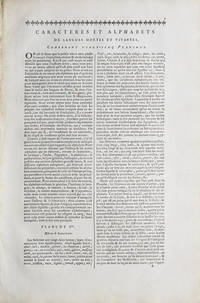
177241089Paris 1772. Pp. 1-17 18 blank; 25 copper-engraved plates Goussier or Des Hauterayes del. Niodot Sculp. 1 vols. Folio. Disbound. A very few spots in text leaves else fine. Pp. 1-17 18 blank; 25 copper-engraved plates Goussier or Des Hauterayes del. Niodot Sculp. 1 vols. Folio. An elegant and visually appealing selection of plates from the Récueil de Planches that extraordinary illustrated supplement to the magnificent Encyclopédie of Diderot and d'Alembert. The plates depict alphabets and characters of more than 40 languages from Assyrian and Hebrew to Chinese Tibetan Japanese and Bengali; the explanatory text gives a fully detailed account of the level of scholarship current in the mid to late eighteenth century. Printing and the Mind of Man describes the Encyclopedie as "a monument in the history of European thought; the acme of the age of reason; a prime motive force in undermining the ancien régime and in heralding the French Revolution; a permanent source for all aspects of eighteenth-century civilization." PMM 200; En français dans le texte 156 unknown
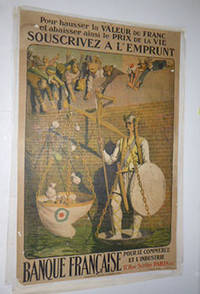
51-4718Paris : Joseph-Charles cica 1917-19. Original lithograph poster. 118 x 75cm. Repaired and mounted on cloth by the artisan binder Sasha Mosalov. . Rare. Politique Histoire Entre-deux-guerres Emprunt Souscription Banque Finance Paris 9è arrondissement En haut d'un mur foule jetant des sacs dans une balance géante dont le plateau représente un bonnet phrygien renversé sur l'autre plateau de la balance se tient un Gaulois portant un bouclier où est représentée l'allégorie du franc Paris : Joseph-Charles , cica 1917-19 hardcover
177241089Paris 1772. Pp. 1-17 18 blank; 25 copper-engraved plates Goussier or Des Hauterayes del. Niodot Sculp. 1 vols. Folio. Disbound. A very few spots in text leaves else fine. Pp. 1-17 18 blank; 25 copper-engraved plates Goussier or Des Hauterayes del. Niodot Sculp. 1 vols. Folio. Exotic Typography in the Encyclopédie. An elegant and visually appealing selection of plates from the Récueil de Planches that extraordinary illustrated supplement to the magnificent Encyclopédie of Diderot and d'Alembert. The plates depict alphabets and characters of more than 40 languages from Assyrian and Hebrew to Chinese Tibetan Japanese and Bengali; the explanatory text gives a fully detailed account of the level of scholarship current in the mid to late eighteenth century. Printing and the Mind of Man describes the Encyclopedie as "a monument in the history of European thought; the acme of the age of reason; a prime motive force in undermining the ancien régime and in heralding the French Revolution; a permanent source for all aspects of eighteenth-century civilization." PMM 200; En français dans le texte 156 unknown books
2006543742006. United States Statutes at Large. Washington: United States Government Printing Office. Vols. 80 to 120 1966-2006 in 115 books. Lacking Vols. 83 & 84 pt. 1. Dampstaining to vols. 116 part 4 and 119 part 1. Publisher's tan buckram with red and black spine labels. Ex-library with library location labels on spines with bar code labels on front covers else very good condition. Reprint Price USD 6815. Special $995. "At the close of each session of Congress or for each calendar year all the acts and resolutions are collected and published in final permanent form in bound volumes called United States Statutes at Large." Additionally they "contain the treaties ratified by the Senate postal conventions such executive agreements as were published in the Treaty Series and the proclamations of the President of the United States." Boyd 100. unknown books
36734vols. 401 to 480; 485; 486; 489 to 492. vols. 401 to 480; 485; 486; 489 to 492. United States Reports Official edition. Washington: Government Printing Office. 86 Vols. vols. 401 to 480; 485; 486; 489 to 492. Original cloth hardcover ex-private law library with stamps else very good. Sixteen 16 linear feet shelf space. $995. unknown
17864986DBA Vevey, Chez l'auteur, 1786. 4°. (1) Bl., VIII S., (488) S. Pappband der Zeit.
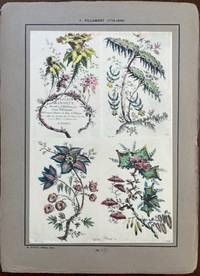
192460304Paris: Ernst Henri 1924. Folio. 2 unnumbered leaves of text. With 40 mounted hand-coloured plates beautifully reproducing the original designs Rococco chinoiserie designs 3 plates w/ old reinforced mounts at upper corners a few w/ old offsetting from the original glue. Preserved in the original quarter-chinoiserie cloth over boards printed illustrated label on front cover front tie loosened from the fore-edge edgewear rubbing still a nice complete set of these plates. First edition thus of this exceptional portfolio reproducing the exquisite and fanciful botanical settings landscapes and allegorical Chinese figures from this extraordinary artist. His chinoiserie engravings exaggerated the wispy and delicate qualities of the style portraying the world as a fairyland fileed with colour and fantasy. His 18th-Century Rococo designs were wildly popular by decorative arts manufacturers and applied to silk textiles porcelain pottery wallpapers and even silver. Pillement 1719-1808 had developed by 1764 a new method of printing on silk with fast colours and that also encouraged the durability and legacy of his designs. The majority of these were engraved by the noted woman artist & engraver Anne Allen a British artist who not only was the second wife to Pillement but created etchings based on his paintings by using the “a la poupee†or multi-colour Intaglio copperplate engraving style of printmaking which breathed life into the intricate scenes. This portfolio reproduces many of her portfolios as well as those executed by Gauthier Dagoty Canot Avril and Robert Cooper. Ernst Henri, hardcover
39734COLOR PRINTING--AMERICAN THE IRIS; AN ILLUMINATED SOUVENIR FOR MDCCCLII. Philadelphia: Lippincott Grambo 1852. Large 8vo. Publisher's gilt red clot all edges gilt. 298 pages including 12 full-page chromolithographic plates. First edition. The book is comprised of text by Mary Eastman and accompanying illustrations from drawings of her husband Captain Eastman made during his nine years in military stationed among the Indian tribes in and around Fort Snelling in Minnesota. The illustrations were printed in color by Peter S. Duval of Philadelphia. John S. Hart the book's editor proudly announced that each print was printed in ten colors overprinting some to produce varied effects. The book is a bright copy with some sporadic as usual. Spine professionally repaired. unknown books