7 772 résultats
First Irish edition, xi, [1], 412, [16]pp., cont. calf, worn, raised bands, without title label, the bottom inch of spine is worn through to stitching.
163011321Antverpiae, Joan Galle, (circa 1630) ; F. Ioannes Nys invenit, Peter de Jode figuravit, Theodor Galle sculpsit et excudit ; titre gravé, portrait et 32 planches légendées. SUIVI de 4 planches gravées par JOAN GALLE : I- Prudentia, II- Justitia, III- Fortitudo, IV- Temperantia (les 4 vertus cardinales). SUIVI de 14 planches de sujets religieux, gravées par CORNELIUS GALLE le Vieux : Silva sacra, Fugit familia sacra, S. Barbara, S. Ianvarius Neapolis patronis, S. Lucia, S. Leontius martyr miraculis gloriossus in Muris Helvetiorum, S. Iacobus Maior, Benedicite omnes bestiae et pecora domino, S. Hieromymus, Vierge à l'Enfant, etc. Soit en tout 52 planches, reliées en 1 volume petit in-4 ; plein vélin ivoire, titre au dos, tranches rouges (reliure du XIXe).
223652Paris, Imprimerie Pierre Gaudin, 1972 in-12 étroit, [11] ff. n. ch., musique notée, illustration en frontispice, en feuilles sous chemise rempliée et illustrée en couleurs d'un bois de Pierre Gaudin.
Folio (ca. 220 x 337 mm). (216) pp. With 106 woodcut illustrations within the text, 85 of which full-page. Woodcut printer's devices to title-page and final page verso. - (Bound with) II: Strein von Schwarzenau, Richard. Gentium et familiarum Romanarum stemmata. [Geneva], Stephanus (Estienne), 1559. (120) pp. With woodcut title-vignette. Contemporary full vellum. First edition. - The first complete edition of this "curious book" (cf. Graesse), a "state handbook of the military and civil organisation of the late Roman Empire" (cf. Hieronymus). Compiled anonymously around 410, the classical text and illustrations were passed on in several manuscripts, first appeared in print in abridged form in 1529 and were published in the present version by the classicist Gelen (ca. 1498-1554), who worked as an editor and translator at the Froben printing office. The woodcut illustrations were created by Conrad Schnitt (1495-1541), except for pp. 6f and 23 (Imperium Orientale, Imperium Occidentale, Constantinople), which probably originate from the hand of Hans Rudolf Manuel Deutsch (1525-71). They show, inter alia, allegoric depictions of parts of the Empire, the insignia of court, civil and military authorities, as well as statues, small buildings and books. Includes the petition to the emperor on warfare ("De rebus bellicis"), the corresponding illustrations, not all of which by Schnitt, showing chariots, ships and other military equipment. The treatise on civil and military organisation by Andrea Alciato, the topographic description of classical Rome by Publius Victor and the conversation between Emperor Hadrian and the philosopher Epictetus can be found towards the end. - Bound with this is a genealogical work on the origins of Roman families by the Austrian historian Strein von Schwarzenau (1538-1600), giving a short description of each family, with a family tree. - With contemporary ownership of the library of the Piarist school in Schlackenwerth (now Ostrov) to the title-page; a previous ownership crossed out. A library shelfmark to the pastedown. A page marker to the final leaf of the "Notitia". Binding somewhat brownstained. Paper evenly browned throughout with very slight brownstaining and waterstaining to a few pages. From the library of the Viennese collector Werner Habel, with his signed and stamped ownership, dated 1978, to the pastedown. VD 16, N 1884. BM-STC German 747. Adams II, 354. Hieronymus, Oberrhein. Buchill. II, 466. Lonchamp 1164. Schweiger 618. Graesse IV, 691. Ebert 14904. Brunet IV, 111. - II: Adams II, 1931. Renouard 118, 2.
16mo (12.5 x 8 cm). [44], [4 blank], 499, [8], [5 blank] pp. With dozens of woodcut illustrations in text. Contemporary limp sheepskin parchment. Third edition in the original Latin, of the first part of Conrad Gesner's very popular book of secrets. It primarily concerns distillation and its use in making medicines, with most of the woodcuts illustrating furnaces, glassware and other equipment for distilling. It discusses the various kinds of distillation, the equipment and techniques, aqueous solutions, the making of medicines from a wide variety of plants, animals and minerals (including metal salts), extracting oils, etc. - "The work begins with a short historical introduction which says that the Greeks and Romans could not yet distil and claims that the art was invented by the Barbarians, Carthaginians and Arabs shortly after the famous Hellenistic physicians. He gives a few short notes on Arabian scientists like Mesue, Avicenna and Bulcasis, describing their methods of making rose-oil" (Forbes). - Conrad Gesner (1516-65), a Zurich scholar of remarkable breadth who wrote on bibliography, botany, zoology, medicine and pharmacology, published the first volume of his De remediis secretis in 1552 under the pseudonym Euonymus Philiatrus. It quickly went through many editions and was translated into French, German, Italian and English by 1559. A second part appeared posthumously, edited by Gesner's student Caspar Wolf (1532-1601) and Froschauer, who printed its first edition. - Binding soiled and a few stains and smudges throughout; a good copy. USTC 151668. Wellcome I, 2778. Not in Durling. Cf. Forbes, A short history of the art of distillation, pp. 120-126.
4to. 2 pts. in 1 vol. (8), 368, (18) pp., final blank. (8), 305 (but: 307), (13) pp. Both title pages printed in red and black. With 2 different woodcut title vignettes and numerous text woodcuts. Contemp. blindstamped pigskin over wooden boards with bevelled edges. Remains of clasps. All edges red. Principal alchemical work of the Swiss physician, botanist and zoologist Gessner: the first complete German edition of the "Thesaurus de remediis secretis", translated by the Zürich theologian Johann Rudolf Landenberger and the physician Johann Jakob Nüscheler. The first part had appeared in German in 1555; only in 1569 did Caspar Wolf edit the posthumous Latin first edition of the second part, based on Gessner's notes. "This collection of recipes for medicines, the distillation of essential oils, and winemaking was first published under the pseudonym Euonymus Philiatrus because Gesner considered it not quite up to his own exact standards. It became his most popular book" (Wellisch). The woodcuts picture various destillation apparatus. - Binding rather rubbed; interior somewhat fingerstained; paper defects to the final three leaves of the index professionally restored (including portions of lost text). As always, the year of printing on the title page, stated as "1582" in Roman numerals, has been corrected to "1583" in slightly different ink. Contemp. ownership of the surgeon Christoff Zirckendorffer in red and brown ink ("A[nn]o 16[0]1 Jar") on the flyleaf. VD 16, G 1809, ZV 25033. Graesse III, 69. Wellisch A 32.18 & B2.14. Wellcome I, 2789. Ferguson I, 315 (note). Vischer (Zürcher Druckschriften des 15. u. 16. Jhs.) K 96. Cf. Durling 2084. Schoene 13415ff.
176694Tours, Rouillé-Ladevèze, 1877 gr. in-8, VII-67 pp., 1 pl., demi-chagrin vert, dos lisse, filets dorés, couv. cons. (rel. moderne). Bel exemplaire.
180810529Mexico: Airzpe. Good with no dust jacket. 1808. Leather. vii 250 pp. Entirely in Spanish. A small octavo. Bound in what appears to be the original leather front board detached spine perished. First blank has an old flourished inscript dated 1824. Text is clean and unmarked paper nice printing is somewhat uneven as to be expected from an 1808 Mexican edition. Goldsmith was pro-Napoleon for many years then took against him publishing an English language edition shortly followed by a Spanish. The Mexican edition is quite scarce. ; 8vo 8" - 9" tall; 250 pages . Airzpe hardcover
1921106601Paris, 1921, in-8°, (40) pp, non paginé, un portrait photographique de Gourmont en frontispice, illustré de plusieurs bois, dont 2 planches hors texte (tous les bois dessinés et gravés par André Rouveyre sauf un par Henry Chapront), impression de Bernouard sur vergé, broché, couv. imprimée rempliée lég. défraîchie, sinon bon état. Edition originale, tirage à petit nombre
1921106602Paris, 1921, in-8°, 37 pp, illustré de plusieurs bois dessinés et gravés par André Rouveyre, impression de Bernouard sur vergé, broché, couv. imprimée rempliée, bon état. Edition originale, tirage à petit nombre
1930Q927Berlin: Ernst Boehme 1930. Wraps. Very good. Wraps quarto 310 x 235mm 124pp. Very Good with scuffing to the covers including two areas of abrasion on the rear wrap; bumping to corners with a consistent crease to the bottom. General handling wear and mild age toning but clean and unmarked. A special issue of the illustrated monthly periodical for the graphic arts and printing industries featuring boxes and packaging. Bound in reflective aluminum foil wrappers produced by "Metallpapier-Bronzefarben-Blattmetallwerke Aktiengesellschaft" in Munich. Contents include trade articles and an incredible number and variety of advertisements and print specimens produced on specialty paper stock using a range of processes. Several pages of color illustrations show the print layout for creating graphic product packaging; articles on special machinery for package forming printing on foils cylinder presses for books offset type transfer printing. Nice feature including the specimen chart for the Futura typeface which had just been designed by Paul Brennar. A superbly graphic publication this issue literally shines. <br/><br/> Ernst Boehme paperback
1935103935Paris, aux dépens des Auteurs 1935 In-4 28 x 21 cm. Reliure éditeur simili-cuir vert foncé, titre doré sur le dos lisse et le premier plat orné d’une figure, 327 pp., illustrations en noir & blanc, index alphabétique, table des matières. Exemplaire en bon état.
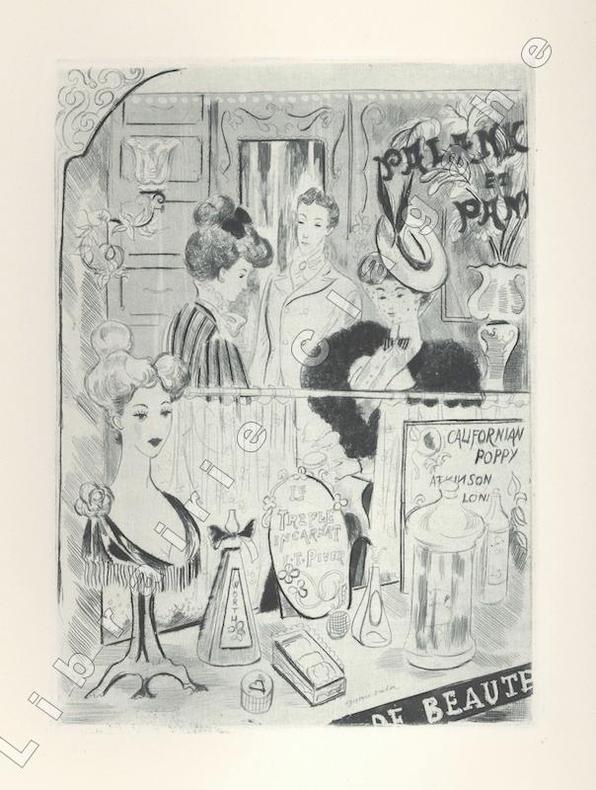
194720378Paris, Emile-Paul Frères (imprimerie de Daragnès), 1947 ; petit in-4° en feuilles sous couverture crème illustrée, chemise-étui de l'éditeur ; 266, [6] pp. et [2] ff. blancs et en tout, 32 eaux-fortes et aquatintes y compris celle de la couverture, dont 16 hors-texte.
1979832061979 Paris, L'Auteur, 1979, in 8° broché, 501 pages ; couverture illustrée.
223108S.l. [Paris], s.d. (1777-78) 3 textes en deux vol. in-8, 40 pp., 31 pp. ; 75 pp., basane bordeaux, dos lisse (reliure moderne).
9433Lugd. Batavorum [Leyde]. Ex Officina Elzeviriana. 1629. In-24, reliure plein vélin à recouvrement. [2]-438 pages. Page de titre illustrée d'une amusante gravure représentant un âne sur un piédestal, auquel deux gentilshommes font leur révérence. Bel exemplaire, bien relié, sans aucune rousseur.
8vo. (104) pp. With woodcut printer's device, 94 woodcut illustrations and 4 woodcut portraits of the evangelists. Contemporary full vellum with giltstamped monogramm "JM" to front cover and handwritten spine-title. First printing of 1547, and the first edition to include the medallion portraits of the Evangelists. There were two editions of the "Icones" printed by Frellon in 1547, following the original one of 1538. The 1547 editions are often merely cited as issues, but the text was entirely reset. - An excellent woodcut book featuring 94 highly appealing illustrations, depicting scenes from the Old Testament as well as the Totentanz, likely carried out by Veit Specklin or Hans Lützelburger after drawings by Hans Holbein the Younger (ca. 1497-1543). Each woodcut is accompanied by a Latin text and a French quatrain by Gilles Corrozet (1510-68). With a Latin preface by Nicolas Bourbon (ca. 1503-50), revealing Hans Holbein's name, and a French preface by Corrozet. - Upper board slightly warped. Paper lightly foxed throughout; 2 pages rather browned. 20th century bookplate of K. D. Dahmen mounted to pastedown. A good copy of this masterpiece of early modern book illustration. Adams B 1963. Mortimer (French) 281. Murray 244. Hollstein 14A,100. Baudrier V, 209.
Folio (275 x 175 mm). 2 ff., 12 ff. Recently bound using an old musical manuscript on vellum. Extremely rare account of Cornelis de Houtman's voyage to the East Indies, undertaken in 1595-97: a pioneering enterprise that initiated Dutch presence in the East Indies and set the standard for Dutch exploration, being organized by the "Company of Distant Lands", the immediate predecessor to the more famous Dutch East India Company (VOC), established in 1602. - This anonymous, first-hand journal, originally published in Dutch as "Verhael vande Reyse de Hollandtsche schepen ghedaen naer Oost Indien" (Middelburg, Barent Langenes, 1597), was the first printed account of the voyage. Two versions of the text appeared, of which the "Verhael" was the shorter, but also the earlier (cf. Rouffaer). Two editions of the German translation, by Conrad Löw, were printed in Cologne in 1598. No priority has been established, but both are now extremely rare: four copies of the edition published by Peter Reschedt are listed in USTC, while none of this Bertram Buchholtz imprint are recorded in USTC or elsewhere. - Houtman's voyage was motivated by the precariousness of Dutch access, as a result of the Dutch Revolt, to the largely Iberian-controlled spice and bullion markets. The Dutch therefore examined the possibility of sailing directly to the East in their own ships, and Houtman was first sent to Portugal in 1592 to investigate the spice trade. He returned two years later, urging direct voyages to the East, and in 1595 led the first such venture. - Houtman's fleet crossed the Atlantic to Brazil before rounding the Cape of Good Hope on 7 February 1595, then sailing across the Indian Ocean from Madagascar to the Sunda Straits. En route they touched on Sumatra, traded for a time in Bantam, a famously wealthy spice port, and made several other stops on the north coast of Java and on Bali. On the homeward journey, the fleet sailed along the south of Java. Houtman's brother Frederick, a talented astronomer who also participated in the voyage, greatly contributed (along with the Dutch navigator Pieter Dirkszoon Keyser) to mapping the southern skies, recording a great number of new constellations. "The voyage was not a financial success, and barely recovered its expenses. The nearly empty holds held only 245 bags of pepper, 45 tons of nutmeg, 30 bales of mace, and a selection of Chinese porcelain. The backers were aghast at the terrible loss of life [only 87 out of 249 men returned, and those who survived were too weakened even to bring their ships into anchorage]. But the voyage was, in another sense, a resounding success in that it showed to the Dutch that they might successfully reach the Indies. In the following year no fewer than 22 ships distributed over six expeditions ventured out, and the rush to the East had begun" (F. Swart, "Lambert Biesman (1573-1601) of the Company of Trader-Adventurers, the Dutch Route to the East Indies, and Olivier van Noort's Circumnavigation of the Globe", Journal of the Hakluyt Society, Dec. 2007). The Compagnie van Verre, which Houtman helped create, merged to form the Dutch East India Company. Houtman's voyage is now known for providing the initial impetus for the Dutch spice trade and colonization of Indonesia. - Lach notes that "firsthand reports of insular Southeast Asia arrived in the Netherlands with Cornelis de Houtman's fleet in August 1597. An anonymous 'Verhael vande reyse' was published [...] in 1597; it went through six editions in that year and the next, including translations into French, German, English and Latin". The published journals of the voyage "provided European readers with the most detailed descriptions of Java to date and with the first continuous description of Bali in any language. By sailing around Java, De Houtman's men were able to ascertain its true size and shape. They discovered that it was not nearly as wide from north to south as it appeared on Portuguese maps, and this was reported in the 'Verhael vande reyse'. This work also contains a detailed description of Bantam, its harbor, fortifications, buildings, people, and trade, the prices of products, and the foreigners who traded there" (Lach). The author of this account is an unidentified shipmate of Houtman's who describes in his own words what was the first incursion into the spice trade by the Dutch. - "The failure of the Barents expedition to open up a route to the East by way of the North East Passage led the Dutch to attempt reaching the East by way of the Cape Route. The Expedition consisting of 4 ships under the command of Cornelis Houtman arrived at Bantam in Java in 1596, where they tried to get a cargo of spices. But hostilities with the Portuguese arose and the fleet was compelled to sail on. The circumnavigation of Java was the first recorded attempt of this kind by any European vessel. Much knowledge of the regions later to become the exclusive territory of the Dutch resulted from the voyage" (Cox I, 262). - Rare institutionally, no copy of this edition is listed in any institution. Of the Reschedt edition, there are four copies, according to USTC (Staatsbibliothek Berlin; BSB Munich; Austrian National Library; New York Public Library). - A tall copy with light toning. In excellent condition. Tiele 122. G. P. Rouffaer, ed., De eerste schipvaart der Nederlanders naar Oost-Indië onder Cornelis de Houtman ('s-Gravenhage, 1915-29) II, pp. [xix-xx], 106-109. D. F. Lach, "Asia in the Making of Europe" (Chicago, 1993) II.1, p. 437f.
8vo. (16), 302 pp. With woodcut printer's device on t. p. 18th-c. marbled calf with label to richly gilt spine. Edges gilt. First and only edition of Hulsbusch's collection of ribald tales. Contains, among other anecdotes, ten stories from Martinus Montanus's "Wegkürzer" and 43 items from Jakob Frey's "Gartengesellschaft", translated into Latin. Among those written by himself is the story of a girl who showed herself naked at her window during a pageant in Augsburg. - The present copy is that of the Méon library described by Brunet: it was auctioned in 1803 at the Meón sale (no. 2446) and was regarded as rare even then. The front flyleaf bears Méon's purchasing memo: he had bought the book for 37 francs at the sale of the library of the great German scientist Johann Heinrich Lambert in 1780. At the Méon sale, it was knocked down to the French veterinarian Jean Baptiste Huzard (1755-1838), whose library stamp is on the reverse of the title page. In the 20th century, the book belonged to the French writer and collector of erotic literature Pierre Lous, whose pencil note is on the front flyleaf. Cf. Brunet III, 1639 (Méon cat.) and auctions catalog of the collection of Pierre Louys, vol. III, 1927, no. 3003. - Title page remargined (no loss to text); somewhat browned throughout. - Very rare; no copy at German auctions since 1950; only 3 copies established in USA via OCLC (Stanford; Univ. of Illinois; Univ. of Maryland). VD 16, H 5864. Adams H 1149. Not in BM-STC German. Goedeke II, 129. Killy VIII, 275. Brunet V, 608. Graesse VI, 537.
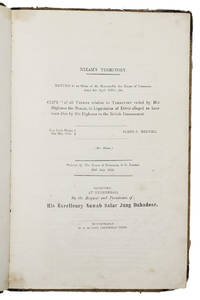
1854ABC_47435Secunderabad near Hyderabad: Robert Hudson Columbian Press 1854. Contemporary half calf orange and blue marbled sides over paper boards gold-tooled double fillets on the spine red sprinkled edges. 33 x 22 cm. The extremely rare Hyderabad edition of the official British papers relating to the so-called Hyderabad debt crisis during which Lord Dalhousie the Governor-General of India and General James Stuart Fraser the British Resident in Hyderabad orchestrated a "shakedown" of the Nizam of Hyderabad whom they claimed owed the British an astounding 7.4 million rupees. This resulted in the Nizam of Hyderabad having to cede the wealthy cotton-growing province of Berar to the British to clear his debts. The first edition of this account appeared at London in 1854 as part of the serial publication of parliamentary papers and the present Hyderabad edition probably later in the same year the first separate publication. It was printed and published by the Columbian Press in Secunderabad "by the request and permission of His Excellency Nawab Salar Jung Bahadoor" the Prime Minister of the Hyderabad State who believed that the papers portrayed Dalhousie and Fraser in a bad light. Nawab Sir Mir Turab Ali Khan Salar Jung I 1829-1883 also known as Salar Jung I was an Indian nobleman who served as Prime Minister of Hyderabad State between 1853 and 1883 and was also the regent for the sixth Nizam Asaf Jah VI from 1869 to 1883.The present work is the ultimate insiders account from the British perspective of the crisis surrounding the Nizam's staggering debt to the British government featuring transcriptions or summaries of all the official correspondence and documents of Lord Dalhousie General Fraser and other colonial senior officials. The present work is extremely rare in this Indian Secunderabad/Hyderabad edition we have not been able to trace any other copy on the market or institutionally. Supposedly the Salar Jung Museum in Hyderabad holds a copy of the same edition but we were not able to verify it.With an owner's inscription "Margaret D. Stubbs" and an orange printer's label "Secunderabad Columbian Press R. Hudson" both on the front pastedown. The binding is somewhat worn without affecting its structural integrity the outer margin of 6 leaves between pp. 52-69 and pp. 83-84 are folded in. With a minor tear in the foot margin of the title-page near the gutter and occasionally very slight staining. Otherwise in good condition.l Cf. WorldCat 941776603 electronic version of the first ed.; for the background: H.G. Briggs The Nizam his history and relations with the British Government London 1861; Kumari Sarjini Regani The cession of Berar in: Indian History Congress 20 1957 pp. 525-259. Robert Hudson, Columbian Press, hardcover
181430733Philadelphia: G. und D. Billmeyer 1814. Very Good. Philadelphia: G. und D. Billmeyer 1814. Reprint. 12mo. iv 1 2-148 vii 1 2-585; 9 pp. register; 1 2-26 pp. catechism. Contemporary sheep with two metal clasps; five raised bands. Light wear to edges; minor scuffing; chipped at spine ends. Binding sound. Allentown bookseller's ticket in German to front pastedown; ownership inscription of Mary Deshler of Lehigh Pennsylvania dated 1841 to preliminaries; interior else tone but unmarked; Very Good. <br /> <br /> Arndt & Eck 2037. G. und D. Billmeyer unknown
Folio (240 x 354 mm). (18), 191 ff. (without final blank). Printer's device on title page and, in a different version, on the last page. Contemporary cardboard binding with marbled spine and ms. label. Stored in custom-made cloth-and-paper slipcase. First issue under this title, previously released as "Expositio in primam fen quarti canonis Avicennae" (1506). A commentary (with the text, in the version of Gerardus Cremonensis) of book four, part (fen) one of Avicenna's systematic "Canon of Medicine", written in Arabic but widely translated throughout the Middle Ages and the basis of medical training in the West as late as the mid-17th century. It continues in use to this day in parts of the Arab world. Through this encyclopedic work, the author exerted "perhaps a wider influence in the eastern and western hemispheres than any other Islamic thinker" (PMM). "The 'Qanun' [...] contains some of the most illuminating thoughts pertaining to distinction of mediastinitis from pleurisy; contagious nature of phthisis; distribution of diseases by water and soil; careful description of skin troubles; of sexual diseases and perversions; of nervous ailments" (Sarton, Introduction to the History of Science). The present part is dedicated to a discussion of feverish illnesses. - 18th century ownership "Manhem" on title page. Some brownstaining throughout, as common; some waterstains near end; occasional inkstains and marginal annotations. An untrimmed, comparatively wide-margined copy. Edit 16, CNCE 2345. Adams A 1541. Durling 245. Cf. Wellcome I, 387 (only the Venice reprint). PMM 11.
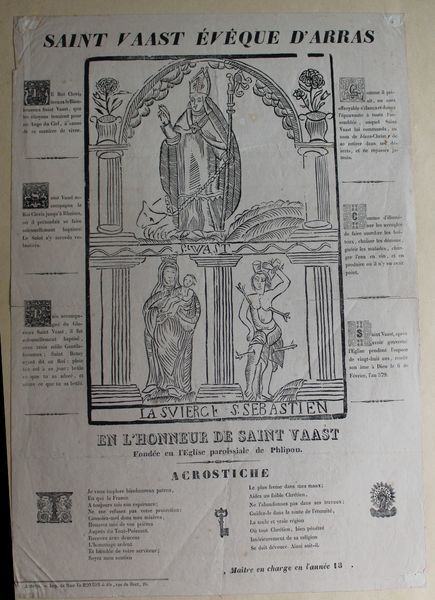
20427Les Andelys, Veuve Monton, s.d. (1918). Une feuille (45 x 30 cm), gravure sur bois représentant Saint Vaast audessus de La Vierge et de Saint Sébastien. Bon état, déchirure latérale réparée.
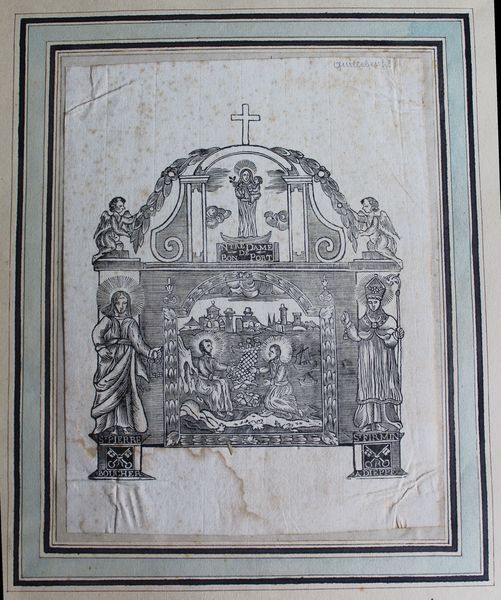
20424Dieppe, Boucher, sans date (fin XVIII ème siècle). Une feuille (25 x 20 cm), gravure sur bois représentant une scène de pèche avec saint Pierre donnant les clés à saint Firmin, flanquée des statues des mêmes saints, coiffée de la Vierge de Notre-Dame de Bon-Port. Bon état, trace de mouillure en pied.
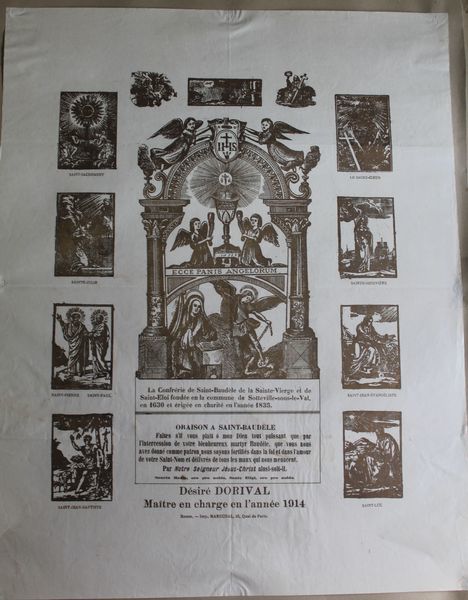
20423Rouen, Maréchal, 1914. Mention imprimée en bas: Désiré Dorival, Maître en charge en l'année 1914. Une feuille (56 x 44 cm), gravure sur bois représentant la Sainte Vierge dans un encadrement de temple, flanquée de huit images de saints. Bon état, marge supérieure courte.