1 337 résultats
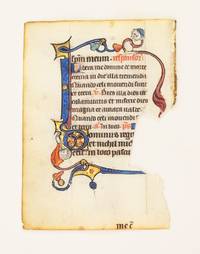
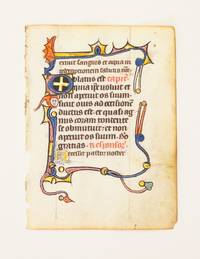
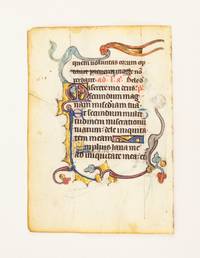
105904Rhineland or possibly Flanders or England: c. 1260-1280. Single leaf 177 x 131mm. 20 lines of text in gothic script. 4-line historiated initial of a knight in armor 4 initials in gold gold highlighting in text. Small drawing of a dragon in red ink drawing of a bird in left margin partly trimmed away. In very good condition. § A very fine and early leaf of interest in that other leaves from this manuscript are known which variously originate from either the Rhineland or England. Elaborate description on back probably English dealer provenance. Private collection California. c. 1260-1280. Single leaf unknown books
122866Naples: late 15th century. A cutting 173 mm x 182 mm with historiated initial 'E' doubtless the introit 'Ecce advenit. for Mass at Epiphany 147 mm x 152 mm. Slight spots of rubbing. In an elaborate gold frame. § The Virgin and Child seated on the right with Joseph behind set among green and yellow hills painted in full colors and liquid gold the initial itself in elaborate leafy design in dark red with pink and white heightening entwined with green leaves at the top and bottom set on a burnished gold ground with colored trefoils in each corner flecked blue surround traces of text and music to the right of the initial verso with parts of 2 lines each of text and of music on a 4-line red stave. Large miniature in the style of the Neapolitan illuminator Cristoforo Majorana documented in Naples from 1480 until 1492 cf. F. Avril Dix siecles d'enluminure italienne 1984 pp. 176-7 no. 156. The standing kinds are painted with splendid robes fringed with pearls. The blue flecked border giving the effect of the whole initial hovering above the vellum derived from the classicising illumination of Mantua and Padua and became a feature of Neapolitan manuscripts of the late fifteenth century. late 15th century. A cutting hardcover books
105895Dutch school: c. 1450 or later. Single leaf 138 x 98mm. Miniature without text image of Christ before Caiaphas being held by a soldier with a jester dancing behind Him disciples behind Him with a cock sitting above the three-sided border of simple flowers. In good condition. § Origin and provenance unknown; from a private California collection. c. 1450 or later. Single leaf unknown books
8716German: c. 1500. Single leaf 132 x 155 mm. Very good matted. § An intriguing painting showing the instruments of the Passion a crowing cock the head of Judas the thirty pieces of silver &c. A somewhat surreal piece with the head and some of the instruments floating in the air against a rich blue background Christ standing before a tomb clad in loincloth and red cloak with a blue cloak on the tomb a ladder and pillar at each side. Some surface wear and damage within the image which is also cropped slightly but an interesting and unusual painting. c. 1500. Single leaf hardcover books
122865France possibly Maine or Anjou: c. 1480. Single leaf 162 mm x 110 mm. Slight fading in an old frame with metal fittings. A finely painted miniature with the use of gold modeling and the cloud of cherubim in the tradition pioneered by Jean Fouquet. § The Virgin and God seated on separate stools in a paneled room God placing a crown on her head a host of blue seraphim behind miniature in an arched compartment above the large initial and three lines of text opening of Compline within a full border of colored flowers and acanthus leaves in little rectangles with ground of liquid gold or pale blue or plain vellum. c. 1480. Single leaf hardcover books
8719Central Italy c.1250. Matted in fine condition. § A well-painted initial of a man in flowing blue and pink robes holding a book to which he gestures probably Saint Paul. Italian miniature paintings of this period are known to be difficult to localize with any accuracy but as the face is strongly drawn with well-proportioned features it might well hail from central Italy. unknown books
107057Britanny: c. 1430. 7.8†x 5.6â€. Illuminated leaf on vellum from a Book of Hours with two large miniatures of St. Nicholas blessing the three children in the pickling tub and of St. Sebastian tied to a pillar in a mountainous landscape while two archers shoot arrows at him in strong color and burnished gold. In good condition. § On the recto St. Nicolas is shown standing on a grassy field holding a crozier against a red decorated wall while the three naked boys stand up in the tub and on the verso St. Sebastian is tied to a post bleeding and pierced with arrows shot at close range. Six initials one-line to three-line illuminated in gold and colours line-fillers; on either side of page panel borders composed of burnished gold leaves on hair-line stems with sprays of colored leaves in center of panel.Unusual and attractive miniatures painted in strong colors in the style which spread the Roham Master westwards from Paris into Rennes and elsewhere in Britanny in the 1420’s and 1430’s. c. 1430. 7.8†x 5.6â€. Illuminated leaf on vellum hardcover books
107067French probably Paris: c. 1475. Single leaf on vellum 4 x 3 1/4 ins. with good margins. 20 lines written in black/brown ink simple floriate border heightened in gold on both sides. § A sweet little leaf from the end of the Mass for the dead. c. 1475. Single leaf on vellum hardcover books
1059101350. Tuscany: c. 1350. <br /> <br /> Folio 430 x 308 mm. Single leaf. With four-line staves of music on both sides with five recto and six verso lines of text beneath. With a very fine initial 'A' in Tuscan colors. The top edge has been repaired perhaps at the time with a strip of vellum for unknown reasons perhaps a mark of ownership removed. Otherwise in very good condition generally clean and fresh and with ample margins.<br /> <br /> § A fine early Tuscan leaf being the responses and versicles for the first reading at Matins. The leaf opens: "Absterget Deus omnem lacrimam ab oculis." Provenance: Bernard M. Rosenthal 1995 with his notes; private collection San Francisco. unknown
14501058951450. Dutch school: c. 1450 or later. <br /> <br /> Single leaf 138 x 98 mm. Miniature without text image of Christ before Caiaphas being held by a soldier with a jester dancing behind him disciples and a cockerel seen through a doorway in the courtyard beyond within a three-sided border of simple flowers. In good condition.<br /> <br /> § Origin and provenance unknown; from a private California collection. unknown
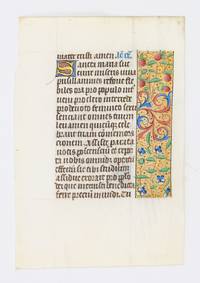
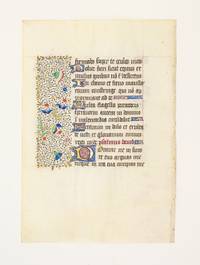
1480ST18547Northern France ca. 1480. 164 x 111 mm. 6 1/2 x 4 3/8". Single column 17 lines in a gothic book hand. <br/> Rubrics in blue many leaves with line fillers in pink and/or blue with gilt bezants and white tracery each leaf with at least one and often many one- or two-line initials in burnished gold on blue and pink ground with white tracery every side with a panel border consisting of colorful acanthus and different types of flowers on a ground that is either entirely painted gold or with a pattern of painted gold and bare vellum. A few leaves with light wrinkling or a hit of soiling or foxing a couple of leaves with inoffensive marginal repairs but IN VERY FINE CONDITION EXTREMELY CLEAN AND BRIGHT.<br/> <br/> Featuring both burnished and painted gold in their decoration and offering a multitude of border patterns to choose from these are extremely attractive leaves that are all the more appealing for their fine condition. unknown
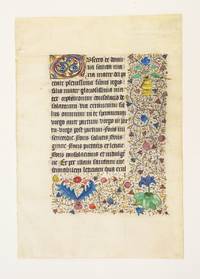
ST17060HFrance probably Besançon 3rd quarter of 15th century. 239 x 165 mm. 9 3/8 x 6 1/2". Single column 15 lines in an elegant gothic book hand. <br/> Rubrics in dark pink line enders in pink and blue with white tracery and gold bezant each with multiple one- and/or two-line initials in burnished gold on dark pink and blue ground with white tracery each side of each leaf with a lovely panel border composed of hairline vines with gold ivy and bezants and colorful flowers and acanthus some with floral arrangements in vases and/or especially leafy vegetation. A couple leaves with a little yellowing or light soiling to vellum occasional small stains or smudges other negligible imperfections but on the whole VERY CLEAN BRIGHT AND WELL PRESERVED.<br/> <br/> From a large Book of Hours probably produced in Besançon these leaves feature very pretty panel borders on every page each with unique flourishes that include colorful acanthus flowers and/or fruits as well as a couple special examples with particularly large fleshy vegetation and vases of floral arrangements. Luxurious touches such as the numerous gilt initials several dozen gilt bezants and ivy leaves in each panel border and the unusually wide margins point to this manuscript having been a costly production. For additional leaves from this same manuscript at different price points please check our website. unknown
ST17060PFrance probably Besançon 3rd quarter of 15th century. 239 x 165 mm. 9 3/8 x 6 1/2". Single column 15 lines in an elegant gothic book hand. <br/> Rubrics in dark pink line enders in pink and blue with white tracery and gold bezant each leaf with a three- or four-line initial painted pink or blue with white tracery filled with pink and blue vines and flowers all on a burnished gold ground ONE SIDE OF EACH LEAF WITH A HALF OR THREE-QUARTER BORDER featuring hairline vines gold ivy and bezants colorful acanthus various flowers fleshy plants and vases with floral arrangements the other side of each leaf with a panel border similarly decorated. ◆Vellum slightly yellowed minor smudging to hairline vines and slight rubbing to paint on a few of the border decorations one leaf with some small stains in the border largely masked by the hairline vines but these issues quite minor and the leaves IN FINE CONDITION overall--very clean bright and well-preserved.<br/> <br/> From a large Book of Hours probably produced in Besançon these leaves feature exceptionally pretty borders each with unique decoration that includes vases of different shapes sizes and hues each containing a different flower arrangement fleshy vegetation and colorful floral accents. The large initials here coupled with the expansive border decoration indicate that these leaves marked the openings of major prayers including "Obsecro te" "O Intemerata" the "Joys of the Virgin" and the "Seven Requests to Our Lord." Luxurious touches such as the several dozen gilt bezants and ivy leaves in each border and the unusually wide margins point to this manuscript having been quite a costly production. For additional leaves from this same manuscript at different price points please check our website. unknown
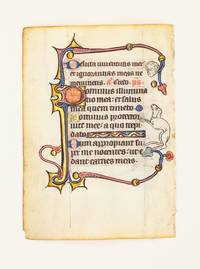
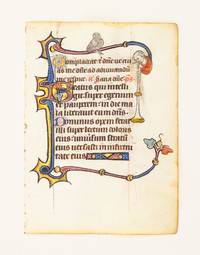
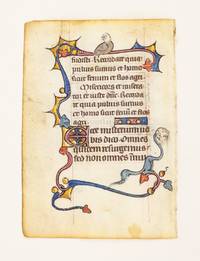
ST16985GFrance first half of 14th century. 110 x 82 mm. 4 3/8 x 3 1/4". Single column 12 lines in a gothic book hand. <br/> Rubrics in red line enders in pink and blue with gold accents each leaf with one or more one-line initials in blue with red penwork or gold with blue penwork some leaves with one two-line initial painted blue filled with either decorative shapes or INHABITED BY A HUMAN HEAD all on a gold ground one side of each leaf WITH A FULL BORDER composed of pink and blue tendrils accompanied by spikey gold decoration and gold accents often terminating in ivy leaves and incorporating EXTRAORDINARILY CHARMING EXAMPLES OF MARGINALIA INCLUDING ANIMALS HUMANS AND HYBRIDS. ◆Vellum slightly soiled and with a few minor imperfections one leaf with a little offsetting in one corner each leaf with a small area excised by a former owner affecting marginalia and a few words of text but each leaf with at least two fully intact examples of marginalia and on the whole the leaves quite clean the colors very bright and the gold sparkling.<br/> <br/> Though diminutive in size these leaves contain enormously appealing marginal decoration in the form of humans animals and hybrid creatures inventively incorporated into the lively borders in manners that range from adorable to bizarre. Especially popular in Flanders Northern France and England during the 13th and 14th centuries marginalia such as these comprise some of the most memorable and entertaining images to be found in any Medieval manuscripts. Despite being found largely in religious books such as Psalters and Books of Hours the images are often strange humorous or even outrageous and they provide us with consistent delight. Being by definition outside of the central text or miniature the margins seem to have been a place where illuminators felt more at ease to experiment resulting in highly imaginative and unique artistic expressions. The present specimens come from a fragmentary manuscript with many leaves either missing or rendered defective where portions of the vellum were cut away as here. Fortunately these leaves each retain at least two excellent examples of marginalia including a very alert hare hybrids with the heads of humans and the bodies of two-legged beasts humans emerging from the border tendrils to help hold up initials a human head with a wizened beard and a stylized hat incorporated into the border and a trumpeter blowing into a long instrument accented with gold. Though fragmentary in appearance these leaves present an excellent opportunity to acquire fine examples of marginalia at an affordable price. For additional leaves from this same manuscript at different price points please check our website. unknown
ST16985PFrance first half of 14th century. 110 x 82 mm. 4 3/8 x 3 1/4". Single column 12 lines in a gothic book hand. <br/> Line enders in pink and blue with gold accents each leaf with one or more one-line initials in blue with red penwork or gold with blue penwork each leaf with one two line initial painted pink or blue--filled with painted floral motifs or a gold cross and ONE INHABITED BY HUMAN FACE--all on a gold ground one side of each leaf with A FULL BORDER composed of pink and blue tendrils accompanied by spikey gold decoration and gold accents often terminating in ivy leaves and incorporating EXTRAORDINARILY CHARMING EXAMPLES OF MARGINALIA INCLUDING ANIMALS HUMAN HEADS AND HUMAN-BEAST HYBRIDS. ◆Occasional minor smudging vellum a little soiled and with a few small stains one leaf with noticeable staining affecting some of the text and decoration but with extremely appealing imagery making up for it another leaf with some marginal offsetting and the inhabited initial slightly rubbed but all other examples of marginalia VERY WELL PRESERVED.<br/> <br/> Though diminutive in size these leaves contain enormously appealing marginal decoration in the form of humans animals and hybrid creatures inventively incorporated into the lively borders in manners that range from adorable to bizarre. Especially popular in Flanders Northern France and England during the 13th and 14th centuries marginalia such as these comprise some of the most memorable and entertaining images to be found in any Medieval manuscripts. Despite being found largely in religious books such as Psalters and Books of Hours the images are often strange humorous or even outrageous and they provide us with consistent delight. Being by definition outside of the central text or miniature the margins seem to have been a place where illuminators felt more at ease to experiment resulting in highly imaginative and unique artistic expressions. The present specimens come from a fragmentary manuscript with many leaves either missing or rendered defective where portions of the vellum were cut away. Fortunately this group of leaves is intact and retains much marvelous imagery including two very alert hares an owl and a wonderful stork with a long beak grabbing the equally long beard emanating from a human-beast hybrid in the upper margin and the heads of humans some in the guise of a fool and storks with long beaks each holding a gold bezant incorporated into the border tendrils. One leaf shows more damage than the others here but contains some very desirable marginalia: a human-beast hybrid with an orange speckled body and a long tail in a stand-off with a snail in the upper margin and the torso of a trumpeter emerging from one of the border tendrils blowing into an extremely long gold instrument held vertically in the fore margin. For additional leaves from this same manuscript at different price points please check our website. unknown
ST16985NFrance first half of 14th century. 110 x 82 mm. 4 3/8 x 3 1/4". Single column 12 lines in a gothic book hand. <br/> Line enders in pink and blue with gold accents each leaf with one or more one-line initials in blue with red penwork or gold with blue penwork each leaf with one two line initial painted pink or blue filled with painted floral motifs and TWO INHABITED BY HUMAN FACES and on a gold ground one side of each leaf with A FULL BORDER composed of pink and blue tendrils accompanied by spikey gold decoration and gold accents often terminating in ivy leaves and incorporating EXTRAORDINARILY CHARMING EXAMPLES OF MARGINALIA INCLUDING ANIMALS HUMAN HEADS AND HUMAN-BEAST HYBRIDS. ◆Vellum a little soiled and with a few small stains one leaf with more obvious soiling varying degrees of smudging two leaves with more noticeable smudging affecting some of the text and decoration another leaf with two of the human heads slightly rubbed but all other examples of marginalia very well preserved and paint quite fresh and the gold sparkling.<br/> <br/> Though diminutive in size these leaves contain enormously appealing marginal decoration in the form of humans animals and hybrid creatures inventively incorporated into the lively borders in manners that range from adorable to bizarre. Especially popular in Flanders Northern France and England during the 13th and 14th centuries marginalia such as these comprise some of the most memorable and entertaining images to be found in any Medieval manuscripts. Despite being found largely in religious books such as Psalters and Books of Hours the images are often strange humorous or even outrageous and they provide us with consistent delight. Being by definition outside of the central text or miniature the margins seem to have been a place where illuminators felt more at ease to experiment resulting in highly imaginative and unique artistic expressions. The present specimens come from a fragmentary manuscript with many leaves either missing or rendered defective where portions of the vellum were cut away. Fortunately this group of leaves is intact and retains much marvelous imagery including several animals a dog a bird a squirrel and a large hare human and bestial heads capping the ends of border tendrils many with a memorable detail such as a bushy beard a massive gold horn or wearing a tall pointy hat including the torso of a person holding a long antler-like club and colorful human-beast hybrids. A couple of these leaves also have initials inhabited by charming little human faces. For additional leaves from this same manuscript at different price points please check our website. unknown
ST16985QFrance first half of 14th century. 110 x 82 mm. 4 3/8 x 3 1/4". Single column 12 lines in a gothic book hand. <br/> Line enders in pink and blue with gold accents each leaf with one or more one-line initials in blue with red penwork or gold with blue penwork each leaf with one two line initial painted pink or blue ONE INHABITED BY HUMAN FACE others filled with painted floral motifs all on a gold ground one side of each leaf with A FULL BORDER composed of pink and blue tendrils accompanied by spikey gold decoration and gold accents often terminating in ivy leaves and incorporating EXTRAORDINARILY CHARMING EXAMPLES OF MARGINALIA INCLUDING ANIMALS HUMAN HEADS AND HUMAN-BEAST HYBRIDS. ◆Vellum with a little soiling and a few small stains slightly more noticeable on one leaf where it is touching the text though not obscuring meaning a few instances of rubbing to gold and decoration including one bird with its detailing rubbed away other minor imperfections but none of these flaws egregious and the most desirable imagery here still very well preserved.<br/> <br/> Though diminutive in size these leaves contain enormously appealing marginal decoration in the form of humans animals and hybrid creatures inventively incorporated into the lively borders in manners that range from adorable to bizarre. Especially popular in Flanders Northern France and England during the 13th and 14th centuries marginalia such as these comprise some of the most memorable and entertaining images to be found in any Medieval manuscripts. Despite being found largely in religious books such as Psalters and Books of Hours the images are often strange humorous or even outrageous and they provide us with consistent delight. Being by definition outside of the central text or miniature the margins seem to have been a place where illuminators felt more at ease to experiment resulting in highly imaginative and unique artistic expressions. The present specimens come from a fragmentary manuscript with many leaves either missing or rendered defective where portions of the vellum were cut away. Fortunately this group of leaves is intact and retains much marvelous imagery including an owl and two other birds one apparently holding a worm in its mouth human heads and torsos capping off the ends of border tendrils including a trumpeter blowing into a particularly long instrument and a man reaching both arms straight into the air as if trying to grab the head attached to the tendril above him and a hybrid with the head of a human in a gold hood and the body of a hare perched gingerly on an ivy branch. For additional leaves from this same manuscript at different price points please check our website. unknown
ST16985LFrance first half of 14th century. 110 x 82 mm. 4 3/8 x 3 1/4". Single column 12 lines in a gothic book hand. <br/> Line enders in pink and blue with gold accents each leaf with one or more one-line initials in blue with red penwork or gold with blue penwork each leaf with one two line initial painted pink or blue filled with painted floral motifs and on a gold or blue ground one side of each leaf with A NEAR-FULL BORDER composed of pink and blue tendrils accompanied by spikey gold decoration and gold accents often terminating in ivy leaves and incorporating EXTRAORDINARILY CHARMING EXAMPLES OF MARGINALIA INCLUDING ANIMALS HUMANS AND HYBRIDS. ◆Vellum a little soiled and lightly stained and wrinkled in places some of the gold a bit rubbed one leaf with some noticeable smudging affecting some of the text and decoration including the head of one of the hybrids but the other examples of marginalia quite well preserved and still retaining much of their original charm.<br/> <br/> Though diminutive in size these leaves contain enormously appealing marginal decoration in the form of humans animals and hybrid creatures inventively incorporated into the lively borders in manners that range from adorable to bizarre. Especially popular in Flanders Northern France and England during the 13th and 14th centuries marginalia such as these comprise some of the most memorable and entertaining images to be found in any Medieval manuscripts. Despite being found largely in religious books such as Psalters and Books of Hours the images are often strange humorous or even outrageous and they provide us with consistent delight. Being by definition outside of the central text or miniature the margins seem to have been a place where illuminators felt more at ease to experiment resulting in highly imaginative and unique artistic expressions. The present specimens come from a fragmentary manuscript with many leaves either missing or rendered defective where portions of the vellum were cut away. Fortunately this group of leaves is intact and retains much marvelous imagery including a particularly annoyed-looking bird two human-beast hybrids with long necks and bushy tails and a trumpeter emerging from the border decoration blowing into a long instrument decorated with gold accents. For additional leaves from this same manuscript at different price points please check our website. unknown
ST16985MFrance First half of 14th century. 110 x 82 mm. 4 3/8 x 3 1/4". Single column 12 lines in a gothic book hand. <br/> Line enders in pink and blue with gold accents each leaf with one or more one-line initials in blue with red penwork or gold with blue penwork each leaf with one two line initial painted pink or blue filled with painted floral motifs and on a gold ground one side of each leaf with A NEAR-FULL BORDER composed of pink and blue tendrils accompanied by spikey gold decoration and gold accents often terminating in ivy leaves and incorporating EXTRAORDINARILY CHARMING EXAMPLES OF MARGINALIA INCLUDING HUMAN-BEAST HYBRIDS. ◆Vellum a little soiled and with a few small stains one leaf with more noticeable smudging affecting some of the text and decoration another leaf with one of the heads a little rubbed but all other examples of marginalia very well preserved.<br/> <br/> Though diminutive in size these leaves contain enormously appealing marginal decoration in the form of humans animals and hybrid creatures inventively incorporated into the lively borders in manners that range from adorable to bizarre. Especially popular in Flanders Northern France and England during the 13th and 14th centuries marginalia such as these comprise some of the most memorable and entertaining images to be found in any Medieval manuscripts. Despite being found largely in religious books such as Psalters and Books of Hours the images are often strange humorous or even outrageous and they provide us with consistent delight. Being by definition outside of the central text or miniature the margins seem to have been a place where illuminators felt more at ease to experiment resulting in highly imaginative and unique artistic expressions. The present specimens come from a fragmentary manuscript with many leaves either missing or rendered defective where portions of the vellum were cut away. Fortunately this group of leaves is intact and retains much marvelous imagery including a beast with an exaggeratedly long body and horns and long-necked beasts with human heads--one who appears to be blowing smoke into the air one with a bearded face as its bottom and another with the body of a stork sporting a hat with a long pointy tendril. For additional leaves from this same manuscript at different price points please check our website. unknown
1440ST12158bAParis ca. 1440. 222 x 162 mm. 8 3/4 x 6 3/8". Single column 16 lines of text in a beautiful gothic book hand. <br/> Rubrics in red leaves with varying numbers of line fillers and one- and two-line initials in burnished gold blue and magenta highlighted with white tracery and WITH LOVELY RINCEAU BORDERS on one or both sides these composed of delicately twining hairline stems bearing red and blue blossoms and FEATURING A PROFUSION OF BURNISHED GOLD IVY LEAVES. IN OUTSTANDING CONDITION the vellum extraordinarily bright fresh and clean and WITH MARGINS AS VAST AS ONE COULD EVER HOPE FOR.<br/> <br/> Commissioned for use by a woman as indicated by the feminine form in the "Obsecro te" the Book of Hours from which these leaves come could only have been a manuscript of great beauty prepared for a household of very substantial wealth and importance. The level of achievement manifested here in both the scribal hand and the execution of the illuminated decoration clearly indicates that some of the best artisans money could buy were at work on this book and only a powerful family could afford to pay their price. Further corroboration of this fact is seen in the leaves' noticeable size and immense margins which are at least as wide as on any Book of Hours leaves we have ever owned. Such a conspicuous display of purchasing power those extra millimeters meant the slaughtering of extra animals and that meant greater cost announces an owner's self-congratulatory consequence that is uncommon except in the grandest of prayer books of the period. Happily the condition here matches the importance of the manuscript which was obviously considered from the beginning--and ever after--an object to be carefully preserved. For additional leaves from this Book of Hours at different price points please check our website. unknown
87191250. Central Italy c.1250. <br /> <br /> Matted in fine condition.<br /> <br /> § A well-painted initial of a man in flowing blue and pink robes holding a book to which he gestures probably Saint Paul. Italian miniature paintings of this period are known to be difficult to localize with any accuracy but as the face is strongly drawn with well-proportioned features it might well hail from central Italy. unknown
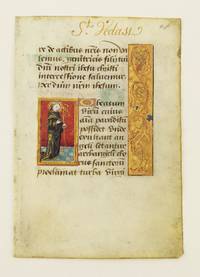
ST12668bKNortheastern France probably Arras late 15th century. 146 x 95 mm. 5 3/4 x 3 3/4". Single column 15 lines in a pleasing bâtarde hand. <br/> Rubrics in red one- and two-line initials in brushed gold on a red or blue ground EACH SIDE OF EACH LEAF WITH A BRUSHED GOLD PANEL BORDER WITH VERY PRETTY ILLUSIONISTIC FLOWERS and one panel with acanthus apparently unfinished; EACH LEAF WITH ONE SMALL MINIATURE measuring approximately 40 x 25 mm. DEPICTING SAINTS. Headlines written in French in a later 18th century calligraphic hand. ◆Light soiling otherwise excellent specimens generally clean and smooth with ample margins and attractive decoration.<br/> <br/> From a charmingly decorated 15th century prayer book these lovely leaves offer the opportunity to acquire a miniature andconsiderable gold ornamentation at an attainable price. One leaf depicts Sts. Peter and Paul in a single frame and the other shows St. Vedast or Waast--a saint that was particularly venerated in France especially in the Arras region whence we be believe these leaves originated. For other leaves from this same manuscript please check our website. unknown
ST12668bJNortheastern France probably Arras late 15th century. 146 x 95 mm. 5 3/4 x 3 3/4". Single column 15 lines in a pleasing bâtarde hand. <br/> Rubrics in red one- and two-line initials in brushed gold on a red or blue ground EACH SIDE OF EACH LEAF WITH A BRUSHED GOLD PANEL BORDER WITH VERY PRETTY ILLUSIONISTIC FLOWERS; EACH LEAF WITH TWO SMALL MINIATURES measuring approximately 40 x 25 mm. depicting saints shown with their attributes. Headlines written in French in a later 18th century calligraphic hand. ◆Light soiling rubrics faded otherwise excellent specimens generally clean and smooth with ample margins attractive decoration and shining gold.<br/> <br/> From a charmingly decorated 15th century prayer book these lovely leaves offer the opportunity to acquire a miniature and considerable gold ornamentation at an attainable price. One leaf depicts St. Andrew holding an "X" shaped cross and St. Etienne i.e. St. Stephen here shown with three stones on his body and the other shows St. Remigius the so-called "Apostle of the Franks" and St. Quentin--a saint that was particularly venerated in France especially in the north whence we be believe these leaves originated. For other leaves from this same manuscript please check our website. unknown
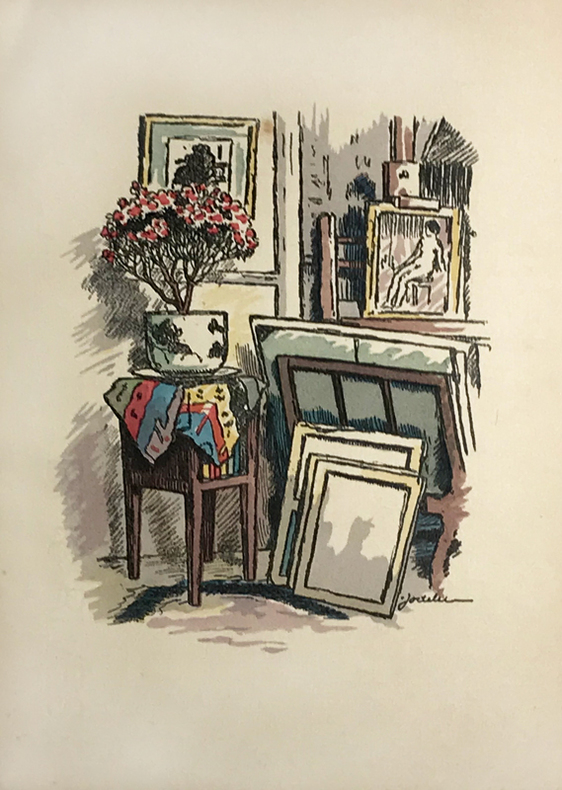
19232560Paris, Henri Jonquières et Cie, 1923 ; in-8, broché ; (3) ff. (bl., faux-titre, titre), 336 pp., (2) ff. (justification, bl.) ; 1 dessin en couleurs en frontispice, 22 dessins en noir in-texte ; couverture blanche à rabats imprimée en noir et marron.
1961003999Paris Hugnet 1961 In-8 En feuilles, couv. à rabats Ed. originale Dédicacé par l'auteur