153 résultats
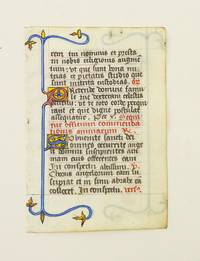
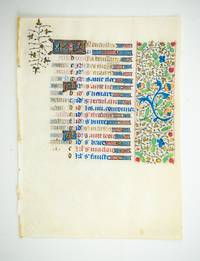
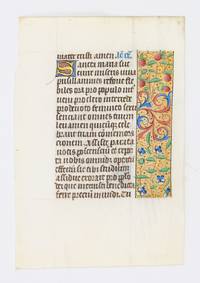
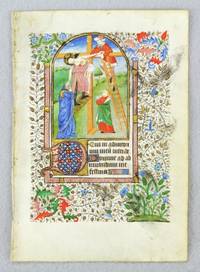
1420ST12005fFrance probably Paris ca. 1420. 210 x 146 mm. 8 1/4 x 5 3/4". Single column recto with five lines of text verso with 16 lines all in a very pleasing very regular gothic book hand. <br/> Attractively matted. Rubrics in red verso with a one-line and two two-line initials as well as a line filler in colors and burnished gold recto with a one-line initial and a line filler in the same style and with a quite large five-line "D" in pink and white with enclosed floral diapering all on a burnished gold ground the same side WITH A LOVELY FULL BORDER of swirling hairline stems bearing numerous leaves and berries of burnished gold and with sprays of acanthus leaves and flowers in multiple colors spilling from the corners this ENCLOSING A POIGNANT ARCH-TOPPED MINIATURE OF THE REMOVAL OF CHRIST FROM THE CROSS measuring approximately 85 x 60 mm. the miniature within a thin gold frame and enclosed in turn on three sides by bars in colors and gold the scene showing two men on ladders unfastening Christ's lifeless body from the cross while Joseph of Arimathea waits below clutching cloth to be used for a burial shroud as the Madonna at the lower left of the picture reaches up to clasp her son's bloody arm. With a small cross stitched in white thread in each upper corner. ◆A little soiling right along hinge edge a few smudges in the border a couple of tiny flakes of paint missing from the cross and the sky otherwise fine the vellum clean and fresh the colors rich and the gold lustrous.<br/> <br/> This is an especially sorrowful scene depicted with power grace and sensitivity by an artist demonstrating very considerable skill in composition and execution. The scene is well designed with the cross providing a device for focus at the center of the miniature. Nicodemus identified by his expensive attire is atop a ladder behind the cross lowering Christ's limp body onto the shoulder of another man probably a servant whose ladder is set against the front. Despite the fact that the corpse is more bones than flesh the artist has made it seem a heavy burden draped over the shoulder of the man as he walks backward down his ladder. Fully stretched out Christ's left arm is held for balance by Nicodemus at the top right while the other arm hangs down toward the Virgin. While we can only see her back her image evokes great pathos as she reaches up with both hands to grasp the mangled arm of her son his blood running from his hand onto hers. Joseph of Arimathea whose position anchors the right side of the picture looks on with concern tightly holding linen to shroud the body. St. John and Mary Magdalen conventional participants in the Deposition are not present in this miniature. While it is possible and even likely that the same artist produced this scene and the miniature of Christ Carrying the Cross this one is better as the faces are more deftly painted and the folds in the various garments are more clearly defined. unknown
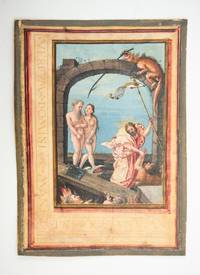
1540ST20622Germany ca. 1540. 183 x 133 mm. 7 1/8 x 5 1/4". <br/> WITH A FULL-PAGE MINIATURE DEPICTING THE HARROWING OF HELL featuring a naked Adam and Eve on the left and on the right Christ bending down to rescue John the Baptist the figures framed by a stone archway supporting a hairy creature who aims the point of a spear directly at Adam and Eve the miniature in a thin brown frame with gilt lines surrounded on two sides by the words "VERBUM DOMINI MANET IN ETERNUM" in gilt all framed in gray and red washes with double rules of black and gilt. Light soiling to frame a little flaking to the gray border and a couple of small scuffs and smudges elsewhere verso with spotting but the miniature vibrant and well preserved with only very trivial imperfections.<br/> <br/> A close copy of an early 16th century engraving by Albrecht Dürer this powerful miniature depicting the Harrowing of Hell is an intriguing artifact that ties together manuscript art print culture and the Reformation. The image depicts an apocryphal tale in the Gospel of Nicodemus in which Christ following his death but before his Resurrection descends into Limbo in order to save righteous souls who had passed away before him particularly figures from the Old Testament. Christ appears here in pale pink robes carrying a long staff with a cross and banner adorning the top. Having just brought down the gates of Hell he stoops to rescue John the Baptist here dressed in furs from its depths. A naked Adam and Eve covering their loins stand at the left of the composition--Adam now a gray-bearded old man as a reflection of sin and mortality but Eve still as she was at the Expulsion in keeping with the period's inclination to retain the classically idealized youthful feminine form. Above them is a stone arch upon which a dog-like demon perches stealthily aiming a spear directly at the oblivious couple. Another demon snaps its jaws at the feet of Christ and we can see a lick of flames below the broken gate as more captive souls clamor to escape. The painting is skillfully done showing the artist's facility with anatomy proportion and foreshortening. The bodies of Adam and Eve are particularly excellent with lovely skin tones and convincing molding. The composition is clearly based on an engraving by Dürer published in 1513 as part of a major series of 16 images known as the "Engraved Passion." In translating a black & white print into a full-color painting the artist here dispensed with a few details seen in Dürer's work such as the shadowy figure behind Adam and Eve and the stigmata on Christ's hand; however the overall composition deviates little from the original suggesting that the artist may have been working from an actual engraving. Although this leaf contains just a few words in the form of a border inscription--"Verbum Domini manet eternum" "the Word of the Lord endures forever"--they are monumentally important. This line from Isaiah 40:8 and 1 Peter 1:25 became the motto of the Lutheran Reformation appearing on art clothing coins and even armor of the 16th century. The Schmalkaldic League an influential group of allied Lutheran principalities in the Holy Roman Empire at the time also adopted it as their motto. Given the dominance of print materials during the Reformation period our hand-painted miniature--possibly produced as a frontispiece--must have been a very special commission. It is also an object that is prime for further study touching on aspects of book production religious art and the transmission of images and ideas in the early modern period. unknown
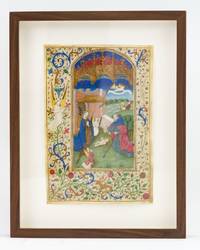
1470ST17765Delft ca. 1470. Leaf: 172 x 115 mm. 6 3/4 x 4 1/2". Frame: 242 x 190 mm. 9 1/2 x 7 1/2". <br/> In an attractive wooden frame. A FINELY PAINTED MINIATURE OF THE NATIVITY within an arch-topped compartment the parents of the Christ Child kneeling before him as he lies on the ground outside the stable Joseph uncharacteristically supporting himself with a cane in his left hand and holding a long burning candle in his right two diminutive angels in attendance the head of an ass sticking out of the stable window in the background to the left AND IN THE RIGHT BACKGROUND A CHARMING DEPICTION OF THE ANNUNCIATION TO THE SHEPHERDS ALL OF THIS BENEATH A VERY DETAILED ARCHITECTURAL CANOPY suspended in the sky AND THE WHOLE WITHIN A FULL BORDER of acanthus leaves and other foliage and flowers in reds blues greens yellows and brushed gold along with very many small burnished gold ivy leaves and buds on hairline stems a small stag in the bottom border and a large delicately shaded angel who mirrors the Virgin's pose in the left border verso blank. ◆A hint of soiling to edges of vellum but IN VERY FINE CONDITION without any paint erosion with the colors rich and true and with the burnished gold still shimmering.<br/> <br/> Notable for its attractive color scheme fine craftsmanship and unusual composition this vibrant leaf was produced by a talented artist belonging to the stylistic group known as the Masters of the Delft Half-Length Figures. The lack of text and blank back of this leaf clearly suggest that it was produced as a singleton intended for insertion in a Book of Hours and its subject matter indicates that it would have faced the opening for the third hour of the day Prime. The present depiction of the Nativity is out of the ordinary in that it is combined with another scene the Annunciation to the Shepherds a subject that usually begins Terce in the Hours of the Virgin. It is a testament to the artist's ingenuity and compositional skills that he has managed to incorporate these two scenes so seamlessly; in fact rather than pulling focus from the main subject celebrating the birth of Christ this secondary scene adds additional interest to the picture and amplifies the storyline. Though the Annunciation to the Shepherds takes place at a distance from the Nativity we immediately grasp their connection and can see how arrival of humanity's savior was felt far beyond the manger. It is also interesting to note how much the artist has emphasized the figure of Joseph. Not only does he take up as much space as the Virgin but the candle and cane he holds frame the Christ child and communicate a strong suggestion of a protective parent the Virgin is doing her part by praying hard but she is more passive. In addition to its engaging subject matter there is a high level of artistic achievement here including delicately molded figures impressively detailed architectural elements and a lovely color palette. The elegant hand seen in this miniature manifests a quiet sophistication that distinguishes this artist as a particularly talented member of his circle. Active from about 1450-80 the Masters of the Delft Half-Length Figures were named by James Marrow after the angels and other figures whose upper bodies are typically found emerging from a cloud within the borders. Although the present leaf uncharacteristically contains a full-length angel in the border it shares other stylistic similarities such as the elaborate architectural canopy hovering over the main composition; and it particularly resembles the work of the artist of Keble College MS 77 an illuminator described in "The Golden Age of Dutch Manuscript Illumination" as "one of the more articulate of the group" whose "figures are more fully modelled and his palette . . . deeper and brighter" than that of his contemporaries. Because of the complexity of the subject matter and the high level of artistic accomplishment seen here this leaf was probably part of an elaborate Book of Hours produced in response to an important commission. unknown
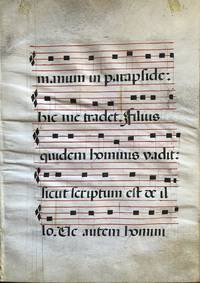
56242A single leaf on vellum black square notation with custodes five staves of five red lines on both sides. Size is 19cm x 26.5cm. Text is in Latin from Mark:14. It begins on the recto: "manum in parapside: hic me tradet filius quidem hominis vadit" and ends on the verso: "Respondens autem iudas qui". One small red initial on the verso. Two small tape marks from matting in the upper margin on the recto; clean and in excellent condition. Part of the Institutional Narrative of the Roman Catholic Mass. A handsome antiphonal leaf. <br/><br/> hardcover
32636Burt Franklin New York. Reprint of the 1822 Edition 1969. 9 Vols. small 4to orig. cloth. "The first bibliography of books printed on vellum; it describes 1750 books owned by what is now the Bibliothèque Nationale Paris and 2750 works which the author traced in other public and private libraries. But it is much more than a mere bibliography of books printed on that precious material; the copious notes make it a valuable bibliography of rare books in many fields." - Breslauer & Folter Grolier Club Bibliography 123. Burt Franklin, New York. (Reprint of the 1822 Edition) 1969 hardcover
1450ST12778-0485-05BFrance ca. 1450. 97 x 61 mm. 3 3/4 x 2 5/8". Single column 20 lines in an attractive gothic book hand. <br/> Each leaf with two or more one- to two-line initials painted in blue or maroon with delicate white tracery and charming enclosed flowers all on a field of burnished gold the left or right margin on one or both sides with a bar border of blue and white terminating in gold ivy leaves in the upper and lower margins. ◆The bar borders just slightly trimmed by the binder otherwise in excellent condition the text well preserved the vellum unusually clean the colors quite bright and the glistening gold without any erosion or loss of brilliance.<br/> <br/> Taken from an intact manuscript we sold in 2006 that was subsequently dismembered these lovely leaves have considerable aesthetic appeal and charm as well as notable interest because of their surprising size distinctive musical and textual content and peculiar hypothetical provenance. In origin the collectarium sometimes called a collectar collectarius collectaneum orationale or capitulare was a compilation of the collects or prayers said during the various hours of the Divine Office. But over time it came to comprise an ad hoc collection of the prayers and ceremonies not found in other service books that were specific to the uses of a particular house congregation or religious order. The presence of music throughout the original book indicates that our leaves were part of a choir book; however unlike most choir book leaves which range from very large to enormous in order to allow simultaneous use by a number of singers the present pocket-size manuscript is quite atypical in that it could only have been used by a single person at any one time. These leaves are also highly unusual and therefore most interesting in that we know from consulting other portions of the original that this collectarium was written not for a monastic house but for a community of religious women who are referred to in other parts of the manuscript as "sisters." Judging from the frequency with which she is mentioned in the original members of that community using the present choirbook seem clearly to have identified closely with the penitent Magdalene the original book containing a portion of the double feast they celebrated for her and her presumed sister Martha. This suggests a fascinating possibility in terms of the manuscript's provenance: beginning in the 13th century houses of penitential sisters known as Magdalens were established in many European cities often by wealthy lay persons with the aim of providing former prostitutes with a safe haven in a religious community. It is just possible that our manuscript leaves were part of a book that was used in such a convent. unknown
41667G. Deydier - Eds Elégance In-8 70pp. illustr. dessins cartes et planches photos hors-texte hommage autographe de Jean Meunier organisateur avec sa carte de visite jointe unknown
10997<p>NP. ND. . FINE LARGE DECORATIVE VELLUM BINDING. Folio. 14.8 x 12.8 inches. A collection of 211 items of late 19th and early 20th century cards and ephemera including 26 rare 3-D movable lift-up Valentines and Christmas cards each mounted onto a white stiff card page and with multiple pieces of ephemera attached around the page. Attractive late nineteenth century binding of full white vellum. Spine with decorative gilt designs within double gilt ruled lines in compartments. Boards with triple gilt ruled borders to the very edges and elaborate dark brown morocco panels with highly decorative gilt tooling. A thin blue ink line inside and out of the brown panels. Four gilt corner pieces inside the middle panel. Red painted initials with gilt borders to the centre of the front panel. Board edges and turn-ins with decorative gilt rolls. Green and white patterned endpapers. All edges gilt. Inner hinges reinforced with buff cloth strip. A little marking and a couple of small splits to the binding but overall a fine and attractive vellum binding housing an interesting collection of rare unusual and highly decorative items.</p> NP. ND. hardcover
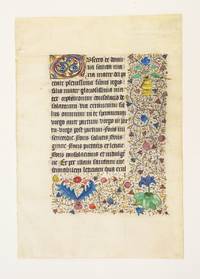
1440ST11459-11Paris ca. 1440. 121 x 89 mm. 4 3/4 x 3 1/2". Single column 15 lines of text in a very fine gothic book hand. <br/> Rubrics in red with multiple one-line initials and line fillers all in blue maroon and burnished gold and with two-line initials in the same colors and gold but also enclosing charming flowers on scrolling stems with marginal extension in the form of gilt ivy leaves on sinuous stems and WITH A FINE SWIRLING PANEL BORDER ON EACH SIDE featuring flowers leaves strawberries and many burnished gold ivy leaves on hairline stems. IN FINE CONDITION with the paint and gold bright fresh and entirely intact.<br/> <br/> This is a lovely little leaf from a fragment of a Book of Hours that obviously was produced for a client of considerable means by skilled craftsmen in a Parisian studio probably a little before the middle of the 15th century. This was clearly intended to be put into a book that could be carried easily on one's person and part of what makes it so charming is this portable size. unknown
ST18310cGermany ca. 1100. 130 x 204 mm. 5 1/8 x 8". Single column 13 extant lines in a late Caroline hand. <br/> Rubrics in red. ◆Recovered from a binding and thus noticeably browned stained and vaguely wavy one side somewhat faded several small holes just two touching any letters other imperfections but still a very presentable specimen the ink especially dark on one side and legible on both.<br/> <br/> This is an early fragment in a distinctive hand lacking the heaviness of other scripts of the period and with a feeling of the elongated grace of the humanistic. Despite having previously been used as a binding scrap the fragment remains definitely readable partly because of the clarity of the scribal hand. Elected pope in 590 Gregory I ca. 540-604 also known as Gregory the Great was one of the most influential pontiffs in the history of the Church. In addition to revising liturgical worship he wrote extensively on theology offering homespun wisdom rather than esoteric debates. His "Homilies on the Gospels" were intended to be preached to common people rather than a monastic audience and as a consequence were greatly admired for their straightforward language and pastoral relevance. unknown
ST18310bGermany ca. 1100. 120 x 200 mm. 4 3/4 x 8". Single column 21 extant lines in a late Caroline hand. <br/> ◆Recovered from a binding and thus noticeably browned and stained several small holes costing perhaps 30 letters other imperfections but still a very presentable specimen the ink dark and with loss of legibility in only one small place.<br/> <br/> This is an early fragment in a distinctive hand lacking the heaviness of other scripts of the period and with a feeling of the elongated grace of the humanistic. Despite having previously been used as a binding scrap the fragment remains extremely legible partly because of the clarity of the scribal hand. Elected pope in 590 Gregory I ca. 540-604 also known as Gregory the Great was one of the most influential pontiffs in the history of the Church. In addition to revising liturgical worship he wrote extensively on theology offering homespun wisdom rather than esoteric debates. His "Homilies on the Gospels" were intended to be preached to common people rather than a monastic audience and as a consequence were greatly admired for their straightforward language and pastoral relevance. unknown
ST12668bLNortheastern France probably Arras late 15th century. 146 x 95 mm. 5 3/4 x 3 3/4". Single column 15 lines in a pleasing bâtarde hand. <br/> Attractively framed leaves with full borders showing one side only and the leaf with images of saints in double-sided glass frame showing both recto and verso. All leaves with rubrics in red and one- and two-line initials in brushed gold on a red or blue ground some leaves with three-line initials on orange or green ground. Each leaf WITH EITHER A FULL BORDER OR PANEL BORDER WITH BRUSHED GOLD GROUND AND VERY PRETTY ILLUSIONISTIC FLOWERS AND FRUITS the leaf with the panel border also FEATURING TWO SMALL MINIATURES OF SAINTS. Headlines written in French in a later 18th century calligraphic hand. ◆Brushed gold a little faded in places otherwise excellent specimens generally clean and smooth.<br/> <br/> From a charmingly decorated 15th century prayer book these beautifully framed leaves are ready to hang on the wall or give as a gift to a lucky recipient. Two types of leaves are offered here: the first consists of a full border with illusionistic flowers fruit and at least one insect or creature; the second contains a panel border and two small miniatures depicting St. Anthony often called the Father of all Monks and the lesser known St. Eligius patron saint of metalworkers. For unframed leaves from this same manuscript please check our website. unknown
1059101350. Tuscany: c. 1350. <br /> <br /> Folio 430 x 308 mm. Single leaf. With four-line staves of music on both sides with five recto and six verso lines of text beneath. With a very fine initial 'A' in Tuscan colors. The top edge has been repaired perhaps at the time with a strip of vellum for unknown reasons perhaps a mark of ownership removed. Otherwise in very good condition generally clean and fresh and with ample margins.<br /> <br /> § A fine early Tuscan leaf being the responses and versicles for the first reading at Matins. The leaf opens: "Absterget Deus omnem lacrimam ab oculis." Provenance: Bernard M. Rosenthal 1995 with his notes; private collection San Francisco. unknown
14501058951450. Dutch school: c. 1450 or later. <br /> <br /> Single leaf 138 x 98 mm. Miniature without text image of Christ before Caiaphas being held by a soldier with a jester dancing behind him disciples and a cockerel seen through a doorway in the courtyard beyond within a three-sided border of simple flowers. In good condition.<br /> <br /> § Origin and provenance unknown; from a private California collection. unknown
1480ST18547Northern France ca. 1480. 164 x 111 mm. 6 1/2 x 4 3/8". Single column 17 lines in a gothic book hand. <br/> Rubrics in blue many leaves with line fillers in pink and/or blue with gilt bezants and white tracery each leaf with at least one and often many one- or two-line initials in burnished gold on blue and pink ground with white tracery every side with a panel border consisting of colorful acanthus and different types of flowers on a ground that is either entirely painted gold or with a pattern of painted gold and bare vellum. A few leaves with light wrinkling or a hit of soiling or foxing a couple of leaves with inoffensive marginal repairs but IN VERY FINE CONDITION EXTREMELY CLEAN AND BRIGHT.<br/> <br/> Featuring both burnished and painted gold in their decoration and offering a multitude of border patterns to choose from these are extremely attractive leaves that are all the more appealing for their fine condition. unknown
ST17060HFrance probably Besançon 3rd quarter of 15th century. 239 x 165 mm. 9 3/8 x 6 1/2". Single column 15 lines in an elegant gothic book hand. <br/> Rubrics in dark pink line enders in pink and blue with white tracery and gold bezant each with multiple one- and/or two-line initials in burnished gold on dark pink and blue ground with white tracery each side of each leaf with a lovely panel border composed of hairline vines with gold ivy and bezants and colorful flowers and acanthus some with floral arrangements in vases and/or especially leafy vegetation. A couple leaves with a little yellowing or light soiling to vellum occasional small stains or smudges other negligible imperfections but on the whole VERY CLEAN BRIGHT AND WELL PRESERVED.<br/> <br/> From a large Book of Hours probably produced in Besançon these leaves feature very pretty panel borders on every page each with unique flourishes that include colorful acanthus flowers and/or fruits as well as a couple special examples with particularly large fleshy vegetation and vases of floral arrangements. Luxurious touches such as the numerous gilt initials several dozen gilt bezants and ivy leaves in each panel border and the unusually wide margins point to this manuscript having been a costly production. For additional leaves from this same manuscript at different price points please check our website. unknown
ST17060PFrance probably Besançon 3rd quarter of 15th century. 239 x 165 mm. 9 3/8 x 6 1/2". Single column 15 lines in an elegant gothic book hand. <br/> Rubrics in dark pink line enders in pink and blue with white tracery and gold bezant each leaf with a three- or four-line initial painted pink or blue with white tracery filled with pink and blue vines and flowers all on a burnished gold ground ONE SIDE OF EACH LEAF WITH A HALF OR THREE-QUARTER BORDER featuring hairline vines gold ivy and bezants colorful acanthus various flowers fleshy plants and vases with floral arrangements the other side of each leaf with a panel border similarly decorated. ◆Vellum slightly yellowed minor smudging to hairline vines and slight rubbing to paint on a few of the border decorations one leaf with some small stains in the border largely masked by the hairline vines but these issues quite minor and the leaves IN FINE CONDITION overall--very clean bright and well-preserved.<br/> <br/> From a large Book of Hours probably produced in Besançon these leaves feature exceptionally pretty borders each with unique decoration that includes vases of different shapes sizes and hues each containing a different flower arrangement fleshy vegetation and colorful floral accents. The large initials here coupled with the expansive border decoration indicate that these leaves marked the openings of major prayers including "Obsecro te" "O Intemerata" the "Joys of the Virgin" and the "Seven Requests to Our Lord." Luxurious touches such as the several dozen gilt bezants and ivy leaves in each border and the unusually wide margins point to this manuscript having been quite a costly production. For additional leaves from this same manuscript at different price points please check our website. unknown
ST16985GFrance first half of 14th century. 110 x 82 mm. 4 3/8 x 3 1/4". Single column 12 lines in a gothic book hand. <br/> Rubrics in red line enders in pink and blue with gold accents each leaf with one or more one-line initials in blue with red penwork or gold with blue penwork some leaves with one two-line initial painted blue filled with either decorative shapes or INHABITED BY A HUMAN HEAD all on a gold ground one side of each leaf WITH A FULL BORDER composed of pink and blue tendrils accompanied by spikey gold decoration and gold accents often terminating in ivy leaves and incorporating EXTRAORDINARILY CHARMING EXAMPLES OF MARGINALIA INCLUDING ANIMALS HUMANS AND HYBRIDS. ◆Vellum slightly soiled and with a few minor imperfections one leaf with a little offsetting in one corner each leaf with a small area excised by a former owner affecting marginalia and a few words of text but each leaf with at least two fully intact examples of marginalia and on the whole the leaves quite clean the colors very bright and the gold sparkling.<br/> <br/> Though diminutive in size these leaves contain enormously appealing marginal decoration in the form of humans animals and hybrid creatures inventively incorporated into the lively borders in manners that range from adorable to bizarre. Especially popular in Flanders Northern France and England during the 13th and 14th centuries marginalia such as these comprise some of the most memorable and entertaining images to be found in any Medieval manuscripts. Despite being found largely in religious books such as Psalters and Books of Hours the images are often strange humorous or even outrageous and they provide us with consistent delight. Being by definition outside of the central text or miniature the margins seem to have been a place where illuminators felt more at ease to experiment resulting in highly imaginative and unique artistic expressions. The present specimens come from a fragmentary manuscript with many leaves either missing or rendered defective where portions of the vellum were cut away as here. Fortunately these leaves each retain at least two excellent examples of marginalia including a very alert hare hybrids with the heads of humans and the bodies of two-legged beasts humans emerging from the border tendrils to help hold up initials a human head with a wizened beard and a stylized hat incorporated into the border and a trumpeter blowing into a long instrument accented with gold. Though fragmentary in appearance these leaves present an excellent opportunity to acquire fine examples of marginalia at an affordable price. For additional leaves from this same manuscript at different price points please check our website. unknown
ST16985PFrance first half of 14th century. 110 x 82 mm. 4 3/8 x 3 1/4". Single column 12 lines in a gothic book hand. <br/> Line enders in pink and blue with gold accents each leaf with one or more one-line initials in blue with red penwork or gold with blue penwork each leaf with one two line initial painted pink or blue--filled with painted floral motifs or a gold cross and ONE INHABITED BY HUMAN FACE--all on a gold ground one side of each leaf with A FULL BORDER composed of pink and blue tendrils accompanied by spikey gold decoration and gold accents often terminating in ivy leaves and incorporating EXTRAORDINARILY CHARMING EXAMPLES OF MARGINALIA INCLUDING ANIMALS HUMAN HEADS AND HUMAN-BEAST HYBRIDS. ◆Occasional minor smudging vellum a little soiled and with a few small stains one leaf with noticeable staining affecting some of the text and decoration but with extremely appealing imagery making up for it another leaf with some marginal offsetting and the inhabited initial slightly rubbed but all other examples of marginalia VERY WELL PRESERVED.<br/> <br/> Though diminutive in size these leaves contain enormously appealing marginal decoration in the form of humans animals and hybrid creatures inventively incorporated into the lively borders in manners that range from adorable to bizarre. Especially popular in Flanders Northern France and England during the 13th and 14th centuries marginalia such as these comprise some of the most memorable and entertaining images to be found in any Medieval manuscripts. Despite being found largely in religious books such as Psalters and Books of Hours the images are often strange humorous or even outrageous and they provide us with consistent delight. Being by definition outside of the central text or miniature the margins seem to have been a place where illuminators felt more at ease to experiment resulting in highly imaginative and unique artistic expressions. The present specimens come from a fragmentary manuscript with many leaves either missing or rendered defective where portions of the vellum were cut away. Fortunately this group of leaves is intact and retains much marvelous imagery including two very alert hares an owl and a wonderful stork with a long beak grabbing the equally long beard emanating from a human-beast hybrid in the upper margin and the heads of humans some in the guise of a fool and storks with long beaks each holding a gold bezant incorporated into the border tendrils. One leaf shows more damage than the others here but contains some very desirable marginalia: a human-beast hybrid with an orange speckled body and a long tail in a stand-off with a snail in the upper margin and the torso of a trumpeter emerging from one of the border tendrils blowing into an extremely long gold instrument held vertically in the fore margin. For additional leaves from this same manuscript at different price points please check our website. unknown
ST16985NFrance first half of 14th century. 110 x 82 mm. 4 3/8 x 3 1/4". Single column 12 lines in a gothic book hand. <br/> Line enders in pink and blue with gold accents each leaf with one or more one-line initials in blue with red penwork or gold with blue penwork each leaf with one two line initial painted pink or blue filled with painted floral motifs and TWO INHABITED BY HUMAN FACES and on a gold ground one side of each leaf with A FULL BORDER composed of pink and blue tendrils accompanied by spikey gold decoration and gold accents often terminating in ivy leaves and incorporating EXTRAORDINARILY CHARMING EXAMPLES OF MARGINALIA INCLUDING ANIMALS HUMAN HEADS AND HUMAN-BEAST HYBRIDS. ◆Vellum a little soiled and with a few small stains one leaf with more obvious soiling varying degrees of smudging two leaves with more noticeable smudging affecting some of the text and decoration another leaf with two of the human heads slightly rubbed but all other examples of marginalia very well preserved and paint quite fresh and the gold sparkling.<br/> <br/> Though diminutive in size these leaves contain enormously appealing marginal decoration in the form of humans animals and hybrid creatures inventively incorporated into the lively borders in manners that range from adorable to bizarre. Especially popular in Flanders Northern France and England during the 13th and 14th centuries marginalia such as these comprise some of the most memorable and entertaining images to be found in any Medieval manuscripts. Despite being found largely in religious books such as Psalters and Books of Hours the images are often strange humorous or even outrageous and they provide us with consistent delight. Being by definition outside of the central text or miniature the margins seem to have been a place where illuminators felt more at ease to experiment resulting in highly imaginative and unique artistic expressions. The present specimens come from a fragmentary manuscript with many leaves either missing or rendered defective where portions of the vellum were cut away. Fortunately this group of leaves is intact and retains much marvelous imagery including several animals a dog a bird a squirrel and a large hare human and bestial heads capping the ends of border tendrils many with a memorable detail such as a bushy beard a massive gold horn or wearing a tall pointy hat including the torso of a person holding a long antler-like club and colorful human-beast hybrids. A couple of these leaves also have initials inhabited by charming little human faces. For additional leaves from this same manuscript at different price points please check our website. unknown
ST16985QFrance first half of 14th century. 110 x 82 mm. 4 3/8 x 3 1/4". Single column 12 lines in a gothic book hand. <br/> Line enders in pink and blue with gold accents each leaf with one or more one-line initials in blue with red penwork or gold with blue penwork each leaf with one two line initial painted pink or blue ONE INHABITED BY HUMAN FACE others filled with painted floral motifs all on a gold ground one side of each leaf with A FULL BORDER composed of pink and blue tendrils accompanied by spikey gold decoration and gold accents often terminating in ivy leaves and incorporating EXTRAORDINARILY CHARMING EXAMPLES OF MARGINALIA INCLUDING ANIMALS HUMAN HEADS AND HUMAN-BEAST HYBRIDS. ◆Vellum with a little soiling and a few small stains slightly more noticeable on one leaf where it is touching the text though not obscuring meaning a few instances of rubbing to gold and decoration including one bird with its detailing rubbed away other minor imperfections but none of these flaws egregious and the most desirable imagery here still very well preserved.<br/> <br/> Though diminutive in size these leaves contain enormously appealing marginal decoration in the form of humans animals and hybrid creatures inventively incorporated into the lively borders in manners that range from adorable to bizarre. Especially popular in Flanders Northern France and England during the 13th and 14th centuries marginalia such as these comprise some of the most memorable and entertaining images to be found in any Medieval manuscripts. Despite being found largely in religious books such as Psalters and Books of Hours the images are often strange humorous or even outrageous and they provide us with consistent delight. Being by definition outside of the central text or miniature the margins seem to have been a place where illuminators felt more at ease to experiment resulting in highly imaginative and unique artistic expressions. The present specimens come from a fragmentary manuscript with many leaves either missing or rendered defective where portions of the vellum were cut away. Fortunately this group of leaves is intact and retains much marvelous imagery including an owl and two other birds one apparently holding a worm in its mouth human heads and torsos capping off the ends of border tendrils including a trumpeter blowing into a particularly long instrument and a man reaching both arms straight into the air as if trying to grab the head attached to the tendril above him and a hybrid with the head of a human in a gold hood and the body of a hare perched gingerly on an ivy branch. For additional leaves from this same manuscript at different price points please check our website. unknown
ST16985LFrance first half of 14th century. 110 x 82 mm. 4 3/8 x 3 1/4". Single column 12 lines in a gothic book hand. <br/> Line enders in pink and blue with gold accents each leaf with one or more one-line initials in blue with red penwork or gold with blue penwork each leaf with one two line initial painted pink or blue filled with painted floral motifs and on a gold or blue ground one side of each leaf with A NEAR-FULL BORDER composed of pink and blue tendrils accompanied by spikey gold decoration and gold accents often terminating in ivy leaves and incorporating EXTRAORDINARILY CHARMING EXAMPLES OF MARGINALIA INCLUDING ANIMALS HUMANS AND HYBRIDS. ◆Vellum a little soiled and lightly stained and wrinkled in places some of the gold a bit rubbed one leaf with some noticeable smudging affecting some of the text and decoration including the head of one of the hybrids but the other examples of marginalia quite well preserved and still retaining much of their original charm.<br/> <br/> Though diminutive in size these leaves contain enormously appealing marginal decoration in the form of humans animals and hybrid creatures inventively incorporated into the lively borders in manners that range from adorable to bizarre. Especially popular in Flanders Northern France and England during the 13th and 14th centuries marginalia such as these comprise some of the most memorable and entertaining images to be found in any Medieval manuscripts. Despite being found largely in religious books such as Psalters and Books of Hours the images are often strange humorous or even outrageous and they provide us with consistent delight. Being by definition outside of the central text or miniature the margins seem to have been a place where illuminators felt more at ease to experiment resulting in highly imaginative and unique artistic expressions. The present specimens come from a fragmentary manuscript with many leaves either missing or rendered defective where portions of the vellum were cut away. Fortunately this group of leaves is intact and retains much marvelous imagery including a particularly annoyed-looking bird two human-beast hybrids with long necks and bushy tails and a trumpeter emerging from the border decoration blowing into a long instrument decorated with gold accents. For additional leaves from this same manuscript at different price points please check our website. unknown
ST16985MFrance First half of 14th century. 110 x 82 mm. 4 3/8 x 3 1/4". Single column 12 lines in a gothic book hand. <br/> Line enders in pink and blue with gold accents each leaf with one or more one-line initials in blue with red penwork or gold with blue penwork each leaf with one two line initial painted pink or blue filled with painted floral motifs and on a gold ground one side of each leaf with A NEAR-FULL BORDER composed of pink and blue tendrils accompanied by spikey gold decoration and gold accents often terminating in ivy leaves and incorporating EXTRAORDINARILY CHARMING EXAMPLES OF MARGINALIA INCLUDING HUMAN-BEAST HYBRIDS. ◆Vellum a little soiled and with a few small stains one leaf with more noticeable smudging affecting some of the text and decoration another leaf with one of the heads a little rubbed but all other examples of marginalia very well preserved.<br/> <br/> Though diminutive in size these leaves contain enormously appealing marginal decoration in the form of humans animals and hybrid creatures inventively incorporated into the lively borders in manners that range from adorable to bizarre. Especially popular in Flanders Northern France and England during the 13th and 14th centuries marginalia such as these comprise some of the most memorable and entertaining images to be found in any Medieval manuscripts. Despite being found largely in religious books such as Psalters and Books of Hours the images are often strange humorous or even outrageous and they provide us with consistent delight. Being by definition outside of the central text or miniature the margins seem to have been a place where illuminators felt more at ease to experiment resulting in highly imaginative and unique artistic expressions. The present specimens come from a fragmentary manuscript with many leaves either missing or rendered defective where portions of the vellum were cut away. Fortunately this group of leaves is intact and retains much marvelous imagery including a beast with an exaggeratedly long body and horns and long-necked beasts with human heads--one who appears to be blowing smoke into the air one with a bearded face as its bottom and another with the body of a stork sporting a hat with a long pointy tendril. For additional leaves from this same manuscript at different price points please check our website. unknown
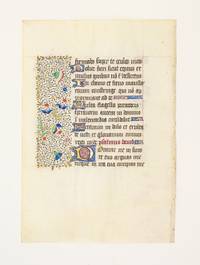
1440ST12158bAParis ca. 1440. 222 x 162 mm. 8 3/4 x 6 3/8". Single column 16 lines of text in a beautiful gothic book hand. <br/> Rubrics in red leaves with varying numbers of line fillers and one- and two-line initials in burnished gold blue and magenta highlighted with white tracery and WITH LOVELY RINCEAU BORDERS on one or both sides these composed of delicately twining hairline stems bearing red and blue blossoms and FEATURING A PROFUSION OF BURNISHED GOLD IVY LEAVES. IN OUTSTANDING CONDITION the vellum extraordinarily bright fresh and clean and WITH MARGINS AS VAST AS ONE COULD EVER HOPE FOR.<br/> <br/> Commissioned for use by a woman as indicated by the feminine form in the "Obsecro te" the Book of Hours from which these leaves come could only have been a manuscript of great beauty prepared for a household of very substantial wealth and importance. The level of achievement manifested here in both the scribal hand and the execution of the illuminated decoration clearly indicates that some of the best artisans money could buy were at work on this book and only a powerful family could afford to pay their price. Further corroboration of this fact is seen in the leaves' noticeable size and immense margins which are at least as wide as on any Book of Hours leaves we have ever owned. Such a conspicuous display of purchasing power those extra millimeters meant the slaughtering of extra animals and that meant greater cost announces an owner's self-congratulatory consequence that is uncommon except in the grandest of prayer books of the period. Happily the condition here matches the importance of the manuscript which was obviously considered from the beginning--and ever after--an object to be carefully preserved. For additional leaves from this Book of Hours at different price points please check our website. unknown
87191250. Central Italy c.1250. <br /> <br /> Matted in fine condition.<br /> <br /> § A well-painted initial of a man in flowing blue and pink robes holding a book to which he gestures probably Saint Paul. Italian miniature paintings of this period are known to be difficult to localize with any accuracy but as the face is strongly drawn with well-proportioned features it might well hail from central Italy. unknown