1 336 résultats
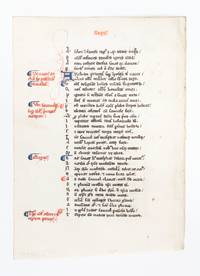
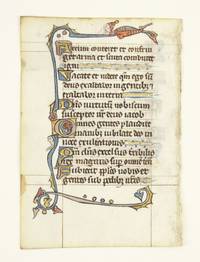
ST12083eItaly ca. 1150. 406 x 273 mm. 16 x 10 3/4". Double column 42 lines in a fine rounded early proto-gothic hand. <br/> Recto with a pleasing three-line red initial. ◆Formerly used in a binding and consequently a bit soiled and trimmed at the head with loss of the first line perhaps 100 or so small wormholes in the margin only a few causing trivial harm to the text a faint grayish stain affecting a couple of words in the top 20 lines of one column on each side but the entirety of the text completely clear and the stately leaf quite fresh and unusually well-preserved in general for a recovered specimen.<br/> <br/> This leaf comes from a very large copy of one of the major texts by one of the great popes of the early Middle Ages. Dealing in part with the central occurrence in the salvation of humanity the text here treats of John 20:19-31 which tells of the risen Christ's appearance to the Apostles. Doubting Thomas insists on touching the Lord's wounds before he will be convinced of the Resurrection. Gregory tells his audience that Thomas was healed of unbelief and so must they be although they cannot see Jesus in the flesh as did Thomas. Written ca. 593 Pope Gregory's 40 homilies on the Gospels enjoyed enduring popularity throughout Medieval times as they offered ordinary Christians practical guidance on applying the lessons of the Gospels to their own lives. Elected pope in 590 Gregory ca. 540-604 was one of the most influential pontiffs in the history of the Church. In addition to revising liturgical worship he wrote extensively on theology offering homespun wisdom rather than esoteric debates. He was declared a saint immediately upon his death. The script here is regular rounded and very pleasing--almost soothing--to the eye. Moreover the letters are so large and there is so little significant damage to the leaf that the text can be easily read from a considerable distance. unknown
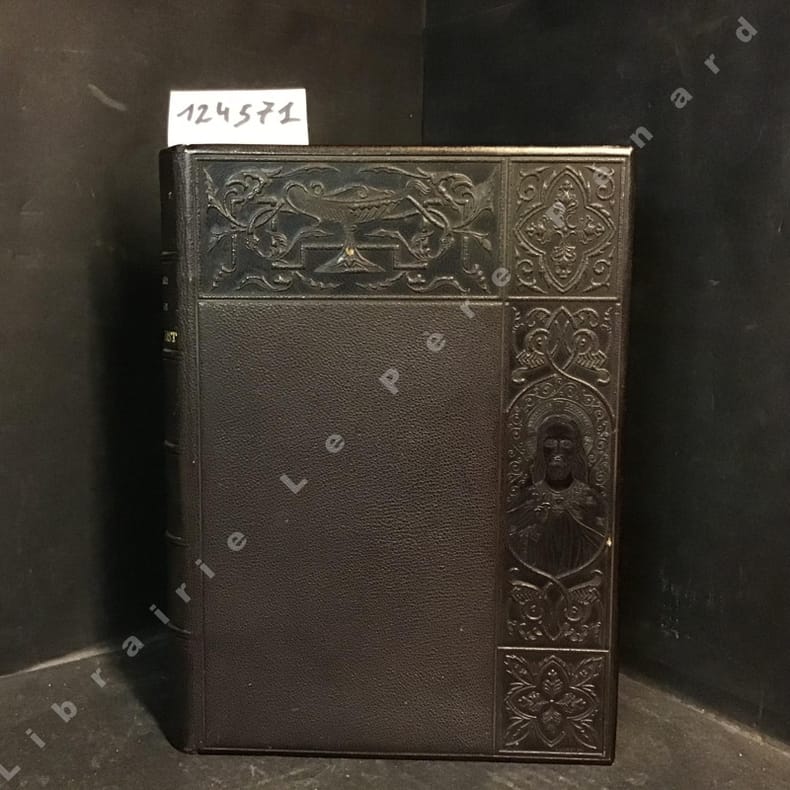
18861245711886 Pellion et Marchet, Editeurs, Dijon - 1886 - Un fort volume in-4, reliure plein chagrin noir, décors à froid sur le premier plat, dos à 5 nerfs avec titre en doré et fleurons à froid, toutes tranches dorées, dorures sur les coiffes et les bords des contreplats, filet doré sur les tranches, frontispice - 616 pages - Nombreuses illustrations hors-texte et ornements en N&B (bandeaux, lettrines, vignettes, culs-de-lampe)
1947013358Paris Editions du Compas 1947 broché, couverture rempliée, chemise et étui de l'éditeur
8199242477.Gpaperback. Good. Access codes and supplements are not guaranteed with used items. May be an ex-library book. paperback
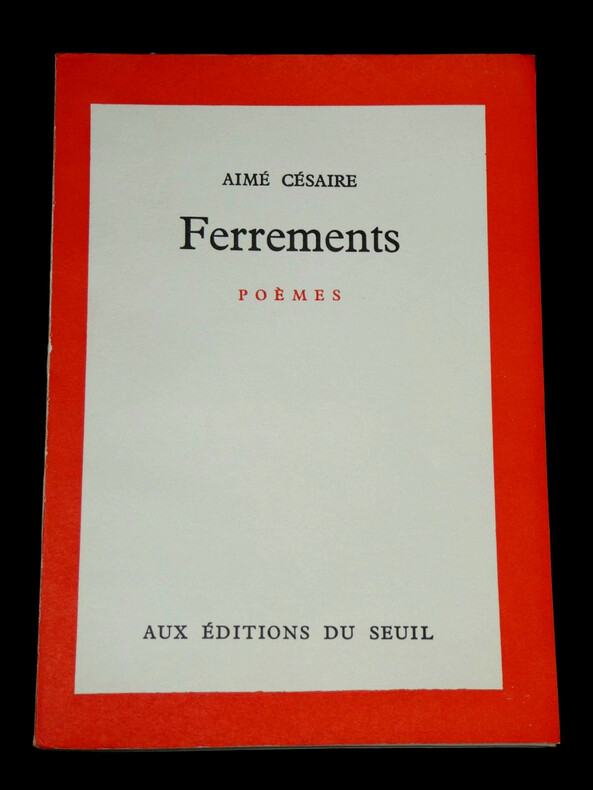
1960boz_001534AIMÉ CÉSAIRE - Ferrements - EO 1/105 sur Vélin neige BROCHÉ - SANS ILLUSTRATEUR - 1960 Auteur : Aimé Césaire Titre : Ferrements, poèmes Édition : Éditions du Seuil, Paris, 1960 Tirage : Édition originale, exemplaire n° 82, l'un des 105 exemplaires numérotés sur papier Vélin Neige. Gravures : Sans illustrateur pour le texte. Reliure : Ouvrage broché sous couverture souple d'éditeur à rabats, dos lisse. Exemplaire conservé à l'état de parution avec ses marges non coupées. Dimensions : 14 x 19,5 cm État : Très bel état de conservation. La couverture est propre avec d'infimes frottements d'usage aux coiffes. L'intérieur est très frais, le papier est blanc et exempt de rousseurs, les feuillets sont préservés avec leurs marges non coupées. Les documents annexes sont en parfait état. Nombre de pages : 93 pages
Twenty Volumes. Illustrated with Etchings, proofs-before-letters on Japan Vellum, and impressions of the Historical Portraits on India Paper. Offsetting from tissue guards marring a few illustrations. Title pages printed in red and black. Uncut. Top edges gold. 8vo. Original full blue cloth bindings, some wear. Original spine paper labels. Spines faded. Victorian Edition. Limited Edition. Number 996 of only 1000 copies. Nice set. Impressive. SET/W49
1957014114Vallauris Imprimerie Arnéra 1957 plaquette in-8 Agrafé, couverture illustrée
1927009370Paris Jean Budry 1927 Broché
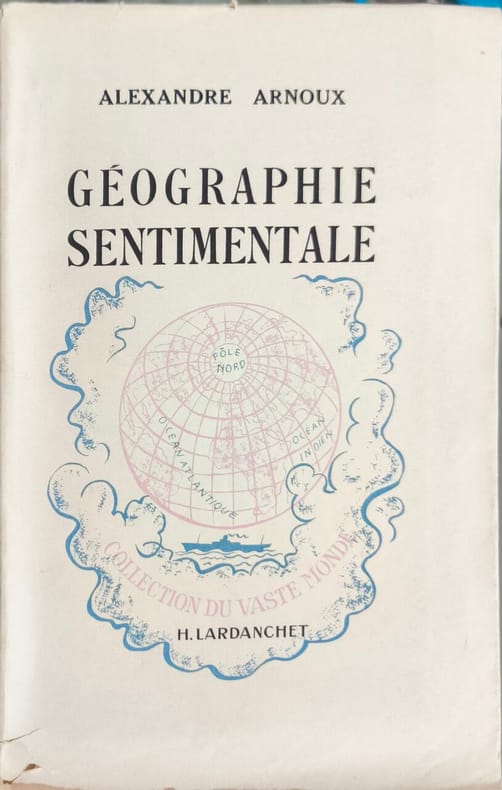
19468123H. Lardanchet 1946 180 pages in8. 1946. Broché couverture rempliée. 180 pages. Géographie sentimentale est un ouvrage d'Alexandre Arnoux romancier et dramaturge français membre de l'Académie Goncourt qui constitue un chant d'amour à Lyon et à la Haute-Provence. Le livre est décrit comme un hommage littéraire et sentimental à ces deux régions
1933011848Paris Éditions des Cahiers libres 1933 In-8 Broché, couverture rempliée
2002015918Paris L'Echoppe - Collection "Envois" 2002 In-16 Broché, couverture à rabats Signé par l'auteur
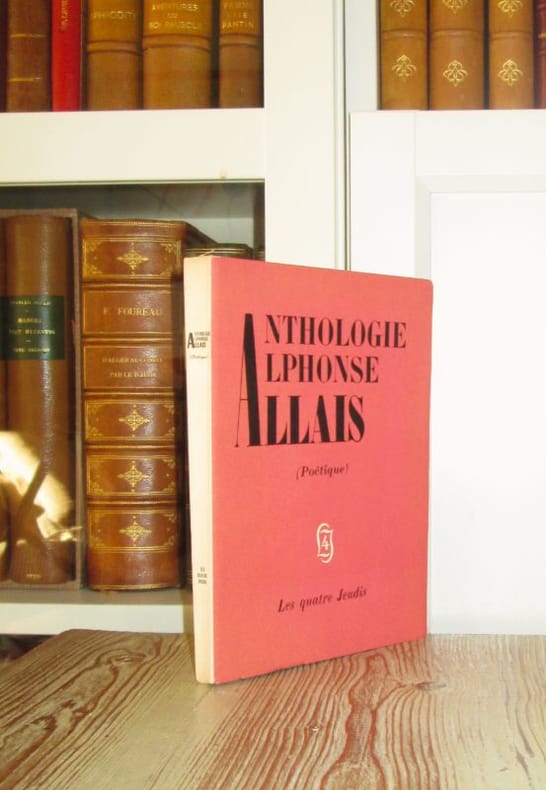
195633110LES QUATRE JEUDIS, 1956. In-8 broché (19 x 14,5 cm). EDITITION ORIGINALE, l'un des 34 exemplaires numérotés sur vélin pur fil du marais, à grandes marges non rognées (après 16 ex. Japon et Hollande), celui-ci le n° 47. Très bel exemplaire bien frais.
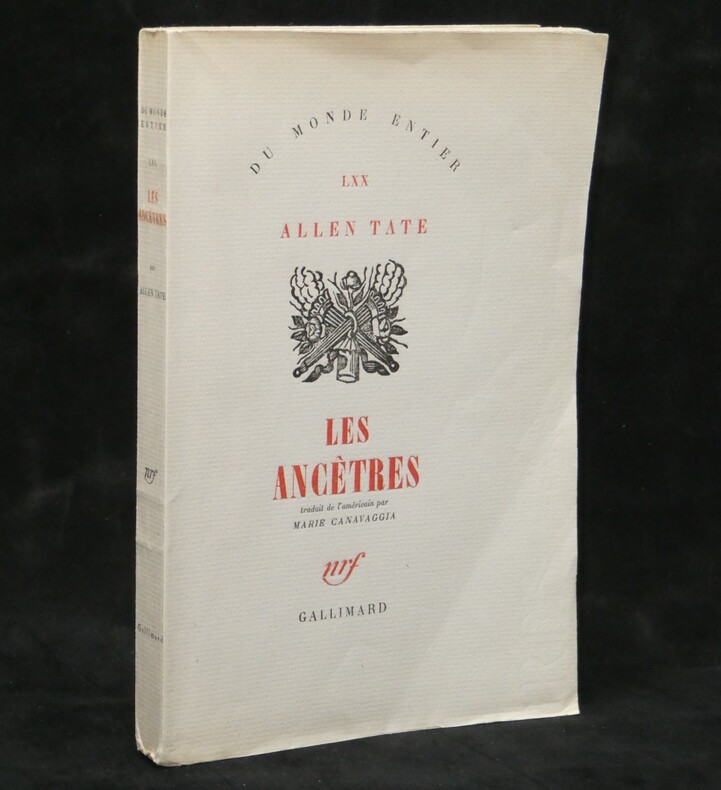
1948boz_001578Auteur : Allen Tate Titre : Les Ancêtres (The Fathers), roman traduit de l'américain par Marie Canavaggia Édition : Gallimard, Paris, 1948 Collection : « Du Monde Entier » (LXX) Tirage : Édition originale de la traduction française. Un des 210 exemplaires sur vélin pur fil Lafuma-Navarre (celui-ci portant le n° 76), seul grand papier Reliure : Broché Dimensions : 14,1 x 21 cm État : Très bel état de conservation, intérieur frais, marges non coupées. Dos légèrement insolé Nombre de pages : 282 pages
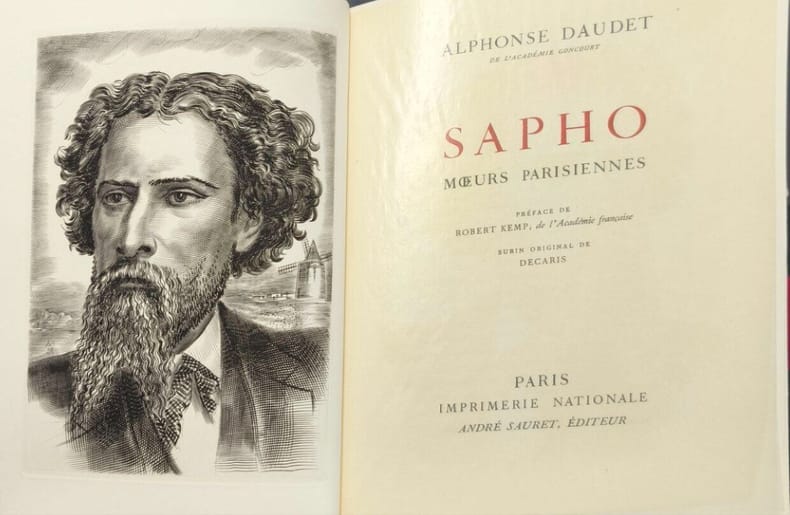
195714398André Sauret Éditeur 1957 277 pages in8. 1957. broché couverture rempliée avec boitier. 277 pages. Sapho (Mœurs parisiennes) d'Alphonse Daudet est un roman publié à la fin du XIXe siècle explorant les relations amoureuses complexes et les mœurs de l'époque parisienne. L'histoire d'inspiration autobiographique relate la passion tumultueuse du narrateur avec une femme plus âgée Marie Rieu modèle du personnage éponyme une relation que Daudet dut interrompre avant son mariage bourgeois
191325630Hans von Weber, München, S. Fischer, Berlin, 1913. Rodenberg 414. Originalpergamentband mit Deckelvignette (Doppelsignet beider Verleger) und Kopfgoldschnitt. [8[, 278, [4] Seiten. 28 : 20 cm.
174857794Madrid, Joseph Mathias Escrivano, ( 1748). Titel, 11 Bll., 392 S.; 442 S., 1 Bl. Kl.-8vo. Flexibles Pgt. d. Zt.
2020I-328-057Jasor 2020. Paperback. Very Good. Former library book. Edition 2020. Ammareal gives back up to 15% of this item's net price to charity organizations. Jasor paperback
THE UNIQUE COPY PRINTED ON REAL VELLUM ("peau de vÈlin") OF THE FIRST AND ONLY EDITION OF THIS EXTREMELY IMPORTANT AND RARE BOOK ABOUT THE TOURAINE. XVI, 208 pp. Beautifully printed on fine vellum, with huge margins, for Jules Taschereau, an important Touraine intellectual, politician, and bibliophile who was also the editor of this volume. 8vo (the remainder of the edition, 180 copies on paper for the SociÈtÈ des Bibliophiles de Touraine, was printed 12mo.) BEAUTIFULLY BOUND BY CAP… IN FULL MOROCCO, spine elegantly gilt in six compartments, triple gilt fillet on covers, turn-ins elegantly gilt. Tiny traces of wear to lower extremties of joints, else FINE AND BRIGHT, COMPLETELY UNCUT, WITH NO DEFECTS. Taschereau I, p. XIX; Taschereau auction catalogue (1875) n∫ 30. UNIQUE AND IMPORTANT.
ST17236Germany mid- to late 12th century. 290 x 217 mm. 11 3/8 x 8 1/2". Single column 21 lines in an attractive proto-gothic book hand. <br/> Rubrics in red several one-line initials in red five red initials measuring two to four lines long and with penwork embellishment A LOVELY SEVEN-LINE WHITE-VINE INITIAL outlined in red and with a pale yellow wash along the edge the lower half of the ground filled with green wash. Lower margins with notations in later Medieval hands. ◆A handful of original holes in the vellum no doubt from stretching the skin during processing with the scribe writing around the flaws where necessary a little soiling to lower outside corner one or two negligible spots otherwise IN FINE CONDITION the ink unusually rich and the paint very bright.<br/> <br/> From a Sacramentary a service book that contained the prayers said during Mass subsumed by the Missal in the 13th century this early leaf was once part of an attractive manuscript of very high quality. The very large and superb "F" opens the Mass for the Feast of the Assumption and the other readings here include Masses for Sts. Hippolytus and Cassian celebrated on 13 August; St. Eusabius 14 August; Vigil of the Assumption of the Virgin 14 August; Assumption of the Virgin 15 August; St. Agapitus 18 August; and the beginning of the Mass for Sts. Timothy Hippolytus and Symphorian 22 August. Sister leaves from this same manuscript have previously appeared in Sam Fogg Cat. 16 "Text Manuscripts and Documents 2200BC to 1600AD" 1995 nos. 30 and 31; Maggs Bros. European Bulletin 20 1995 no. 37; Quaritch Cat. 1270 "Bookhands of the Middle Ages VI" 2000 nos. 69 and 70; Sotheby's 6 December 2001 lot 8; and Bloomsbury 6 December 2017 lot 16. The Fogg description notes that similar initials can be seen in French German and Flemish manuscripts of the period "but very few manuscripts have the special characteristics of this one." For example the initials on the sister leaves described by Fogg contain atypically mauve and green as well as an "unusual . . . exterior contoured ground which is not confined by any geometric form." This means there is no line or shape to box in or define the capital's form; rather it appears as if surrounded by an aura or gentle shadow. Our initial contains a green ground only no mauve but the same unusual and attractive yellow aura. It is rare to find Romanesque leaves of this size and caliber in such fine condition and the present leaf with its beautiful regular proto-gothic hand exceptional white-vine initial and several large decorative initials in red is especially desirable. unknown
ST17768<p>England second half of 12th century but before 1180. 313 x 198 mm. 12 1/4 x 7 3/4. Double column 32 lines in a lovely late Caroline hand verso with some lines erased and corrected in a smaller hand. <br />Mounted in a fine tan cloth folder between sheets of textured acid-free paper. Front pastedown with book label of the Schøyen Collection with their shelf mark MS 237 written in ink. ◆Recovered from a binding and thus with overall toning and soiling recto somewhat browned from binder's glue but almost entirely confined to three margins and the verso virtually unaffected other trivial imperfections but in surprisingly good condition given its history the very rich ink especially dark and well preserved.<br /><br />This is an exceptionally lovely example of an early English book hand standing at the crossroads of the Caroline and proto-gothic calligraphic traditions. According to Thompson "In the twelfth century the scribes seem to have vied with each other in producing the best types of book-writing of which they were capable with the result that remarkable precision in the formation of the letters was attained and that the century may be named as excelling all others for the beauty of its MSS." "Greek and Latin Paleography" p. 436 The present leaf certainly lives up to this description being notable for its exceptionally neat and legible script written with uncommonly pretty and regular letter forms by a practiced and confident hand. The Caroline tradition is apparent in certain tendencies such as the use of "&" for "et" and the lack of biting curves between letters while a shift toward the proto-gothic can be seen in the vertical and compressed letter forms as well as the increased use of abbreviations and ligatures. Although the present work has often been credited to Haymo of Halberstadt due to a longstanding error in attribution reaching back to the 15th century modern scholarship now recognizes Haimo of Auxerre a monk at the Abbey of Saint-Germain in Auxerre d. ca. 875 as its true author. A prominent theologist and writer during the Caroline Renaissance Haimo produced a number of influential commentaries on various books of the Bible. The provenance on this leaf can be traced back as far as the mid-19th century when it was auctioned at Sotheby's on 21 August 1858 lot 119.2 sold as part of an album containing various leaves and fragments put together by Philip Bliss 1787-1857 registrar of the University of Oxford. It then went into the celebrated collection of Sir Thomas Phillipps 1792-1872 and was eventually sold by the Robinson Brothers on 24 April 1911 lot 390.3. This leaf has previously appeared in Quartich's catalogue 1036 "Bookhands of the Middle Ages" no. 79.5 and was most recently in the collection of Martin Schøyen his MS 237.</p>
ST18542England ca. 1375. 287 x 198 mm. 11 1/4 x 7 3/4. Single column 32 lines in a small rounded English gothic hand with rubrics in the margins. <br/> Rubrics in red running title in red paragraph marks in red or blue two initials measuring two lines in height and colored blue with red penwork. See: P. E. Beichner "Aurora Petri Rigae Biblia Versificata A Verse Commentary on the Bible." ◆Remnants of mounting tape in top margin of recto but a really excellent specimen the hand very clear the ink especially rich and the vellum extremely clean and quite bright.<br/> <br/> Written in a gothic hand heavily influenced by the English secretarial style this leaf comes from a copy of the "Aurora" a commentary on the Bible in verse form written in the late 12th century by French poet Petrus Riga 1140-1209 a canon of Rheims cathedral. Although little is known about the author's life Riga's text became immensely popular throughout Europe and was routinely studied in Medieval universities. According to Beichner "for those who could read Latin it supplied Scriptural lore in a popular form and it also served as a book of popular theology devotional reading moral instruction and entertainment. Its influence was propagated by teachers preachers and lexicographers by poets and other writers. It was studied imitated translated and quoted. Not only was it widely read in monasteries and convents but it was also recommended reading for the sons of nobles." It is interesting to note that although Riga's work was copied numerous times in the 13th century copies from the later Medieval period such as the present work are uncommonly rare. The parent manuscript containing our leaf was previously in the possession of the Dukes of Westminster and was sold at Sotheby's on 11 July 1966 lot 229 when it was advertised as having 267 leaves missing the first gathering plus 13 other leaves. Bookseller Francis Edwards acquired the manuscript at that sale removed three damaged leaves and sold the remainder. It was thereafter broken up and dispersed. Several sister leaves are now in the collections of Marquette University Lawrence University and the University of South Carolina. unknown
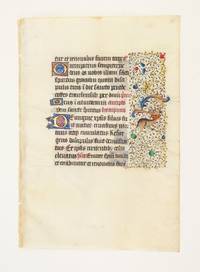
ST17060NFrance probably Besançon 3rd quarter of 15th century. 239 x 165 mm. 9 3/8 x 6 1/2". Single column 15 lines in an elegant gothic book hand. <br/> Rubrics in dark pink line enders in pink and blue with white tracery and gold bezant one- and two-line initials painted gold on pink and blue ground with white tracery each side with a panel border decorated with hairline vines gold bezants and ivy and colorful flowers and acanthus RECTO BORDER INHABITED BY A CHARMING DOG-LIKE CREATURE. ◆A small light stain in border decoration largely masked by dense hairline vines but IN FINE CONDITION--bright clean and well preserved.<br/> <br/> From a large Book of Hours probably produced in Besançon this leaf features very pretty panel borders including one with a particularly charming inhabitant in the form of a dog-like creature with no front legs wearing an orange collar and emitting an acanthus leaf from its mouth. Imaginative touches like this and luxurious elements such as the several dozen gilt bezants and ivy leaves in each border and the unusually wide margins point to this manuscript having been quite a costly production. For additional leaves from this same manuscript at different price points please check our website. unknown
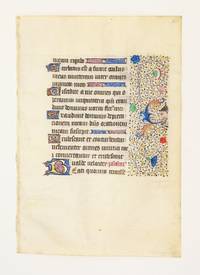
ST17060RFrance probably Besançon 3rd quarter of 15th century. 239 x 165 mm. 9 3/8 x 6 1/2". Single column 15 lines in an elegant gothic book hand. <br/> Rubrics in dark pink line enders in pink and blue with white tracery and gold bezant several one-line initials and one two-line initial in burnished gold on dark pink and blue ground with white tracery each side with a panel border composed of hairline vines with gold ivy and bezants a few colorful flowers and EACH FEATURING THE FACE OF A MAN EMITTING ACANTHUS LEAVES FROM HIS MOUTH. ◆A few tiny marginal spots one of the faces slightly rubbed otherwise IN BEAUTIFUL CONDITION.<br/> <br/> In addition to the floral decoration and vines often found in the borders of Books of Hours this leaf features a duo of delightful inhabitants in the form of faces emitting colorful acanthus from their mouths. Each figure is individualized the face on the recto with dark hair flushed cheeks and a prominent nose; on the verso is a face with a much paler complexion a tonsured hairstyle a large but very short nose and fine gray whiskers. This kind of imaginative work together with luxurious touches such as the many gilt initials several dozen gilt bezants and ivy leaves in each panel border and the unusually wide margins point to this manuscript having been a costly production. For additional leaves from this same manuscript at different price points please check our website. unknown
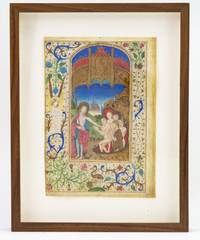
1470ST17764Delft ca. 1470. Leaf: 175 x 122 mm. 6 7/8 x 4 3/4"; Frame: 250 x 195 mm. 9 3/4 x 7 3/4". No text on recto or verso. <br/> In an attractive wooden frame. A FINELY PAINTED MINIATURE OF THE HARROWING OF HELL within an arch-topped compartment the mouth of hell depicted on the left with a fiery red interior and five people emerging from it the figure of Christ on the left holding a cross on a long staff and half-clothed in a pink and blue robe the background with a castle in the distance ALL OF THIS BENEATH A VERY DETAILED ARCHITECTURAL CANOPY suspended in the sky AND THE WHOLE WITHIN A FULL BORDER of acanthus leaves and other foliage and flowers in reds blues greens yellows and brushed gold along with very many small burnished gold ivy leaves and buds on hairline stems a small stork in the bottom border and a large delicately shaded angel in the left border. ◆Left margin trimmed very close to decoration just escaping loss and the other three margins ample mild darkening right at fore and tail edge but not reaching into borders otherwise IN FINE CONDITION the colors rich and true and the burnished gold still shimmering.<br/> <br/> This extraordinary miniature notable for its uncommon subject matter memorable imagery and fine workmanship was produced by a talented artist belonging to the stylistic group known as the Masters of the Delft Half-Length Figures. The subject here is infrequently depicted in Books of Hours: the Harrowing of Hell appears as a full-page miniature in only three of the 119 prayer books described by Roger Wieck in his "Time Sanctified" and three others contain a Harrowing depiction inside an initial. Christian theological tradition tells us that after his crucifixion Christ went to liberate souls from Limbo--a location inhabited by those barred from entry into Heaven because they died before the Redemption. In our scene Christ wrapped in a regal cloak and carrying a long staff his hands and feet still bleeding from the wounds he received on the Cross reaches into an absolutely wonderful Hellmouth to extricate Adam and Eve and other naked souls while the recently deceased and original saint John the Baptist still clad in an animal skin garment waits patiently for his turn to emerge. The great maw of Hell as depicted here has bulging eyes a distended snout thickly matted hair and a bad complexion; his gaping mouth punctuated by sharp gray teeth glows red hot and one can tell from the creature's expression that he is loath to comply with this rescue of souls. In addition to its compelling subject matter there is a high level of artistic achievement here including delicately molded figures impressively detailed architectural elements and a lovely color palette. The elegance and quiet sophistication observed in this miniature distinguishes the artist responsible for this work as a particularly talented member of his circle. Active from about 1450-80 the Masters of the Delft Half-Length Figures were named by James Marrow after the angels and other figures whose upper bodies are typically found emerging from a cloud within the borders. Although the present leaf uncharacteristically contains a full-length angel in the border it shares other stylistic similarities such as the elaborate architectural canopy hovering over the main composition; and it particularly resembles the work of the artist of Keble College MS 77 an illuminator described in "The Golden Age of Dutch Manuscript Illumination" as "one of the more articulate of the group" whose "figures are more fully modelled and his palette . . . deeper and brighter" than that of his contemporaries. Because the subject of the present miniature goes beyond the standard image program seen in routine productions and because of the high level of artistic accomplishment seen here this leaf was almost certainly part of an elaborate Book of Hours produced in response to an important commission. unknown
ST16379-008France late 13th century. 125 x 88 mm. 4 7/8 x 3 1/2". Single column 15 lines in a gothic book hand. <br/> Attractively matted. Folio number in red several line enders in gold with blue penwork 10 one-line initials in gold on blue and pink ground one two-line initial painted pink and filled with blue and orange acanthus on gilt ground verso with a three-quarter border branching from the larger initial composed of pink and blue curling lines accentuated with gold spikes bezants and painted ivy leaves UPPER BRANCH TERMINATING IN A WONDERFUL HYBRID CREATURE WITH THE FACE OF A MAN AND THE BODY OF AN ORANGE BEAST AND THE LOWER BRANCH INCORPORATING ANOTHER FACE WITH A LONG BEARD. From the collection of Joseph Pope his MS Bergendal 116 about whom see below. ◆A little soiling and staining along edges of vellum and a couple of small marks in lower margin verso but in excellent condition overall the paint especially bright and fresh.<br/> <br/> From the distinguished collection of Canadian financier Joseph Pope 1921-2010 this charming leaf comes from a small-format Psalter intended for private use and features two amusing drolleries incorporated into the marginal design. Pope's collection was sold by Sotheby's on 5 July 2011 where this leaf appeared as part of lot 115; it was later listed in Quaritch Catalogue 1422 no. 88 which states that "according to Pope's note this leaf was found tipped in to a much later Book of Hours his MS Bergendal 64--produced in the southern Netherlands for a southern French patron during the first half of the 15th century--at f. 94 the middle of the Penitential Psalms; the manuscript was acquired by Pope at Sotheby's sale of 6 December 1983 lot 79.". unknown