[LETI Gregorio].Livre Rare Book

1 336 résultats
1668169[Amsterdam, Daniel Elzevier ?], 1668 ; in-16 de 332 pp., vélin ivoire de l'époque à rabats, dos lisse, titre à l'encre.
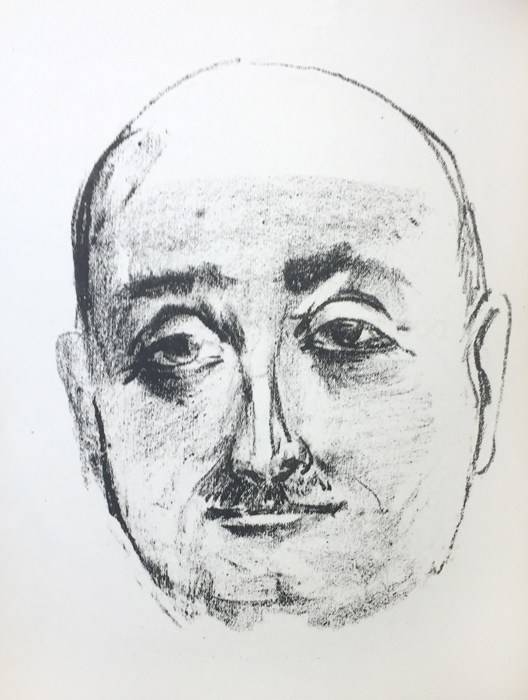
19472192Paris, Marcel Bruker, 1947 ; in-folio, plein chagrin-maroquiné rouge-orangé, dos à quatre nerfs, magnifiques gardes de papier marbré rouge vif, or et noir, tête dorée, couverture et dos conservés, étui bordé ; (48) ff. (1 bl., faux-titre verso portrait lithographié, titre, faux-titre, avant-propos, 10 ff. par Jean Bourguignon, 12 ff. fac-similé du testament de Louis XIV, 2 ff. liste des ouvrages publiés par Lucien-Graux (43 au total), 1 ff. achevé d'imprimer et justification du tirage, 1 ff. bl.
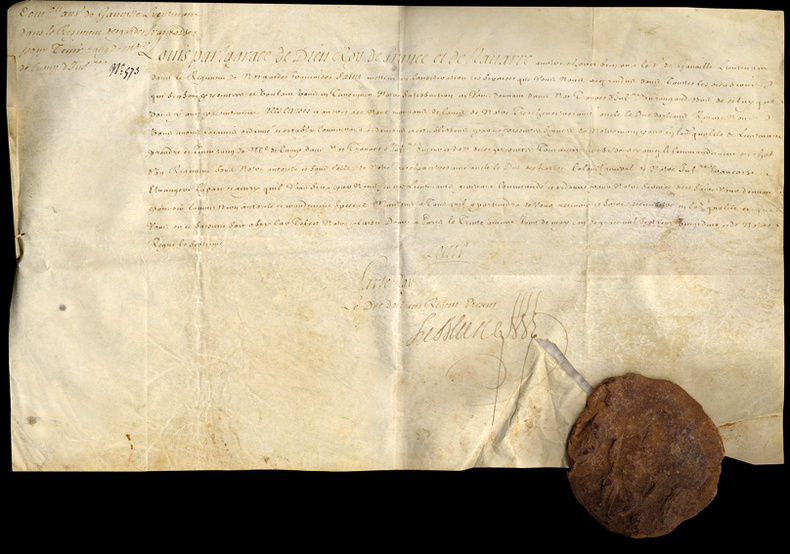
17229243Ensemble de deux documents manuscrits sur parchemin :– La nomination elle-même, sur parchemin (29,5 x 48,5 cm), scellé du grand sceau de cire jaune sur simple-queue, signé "Louis" et "par le Roi le Duc d'Orléans Régent Présent, signé Le Blanc" (Claude, secrétaire d'État du département de la Guerre), en date du 31 mai 1722.– Le brevet de réception du sieur de Gauville, mestre de camp de l'Infanterie française, par Louis d'orléans, Duc de Chartres, Premier Prince de Sang, colonel général de l'infanterie française et étrangère, Gouverneur et Lieutenant Général par le Roy dans la province de Daufiné, Grand Maitre des Ordres Militaires de Notre Dame du Mont Carmel et de St Lazare de Jérusalem, à Versailles, le 17 juin 1722. Signé Louis d'Orléans et plus bas du secrétaire, scellé sur simple queue du sceau de cire jaune aux armes des Orléans.
9560Manuscrit ancien, in-8, vélin ivoire de l'époque, en deux parties de 64 et 80 pp., frontispice gravure de la Vierge à l'enfant.
16782763Paris, André Pralard, 1678-1679 ; trois tomes in-12 reliés en deux volumes, plein vélin ivoire, titre manuscrit, armes dorées, au centre des deux plats, du comte de Nédonchel (reliure de l'époque) ; (14) ff., 416 pp., (5) ff. ; 497 pp., (5) pp., (1) f. blanc ; (8) ff., 238 pp., (5) ff. dont 2 blancs ; 8 planches hors-texte.
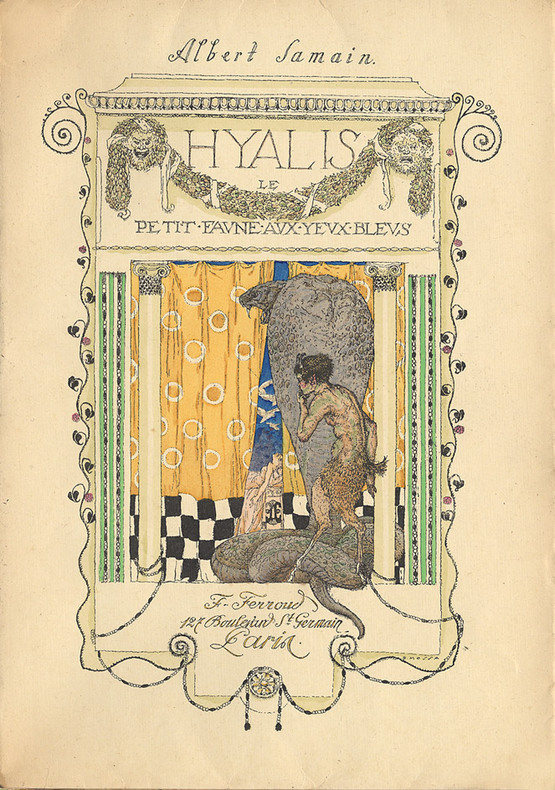
191815751Paris, Ferroud, 1918 ; petit in-4, broché ; 59 pp., couverture crème rempliée illustrée en couleurs ; frontispice et 6 compositions à pleines pages, faux-titre, vignette de titre, lettrines et in-texte, aquarellés à la main et au pochoir par Charpentier.
172892806Frankfurt am Main, Friedrich [Daniel] Knoch seel. Söhne, 1728. [1] Bl., 992 S., [104 ] Bl. 18 cm. Pgt der Zeit.
193060793Bergisch Gladbach, J. W. Zanders, o. J. (um 1930). Qu.-4°. Titelblatt u. 6 Zeichenpapiere, geheftet in illustr. OUmschlag.
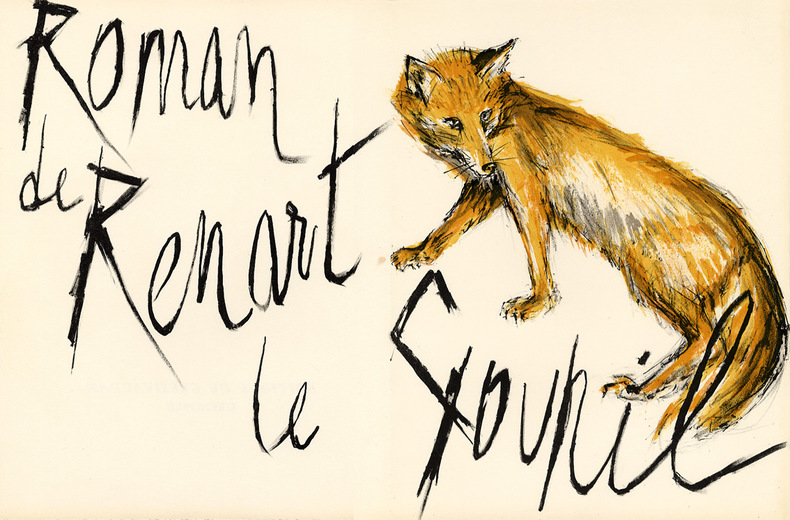
19692207Grenoble, Editions du Grésivaudan, 1969 ; in-folio, en feuillets sous chemise-étui de l'éditeur tissu marron, titre rouge au dos de la chemise, étui muet ; 196 pp., (3) ff. ; 20 lithographies originales en couleurs hors-texte protégées par des serpentes ; couverture blanche à rabats imprimée en noir.
164511208Lugd. Batavorum (Leyde), Franciscus Hackius, 1645 ; in-8 ; plein vélin ivoire à recouvrements, titre manuscrit au dos (reliure de l'époque) ; (16) pp., dont le titre gravé représentant une scène de théâtre, 1136, (48) pp. d'index.
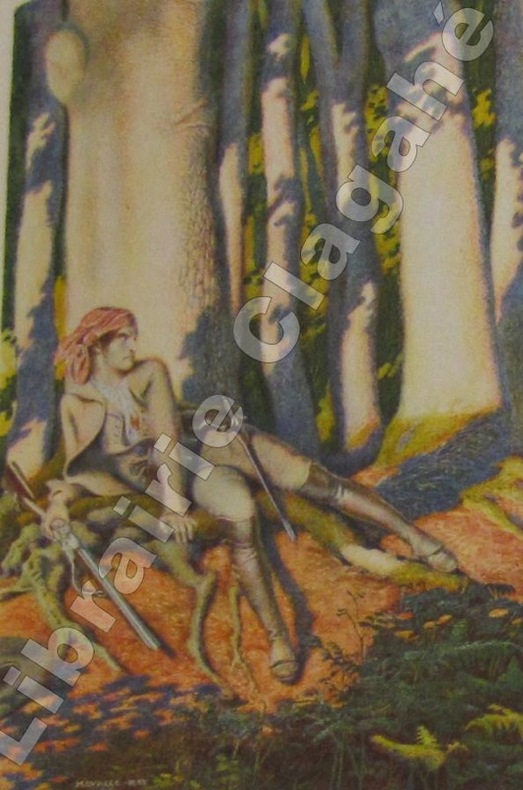
19122165Paris, Société Normande du livre illustré, 1912, in-4; demi-chagrin maroquiné bordeaux à coins, dos à cinq nerfs, tête dorée, couv. et dos conservés, étui bordé; X-266 pp., (3) ff., 11 planches en couleurs de Maurice Ray gravées sur cuivre au repérage.
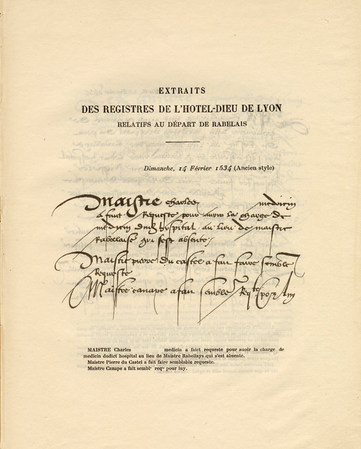
18939046Lyon, Storck, s.d. (1893) ; in-4 ; bradel demi-percaline à coins vert-sapin, grande pièce de titre grenat, plats conservés (reliure de l'époque) ; (4), 61, (3 bl.), (8) pp. d'extraits des registres de l'Hôtel-Dieu de Lyon relatifs au départ de Rabelais et 6 reproductions.
1934011800Paris Robert-J. Godet 1934 In-8 Demi-reliure
1934015005Paris 1934 In-8 Broché
First edition, large 8vo (240 x 155 mm), vi, 85, [1]pp., 200 copies printed, this being the only copy PRINTED ON VELLUM, title printed in red and black, marbled endpapers, bound in contemporary smooth light tan calf, both boards with gilt scrolled border in gilt and blind with central crest of Dawson Turner in blind, spine lettered in gilt direct with a decorative border, spine rubbed, joints cracked, all edges gilt. A unique copy specially printed on vellum and bound for the compiler Dawson Turner (1775-1858), banker, naturalist, patron of the Arts, antiquary and collector. In all these pursuits Dawson Turner excelled, he published usually at his own expense in very small editions, and on occasions had a special copy printed on vellum for himself, as here. There is a prefatory letter to the Rev. S. C. E. Neville Rolfe and Daniel Gurney, signed Dawson Turner, Yarmouth, September 1847. In this valuable work, the parishes are arranged in Deaneries, the data set out in tabular form. There are very full indexes of parishes, incumbents and patrons. The Rev. Strickland Charles Edward Neville Rolfe (1789-1852) was vicar of Heacham, and Daniel Gurney (1791-1880) was a well-known banker and antiquary of King's Lynn. It was these two gentlemen who obtained a transcript from the Episcopal Registers which made the present publication possible. Provenance: Sold as lot 2073 by Sotheby's at the auction of Dawson Turner's library in March of 1853.
18396374Genève, chez les principaux libraires, 1839. 2 volumes in-8 de 524; 604 pages demi-maroquin lie-de-vin, dos lisse orné de fleurons et filets verticaux dorés (un petit manque à une coiffe, un frottis à une coiffe), couvertures et dos conservés, exemplaire non rogné. De toute beauté. La reliure est signée Hans Asper.
18405587Genève, Ledouble & Ab. Cherbuliez, 1840. In-8 de [4]-462-[2] pages, demi-maroquin chocolat à coins, dos lisse orné de fers romantiques. Déchirure sur la page de faux-titre, sans manque, mors, coiffes et coins légèrement frottés.
2005LFA-126742471Un ouvrage de 112 pages, format 150 x 210 mm, illustré, broché, publié en 2005, Impr. Delta, bon état
19158494Portland Maine: Thomas Bird Mosher 1915. First edition thus number 22 of 25 copies printed on Japan Vellum. 8vo 19x14cm v xvi 3 142 1pp. Two initials printed in red text printed within borders few leaves unopened. Bound in gilt stamped parchment boards and in near fine condition with bumped corners. In original plain paper jacket which shows toning and a few tears and housed in toned paper slipcase with two ownership signatures one being Primrose Rupp Hinton. <br /> <br /> Very scarce and beautiful Mosher printing on Japanese vellum. Sirenica is a 1913 novel by Leith which explores the myth of the Siren Song and the struggle by man for the unobtainable. <br /> <br /> <br /> This copy with an interesting ownership provenance from journalist Primrose Rupp Hinton who was longtime society editor for the Aberdeen Daily World in Aberdeen WA. . Thomas Bird Mosher unknown
182446970Paris, Crapelet für De Bure frères, 1822 bzw. 1824. Gr.-8°. XI, IV, 348 S.; 2 Bll., II, 120; VI, 84; VIII, 332 S.; 2 Bll., 380 S. - XVI, 291; VIII, 264; VII, 314 S., Einheitliche HLdr.-Bde. d. Zt. m. Rückenverg., je zwei goldgepr. Rückenschildern u. dreiseitig marmor. Schnitt.
ST17587France late 12th century. 176 x 132 mm. 7 x 5 1/4". Single column 18 lines in a protogothic hand text on one side only. <br/> Rubrics in red "Liber" in upper margin in red. Recto and verso with scribblings by later hands the name "Simon Pivante" clearly visible on recto but the others illegible. ◆Recovered from a binding and thus with obvious staining folds and rubbing a couple lines at top and bottom and a few other words here and there too rubbed to make out but by and large still very legible and in a pleasing hand.<br/> <br/> This leaf is primarily of interest for its content containing a rare example of Anastasius Bibliothecarius' "Historia Ecclesiastica" of the Byzantine Church also known as the "Chronographia tripartita" compiled from the works of the near-contemporary Greek authors Theophanes Nicephorus and Syncellus. According to the Catholic Encyclopedia Anastasius Bibliothecarius ca. 810-79 "learned Greek from Greek monks and obtained an unusual education for his era so that he appears to be the most learned ecclesiastic of Rome in the barbaric period of the ninth century." He earned the moniker "Bibliothecarius" from his appointment as librarian of the Roman Church a position he held during the reign of popes Adrian II 867-72 and John VIII 872-82. It is possible that Anastasius was also the same figure elected antipope in 855 as recorded in at least one contemporary chronology but historians disagree on the validity of this identification. Anastasius' work appears to be extremely rare in the marketplace. unknown
ST12778-0082South Germany or more probably Austria second half of the 12th century. 429 x 304 mm. 16 7/8 x 12". Double column 36 lines of text in a fine proto-gothic hand. <br/> ◆Text a bit faded on one side an upper corner slightly defective minor soiling and with the grain of the vellum apparent on verso but with the beautiful text entirely legible and the leaf as a whole quite pleasing.<br/> <br/> The hand here is memorable featuring wide upright letters that could not be more regular. Elected pope in 590 Gregory ca. 540-604 was one of the most influential pontiffs in the history of the Church. In addition to revising liturgical worship he wrote extensively on theology offering homespun wisdom rather than esoteric debates. He was declared a saint immediately upon his death. unknown
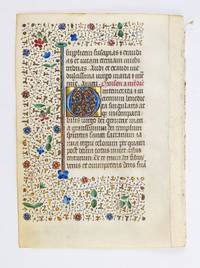
1475ST19653NNorthern France ca. 1475. 155 x 110 mm. 6 x 4 1/4". Single column 16 lines in a gothic book hand. <br/> Rubrics in dark pink ONE EXQUISITE FOUR-LINE INITIAL painted blue with white detailing filled with red and blue vines and leaves on a burnished gold ground with a painted and gilt bar border on one side each end capped with a flower the text surrounded on three sides with a border of acanthus leaves dense rinceaux colorful flowers gold ivy leaves and bezants. A couple negligible imperfections but IN VERY FINE CONDITION<br/> <br/> One of the most popular optional prayers in the 15th century Book of Hours "O Intemerata" "Oh immaculate virgin" is a brief supplication in which the Virgin is glorified for her purity as the "unspotted and forever blessed singular and incomparable Virgin Mary Mother of God." The present leaf is given special emphasis with the presence of a three-quarter rinceaux border surrounding the text and the opening of the prayer is marked by an especially pretty and finely detailed initial that glitters with burnished gold. The leaf is unusually beautiful precisely rendered and in very fine condition. unknown
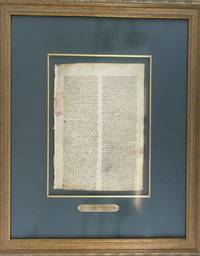
ST12778-0799Italy ca. 1275. 272 x 193 mm. 10 3/4 x 7 1/2". Double column 67 lines of text in a pleasing regular gothic hand. <br/> In a very attractive 21 1/2 x 17 1/2" walnut frame of antique design with the leaf in a sunken compartment with a gold lip a brass label below the compartment. Once purchased from Quaritch with their description on the back. ◆Formerly used as the flyleaf in a binding so slightly soiled text with minor fading a very small portion perhaps one or two lines of the text trimmed off at bottom half a dozen small round wormholes but still an attractive legible example of an unusual text.<br/> <br/> The Quaritch description says that the leaf is from "a Medieval medical work based on Galen concerned with fevers especially those that last a single day 'febres ephemerae'; the present leaf contains the text of chapters 4-7. The author speaks about bloodletting not . . . for the young or elderly baths honey the better kind is clean clear and of sharp odor and delicate Roman women. He cites Hippocrates and the 'Regimen Sanitatis' of Salerno as well as his own writings 'Quisquis igitur se non exercet in meis libris non poterit intelligere' 'Whoever then does not train himself in my own books will not be able to understand'. The text has a strong Galenic tone although it is not a translation of Galen's 'De Differentiis Febrium' and suggests a Medieval work based on Galen and possibly from the great Salerno medical school. The vocabulary includes post-classical words such as 'acetositas' acidity and even some words unrecorded in the massive 'Thesaurus Linguae Latinae' Oxford Medieval Latin Dictionary and Du Cange such as 'crapulositas' drunkenness and 'indigestabilitas.'" The leaf has obvious interest for its content and it is well presented in its attractive frame. unknown
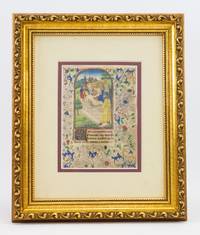
ST19540bSouthern Netherlands Bruges third quarter of 15th century. Matted leaf: 150 x 150 mm. 5 7/8 x 4 3/8". Frame: 307 x 258 mm. 12 x 10 1/4". Single column with four lines below the miniature and the obverse with 17 lines in a batarde hand. <br/> Attractively matted and framed the leaf slightly shifted in the mat revealing top and side edges but in no danger of damage. Rubrics in red four one-line initials and three three-line initials all but one in burnished gold on blue and red ground with white tracery the initial beneath the miniature painted pink on a burnished gold ground and filled with painted ivy vines AN ARCH-TOPPED LARGE MINIATURE DEPICTING THE ENTOMBMENT the body of Christ surrounded by seven other people depicted in an outdoor setting with the turrets of a walled city in the background the miniature in a double frame of gold and pink surrounded by A FULL BORDER composed of hairline vines acanthus colorful flowers and gilt bezants and inhabited by a small bird. Minor soiling and a faint thumb print to borders but IN VERY FINE CONDITION THE MINIATURE BEAUTIFULLY PRESERVED.<br/> <br/> This is a beautifully rendered and deeply touching scene depicting the entombment of the crucified Christ and the pathos experienced by those at his side. Holding the sheet on which the body is lowered into the sarcophagus are on the far left the richly clothed Joseph of Arimathea and on the far right Nicodemus who dons an especially lovely yellow garment with delicate embroidery. Between the two men in the foreground but behind the body are the Virgin Mary who presses the hand of her deceased son to her lips; John the Evangelist whose body is turned toward the Virgin in a gesture of support but whose gaze is focused on the Savior; and Mary Magdalene who holds a small ointment jar. Two other women with halos stand closely behind them consoling one another. The artist has done a masterful job at creating a composition that captures the emotional gravity of the scene: Christ's body gently cradled in a white sheet is on full display with blood still trickling from the wounds on his head and side. Despite there being seven people crowded around him our attention is drawn to the action between Christ and the Virgin who gently grasps his hand with motherly affection and bids him a final farewell. Flickers of different emotions appear on the faces of his followers including pity sorrow stoicism and disbelief--echoing perhaps the viewer's own range of feelings upon viewing this image. The level of detail excellence of composition care seen in the molded bodies and faces and the convincing setting suggest that the artist was quite practiced and that the original manuscript from which the leaf comes was of very high quality. unknown