AN EARLY VELLUM MANUSCRIPT LEAF FROM A SACRAMENTARY IN LATIN, WITH A LARGE ROMANESQUE INITIALBiblio.com
153 résultats
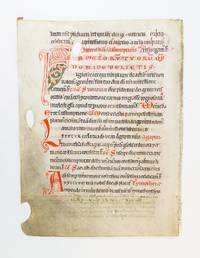
ST17236Germany mid- to late 12th century. 290 x 217 mm. 11 3/8 x 8 1/2". Single column 21 lines in an attractive proto-gothic book hand. <br/> Rubrics in red several one-line initials in red five red initials measuring two to four lines long and with penwork embellishment A LOVELY SEVEN-LINE WHITE-VINE INITIAL outlined in red and with a pale yellow wash along the edge the lower half of the ground filled with green wash. Lower margins with notations in later Medieval hands. ◆A handful of original holes in the vellum no doubt from stretching the skin during processing with the scribe writing around the flaws where necessary a little soiling to lower outside corner one or two negligible spots otherwise IN FINE CONDITION the ink unusually rich and the paint very bright.<br/> <br/> From a Sacramentary a service book that contained the prayers said during Mass subsumed by the Missal in the 13th century this early leaf was once part of an attractive manuscript of very high quality. The very large and superb "F" opens the Mass for the Feast of the Assumption and the other readings here include Masses for Sts. Hippolytus and Cassian celebrated on 13 August; St. Eusabius 14 August; Vigil of the Assumption of the Virgin 14 August; Assumption of the Virgin 15 August; St. Agapitus 18 August; and the beginning of the Mass for Sts. Timothy Hippolytus and Symphorian 22 August. Sister leaves from this same manuscript have previously appeared in Sam Fogg Cat. 16 "Text Manuscripts and Documents 2200BC to 1600AD" 1995 nos. 30 and 31; Maggs Bros. European Bulletin 20 1995 no. 37; Quaritch Cat. 1270 "Bookhands of the Middle Ages VI" 2000 nos. 69 and 70; Sotheby's 6 December 2001 lot 8; and Bloomsbury 6 December 2017 lot 16. The Fogg description notes that similar initials can be seen in French German and Flemish manuscripts of the period "but very few manuscripts have the special characteristics of this one." For example the initials on the sister leaves described by Fogg contain atypically mauve and green as well as an "unusual . . . exterior contoured ground which is not confined by any geometric form." This means there is no line or shape to box in or define the capital's form; rather it appears as if surrounded by an aura or gentle shadow. Our initial contains a green ground only no mauve but the same unusual and attractive yellow aura. It is rare to find Romanesque leaves of this size and caliber in such fine condition and the present leaf with its beautiful regular proto-gothic hand exceptional white-vine initial and several large decorative initials in red is especially desirable. unknown
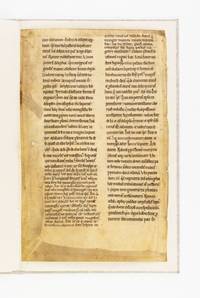
ST17768<p>England second half of 12th century but before 1180. 313 x 198 mm. 12 1/4 x 7 3/4. Double column 32 lines in a lovely late Caroline hand verso with some lines erased and corrected in a smaller hand. <br />Mounted in a fine tan cloth folder between sheets of textured acid-free paper. Front pastedown with book label of the Schøyen Collection with their shelf mark MS 237 written in ink. ◆Recovered from a binding and thus with overall toning and soiling recto somewhat browned from binder's glue but almost entirely confined to three margins and the verso virtually unaffected other trivial imperfections but in surprisingly good condition given its history the very rich ink especially dark and well preserved.<br /><br />This is an exceptionally lovely example of an early English book hand standing at the crossroads of the Caroline and proto-gothic calligraphic traditions. According to Thompson "In the twelfth century the scribes seem to have vied with each other in producing the best types of book-writing of which they were capable with the result that remarkable precision in the formation of the letters was attained and that the century may be named as excelling all others for the beauty of its MSS." "Greek and Latin Paleography" p. 436 The present leaf certainly lives up to this description being notable for its exceptionally neat and legible script written with uncommonly pretty and regular letter forms by a practiced and confident hand. The Caroline tradition is apparent in certain tendencies such as the use of "&" for "et" and the lack of biting curves between letters while a shift toward the proto-gothic can be seen in the vertical and compressed letter forms as well as the increased use of abbreviations and ligatures. Although the present work has often been credited to Haymo of Halberstadt due to a longstanding error in attribution reaching back to the 15th century modern scholarship now recognizes Haimo of Auxerre a monk at the Abbey of Saint-Germain in Auxerre d. ca. 875 as its true author. A prominent theologist and writer during the Caroline Renaissance Haimo produced a number of influential commentaries on various books of the Bible. The provenance on this leaf can be traced back as far as the mid-19th century when it was auctioned at Sotheby's on 21 August 1858 lot 119.2 sold as part of an album containing various leaves and fragments put together by Philip Bliss 1787-1857 registrar of the University of Oxford. It then went into the celebrated collection of Sir Thomas Phillipps 1792-1872 and was eventually sold by the Robinson Brothers on 24 April 1911 lot 390.3. This leaf has previously appeared in Quartich's catalogue 1036 "Bookhands of the Middle Ages" no. 79.5 and was most recently in the collection of Martin Schøyen his MS 237.</p>
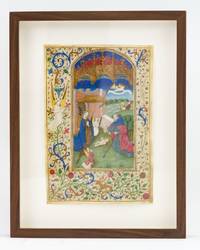
1470ST17765Delft ca. 1470. Leaf: 172 x 115 mm. 6 3/4 x 4 1/2". Frame: 242 x 190 mm. 9 1/2 x 7 1/2". <br/> In an attractive wooden frame. A FINELY PAINTED MINIATURE OF THE NATIVITY within an arch-topped compartment the parents of the Christ Child kneeling before him as he lies on the ground outside the stable Joseph uncharacteristically supporting himself with a cane in his left hand and holding a long burning candle in his right two diminutive angels in attendance the head of an ass sticking out of the stable window in the background to the left AND IN THE RIGHT BACKGROUND A CHARMING DEPICTION OF THE ANNUNCIATION TO THE SHEPHERDS ALL OF THIS BENEATH A VERY DETAILED ARCHITECTURAL CANOPY suspended in the sky AND THE WHOLE WITHIN A FULL BORDER of acanthus leaves and other foliage and flowers in reds blues greens yellows and brushed gold along with very many small burnished gold ivy leaves and buds on hairline stems a small stag in the bottom border and a large delicately shaded angel who mirrors the Virgin's pose in the left border verso blank. ◆A hint of soiling to edges of vellum but IN VERY FINE CONDITION without any paint erosion with the colors rich and true and with the burnished gold still shimmering.<br/> <br/> Notable for its attractive color scheme fine craftsmanship and unusual composition this vibrant leaf was produced by a talented artist belonging to the stylistic group known as the Masters of the Delft Half-Length Figures. The lack of text and blank back of this leaf clearly suggest that it was produced as a singleton intended for insertion in a Book of Hours and its subject matter indicates that it would have faced the opening for the third hour of the day Prime. The present depiction of the Nativity is out of the ordinary in that it is combined with another scene the Annunciation to the Shepherds a subject that usually begins Terce in the Hours of the Virgin. It is a testament to the artist's ingenuity and compositional skills that he has managed to incorporate these two scenes so seamlessly; in fact rather than pulling focus from the main subject celebrating the birth of Christ this secondary scene adds additional interest to the picture and amplifies the storyline. Though the Annunciation to the Shepherds takes place at a distance from the Nativity we immediately grasp their connection and can see how arrival of humanity's savior was felt far beyond the manger. It is also interesting to note how much the artist has emphasized the figure of Joseph. Not only does he take up as much space as the Virgin but the candle and cane he holds frame the Christ child and communicate a strong suggestion of a protective parent the Virgin is doing her part by praying hard but she is more passive. In addition to its engaging subject matter there is a high level of artistic achievement here including delicately molded figures impressively detailed architectural elements and a lovely color palette. The elegant hand seen in this miniature manifests a quiet sophistication that distinguishes this artist as a particularly talented member of his circle. Active from about 1450-80 the Masters of the Delft Half-Length Figures were named by James Marrow after the angels and other figures whose upper bodies are typically found emerging from a cloud within the borders. Although the present leaf uncharacteristically contains a full-length angel in the border it shares other stylistic similarities such as the elaborate architectural canopy hovering over the main composition; and it particularly resembles the work of the artist of Keble College MS 77 an illuminator described in "The Golden Age of Dutch Manuscript Illumination" as "one of the more articulate of the group" whose "figures are more fully modelled and his palette . . . deeper and brighter" than that of his contemporaries. Because of the complexity of the subject matter and the high level of artistic accomplishment seen here this leaf was probably part of an elaborate Book of Hours produced in response to an important commission. unknown