8 369 résultats
pp. ix, 259, (8) [Appendix], 12 [Publisher's catalogue]. Illustrated half title, Frontis and six worn plates by Abraham John Mason. Early manuscript ownership of New Jersey businessman and industrialist, Edwin J.C. Atterbury on title page. Early penciled name of Seba Smith on the frontis. Seba Smith (1792-1868) was an American humorist, jounalist, and writer. He was one of the first writers to use American vernacular in humor. His series with the New England character Major Jack Downing was popular after its start in 1830. Smith's dry satirical humor influenced other humorists, including Artemus Ward and Finley Peter Dunne (Mr. Dooley). Foxed. Some plates and pages loose. 165 mm. Original green very worn muslin cloth binding. Lacks spine. Front board detached. Worn printed paper label of the D. McKercher's Circulating Library pasted on front board. Binding needs to be resewn. S&S/AI 24106. Sabin 84170. Wright I, 834. Hamilton 1012. Second edition. Hardbound. Poor. VERY SCARCE. AI BX 7
86229hardcover. Vol. VI No. 1-Vol. VII No. 25. April 5 1905-December 15 1907. 4to modern buckram; ex-lib. Habana 1905-1907.<br/> <br/> unknown
(Milano), Photopress, s.d. (anni 50?) Al verso applicata velina con testo dattiloscritto in inglese: "Bebe" the leopard in the Bathroom of Ariadne, one of the rooms in the Pavillion of Light at the Daily Mail Ideal Home Exhitition", traduzione manoscritta in italiano e timbri: 2 (biffati) di Photopress e di Oscar Vianello Photo Agency, San Remo e quello d'appartenenza di Amerigo Manzini (1883-1978), commediografo e giornalista.
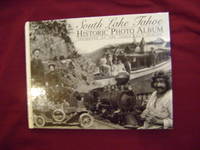
2000224595np.: Lake Tahoe Historical Society. 2000. First edition. . Decorated hard cover. . Fine copy. As new. Folio. . Illustrated. Important reference work. Very scarce in this condition. Lake Tahoe Historical Society. hardcover
in-8vo ril. carton. carta francese, carta uso mano (tutte le pagine sono bianche, naturalmente).
Roma, REC, 1966, 16mo brossura con copertina illustrata, pp. 230, alcune foto all'interno.
197998543Paris, Armand Colin 1979 3 volumes. in-8 23,5 x 17,5 cm. Reliures éditeur toile marron, jaquettes illustrées en couleurs, 543-599-605 pp., 29-29-58 cartes et graphiques, nombreuses illustrations, notes bibliographiques, index, tables des cartes et graphiques, tables des illustrations, tables des matières à la fin de chaque volume. Ensemble en bon état.
3823Phnom Penh, Septembre et Décembre 1943. 2 Journaux de 4 et 2 pages chacun, datés du samedi 18 Septembre 1943 (deuxième année, No 444) et vendredi 29 Décembre 1944 (troisième année, No 822), malgré les plis, bon état.
200020408Centre Pompidou 2000 In-4, broché couv. blanche, reliure spirale, photographies et illustrations en noir et en couleurs, 199 pp. Bon état.
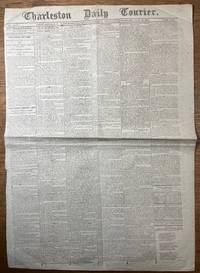
186435376Charleston: A. S. Willington & Co 1864. First Edition. Newspaper. Good. Newspaper. Approximately 23" x 16.5". Single sheet two pages. Folded. Light vertical crease. Stitching removed on the extreme left edge. A few tiny pin holes to the paper. <br /> <br /> Contents include the latest Civil War news reporting including General Lee's battle success; General Johnston's army victory at Kennesaw Mountain; the Siege of Charleston Three Hundred and Forty-Ninth Day and several more news items. On the back page is the publisher information advertisements and a printed act of authority to levy taxes for support the war effort. A. S. Willington & Co unknown
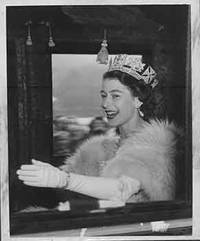
18-0049Manchester UK: Daily Express 1952. . Glossy B&W newspaper photograph. 8 x 10 inches with border. Very Good. Some wear and creasing from handling. In protective sleeve.A collection of vintage gelatin silver press prints of the royal family including the Queen's Coronation The Duke and Duchess of Kent Princess Elizabeth and the Duke of Edinburgh's wedding day 20 November 1947 Princess Elizabeth and Margaret Rose some age related toning v.s. 38 Manchester, UK: [Daily Express], 1952. unknown
1980131201London: Express Newspapers 1980-2006. 1st editions. Nice copies. large octavo. laminated boards c.1700pp. illusts. Nos. 45 46 48-55 57 58 62 63 67 68 71. All nice copies. 1990 copy has dust jacket with Rupert poster on verso. One ownership notation one page coloured. Two numbers have slight rubbing to boards o/w a very nice run Express Newspapers hardcover
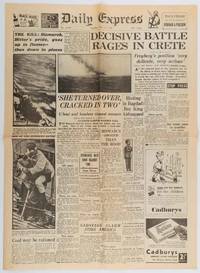
1941214662London.: London Express Newspaper Ltd. 1941. Black and white photographic illustrations and advertisements 4pp. Single folded sheet evenly browned though more noticeable at edges overall a very good copy. 57 x 42cm. . London Express Newspaper, Ltd. unknown
1937130496London: Daily Mirror 1937. 1st edition. Very Good. large octavo. spiral-bound 46pp. b/w pls. Charing Cross Road bookshops by night swimming costume girls & nudists in Kent. Lovely period piece Daily Mirror unknown
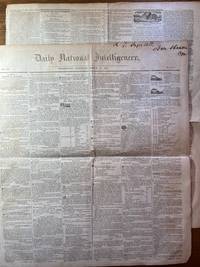
183236785Washington DC: Gales & Seaton 1832. Newspaper. Good. Newspaper. Approx. 21" x 18." 4 pages. Two folds. Sheets are detached. Newspaper has light toning. Name of R. J. Ingersoll New Haven Con" written top of issue. Possibly the same Ingersoll that served 4 terms in Congress from 1825-1833. <br /> <br /> Entire contents of page 2 concern "The Cherokee Case. Opinion of the Supreme Court delivered by Mr. Chief Justice Marshall January Term 1832. Samuel A. Worcester vs. The State of Georgia." The case is also printed on the first column of page 3. Supreme Court case of Samuel Worcester. From the Brittannica website: <br /> <br /> Worcester v. Georgia involved a group of white Christian missionaries including Samuel A. Worcester who were living in Cherokee territory in Georgia. In addition to their missionary work the men were advising the Cherokee about resisting Georgia's attempts to impose state laws on the Cherokee Nation a self-governing nation whose independence and right to its land had been guaranteed in treaties with the United States government. In an effort to stop the missionaries the state in 1830 passed an act that forbade "white persons" from living on Cherokee lands unless they obtained a license from the governor of Georgia and swore an oath of loyalty to the state. Worcester and the other missionaries had been invited by the Cherokee and were serving as missionaries under the authority of the U.S. federal government. They did not however have a license from Georgia nor did they swear a loyalty oath to that state. Georgia state authorities arrested Worcester and several other missionaries. After they were convicted at trial in 1831 and sentenced to four years of hard labour in prison Worcester appealed to the U.S. Supreme Court.<br /> <br /> Worcester argued that Georgia had no right to extend its laws to Cherokee territory. He contended that the act under which he had been convicted violated the U.S. Constitution which gives to the U.S. Congress the authority to regulate commerce with Native Americans. The Constitution also bars the states from passing laws that alter the obligations of contracts-in this case treaties. Several treaties between the Cherokee and the U.S. government recognized the independence and sovereignty of the Cherokee Nation. Furthermore Worcester argued that the Georgia laws violated an 1802 act of Congress that regulated trade and relations between the United States and the Indian tribes.<br /> <br /> The Supreme Court agreed with Worcester ruling 5 to 1 on March 3 1832 that all the Georgia laws regarding the Cherokee Nation were unconstitutional and thus void. Writing for the court Chief Justice John Marshall held that "the Indian nations had always been considered as distinct independent political communities retaining their original natural rights as the undisputed possessors of the soil." Even though Native Americans were now under the protection of the United States he wrote that "protection does not imply the destruction of the protected." Marshall concluded:<br /> The Cherokee Nation then is a distinct community occupying its own territory.in which the laws of Georgia can have no force and which the citizens of Georgia have no right to enter but with the assent of the Cherokees themselves or in conformity with treaties and with the acts of Congress. The whole intercourse between the United States and this Nation is by our Constitution and laws vested in the Government of the United States.<br /> <br /> Georgia however ignored the decision keeping Worcester and the other missionaries in prison. Eventually they were granted a pardon and were released in 1833. Pres. Andrew Jackson declined to enforce the Supreme Court's decision thus allowing states to enact further legislation damaging to the tribes. The U.S. government began forcing the Cherokee off their land in 1838. In what became known as the Trail of Tears some 15000 Cherokee were driven from their land and were marched westward on a grueling journey that caused the deaths of some 4000 of their people.<br /> <br /> The Supreme Court agreed with Worcester ruling 5 to 1 on March 3 1832 that all the Georgia laws regarding the Cherokee Nation were unconstitutional and thus void. Writing for the court Chief Justice John Marshall held that "the Indian nations had always been considered as distinct independent political communities retaining their original natural rights as the undisputed possessors of the soil." Even though Native Americans were now under the protection of the United States he wrote that "protection does not imply the destruction of the protected." Marshall concluded:<br /> The Cherokee Nation then is a distinct community occupying its own territory.in which the laws of Georgia can have no force and which the citizens of Georgia have no right to enter but with the assent of the Cherokees themselves or in conformity with treaties and with the acts of Congress. The whole intercourse between the United States and this Nation is by our Constitution and laws vested in the Government of the United States.<br /> <br /> Georgia however ignored the decision keeping Worcester and the other missionaries in prison. Eventually they were granted a pardon and were released in 1833. Pres. Andrew Jackson declined to enforce the Supreme Court's decision thus allowing states to enact further legislation damaging to the tribes. The U.S. government began forcing the Cherokee off their land in 1838. In what became known as the Trail of Tears some 15000 Cherokee were driven from their land and were marched westward on a grueling journey that caused the deaths of some 4000 of their people. Gales & Seaton unknown
13915London. May and June 1888. 4pp. foolscap 8vo. Bifolium. In fair condition on aged paper. First page headed: 'The Edgware Road Fire The proprietor of "The Daily Telegraph" have as hitherto on similar occasions opened a Subscription list for the Sufferers and it is estimated that £3000 will be required to meeet the urgent claims for relief which are already too well known I shall be glad to receive any donations you may be pleased to give on their behalf JNER.'. Arranged in eight columns two to a page with running totals and a grand total of £16 1s 0d. The first donation is for 10s 6d from 'Mr. Kynock' and the last for 1s from Mr Catliffe'. Accompanying the list are two newspaper cuttings laid down on one side of a piece of 12mo paper with manuscript heading The Edgware Rd. Fire Fund'. The first cutting records the donation of £20 by 'Fredk. Gorring Buckingham Palace-road' and of £16 1s 0d by 'Employés of Fredk. Gorringe'; the second cutting reproduces a letter from Gorringe reading: 'TO THE EDITOR OF "THE DAILY TELEGRAPH." SIR - I have pleasure in sending a cheque for £20 towards the fund being raised for the assistants who are sufferers by the Edgware-road fire; also one for £16 1s from my employés. - Yours faithfully FREDK. GORRINGE. Buckingham Palace-road June 5.' The fire had occurred on 30 May 1888 with The Times devoting the following day's editorial to it beginning: 'London has been visited by many greater and more destructive fires but by few more tragic and pathetic in their circumstances than that which occurred in the Edgware-road shortly after six o'clock yesterday morning. The large drapery establishment of Messrs. GARROULD occupying the angle formed by the Edgware-road and Queen-street was suddenly attacked by fire and five of the young assistants who slept in the upper floors were burnt to death or suffocated while five more were seriously scorched or injured by jumping from the windows.' The Times drew parallels with another fire eight months before at the Exeter Theatre and concluded that it had 'once more taught Londoners the lesson that they cannot have efficient protection from fire without paying for it'. [London. May and June 1888.] unknown
23776Anstey's TLS on his Daily Telegraph Magazine letterhead and dated 20 March 1970. Hayden-Guest's article evidently written shortly before that date. A curious artefact indicating Garbo’s iconic status and an early example of a journalistic trend which has gained ground since the late 1960s. Hayden-Guest still active as a writer is the son of the diplomat Peter Haden-Guest 4th Baron Haden-Guest and brother of the 5th Baron Christopher who is won fame as ‘Nigel’ in the film ‘Spinal Tap’. Anstey who edited the Daily Telegraph magazine for twenty-two years from its inception in 1964 has been variously described as ‘the last of the great autocratic magazine editors’ ‘tyrannical’ and ‘completely terrifying’ with a habit of sending his employees ‘alarming memos on the eve of their summer holidays’. He ‘did not often meet his reporters personally instead he wrote notes and invited them once a year to the magazine’s Christmas party’. While grateful for the money John Betjeman found working for the magazine ‘hateful’. Gitta Sereny who contributed extensively to what she considered ‘the best of the weekend colour supplements’ found Anstey ‘difficult’ but ‘extraordinary’. Both are items in fair condition lightly aged and stapled together. ONE: Unsigned Carbon Typescript of article titled ‘GRETA GARBO - a Personal Memoir Anthony Haden-Guest’. 5pp long 8vo. Single-spaced on five leaves. As Item Two makes clear the article is a spoof of the ‘type of article’ which Anstey describes as the ‘anti-profile’: pretentious and implying in conspiratorial tones an implausible familiarity with the subject. It is the sort of writing which Martin Amis would begin by satirizing. The beginning sets the tone: ‘Some people just a few call her ‘Greta’ right to her face That face. Charlie Chaplin does to name but one. All the same most people who are so close that they could call her ‘Greta’ in fact call her ‘G. G.’. Acquaintances But wouldn’t that be enough call her “Miss Garbo†and a very few indulge her own conspiratorial urges and refer to her as “Miss Brownâ€. As indeed she sometimes does herself. I am indebted for this information to the writings of Mr Norman Zierold who does not say what he calls her or what she calls him. / Personally I like to call her simply “Greta Garboâ€.’ Further on comes a passage which like the rest of the article may or may not be a complete fiction: ‘Actually the first time that I was introduced to Greta Garbo was under pretty funny circumstances but Destiny as so many of her great motion pictures have pointed out gets up to some pretty funny things. Certainly it seemed funny to see Garbo at a party especially this sort of party a flourescent celebration of . . . Well not Garbo though she is incontestably the centre of it all. An acid/rock group is pounding nervily away into the statutory light-machine and a film is being projected onto a wall which is white and narrow - so narrow that most of the party is taking place without artistic licence in the movie.’ Towards the end Haden-Guest stretches the bounds of credulity with the following: ‘Great Garbo! Now she is looking at me . . . The ageing roue is nowhere to be seen. Her shoulders are working hugely and her throat and the face . . . planes shift as conflicting emotions do massive internal furniture removals but now Garbo looks so worried and she says it - She actually says it - “I want to be aloneâ€. / Yes she is really saying it and not just once because she repeats it - “I want to be aloneâ€. / Well yes. Great Garbo want to be alone -’. TWO: Typed Letter Signed ‘J A’ from John Anstey 20 March 1970 addressed to ‘Anthony Haden-Guest Esq. C/o Chateau Marmont Los Angeles California U.S.A.’ ‘c. c. Pat Kavanagh’ 1p 8vo. He begins: ‘Dear Anthony I read the Great Garbo article when it first came in. Last night I read it again. It is a difficult one. However I know that you have misgivings about it - and I fear that I have them too.’ Anstey’s opinion is that the piece ‘just does not work at the moment. ‘It does not come across as the sort of “anti-profile†we were thinking about. It starts off by being intriguing. But then one just gets confused and there is a danger of it seeming rather pretentious: which is one of the faults of the type of article which it should be satirizing.’ He suggests that they ‘look at it again’ when Haden-Guest gets back from America. ‘The formula is right at the moment but we must overcome the danger of pretentiousness and it must seem less pointless than it is at the moment. The last paragraph cleverly suggests that there is nothing more to know about Greta Garbo than we learn here: but somehow I think that we have got to say more.’ The letter ends: ‘How is California Can you let me know about the Hollywood idea as soon as possible.’ Not known if published in any form despite Googlebooks. Anstey's TLS on his Daily Telegraph Magazine letterhead, and dated 20 March 1970. Hayden-Guest's article evidently written short unknown
201708028Paris, Larousse, 2003 ; in-4, 187 pp., cartonnage de l'éditeur.
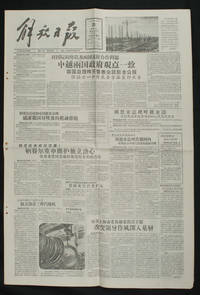
1956163839上海.Shanghai.: 解放日报社.Jie fang ri bao she. 1956. Two issues of Chinese language daily newspaper covering reports of the 1956 Melbourne Olympic Games published by Jiefang Daily Press on November 22nd 1956 issue no. 2710 and 23rd issue no. 2711 in Shanghai. Black and white illustrations each issue a single sheet printed on double sided folded complete. Small pin-holes along central folds with stain marks occasional tear on folds overall in very good condition. Text in Chinese language. Sheet measures 57 x 77.6cm. The Melbourne Olympic coverage is on Page 3 in both issues. Issue no. 2710 gives general information about soon to be opened ceremony in Melbourne with more than 60 countries and regions athletes' participating. It also forecasts the possible win of the Soviet Unions' basketball team. Issue no. 2711 explains that China had to withdraw from the Games because the Republic of China/Taiwan had been allowed to compete. Nations include Egypt Iraq Lebanon Netherlands Spain and Switzerland also pulled out of the Olympics. It states that Egypt Iraq and Lebanon's boycott is due to the Suez Crisis. However the article avoids mentioning that it was the Soviet Union's involvement in Hungarian Revolution which led to the boycott of the Games by three nations. The Australian Middle-distance runner John Landy took the Olympic Oath to mark the official opening of 1956 Summer Olympics. <br> <br>Jiefang Daily was first published in May 28th 1949 covering international domestic and Shanghai local news. These two issues feature Premier Zhou Enlai's state visit to Vietnam. It is the Party newspaper for the Shanghai Committee of the Communist Party of China. These two issues feature Premier Zhou Enlai's state visit to its communist neighbour Vietnam and the hot news of Israel's invasion in Egypt. It also reports on the thank you note from the Egyptian President Gamal Abdel Nasser to Premier Zhou for the financial support of Swiss Franc Fr.20000000. . 解放日报社.[Jie fang ri bao she]. unknown
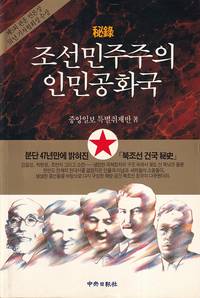
1992221177서울 Seoul.: 中央日報社 Chungang Ilbosa. 1992. Profuse black and white photographic illustrations and plates 422pp. 22 x 15cm. Text in Korean. Small remainder stamp lower edge paperback covers little shelf worn otherwise a very good copy. . 中央日報社 [Chungang Ilbosa]. paperback
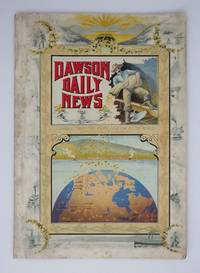
1909144664Dawson: Dawson Daily News 1909. 72 pp. Folio. 39 X 27.2 cm. Very attractive original printed covers. Very slightly frayed more so on the back cover. Title page somewhat browned but the rest of the text is clean. Dozens of black and white portraits scenery images and a single map. Several sections of Dawson advertising. A very nice example of a fragile and large item. Not in Kurutz but there are two similar items in Kurutz dated 1902 and 1905. Not in Smith Tourville or any other bibliography I consulted. One of the most interesting brochures I have encountered before. The design of the colorful wrappers is brilliant with gold being the theme. There are 20 small vignette images of Klondike themed items. A large White Pass Railway ad and on the front cover a map showing Northern Canada. The first interesting thing when you open to the title page is a Robert Service poem "Written Specially for the Dawson News"! There are over 60 individual articles written on all aspects of life in the North and composed by the who's who of famous people. You certainly get the impression that Dawson was booming 10 years after the Rush. One of the most interesting images is of a map of a 50 mile long Main Line Ditch to provide water for the mines. It must have been an engineering marvel!! Rare and I am surprised Gary never encountered another example. 1909 Dawson Daily News unknown
194452719Paris, Les Éditions Nationales, 1944. 4°. Mit 16 pochoirkolor. lithogr. Tafeln, 2 (1 kolor.) zusätzlichen Folgen der 16 Lithographien, 6 weiteren, nicht verwendeten Lithographien u. einer sign. mont. Orig.-Federzeichnung von Pierre Leconte. 356 S., 1 Bl. - Angeb. - Fargue, Léon-Paul. Présentation de 1900. (= La vie en France au début du XXe siècle). Ebda., 1944. Mit 12 Illustrationen von Dignimont. 20 nn. Bll. (die beiden ersten weiß), Rotbrauner HMaroquin-Bd. d. Zt. a. 4 Bünden m. etw. Rückenverg., goldgepr. Rückentitel u. den eingeb. OUmschlägen.
192728652Nantes Imprimerie Ch. Garciau pour LE PAIN QUOTIDIEN 1927 -in-8 broché un menu, imprimé et illustré à l'encre bordeaux, format : 22 x 15,5 cm, BANQUET DU PAIN QUOTIDIEN (NANTES) MENU DU 26 SEPTEMBRE 1927 Nantes Imprimerie Ch. Garciau pour LE PAIN QUOTIDIEN Editeur,
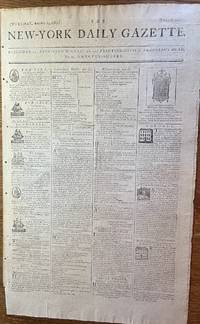
178936787New York: Published by Archibald M' Lean At His Printing-Office Franklin's Head No. 41 Hanover Square 1789. Newspaper. Very good. Newspaper. Bifolium. Approximately 19.25" x 12". 4 pages. Printed in 4 columns. Paper removed from a larger gathering with small stitch holes on the left margin facing the front. Illustrated with woodcuts. <br /> <br /> Contents include proceedings of Congress; a law to regulate or toiling of the Bells of several Churches in the City for Funerals; reprint of a humorous piece taken from a British Publication; illustrated advertisements; and several placed notices sales services etc. <br /> <br /> Scarce early New York newspaper. Published by Archibald M' Lean, At His Printing-Office, Franklin's Head, No. 41, Hanover Square unknown
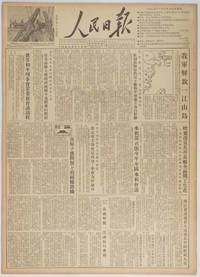
1919218294Bejing. Number 2385. January 191955. Line map cartoon in text black and white photographic images in text 4pp 53.5 x 38cm text in traditional Chinese characters. Light browning a few areas with washi repair in good condition. The article surrounding the page one map shows where the Chinese army and air force liberated Yijiangshan Island near Dachen Island to the north of Taiwan. Jiang Kai-shek's army had been using this island to carry out attacks from Dachen Island. Another article on page 1 welcomes USSR providing their experience in the peaceful use of atomic energy. In fact the Chinese nuclear weapons program had just begun under an agreement with the USSR only days before this newspaper was published; it would culminate in their first atomic test in October 1964. . unknown