158 résultats
234933hardcover. near fine. 36 full-page plates in very clean condition. Includes the list of plates in French and the lovely allegorical frontispiece for "Chirurgie" section but no actual title page. Folio rebound in recent cloth-backed marbled boards. N.P. N.D. circa 1760. Ownership information inside front cover still in near fine condition -- an uncommon collection of these medical plates.<br/><br/> 36 plates from Diderot's 18th century Encyclopedia depicting interesting medical instruments and various operations from Lithotomy and a rather horrible looking Mastectomy to Craniotomy and Amputation.<br/><br/> unknown books
1774BL4658The Hague:: Chez Gosse Fils 1774. 1774. <br /><br /> 7 volumes. 8vo. xii 4 604; viii 434; xii 612; viii 417 1; xii 416; viii 406; viii 448 pp. Half-titles vols. 1 3 5 7 7 engraved plates 7=4 meaning 7 large folding engraved maps are present as issued of which 4 are unique and 3 are duplicates again as issued vols. 1 & 2 and 3 & 4 have the same two maps each marked "Tome 1&2" - or – "Tome 3&4" V: Gulf of Mexico; VI & VII: 2 copies large folding eng. map of North America errata. <br /><br /> Original full mottled calf ornate gilt spines dual leather gilt-stamped spine labels; some wear to extremities. Unidentified rubber-stamps on half-title or titles purple: feathered crown over two crossing feather pens a ribbon draped over a rod with the word: ----bekholes. Very good set lacking the engraved portrait of the author but complete with all the text and 7 plates and 7 maps. "Man will never be free until the last king is strangled with the entrails of the last priest" – Denis Diderot. EARLY EDITION first issued in 1770 of this classic that opens with the discovery of North America then thought of as the New World while looking for passage to India. This edition was edited and improved over previous editions. The work is embellished with 7 historiated "frontispiece" elaborately engraved plates located at the beginning of the narrative show indigenous peoples in natural settings. The 4 folding engraved maps depict the entire world North America including Hudson Bay and Greenland to the north and reaching as far south as the Gulf of Mexico and east to the western part of Africa and the Gulf of Mexico region reaching to the northern part of S. America. 3 additional maps repeat three of the original maps. <br /><br /> "The book examines the East Indies South America the West Indies and North America. The final chapter comprises theory around the future of Europe as a whole. Raynal also examines commerce religion slavery and other popular subjects all with a perspective from the French Enlightenment." – Wikip. <br /><br /> Born April 12 1713 at Saint-Geniez in Rouergue Raynal received a Jesuit education at Pezenas. "Collaboration was crucial to Raynal's greatest achievement as an editor and author. It was Raynal after all who shepherded into print one of the eighteenth century's most influential collective efforts the massive Histoire philosophique et politique des etablissements et du commerce des Europeens dans les deux Indes a philosophical and political history . . . Printed in three "authorized" versions edited by Raynal 1770 1774 and 1780 the Histoire des deux Indes was the work of a score of authors among them Denis Diderot Jean le Rond d'Alembert Charles Pinot-Duclos and Paul-Henri Thiry The Baron d'Holbach 1723-1789. Diderot and d'Holbach denounced the tyranny of despotism which touched a nerve from the French monarchy resulting in the book being condemned by the French parliament in 1781. Raynal was exiled from France and in fact an order was issued for his arrest even though his name did not appear on the first edition of the work. <br /><br /> The Histoire des deux Indes attempted a comprehensive history of the contemporary European colonial enterprise in the Far East and the Atlantic world. Beginning with the fifteenth-century Portuguese explorations and culminating with a sweeping analysis of all colonial powers in the eighteenth century the Histoire laid bare the progress of conquest for each European nation and its trading companies. Often the 'progress' translated into the abuses made possible by the disproportionate use of force and state-sponsored trading monopolies. No colonial power was spared. . ." – Bill Marshall Cristina Johnston France and The Americas: Culture Politics And History ABC-CLIO 2005 p. 978. <br /><br /> "Diderot was one of the most forceful critics of European colonization. In his contributions to Raynal's Histoire des deux Indes he challenges the view that indigenous people benefit from European civilization and argues that the European colonists are the uncivilized ones. He claims that culture "national character" helps to inculcate morality and reinforces norms of respect but these norms tend to dissipate when the individual is far from his country of origin. According to Diderot colonial empires frequently become the sites of extreme brutality because the colonists are far away from legal institutions and informal sanctions and this weakens the habits of restraint exposing natural man's full instinct for violence Muthu 2003." – Margaret Kohn "Colonialism" Stanford Encyclopedia of Philosophy. <br /><br /> Feugere Anatole Bibliographie critique de l'abbe Raynal. Angouleme: Impr. ouvriere 1922. See: Censure de la faculte de theologie de Paris. 1774; Morley John Diderot and the Encyclopedists London: Macmillan 1886. Chez Gosse, Fils, 1774. hardcover books
122540Paris 1763. Folio 253 x 393mm. 50 pages of descriptive text & 23 loose plates with their accompanying 2 text sheets. Slight browning to margins a little spotting otherwise very good. § The 23 plates and descriptive text for the entry of Chymie from volume III of plates. Plates come in two sets. The first of these contains one unnumbered plate titled Laboratoire et Tables des Rapports and this is a double and four further numbered plates titled Caracteres de Chymie. The second set in this suite has various titles and the plates are numbered 1-18. The first plate is titled Fourneaux Ustencilles &c. the following fifteen Chymia the seventeeth plate Chymia Cristallisation des Sels and the penultimate and final plates are also under Chymie. Plate 15 is continued on a second sheet.2 pages 247 & 249 from volume I of the Encyclopédie 1751 including Comparaison de la chymie la poésie and Causes qui s'opposent aujourd'hui à ses progrès30 pages 408-437 from volume III of the Encyclopédie 1753 including information on La chymie en général Les chemistes célèbres and L'histoire de la chymie. 3 pages 367 731 & 732 from volume VIII of the Encyclopédie 1765 including La chymie hydraulique de M.le comte de la Garaye L'influence des astres établie dans la chymie par les alchymistes and Rétablie par Urbain Hierne1 page 145 from volume IX of the Encyclopédie 1765 including La description d'un laboratoire de chymie6 pages 272 339 & 339-342 from volume X of the Encyclopédie 1765 including Arnauld de Villeneuve Les explications méchaniques de la dissolution and Comment la chymie a imité la nature dans la minéralisation des métaux.1 page 201 from volume XV of the Encyclopédie 1765 including Partie de la chymie appellée simia par les Arabes1 page 92 from volume XVII of the Encyclopédie 1765 including Avantages que la chymie a tirés de l'invention de verre1 page 880 from volume III of the Supplément à l'Encyclopédie 1777 which includes La connoissance de la chymie nécessaire au médecin5 pages 336-340 from volume IV of the Supplément à l'Encyclopédie 1777 which includes Union de la chymie & de la physiqueWith some browning to a few leaves. unknown books
122578Paris 1769. Folio 253 x 393mm. 17 pages of descriptive text & 30 loose plates with their accompanying 3 text sheets from the volume of plates. Slight browning to margins a little spotting otherwise very good. § The 30 plates and descriptive text for the entry of Menuisier en Voiture from volume VII of plates. Plates are numbered 1-30.Also with the relevant entries listed under Voiture and Voiturier in the Table Analytique et Raisonnée du Dictionnaire des Sciences Arts et Métiers. Vol II 17802 pages 129 & 444 from volume II of the Encyclopédie 1751 including information on Basternes and Brouettes2 pages 14 & 697 from volume III of the Encyclopédie 1753 including information on Chaises de poste and Voiture par terrers plus coûteuse pour les marchandises que par eau1 page 592 from volume IX of the Encyclopédie 1765 including Les Romains1 page 775 from volume XI of the Encyclopédie 1765 including Usage en Asie1 page 386 from volume XIV of the Encyclopédie 1765 including Observations sur les roues des voitures3 pages 426 427 & 473 from volume XVII of the Encyclopédie 1765 including information on Voitures publiques Voitures pour porter les marchandises and Vourstes1 page 826 from volume I of the Supplément à l'Encyclopédie 1776 which includes further information on Basternes1 page 116 from volume II of the Supplément à l'Encyclopédie 1776 which includes information on Caleches1 page 994 from volume IV of the Supplément à l'Encyclopédie 1777 which includes de méchanique1 page 775 from volume II of the Encyclopédie 1751 which includes Voitures dans les états du grand feigneur under Voiturier1 page 693 from volume IV of the Encyclopédie 1754 which includes information on Déclarations des voituriers de marchandises under Voiturier1 page 72 from volume V of the Encyclopédie 1755 which includes information on Obligations des voituriers par rapport aux bureaux des douanes and Feuilleret under Voiturier1 page 413 from volume XIV of the Encyclopédie 1765 which includes information on Voituriers oyu rouliers under VoiturierWith some browning to a few leaves. unknown books
176730163Paris 1767. The following plates come from a defective copy of Volume 5 and are generally in excellent condition with full margins: 32 plates divided into six suites showing engravers in ateliers equipment tools and several types of engraving: 8 plates containing attractive drawings of different steps in the art of engraving such as etching copper-plate engraving mezzotint engraving crayon engraving black engraving and including the tools needed. With their accompanying 9 text pages . Plates are numbered 1-8 and plate 1 is a double plate. <br/><br/> unknown books
1923175600Paris: Editions Rene Kieffer 1923. Hardcover. VG- front cover cleanly detached from spine easy fix preliminary pages attached by a thread. otherwise lovely. Navy leather boards with gilt stamped illustrations and spine lettering. Decorative color-illustrated end papers. 255 pp. Color illustrations. Text in French. This copy is number 191 of an edition of 600. Editions Rene Kieffer hardcover books
1771410481771. DIDEROT. Tapestry-weaving in 3 parts: 7 pp. 45 plates of which 11 are double-page. From vol. 8. Folio bound in half terra-cotta morocco over salmon cloth boards gilt. Tapissier with a view of the Boutique and the many products available therein including curtains bedspreads upholstery and so forth. With two additional suites entitled Tapisserie de basse-lisse des Gobelins and Tapisserie de haute-lisse des Gobelins which illustrate the practice of the famous Gobelins tapestry factories. These tapestries were decorated with pictorial subjects; painted; embroidered; woven in colours gold and silver thread and so forth. Alan Summerly Cole distinguishes between the practices of Gobelins and Beauvais: "At the Gobelins the warp threads are stretched in frames standing vertically high warp or haute lisse: at Beauvais in frames placed horizontally with the ground low warp or basse lisse." This suite of plates and text derives from the great French eighteenth-century Encyclopédie edited by Denis Diderot and Jean Le Rond D'Alembert. The Diderot & D'Alembert Encyclopédie remains "A monument in the history of European thought; the acme of the age of reason; a prime motivating force in undermining the Ancien Régime and in heralding the French Revolution; a permanent source for all aspects of eighteenth-century civilization." Printing and the Mind of Man. hardcover books
122464Paris 1769. Folio 253 x 393mm. 32 pages of descriptive text & 32 loose plate sheets with their accompanying 3 text sheets from the volume of plates. Slight browning to margins a little spotting otherwise very good. § 32 of the 33 plates and descriptive text for the entry of Manege Horsemanship from volume VII of plates. Plate 13 is missing.Also with the relevant entries listed under Trot in the Table Analytique et Raisonnée du Dictionnaire des Sciences Arts et Métiers. Vol 2 1780. 2 pages 27 & 57 from volume I of the Encyclopédie 1751 including information on Utlité des exercices and Pensionaire dans une académie.1 page 850 from volume II of the Encyclopédie 1751 including information on Marchines qui peut préparer les enfans aux premiers élémens du manege. 7 pages 335 336 883-894 & 239-242 from volume V of the Encyclopédie 1755 including information on Écoles dans les maneges L'histoire de l'art & Observations importans fur l'art du cavalier. 1 pages 685 from volume X of the Encyclopédie 1765 including information on Piliers dans les maneges.8 pages 453 454 451 452 454 455 & 456 from volume VII of the Encyclopédie 1757 describing Les mouvemens du cheval.1 page 709 from volume XVI of the Encyclopédie 1765 Défauts du cheval.1 page 396 from volume III of the Supplément à l'Encyclopédie 1777 which includes the entry for Mouvement du trot. unknown books
122583Paris 1762. Folio 253 x 393mm. 20 pages of descriptive text & 49 loose plates with their accompanying 4 text sheets. Slight browning to margins a little spotting otherwise very good. § The 37 plates and descriptive text for the entry of Art Militaire from volume I of plates with the additional 12 plates from the Supplementary Plates Volume. There are three sets of plates under this section in volume I and these are titled Exercice 5 numbered plates Evolutions numbered plates 1-15 and Fortification 17 numbered plates with plate 8 divided over two sheets. In the Supplementary Plates Volume there are another five sets of plates and these are titled Tactique des Grecs 2 numbered plates both with a 4 inch vertical incision within the left margin Tactique des Romains 3 numbered plates Art Militaire des Turcs 3 numbered plates with one double plate Fortification 1 unumbered plate and lastly Nouvelle Artillerie 3 numbered plates with two double plates one of which is continued on a second sheet. There were originally thirteen another plates in this suite from the Supplementary Plates Volume covering the topic Arms and Machines of War but these are all missing.7 pages 238-244 from volume VI of the Encyclopédie 1756 including Exercices militaire des Romains1 page 1018 from volume VII of the Encyclopédie 1757 including Gymnastique militaire5 pages 511-514 & 577 from volume X of the Encyclopédie 1765 including information on La discipline des Romains en général and Congés militaires1 page 250 from volume XII of the Encyclopédie 1765 including Peines militaires3 pages 98 537 & 858 from volume XIII of the Encyclopédie 1765 including Avantages des institutions militaires des anciens sur les nôtres par rapport à la population Récompenses militaires and further information on Peines militaires4 pages 101-104 from volume XV of the Encyclopédie 1765 including La discipline militaire des légionsWith some browning to a few leaves.This large suite of plates covers almost all aspects of the military arts displaying many manoeuvres formations and uniforms. Furthermore illustrations of a variety of fortifications canon catapults and battle plans help to make this a broad-ranging and fascinating study of the subject. A large amount of text accompanies this suite of plates describing military strategy exercises and other topics for instance the Roman military system. These include contributions by Charles-Louis de’Authville Des Amourettes Guilluame Le Blond and Chevalier Louis de Jaucourt the aristocrat who help fund the project and who wrote aroun d one quarter of the Encyclopédie. unknown books
122515Paris 1768. Folio 253 x 393mm. 39 pages of descriptive text & 21 loose plates with their accompanying 6 text sheets from the volume of plates. Slight browning to margins a little spotting otherwise very good. § The 21 plates and descriptive text for the entry of Histoire Naturelle Oiseaux from volume VI of plates. The twenty-one plates are numbered 30-50. Plate 50 is continued on a second sheet.Also with the relevant entries listed under Ornitholite Ornithologie and Ornithologue in the Table Analytique et Raisonnée du Dictionnaire des Sciences Arts et Métiers. Vol II 17801 page 690 from volume II of the Encyclopédie 1751 including La différence entre les oiseaux de proie & les granivores1 page 1007 from volume V of the Encyclopédie 1755 including further information on La différence entre les oiseaux de proie & les granivores2 pages 200 & 201 from volume VIII of the Encyclopédie 1765 including Observations sur le mouvement de leurs paupieres and Oiseaux de nuit13 pages 433-445 from volume XI of the Encyclopédie 1765 including Oiseau Ornithologie observations générales3 pages 555 557 & 560 from volume XII of the Encyclopédie 1765 including Oiseaux des paradis observations sur les pieds de cet oiseau and Leur pieds & leurs jambes2 pages 708 & 709 from volume XIII of the Encyclopédie 1765 including Leur queue11 pages 32-3 432 433 440 441 447-449 733 & 735 from volume XVII of the Encyclopédie 1765 including Gésier des oiseaux Du chant & de la voix des oiseaux Chasses avec les oiseaux de proie Vol des oiseaux and Chant des oiseaux au printems2 pages 299 & 300 from volume II of the Supplément à l'Encyclopédie 1776 which includes information on Observations sur leur cerveau & sur leur cervelet2 pages 123 & 124 from volume II of the Supplément à l'Encyclopédie 1776 which includes information on Blason La maniere de représenter différentes especes d'oiseaux and Les pays éloignés2 pages 186 & 187 from volume IV of the Supplément à l'Encyclopédie 1777 which includes information on Ornithologie en général under OrnithologieWith some browning to a few leaves.These plates were the work of François-Nicolas Martinet 1731-1800 a French engraver and illustrator of note. One of the most influential ornithologists of his day his popularity was the result of his ability to depict the birds realistically. Perhaps his most famous illustrations were those for Mathurin Jacques Brisson's Ornithologia sive Synopsis Methodica 1760-63. His twenty-one plates here show many birds now scarce or endangered and are an essential document of eighteenth-century French ornithology. Also included is Goussier's chart of various bird bills and feet.The text entries accompanying these plates help to explain the anatomy of birds as understood at the time. These include the entries for Carnacier Estomac and Ventricule. Other articles are on owls birdsong and ornithology in general. The contributors to these sections include Pierre Tarin a French writer and doctor and Chevalier Louis de Jaucourt an aristocrat who wrote around one quarter of the completed Encyclopédie. unknown books
122480Paris 1763 Folio 253 x 393mm. 34 pages of descriptive text & 38 loose plates with their 6 accompanying text sheets. Slight browning to margins some heavy spotting otherwise very good. § The 38 plates and descriptive text for the entry of Dessein from volume III of plates. Plates are numbered 1-38. Plate 3 is a double plate. There are some small tears on the inside margins.Also with the relevant entries listed under Dessin Dessinateur and Dessiner in the Table Analytique et Raisonnée du Dictionnaire des Sciences Arts et Métiers. Vol 1 1780.1 page 404 from volume I of the Encyclopédie 1751 including L'ouvrage du dessin dit anamorphose.2 pages 469 & 700 from volume II of the Encyclopédie 1751 including information on Dessein and Dessins formés par les combinaisons de carreaux mi-partis.3 pages 195 363 & 499 from volume III of the Encyclopédie 1753 including Dessin charbonné Beauté des choix dans le dessin and Dessin de clair-obscur1 page 889 from volume IV of the Encyclopédie 1754 including Disputes3 pages 331 406 & 981 from volume V of the Encyclopédie 1755 including Le coloris & l'expression Effet dans le dessin and Dessin des esquisses.2 pages 749 & 774 from volume VI of the Encyclopédie 1756 including Les figures géométriques and Dessin de la figure.2 pages 800-801 from volume XII of the Encyclopédie 1765 including Dessin à la plume.3 pages 441 469 & 881 from volume XIII of the Encyclopédie 1765 including Projet further information on Dessin de la figure and L'art de réduire un dessin1 page 820 from volume XIV of the Encyclopédie 1765 including information on Premiee invention du dessin2 pages 530-531 from volume XVI of the Encyclopédie 1765 including Dessin d'architecture appellé trait.1 page 920 from volume II of the Supplément à l'Encyclopédie 1776 which includes information on Expression1 page 605 from volume 1 of the Supplément à l'Encyclopédie 1776 which includes information on L'études under Dessinateur1 page 641 from volume II of the Supplément à l'Encyclopédie 1776 which includes information on L'importance du coup d'œil dans le dessinateur under Dessinateur. unknown books
1749276297London 1749. hardcover. near fine. 2 volumes bound in one. 150; 4 141 7 pages with text in French. Illustrated with 5 of 6 plates in 1st volume and 3 plates in second volume. 12mo contemporary calf-backed speckled boards; gilt spine with red label. Londres: no publisher stated i. e. Amsterdam: Marc-Michel Rey 1749 & 1751. Near fine copy of 2 scarce titles.<br/><br/> Both titles by Denis Diderot published anonymously with a fictitious imprint "Londres 1749" on title page: Probably the 3rd or 4th edition published in Amsterdam the same year as the first edition --Adams LG4; Tchemerzine 1977 II 925d. OCLC lists only 6 copies of this edition of "les Aveugles" Cornell Stanford Dartmouth Exeter British Library & Biblioteca Nacional de Espana. "les Sourds et Muets" is one of several editions published in Paris in 1751 each with slightly varying title pages and pagination. OCLC lists 13 copies.<br/><br/> unknown books
174528011Amsterdam i.e. Paris: Chez Zacharie Chatelain 1745 1745. First edition. Tchemerzine Bibliographie d'Editions Originales ou Rares d'Auteurs Francais II 916; and see P.N. Furman Diderot A Critical Biography. Edges somewhat rubbed; hinges starting but sound; very good copy. 8vo contemporary mottled calf dark red morocco label gilt decorations and lettering. Vignette title-page two plates and two headpieces by Etienne Fessard after Louis Durand. ¶ The first book by the great French philosopher writer and polymath Denis Diderot 1713-1784 a translation of An Inquiry Concerning Virtue 1699 by Anthony-Ashley Cooper the Earl of Shaftesbury. Diderot adapted "Shaftesbury's text pretty freely adding his own interjections and digressions" - Furman. Diderot's Essai challenged the doctrine of the church which required that it be published anonymously and with a false imprint. The only evidence of authorship are the initials "M. S." in the title. Shaftesbury's essays like Lucretius's De Rerum Natura had an important influence on the young Diderot. Red oval stamp of the Bibliothèque du Clergé Paroisse St. Nicolas du Chardonnet on the title-page. <br/><br/> Amsterdam [i.e. Paris]: Chez Zacharie Chatelain, 1745 unknown books
17492305752Amsterdam: Au Pays Libre pour Le Bien Public 1749. Full-Leather. Very Good/No Jacket. Paper label on spine base corners a bit rubbed minor loss of gilt bookplate of philosopher Paul Desjardins on front endpaper. 1749 Full-Leather. viii 124; iv 99 5 pp. 16mo. Original full leather gilt titles decorations and triple rule marbled endpapers all edges gilt. Two works in one volume: Essai sur la Liberte de Produire ses Sentimens attributed to either Elie Luzac or Julian Offroy de la Mettrie 1749 with Pensees sur l'Interpretation de la Nature by Denis Diderot 1754 first edition. French text. "Elie Luzac wishing to justify his publication of the book L'Homme machine had in 1749 brought out anonymously the Essai sur la liberte de produire ses sentimens. It was a crisp and well-reasoned work which contended Au Pays Libre pour Le Bien Public hardcover books
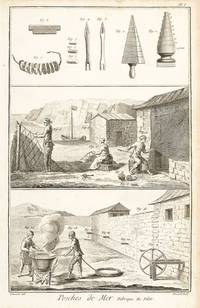
122551Paris: 1771. Folio 253 x 393mm. 10 pages of descriptive text & 35 loose plates with their accompanying 5 text sheets from the volume of plates. Slight browning to margins a little spotting otherwise very good. § The 35 plates and descriptive text for the entry of Pêches Pêches de Mer Pêches de Rivieres Fabrique des Filets from volume VIII of plates. Plates are numbered 1-35. Seventeen of the plates cover Pêches de Mer and eighteen cover fishing in general for instance hooks nets and rivers.2 pages 15 & 651 from volume VI of the Encyclopédie 1756 including La pêche des étangs and Cooment les Anglois préparent les feves pour servir d'appât au poisson4 pages 222-225 from volume XII of the Encyclopédie 1765 including information on Les instrumens1 page 219 from volume XIV of the Encyclopédie 1765 including L'article Rets1 page 882 from volume II of the Supplément à l'Encyclopédie 1776 which includes La pêche dans les étangsWith some browning to a few leaves. (1771). Folio unknown books
122586Paris 1771. Folio 253 x 393mm. 7 pages of descriptive text & 25 loose plates with their accompanying 2 text sheets. Slight browning to margins a little spotting otherwise very good. § The 25 plates and descriptive text for the entry of Sellier-Carrossier from volume IX of plates. Plates are numbered 1-25 with fourteen double plates plates 4-17.Also with the relevant entries listed under Carrosse in the Table Analytique et Raisonnée du Dictionnaire des Sciences Arts et Métiers. Vol I 17801 page 793 from volume V of the Encyclopédie 1755 including information on Separation des selliers & des éperonniers en 16781 page 934 from volume XIV of the Encyclopédie 1765 including information on Discipline de cette communauté1 page 594 from volume I of the Encyclopédie 1751 including Arcs de fer pour le ferrure de carosses under Carosse1 page 705 from volume II of the Encyclopédie 1751 including Parties du carosse under Carosse2 pages 811 & 850 from volume VI of the Encyclopédie 1756 including Chevaux de carosse and Fleches de carosse under Carosse1 page 537 from volume XV of the Encyclopédie 1765 including Rideaux de carosse appellés flores under CarosseWith some browning to a few leaves. unknown books
122582Paris 1765. Folio 253 x 393mm. 40 pages of descriptive text & 46 loose plates with their accompanying 5 text sheets from the volume of plates. Slight browning to margins a little spotting otherwise very good. § The 46 plates and descriptive text for the entry of Manufacture des Glaces from volume XVII of plates. Plates are numbered 1-46 with eight double plates Plates 1 2 32 33 43-46. Plate 3 is continued on a second sheet. These plates cover a wide range of topics in particular Les glaces soufflées and Les glaces coulés.40 pages 115-154 from volume XVII of the Encyclopédie 1765 including La fabrication des GlacesWith some browning to a few leaves. unknown books
1979309452Milan: Franco Maria Ricci 1979. Illustrated. 12 Volumes of plates; 5 of text and one final volumes of Essays etc. Folio. Original cloth spines sunned else fine. Illustrated. 12 Volumes of plates; 5 of text and one final volumes of Essays etc. Folio. Complete. Franco Maria Ricci unknown books
1780047124Paris 1780. Disbound. Very Good Condition. Disbound sets of plates with the plate lists and descriptions comprising the section of theater floorplans and theater machines. Plans for the Théatre de Turin Salle de la Comédie de Pyon Tprdionne à Rome Théatre Royal à Naples la Salle de Spectacle de la Comèdie Françoise etc. 31 plates with an additional 13 plate supplement. The second set of plates shows designs for theatrical machines for simulating tempest tossed ships landslides fires. The plates depict the intended result and a wide shot of the apparatus and then close up of the gears that make the machines function. 49 plates. Plates ca. 15" x 10" with some folding out. undated ca. 1780. Housed in an old cloth portfolio. Some soiling to a few sheets minor flaws most plates fine or nearly so. Size: Folio. Quantity Available: 1. Shipped Weight: Under 1 kilo. Category: Theatre & Plays; Inventory No: 047124. unknown books
1762100610Paris: Chez Briasson et. al 1762. Originally included in the first fascicle "livraison" of Recueil de planches sur les sciences les arts libéraux et les arts méchaniques. 6 pp. text three leaves XIV-XXXIII engraved plates illustrating. Folio. Removed. Slightly toned at edges final plate a little ragged at outer edge; otherwise lates and first leaf of text clean and sound. Originally included in the first fascicle "livraison" of Recueil de planches sur les sciences les arts libéraux et les arts méchaniques. 6 pp. text three leaves XIV-XXXIII engraved plates illustrating. Folio. WITH: Marechal Ferrant Farrier or Blacksmith with 7 engraved plates one folding Bourrelier Harness Maker et Bourrelier-Bastier with 7 plates Sellier-Carrossier Plates I II III and XVIII-XXV 11 plates Menuisier en Voiture Plates I-XXX 30 plates. Chez Briasson et. al unknown books
122524Paris 1765. 41 pages of descriptive text & 52 loose plates with their accompanying 23 textsheets from the volume of plates. Slight browning to margins a little spotting otherwise very good. § The 52 plates and descriptive text for the entry of Forges ou Art du Fer from volume IV of plates. The first section contains ten platesnumbered 1-10. The second section also contains ten platesnumbered 1-10 although plates 1 and 2 are double plates. The third sections contains twelve plates numbered 1-12 with plates 1 and 2 being double plates. The fourth section is made up of 7 plates numbered 1-7 with plates 1 2 and 3 being double plates. There is a small about of damage to plate 5 of the fourth section.This mammoth suite of plates tackles the casting of iron beginning with images of various mines and the collecting of ore. Small and giant furnaces are examined and the casting and finishing of the iron are shown. All aspects of forging are covered in this incredible suite of plates. No guide to eighteenth-century forging is so complete and comprehensive. Also included to help explain the art are many text entries on the subject carefully selected from the Encyclopédie text volumes.These include articles by Diderot and Étienne-Jean Bouchu a pioneering French steelmaker. Furthermore an article on the casting of horseshoes was contributed by Claude Bourgelat a renowned veterinary surgeon. unknown books
122513Paris 1768 and the Supplementary Plates Volume 1777. Folio 253 x 393mm. 42 pages of descriptive text & 35 loose plates with their accompanying 7 text sheets from the volume of plates. Slight browning to margins a little spotting otherwise very good. § The 29 plates and descriptive text for the entry of Histoire Naturelle Regne Animal from volume VI of plates with an additional 6 plates from the Supplementary Plates Volume. The twenty-nine plates from volume VI are numbered 1-29 with seven accompanying text sheets. This suite includes plates on land quadrupeds and sea mammals in particular.The six supplementary plates come in two sets. The first set contains four plates numbered 1-4 and these cover frogs and zoophytes in particular. The second set contains 2 plates numbered 2 & 3 and these cover hermaphrodites. Unfortunately the first plate is this set is missing.Also with the relevant entries listed under Animalité in the Table Analytique et Raisonnée du Dictionnaire des Sciences Arts et Métiers. Vol I 178012 pages 88 89 98 99 122 & 468-476 from volume I of the Encyclopédie 1751 including Plus il approche de l'adolescence plus il croît lentement La durée de sa vie peut se mesurer par celle de tems de l'accroissement Sels animaux Sels qui se trouvent dans le corps de l'animal Action animale and Animal Histoire Naturelle.3 pages 214 318 & 813 from volume II of the Encyclopédie 1751 including Animal Bête Brute Bonté animale and Cendres animales4 pages 31-33 & 596 from volume III of the Encyclopédie 1753 including Chaleur de l'animal; principaux phénomenes qu'elle présente and La dilatation & la contraction des dimensions extérieures du corps sont essentielles à la vie de l'animal1 page 363 from volume VI of the Encyclopédie 1756 including Facultés animales4 pages 35 36 51 & 110 from volume VII of the Encyclopédie 1757 including Plus les autres visceres sont petits dans un animal à proportion du sujet plus le foie est grand Fonctions animales and Accroissement & décroissement de la force de l'animal1 page 236 from volume VIII of the Encyclopédie 1765 including De l'animal selon la philosophie de Hobbes1 page 841 from volume X of the Encyclopédie 1765 including Mouvement animal7 pages 360-366 from volume XI of the Encyclopédie 1765 including Economie animale3 pages 39 585 & 586 from volume XV of the Encyclopédie 1765 including La premiere notion dans l'animal Substances animales and De l'acide animal 1 page 175 from volume XVI of the Encyclopédie 1765 including information on Les corps terreux naturels tirés de regne animal: leur usage en médecine2 pages 435 & 436 from volume I of the Supplément à l'Encyclopédie 1776 which includes information on Les animals en général 1 page 490 from volume II of the Supplément à l'Encyclopédie 1776 which includes information on Caractere distinctif de l'animalWith some browning to a few leaves.Contributed by François-Nicolas Martinet 1731-1800 famous for his ornithological engravings these plates display many noted mammals reptiles and amphibians. Martinet was well regarded because of his ability to depict the creatures realistically and many of his subjects are now scarce or endangered. Perhaps his most famous illustrations were those for Mathurin Jacques Brisson's Ornithologia sive Synopsis Methodica 1760-63. These visually compelling plates show creatures of all sorts from elephants to capybara and apes sloths and monkeys to cabasssou armadillos surinam toads and chameleons. Martinet's illustrations are detailed and informative although in places are charmingly naïve. Several relevant text entries follow and these include Animal by Diderot and Louis-Jean-Marie Daubenton a French naturalist of note. Futher articles were contributed by Pierre Tarin Paul Jacques Malouin and Baron de Haller. leur usage en médecine2 pages (435 & 436) from volume I of the Supplément à l'Encyclopédie (1776) which includes information unknown books
122533Paris 1762. Folio 253 x 393mm. 20 pages of descriptive text & 40 loose plates with their accompanying text sheet. Slight browning to margins a little spotting otherwise very good. § The 11 plates and descriptive text for the entry of Antiquités from volume I of plates with 29 plates from the Supplementary Volume of Plates.Plates from Volume I are numbered 1-11 and plate 3 is a double plate.The 29 plates from the Supplementary volume are titled and often numbered. The first of these plates is entitled Judaiques and this is an unnumbered double plate. The second plate is entitled Babyloniennes et Egyptiennes and this is numbered. There are then four plates entitled Ruines de Palmyre and these are numbered 1-4. Four further plates on the Ruines de Baalbeck follow and these are also numbered 1-4 with one double plate. There are also two plates entitled Ruines de Athens and these are numbered. Thirteen plates are on the subject of Art and these are numbered 1-13 with 3 double plates. Two plates follow which are titled Aggleston and Catacombes de Naples. The last two plates are titled Colonne de Cussy numbered 1-2.Also with the relevant entries listed under Antiques in the Table Analytique et Raisonnée du Dictionnaire des Sciences Arts et Métiers. Vol I 1780.2 pages 516 & 785 from volume I of the Encyclopédie 1751 including L'exposition de divers sentimens de plusieurs nations sur l'antiquité de monde Architecture and Les Egyptiens5 pages 22 342 388 391 & 392 from volume III of the Encyclopédie 1753 including information on Les Chaldéens Les Chinois Sentiment de M.Marsham and further information on L'exposition de divers sentimens de plusieurs nations sur l'antiquité de monde2 pages 980 & 981 from volume IV of the Encyclopédie 1754 including Les arts & les sciences and Recherches de M.Freret sur les antiquités chinois2 pages 434 & 835 from volume V of the Encyclopédie 1755 including further information on Les Egyptiens and L'exposition de divers sentimens de plusieurs nations sur l'antiquité de monde1 page 46 from volume IX of the Encyclopédie 1765 including Maimonidès1 page 89 from volume XIII of the Encyclopédie 1765 including La population du monde dans les siecles reculés1 page 652 from volume IX of the Encyclopédie 1765 which includes Loix antiques des Visigoths under Antiques1 page 742 from volume XI of the Encyclopédie 1765 which includes information on Graveurs qui ont excellé à imiter l'antique under Antiques1 page 268 from volume XII of the Encyclopédie 1765 which includes information on Peinture Antique under Antiques2 pages 462 & 463 from volume I of the Supplément à l'Encyclopédie 1776 which includes Art du dessin under Antiques1 page 921 from volume II of the Supplément à l'Encyclopédie 1776 which includes Force & beauté d'expression under Antiques1 page 515 from volume III of the Supplément à l'Encyclopédie 1777 which includes Importance de l'étude des antiques pour les artistes under AntiquesWith some browning to a few leaves.A selection of relevant text entries are included with these plates. Of particular note are those on Antiquité by Edme Mallet Antiquité en architecture by Jacques-François Blondel and two articles on Antique one by Marc-Antoine Eidous.Although an abbot and primarily concerned with theology Mallet also wrote on history and literature. Having studied at the Barnabites College of Montargis Mallet became a key figure in the success of the Encyclopédie. Dying before the project was completed Mallet still managed to produce over a thousand articles. Although his views are often criticised as restricted and narrow-minded he acted as a safeguard for the project which could have been suspended if the religious articles had proved too controversial. His article on antiquities is a general overview whereas Blondel's contribution focuses on architecture. After studying with Gilles-Marie Oppenord Blondel earned a living as an engraver and writer. He became a well-regarded architect also publishing many of his lectures and contributing to major works such as Augustin-Charles d'Aviler's Cours d'Architecture 1737. Founder of the École des Arts he inspired many young architects such as his fellow encyclopédist Lucotte. Praised for his Traité de la Décoration des Edifices he was also an accomplished engraver of plates. He had already produced his own encyclopedia of architecture so was well-accustomed to the practises of the encyclopedist. With numerous creative abilities as displayed in his work at the Metz Cathedral he wrote nearly five hundred articles for the Encyclopédie. Marc-Antoine Eidous was a French writer and translator born in Marseilles. Despite his relatively basic education he was a tireless writer and translator focusing mainly on philosophy travel and agriculture. After serving as an engineer in the Spanish army he devoted much of his time to literature. Best known for his work on heraldry he contributed around 450 articles. His writing has been criticised for a lack of elegance but he gives a very clear summary of the antiquities in this entry.The plates include Greek and Roman architecture Judaic antiquities armour clothing furniture and many other subjects. Of particular note are the plates showing the Pantheon the Colosseum as it would have been when built and as a ruin the Arch of Constantine the Circus of Maxentius known as the Cirque de Caracalla until the 19th-century the forum in ruins Trajan's column before the bronze figure of St. Peter was added in 1587 and St. Peter's Basilica in Rome. Also displayed are some items of jewellery and ceremonial dress alongside other ornaments.There are over twice as many plates in the supplement. The suite begins with a double plate of Noah's Ark and covers the Tower of Babel the Pyramids and the Sphinx at Giza. Further plates are plans and reconstructions of Palmyra Baalbeck and Athens before the extensive 19th-century excavations. These are followed by depictions of the Apotheosis of Homer by Archelaus of Priene Achilles's shield the Roman Cussy-la-Colonne and many types of decorated chairs and lamps. Indeed two pages are dedicated solely to different types of sandal. With large and attractive illustrations such as that of the catacombs in Naples these plates of classical antiquity are particularly pleasing. hardcover books
178562448Paris; Liege: Panckoucke; Plomteux 1785. 9 engraved plates by Benard after Lucotte. 9 vols. 9-1/2 x 7 inches image size. Matted framed and glazed. Fine. 9 engraved plates by Benard after Lucotte. 9 vols. 9-1/2 x 7 inches image size. The complete set of these beautiful plates relating to Court Tennis "le Jeu des Paumes" from the Récueil de Planches that extraordinary illustrated supplement to the magnificent Encyclopédie of Diderot and d'Alembert. The plates depict the creation of implements and play of tennis and billiards in the late 18th century and have never been surpassed for their beauty and historical accuracy.<br/><br/>Pl. 1 - Paulmerie Jeu de Paulme et Construction de la Racquette<br/>Pl. 2 - Paulmerie Instrumens de Paulme<br/>Pl. 3 - Paulmerie Instrumens de Paulme<br/>Pl. 4 - Paulmerie Instrumens de Paulme et de Billiard<br/>Pl. 5 - Paulmerie Salle de billiard et Instrumens de Billiard<br/>Pl. 6 - Paulmerie 1er Plan d'un Jeu de Paulme quarré et Salle de Billiard<br/>Pl. 7 - Paulmerie Plan audessus des murs du Jeu de Paulme<br/>Pl. 8 - Paulmerie Coupes du Jeu de Paulme quarré<br/>Pl. 9 - Paulmerie Plans au Rez de Chaussée et audessus des murs d'un Jeu de Paulme a dedans. Panckoucke; Plomteux unknown books
122547Paris 1763. 3 pages of descriptive text & 37 loose plates with their accompanying 3 text sheets from the volume of plates. Slight browning to margins a little spotting otherwise very good. § The 33 plates and descriptive text for the entry of Lutherie from volume V of plates alongside the 6 additional plates from the supplementary plates volume. The first section contains eleven plates numbered 1-11 while the second section contains 22 plates numbered 1-22. Plate 22 in this second section is a double plate and plate 10 is continued on a second sheet. Additionally there are 4 plates from the supplementary volume of plates numbered 1-4 with two double plates plates 2 & 4. Plate 4 from the supplementary volume is damaged with a four inch horizontal tear in from the left edge.Also with the relevant entries listed under Luth in the Table Analytique et Raisonnée du Dictionnaire des Sciences Arts et Métiers. Vol 1 17801 page 778 from volume IX of the Encyclopédie 1765 including information on L'origine de cet instrument under Luth1 page 252 from volume XVI of the Encyclopédie 1765 including En quoi le théobre en differe under Luth1 page 815 from volume III of the Supplément à l'Encyclopédie 1777 which includes LuthierWith some browning to a few leaves.The first 11 plates relate to the building of a pipe organ including a ratio of stops and a tuning scale. The remaining plates cover an array of instruments old and new and the tools used to make them. A graphic interpretation of the Orchestra of the Age of Enlightenment. unknown books