158 résultats
1792290119Berne. : Beat Louis Walthard. 1792 . Publishers plain wraps. . Very good covers worn and lightly soiled. 4to. 26.8x20.7 cm. . French text. Volume 11 only. Sections on musical instrument making carpentry mining paper and parchment making and weaving all with plates and an explanatory table of contents. weight: 1.8 lb. 93 engraved plates some folding. Beat Louis Walthard. paperback books
1931002209Paris 1931 1932. Limited First Edition. Half Morocco over Marbled Paper. Very Good. No. 351 of 600 with total issuance in various forms of 3416 copies. This set was issued with papier pur fil Lafuma. With 24 color plates and 40 black and white illustrated plates in the two volumes. Bound attractively with decorated morocco with various curly-cue gilt ornamentation. The set epitomizes the inter-war French vogue for soft core erotica here with literary pretensions or pedigree from the eighteenth century that hotbed of erotic gamboling before squelched by the Revolution. Some spotting on the fore-edges. Rubbing on the spine extremities and the edges. Overall a handsome set. <br/><br/> unknown books
122576Paris 1777. Folio 253 x 393mm. 45 pages of descriptive text & 7 loose plates. Slight browning to margins a little spotting otherwise very good. § The 7 plates and descriptive text for the entry of Fabrique des Armes from the supplementary volume of plates. Plates are numbered 1-7.Also with the relevant entries listed under Armes in the Table Analytique et Raisonnée du Dictionnaire des Sciences Arts et Métiers. Vol I 17803 pages 401 461 & 743 from volume IV of the Encyclopédie 1754 including information on Les armes courtoises Cri d'armes and Défi d'armes1 page 383 from volume VI of the Encyclopédie 1756 including Le maniement des armes16 pages 286 300 397 & 985-998 from volume VII of the Encyclopédie 1757 including Anciennes armes des François Sergent d'armes Le calibre de ces armes Réflexions sur ce sujer and Premieres armes qui ont été employées à la guerre3 pages 8 279 & 521 from volume VIII of the Encyclopédie 1765 including Les armes des cavaliers des hussards des dragons & des fantassins Homme d'armes and Les armes de jet2 pages 172 & 177 from volume XI of the Encyclopédie 1765 including Noblesse par les armes and Noblesse de nom & d'armes3 pages 109 671 & 672 from volume XII of the Encyclopédie 1765 including Pas d''armes and Places d'armes2 pages 249 & 316 from volume XIII of the Encyclopédie 1765 including Poursuivant d'armes and L'honneur rendu en préfentant les armes4 pages 322-324 & 574 from volume XIV of the Encyclopédie 1765 including Roi d'armes and Salle d'armes10 pages 86-93 120 & 121 from volume XV of the Encyclopédie 1765 including Servent d'armes Service d'armes and further information on Sergent d'armes1 page 874 from volume XVI of the Encyclopédie 1765 including Veille des armesWith some browning to a few leaves.This suite of seven plates depicts the manufacture of guns the tools and machines used and the mechanisms inside the weapons. There are many articles supporting the plates and these range over a variety of military topics. With entries by Diderot D'Alembert Edme Mallet Chevalier Louis de Jaucourt Blondel and Boucher D'Argis among many more these plates are a fine example of the work of some of the key Encyclopédistes. Also included are entries by Louis-Élisabeth de La Vergne de Tressan a French medievalist writer and soldier. unknown books
122581Paris 1765. Folio 253 x 393mm. 1 page of descriptive text & 8 loose plates with their accompanying text sheet from the volume of plates. Slight browning to margins a little spotting otherwise very good. § The 8 plates and descriptive text for the entry of Fleuriste Artificiel from volume IV of plates. Plates are numbered 1-8. Plate 8 is a double plate.1 page 780 from volume XVII of the Encyclopédie 1765 including information on Les ouvrages : description des opérations de son art.With some browning to a few leaves.An important home industry in the eighteenth-century France was for some time at the forefront of the manufacture of artificial flowers. The first plate's charming studio scene depicts a small yet busy and lively workshop. Further plates show the patterns used and the tools employed the aim of the plates volumes being the provision of useful guides for learning and improving the craft. The final plate larger than the rest is an illustration of a marvellous table display a depiction of a formal garden. The suite and the accompanying article on Fleuriste are the work of Jacques-Raymond Lucotte whose contribution to the plates volumes is far more extensive than his work in the text volumes. He designed over 650 himself and wrote around forty-five of their commentaries. He was heavily influenced by the Descriptions des arts et métiers of the Paris Académie royale des sciences. Although his speciality was masonry and architecture his contribution on artificial flowers is characteristic of his attention to detail. description des opérations de son art.With some browning to a few leaves.An important home industry in the eighteenth-century unknown books
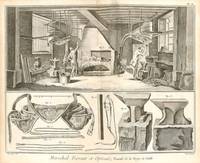
122569Paris 1769. Folio 253 x 393mm. 2 pages of descriptive text & 7 loose plates with their accompanying text sheet from the volume of plates. Slight browning to margins a little spotting otherwise very good. § The 7 plates and descriptive text for the entry of Marechal Ferrant from volume VII of plates. Plates are numbered 1-7. Plate two is a double plate. Half of plate 1 has been torn out and is missing.1 page 95 from volume X of the Encyclopédie 1765 including Réglemens principaux de cette maîtrise1 page 425 from volume III of the Supplément à l'Encyclopédie 1777 which includes Conoiffances qu'ildoit posséderWith some browning to a few leaves. unknown books
D4821c. late-18th century. Near Fine. Collection of 12 copper-engraved plates by Benard Direxit relevant to rope-making likely from Diderot's Encyclopedie. Loose leaves are about 9-by-12 inches plates numbered 24 26 27 28 31 32 33 35 36 37 and 18-by-12 inches numbered 34 91 and all are labeled "Marine" at the bottom. Includes scenes of men fashioning ropes and pulley systems numbered figures and with two botanical plates showing the controversial weed that hemp rope is made from. Near fine with some light wrinkling and dust-soiling along the edges. Suitable for display. <br/><br/> unknown books
1771003772Paris 1771. First Edition. Buckram cloth folio folder. . Near Fine. Folio 38.5 by 25 cm with two double plates 50 cm wide and the triple plate 68 cm wide. The six plates show the steps in the casting of massive equestrian statues one of the staples of public monuments before the twentieth century. As the rule with the plates in the Diderot and d'Alembert Encylcopedie though the plates are handsome works of art transcending their pedagogic purpose and the images here have an element of the curious and novel that separates them from more traditional equestrian artwork. The plates and their two page textual description that precedes them were carefully removed from the larger volume and remain attached to each other like a thinner brochure. Other than occasional light and insignificant soiling and minor age toning the plates are clean and fresh. The folder made to house them is of a modern buckram cloth decidedly utilitarian in appearance but not unattractive with their multi-color ribbon ties. <br/><br/> hardcover books
178041047Paris 1780. First edition. 1 p. of text & 13 plates 2 double-page. 1 vols. Folio. Disbound. Fine. First edition. 1 p. of text & 13 plates 2 double-page. 1 vols. Folio. From Diderot-d'Alembert's Encyclopédie which was published in Paris Neuchatel and Amsterday from 1751-1780. The plates Recueil de Planches were published in 11 volumes from 1762-1777 and are among the glories of book illustration of the 18th century. unknown books
122484Paris 1771. Folio 253 x 393mm. 9 pages of descriptive text & 18 loose plates with their accompanying 2 text sheets from the volume of plates. Slight browning to margins a little spotting otherwise very good. § The 18 plates and descriptive text for the entry of Potier de Terre from volume VIII of plates. Plates are numbered 1-18. Plate 17 is a double plate.2 pages 776 & 784 from volume XII of the Encyclopédie 1765 including Danger du vernis qu'ils emploient and Vernis de potiers.2 pages 182 & 184 from volume XIII of the Encyclopédie 1765 including information on Taches brunes & vertes and Communauté des potiers de terre à Paris.1 pages 857 from volume XIV of the Encyclopédie 1765 including Cimment ils sont sécher leurs ouvrages.1 page 177 from volume XV of the Encyclopédie 1765 including information on Le siege du potier.1 page 584 from volume XVII of the Encyclopédie 1765 including information on La poterie de Wladenbourg en Allemagne.2 pages 517 & 518 from volume IV of the Supplément à l'Encyclopédie 1777 which includes Trois principales especes de poteries que l'on peut faire avec ces terres and Poterie de fayence de terre d'Angleterre & de terre à feu. unknown books
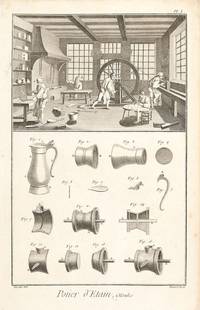
122528Paris 1771. 14 pages of descriptive text & 9 loose plates with their accompanying 2 text sheets from the volume of plates. Slight browning to margins a little spotting otherwise very good. § The 9 plates and descriptive text for the entry of Potier d’Etain fromvolume VIII of plates. Plates are numbered 1-9.1 page 557 from volume I of the Encyclopédie 1751 includingOpérations : apprêter l’étain1 page 499 from volume IV of the Encyclopédie 1754 includingCrochets3 pages 351 597 & 798 from volume V of the Encyclopédie 1755 including information on L’écouanne Empreinte ou calibre and L’épiller3 pages 7 9 & 10 from volume VI of the Encyclopédie 1756including Comment les potiers allient leurétain and Raisons qui doivent les engager à ne point tromper dans la qualité de l’étain1 page 865 from volume VII of the Encyclopédie 1757 includingLesgrattoirs1 page 749 from volume XI of the Encyclopédie 1765 includingPaillonner la vaisselle1 page 228 from volume XIV of the Encyclopédie 1765 including Revercher l’étain1 page 392 from volume XV of the Encyclopédie 1765 including La maniere de souder qualité de la soudure1 page 478 from volume XVI of the Encyclopédie 1765 includingTourner l’étain. apprêter l’étain1 page (499) from volume IV of the Encyclopédie (1754) includingCrochets3 pages (351 unknown books
1777LD14345likely Paris: n.p. n.d. c. 1777. Hardcover. Very Good. Marbled paper over boards plain paper backstrip with faded manuscript title; folio 390x247mm; pp. 12 text in French and 38 engraved plates. Some chipping along spine and edges of boards. FFEP brittle and detached; plates III double-page VII XII XIV XV XXIII XVII XXX waterstained along fore-edge creeping somewhat into images. <br/><br/>Printed to accompany "Recueil de planches sur les sciences les arts libéraux et les arts méchaniques avec leur explication" the plates accompanying the "Encyclopédie ou Dictionnaire raisonné des sciences des arts et des métiers" of Diderot and d'Alembert. The volume was issued in 1763 the entire set completed in 1777. The plates were engraved by Bénard 32 and Prévost 6. n.p. hardcover books
122564Paris 1765. Folio 253 x 393mm. 55 pages of descriptive text & 12 loose plates with their accompanying 3 text sheets from the volume of plates. Slight browning to margins a little spotting otherwise very good. § The 12 plates and descriptive text for the entry of Fayencerie from volume IV of plates. Plates are numbered 1-12.Also with the relevant entries listed under Fayence in the Table Analytique et Raisonnée du Dictionnaire des Sciences Arts et Métiers. Vol 1 17805 pages 371 & 455-460 from volume VI of the Encyclopédie 1756 including La ville de Faenza en Italie and Fayence en général1 page 609 from volume XVI of the Encyclopédie 1765 including information on Fayence trezalée2 pages 33 & 518 from volume IV of the Supplément à l'Encyclopédie 1777 which includes Manufacture de fayence and Poterie de fayenceWith some browning to a few leaves.All aspects of pottery and crockery have been examined in these plates originally designed by Lucotte. Opening with a scene of the earthworks the plates display both simple and ornate crockery a variety of tools and pieces of equipment and most notably different types of pottery wheels with accurate representations of kilns and a pottery mill. Lucotte's contribution to the plates volumes is far more extensive than to the text volumes designing over 650 himself and writing around forty-five commentaries. He was heavily influenced by the Descriptions des arts et métiers of the Paris Académie royale des sciences as seen here. Although not working on one of his specialities he approaches his work on pottery and crockery with his characteristic enthusiasm and attention to detail. unknown books
122518Paris 1771. Folio 253 x 393mm. 1 page of descriptive text & 12 loose plates with their accompanying 3 text sheets from the volume of plates. Slight browning to margins a little spotting otherwise very good. § The 12 plates and descriptive text for the entry of Laminage du Plomb from volume VIII of plates. Plates are numbered 1-12 with 3 triple plates 1 2 & 7 and 3 double plates 3 4 & 8. The editors originally counted 18 plates with 6 double plates although this is incorrect.1 page 783 from volume XII of the Encyclopédie 1765 which includes information on Laminage du plombWith some browning to a few leaves.The plates presented here were made from drawings by Goussier who writes with a great understanding of the crafts. A key contributor to the Encyclopedie this suite of plates is a fine example of Goussier's great versatility and perception and not least his ingenuity. unknown books
122487Paris 1771. Folio 253 x 393mm. 14 pages of descriptive text & 5 loose plates with their accompanying 2 text sheets from the volume of plates. Slight browning to margins a little spotting otherwise very good. § The 5 plates and descriptive text for the entry of Mosaïque from volume VIII of plates. Plates are numbered 1-5. Plate 4 is a double plate.1 page 659 from volume VIII of the Encyclopédie 1765 including Les Romains11 pages 78 79 & 741-750 from volume X of the Encyclopédie 1765 including information on Compartimens de pavés en marbre and Mosaïque en général.1 page 193 from volume XII of the Encyclopédie 1765 including L'usage des pavés en mosaïque à Rome.1 page 353 from volume III of the Supplément à l'Encyclopédie 1777 which includes Mosaïque de Herculanum.Included with these plates are several relevant entries on Mosaics including the main ten-page article by Chevalier Louis de Jaucourt. The article primarily concerns the role of mosaics in Christendom philosophy and also their manufacture. Despite focusing largely on the sciences Jaucourt has been regarded as an important philosopher as well. The article for mosaics is therefore a good example of this polymath's varied interest and specialties. The 5 plates largely concern the workmanship of this art and the atelier itself. 8 mosaic patterns are also reproduced including Europe Raised by Jupiter Neptune and his Trident and a Barge on the Nile. There is one double plate depicting the Nile Mosaic of Palestrina with various useful annotations. Thought to be the earliest Roman depiction of Nilotic scenes close examination suggests that it was produced in the reign of Sulla ca. 100 B.C. It is important for a number of reasons and could possibly be one of the mosaics referred to by Pliny in his Naturalis Historiœ. Having remained in the Barberini family since the 17th-century the mosaic can now be found in the Museu Nazionale Prenestino. unknown books
122519Paris 1772. Folio 253 x 393mm. 13 pages of descriptive text & 10 loose plates with their accompanying 2 text sheets from the volume of plates. Slight browning to margins a little spotting otherwise very good. § The 10 plates and descriptive text for the entry of Rubanier from volume XI of plates. Plates are numbered 1-10 and they are all double plates.1 page 537 from volume III of the Encyclopédie 1753 including information on L'opération de mettre le clinquant2 pages 137 & 211 from volume IV of the Encyclopédie 1754 including information on L'ouvrage de rubanerie contre-marché and Corde à encorder1 page 17 from volume V of the Encyclopédie 1755 including Dê1 page 860 from volume VI of the Encyclopédie 1756 including Imitation de toutes sortes se fleurs1 page 694 from volume VII of the Encyclopédie 1757 including Détail sur le passage des rames de glacis2 pages 711 & 712 from volume XI of the Encyclopédie 1765 including Description de l'ourdissage1 page 185 from volume XII of the Encyclopédie 1765 including Dessins des tissutiers-rubaniers1 page 423 from volume XIV of the Encyclopédie 1765 including La comnauté des maîtres rubaniers de la ville de Paris1 page 697 from volume XV of the Encyclopédie 1765 including Passer sur un pié2 pages 425 & 538 from volume XVI of the Encyclopédie 1765 including Opération de souder and Tramer finWith some browning to a few leaves. unknown books
122560Paris 1769. Folio 253 x 393mm. 1 page of descriptive text & 10 loose plates with their accompanying text sheet from the volume of plates. Slight browning to margins a little spotting otherwise very good. § The 10 plates and descriptive text for the entry of Maréchal Grossier from volume VII of plates. Plates are numbered 1-10.1 page 966 from volume VII of the Encyclopédie 1757 including information on AmsterdamWith some browning to a few leaves. unknown books
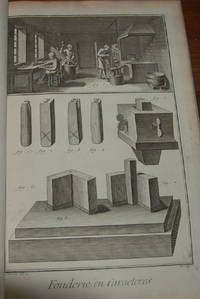
177233947Paris 1772. Folio 3 pages of letter press and 8 engraved plates. Bound in plain paper wraps. Printing and the Mind of Man 200: "a momument in the history of European thought; the acme of the age of reason; a prime motive force in undermining the ancien regime and in heralding the French Revolution; a permanent source for all aspects of eighteenth-century civilization. Light foxing to the letterpress near fine copy. Illustrations and text about the type foundry. unknown books
122571Paris 1771. Folio 253 x 393mm. 1 page of descriptive text & 8 loose plates with their accompanying text sheet from the volume of plates. Slight browning to margins a little spotting otherwise very good. § The 8 plates and descriptive text for the entry of L'Art de Faire des Tapis de Pié Façon de Turquie from volume IX of plates. Plates are numbered 1-8. Plates 1 & 2 are double plates.1 page 896 from volume XV of the Encyclopédie 1765 including Description de la façon de travaillerWith some browning to a few leaves.The plates in this suite come with their accompanying text sheets which describe the looms and processes shown in the great depth characteristic of the Encyclopédie. The plates show a number of different looms being used and several floral patterns being created. Together they make an excellent guide to the craft at that time unknown books
122473Paris 1763. Folio 253 x 393mm. 3 pages of descriptive text & 11 loose plates with their accompanying text sheet. Slight browning to margins a little spotting otherwise very good. § The 11 plates and descriptive text for the entry of Faiseur de Metier à Bas from volume II of plates. Plates are split into two sets with 7 numbered plates in the first set and 4 numbered plates in the second. The set titles are Métier à faire des bas and Travail du bas au metier. There are 6 double plates in the first set Plates 2-7 and two in the second set Plates 1 & 2. Plate 4 from the first set has a 1.5 inch tear down crease.The plates in this suite are as much a guide to the use of the loom as they are to its construction. Indeed a great variety of 18th century looms are depicted each helpfully annotated in the accompanying text sheets. Diderot visited most of the small ateliers and larger factories which were written on often accompanied by Goussier the 'third encyclopédist' and the motivating force behind the plates volumes. No publication before this or for many years after devoted this amount of attention to the mechanical arts. The Encyclopédistes were devoted to the propagation of new ideas and improved methods and this suite is a fine example also accompanied by the text entry for Metier by Chevalier Louis de Jaucourt. unknown books
122544Paris 1771. Folio 253 x 393mm. 1 page of descriptive text & 16 loose plates with their accompanying 2 text sheets. Slight browning to margins a little spotting otherwise very good. § The 16 plates and descriptive text for the entry of Tabletier-Cornetier from volume IX of plates. Plates are numbered 1-16.1 page 253 from volume IV of the Encyclopédie 1754 including Tabletier-CornetierWith some browning to a few leaves. unknown books
122477Paris 1772 Folio 253 x 393mm. 34 pages of descriptive text & 8 loose plates with their accompanying text sheets. Slight browning to margins a little spotting otherwise very good. § The 8 plates and descriptive text for the entry of Teinture en Soie ou Teinture de Riviere from volume X of plates. Plates are numbered 1-8 and plate 1 is a double plate.Also with the relevant entries listed under Teinturier in the Table Analytique et Raisonnée du Dictionnaire des Sciences Arts et Métiers. Vol II 1780.1 page 312 from volume I of the Encyclopédie 1751 including information on L'alun.1 page 170 from volume III of the Encyclopédie 1753 including information on Teinture des Chapeaux.1 page 584 from volume IV of the Encyclopédie 1754 including Cuves des teinturiers.3 pages 927 930 & 931 from volume XV of the Encyclopédie 1765 including information on Le tartre.27 pages 7-32 & 480 from volume XVI of the Encyclopédie 1765 including Le teinture en général and Le tourne-sol.1 page 513 from volume XVII of the Encylopédie 1765 including L'urine.1 page 5 from volume II of the Supplément à l'Encyclopédie 1776 which include Recette pour teindre le bois.1 page 511 from volume IX of the Encyclopédie 1765 which includes Magistrats devant lesquels les teinturiers de Paris qui ont besoin de l'eau doivent se pourvoir under Teinturier.1 page 466 from volume XII of the Encyclopédie 1765 which includes information on Teinturiers de grand & du petit teint under Teinturier. unknown books
122520Paris 1772. Folio 253 mm x 393 mm. 6 pages of descriptive text & 8 loose plates with their accompanying text sheet. Slight browning to margins a little spotting otherwise very good. § The 8 plates and descriptive text for the entry of Tisserand from volume XI of plates. Plates are numbered 1-8. Plates 2 and 6 are double plates.1 page 715 from volume III of the Encyclopédie 1753 includinginformation on L’ensuple.1 page 289 from volume VII of the Encyclopédie 1757 includinginformation on L’opération de frapper1 page 465 from volume X of the Encyclopédie 1765 includingLe description du métier sur lequel il travaille2 pages 50 & 714 from volume XI of the Encyclopédie 1765including information on Navettes du tisserand1 page 88 from volume XVI of the Encyclopédie 1765 includinginformation on Temple. unknown books
122474Paris 1763. Folio 253 x 393mm. 6 pages of descriptive text & 11 loose plates with their accompanying text sheet. Slight browning to margins a little spotting otherwise very good. § The 11 plates and descriptive text for the entry of Draperie from volume III of plates. Plates are numbered 1-11. Plates 4 and 10 are double plates.3 pages 107-109 from volume V of the Encyclopédie 1755 including information on Draperie en général.1 page 529 from volume VIII of the Encyclopédie 1765 including information on L'art avec lequel les draperies doivent être jettées.1 page 906 from volume I of the Supplément à l'Encyclopédie 1776 which includes La maniere de blanchir les étoffes de laine.1 page 701 form volume III of the Supplément à l'Encyclopédie 1777 which includes La maniere de laner ou garnir les draps.This suite of plates beings with a charming scene of two men washing textiles one in a nearby stream and another in his vat. The following plates describe further the complex art of spinning cloth and the many different pieces of equipment used. The double plates for instance display the larger machinery of the drapery. The text includes Draperie by Claude-Henri Watelet best known for his writings on gardens and the arts and several more specific papers on tools and processes for instance Foulonier by Diderot. hardcover books
122565Paris 1765. Folio 253 x 393mm. 6 pages of descriptive text & 16 loose plates with their accompanying 2 text sheets from the volume of plates. Slight browning to margins a little spotting otherwise very good. § The 16 plates and descriptive text for the entry of Eperonnier from volume IV of plates. Plates are numbered 1-16.6 pages 559 765-769 from volume V of the Encyclopédie 1755 including Réglemens Les chevaux and Pourquoi cette communauté a quitté S. Eloi pour invoquer S. Gilles.With some browning to a few leaves.With the main text entries for Eperon and Eperonnier this suite of plates is a comprehensive guide to the many different types of eighteenth-century spur both English and French and how they are created. The fabrication of the horse's bits and spurs are shown being made with two visually-delightful busy workshop views. unknown books
122479Paris 1771 Folio 253 x 393mm. 2 pages of descriptive text & 11 loose plates with their 2 accompanying text sheets from the volume of plates. Slight browning to margins a little spotting otherwise very good. § The 11 plates and descriptive text for the entry of Orfevre-Jouaillier Metteur en œuvre from volume VIII of plates. Plates are numbered 1-11.1 page 707 from volume IV of the Encyclopédie 1754 which includes information on L'opération de découvrir la pierre audedans de son feuilleti.1 page 188 from volume XI of the Encyclopédie 1765 which includes Noir don't cet artiste fait usage. unknown books