105 170 résultats
1678108891678 1 P., G. Quinet, 1678, in-12 de 183 pp., relié pleine basane, dos 5 nerfs richement orné, titre or sur pièce de maroquin bordeaux, roulette sur les nerfs et sur les coupes, tranches mouchetées, gardes peignées ; empreintes d'armes estampées à froid sur les plats, ducales semble-t-il ; n'ai pas réussi à déterminer ce qui meuble les quartiers.
1979844811979 Editions André Sauret Editeur - 1979 - 8 volumes, in-quarto, plein cuir marron siglé Albert Camus à froid en bas du premier plat, titre, auteur et tomaison en doré + emboîtage éditeur en carton toilé marron, avec ourlet de cuir sur les ouvertures, tranche supérieure dorée - 410 + 292 + 437 + 371 + 351 + 560 + 341 + 367 pages - Tirage numéroté 940/2500 sur vélin d'Arches filigrané "Albert Camus", numéroté à la presse
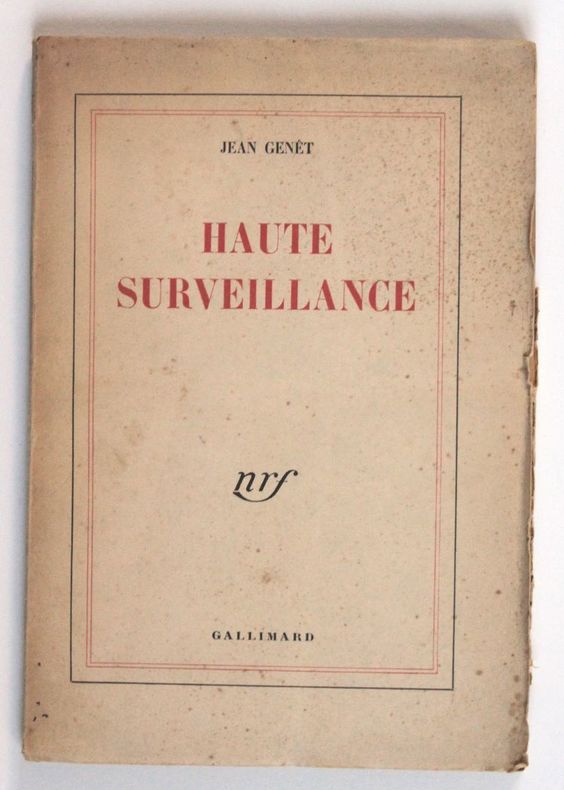
19484308Paris Gallimard 1948 in-8 broché Paris, Gallimard, 1949 (10 mars). 20,5 x 14,5 cm, in-8, 135 (1) pp., broché.
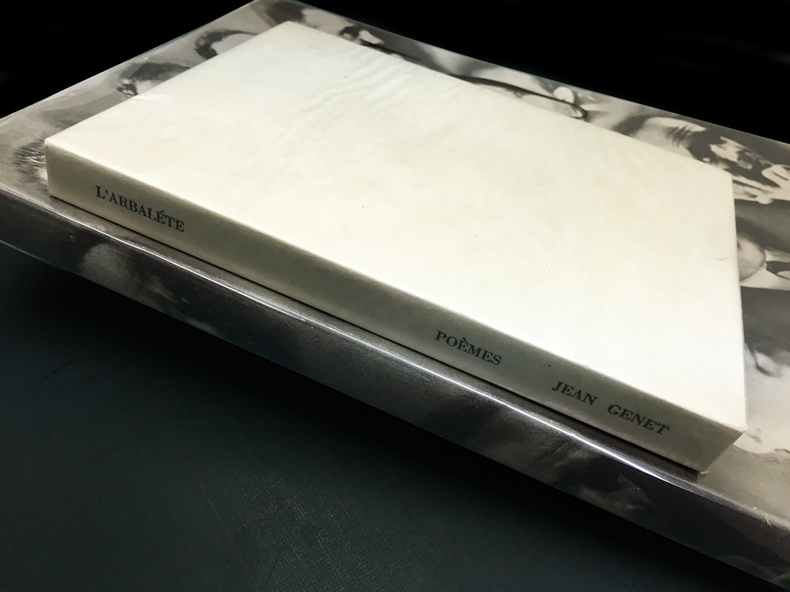
19481506L'Arbalète, Marc Barbezat 1948. 1 volume in-4 broché. Couverture rempliée illustrée d'un photomontage de Douchan Stanimirovitch, rhodoïd sérigraphié du titre sur les plats. ÉDITION ORIGINALE COLLECTIVE DES POÈMES DE JEAN GENET : Le condamné à mort, Marche funèbre, La galère, La parade, Un chant d'amour, Le pêcheur du Suquet. Typographie en deux tons. Tirage unique à 1000 exemplaires sur papier pur fil Lana, celui-ci exemplaire d'éditeur non numéroté. JOINT : POÈMES. L'Arbalète, Marc Barbezat 1962. 1 volume in-8 (205 x 150 mm) broché sous couverture de papier Japon nacré rempliée imprimée sur le premier plat et le dos. La deuxième édition a été tirée à 128 exemplaires numérotés (+ des alfa). Celui-ci 1 DES 25 SUR JAPON BLANC NACRÉ (n°III), PREMIER PAPIER. Les 2 volumes à l'état de neuf, non coupés.
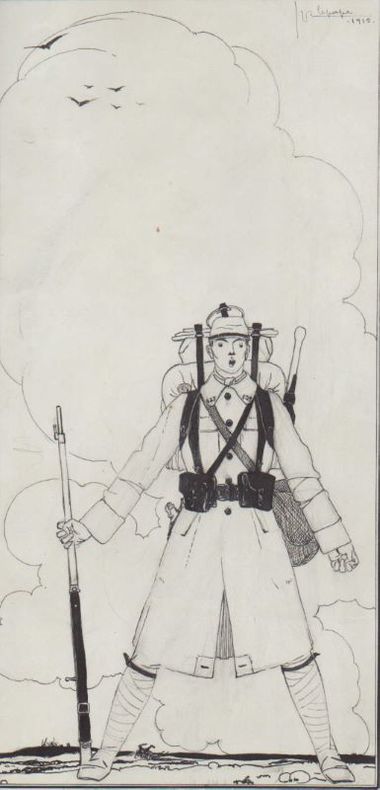
191620685Saudé 1916 1 Encre de Chine signée et datée en haut à droite, 1915, 29 x 13.5 cm.
Quattro libretti legati insieme all’epoca in bella legatura in pergamena rigida: A Milan, chez Joseph Galeazzi, 1765. Pp. 46, (2); A Milan, chez Joseph Galeazzi, 1765. Pp. 23, (1); Paris, chez Durand, 1773. Pp. 39, (1); A Paris, 1773. Pp. 40. Axs
187684361876 1 Tiré sur grand papier à 200 exemplaires, l'un des 170 sur papier de Hollande, le n° 43. Paris, Librairie des Bibliophiles, "Bibliothèque classique", 1876, 2 volumes in-8° de XXVI-299 pages & 350 pages reliés demi-maroquin bleu-nuit à coins, titres or sur dos à nerfs joliment ornés, dates or en pied, couvertures conservées, têtes dorées. (reliure signée de Champs)
in-8, pp. 79 (MANCA L'OCCHIETTO), leg. 800esca p. pelle blu. Ad un'introduzione storica fa seguito un disordinato, ma assai utile, dizionario che fornisce notizie sugli Accademici e le loro opere, e soprattutto sulle opere teatrali rappresentate o stampate in Siena dalla metà del XVI secolo alla metà del Settecento. Fondata da un gruppo di artigiani nel 1531 e trasformata in Accademia nel 1690, la Congrega dei Rozzi fu una delle istituzioni culturali più prestigiose di Siena; ebbe fra i suoi intendimenti quello di raffinare in una versione "cittadina" la letteratura popolare, soprattutto quella teatrale e poetica. Raro libretto, opera di un libraio antiquario, importante per lo studio dei rapporti fra teatro rusticano e teatro cittadino. (Qualche alone, uno strappetto nel margine dell'ultimo f.).. Non riscontrato in alcuna bibliografia..
in-8, pp. (8), 102, (2), leg. del tempo p. pelle marmorizz., tit. e fregi oro al dorso (con piccola mancanza), tagli rossi. Prima edizione di questa rara opera del Riccoboni (Antoine-François-Valentin, figlio di Luigi, detto ''Lelio Fils'', nato a Mantova nel 1707 e morto a Parigi nel 1772). In essa l'autore ''intese dare forma pratica alle teorie formulate da suo padre. Pur predicando come lui il culto della naturalezza, A.-F. definiva i limiti della sincerità e della sensibilità dell'attore, il quale non può esprimersi con efficacia se non nell'assoluta padronanza dei propri mezzi. La controversia avviata su questo problema tra Lelio padre e Lelio figlio diede origine al dibattito immortalato da Diderot col ''Paradoxe sur le comédien'' (Encicl. Spettacolo VIII, 943-4). L'opera fu tradotta in italiano ed apparve a Venezia nel 1762. In fine è allegata l'opera anonima ''Varietés amusantes et instructives'', Paris, J. Clousier, 1749. Bell'esemplare.. De Courville n. 652. Cat. Rasi p. 491..
5 volumi in-8 gr., pp.XLVII, 774, 424, 630, 618, leg. m.marocchino verde e ang., dorsi a nervi con titoli e filett. oro. Comprende gli scritti del valente critico teatrale dal 1911 al 1952, in gran parte pubblicati nel Corriere della Sera, su commedie, autori ed interpreti del periodo. Numerose illustrazioni corredano gli articoli. Vasta e importante opera, in ottimo esemplare.. .
182836913A. Sautelet & Cie pour les 6 premiers volumes Aimé André & Ladrange pour le dernier A. Mesnier pour les tomes 7, 8 et 9 | Paris 1828-1836 | 12.50 x 21.50 cm | 10 volumes reliés
- s.l. 27 juin 1966, 21x27cm, une feuille. - Lettre autographe signée de Marcel Carné adressée à Carlo Rim, 25 lignes à l'encre bleue, le remerciant pour le discours qu'il a prononcé regardant notamment l'oeuvre de Marcel Carné mais aussi les lois régissant le milieu du cinéma. Marcel Carné loue la clairvoyance et la hauteur morale du discours de Carlo Rim : "... indépendamment des éloges, trop flatteurs, que vous avez bien voulu me décerner, j'ai admiré son courage tranquille, sa fermeté dans sa concision et, par-dessus tout, son grand désir que les lois régissant la profession accordent, enfin, à chacun ce que devrait logiquement leur valeur leur travail..." Le réalisateur de "Quai des brumes" et des "Enfants du paradis" apprécie tout autant ce salutaire corporatisme dont Carlo Rim a fait preuve lors de son allocution : " Quelqu'un a parlé de "chaleur humaine", je crois que c'est le mot qui convenait. Rarement, en effet, je n'ai senti, comme ce jour-là, un tel esprit de solidarité, une telle estime affectueuse. Bref, un tel soutien moral. Je vous remercie encore une fois d'y avoir contribué pour une très large part. Amicalement et vôtre. Marcel Carné." Pliures centrales inhérentes à la mise sous pli, Carlo Rim a ajouté le nom de Marcel Carné, à l'encre verte, en angle supérieur gauche de la lettre. Carlo Rim fut un écrivain provençal, auteur notamment de "Ma belle Marseille", un caricaturiste, un cinéaste : "Justin de Marseille", "L'armoire volante", "La maison Bonnadieu", et fut notamment l'ami de Fernandel, de Raimu et Marcel Pagnol mais aussi de Max Jacob et André Salmon qu'il rencontra à Sanary. [ENGLISH DESCRIPTION ON DEMAND]
1 vol. in-8 reliure de l'époque demi-basane à petits coins marron, Adolphe et Clara ou Les deux prisonniers ; Comédie en un acte et en prose ; mêlée d'ariettes. Représente, pour la première fois, à Paris, sur le Théâtre de l'Opéra-Comique national, rue Favart, le 12 pluviôse , an 7, De l'Imprimerie du Citoyen Cailleau, Paris, An Septième, 36 pp. [ Ave : ] La Folle Journée, ou Le Mariage de Figaro, Comédie en cinq Actes, en Prose, par M. de Beaumarchais. Représentée pour la première fois par les Comédiens Français ordinaires du Roi, le Mardi 27 avril 1784, Chez Ruault, Au Palais Royal, 1785, 2 ff., lvi pp., 1 f., 234 pp. [ Avec : ] L'Orphelin de la Chine, Tragédie par Mr. Arouet de Voltaire, Représentée pour la première fois à Paris, le 20 août 1755, Conforme à l'édition in-4 donnée par l'auteur, Chez Louis Chambeau, Avignon, 1770, 50 pp. [ Avec : ] Elina et Nathalie, ou Les Hongrois, Drame en trois actes et en prose, traduit de Kotzebue, par Le C. Pointe, Représenté, pour la première fois, à Paris, sur le Théâtre de Molière, le 8 Ventôse an X, arrangé pour la scène française par les Citoyens Dé*** et A.-J. Dumaniant, Chez Barba, Libraire, palais du Tribunat, Paris, An X, 1802, 63 pp. [ Avec : ] Les Fausses Infidélités, Comédie en un Acte et en Vers ; par M. Barthe, de l'Académie de Marseille, Représentée par les Comédiens François ordinaires du Roi, le 25 janvier 1768, Chez Louis Chambeau, Avignon, 1769, 27 pp. [ Avec : ] Le Mai, Comédie en trois actes, mêlée de vers et de prose, d'ariettes et de vaudevilles, et terminée par un Ballet, représente pour la première fois, par les Comédiens Italiens Ordinaires du Roi, le 8 mai 1776, Chez la Veuve Duchesne, Paris, 1776, 65 pp. (au privilège : lu et approuvé par Crébillon) [ Avec : ] Aucassin et Nicolette, ou Les Moeurs du Bon Vieux Temps, Comédie, remise en trois actes et en vers, dont une partie est en musique ; représentée pour la première fois, devant Leuers Majestés, à Versailles, le 30 décembre 1779, par les Comédiens Italiens Ordinaires du Roi, & à Paris, le 3 Janvier 1780, & reprise le 7 Janvier 1782, Chez Brunet, A Paris, 1782, 46 pp. et 1 f. Intéressant recueil rassemblant notamment une rare traduction de Kotzebue, et 6 autres pièces. Etat très satisfaisant ("La Folle Journée" est incomplète des 2 derniers feuillets, petit mq. à un mors en queue, nombreux ex-libris manuscrit Gualy de St-Rome ou Dauriac Gualy Chevalier de Saint Louis) Français
18692677DBLeipzig und Winterthur, Rieter-Biedermann, (1869). Folio. (6) Bl., XXXI, 269 Seiten (gestochene Noten). Mit 1 gest. Portrait von C. Gonzenbach, 4 Stahlstichtafeln von Heinr. Merz und 2 Seiten Notenhandschrift-Faksimile. Blind- und goldgeprägter Original Leinenband mit Goldprägunge und -verzierungen.
17559438A Londres, sans nom, 1755. 4 tomes en 2 volumes in-12 de [4]-321-[4]-298[4]; [4]-284-[4]-247-[3] pages, plein veau moucheté, dos à 5 nerfs ornés d'encadrements, roulettes et fleurons dorés, étiquettes de titre et tomaison bordeaux et beige, roulette dorée sur les coupes, tranches rouges. La page de titre du tome II se trouve être celle du tome III. Infime manque à la coiffe supérieure du second volume. Ex-libris Alfred Lambert.
129456aafParis, Ed. Monnier & Cie. - Alphonse Piaget, Éditeur, 1882 - 1883, gr. in-8vo, (28.5x19 cm), richement illustré avec des photogr. orig. d’acteurs et d’actrices par Baccard (Bacard) Fils. Phot. dans les premiers volumes, reliure en d.-toile aux larges coins, dos insolé avec pièce de titre, vignette et ‘volume’. (rel. Pierson). Bel exemplaire.
Pp. 100 (ma in realtà vi + 106). Unito a: BRUEYS et PALAPRAT. L'avocat Patelin, comedie en trois actes et en prose... Nouvelle Edition, entièrement conforme à la représentation. A Paris, Fages, an VI. Pp. 36. Unitp a: DESTOUCHES. La fausse Agnès, ou le Poete campagnard... Nouvelle édition. a Paris,chez la Veuve Duchesne, 1784. Pp. 56 + 1 cb. Unito a. POINSINET. Le cercle ou la soirée a la mode, Comédie épisodique... A Paris, Fages, 1802. Pp. 32. Unito a: BARTHE. Les fausses infidélités, Comédie en un acte en vers... A Paris, Prault, 1768. Pp. 46 (2). Unito a: COLLE. La partie de chasse de Henry IV... A Paris, Gueffier, 1775. Pp. ix, 124. Unito a: DE MONVEL. L'amant bourru, comédie. A Paris, chez Duchesne, 1797. Pp. (4) 72. Miscellanea di 7 opere in un volume di cm. 20, legatura coeva (tedesca?) in mezza pelle, dorso liscio con fregi e titoli in oro su tassello. Ben conservato. Raccolta di pièces di teatro fra cui spicca il raro testo di Goldoni: Le Bourru Bienfaisant. Si tratta della rara edizione originale, poi tradotta in lingua italiana dallo stesso Goldoni ed apparsa nel 1789 con il titolo: Il burbero benefico. Originariamente scritta in occasione del matrimonio di Luigi XVI con Maria Antonietta, fu una delle sue commedie più riuscite. Cfr. Salvioli (575): "Assai rara e ricercata"; Spinelli 164.
187144951Boston 1871. 1st printing presumed ca 1870. Self wrappers. Slight age-toning to paper; a few small tears at edges and one central pin hole that runs through all four pages; overall very good. Single sheet folded once to form four pages. Engraved borderds and illustrations in text. Folded: 10-1/4" x 6-9/16" <br/><br/>A playbill for a production of "No Thoroughfare" at the Boston Theatre with Charles Fechter playing the role of Jules Obenreizer and Carlotta Leclercq in the role of Marquerite. The playbill has many local advertisements and some information about the theatre company in the years 1870 and 1871. Charles Fechter travelled from London to the United States in 1870 and enjoyed a very succesful career in Boston. Critics disaproved of his "Hamlet" also advertised on this playbill but were captivated by his refined style and Continental training Hornblow vol. 2 p. 214. unknown books
24274Treadgold’s two letters from the BBC200 Oxford Street London both dated 1951. Three of MP’s scripts dated from the same year and the rest of the material from around this time. The material collected here is perhaps unique: it is not clear whether any material relating to Macqueen-Pope’s BBC broadcasts has survived elsewhere. It is hard to overestimate the significance of ‘Popie’ to the history of the London stage. Other items from among his papers offered seperately attest to the regard in which he was held by both actors and those behind the scenes as the foremost chronicler of a cherished era that was quickly passing into oblivion. His entry in the Oxford DNB describes how in the 1950s he was ‘in demand as a lecturer on the theatrical subjects he loved and he appeared often in the same capacity on radio and on television. Ironically he regarded these two forms of public entertainment and television in particular as representing a serious threat to the survival of theatre about which he cared passionately’. A total of twenty-seven items; comprising 15 BBC radio scripts by MP with an additional five earlier drafts of some of them together with two TLsS to MP from Mary Treadgold of the BBC Overseas Service two carbons of notes from MP to Treadgold and three typed music lists by MP for the particular broadcasts. Fifteen of the items Five and Seven to Twenty comprising eleven scripts and earlier drafts of four of them are from a series of ‘Theatre Songs and Stories by W. Macqueen-Pope’ broadcast on the BBC Overseas Service in 1951. The other scripts would appear to have been broadcast on the same channel at the same time. Apart from Item Six which is worn and chipped but with text complete the material is in good overall condition with the inevitable slight aging and wear and with slight rust-staining from paperclips. All items in 4to except for Five and Six which are foolscap 8vo and a total of 131pp. Items Thirteen and Eighteen incomplete; the other twenty-five items complete. ONE and TWO: Two drafts of ‘Half a Century of Musical Comedy / Script and Narration by W. Macqueen-Pope’ both headed ‘Broadcast’. Both 16pp. Undated but from 1951 as states that 1894 was ‘57 years ago’. The second a black ink carbon incorporates the typed emendations in the first a blue-ink carbon. THREE. ‘Bring Back Harlequin’. Dated 27 December 1951 and headed ‘Broadcast’. 7pp with pencil emendations. FOUR: ‘Music From the Theatre by W. Macqueen-Pope.’ Headed ‘Broadcast’. 4pp. FIVE. ‘Theatre Songs and Stories by W. Macqueen-Pope’ concerning ‘The Gaiety Theatre London’. In top right-hand corner of first page: ‘Rough specimen of Broadcast.’ 5pp foolscap 8vo. SIX. ‘1 Memories of Olympia by W. Macqueen-Pope.’ 4pp foolscap 8vo. Items Seven to Twenty are all headed ‘Theatre Songs and Stories by W. Macqueen-Pope.’ with ‘Broadcast’ at top left of first page. SEVEN and EIGHT. Two drafts of ‘No. 2. Theatre Royal Drury Lane’. Both headed ‘2nd Broadcast’. The earlier 4pp; the later also 4pp with ‘Broadcast’ at head of first page by MP in pencil and carrying a couple of pencil emendations. Both drafts refer to the recent death of Ivor Novello the first describing him as ‘an immortal’ whose ‘music will be played so long as there remains a British audience to listen to it’. NINE and TEN. Two drafts of ‘The Adelphi Theatre’. The earlier 8pp with additional leaf carrying typed note headed ‘Broadcast Inset after ‘Nymph Errant’; the later 5pp abridged and rewritten but incorporating the ‘Inset’. Regarding ‘The Quaker Girl’ MP writes: ‘A wonderful show for the wonderful nights of a wonderful period. That first night on 5th November 1910 was a triumph for all concerning and sitting in the stalls with his bride and applauding as enthusiastically as anyone was a young politician named Winston Churchill.’ ELEVEN. ‘The Alhambra. Leicester Square.’ 4pp. Pencil emendation. TWELVE and THIRTEEN. ‘Daly’s Theatre’. 4pp; with first page only of later draft with minor pencil emendations. FOURTEEN. ‘The Holborn Empire’. Dated 21 November 1951. 5pp. FIFTEEN and SIXTEEN. Two drafts of ‘The Palace Theatre’. The earlier 8pp with a few emendations in pen; the later 5pp incorporating the emendations and with pencil addition. SEVENTEEN and EIGHTEEN. Two drafts of ‘The London Coliseum’. The earlier of 4pp with an addition in pencil; the later lacking p.3 of 4pp incorporating the addition. NINETEEN. ‘The Oxford Music Hall’. 4pp with addition in pencil. TWENTY. ‘His Majesty’s Theatre.’ Dated 21 November 1951. 4pp. TWENTY-ONE and TWENTY-TWO. Two sets of music lists. The first of 6pp with the pages headed: ‘Adelphi Music’ ‘Palace Theatre Music - in place of London Pavilion’ ‘Savoy Music’ ‘Daly’s Music’ ‘Alhambra’ and ‘Music for Drury Lane’; the second 3pp with pencil emendations the pages headed: ‘Adelphi’ ‘Palace’ and ‘Adelphi’ followed by ‘Palace’. TWENTY-THREE. Music list accompanying Item Four ‘Music from the Theatre’ headed ‘Tunes for 2nd Broadcast’ with entries ticked in pencil. TWENTY-FOUR and TWENTY-FIVE. Two TLsS from Mary Treadgold Talks Producer General Overseas Service to MP. Each on BBC 200 Oxford Street letterhead. The first 21 June 1951 2pp giving ‘the Music List for Daly’s; the second 20 September 1951 2pp giving a long list of ‘the music - with comments - for both the Coliseum and the Oxford. The programme for the Oxford is being broadcast fairly soon so it is really essential now that we get these two scripts recorded pretty quickly.’ Checked in pencil with autograph notes by MP. TWENTY-SIX and TWENTY-SEVEN. Carbons of TNsS from MP to Treadgold 26 June and 2 August 1951. Each 1p. The first with carbon copy of MP’s signature. In the first he suggests that ‘we use the Merry Widow as the signature tune rather than the Dollar Princess. The Widow was Daly’s most outstanding play.’ The second presents ‘the Adelphi and Palace scripts. The Adelphi is a bit “talk-ey†but we cannot help it. The stories have the merit of being good ones.’ Treadgold’s two letters from the BBC,200 Oxford Street, London, both dated 1951. Three of MP’s scripts dated from the same unknown
DOMENICHI LODOVICO. LE DUE CORTIGIANE, COMEDIA DI M. LODOVICO DOMENICHI, AL SIGNOR LUCA SORGO GENTILHUOMO RAGUGEO. Venetia, Francesco FRANCESCHINI 1567.[Teatro-Raro] (Cm. 15.7) interessante legatura in piena pergamena antica manoscritta ( sec. XVI) rimontata, sguardie antiche. --- cc. 44. elegante corsivo, bella grande marca tipografica al frontis. Grandi capolettera figurati. Precede la dedica, l' argomento e il prologo. Apparsa nel 1563 per il Torrettino, è questa una seconda edizione molto rara. Manca a CHOIX, MORANTI, ADAMS, BRUNET e GAMBA. Il CENSUS, EDIT 16, registra solo 8 copie nelle biblioteche Italiane e l' HAYM la pone fra i libri rari. E una traduzione della baccheide di plauto, assai fedele. Nel prologo si legge: " colui che prima la compose in greco la chiamò evantide. Plauto che la fece latina la intitolò bacheide, è il nostro, che l' ha ridotta in toscano, la domanda- le due cortigiane". Insignificante restauro all' angolino bianco in alto al frontis, lievissima patina del tempo, per il resto esemplare molto bello fresco e ben marginato. --- ALLACCI 267; --- BREGOLI: ITALIAN THEATER n° 219; --- BM. STC. 222; --- GRAESSE II 420; --- HAIM 300/14.[f10] Libro
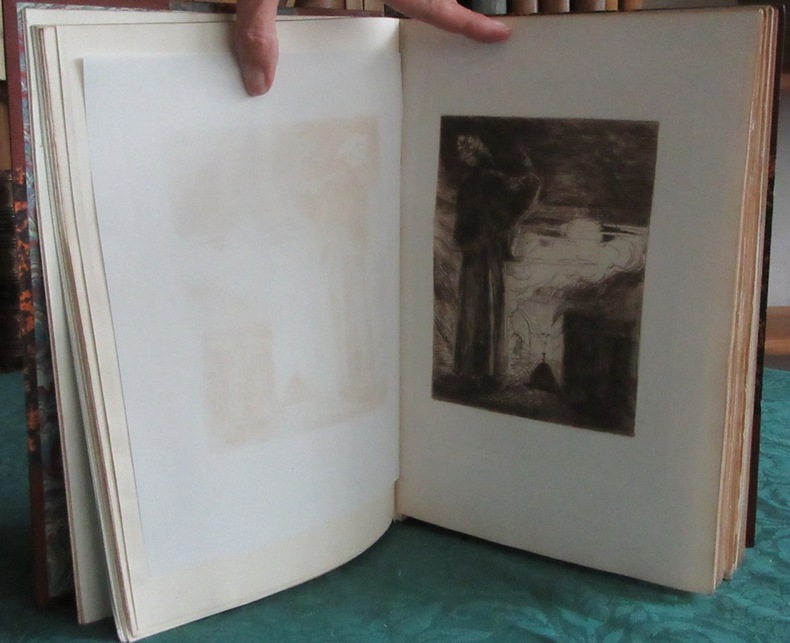
188519251Poésie de Victor Hugo parue pour la 1ère fois en 1878.21 compositions dessinées et gravées par Jean-Paul Laurens (en 3 états).Cette édition a été tirée à 300 exemplaires. Celui-ci (N°11) un des 50 de tête sur papier du Japon.Paris, A Quantin - 1885 - 100 pages de texte.Belle reliure demi maroquin terre de Sienne à coins signée Allô. Dos à nerfs richement orné et doré, avec pièce de titre verte. filet doré bordant les plats. Couverture conservée. Non rogné. Serpentes. Pas de rousseur. Très bon état. Bel exemplaire. Format in-4°(33x22).Jean-Paul Laurens (1838-1921) est élu membre de l’académie des beaux-arts en 1891. Il entretenait des liens d’amitié avec la famille d’André Gide, avec Charles Péguy et Auguste Rodin.À la fois critique satirique de la papauté et exposé de la pensée religieuse et humaine du poète, l'oeuvre est présentée comme un rêve en deux scènes. Elle parut en 1878, mais avait été en fait presque entièrement écrite en 1874-1875, dans la ligne de l'anticléricalisme croissant de l'auteur.
[500 Teatro](cm. 34.5) cartonato recente uso antico. Titolo manoscritto al dorso. -cc. 4 nn., pp. 1118, cc. 39 nn. con indice privilegio e colophon. Grande marca al frontis, bellissimi fregi e grandi capilettera di ottima fattura. Prima edizione col commento del Lambini, molto rara. Graesse :" tres estimee a cause du commentaire; Lambin etant mort avant l'achevement de son travail, Jac. Helias l'a termine". Essendo a grandi margini è quasi sicuramente uno degli esemplari in carta particolare che cita Brunet:"en existe des esemplaires en gr. papier, qui sont rares et assez precieux". Qualche ombreggiatura alle prime due carte e lievissima e uniforme a tutto il volume, ma buon esemplare marginoso e nitido. * Adams P 1500; *BM. STC: French 355; *Graesse V 327; * Brunet IV 708. [F. 81] Libro
[Teatro] (cm.15,5) Ottimo mz. Vitello fine 700. Titolo e fregi in oro al dorso con monogramma (M.S.). -pp.239, p.1nn. Con Colophon e registro. Bello stemma a piena pagina in xilografia alla v carta. Prima edizione rarissima delle due opere assieme che separatamente furono edite nel 1589 e il Tancredi nel1597. Cfr. Allacci 525 e 751, Soleinne IV 4227-4228 e Quadrio IV p.75. Anche gli "Scherzi" in fine sono in prima edizione. Le tre opere hanno frontis propri, stessa data e numerazione continua. Vecchio rinforzo al margine bianco del frontis intaccato dall'umido come aluce carte successive a scomparire. Piccolo tarlo ben restaurato al margine di alcune carte interne e qualche lieve alone ma buon esemplare su carta pesante stampato con notevole eleganza. Manca a molta bibliografia consultata, compreso Allacci, Adams, Bm. STC. Una sola copia è ampiamente descritta in: Bregoli- Russo "Renaissance Italian Theater" 600. Il Census Iccu riporta solo 12 copie nelle biblioteche italiane.[f64] Libro
in-4, pp. (8), 72, attraente leg. del primo XVIII sec. in p. marocch. granata, duplice cornice dorata ai piccoli ferri sui piatt, dorso a nervi con fregi oro, bordi e tagli dor. (18 ff. bianchi in fine, una cerniera debole). Impresa tipogr. fig. al tit., fregi ed iniz. silogr. Dedica dell'a. a Luigi Lollino e Benedetto Giorgio. Prima edizione di quest'opera, il cui primo discorso (pp. 1-40) fa parte dell'aspra e lunga polemica letteraria che aveva suscitato ''La Canace'' dello Speroni e la successiva ''Apologia'', appositamente da lui scritta in difesa della sua tragedia (cfr. quanto afferma a tal proposito Apostolo Zeno nelle sue ''Annotazioni'' alla ''Biblioteca dell'eloquenza italiana'' del Fontanini, I, pp. 469-470). Il secondo discorso è un dotto trattatello di carattere generale sulla nobiltà nei suoi vari aspetti. L'autore, di Padova (ivi morto nel 1611), fu pubblico lettore in quella Università, uno dei più illustri membri dell'Accademia degli Animosi e di quella dei Ricovrati, polemista ed autore di svariate opere assai stimate, quali i ''Discorsi poetici'' (1600) e i ''Due discorsi, l'uno contra le tragicomedie et moderne pastorali, l'altro particolarmente contro contra il Pastor fido di B. Guarini''. Ottimo esempl. (antica firma nel margine infer. del tit.).. Manca al BMC e all'Adams. Cat. Olschki 141, n. 496..
17478707Paris, Sébastien Jorry, 1747. In-12 de [4]-152 pages, plein maroquin rouge, dos à nerfs orné de filets et fleurons dorés, triple filet doré encadrant les plats, double filet doré sur les coupes, dentelle dorée intérieure, tranches dorées. Belle reliure parfaitement exécutée par Hardy.