COCTEAU JeanMareMagnum

105 175 résultats
- S.n., s.l. 27 avril 1954, 21x27cm, une feuille. - Lettre autographe signée de Jean Cocteau, président du jury du festival de Cannes 1954 qui s'était tenu du 25 mars au 9 avril, adressée à son ami Carlo Rim, 17 lignes à l'encre bleue : "cette étrange foire d'empoigne à laquelle j'essayai de donner quelque grâce" Jean Cocteau loue encore l'impartialité et la clairvoyance de Carlo Rim : "Je dois te dire ma reconnaissance pour ton oeil qui savait voir au dessus du lieu..." et dénonce les luttes d'influence troublant et entourant l'attribution des prix dont il fit les frais : "Le plus drôle c'est que ma dernière tentative de justice dérangeait encore de combinés - l'entourage de Clément [Il s'agit de René Clément qui concourait cette année-là avec Monsieur Ripois] (il n'y est pour rien) espérant un scandale publicitaire, annulé par le prix spécial... Les petits copains que tu connais dirent qu'on m'avait téléphoné de ordres (sic)." Satisfait d'être débarrassé de cette encombrante charge, Jean Cocteau n'en conseille pas moins son ami Carlo Rim, membre du jury, d'être vigilant pour l'édition prochaine du festival : "Le jeu n'étant pas la chandelle. L'année prochaine ouvre "l'oeil" sur le travail de mon successeur. il aura bonne mine (comme on dit)." Dans sa lettre, Jean Cocteau mentionne René Clément qui concourait cette année-là avec "Monsieur Ripois" qui obtint donc, à la grande joie et à l'instigation de l'entourage de René Clément, le grand prix du jury, "La porte de l'enfer" de Teinosuke Kinugasa remportant le grand prix. Traces de pliures inhérentes à la mise sous pli. Provenance : du fonds Carlo Rim. Carlo Rim fut un écrivain provençal, auteur notamment de "Ma belle Marseille", un caricaturiste, un cinéaste : "Justin de Marseille", "L'armoire volante", "La maison Bonnadieu", et fut notamment l'ami de Fernandel, de Raimu et Marcel Pagnol mais aussi de Max Jacob et André Salmon qu'il rencontra à Sanary. [ENGLISH DESCRIPTION ON DEMAND]
- Ludovic Baschet, Paris 1880, 35x64 cm, relié. - Edition originale, un des 100 exemplaires sur Hollande avec les gravures avant la lettre sur Japon. Reliure en demi chagrin à coins chocolat, dos à 6 nerfs, date et lieu d'édition en pied, plats de papier moucheté, traces de frottements sur les plats, trace circulaire sur le deuxième plat, quelques épidermures sur les coupes, coins émoussés. Edition agrémentée de nombreuses gravures hors-texte en bois de bout et héliogravures, représentant les portraits des grands auteurs et des grands comédiens de la Comédie française. Quelques rousseurs éparses, sinon bel et imposant exemplaire agréablement établi. [ENGLISH DESCRIPTION ON DEMAND]
- Les éditions nationales, Paris 1935, 17x22,5cm, relié. - Edition illustrée d'une aquarelle et de dessins de Gus Bofa, un des 100 exemplaires numérotés sur B.F.K. de Rives. Reliure en plein maroquin rouge, dos à cinq nerfs sertis de filets noirs, gardes et contreplats de papier à effet moiré, couvertures et dos conservés, tête dorée, coins supérieurs légèrement émoussés sans gravité. Deux petits frottements sur deux nerfs. Bel exemplaire agréablement établi. [ENGLISH DESCRIPTION ON DEMAND]
- Paris, Paris 19 mai 1959, 21x27cm, une feuille. - Touchante lettre autographe signée de Marcel Pagnol adressée depuis Monte Carlo à son grand ami Carlo Rim, 9 lignes à l'encre bleue, : "Petit Carlo, Où es-tu? Donne-moi ton adresse, car il faut que je t'écrive sérieusement à propos du droit d'auteur au cinéma. C'est urgent, et important pour tous. Je t'embrasse et aussi Alice, Maqrcel. Monte Carlo" Pliures centrales inhérentes à la mise sous pli, Carlo Rim ayant inscrit une date au crayon de papier, probablement celle de la réception de la lettre. Il a également indiqué en dessous, toujours au crayon de papier : 27 mai ass.ger. SACD à Pleyel. Carlo Rim fut un écrivain provençal, auteur notamment de "Ma belle Marseille", un caricaturiste, un cinéaste : "Justin de Marseille", "L'armoire volante", "La maison Bonnadieu", et fut notamment l'ami de Fernandel, de Raimu et Marcel Pagnol mais aussi de Max Jacob et André Salmon qu'il rencontra à Sanary. Répétiteur de l'aspirant bachelier Jean Marius, futur Carlo Rim, le tout jeune licencié Marcel Pagnol préféra lui enseigner le bilboquet, raillant l'inutilité du baccalauréat. Ce fut le début d'une amitié indéfectible entre les deux artistes dont la littérature, le théatre et les films contribuèrent à la célébrité du pays des cigales. [ENGLISH DESCRIPTION ON DEMAND]
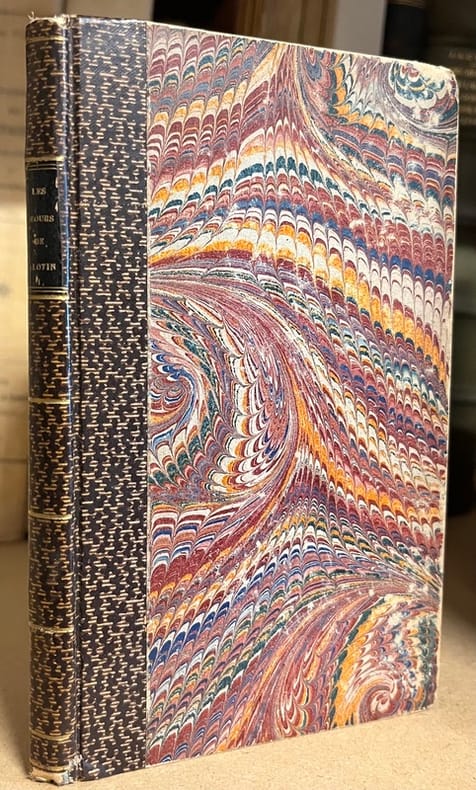
- Meline, Cans & Cie, Bruxelles 1840, 11x17cm, relié. - Nouvelle édition. Reliure à la bradel en demi percaline violette, dos lisse orné d'un motif floral doré, date en queue, pièce de titre de chagrin noisette, couvertures conservées. Petites rousseurs marginales, sinon agréable et rare exemplaire. [ENGLISH DESCRIPTION ON DEMAND]
20 vol. in 16° (12,5x9cm), leg. coeva in mz pelle e carta marmorizzata, titoli e fregi in oro al dorso etich.; 1 tv. f.t. nel primo vol. raff. l'a.. Vol I, 2 tomi pp. VII, 272, 2, 293,3 contenenti la Vita; Vol II pp. 243; Vol III pp.304 Vol IV pp. 296; Vol V pp.304; Vol VI pp. 279; Vol VII pp. 174; Vol VIII pp. 222; Vol IX pp. 285; Vol X pp. 299; Vol XI, 2 voll pp. 214; 218, 2; Vol XII pp 291; Vol XIII pp. 267; Vol XIV pp. 230; Vol XV pp. 363; Vol XVI pp. 251; Vol XVII pp. 235; Vol XVIII pp. 269; Vol XIX pp. 231; Vol XX pp. 375; Buon esemplare internamente fresco e ben conservato. Bustico 19
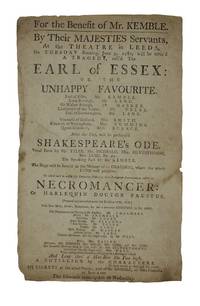
1781AQ31604Leeds: s.n. 1781. Single leaf broadside. Browned and creased some marginal chipping/tearing. An apparently unrecorded playbill advertising a benefit night of John Philip Kemble 1757-1823 at the provincial Theatre in Leeds in 1781. This appearance pre-dates Kemble's London debut by two years. At this time he was touring as a member of Tate Wilkinson's Company on the Yorkshire circuit; indeed it was Wilkinson who had constructed the Leeds theatre in 1771. Kemble son of actor-manager of a strolling theatrical troupe Roger Kemble and younger brother of actress Sarah Siddons took to acting in 1776 joining Wilkinson in 1778. Later in 1781 he moved to the Smock Alley theatre in Dublin before joining his sister at Drury Lane in September 1783. At Leeds he played the titular role in the tragedy of The Earl of Essex after which 'Shakespeare's Ode' was performed in which the majority of the players took vocal parts but with Kemble himself taking the speaking role. The evening concluded with the 'New Pantomime Entertainment' of Necromancer: of Harlequin Doctor Faustus an imaginative retelling of Christopher Marlowe's Doctor Faustus by pantomimist and theatre manager John Rich 1692-1761 first performed in 1723. . Dimensions 190 x 300 mm. [s.n.] unknown
AQ21437Valetta: s.n. s.d. Single leaf broadside edges uncut. several horizontal folds lightly creased manuscript title to verso. An apparently unrecorded late Victorian playbill advertising an evening's entertainment starring members of the British armed forces held at the lavish Theatre Royal in Malta's capital Valetta. The venue was constructed in 1866 after designs by Edward Middleton Barry 1830-1880 the architect of Covent Garden Theatre. A mere six years after completion the building's interior was ravaged by fire forcing closure; performances would not resume until restoration works concluded in 1877. The theatre was destroyed during Luftwaffe bombings in 1942. The ruins today serve as an open-air performing arts venue. . Dimensions 210 x 310 mm. [s.n.], [s.d.] unknown
17437Drafts without place or date. Covering letter to Poke dated 20 January 1951 without place . ONE: The earlier of the two drafts titled 'It Was Top of the Bill The Story of Music Hall. by W. Macqueen-Pope.' 14pp. 4to. Paginated 1-12 with two further pages carrying material to be inserted. With a few autograph emendations including an addition to the ending. Macqueen-Pope writes knowledgeably and with a passion for his theme which is that 'Music Hall reflected public taste even more accurately than did the "legitimate" Theatre because it was created by the people themselves. The basis of the Drama of the Theatre - was religion. The origin of Music Hall was the public house and the Tavern.' Among those discussed are Marie Lloyd Herbert Campbell Dan Leno Harry Champion George Robey. The article begins: 'Music Hall - real Music Hall - is dead. There is something called Variety which appears to flourish today but it bears no more resemblance to true Music Hall than "Othello" bears to "Oklahoma". It takes place on a stage it has a succession of "turns" but there the likeness ends.' TWO: Later version of the two drafts incorporating the emendations in the first. Same title. The ending reads: 'And there in the words of one of the remaining members of that class of real Londoners who made the Music Hall - the type that Chevalier Alec Hurley and Gus Elen showed on the Music Hall stage is the chief reason today why Music Hall is dead. Yet in a few artists it lingers on like its melodies refusing to die whilst there remains sic some individuals with their own style and not just truants from the Radio Studios - and there is still Gracie Fields . . . . she is Music Hall.' THREE: Typed carbon copy of letter to 'Dear Greville' from Macqueen-Pope: 'Here is the story of "Music Hall". It looks a bit long but it is a big subject and I hahve packed it full of stories. It is in a sense an epitome of my book "The Melodies Linger On" recently published by W. H. Allen Ltd - and so is in the news. I dont think anyone has told the real truth about Music Hall before - and why it died.' In a postscript he assures him that 'The bit about the bus conductor is the solemn truth.' Drafts without place or date. Covering letter to Poke dated 20 January 1951 [ without place ]. unknown
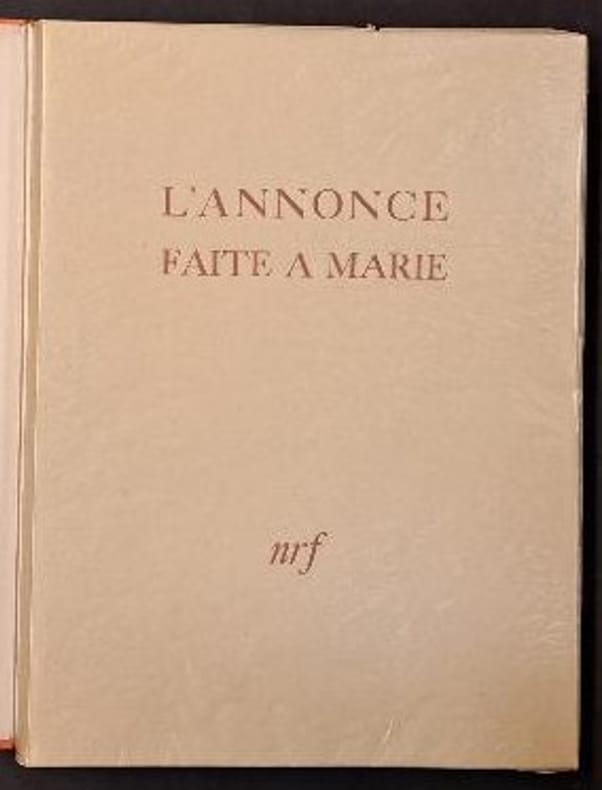
1951119548Paris, Nrf Gallimard 1951 In-folio 39 x 29 cm. En feuillets, sous couverture rempliée, chemise et étui rigides, 260 ff., illustré de 45 burins de Pierre-Yves Trémois. étui présentant des traces de manipulation, livre et pages en bon état.
1706102366Londres, Chez Jacob Tonson, Marchand Libraire, à Grays-Inn-Gate 1706 5 volumes. In-16 17 x 10 cm. Reliures de l’époque veau havane, dos à nerfs encadrés de fers dorés, pièces de titre et de tomaison maroquin grenat, [8]-[40]-[6]-356-[14] pp. - [4]-406-[8] - [4]-408-[16] - [6]-408-[8] - [10]-408-[6] pp. Reliures légèrement frottées coins émoussés et frottés, manque une pièce de titre, intérieur assez frais.
18891212San Francisco: Theatrical Publishing Co 1889. Very good. Broadside 17 x 6 inches. Previously folded. Small closed tear at top edge. Even tanning. An attractive broadside advertisement for entertainments at a downtown San Francisco theater in 1889. The Wigwam Theater was built in 1884 on the corner of Stockton and Geary Streets as a headquarters and event space for the presidential campaign of the Blaine and Logan Republican ticket. After Blaine lost the election to Grover Cleveland the Republican party leased the brick and sheet iron building to an Austrian immigrant named Gustav Walter who operated it first as a beer hall and then turned it into a venue for variety and vaudeville acts in the late 1880s. The present broadside promotes a slate of acts to be performed on March 11 1889 that range from vaudevillians and sketch comedians to acrobats and prestidigitators. With three lively woodcuts of actors and printed in a variety of types. We locate a portfolio of promotional material for the Wigwam at the Bancroft Library but no other records. Theatrical Publishing Co unknown books
189021271New York 1890. Hardcover. Near fine. Oblong 24mo. black cloth scrapbook with compiler's intials printed in gilt on cover. Contains ~171 leaves with pasted cut-outs of photos and illustrated portraits of stars about 65 in total with orginal typewritten in blue ribbon but top copy biographical information for each. About near fine overall. Light soil to rear board. First leaf detached but otherwise sound throughout and clean with just a bit of wrinkling near glued portraits. <br/><br/>A carefully assembled and impressively detailed set of photos and bios of contemporary American and British actors singers and athletes about 42 of whom are men and 23 women. A few of their names include: Mittens Willett Katie Putnam Mollie Thompson Maude Wilson Hattie Delaro Captain Jack Crawford De Wolf Hopper Frederick Barham Warde William P. Davidge Frank Daniels and Matthew Kilroy. The theatre performers worked in a variety of styles including vaudeville opera and burlesque. Toward the end of the book the focus shifts to athletes all of whom are men: many baseball players in the National League as well as runners rowers and a bicyclist. The scrapbook's biographies are quite detailed some spanning as long as six pages with information presumably gathered from newspapers; likely also the source of the stars' portraits. An absorbing record compiled by an engaged fan during the embryonic stages of celebrity-focused media in the US. hardcover books
In-8, [8]-104; [20]-208; 94; 92; 46-[2]; 16p. Recueil des pièces de théatre du Président Hénault, publiées par ses soins peu de temps avant sa mort. Contient: Cornélie, vestale. - Nouveau théatre françois, ou François second. - La petite maison. - Le jaloux de lui-meme. - Le réveil d'Epiménide. - Le temple des chimères. Gravure de la page de titre par Eisen. Chaque pièce comporte en tete un bandeau gravé, par Eisen, Cochin ou De Seve. Traces d'usage à la reliure, coins émoussée, accroc à la coiffe, petit manque de cuir à la charnière du plat inférieur, sinon bel exemplaire, exempt de toute rousseur. Rare.
8 volumes gr. In-8, environ 1700p. au total. Edition de luxe au tirage limité et numéroté sur Arches. Illustré de 173 aquarelles reproduites en pleine page de Dubout coloriées à la main par Maurice Beaufumé. Collection complète à l'état de neuf.
5 volumes pt. In-4, 470-473-420-472-428p. + 1 coffret pour les suites. Edition numérotée illustrée de nombreuses compositions en couleurs de Robert Beltz. Celui-ci est un des 440 exemplaires sur vélin de Hollande van Gelder accompagnés de 2 suites des illustrations présentées sous un coffret séparé. Précédé d'une étude de Jacques Scherer. Exemplaire en parfaite condition.
Pt. In-4, 177p. Edition numérotée 1/500 exemplaires sur vélin blanc (seul tirage après 50 exemplaires de tete sur Japon). Illustré de 10 hors-texte en couleurs de Barte. Typographie soignée en 2 couleurs. Dos de la reliure uniformément passé, sinon très bel exemplaire.
176811641, , 1768-1778. 5 pièces reliées en 1 vol. in-8, veau marbré, dos orné à nerfs, pièce de titre en maroquin rouge, tranches marbrées (reliure de l'époque).
In-4 p. (mm. 303x220), 1 volume, tutta tela moderna blu. Di questo celebre quotidiano satirico, pp. 4 cad. numero, ciascuno con bella xilografia a piena pagina nel t., offriamo la “prima annata”. così composta: - 1848, Anno I, dal n. 1 (sabato, 18 marzo) al n. 219 (sabato, 30 dicembre). Il n. 135 non figura editorialmente (doveva essere giovedì, 21 settembre) ma le date sono esatte. Il mese di settembre ha pure pagine con numerazione e errata. Mancano 2 numeri: il 15 (sabato 8 aprile) e il 150 (sabato 7 ottobre) Precisiamo che nel 1848 la pubblicazione fu sospesa dal 15 al 27 maggio. Il volume contiene anche: "L’Arlecchino nei teatri", settimanale dedicato al teatro (usciva ogni domenica), con propria numerazione, sempre di 4 pagine e con xilografia a p. pag., dal n. I (domenica, 15 ottobre) al n. XI (domenica, 31 dicembre). Mancano solo le pp. 3/4 del n. I. Cfr. Diz. del Risorgimento Nazionale,I, p. 52: “Iniziò le sue pubblicazioni a Napoli il 18 marzo 1848, ed è uno dei giornali più popolari e ricordati di quel periodo tempestoso di vita partenopea. Diretto da Emanuele Melisurgo ed amministrato da Giuseppe Coppola, ebbe redattori ordinari e straordinari: Giuseppe Orgitano, Felice Nicolini ed Achille de Lauzières tra i primi, Michelangelo Tancredi, Giuseppe Rosati e Domenico Ventimiglia tra gli altri.. Di piccolo formato era povero di scritti: il largo disegno del titolo prendeva una metà della prima pagina, e tutta la terza pagina era occupata dalla caricatura, disegnata prima da Enrico Colonna, poi da Luigi Mattei, ma quasi sempre ispirata dal Melisurgo.. Tuttavia il giornaletto, battagliero, ma non violento, pronto alla satira al momento opportuno, mordace ma mai offensivo, incontrò sin da principio il favore del pubblico e vide sempre crescere il numero dei suoi lettori. Il 16 giugno 1849, anno II, n. 103, l’Arlecchino finì di vivere”. Cfr. anche Cat. dei Periodici Popolari del Risorgimento,III,76: “Per i fatti del 15 maggio 1848 la redazione fu assalita dalla polizia; riprese le pubblicazioni il 29 maggio”. Vari fascicoli sono stampati su carta azzurra. Con qualche fiorit. ma complessivam. buon eseemplare.
In 4° (31 x 24 cm.), mz. pelle edit. con tit. oro impressi al piatto e dorso. 24 voll. + 2 voll. di (800 pp. c.ca cad.) supplemento e 1 vol. con atlante e repertorio geografico, molte ill. in nero e a colori n.t. e tavv. f.t., anche ripiegate. Monumentale opera in ottima conservaz.
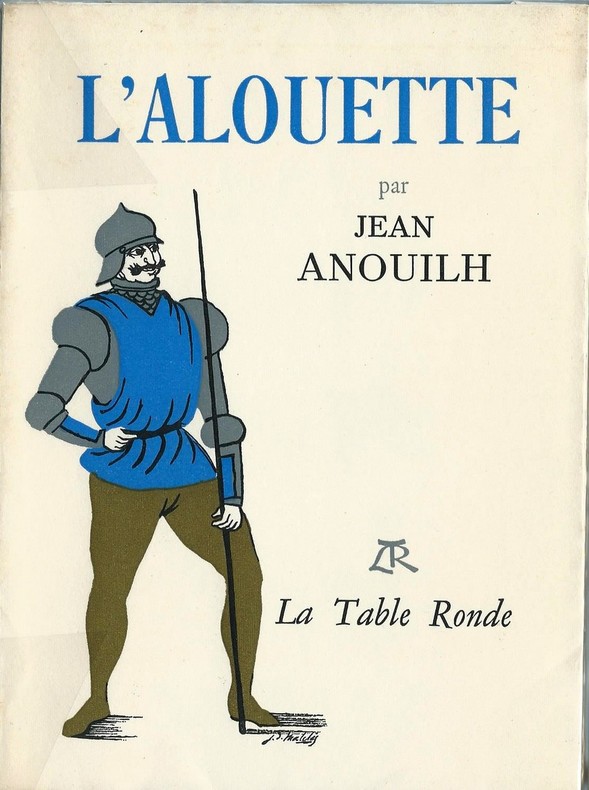
198126253Editions La Table Ronde 1953. In-8 broché de 229 pages au format 14 x 19,5 cm. Couverture rempliée, illustrée par Jean-Denis Malclès. Dos bien carré. Plats et intérieur parfaits. Exemplaire non coupé. Un des 30 exemplaires hors commerce du tirage de tête, numérotés sur Vélin Crèvecoeur ( n° H.C IV ). Etat superbe, proche du neuf. Edition originale, enrichie d'une magnifique dédicace autographe, signée, pleine page, de l'auteur à Monette Rapin.
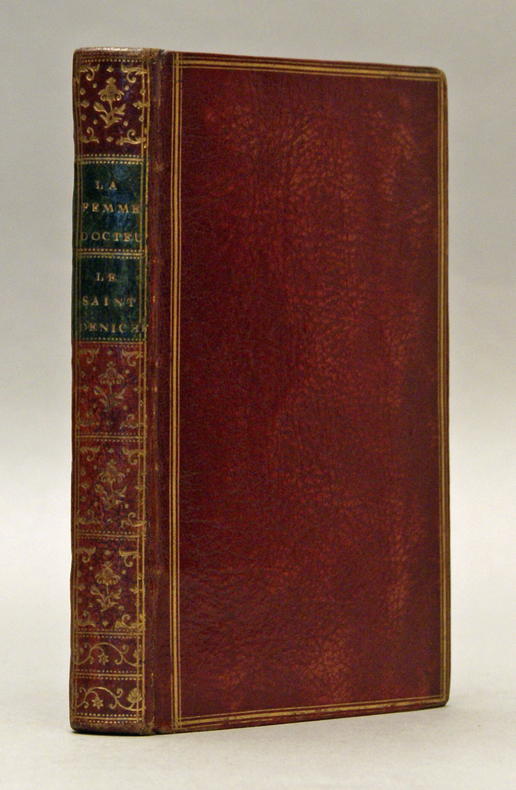
179La Haye, Adrian Moetjens, 1731 ; in-12 de [7] ff., 150-144 pp., reliure de l'époque, maroquin rouge, filets dorés en encadrement sur les plats, dos lisse orné, pièces vertes, roulette intérieure, tranches dorées.
239843Paris, Thomas Jolly, 1664 in-12, [6] ff. n. ch. (titre, dédicace au duc Christian-Louis de Mecklembourg-Schwerin, privilège), 72 pp., demi-percaline Bradel fantaisie, dos orné de filets dorés, pièce de titre noire, tranches mouchetées de rouge (reliure du XIXe). Coins abîmés, coiffe inférieure frottée, petits trous de vers stoppés en marge inférieure.
Edizione originale. Esemplare nella rara variante in inchiostro blu, in condizioni più che buone (quasi ottime), con sfrangiature e piccole perdite marginali che non toccano il testo. Poster réclame di grande impatto visivo per l’evento del primo film ufficiale del movimento futurista: «Si tratta senza dubbio del reperto di cinema futurista più iconico e impressionante dal punto di vista grafico: un poster di cm 64 x 44 a stampa cubitale solo recto, con grafica di grande impatto e modernità. Il poster è noto in due tirature pressoché identiche ma una stampata interamente in vivace inchiostro sanguigna, l’altra in inchiostro blu elettrico» (Coronelli). -- Elementi stilistici e contenutistici hanno portato recentemente a metter in dubbio la datazione al 1916, usualmente attestata nei cataloghi antiquari e nel repertorio dedicato da Paolo Tonini ai «Manifesti del futurismo italiano», oppure la versione leggermente diversa attestata da Giovanni Lista nel suo libro sul «Cinema futurista» del 2010 («manifesto per una tournée del film “Vita futurista” progettata all’inizio del 1917»): «Le caratteristiche tecniche del reperto ben si combinano con una collocazione primonovecentesca: carta satinata — molto usata, quindi completamente caduta in disuso nel corso del secondo Novecento — e stampa tipografica a caratteri di legno. L’aspetto grafico porterebbe a escludere gli anni Dieci, collocando piuttosto il documento nella decade intermedia 1925- 1935 – senza scartare aprioristicamente l’eventualità che il poster possa essere ricondotto a un progetto-revival del dopoguerra» (Coronelli). -- «“Vita futurista”, lungo 900 metri, con la partecipazione di Marinetti, Corra, Settimelli, Chiti, Balla, Nerino, Nannetti, Venna, Spina. [...] il film conteneva diverse trovate dell’arte d’avanguardia: una sequenza di “cinema diretto”, l’ingrandimento e il distanziamento degli oggetti, alcune immagini astratte di ombre e linee in movimento, il ricorso agli specchi deformanti, ecc. [...] per il loro film, i futuristi adottarono il modello della scena del varietà, con i suoi numeri ritmicamente concatenati nella più assoluta eterogeneità di forma e contenuto. [...] si trattava della stessa scelta che alimentava la rivoluzione teatrale futurista con le “sintesi”, le “sorprese” e le improvvisazioni sceniche. [...] in modo generale, il film rifletteva così il connubio dei futuristi con il mondo del teatro di varietà (Petrolini, Spadaro) e del cinema comico popolare (Polidor, Ridolini) […]» (Diz. Fut., p. 272a-b). Tonini, I manifesti del futurismo italiano, n. 103.2; Lista, Il Cinema futurista (2010), illustrazione dopo p. 64; Coronelli, Reperti cartacei del cinema futurista sul mercato antiquario: il poster “Primo film futurista” (Convegno internazionale nei cento anni del Manifesto della cinematografia futurista, Bologna 2015: 157-167)
199532S.l., 1777 in-12, [2] ff. n. ch. (titre, liste des rôles), 140 pp., cartonnage de papier doré, dos lisse muet, tranches mouchetées de rouge (reliure de l'époque). Importants manques de papier au dos.