Sobel, Sharon (Professor of Theatre and Costume Design, University of Nebraska, Omaha, USA)Biblio.com
1 094 résultats
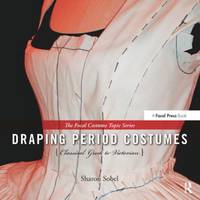
ria9780240821337_inpHardback. New. New Book; Fast Shipping from UK; Not signed; Not First Edition; Draping Period Costumes provides you with the skill set you need to break away from two-dimensional patterns to drape three dimensional costumes. The basics of draping are explained in precise detail followed by step-by-step draping pr hardcover
2461810 to 13 March 1931. Knight Frank & Rutley 20 Hanover Square London W.1. Printed by J. Davy & Sos Ltd. 8-9 Frith Street London. As the Great Depression hit Gibbons found himself over-extended and was forced into bankruptcy. The present item is scarce. The only copy on JISC is at the Paul Mellon Centre Library. 68pp 8vo. In grey printed wraps and with purchase slip tipped in. In fair condition lightly aged and worn. At head of title-page: ‘By Direction of Lieut.-Col. SIR WALTER GIBBONS K.B.E. D.L. Following the Sale of the Freehold and the proposed conversion of the Property into high-class Residential Flats.’ ‘Conditions of Sale’ on reverse of title. 974 lots. ‘Order of Sale’ as follows: First Day The Reception Rooms; Second Day Pictures Drawings and Engravings / Books; Third Day The Boudoir The Study The Secretary’s Office The Bedroom Furnishings; Fourth Day Silver and Plated Ware / China and Glass / Wine Linen and the Domestic Offices’. Around half of the book lots on the second day 300-508 are annotated in pencil with a bookseller’s bids. Loosely inserted is a slip of paper with a pencil note in the same hand: ‘clear Saturday / one lot only / 371 12/-/-’. 10 to 13 March 1931. Knight, Frank & Rutley, 20 Hanover Square, London, W.1. Printed by J. Davy & Sos, Ltd., 8-9 Frith Street, L paperback
22014On letterhead of 'Mr. John Hare's Autumn Provincial Tour 1900' Birmingham Liverpool Manchester. 15 September 1900. 2pp 12mo. In good condition lightly aged. The letter casts an interesting sidelight on the practicalities of the late-Victorian theatre. He begins by explaining that he is sending back a wig he made for him which was 'an admirable one in every way' and asking that he make him 'one like it for America & to bestow your best skill on it as it is of great importance to me'. He instructs him to 'make the wig a shade darker something of the color it is dyed behind & put a little natural white hair on the temples each side'. He urges him to be 'very careful that the waive is a natural one & not overdone it looks bad from the front see Mr in Julius Caesar'. He ends with the assumption that Clarkson will 'do your best for me'. James Morton in his 'Gangland Soho' 2012 alleges that Clarkson who has a blue plaque to his name at 41-43 Wardour Street was not only a repeated insurance fraudster but a notorious homosexual blackmailer after whom the public lavatory in Dansey Place was named 'Clarkson's Cottage'. On letterhead of 'Mr. John Hare's Autumn Provincial Tour, 1900' (Birmingham, Liverpool, Manchester). 15 September 1900. unknown
2415115 and 19 November 1957. Both on his letterhead. Carbon of Macqueen-Pope’s reply 18 November 1957 from Coventry House 5/6 Coventry Street W.1. For information on Littler see the entry in the Oxford DNB of his brother Prince Frank Littler 1901-1973 who did not share Emile’s ‘affection for plays or players individually’. Also see Macqueen-Pope’s entry in the same work. The three items in fair condition lightly aged and creased. Both signed ‘Emile’. ONE: TLS of 15 November 1957. 1p 4to. Reads: ‘My dear Popie / You know about everything in the Theatre and I am wondering if you could tell me how many London pantomimes Julian Wylie did either by himself or as the Wylie-Tate organisation. / I would be very interested to know if by any chance you have this information available.’ In autograph: ‘Many THANKS -’ and minor correction. With pencil note by recipient. TWO: TLS of 19 November 1957. 1p 4to. He thanks him for his letter ‘which I greatly appreciate. / I had been asked whether Julian Wylie had done more pantomimes in London than I had or vice versa. I had an idea that I was quite a number ahead and you have kindly confirmed it. Actually I have done fourteen in the West End and nobody living to-day has done as many as that.’ He thanks him for his trouble and evidently sending a bottle of wine ends: ‘Would you toast Julian with the attached.’ THREE: Unsigned carbon of Macqueen-Pope’s reply to Item One 18 November 1957. Speaking form memory since his ‘references’ are ‘at home’ he gives details of ‘nine major pantomimes’ that ‘Julian did’ in London. 15 and 19 November 1957. Both on his letterhead. Carbon of Macqueen-Pope’s reply, 18 November 1957, from Coventry House, 5/6 C unknown
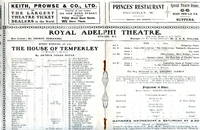
7546'Weightman Mountain & Andrews Ltd. Printers 31 & 33 Victoria Street Westminster S.W. 14/2/10' i.e. 14 February 1910. Dimensions roughly 26 x 20 cm. Four printed pages in a bifolium stapled into coloured illustrated covers. A scarce piece of theatre ephemera in reasonable condition: creased with rusted wraps and with one short closed tear to front cover which carries the words 'Adelphi Theatre. Sole Proprietors A. & S. Gatti.' and an illustration painted in an impressionist style of a fashionable group dining. Stamped 'Saturday Feb 19'. The back cover also in colour carries an advertisement for 'Vinolia Toilet Preparations' with an illustration entitled 'Envy' by 'W. O.' Advertisements throughout including a full-page advertisement for Edwardes' Gaiety and Daly's Theatres other advertisements include ones for 'Madame Dowding Court Corsetiere' and 'Odol The World's Dentifrice'. Half-page 'Refreshment Tariff'. Cast list and details of performance in central double-page spread. Doyle took a six-month lease on the Adelphi in order to produce 'The House of Temperley'. The death of King Edward VII caused a serious slump in ticket sales and this coupled with the subject which was considered unsuitable for ladies resulted in a short run. There is no copy of this item on COPAC. The play did not appear in book form. Note: "The House of Temperley is a 1913 British silent drama film directed by Harold M. Shaw and starring Charles Maude Ben Webster and Lillian Logan.1 It is based on the 1896 novel Rodney Stone by Arthur Conan Doyle and is sometimes known by the alternative title Rodney Stone. The House of Temperley was the first film made by the London Film Company and first shown in Nottingham" Wikipedia not mentioning the play; B. See also Conan Doyle Encyclopedia. See Image. ['Weightman Mountain & Andrews, Ltd., Printers, 31 & 33 Victoria Street, Westminster, S.W. 14/2/10' [i.e. 14 February 1910].] paperback
68-6434Paris France: Simon Theatre Francais Bordeaux 1889. Folio. Telegram mounted on illustrated color pencil sheet of backing paper with hand written dated note in black ink. Good with tears & losses. En Francais. Provenance:Colette Monceau born Nancey 1921-2016. Biographical note: born in Nice in 1921 Colette Monceau was a student of Charles Dullin in the second half of the forties and played in several plays during the same period. At the end of the 1950s she took courses at Pierre Foix's school of graphology in Paris and worked in particular on dance as part of the exam for the Group of Consulting Graphologists of France. Having become a consultant graphologist she also teaches this technique. Particularly interested in the writings of Louis Jouvet and Sarah Bernhardt she wrote three works that remained unpublished as well as several articles. It constitutes a thousand files devoted to actors and actresses as well as personalities from varied backgrounds. Colette Monceau née Nancey 1921-2016. Notice biographique : née à Nice en 1921 Colette Monceau est élève de Charles Dullin dans la seconde moitié des années quarante et joue dans plusieurs pièces à cette même période. À la fin des années cinquante elle suit les cours de l’école de graphologie de Pierre Foix à Paris et travaille notamment sur la danse dans le cadre de l'examen du Groupement des graphologues conseils de France. Devenue graphologue-conseil elle enseigne également cette technique. S'intéressant notamment aux écritures de Louis Jouvet et de Sarah Bernhardt elle rédige trois ouvrages restés inédits ainsi que plusieurs articlesExpertise by Daniel BRUKARZ Expert auprès de la CEA. Paris. Paris, France: Simon Theatre Francais Bordeaux, 1889. unknown
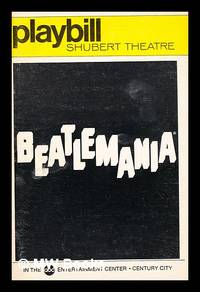
1978373553New York: The Shubert Organization 1978. First Edition. Softcover. Near fine pamphlet copy; wrappers very slightly dulled. Remains particularly well-preserved overall: tight bright and clean. Physical description; 32 pages ; 20 cm. Subjects; New York State New York. Theater programs. Theatre; history. Drama; history. The Beatles; history. The Beatles; Beatlemania. New York: The Shubert Organization paperback
19-4894Tokyo: 1950. 4to. 36 pp. Soft cover. Very good with writing on front cover. Some color plates. Text in English and Japanese. Includes two pages of handwritten notes. Tokyo: 1950. paperback
15-10941Tokyo Japan: Shinbashi Theatre 1959. 8vo. 20 pp. Stapled Wraps Very Good with toning to covers. Text in English & Japanese. Scarce. Tokyo, Japan: Shinbashi Theatre, 1959. paperback
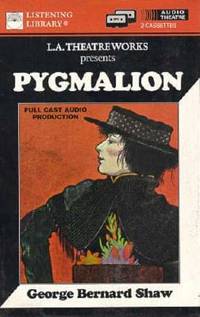
0807235563-11-1Listening Library. Very Good. It's a well-cared-for item that has seen limited use. The item may show minor signs of wear. All the text is legible with all pages included. It may have slight markings and/or highlighting. Listening Library unknown
23795Item One dated 1 November 1923; Items Two and Three undated but from around the same time. Shakespeare Memorial Theatre Stratford-upon-Avon. The three items of ephemera are in good condition lightly aged. ONE: Circular headed ‘SHAKESPEARE MEMORIAL THEATRE / STRATFORD-UPON-AVON / ENDOWMENT FUND.’ Dated 1 November 1923 and with autograph signature possibly by proxy of ‘H C Lacey’ ‘Organising Secretary H. C. LACEY M.B.E.’. Shakespeare’s coat of arms printed in red ink at top right. Begins with the debatable assertion: ‘Many men and women have given great gifts to our Nation - inventions discoveries territory and creations of literature and art - but the greatest of all is the glorious inheritance bequeathed to humanity by William Shakespeare.’ Continues in the same pretentious vein before describing the ‘reproach that the Library Sculpture and Art Gallery Reading Room and Lecture Hall at Stratford-upon-Avon is unable to complete its catalogue maintain a librarian or fully develop its educational facilities owing to lack of funds. / The entire Press of the English-speaking world the leaders of Politics Art Drama Literature and Society the Lord Mayor of London and the Mayors of the principal cities and towns warmly endorse the appeal of the Governors of the Memorial for funds to enable the intentions of the Founders to be fully realised. / To this end November 8th. is to be observed as National Shakespeare Day. Each district city and town has been asked to raise its quota. There will be no street collections prize schemes or ballots but just this appeal to those who value the “Common Heritage†to send a subscription be it large or small one shilling or hundreds of shillings one pound or hundreds of pounds to the Shakespeare Memorial Endowment Fund.’ Ends with reference to ‘our greatest sic National Bard’. TWO: Printed advertisement for ‘National Shakespeare Day Appeal / for Tribute to Shakespeare / TO ENDOW THE MEMORIAL THEATRE LIBRARY / READING ROOM ART GALLERY AND LECTURE ROOM / Erected in the Poet’s Memory in Stratford-upon-Avon the Town of his Birth.’ Titled on front cover with black and white illustration of rural scene ‘OUR “COMMON HERITAGE.†/ THE SHAKESPEARE MEMORIAL THEATRE / STRATFORD-UPON-AVON.’ 4pp landscape 16mo. Bifolium. Middle two pages describe ‘The Appeal in Brief’ in small print: ‘The Hope’ ‘The Measure of Realisation’ ‘The Great Need’. At end: ‘Will you pay tribute’ List of ‘Patrons Governors Hon. Governors and Life Members’ on last page with quotation from The Times 23 April 1923. Enclosed is THREE: A ‘Donation & Subscription Form’ on one side of single 16mo leaf of browned paper. Headed ‘NOVEMBER 8th. 1623. / Publication of the First Folio of / SHAKESPEARE’S PLAYS. / His Glorious Gift to Humanity.’ The entry in the Oxford DNB for its director Bridges-Adams reminds us that 'On 6 March 1926 the Memorial Theatre was burnt down greatly to the relief of G. B. Shaw.' Item One dated 1 November 1923; Items Two and Three undated but from around the same time. Shakespeare Memorial Theatre, Stratfo unknown
23794Shakespeare Memorial Theatre Stratford-upon-Avon. Neither item dated but both from 1923 and before ‘National Shakespeare Day’ 8 November 1923. The two items of ephemera are in good condition lightly aged. ONE: Printed advertisement for ‘National Shakespeare Day Appeal / for Tribute to Shakespeare / TO ENDOW THE MEMORIAL THEATRE LIBRARY / READING ROOM ART GALLERY AND LECTURE ROOM / Erected in the Poet’s Memory in Stratford-upon-Avon the Town of his Birth.’ Titled on front cover with black and white illustration of rural scene ‘OUR “COMMON HERITAGE.†/ THE SHAKESPEARE MEMORIAL THEATRE / STRATFORD-UPON-AVON.’ 4pp landscape 16mo. Bifolium. Middle two pages describe ‘The Appeal in Brief’ in small print: ‘The Hope’ ‘The Measure of Realisation’ ‘The Great Need’. At end: ‘Will you pay tribute’ List of ‘Patrons Governors Hon. Governors and Life Members’ on last page with quotation from The Times 23 April 1923. Enclosed is TWO: A ‘Donation & Subscription Form’ on one side of single 16mo leaf of browned paper. Headed ‘NOVEMBER 8th. 1623. / Publication of the First Folio of / SHAKESPEARE’S PLAYS. / His Glorious Gift to Humanity.’ The entry in the Oxford DNB for its director Bridges-Adams reminds us that 'On 6 March 1926 the Memorial Theatre was burnt down greatly to the relief of G. B. Shaw.' Shakespeare Memorial Theatre, Stratford-upon-Avon. Neither item dated, but both from 1923, and before ‘National Shakespeare Da unknown
2602420 of Brassington’s 21 letters from between 1899 and 1902 and on letterheads of Shakespeare Memorial Stratford-upon-Avon; the other is from 1910. Among the other items are ones dated from between 1899 and 1928. The Shakespeare Memorial Theatre was founded through the efforts of local brewer Charles Edward Flower 1830-1892 after whose death its management was taken over by his brother Edgar Flower 1833-1903 also Chairman of the Shakespeare Birthplace Trust. On Edgar’s death these duties fell to his son Archibald Flower 1865-1950 several times mayor of Stratford-upon-Avon. The present correspondence concerns a gift to Shakespeare Memorial Association by the appropriately-named anatomist Evan Marlett Boddy. Between 1899 and 1901 Boddy donated at least twelve portraits to be hung in the Shakespeare Memorial reading room from the correspondence wood carvings also appear to have been donated. Details of the first seven portraits are contained in a letter of 11 December 1899 from Boddy to the Shakespeare Memorial librarian the archaeologist W. S. Brassington for which see below. The paintings included supposed works by Henry Fuseli ‘The Fuseli Macbeth’ and Sir Peter Lely Nell Gwynne Henry Wyatt Coleridge and a portrait said to be by Romney of a young Percy Bysshe Shelley five letters by Brassington relating to which are offered separately one of Alexander Pope ‘attributed to Hogarth’ as well as a ‘Garrick portrait’ one of Nell Gwynne and a ‘Spanish Lady’. In 1916 Boddy demanded their return on discovering that the Archibald Flower had broken the condition that Boddy had arranged in 1900 with the then librarian W. S. Brassington: ‘The Portraits were to be hung together and remain so.’ The present collection of 37 items is in good condition lightly aged apart from a couple of items are creased and worn both being repaired with archival tape. The 20 of Brassington’s 21 letters dating from the years 1899 to 1902 totaling 39pp 12mo; and 1p 4to convey his enthusiasm with regard to the donation. In the first letter 9 December 1899 Brassington acknowledges receipt of a letter from Boddy ‘respecting portraits of Shakespeare’ noting with pleasure Boddy’s ‘kind proposal to present the pictures to the Shakespeare Memorial’. Three days later 12 December 1899 he arranges to ‘come over and view’ ‘the pictures which you so generously propose to bestow upon the Shakespeare Memorial’. On 16 December arrangements are made for the removal of the pictures by ‘stage carpenter’ Henry Mann with Brassington reporting that ‘Mr Flower our Chairman who is at present away from home . thinks it most kind of you to make this very handsome present’. And a week later 19 December 1899 he acknowledges receipt of ‘the seven portraits which you so generously bestow upon the Shakespeare Memorial’ adding ‘Now that the portraits are in a good light I am more than ever delighted with them and I think you will be so when you see them in the Gallery.’ On the same day 19 December 1899 Edgar Flower writes to Boddy from The Hill Stratford-on-Avon as ‘Chairman of the Council’ to report ‘how greatly the gift is approved’. He continues: ‘In due course you will receive an official acknowledgment but in the meantime allow me to say personally that I consider each of the portraits as of great merit and interest and that they wil be conserved as your gift in the gallery to which they are a magnificent addition’. Six months later the works have been properly hung and on 23 June 1900 he writes that the ‘beautiful pictures have been much admired to-day by our London visitors many of whom had not seen Stratford before’. Four days later he informs Boddy that his ‘beautiful pictures reached here in safety. The “lady†is before me in a good north light and looks magnificent.’ Shortly afterwards 10 July 1900 he goes into some detail with regard to the hanging: ‘The “Spanish Lady†and other pictures now adorn the walls of the Memorial and are being very greatly admired. Mr Flower is unwell and I have not been able to obtain his signature to a card of thanks but at the monthly committee meeting great satisfaction was expressed at your generosity. The Grinling Gibbons’ carving now stands upon the carved oak mantle shelf of the Reading Room. It is most handsome and suitable since it represents the arms of London where Shakespeare lived for the greater part of his life. Moreover the carving hides an ugly modern Dutch bronze portrait of Shakespeare now well out of sight! / The Seven ages of Man adorn the staircase. And the “Spanish Lady†hangs over-against Nell Gwynne above the other portraits in the end gallery.’ The letter continues with speculation about the subject’s identity. On 23 July 1900 he reports: ‘The two valuable additions to the collection of paintings so kindly presented by you to the gallery are now placed on the walls. The Fuseli hangs near another example by the same master in the 1st gallery the Sir Peter Lely is placed with the other portraits between Nell Gwynn and the Spanish Lady’ which is ‘one of the most beautifully painted pictures I have ever seen’. He is so struck by it that he ‘went to the Dulwich Gallery last week to make notes but found nothing like this picture there’. A letter of 1 November 1900 begins by commending Boddy’s gift of the proof of his ‘brochure’ ‘Shakespeare’s Garden’. Brassington then discusses his holiday ‘in a cottage on the quay at Minehead. We had a good time at that old-world place and I ventured to Stratford refreshed. I had found the summer season with its crowd of Americans rather trying.’ He is relieved that Boddy was well treated by the staff in his absence: ‘they all take the greatest interest in the work of the memorial . Unfortunately of late there has been a discordant note sounded by Miss Corelli but people here are now aware that a great fuss is being made about a little matter.’ Turning to Boddy’s gift he writes: ‘I am glad you approve of the arrangement of the portraits. We expect next week to receive a portrait and a bust of Miss Mary Anderson and possibly a bust of Ellen Terry so you see we are adding to the collection and to the interest of the place.’ On 27 November 1900 he reports that he has been told by ‘Elliott’ that ‘the portrait of the boy with a dog which you recently presented to the Memorial appears to me to be more like the work of Vandyck than of any other artist. I sincerely hope it may be so’. And on 18 January 1901 he writes: ‘The two paintings reached here safely - they are beauties.’ On 3 June 1901 Brassington writes on the wider question of ‘Memorial Picture Gallery’ reporting that he has had ‘a call from Mr Frank Richards 1863-1935; Newlyn School an artist late of Birmingham now of No. 6 Addison Studios West Kensington. / Mr Richards has painted a large picture of “Hamlet†which he wishes to place in the Memorial Picture Gallery. Sir Henry Irving and Mr Flower have offered £10. each towards a subscription to buy the picture for the Memorial and it is possible that Mr Richards may write to you on this subject.’ He gives further details of appeal reporting Edgar Flowers’ opinion that that painting is ‘a fine work of art though in his opinion the face of Hamlet is too old looking’. He discusses the difficulties involved in dealing with such a ‘large Shakespearian picture’ two or three of which have been offered to the Memorial there being ‘no fund for the purchase’ and a reluctance on the part of the governors ‘to make an appeal either to the Governors or the public. The Committee feel that any suggestion of begging for donations should be avoided at the same time they dont like the idea of refusing a good and suitable picture’.Fifteen years later the mood has drastically worsened. Seven items from 1916 mostly carbon copies of TLsS dealing with a complaint by Boddy regarding the handling of a collection of historic portraits presented by him to the Shakespeare Memorial Association in 1900. Boddy states in a TLS copy to Steward Dick from Ashted Row Birmingham 17 June 1916: ‘I was certainly more than surprised to find my pictures scattered about the building in a most indiscriminate manner. I presented them to the Memorial on the distinct understanding that they were to be kept together’. Edgar Flower’s son Archibald replies in an undated carbon from The Hill Stratford on Avon: ‘I am indeed sorry that there should have been any misunderstanding and that you who have been a govener sic so long should have been caused pain by the rehanging of these pictures / At the time you gave these my father was chairman and I had no knowledge of your having expressed any special wish as to the grouping.’ The other five items relating to this complaint are a copy of a letter of complaint from Boddy to W. S. Brassington ‘being that you were Librarian at the Memorial Theatre when I presented my collection of pictures’ stating that he has ‘demanded the return of all my pictures’ and two copy letters from W. S. Brassington to Boddy one referring to ‘these tiresome people at Stratford’ and copies of a memorandum ‘Suggestion for Inscription / Collection of Historic Portraits’ and note to Stewart Dick see below stating that the matter is in the hands of Boddy’s solicitor. Other material comprises: ONE: ALS copy from Boddy to Brassington Ashted Row Birmingham 11 December 1899. Giving details of seven portraits he would be ‘pleased to present’ and suggesting that he visit to view them. ‘Though the portraits do not relate to Shakespeare I think when you see them you will agree with me that they will be a valuable and most interesting addition to your collection.’ TWO: An ALS from Brassington 31 August 1910 hinting at trouble to come with regard to ‘the circumstances connected with your suggestion for a tablet’: ‘Your wishes were clearly expressed to the committee when the pictures were received & would be recorded in the Minute book. / It seems to me that the words quoted by Mr Archibald Flower constitute a condition & that the gift was accepted on those terms - certainly that is what I understood.’ THREE: Two ALsS to Boddy from Stewart Dick one 22 July 1916 on letterhead of the Old Brewery House Stratford-upon-Avon the other undated on same letterhead cancelled in favour of Shakespeare Memorial Theatre. He begins the dated letter: ‘Mr Lowndes has handed me the letter from Messrs Philip Baker & Co regarding your pictures. Dont you think that the best plan will be for me to run up to you one day next week . I am sure after meeting you the other day that we can arrange the matter quite amicably without troubling the lawyers further.’ On the reverse of the letter is a pencil draft of Boddy’s reply informing him that ‘the matter is now entirely in the hands of my solicitors’ for typed carbon of which see above. Dick’s second undated letter is a longish one 4pp 12mo 67 lines apparently from the time of the donation commenting enthusiastically on the pictures and asking for information about them. FOUR: Transcription by Brassington of ‘Suggestion for Inscription’ by Edgar Flower dated April 1900. States that the collection of twelve paintings was ‘presented to the Shakespeare Memorial Association by Evan Marlett Boddy Esqr. F.R.C.S. on condition that the pictures be kept together and not removed from the Memorial Buildings at Stratford on Avon.’ FIVE: An ALS to Boddy from Charles Lowndes 26 April 1900 on Shakespeare Memorial letterhead apologising for spelling Boddy’s name wrongly. SIX: Signed receipt for ‘Black & gold frame’ from J. Morgan of Stratford-upon-Avon 12 January 1901 on his letterhead. SEVEN. Printed notice by ‘Edgar Flower / Chairman’ Shakespeare Memorial Stratford-upon-Avon dated 20 June 1900 regarding ‘Presentation of William Page’s Bronze Bust of Shakespeare’ to the Whitefriars’ Club City of London. EIGHT: Printed ‘Fifty-second Report of the Council to be submitted to the General Meeting of the Governors of the Shakespeare Memorial Theatre Stratford-upon-Avon convened for Monday April 23rd 1928.’ 4pp folio. With long list of officers and governors statement of expenditure and receipts and report of executive council. 20 of Brassington’s 21 letters from between 1899 and 1902, and on letterheads of Shakespeare Memorial, Stratford-upon-Avon; th unknown
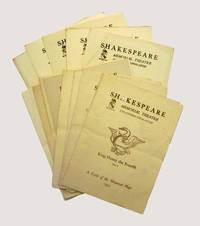
19516675Stratford upon Avon; Shakespeare Memorial Theatre 1951-1956. 1951. Original Wrappers. 29 programmes for productions of Shakespeare's plays during the 1950s. Quarto each approx 25 cm x 19. Four have printed synopses loosely inserted while Richard III has a printed pedigree; 2 include promotional slips relating to refreshments. Each have a historic central horizontal crease from folding and several are lightly soiled with minor foxing to rear covers otherwise all are clean and bright; one of the 1952 Tempest copies is creased to lower edge and has ownership inscription to front top corner. Overall condition: Very Good. All the productions excepting Voplone in 1952 were of Shakespeare's plays and there is only one duplicate in the series The Tempest 1952. An exceptional record of the actors and supporting production and theatre staff. Scarce. Stratford upon Avon; Shakespeare Memorial Theatre, 1951-1956. unknown
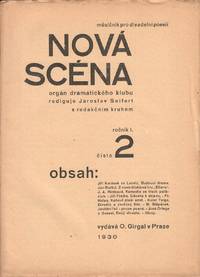
P5666Prague: Otto Girgal 1929-1930. Small quartos 24.5 × 17.5 cm. Original printed wrappers; consecutive pagination 135 6 pp. Occasional illustrations. Small loss to lower right corner of first issue not affecting text; the other issues in fine condition in protective mylar. Complete run of this Czech avant-garde theatre journal which arose as a polemical forum for a less conservative more visually inventive and experimental theatre and was edited by the poetist writer Jaroslav Seifert. As the surrealist poet Vítězslav Nezval writes in his manifesto "The avant-garde stage" from the first issue: "Forget all theatres that don't implement the most furtive needs of your bodies and souls forget them all" p. 9. With theoretical essays and manifestos by F. X. Šalda Jan Bartoš E. F. Burian Arnošt Dvořák Karel Teige Jiří Karásek ze Lvovic Vítězslav Nezval; poetry by Halas and Hora; excerpts of plays by Nezval Bartoš Alfred Jarry and others. Also contains shorter glosses about cultural events related to theatre. With drawings by Toyen Jaroslav Král František Muzika and Arch. Heythum and appealing understated typographic design throughout to both front and rear wrappers. KVK OCLC show copies at the British Library Bayerische Staatsbibliothek Cambridge Deutsche Nationalbibliothek Getty Harvard Herder-Institut and Oxford. unknown
1326995618.Gpaperback. Good. Access codes and supplements are not guaranteed with used items. May be an ex-library book. paperback
1984532c6646U.K.: A.E.T.C. 1984. Book. Illus. by Schweitzer Alex. Good. Paperback. First Edition. 4to - over 9¾" - 12" tall. 64 pages. Many black and white photos. "Researched with pensioners from the West Indies India the Far East Cyprus Poland and Italy. In their own words contributors recall their homelands their arrival in Britain settling in London and their varied experiences here. In all cases stories appear in the original language as well as English." - from title page. Clean and unmarked with light wear. A quality copy. A.E.T.C. Paperback
15-7734London: Scala Theatre 1952. 4to. 16 pp. Soft Covers Very Good with staining minor creasing and edge wear. Illustrated. Program for the First Amateur Production. London: Scala Theatre, 1952. paperback
15-6881London: Saville Theatre 1962. THEATRE PROGRAM. 8vo. 12 pp. Very good in wraps with creasing some staining minor edge wear some shelf wear. Photographs. Includes extract of article on Ustinov by Peter Daubeny penned in 1962. London: Saville Theatre, 1962. paperback
22783On letterhead of The Western Times Office Exeter. 30 March 185 '. Phelps's entry in the Oxford DNB gives the background to the present letter stating that Phelps 'married Sarah Cooper 1810/11–1867 on 11 August 1826; she was just sixteen. However their marriage was very happy: they were a devoted couple and Sarah later served as Phelps's dresser. Phelps preferred home life with her to clubs or social gatherings. His other delights were angling and shooting and he purportedly knew every trout stream in England. They had three sons and three daughters including William Robert 1828–1867 who became chief justice of St Helena and Edmund d. 1870 who became an actor.' 3pp 12mo. Bifolium. In fair condition lightly aged and worn. Folded twice. The first three digits of the year are printed in the letterhead and have not been completed. The letter begins: 'My dearest/ I promised to write to-day I believe though I can only tell you that I am well and getting lots of fresh air - Yesterday the boys and I went fishing but found the river flooded - it was showery but still delightful - To-day the weather is better and we think of going off to morrow and trying our luck at Axminster'. With reference to his son William Robert noticed above he writes: 'I took a long walk with Bob this morning and had a long talk with him - he seems perfectly settled - Latimer says he gets on famously - his health is very much better and he looks well'. He asks her to write and tell him 'how the Concert went off last night and what was in the house - Mr Latimer is laying down all kinds of plans for my going to all sorts of places but I think I can come home at the end of the week'. If he finds 'any difficulty in getting away' 'Greenwood' - i.e. Thomas Greenwood the lessee of Sadler's Wells - is to 'send a line to say I am wanted'. He ends by asking her to 'have every thing ready to start off for Farningham as soon as I return - the holidays are short and I must make the most of my time - Kiss the boy all over for me God bless you my darling S. P.' On letterhead of The Western Times Office, Exeter. 30 March 185[ ]'. unknown
2682629 December 1917; on letterhead of the Rialto Times Square New York. One page quarto. On paper discoloured with age. Attached along one edge of blank verso to card mount. Reads 'To simply tell you that your work is good would be putting it mildly. Things that I have heard all about me as I sat and watched the performance for the first time from a loge seat if you heard them make sic you very very happy. Your appearance is majestic; your enunciation beautiful; your reading and interpretation a delight. I cannot tell you how proud I am of you. Not alone have you done a great thing for yourself but you have thrilled and will thrill many thousands in your audiences and most especially those that are Americans. I want you to know that I appreciate the hardships and inconveniences under which you are working but you may be sure that I am not one to forget.' Signed 'S. L. Rothapfel'. 29 December 1917; on letterhead of the Rialto, Times Square, New York. unknown
1958HALL512437Paperback. 1958. Foreword by Olga Knipper Chekhova. Souvenir Programme. 16pp 4to illustrations London 1958. Contains portraits and details of 24 members of the company. Together with 12-page programmes for the productions of The Three Sisters Uncle Vanya & The Cherry Orchard. 4 items. The souvenir programme is slightly marked. . paperback
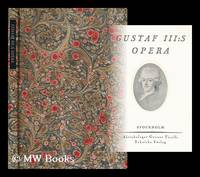
1923203932Stockholm : Gunnar Tisells tekniska forlag 1923. First Edition. Hardback. Near fine copy bound in contemporary floral boards. Gilt-blocked leather label on spine. Slightest suggestion only of dust-dulling to the spine bands and panel edges. Remains particularly well-preserved overall; tight bright clean and strong. ; 8vo 8"" - 9"" tall; 87 pages; Description: 87p. plates ports. ; 24cm. Subjects: Gustaf III -- Opera -- Royal Theatre -- Sweden. Stockholm : Gunnar Tisells tekniska forlag hardcover
11-0910Stratford-upon-Avon: Royal Shakespeare Theatre ca. 1980s. Poster measuring 20 x 30 inches. Very good. Stratford-upon-Avon: Royal Shakespeare Theatre, ca. 1980s. unknown
11-0911Stratford-upon-Avon: Royal Shakespeare Theatre ca. 1980s. Poster measuring 20 x 30 inches. Directed by Trevor Nunn. Very good. Stratford-upon-Avon: Royal Shakespeare Theatre, ca. 1980s. unknown