1 833 résultats
1922mon0000074106Charles Griffin and Company Limi 1922-01-01. Hardcover. Good. in x in x in. Ex-library book usual markings. Hardback. Clean text sound binding. Charles Griffin and Company Limi hardcover
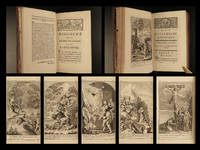
176818084<p><b>1768 Fleury Historical Catechism Illustrated BIBLE BANNED Prohibited Book Index</b></p><p>Claude Fleury was a 17th-century French priest best-known for his histories of the church and church doctrine. One of his best works was his '<i>Historical Catechism'</i> – a history of Christian doctrine. It covers the secrets of the foundation of Christianity siting references from scripture and Bible stories. The <b>Catholic Church condemned this book and immediately placed it on the Prohibited Books Index.</b></p><p>This impressive 1768 two-volume edition <b>contains 40 full-page engravings</b>depicting iconic Bible scenes including Creation and the Great Flood!</p><p>Item number: #18084</p><p>Price: $599</p><p>FLEURY Claude</p><p><b><i>CateÌchisme historique contenant en abreÌgeÌ l'histoire sainte & la doctrine chreÌtienne</i></b></p><p>A Paris : Chez Herissant fils 1768.</p><p><u>Details</u>:</p><p>· Collation: Complete with all pages – 2 volumes</p><p>o Vol. I – vii cxi 1 228</p><p>§ 31 engraved plates</p><p>o Vol. II – viii 446 2</p><p>§ 9 engraved plates</p><p>· Language: French</p><p>· Binding: Leather; tight and secure</p><p>· Size: ~6.75in X 4in 17cm x 10.5cm</p><p>Our Guarantee:</p><p>Very Fast. Very Safe. Free Shipping Worldwide.</p><p>Customer satisfaction is our priority! Notify us with 7 days of receiving and we will offer a full refund without reservation!</p><p>18084</p><p><br /></p><p>Photos available upon request.</p> Herissant fils hardcover
1716ANT237A. Bruxelles: Chez Eugene Henry Fricx 1716. Full leather. 12mo. Complete in 34 volumes.Full leather boards with raised bands and some gilt decorations along spines. Title plates are black leather with some gilt decorations and borders. Some of the title blocks are chipping and missing small piece. Ex-library with tipped in stickers on paste down end papers. Volumes are worn scuffed and worn. Spines are chipped at edges some are missing headbands. Some of the spines are cracking down the middle. Corners are curling and gently bumped and rubbed so that the board beneath is exposed. Spine/board seams are cracking; but boards are attached. Moderate foxing throughout; some more affected than others. Good condition considering age. A. Bruxelles: Chez Eugene Henry Fricx hardcover
BN103739LIB DES ECOLES. Softcover. Je lis et j'écris avec Salto CP - Guide pédagogique <br/><br/>Je lis et j'écris avec Salto CP - Guide pédagogique LIB DES ECOLES paperback
BN312558Éd. Faton. La crypte archéologique du parvis de Notre-Dame Guide & monographie <br/><br/>La crypte archéologique du parvis de Notre-Dame Guide & monographie Michel Fleury et Venceslas Kruta Éd. Faton unknown
201554003Norwalk Connecticut: Easton Press 2015. First Easton Press edition. Folio 20" x 12". 2 vols. The deluxe edition in full brown leather covers illustrated and lettered in gilt. A.e.g. Illustrated with 100s of portraits sketches and maps by Forbes Waud Taylor Beard Becker Lovie Schell Crane and numerous other eye-witnesses to the strife. A limited edition but the limitation not stated. A fine as new set still in publisher's original shrinkwrap and the original shipping box. <br /> <br /> Contents: History of the Grand Army of the Republic / by Paul Vandervoort -- History of the Sons of Veterans / by A.P. Davis and by Frank P. Merrill -- Chronological list of events 1860-1865 and miscellaneous statistics / compiled and arranged by T. Campbell-Copeland.<br /> <br /> Note: this majestic tribute to America's Civil War was first printed in 1884-1885 by J. H. Brown. This current Collector's Edition reprint was offered by the Easton Press in 2015 at $660. Easton Press unknown
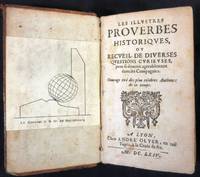
16649877Lyon: Andre Olyer. Good with no dust jacket. 1664. Leather. vi 228 x pp. Includes "Le Ballet des Proverbes. Danse par le Roy le 17 Fevrier 1654. " Ouvrage tire des plus celebres autheurs de ce temps." Full leather contemporary binding corners rubbed spine head rubbed bottom spine rubbed and compartment leather partially gone 5 raised bands scuffed lack on the rear. Interior no blanks paper generally aged with some foxing throughout bottom corner of page 7 torn off affecting text but otherwise complete and good. Bookplate of proverb collector and reputed WWII spy de Guinzbourg this the first iteration as Lt. Col. A curious book of proverbs long attributed to the Count of Cramail who had written a Comedy of Proverbs but more recently attributed to a plagiarism of Fleury de Bellingen's 1653 work on proverbs. Proverbs were extremely popular in the 1600s and as here were used during entertainments. This includes the rather obscure proverb "shit on your throat" always an attention getter at parties! ; 12mo 7" - 7½" tall; 228 pages . Andre Olyer hardcover
184539012Rochefort: Honorine Fleury 1845. Two volumes complete. AN EXCELLENT SET OF THE FIRST AND ONLY EDITION aside from several recent reprints OF THIS RARE HISTORY OF ROCHEFORT COMPLETE WITH LITHOGRAPHED PORTRAITS BY GARNIER AND THREE FOLDING MAPS. I: 7 II XXVII 468 XII pp 2 lithographed portraits by A. Garnier and a handcolored folding map; 3 528 XI pp a lithographed portrait and two folding maps. Printed on fine wove paper. 8vo. Attractively bound in contemporary quarter calf and decorated boards. Light wear to bindings internally clean. Rare. <br/><br/> Honorine Fleury hardcover
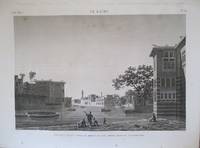
1965Middle East: Paris Impremerie de C.L.F.Pancoucke 1820-1829. Copper engraved view of the grand square of Birket-el-Fyl Cairo from the first volume of the "Etat Modene "of the "Description de l'Egypte" 2nd Edition; 1822; black & white; verso blank. Blind stamp of the publisher Panckoucke to margin. The view shows the square in a state of flood with boats upon the water. Good dark impression; some foxing to plate darker spots to lower margin; in the upper margin remains of glue from tissue guard outside the platemark. "Description de l'Egypte ou Recueil des observations et des recherches qui ont été faites en Egypte pendant l'expédition de l'armée française." When Napoleon Bonaparte invaded Egypt in 1798 he brought with him an entourage of more than 160 scholars and scientists. Known as the French Commission on the Sciences and Arts of Egypt these experts undertook an extensive survey of the country's archeology topography and natural history. . For four years more than 150 artists engineers linguists and scientists traveled throughout the country examining almost every aspect of ancient and contemporary Egypt. They recorded and measured in meticulous detail Egypt's topography flora and fauna and its ancient and contemporary architecture. A soldier who was part of the expedition found the famous Rosetta Stone which the French linguist and scholar Jean-François Champollion 1790-1832 later used to unlock many of the mysteries that long had surrounded the language of ancient Egypt. The Egyptian expedition ended with a total military failure. The French left Egypt in 1801 with the honors of war but defeated; yet military failure remains a significant event in the history of knowledge because it is the first time a military expedition was accompanied by a scientific expedition. In 1802 Napoleon authorized the publication of the commission's findings in a monumental multi-volume work that included plates maps scholarly essays and a detailed index. Publication of the original Imperial edition began in 1809 and continued to 1822 sold by subscription. It proved so popular that a second edition was published under the post-Napoleonic Bourbon Restoration. The "Royal edition" published in Paris by C.L.F. Panckoucke from 1820-1830. The Second edition consists of 11 or 12 volumes of plates in folio and 24 of text bound as 26 8vo. Brunet:II 617; Blackmer/Navari: 476 1st edition Middle East Egypt Cairo Birket-el-Fyl Paris Impremerie de C.L.F.Pancoucke 1820-1829 unknown
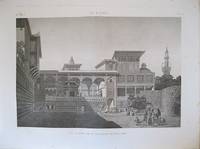
1967Middle East: Paris Impremerie de C.L.F.Pancoucke 1820-1829. Copper engraved view of the interior of a noble Egyptian house Cairo from the first volume of the "Etat Modene "of the "Description de l'Egypte" 2nd Edition; 1822; black & white; verso blank. Blind stamp of the publisher Panckoucke to margin. The view shows the courtyard of the house belonging to Osman Bey Visitors arrive on horse and camel and are ushered up to an audience with the Bey. The view shows the ornate decoration of the house with a minaret in the background. Good dark impression; some foxing mainly to blank margins. "Description de l'Egypte ou Recueil des observations et des recherches qui ont été faites en Egypte pendant l'expédition de l'armée française." When Napoleon Bonaparte invaded Egypt in 1798 he brought with him an entourage of more than 160 scholars and scientists. Known as the French Commission on the Sciences and Arts of Egypt these experts undertook an extensive survey of the country's archeology topography and natural history. . For four years more than 150 artists engineers linguists and scientists traveled throughout the country examining almost every aspect of ancient and contemporary Egypt. They recorded and measured in meticulous detail Egypt's topography flora and fauna and its ancient and contemporary architecture. A soldier who was part of the expedition found the famous Rosetta Stone which the French linguist and scholar Jean-François Champollion 1790-1832 later used to unlock many of the mysteries that long had surrounded the language of ancient Egypt. The Egyptian expedition ended with a total military failure. The French left Egypt in 1801 with the honors of war but defeated; yet military failure remains a significant event in the history of knowledge because it is the first time a military expedition was accompanied by a scientific expedition. In 1802 Napoleon authorized the publication of the commission's findings in a monumental multi-volume work that included plates maps scholarly essays and a detailed index. Publication of the original Imperial edition began in 1809 and continued to 1822 sold by subscription. It proved so popular that a second edition was published under the post-Napoleonic Bourbon Restoration. The "Royal edition" published in Paris by C.L.F. Panckoucke from 1820-1830. The Second edition consists of 11 or 12 volumes of plates in folio and 24 of text bound as 26 8vo. Brunet:II 617; Blackmer/Navari: 476 1st edition Middle East Egypt Cairo House of Osman Bey Paris Impremerie de C.L.F.Pancoucke 1820-1829 unknown
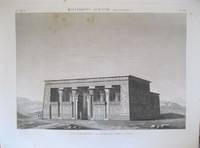
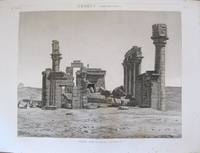
1981Middle East: Paris Impremerie de C.L.F.Pancoucke 1820-1829. Copper engraved view of the temple of Esna from the first volume of the "Antiquities "of the "Description de l'Egypte" 2nd Edition; black & white; verso blank. Blind stamp of the publisher Panckoucke to margin. The view shows a reconstruction of the temple of Khnum. at Esné The tutelary deities of Latopolis seem to have been the triad – Khnum and Neith and Heka their offspring. The temple of Esna dedicated to this triad was remarkable for the beauty of its site and the magnificence of its architecture. It was built of red sandstone and its portico consisted of six rows of four columns each with lotus-leaf capitals all of which however differ from each other Good dark impression; some foxing to sky and spotting to margins. "Description de l'Egypte ou Recueil des observations et des recherches qui ont été faites en Egypte pendant l'expédition de l'armée française." When Napoleon Bonaparte invaded Egypt in 1798 he brought with him an entourage of more than 160 scholars and scientists. Known as the French Commission on the Sciences and Arts of Egypt these experts undertook an extensive survey of the country's archeology topography and natural history. . For four years more than 150 artists engineers linguists and scientists traveled throughout the country examining almost every aspect of ancient and contemporary Egypt. They recorded and measured in meticulous detail Egypt's topography flora and fauna and its ancient and contemporary architecture. A soldier who was part of the expedition found the famous Rosetta Stone which the French linguist and scholar Jean-François Champollion 1790-1832 later used to unlock many of the mysteries that long had surrounded the language of ancient Egypt. The Egyptian expedition ended with a total military failure. The French left Egypt in 1801 with the honors of war but defeated; yet military failure remains a significant event in the history of knowledge because it is the first time a military expedition was accompanied by a scientific expedition. In 1802 Napoleon authorized the publication of the commission's findings in a monumental multi-volume work that included plates maps scholarly essays and a detailed index. Publication of the original Imperial edition began in 1809 and continued to 1822 sold by subscription. It proved so popular that a second edition was published under the post-Napoleonic Bourbon Restoration. The "Royal edition" published in Paris by C.L.F. Panckoucke from 1820-1830. The Second edition consists of 11 or 12 volumes of plates in folio and 24 of text bound as 26 8vo. Brunet:II 617; Blackmer/Navari: 476 1st edition Middle East Egypt Esne Esna Latopolis Paris Impremerie de C.L.F.Pancoucke 1820-1829 unknown
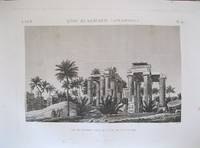
1982Middle East: Paris Impremerie de C.L.F.Pancoucke 1820-1829. Copper engraved view of the temple of Qau el-Kebir from the fourth volume of the "Antiquities "of the "Description de l'Egypte" 2nd Edition; black & white; verso blank. Blind stamp of the publisher Panckoucke to margin. The view shows the ruins of the temple Qau or Qau el-Kebir surrounded by palm trees Qau is located by the site of ancient Tjebu known in ancient Greek records as Antaeopolis 'city of Antaeus' on the east bank of the Nile midway between the towns of Akhmim and Asyut The temple was built by Ptolemy IV. substantial parts of which were still standing at the beginning of the 19th century sadly it was swept away by the Nile flood of 1821 Good dark impression; some light foxing to sky and spotting to margins. "Description de l'Egypte ou Recueil des observations et des recherches qui ont été faites en Egypte pendant l'expédition de l'armée française." When Napoleon Bonaparte invaded Egypt in 1798 he brought with him an entourage of more than 160 scholars and scientists. Known as the French Commission on the Sciences and Arts of Egypt these experts undertook an extensive survey of the country's archeology topography and natural history. . For four years more than 150 artists engineers linguists and scientists traveled throughout the country examining almost every aspect of ancient and contemporary Egypt. They recorded and measured in meticulous detail Egypt's topography flora and fauna and its ancient and contemporary architecture. A soldier who was part of the expedition found the famous Rosetta Stone which the French linguist and scholar Jean-François Champollion 1790-1832 later used to unlock many of the mysteries that long had surrounded the language of ancient Egypt. The Egyptian expedition ended with a total military failure. The French left Egypt in 1801 with the honors of war but defeated; yet military failure remains a significant event in the history of knowledge because it is the first time a military expedition was accompanied by a scientific expedition. In 1802 Napoleon authorized the publication of the commission's findings in a monumental multi-volume work that included plates maps scholarly essays and a detailed index. Publication of the original Imperial edition began in 1809 and continued to 1822 sold by subscription. It proved so popular that a second edition was published under the post-Napoleonic Bourbon Restoration. The "Royal edition" published in Paris by C.L.F. Panckoucke from 1820-1830. The Second edition consists of 11 or 12 volumes of plates in folio and 24 of text bound as 26 8vo. Brunet:II 617; Blackmer/Navari: 476 1st edition Middle East Egypt Qau el-Kebir Qâou El Kebyreh Antæopolis. Paris Impremerie de C.L.F.Pancoucke 1820-1829 unknown
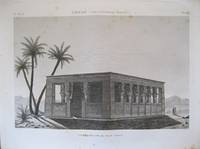
1979Middle East: Paris Impremerie de C.L.F.Pancoucke 1820-1829. Copper engraved view of the small temple or Birth House at Edfu from the first volume of the "Antiquities "of the "Description de l'Egypte" 2nd Edition; black & white; verso blank. Blind stamp of the publisher Panckoucke to margin. The view shows a reconstrucion of the small temple or Birth house described in the Antiquites. Opposite the large temple of Horus is another much smaller temple in a rather poorer state of preservation - the mammisi Birth House. The floral columns are crowned with sculptures of the god Bes a disfigured domestic god considered the guardian of expectant mothers and newborn infants. Since the scenes on the outside had been destroyed the French artists executed an imaginary reconstruction of the temple with all the decoration typical of similar monuments. Good dark impression; some spotting mainly to margins a few to image. "Description de l'Egypte ou Recueil des observations et des recherches qui ont été faites en Egypte pendant l'expédition de l'armée française." When Napoleon Bonaparte invaded Egypt in 1798 he brought with him an entourage of more than 160 scholars and scientists. Known as the French Commission on the Sciences and Arts of Egypt these experts undertook an extensive survey of the country's archeology topography and natural history. . For four years more than 150 artists engineers linguists and scientists traveled throughout the country examining almost every aspect of ancient and contemporary Egypt. They recorded and measured in meticulous detail Egypt's topography flora and fauna and its ancient and contemporary architecture. A soldier who was part of the expedition found the famous Rosetta Stone which the French linguist and scholar Jean-François Champollion 1790-1832 later used to unlock many of the mysteries that long had surrounded the language of ancient Egypt. The Egyptian expedition ended with a total military failure. The French left Egypt in 1801 with the honors of war but defeated; yet military failure remains a significant event in the history of knowledge because it is the first time a military expedition was accompanied by a scientific expedition. In 1802 Napoleon authorized the publication of the commission's findings in a monumental multi-volume work that included plates maps scholarly essays and a detailed index. Publication of the original Imperial edition began in 1809 and continued to 1822 sold by subscription. It proved so popular that a second edition was published under the post-Napoleonic Bourbon Restoration. The "Royal edition" published in Paris by C.L.F. Panckoucke from 1820-1830. The Second edition consists of 11 or 12 volumes of plates in folio and 24 of text bound as 26 8vo. Brunet:II 617; Blackmer/Navari: 476 1st edition Middle East Egypt Edfu Paris Impremerie de C.L.F.Pancoucke 1820-1829 unknown
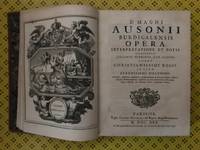
52049Parisiis: typis Jacobi Guerin ad Ripam Augustinianorum 1730. Delphin edition. 2 vols. bound as 1. 4to. pp.iii iv-lxvii i 432; iii 434-684 ii 16 clii 2 plates engraved title-page by Mathey and 1 further numismatic plate opposite p.667. "Obscoena e textu Ausoniano resecta" and indices at rear. Very clean internally. Later c.1800 tan sheep neatly rebacked marbled edges and endpapers. Corners a little worn but a very good copy indeed. Blind embossed coat of arms to each board of John Bligh 4th Earl of Darnley 1767-1831 with the motto 'Finem Respice'. Bligh was a British peer and noted amateur cricketer. According to Brunet a highly regarded edition. Schweiger I 22; Moss I 216 and Brunet I 574. Parisiis: typis Jacobi Guerin, ad Ripam Augustinianorum, 1730. unknown
1726AQ17537London: s.n. 1726. Two volumes bound as one. 4 lxiii 1 120 4 297 11. Contemporary gilt-tooled panelled black morocco A.E.G. Rubbed slight chipping to head and foot of spine short crack to lower compartment corners bumped edges dusty. Marbled endpapers recent book-label to FEP front blank fly-leaf pasted to FFEP later inked ownership inscriptions to verso of front blank fly-leaf and head of title occasional light spotting. The rare first edition in English 'Newly Translated from the French' by William Crathorne of Claude Fleury's 1640-1723 Le catechisme historique 1683; an authoritative evaluation of Catholic Catechism and ecclesiastical doctrine. ESTC records copies at just four locations in the British Isles BL NLS Manchester and Oxford; and a further four worldwide California SMU St. John's College Auckland and Texas. ESTC T115024. First edition in English. 12mo. [s.n.] unknown
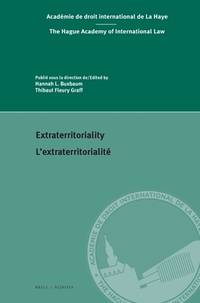
2022__9004522530Martinus Nijhoff 2022. Hardcover. New. 900 pages. French language. 9.00x6.00x2.00 inches. Martinus Nijhoff hardcover
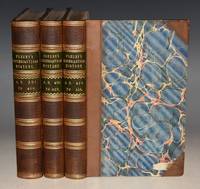
101536Oxford John Henry Parker Rivingtons 1842-44 1st 1842-44 1st. Three Volumes. Hardback 8.75 x 5.5 inches. Quarterbound calf leather to spine and corners and marbled papered boards. Raised and gilt banding to spines with blind embossed decoration and twin dark green leather spine labels lettered in gilt. Speckled page edges. Overall very good conditions. Some handling marks to boards a couple of thin surface chips to leather on spine edge of vol.1 and corners of vols. 2 & 3. Some dark foxing spots to blank prelims lighter foxing to title pages neat inscription to top of title page in vol.1. One or two occasional minor foxing spots to inside pages else pages all very clean bright and tight throughout. Else a very good clean and tight set. 3 vols: ccxx 400 463 & 471pp. A highly regarded English translation by John Henry Newman later Cardinal Newman of the foundational work by French historian Claude Fleury. Details the growth of the early Christian Church the rise of major heresies such as Nestorianism and the political dynamics between the priesthood and imperial power. Oxford, John Henry Parker, Rivingtons, 1842-44 1st 1842-44 1st hardcover
18429032517London: John Henry Parker 1842. Hardcover. Very Good. Ex-library. Translated by Newman. Bound in brown cloth with spines stamped in gilt covers blind-stamped. Text blocks are in very good condition clean and bright with library bookplates stamps and very minor foxing to endpapers. Minor wear to corners heads and heels sunning to spines. 5 1/2 x 8 1/2 inches. <br/><br/> John Henry Parker hardcover
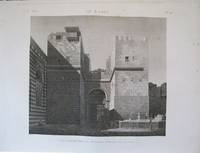
1964Middle East: Paris Impremerie de C.L.F.Pancoucke 1820-1829. Copper engraved view of one of the gateways to Cairo from the first volume of the "Etat Modene "of the "Description de l'Egypte" 2nd Edition; 1822; black & white; verso blank. Blind stamp of the publisher Panckoucke to margin. Good dark impression; a few some spotting mainly to margins but also a few in image. "Description de l'Egypte ou Recueil des observations et des recherches qui ont été faites en Egypte pendant l'expédition de l'armée française." When Napoleon Bonaparte invaded Egypt in 1798 he brought with him an entourage of more than 160 scholars and scientists. Known as the French Commission on the Sciences and Arts of Egypt these experts undertook an extensive survey of the country's archeology topography and natural history. . For four years more than 150 artists engineers linguists and scientists traveled throughout the country examining almost every aspect of ancient and contemporary Egypt. They recorded and measured in meticulous detail Egypt's topography flora and fauna and its ancient and contemporary architecture. A soldier who was part of the expedition found the famous Rosetta Stone which the French linguist and scholar Jean-François Champollion 1790-1832 later used to unlock many of the mysteries that long had surrounded the language of ancient Egypt. The Egyptian expedition ended with a total military failure. The French left Egypt in 1801 with the honors of war but defeated; yet military failure remains a significant event in the history of knowledge because it is the first time a military expedition was accompanied by a scientific expedition. In 1802 Napoleon authorized the publication of the commission's findings in a monumental multi-volume work that included plates maps scholarly essays and a detailed index. Publication of the original Imperial edition began in 1809 and continued to 1822 sold by subscription. It proved so popular that a second edition was published under the post-Napoleonic Bourbon Restoration. The "Royal edition" published in Paris by C.L.F. Panckoucke from 1820-1830. The Second edition consists of 11 or 12 volumes of plates in folio and 24 of text bound as 26 8vo. Brunet:II 617; Blackmer/Navari: 476 1st edition Middle East Egypt Cairo Paris Impremerie de C.L.F.Pancoucke 1820-1829 unknown
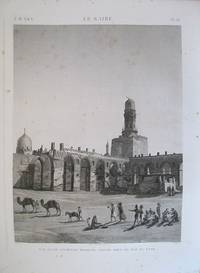
1969Middle East: Paris Impremerie de C.L.F.Pancoucke 1820-1829. Copper engraved view of an old mosque Cairo from the first volume of the "Etat Modene "of the "Description de l'Egypte" 2nd Edition; 1822; black & white; verso blank. Blind stamp of the publisher Panckoucke to margin. The view shows the mosque close to the gate of Bab el Nasr and the city walls. In the foreground are travelers arriving in the city by camel and donkey. Two French soldiers seem to be moving on a group of musicians and healers. Good dark impression; foxing to sky and blank margins. "Description de l'Egypte ou Recueil des observations et des recherches qui ont été faites en Egypte pendant l'expédition de l'armée française." When Napoleon Bonaparte invaded Egypt in 1798 he brought with him an entourage of more than 160 scholars and scientists. Known as the French Commission on the Sciences and Arts of Egypt these experts undertook an extensive survey of the country's archeology topography and natural history. . For four years more than 150 artists engineers linguists and scientists traveled throughout the country examining almost every aspect of ancient and contemporary Egypt. They recorded and measured in meticulous detail Egypt's topography flora and fauna and its ancient and contemporary architecture. A soldier who was part of the expedition found the famous Rosetta Stone which the French linguist and scholar Jean-François Champollion 1790-1832 later used to unlock many of the mysteries that long had surrounded the language of ancient Egypt. The Egyptian expedition ended with a total military failure. The French left Egypt in 1801 with the honors of war but defeated; yet military failure remains a significant event in the history of knowledge because it is the first time a military expedition was accompanied by a scientific expedition. In 1802 Napoleon authorized the publication of the commission's findings in a monumental multi-volume work that included plates maps scholarly essays and a detailed index. Publication of the original Imperial edition began in 1809 and continued to 1822 sold by subscription. It proved so popular that a second edition was published under the post-Napoleonic Bourbon Restoration. The "Royal edition" published in Paris by C.L.F. Panckoucke from 1820-1830. The Second edition consists of 11 or 12 volumes of plates in folio and 24 of text bound as 26 8vo. Brunet:II 617; Blackmer/Navari: 476 1st edition Middle East Egypt Cairo Bab el Nasr Paris Impremerie de C.L.F.Pancoucke 1820-1829 unknown
1984Middle East: Paris Impremerie de C.L.F.Pancoucke 1820-1829. Copper engraved view of the temple of Hermonthis. from the first volume of the "Antiquities "of the "Description de l'Egypte" 2nd Edition; black & white; verso blank. Blind stamp of the publisher Panckoucke to margin. The view shows the ruins of the temple of Hermonthis. The temple was dedicated to Menthu a god whose name means "nomad". Menthu was associated with raging bulls strength and war. He was also said to manifest himself in a white bull with a black face which was referred to as the Bakha. Egypt's greatest general-kings called themselves Mighty Bulls the sons of Menthu. Good dark impression; generally clean; some spotting to margins; remains of glue and tissue guard to upper margin. "Description de l'Egypte ou Recueil des observations et des recherches qui ont été faites en Egypte pendant l'expédition de l'armée française." When Napoleon Bonaparte invaded Egypt in 1798 he brought with him an entourage of more than 160 scholars and scientists. Known as the French Commission on the Sciences and Arts of Egypt these experts undertook an extensive survey of the country's archeology topography and natural history. . For four years more than 150 artists engineers linguists and scientists traveled throughout the country examining almost every aspect of ancient and contemporary Egypt. They recorded and measured in meticulous detail Egypt's topography flora and fauna and its ancient and contemporary architecture. A soldier who was part of the expedition found the famous Rosetta Stone which the French linguist and scholar Jean-François Champollion 1790-1832 later used to unlock many of the mysteries that long had surrounded the language of ancient Egypt. The Egyptian expedition ended with a total military failure. The French left Egypt in 1801 with the honors of war but defeated; yet military failure remains a significant event in the history of knowledge because it is the first time a military expedition was accompanied by a scientific expedition. In 1802 Napoleon authorized the publication of the commission's findings in a monumental multi-volume work that included plates maps scholarly essays and a detailed index. Publication of the original Imperial edition began in 1809 and continued to 1822 sold by subscription. It proved so popular that a second edition was published under the post-Napoleonic Bourbon Restoration. The "Royal edition" published in Paris by C.L.F. Panckoucke from 1820-1830. The Second edition consists of 11 or 12 volumes of plates in folio and 24 of text bound as 26 8vo. Brunet:II 617; Blackmer/Navari: 476 1st edition Middle East Egypt Hermonthis Erment Paris Impremerie de C.L.F.Pancoucke 1820-1829 unknown
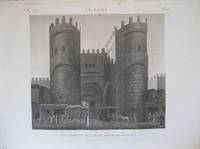
1963Middle East: Paris Impremerie de C.L.F.Pancoucke 1820-1829. Copper engraved view of one of the gateways to Cairo from the first volume of the "Etat Modene "of the "Description de l'Egypte" 2nd Edition; 1822; black & white; verso blank. Blind stamp of the publisher Panckoucke to margin. The view shows the massive gateway to the city with some small workshops & shops built against the walls. Good dark impression; a few some spotting mainly to margins but also a few in image. "Description de l'Egypte ou Recueil des observations et des recherches qui ont été faites en Egypte pendant l'expédition de l'armée française." When Napoleon Bonaparte invaded Egypt in 1798 he brought with him an entourage of more than 160 scholars and scientists. Known as the French Commission on the Sciences and Arts of Egypt these experts undertook an extensive survey of the country's archeology topography and natural history. . For four years more than 150 artists engineers linguists and scientists traveled throughout the country examining almost every aspect of ancient and contemporary Egypt. They recorded and measured in meticulous detail Egypt's topography flora and fauna and its ancient and contemporary architecture. A soldier who was part of the expedition found the famous Rosetta Stone which the French linguist and scholar Jean-François Champollion 1790-1832 later used to unlock many of the mysteries that long had surrounded the language of ancient Egypt. The Egyptian expedition ended with a total military failure. The French left Egypt in 1801 with the honors of war but defeated; yet military failure remains a significant event in the history of knowledge because it is the first time a military expedition was accompanied by a scientific expedition. In 1802 Napoleon authorized the publication of the commission's findings in a monumental multi-volume work that included plates maps scholarly essays and a detailed index. Publication of the original Imperial edition began in 1809 and continued to 1822 sold by subscription. It proved so popular that a second edition was published under the post-Napoleonic Bourbon Restoration. The "Royal edition" published in Paris by C.L.F. Panckoucke from 1820-1830. The Second edition consists of 11 or 12 volumes of plates in folio and 24 of text bound as 26 8vo. Brunet:II 617; Blackmer/Navari: 476 1st edition Middle East Egypt Cairo Paris Impremerie de C.L.F.Pancoucke 1820-1829 unknown
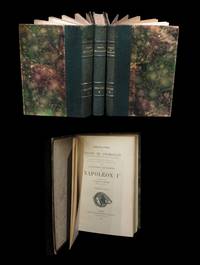
1901289961901. Paris Edouard Rouveyre 1901. 3 vol. au format in-8 218 x 143 mm de li pp. 1 f. n.fol. 8 pp. 330 pp. 2 ff. de catalogue ÂŽditeur in fine n.fol. et 2 ff. bl. ; 2 ff. bl. 2 ff. n.fol. 334 pp. et 2 ff. bl. 1 volume ˆ pagination erratique. Reliures uniformes de l'ÂŽpoque de demi-cuir ÂŽmeraude ˆ l'imitation de maroquin dos ˆ nerfs ornÂŽs de filets ˆ froid titre dorÂŽ tomaison dorÂŽe tranches mouchetÂŽes. Edition en grande partie originale ; complÂte des trois volumes la constituant. Le dernier - imprimÂŽ sur papier vert d'eau - est constituÂŽ de la reproduction des ''Notes marginales ÂŽcrites par NapolÂŽon Ier ˆ Sainte-HÂŽlÂne sur un exemplaire des MÂŽmoires . de Fleury de Chaboulon''. ''Source importante pour le retour de l'”le d'Elbe et les Cent Jours nottamment en ce qui concerne les intrigues de FouchÂŽ Les notes de NapolÂŽon sur la premiÂre ÂŽdition de l'ouvrage de Fleury n'ont pas ÂŽtÂŽ reproduites dans l'ÂŽdition officielle de la Correspondance. Elles permettent de rectifier dans la prÂŽsente publication de nombreuses inexactitudes et d'ÂŽliminer les ''bruits d'antichambre'' selon l'expression de NapolÂŽon rapportÂŽs par Fleury''. in Tulard. Tulard Bibliographie critique des MÂŽmoires sur le Consulat et l'Empire p. 63. Angles et coupes lÂŽgÂrement ÂŽlimÂŽs. Infimes altÂŽrations superficielles affectant par ailleurs les reliures. Du reste trÂs belle condition. b42961 unknown
160257Brugge Franciscus van Eeck. 1787. Contemporary brown paper-spine hardback hand-marbled covers 1787-1789 12mo: in 16 volumes complete about 5700 pages With endex volume. Fine complete set. . Brugge, Franciscus van Eeck. 1787 hardcover
150227John Murray 1819. 2 vols. 8vo 8½ x 5½ ins. Contemporary half calf on marbled paper-laid boards spines blind-tooled in with monograms in top compartments gilt lettered labels and red sprinkled edges spines lightly faded and marked - otherwise a VG set. Pp. xvi 415 1 blank & ii 419 1 prelims rather toned; previous owner's armorial bookplate on front paste-downs; no inscriptions. John Murray, 1819 unknown