Charles Louis Fleury Panckoucke,Biblio.com
1 833 résultats
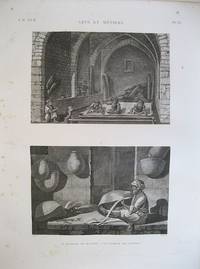
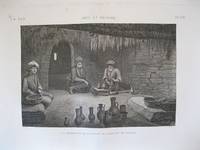
1989Trades Professions & the Arts: Paris Impremerie de C.L.F.Pancoucke 1820-1829. Copper engraving showing the interior of a potter's workshop from the second volume of "Etat Moderne" of the "Description de l'Egypte" 2nd Edition; black & white; verso blank. Blind stamp of the publisher Panckoucke to margin. The image shows the workshop with the potter at his wheel. Good dark impression; some light spotting to margins; remains of glue and tissue guard to upper margin. "Description de l'Egypte ou Recueil des observations et des recherches qui ont été faites en Egypte pendant l'expédition de l'armée française." When Napoleon Bonaparte invaded Egypt in 1798 he brought with him an entourage of more than 160 scholars and scientists. Known as the French Commission on the Sciences and Arts of Egypt these experts undertook an extensive survey of the country's archeology topography and natural history. . For four years more than 150 artists engineers linguists and scientists traveled throughout the country examining almost every aspect of ancient and contemporary Egypt. They recorded and measured in meticulous detail Egypt's topography flora and fauna and its ancient and contemporary architecture. A soldier who was part of the expedition found the famous Rosetta Stone which the French linguist and scholar Jean-François Champollion 1790-1832 later used to unlock many of the mysteries that long had surrounded the language of ancient Egypt. The Egyptian expedition ended with a total military failure. The French left Egypt in 1801 with the honors of war but defeated; yet military failure remains a significant event in the history of knowledge because it is the first time a military expedition was accompanied by a scientific expedition. In 1802 Napoleon authorized the publication of the commission's findings in a monumental multi-volume work that included plates maps scholarly essays and a detailed index. Publication of the original Imperial edition began in 1809 and continued to 1822 sold by subscription. It proved so popular that a second edition was published under the post-Napoleonic Bourbon Restoration. The "Royal edition" published in Paris by C.L.F. Panckoucke from 1820-1830. The Second edition consists of 11 or 12 volumes of plates in folio and 24 of text bound as 26 8vo. Brunet:II 617; Blackmer/Navari: 476 1st edition Trades Professions & the Arts Egypt Pottery Paris Impremerie de C.L.F.Pancoucke 1820-1829 unknown
1996Trades Professions & the Arts: Paris Impremerie de C.L.F.Pancoucke 1820-1829. Copper engravings 2 on 1 plate showing the trades of reed mat and basket weaving from the second volume of "Etat Moderne" of the "Description de l'Egypte" 2nd Edition; black & white; verso blank. Blind stamp of the publisher Panckoucke to margin. The images show the mat maker weaving the reed and the basket weaver stitching the basket . Good dark impression; some spotting to margins; remains of glue and tissue guard to right margin. "Description de l'Egypte ou Recueil des observations et des recherches qui ont été faites en Egypte pendant l'expédition de l'armée française." When Napoleon Bonaparte invaded Egypt in 1798 he brought with him an entourage of more than 160 scholars and scientists. Known as the French Commission on the Sciences and Arts of Egypt these experts undertook an extensive survey of the country's archeology topography and natural history. . For four years more than 150 artists engineers linguists and scientists traveled throughout the country examining almost every aspect of ancient and contemporary Egypt. They recorded and measured in meticulous detail Egypt's topography flora and fauna and its ancient and contemporary architecture. A soldier who was part of the expedition found the famous Rosetta Stone which the French linguist and scholar Jean-François Champollion 1790-1832 later used to unlock many of the mysteries that long had surrounded the language of ancient Egypt. The Egyptian expedition ended with a total military failure. The French left Egypt in 1801 with the honors of war but defeated; yet military failure remains a significant event in the history of knowledge because it is the first time a military expedition was accompanied by a scientific expedition. In 1802 Napoleon authorized the publication of the commission's findings in a monumental multi-volume work that included plates maps scholarly essays and a detailed index. Publication of the original Imperial edition began in 1809 and continued to 1822 sold by subscription. It proved so popular that a second edition was published under the post-Napoleonic Bourbon Restoration. The "Royal edition" published in Paris by C.L.F. Panckoucke from 1820-1830. The Second edition consists of 11 or 12 volumes of plates in folio and 24 of text bound as 26 8vo. Brunet:II 617; Blackmer/Navari: 476 1st edition Trades Professions & the Arts Egypt Reed mat maker Basket weaver Paris Impremerie de C.L.F.Pancoucke 1820-1829 unknown
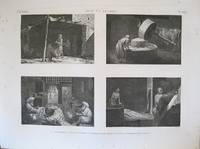
1986Trades Professions & the Arts: Paris Impremerie de C.L.F.Pancoucke 1820-1829. Copper engravings 4 on 1 plate showing the trades of toolmaker plaster grinder tanner or currier and coffee roaster from the second volume of "Etat Moderne" of the "Description de l'Egypte" 2nd Edition; black & white; verso blank. Blind stamp of the publisher Panckoucke to margin. The images show the workshops of the various trades: the toolmaker forging a pickhead; the miller of plaster with his mill powered by an ox; the coffee roaster stirring the beans over a fire and the naked curriers/tanners stretching the skins to make Marocco leather. Good dark impression; generally clean; some spotting to margins; remains of glue and tissue guard to upper margin. "Description de l'Egypte ou Recueil des observations et des recherches qui ont été faites en Egypte pendant l'expédition de l'armée française." When Napoleon Bonaparte invaded Egypt in 1798 he brought with him an entourage of more than 160 scholars and scientists. Known as the French Commission on the Sciences and Arts of Egypt these experts undertook an extensive survey of the country's archeology topography and natural history. . For four years more than 150 artists engineers linguists and scientists traveled throughout the country examining almost every aspect of ancient and contemporary Egypt. They recorded and measured in meticulous detail Egypt's topography flora and fauna and its ancient and contemporary architecture. A soldier who was part of the expedition found the famous Rosetta Stone which the French linguist and scholar Jean-François Champollion 1790-1832 later used to unlock many of the mysteries that long had surrounded the language of ancient Egypt. The Egyptian expedition ended with a total military failure. The French left Egypt in 1801 with the honors of war but defeated; yet military failure remains a significant event in the history of knowledge because it is the first time a military expedition was accompanied by a scientific expedition. In 1802 Napoleon authorized the publication of the commission's findings in a monumental multi-volume work that included plates maps scholarly essays and a detailed index. Publication of the original Imperial edition began in 1809 and continued to 1822 sold by subscription. It proved so popular that a second edition was published under the post-Napoleonic Bourbon Restoration. The "Royal edition" published in Paris by C.L.F. Panckoucke from 1820-1830. The Second edition consists of 11 or 12 volumes of plates in folio and 24 of text bound as 26 8vo. Brunet:II 617; Blackmer/Navari: 476 1st edition Trades Professions & the Arts Egypt Toolmaker Plaster Miller Coffee Roaster Tanner/ Currier Paris Impremerie de C.L.F.Pancoucke 1820-1829 hardcover
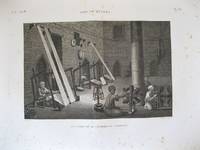
1988Trades Professions & the Arts: Paris Impremerie de C.L.F.Pancoucke 1820-1829. Copper engraving showing the interior of a weaver's workshop from the second volume of "Etat Moderne" of the "Description de l'Egypte" 2nd Edition; black & white; verso blank. Blind stamp of the publisher Panckoucke to margin. The image shows the workshop with two weavers at their looms whilst apprentices spin threads. Good dark impression; foxing & spotting to margins; remains of glue and tissue guard to upper margin. "Description de l'Egypte ou Recueil des observations et des recherches qui ont été faites en Egypte pendant l'expédition de l'armée française." When Napoleon Bonaparte invaded Egypt in 1798 he brought with him an entourage of more than 160 scholars and scientists. Known as the French Commission on the Sciences and Arts of Egypt these experts undertook an extensive survey of the country's archeology topography and natural history. . For four years more than 150 artists engineers linguists and scientists traveled throughout the country examining almost every aspect of ancient and contemporary Egypt. They recorded and measured in meticulous detail Egypt's topography flora and fauna and its ancient and contemporary architecture. A soldier who was part of the expedition found the famous Rosetta Stone which the French linguist and scholar Jean-François Champollion 1790-1832 later used to unlock many of the mysteries that long had surrounded the language of ancient Egypt. The Egyptian expedition ended with a total military failure. The French left Egypt in 1801 with the honors of war but defeated; yet military failure remains a significant event in the history of knowledge because it is the first time a military expedition was accompanied by a scientific expedition. In 1802 Napoleon authorized the publication of the commission's findings in a monumental multi-volume work that included plates maps scholarly essays and a detailed index. Publication of the original Imperial edition began in 1809 and continued to 1822 sold by subscription. It proved so popular that a second edition was published under the post-Napoleonic Bourbon Restoration. The "Royal edition" published in Paris by C.L.F. Panckoucke from 1820-1830. The Second edition consists of 11 or 12 volumes of plates in folio and 24 of text bound as 26 8vo. Brunet:II 617; Blackmer/Navari: 476 1st edition Trades Professions & the Arts Egypt Weaving Paris Impremerie de C.L.F.Pancoucke 1820-1829 unknown
175524021755. : 75 . 1 Blank pages / 1 Blank pages / 1 Blank pages / 403 Pages / 5 NNP / 3 Blank pages Binding: Contemporary Full Leather Sextodecimo 16mo Height cm: 17 CM Width cm: 10 CM Thickness cm: 27 CM hardcover
62113Impr. P. Pigelet Orléans 1925 In-8 23 cm 160pp. illustr. et planches en couleurs hors-texte Nb-0369 unknown
62082Impr. Albert Lyon 1879 2 volumes In-8 22 cm feuillets libres 15pp. illustr. Nb-0370 unknown
46852Sedopols - réimpression de l'édition de 1881 In-12 207pp. illustr. et 2 planches dépliantes unknown
63078Eds Masson Paris 1920 In-8 22 cm 40pp. hommage autographe de l'auteur: Au grand peintre des Crepuscules d'Islam Nb-0386 unknown
43329Eyrolles - première édition In-8 523pp. illustr. figures et tableaux reliure pleine toile de l'éditeur unknown
1983133197Paris: Grassin 1983. Broché. Bon état. in-8. En feuilles sous emboitage Exemplaire numéroté Grassin unknown
51482Eds Ch. Delagrave In-8 1164pp. illustr. 953 figures 44 tableaux et 110 cartes texte sur trois colonnes reliure pleine toile percaline de l'éditeur avec décors dorés Nb-0148 unknown
42236Eyrolles - Physique générale et expérimentale d'après le Traité de J. Lemoine et A. Blanc In-8 439pp. illustr. nombreuses figures reliure pleine toile de l'éditeur unknown
50497Les Editions du Mémorial In-12 144pp. illustr. cartes Nb-0120 unknown
2011BN41508Flammarion Verlag 2011. 2011. Hardcover. 240 x 284 mm. Ce n'est pas un hasard si aujourd'hui le repas français est inscrit par l'UNESCO au patrimoine immatériel mondial car l'art de recevoir à la française ne se résume pas à ces trois verbes : préparer cuisiner servir. Porté haut par des générations de cuisiniers pâtissiers sauciers maîtres d'hôtels chefs de rang. l'art de recevoir est enseigné par l'Institut Paul Bocuse à des étudiants venus du monde entier. Ils sont formés aux métiers de la restauration et de l'hôtellerie avec un seul mot d'ordre la perfection. Étiquette et protocole choix d'un repas et recettes adaptées aux circonstances table dressée dans les règles de l'art service efficace et impeccable rien n'est laissé au hasard pour le plus grand plaisir des convives. Cet ouvrage permettra à chacun d'appliquer chez soi ce qui fait l'excellence d'un tel établissement sans oublier que convivialité et plaisir donnent tout leur sens à un bon repas. Sprache französisch Maße 240 x 284 mm Kunst Musik Theater ISBN-10 2-08-125609-6 / 2081256096 ISBN-13 978-2-08-125609-5 / 9782081256095 L'Art de recevoir à la française Institut Paul Bocuse L'art de recevoir a la francaise Pitte Jean-Robert; Dumas Catherine; Zizza-Lalu Eve-Marie Fleury François <br/><br/>Kunst Musik Theater ISBN-10 2-08-125609-6 / 2081256096 ISBN-13 978-2-08-125609-5 / 9782081256095 L'Art de recevoir à la française Institut Paul Bocuse L'art de recevoir a la francaise Pitte Jean-Robert; Dumas Catherine; Zizza-Lalu Eve-Marie Fleury François Ce n'est pas un hasard si aujourd'hui le repas français est inscrit par l'UNESCO au patrimoine immatériel mondial car l'art de recevoir à la française ne se résume pas à ces trois verbes : préparer cuisiner servir. Porté haut par des générations de cuisiniers pâtissiers sauciers maîtres d'hôtels chefs de rang. l'art de recevoir est enseigné par l'Institut Paul Bocuse à des étudiants venus du monde entier. Ils sont formés aux métiers de la restauration et de l'hôtellerie avec un seul mot d'ordre la perfection. Étiquette et protocole choix d'un repas et recettes adaptées aux circonstances table dressée dans les règles de l'art service efficace et impeccable rien n'est laissé au hasard pour le plus grand plaisir des convives. Cet ouvrage permettra à chacun d'appliquer chez soi ce qui fait l'excellence d'un tel établissement sans oublier que convivialité et plaisir donnent tout leur sens à un bon repas. Sprache französisch Maße 240 x 284 mm Flammarion Verlag hardcover
6630153812.Gpaperback. Good. Access codes and supplements are not guaranteed with used items. May be an ex-library book. paperback
6630161491.Gpaperback. Good. Access codes and supplements are not guaranteed with used items. May be an ex-library book. paperback
6630166612.Gpaperback. Good. Access codes and supplements are not guaranteed with used items. May be an ex-library book. paperback
6630164059.Gpaperback. Good. Access codes and supplements are not guaranteed with used items. May be an ex-library book. paperback
1995Q-1570710457Sourcebooks 1995-06-01. Paperback. New. In shrink wrap. Looks like an interesting title! Sourcebooks paperback
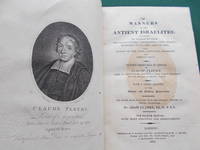
1820014021London: Printed for W. Baynes & Son 1820. Book measures 22.5x14.5.cm. xvi 3831pp. Bound in half calf calf corners marble boards raised bands. Binding heavily worn. Internally occasional library mark or stamp. Pages in good condition. A good copy. . Half Calf. Good Plus. 8vo. Printed for W. Baynes & Son Hardcover
6208993563.Gpaperback. Good. Access codes and supplements are not guaranteed with used items. May be an ex-library book. paperback
6208993644.Gpaperback. Good. Access codes and supplements are not guaranteed with used items. May be an ex-library book. paperback
6208993547.Gpaperback. Good. Access codes and supplements are not guaranteed with used items. May be an ex-library book. paperback
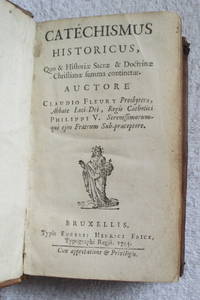
170526613Bruxellis: Eugenii Henrici Fricx 1705. edition not stated in contemporary full calf gilt decoration on spine the binding a little worn at corners but sound and strong pages 8 147 : 334 11 3 blank two parts in one volume Historicus Minor and Historicus Major. Despite his high standing in French society the Roman Congregation of the Index condemned this work. Text is in Latin. Reprint. Full-Leather. Very Good/No Jacket. 24mo - over 5" - 5¾" tall. Eugenii Henrici Fricx Hardcover