Aesop; Gregynog PressBiblio.com
1 631 résultats
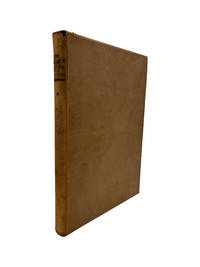
1931001609<p>Newtown: The Gregynog Press 1931. 8 146pp 2. Publishers sheep title blocked in black to spine. Spine rubbed affecting a couple of the letters to title minor rubbing to extremities with small scuff to lower top corner. Edges of endpapers browned small stain to title just beneath illustrators name a couple of small and very minor marks to margins generally quite bright and clean. Number one hundred and seventy-two of two hundred and twenty-five copies bound thus by the Gregynog Press bindery another twenty-five copies were specially bound with their name to foot of lower endpaper. Actually published in April 1932 in Bembo type on Barcham Green hand-made paper with thirty-seven wood engravings by Agnes Miller Parker and wood engraved initials by William MacCance. For the illustrator see Selborne 'British Wood-Engraved Book Illustration 1904-1940' pages 382-392. Franklin page 282; Harrop 20 noting that "never can living creatures have been more successfully portrayed in so static a medium" Harrop page 96. First Thus. Hardback. Good. Illus. by Parker Agnes Miller. Folio. Private Press.</p> The Gregynog Press hardcover
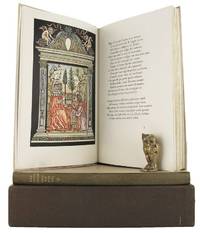
163103Verona: Officina Bodoni 1973. with the woodcuts newly engraved and coloured after a copy in the British Museum. Epilogue in English by Giovanni Mardersteig. Two volumes. Volume I: Pp. 2782blank colophon 68 pochoir woodcuts attributed to Liberale da Verona recut by Anna Bramanti; Volume II: THE FIRST THREE BOOKS OF CAXTON'S AESOP containing the fables illustrated in the Verona Aesopus of MCCCCLXXIX. Pp. 1202blank colophon; med. 8vo; green morocco spines lettered and decorated in gilt 'cloudy' vellum boards lettered and decorated in gilt the spines uniformly faded; t.e.g. others uncut; together within a brown card slipcase edges slightly worn; bookseller's small stamp at top edge of upper pastedowns; Officina Bodoni Verona 1973. One of 130 sets thus total edition 160. Barr 91. Printed on handmade paper watermarked with a goose like that of the original edition this reinterpretation of an early illustrated book printed in Verona in 1479 by Giovanni Alvise was published to mark the 50th anniversary of the Officina Bodoni. A list of the woodcuts with page numbers is loosely inserted in Volume I together with the publisher's prospectus. Volume I contains the Latin text of the 1479 edition with Accio Zucco's Italian translation. Volume II contains the fables in Caxton's translation with the first fable and the final six of the Veronese edition which Caxton did not include translated from the Latin by Betty Radice. The illustrations were coloured by hand at the Atelier Daniel Jacomet Paris. 'The Aesop cuts show a rich spectrum of colours with delicate hues that recall miniatures. Mardersteig maintained that only a great master could have made the preliminary drawings for the fable illustrations and had in mind at the outset the colouring which would give life to the linear woodcuts. This artist he identified on stylistic grounds with the miniaturist Liberale da Verona whose paintings are to be seen in the large choir-books in the Piccolomini Library in Siena Cathedra and elsewhere' Barr page 90. Officina Bodoni unknown
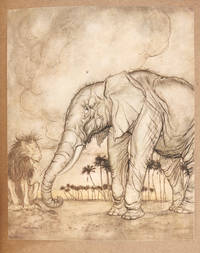
191389076Paris: Librairie Hachette et Cie 1913. Fine. Rackham illustrates the father of the Western fable Librairie Hachette et Cie Paris 1913 23 x 29.5 cm relié Illustrated edition with compositions by Arthur Rackham 13 in colour tipped in with captioned tissue guards and 52 black-and-white illustrations in the text one of 55 copies on japon signed by Arthur Rackham on the limitation page deluxe issue.  Publisher’s full vellum binding flat spine gilt-lettered with gilt-stamped animals upper cover gilt-stamped with the title and an illustration of animals top edge gilt uncut lower cover silk ties preserved.  A fine copy of the works of the most celebrated fabulist illustrated by Arthur Rackham one of the rare copies on japon.  Provenance: Maurice Feuillet with his manuscript ex-libris on the half-title. A renowned press illustrator notably for major judicial cases but also an art critic and founder of the Figaro artistique Feuillet remains famous for his courtroom sketches at the trials of Émile Zola in 1898 and Alfred Dreyfus in 1899.  Librairie Hachette et Cie hardcover
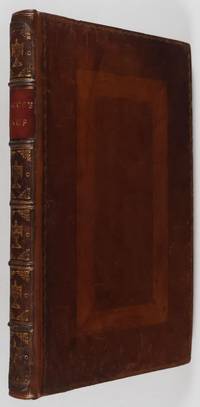
168730747London: H. Hills jun. for Francis Barlow 1687. Second Barlow Edition. Hardcover. Good . Folio 30.8 by 19.4 cm. 10 40 40 17 2-221 3: table pp; engraved title letterpress title engraved arms of the dedicatee William Cavendish Earl of Devonshire; engraved portrait of Aesop; 30 of 31 numbered full page copperplate engraved plates in the Life; 110 half page engraved plates accompany the fables. 18th-century paneled calf expertly rebacked retaining original backstrip borders and spine tooled in gilt. Light staining and scuffs to covers. Occasional light stains and smudges throughout mostly marginal; a few careful repairs at torn margins; professional repair at margin plate 2 just encroaching on printed surface; 3 cm perforation in plate Fable XII; moderate staining at plate Fable XLVIII; Text block good with otherwise clean plates complete but for the so-called 'indecent' or 'scandalous' plate 17 often defaced or lacking. A good or better copy handsomely bound.<br /> <br /> Second Barlow edition of these superbly illustrated Fables of Aesop first published in 1666. Each of the 110 fables include a half-page engraving text fable and moral in both French and Latin along with new captions in English by Aphra Behn. The English Life of Aesop is likely a reissue of the original sheets from the small-paper copies of the 1666 edition; the French Life is a new version. They are interspersed with thirty full-page plates mostly signed by Thomas Dudley the unsigned plates were engraved by Barlow. <br /> <br /> According to his contemporary the engraver and antiquary George Vertue Francis Barlow d. 1704 came from Lincolnshire and apprenticed in London to the portrait painter William Shepherd. Early and late in his career Barlow designed sets of natural history plates which were etched by Wenceslaus Hollar Richard Gaywood Jan Griffier and Francis Place. These prints proved to be an important source for artists and craftsmen of succeeding generations. Along with his engravings for Edward Benlowes's Theophilia 1652 the present suite of illustrations for Aesop's Fables are considered to be Barlow's finest. The preliminary drawings reside in the British Museum. While Barlow's house at "the Golden Eagle in New-Street near Shoo-lane" was burnt in the great fire the copper plates for the volume survived. ODNB.<br /> <br /> Provenance and annotations: "The Gift of Rich. Wesley Esq to his Son Garret Wesley Year of Christ 1741" entered in black ink at the front endleaf; Garret's entry appears beside the imprint at the title and his "cypher" substitution chart for Greek and English letters appears beneath the gift dediction. A later owner "E.R." has noted in pencil at the pastedown that this book belonged to R. and G. Wesley "ancestors of the Wellesley Family see the autographs for the letter afterwards to the Marquis Wellesley Revnd Dr Wellesley at whose sale I bought it." At the front pastedown is the bookplate of George Aiken Batchelder 1860-1936 who was Vice President E. H. Rollins & Sons Bonds San Francisco California. The bookplate partially obscures another note in pencil which appears to mention the absence of the 'indecent' plate. References: ESTC R22991; S. O'Connell "Barlow Francis" in: ODNB online; Press Reference Library Western Edition Notables of the West vol. I p. 163 International News Service 1913.<br /> <br /> Full title and imprint: AEsop's fables with his life: in English French and Latin. Newly translated. Illustrated with one hundred and twelve sculptures. To this edition are likewise added thirty one New figures representing his life. By Francis Barlow. London: Printed by H. Hills jun. for Francis Barlow and are to be sold by Chr. Wilkinson at the Black-boy against St. Dunstan's Church in Fleet-street Tho. Fox in Westminster-hall and Henry Faitborne at the Rose in St. Paul's Church-yard. M.DC.LXXXVII. 1687. H. Hills jun. for Francis Barlow hardcover
In folio (mm. 455 x 305), cartonato marmorizzato ottocentesco, 4 cc.nn. (la prima bianca), 176 pp.num., 2 cc.nn., stampato a 2 colonne, il testo greco e la versione latina accanto. Vi sono raccolte 149 favole, senza commenti. Cfr. Brooks,796: "D’une simple beauté incomparable (Geering)”. (Nello stesso anno il Bodoni stampò la stessa opera in-4 gr., a singole colonne: il testo greco colla versione latina a fronte) - Brunet,I,87: “Edition de luxe”. Solo qualche lieviss. traccia d’uso, altrim. fresco esempl. con barbe, ben conservato.
191389076Librairie Hachette et Cie | Paris 1913 | 23 x 29.5 cm | relié
1806001310Paris Imprimerie de P. Didot l'Aîné 1806
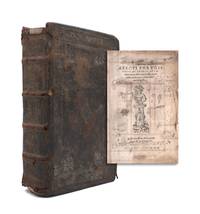
1538338977Basilae: In officina Heruagiana 1538. Collection first published by Froben 1518. A1-Z8: 393 5 pp. 8vo. Late 17th-century stamped-calf binding loss to head and foot of spine title page with borders drawn on it some loss to title page not affecting text annotated throughout some worming needs to be resewn and binding reattached title page should be repaired. Provenance: Johannis Miller. Collection first published by Froben 1518. A1-Z8: 393 5 pp. 8vo. With ownership signaure to the title page: "Ex Libris Johannis Miller pret. 1s. 0d Anno Dm 1693" a further ownership signature to the recto of the last leaf "Ex Libris Johannis Miller A D 1688" and annotations throughout the text. Rev. John Miller 1666-1724 was commissioned fort chaplain of the New York companies in 1692 spending 1692-1695 in New York: "Miller was the sole officiating Episcopal clergyman in the entire province of New York during the three years of his residence; his activities as evinced by contemporary records and his familiarity with all inhabited parts extended beyond the confines of the city." During this time he wrote extensive notes about New York and drew a map of the fort. When his returning vessel was overtaken by French Privateers he threw his documents overboard to destroy the intelligence contained therein. He later rewrote many of his observations and redrew the map from memory it's retained in his manuscripts at the British Museum from George Chalmers in 1842 and was later published in Valentine's 1842-3 Manual. He returned to England where he was given the post of vicar of Effingham gaining a reputation as a "worthy and respectable vicar" and "a man of research." His library was still "preserved with great care" by his successor in the beginning of the nineteenth century then consigned and sold in New York by Bangs and Company in 1894. A number of his books have found their way into prominent libraries and collections Stokes' Iconography; Paltsits Victor Hugo intr. "New Yorke Considered and Improved A.D. 1695 by John Miller" Electronic Texts in American Studies 17. <br /> <br /> The present work seems to have gone from him to another owner Richard Norton and then to Thomas Norton; the second page has the ownership signature and note: "Thomas Norton pretium / Thomae Dicitur Fr Richard". Thomas Norton could be Thomas Norton 1684-1748 Whig Member of Parliament of Ixworth Abbey Bury St. Edmunds Suffolk; the grandson of Col. Richard Norton M.P. 1615-1691 intimate friend of Cromwell; and nephew of Maj. Richard Norton.<br /> <br /> Contents include: Aesopi Fabulatoris vita Aesopi Fabulae Gabriae Graeci Tetrasticha Ex Aphthonij Sophistae exercitamentis Ex Philostrati imaginibus fabulae Ex Hermogenis exercitamentis / Prisciano interprete Ex Auli Gellij libro secundo capite undetrigesimo Apologus Aesopi Phrygis memoratunon inutilis Homeri Ranarum et murium pugna heavily annotated Musaeus De Ero et Leandro annotated Expositio capitvm admonitoriorum aedita ex tempora ab Agapeto Hippocratis Iusiurandum GaleÅmyomachia hoc est Felium & murium pugna annotated with translations from the Greek. USTC 608058 In officina Heruagiana unknown
179319695London: John Stockdale 1793. FIRST EDITION FIRST ISSUE. Gay Vol. II includes the advertisement leaf following the title page and publisher's advertisement on verso of final text leaf for an edition of Barlow's Aesop and Stockdale fables of Aesop no dates noted. Engraved title page in each volume plus 112 plates in the Aesop and 70 plates in Gay 12 by William Blake; plates with blank leaves as guards. A large paper copy bound in polished mottled calf with matching flyleaves gilt-ruled around the edges and inner dentelles gilt decorated spine. All edges gilt. Interior has some light offsetting from plates as usual. First edition first issue of both works with the long "s" throughout. An exquisite set. John Stockdale unknown
1632F6HD0MAV59JYLeiden 1632. 8vo. Joannes Maire Contemporary vellum sewn at three stations but with 2 tanned leather thongs laced through the joints each board with a panel stamp 59 x 50 mm of the Amersfoort coat of arms in a circular laurel wreath in a rectangle with winged angel heads in each corner in a frame of double filets. Most endpapers later. With Maire's woodcut "fac et spera" device on title-page Breugelmans Maire device 10 47 woodcut illustrations 5 x 6.5 cm by Christoffel van Sichem II in the text and 3 woodcut decorated initials 2 series. Set in Greek and roman types with extensive italic. 158 2 pp. Rare second edition one of three dated "1632" of a popular Greek and Latin school book edited by the famous Dutch neo-Latin poet humanist and Leiden Professor of Greek Daniel Heinsius 1580-1655 with 47 beautiful woodcut illustrations by Christoffel van Sichem II. Aesop's fables were prescribed by the States of Holland in the Hollandsche schoolordre of 1625 as one of the books to be read in the 3rd class. Christoffel van Sichem II ca. 1577-1658 the second of several woodcut artists in that family studied with Jacques de Gheyn and was one of the leading Dutch book illustrators in the first half of the 17th century. Although the book has no prize certificate or inscription and no owner's name the coat-of-arms of the city of Amersfoort on the binding of a school book strongly suggests a prize binding for a student at the Amersfoort Latin school. With an occasional contemporary manuscript note in Greek and Latin. With a small dark stain in the lower inside corner of the foot margin of many leaves not approaching the text and with very slight browning throughout but still in good condition. The vellum of the binding is dirty and slightly rubbed but also good.l Landwehr Emblem & fable books F025 2 copies; Hollstein XXVII Van Sichem II 31; for the panel-stamp: Spoelder Prijsboeken Amersfoort 1. hardcover
15181331015Basileæ: In Officina Heruagiana Johann Herwagen; Johannes Froben 1538/1518. Hardcover. Octavo a-x8 y7 A8 B4; VG; bound in 17th century calf plain paneled spine; some rubbing and wear to binding minor worming to binding; mild soiling to interior;<br /> <br><br /> <br><br /> Lacking y8-z8; The wanting leaves of the 1538 edition substituted after 350 with new pagination of 106-126 with the Galeomyomachia in Greek only from the 1518 Froben edition of Aesopi Phrygis vita et fabellæ cum latina interpretatione. Early substitution i.e. 17th century or earlier as the textblock is integral and the binding unrestored;<br /> <br><br /> <br><br /> Printer's device on title page and on verso of last leaf.; Wide margins; Second title page trimmed at top; small holes in upper and lower gutters of the entire first part from previous binding;<br /> <br><br /> <br><br /> Text in Greek and Latin on facing pages for the Aesop Greek only for the Galeomyomachia<br /> <br><br /> <br><br /> Provenance to the recto and verso of the ffep Fitzwilliam family provenance in several early hands the largest stating playfully: "William Fitzwilliam not his Book but John Fitzwilliam his booke";<br /> <br><br /> <br><br /> Scattered marginalia and underlining including extensive minute annotations in an early faded 16th century hand around the rear printer's mark other minor annotations throughout notably in English on Midas on page 315.;<br /> <br><br /> <br><br /> Scarce; PD consignment; shelved case 3. USTC: 608058;<br /> <br><br /> USTC lists 15 copies 14 in Europe and 1 at the University of Toronto.;<br /> <br><br /> <br><br /> A 1538 edition of Aesop's Fables printed by Johann Herwagen with an appended 1518 edition of the Galeomyomachia Battle of Cats and Mice printed by Johann Froben. Galeomyomachia usually found bound with five other printings by Froben 1518.;. 1331015. Shelved Dupont Bookstore. In Officina Heruagiana [Johann Herwagen]; [Johannes Froben] hardcover books
190925107London: Hodder & Stoughton 1909. Limited first edition of 750 copies numbered and signed by the artist. Illustrated with 25 beautiful plates in color by Edward J. Detmold including two extra plates not found in the trade edition. Thick folio publisher’s original full white polished buckram the upper cover artfully decorated with the original gilt pictorial designs surrounded by a frame ruled in gilt and filled with intertwined vines the spine handsomely gilt lettered and decorated with gilt device and gilt rules t.e.g. housed and protected in the original slipcase. A fine copy with just very light age mellowing at the spine panel the corners fine and sharp the plates all in excellent condition the text-block clean and white essentially a near as pristine copy in a protective slipcase. The slipcase with some wear as would be expected. The book profiting by the presence of the slipcase with the white cloth remaining clean and the giltwork very bright. FIRST EDITION LIMITED SIGNED NUMBERED AND SPECIALLY BOUND. This title represents in our opinion Detmold's very best work. The grace and sensitivity of the illustrations reflect a certain Eastern sensibility. The artist’s powers in the delicate communication of nature’s spirit are exemplified by these wonderful paintings rich with the wide variety of the colours in the spectrum.<br> This is a very fine copy of the best printing of the work numbered and signed by Detmold. Hodder & Stoughton hardcover
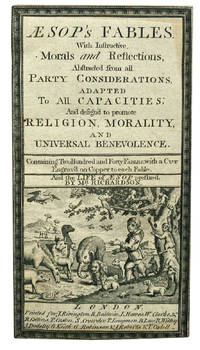
176073880London:: Printed for J. Rivington R. Baldwin and 12 others 1760. Early edition. 19th c. dark blue straight-grain morocco. Lacking one engraved plate as noted. Tiny old ink name partially effaced from title; old signature practiced on the verso of one plate not visible on recto and ink calculations at the bottom margin of one page of text; neat repair to one torn leaf; some light spots and inoffensive soiling. Joints partially cracked; edges and corners quite rubbed; still sound. . 12mo. Engraved illustrated title page. Containing Two Hundred and Forty i.e. 230 Fables with a Cut Engrav'd on Copper to each Fable. The engravings were printed ten to a page and this copy is unfortunately lacking one of the 24 plates Plate XIII. . And the Life of Aesop prefixed by Mr. Richardson. Printed for J. Rivington, R. Baldwin [and 12 others], unknown
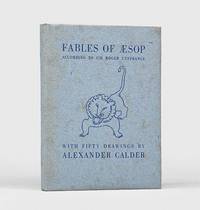
1931159579Paris: Harrison of Paris 1931. In the original slipcase with the elusive paper-knife First Calder edition limited issue number 262 of 595 copies on Auvergne paper from a total edition of 665 scarce retaining both the slipcase and the paper-knife. The text of the present edition is based Roger L'Estrange's ground-breaking translation of Aesop's Fables 1692. Harrison of Paris was founded by publisher and heiress Barbara Harrison Wescott 1904-1977 and art patron and curator Monroe Wheeler 1899-1988 in 1930. Wheeler designed this book the pale blue covers of which were made from schoolchildren's aprons Becker p. 62. The illustrator Alexander Calder came from a long line of sculptors and first took up printmaking after moving to Paris in 1926 where he befriended Marcel Duchamp Fernand Leger Joan Miró and Piet Mondrian. Quarto. Illustrated throughout by Alexander Calder. Original light blue paper-covered boards front cover lettered in dark blue with Calder illustration edges untrimmed endleaves uncut. With the original paper knife loosely inserted. Housed in the original red card chemise and slipcase. A touch of foxing to wrappers faint offsetting from paper-knife on half-title. A near-fine copy a little wear to slipcase. David P. Becker Drawings for Book Illustration 1980. hardcover
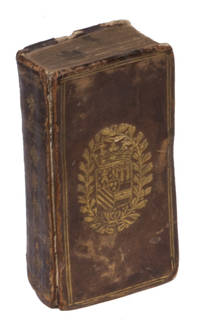
1623ABC_45188Paris: Jean Libert 1623. Contemporary French gold-tooled calf sewn on 2 supports each board with the coat-of-arms of Henri de La Tour 1555-1623 Duc de Bouillon and Prince of Sedan who married the daughter of William the Silent founding father of the Dutch Republic with a French Ducal crown the whole in a wreath of 2 laurel branches with berries the flat spine divided into 4 fields each with a central decoration gilt edges. Marbled paste-downs fine-toothed combed pattern in red blue and white. 16mo. With a woodcut decoration on the title-page and woodcut decorated initials in the text. Very rare 24º edition of 150 prose fables by Aesop and 43 verse fables by Babrius here called Gabrius in Greek and Latin on facing pages remotely based on the text of the illustrated humanistic editions published by Jean de Tournes in Lyons. While the existence of Aesop ca. 620-ca. 584 BCE as a story teller is attested in many early sources the canon that appears under his name contains fables passed down orally and rendered in literary form by many authors over the centuries. Babrius wrote verse fables shortly before 200 CE that were later rendered in Greek prose and added to the Aesop canon. Although the title-page indicates that the fables are illustrated the present edition never contains woodcuts: Libert apparently copied his title from one of the illustrated editions. He does include Maximus Planudess extensive account of Aesops life preceding the fables. Although the earliest European marbled papers appear to have been made in or around southern Germany they were not combed. Wolfe notes that the French first used marbled paper for bookbindings and the present paste-downs closely resemble his earliest example of combed marbled paper. The arms on the binding are quartered with an inescutcheon. The Counts of Auvergne had born the quartered arms of La Tour and the Counts of Auvergne with the inescutcheon of the Counts of Boulogne since 1389. With the Counts of Boulogne extinct the arms passed to another branch of the family descending to Henri de La Tour 1555-1623 who took the title Duc de Bouillon by marriage in 1591 and later inherited the title Vicomte de Turenne from his father. In 1595 he married Elisabeth van Oranje Nassau daughter of William the Silent 1533-1584. Their second son was the famous Marshal Turenne 1611-1675. Early owners inscription on title-page in ink. Lacking the last leaf of the index title-page cut short at the head not affecting the text and a small worm hole in the second half sometime affecting a letter in the first line but otherwise in good condition. Binding rubbed not affecting the arms and backstrip worn a few small chips and holes and hinges cracked.l KVK & WorldCat 2 or 3 copies; cf. Bodemann 29.2 similar 1570 De Tournes ed. Jean Libert, unknown
06684London: William Heineman 1912. Where Ancient Fable Meets Arthur Rackham's Enchanted Imagination<br /> The Signed Limited Edition of Aesop's Fables 1912<br /> <br /> RACKHAM Arthur. AESOP. Aesop's Fables. A New Translation by V.S. Vernon Jones with an Introduction by G. K. Chesterton and Illustrations by Arthur Rackham. London: William Heinemann 1912. <br /> <br /> Limited to 1450 numbered copies signed by the artist this being copy no. 1103.<br /> <br /> Large quarto 11 7/16 x 8 7/8 inches; 291 x 227 mm. xxix 1blank 223 1 pp. Thirteen color plates mounted on heavy brown paper with captioned tissue guards and fifty-three black and white text drawings. <br /> <br /> Publisher's white buckram front cover and spine pictorially stamped in gilt top edge gilt others uncut. Spine very slightly darkened otherwise a very fine copy the gilt bright and fresh.<br /> <br /> Aesop's Fables or the Aesopica is a collection of fables credited to Aesop a slave and story-teller believed to have lived in ancient Greece between 620 and 560 BC.<br /> <br /> The 1st century AD philosopher Apollonius of Tyana is recorded as having said about Aesop: ". like those who dine well off the plainest dishes he made use of humble incidents to teach great truths and after serving up a story he adds to it the advice to do a thing or not to do it. Then too he was really more attached to truth than the poets are; for the latter do violence to their own stories in order to make them probable; but he by announcing a story which everyone knows not to be true told the truth by the very fact that he did not claim to be relating real events" Philostratus Life of Apollonius of Tyana Book V:14.<br /> <br /> Lattimore and Haskell pp. 38-9. Riall p. 111. London: William Heineman, 1912 unknown
1760962Z5London: J. Rivington et al 1760. Leather. Fine. 7" by 4". None stated. A beautifully bound eighteenth century engraved collection of Aesop's renowned fables bound in half calf and housed in a cloth chemise and uniform slipcase. The Samuel Richardson edited edition. Bound by Eric Sweet a keen collector of private press and fables. He studied at the Brighton College of Art before moving to London to work as a lettering artist and typographer for advertising agencies later becoming the head of Birmingham School of Printing. Sweet's bindings are unique and striking reflecting the topics of the volumes in distinctive style.Illustrated with a monochrome copper engraved frontispiece and twenty-four monochrome cooper engraved plates each depicting ten engravings. Collated complete. Frontispiece incorrectly bound facing pp. xv. A charming collection of fables credited to Aesop a Greek storyteller and fabulist whose tales were characterised by the anthropomorphic animal characters. This collection includes two hundred and forty fables with an account of the life of Aesop by Samuel Richardson. Bound in modern quarter calf with marbled paper to the boards and a cloth chemise and slipcase. Endpapers and blanks renewed. Undated dated by copies held institutionally. Bound in modern quarter calf with marbled paper to the boards and with a cloth chemise and matching slipcase. Endpapers and blanks renewed. Externally lovely. Frontispiece bound before pp.xv. Bookplate of 'Eric Sweet' to the front pastedown. Internally firmly bound with washed bright pages and generally clean with only the odd spot. The slipcase has spotting. Fine J. Rivington et al hardcover
17603939<p>An attractive copy of the fourth of five illustrated editions with Richardson's Life of Aesop. It was first published in 1739 with a title-page dated 1740 with subsequent editions in 1749 1753 two issues and 1775. All of the editions are scarce with ESTC listing four copies of the first edition two copies of the second five of the third edition. The 25 engraved plates include delightful illustrations in miniature for each of the fables with a brief caption and fable number given above each illustration. The engraved title-page is also very attractive with an idealised illustration of a landscape peopled with different animals.</p><p>ESTC t118432 listing BL Bodleian Szczecin Public Library Louisiana State University Rice UCLA and Yale.</p> J. Rivington, R. Baldwin, J. Hawes, W. Clarke, R. Collins, T. Caslon, S. Crowder, T. Longman, B. Law, R. Withy, J. Dodsley, G. K
15341394218Basileae Basel: In officina Frobeniana 1534. Hardcover. Octavo 363 5 pages. In Good condition. Bound in later half brown calf with teal paper-covered boards; label bearing gilt titling to spine. Light plus rubbing to head and tail of spine; moderate split to front joint and split starting at rear joint. Moderate rubbing to edges and corners of boards. Surfaces of boards with moderate plus rubbing and scratching with a few minor chips to paper at edges of boards. Text block edges stained red. Pencil annotations to front paste down and front free endpaper. Damp staining visible to fore edges of front pastedown front free endpaper to p. 32 and to all pages from p. 335 on only slightly impacting text. Text block with light plus age toning and scattered ink annotations including a sizable ink blot on p. 320 text still legible. BW Consignment. Shelved case 3. This work was printed in the workshop of the Froben Press in 1534 about seven years after the death of Johann Froben the press' founder. Following Johann Froben's death the press was managed by his son Hieronymus 1501-1563. The Froben family including Hieronymus's brother-in-law Nikolaus Episcopius contributed to the establishment of Basel as a significant hub of the European book trade. All three men were friends of Erasmus and published many of his works. They also collaborated regularly with Hans Holbein the Younger who designed a printer's device for the Froben firm the Hermes caduceus printed on the title page of this work. 1394218. Special Collections. In officina Frobeniana hardcover
190939157London: Hodder & Stoughtond 1909. Very good plus. First edition out of series copy of this large paper edition of Detmold's beautifully illustrated interpretation of Aesop's fables with an original watercolor on parchment signed by Detmold tipped in. In his vibrant and stylish illustrations for this limited edition of Aesop's Fables Edward Detmold exhibits aesthetic influences drawn from a variety of sources including Japanese and Chinese paintings Art Nouveau and classical Western art. This copy is supplemented with an original watercolor by Detmold apparently an early iteration of an illustration of a redshank chick that would appear in his circa 1912 BOOK OF BABY BIRDS. 12.5'' x 10.25''. Original white gilt pictorial cloth. Top edge gilt other edges machine deckle. 25 tipped-in color plates. Unpaginated. Bookplate of Sir Francis Carruthers Gould to front pastedown. Original Detmold watercolor on parchment tipped onto verso of front flyleaf; likely an artist's copy no limitation page present. Binding with light bumping to corners and spine ends a few tiny spots of soil to rear; spine sunned. Watercolor with margins marked-up for framing. Endpapers with mild toning leaves with occasional tiny spots of soil or foxing. Sound with vibrant colors. Hodder & Stoughtond unknown
122913London: for R. Sare B. Took M. Gillyflower A. & J. Churchil G. Sawbridge and J. Hindmarsh 1699. 2 vols. in one folio 10 28 8 476; 16 238 2 ads. pp. Engraved frontispiece portrait of L’Estrange by Roger White after Geoffrey Kneller and full page engraving of Aesop and animals both in vol. 1. Contemporary calf neatly rebacked and tips restored a clean very well-margined copy. Inscribed twice by John Bailward dated 1730 and a few pencil notes and sketches in the text. § One of the first collections of fables prepared specifically for children. Third edition corrected and amended from the 1692 edition. With the second part in first edition the two seldom found together. Roger L'Estrange 1616-1704 was Tory journalist and pamphleteer notorious for his censorship of “seditious†Whig publications in his role as Surveyor of the Press. His edition of Aesop was commissioned by a group of booksellers and appeared two years after Locke first recommended Aesop as a first reading book for children. Muir writes it was “the best and largest collection of fables in English and he had children especially in mind when making his compilation… He included many other fabulists besides Aesop notably a selection from La Fontaine within 20 years of the first appearance of any of his fables in French. It is highly probable that this was their earliest appearance in English.†The DNB notes of L’Estrange’s Aesop that it was “an assemblage of fables and facetiae from a variety of sources ancient and modern the second volume being wholly unAesopian. The trenchant reflections added to the individual fables possess a strong political animus and were to draw severe criticism from the later whig fabulist Samuel Croxall; but all L'Estrange's translations have some degree of political colouring… This compilation also includes a biography of Aesop an alphabetical table of the fables and fables by Barlandus Anianus Abstemius Poggius and La Fontaine.†DNB. Wing A-709 and A-1247. Muir English Children’s Books p.24. for R. Sare unknown books
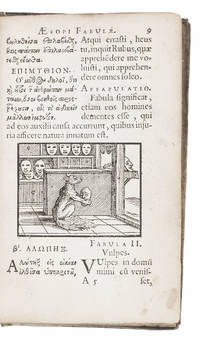
1653000384Amsterdam: Joannem Janssonium 1653. Period Calf. Fair. 12mo - over 6¾" - 7¾" tall. Amsterdam: Joannem Janssonium 1653 dated in apostrophic Roman numerals. Engravings. 12mo; full calf with some tooling see scan. Accompanied by two simple later handmade paper protective jackets. Rubbed soiling shelfwear; binding broken exposing interior of spine. Two previous owner's inscriptions on ffep Josephus Stephani Dedit Hosepho de Villis 1675; Matt Kenrid 1748. Fair to About Good. See scans. Also: 'Eae item quas Avienus carmine espresit. Accedit Ranarum & Murium Pugna Homero olim ascripta. Cum elegantisimis in utroque libello Figuris & utriusque Interpretatione plurimus in Iocisemendata. Exdecreto D.D. Hollandae Ordinum in ufum Scholarum.' Rare 17th century specimen of Aesop's fables published by 17th Century Amsterdam publisher Joannem Janssonium. Fables here presented in Greek and Latin on opposing pages with engraving illustrations. Fragile and precious example no doubt one for the children of the time judging from the illustrations. See scans. L51 <br/> <br/> Joannem Janssonium unknown
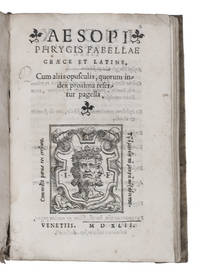
1542736Venice 1542. Small 8vo 16 x 11 cm. colophon: Giovanni Farri and brothers Contemporary limp sheepskin parchment straight-sewn on 3 alum-tawed split thongs laced through the joints fore-edges folded over with fragments of a vellum manuscript in a rotunda gothic hand used to reinforce the spine. With Farris woodcut device on the title page crowned head with 3 faces flanked by Farri's initials I . F on a scrollwork shield repeated on verso of last leaf; 1 woodcut decorated initial but further with spaces left for manuscript Greek and Latin initials with printed guide letters; and a vine-leaf ornament Vervliet 38. Set in Greek and Aldine-style italic with incidental roman. 364 4 pp. Venice school edition of Aesop's fables with parallel text in Greek and Latin. The book is neatly printed and the clear Greek type has relatively few ligatures. Besides the life of Aesop and Aesop's fables the book contains several collections of fables and single fables by other authors pp. 232-364: Ignatius von Nicaea Gabriae Graeci fabellae often added to the Aesop canon; Aphthonius Excercitamentis de fabula; Philostratus De fabula; pseudo Homer Batrachomyomachia the battle of frogs and mice a parody of Homer's Iliad; Musaeus De Ero & Leandro Hero and Leander; Agapetus De officio regis; Hippocrates Ius iurandum the Hippocratic oath! and Theodorus Prodromus Galeomnomachia the battle between the cats and the mice the last two in Greek only. The book ends with a 4-page index and the colophon.With a few contemporary manuscript notes in brown ink. With some marginal worm holes mostly in the gutter of quires r and s and some mostly marginal water stains more serious in quire c and a dark stain in the upper outside corner of 2 leaves not approaching the text otherwise in good condition. The binding is wrinkled with a 1½ x 2 cm gap in the backstrip some small tears and the 2 pair of ties lost. A nice early student edition of Aesop with very extensive additions.l EDIT 16 CNCE 364; STC Italian p. 8; USTC 807871. hardcover
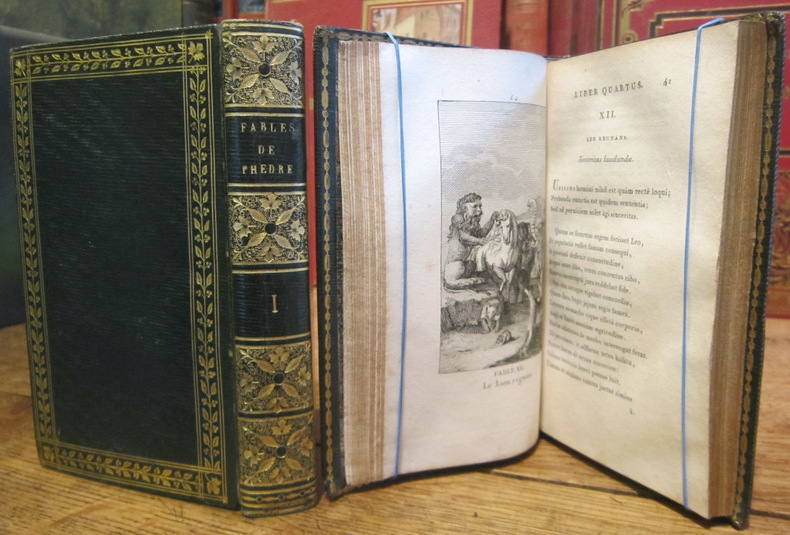
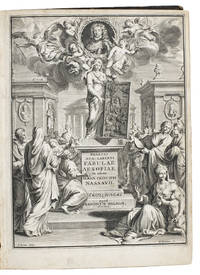
1701ABC_45394Amsterdam 1701. 4to. François Halma Contemporary half calf brown sprinkled paper sides brown spine label with title in gold red sprinkled edges. With an engraved frontispiece by P. Boutats after J. Goeree an engraved printer's device on the title-page a folding portrait of the dedicatee Johan Willem Friso van Nassau-Dietz by P. van Gunst after B. Vaillant and 18 engraved plates with 6 roundels on each plate illustrating the 99 fables and 5 prologues 3 portraits of Aesop and tailpieces and historiated initials all by Jan van Vianen. 32 160 84 pp. Gorgeous edition of the 94 Aesop fables with 5 additional fables found by the German philologist and classical scholar Marquart Gudius together with his extensive and scholarly notes printed in two columns below each fable the whole prepared by David van Hoogstraten 1658-1724 the conrector of the Latin School of Amsterdam 1694-1722. Apart from being a prolific Dutch and Neo-Latin poet he was an esteemed linguist and philologist who edited a number of classical authors. His present splendid Phaedrus edition intended for and dedicated to the young Stadholder of Friesland and Groningen the crown-prince Johan Willem Friso of the Nassau family is magnificently printed in the style of the French in usum Delphini editions made for Le Grande Dauphin. With the bookplate of John Blackburne on the front paste-down. Spine damaged front hinge weak paper sides worn and partly torn off some small marginal tears in the portrait of Johan Willem Friso but otherwise in good condition.l Bodemann 94.1; Fabula docet 42; Landwehr F163; Schwabe/Barbier pp. 69-70. unknown
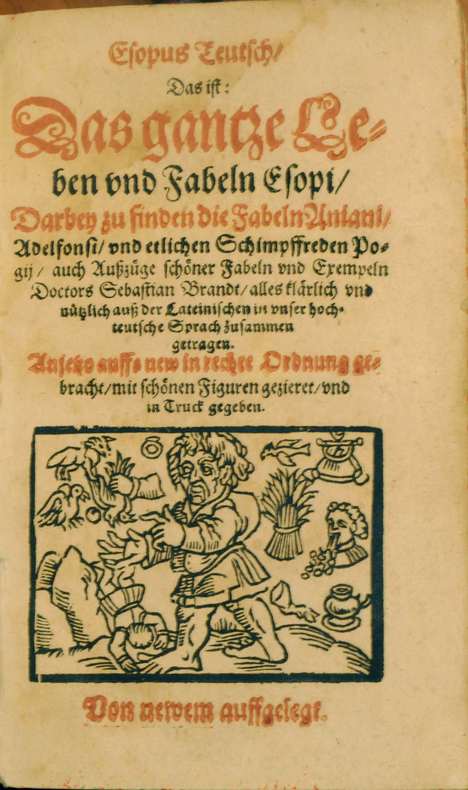
46404621s. l. n. d., , [Francfort, début XVIIe] ; in-8, vélin ancien. Titre en rouge et noir avec 1 bois gravé, 3 ff. n. ch., 452 pp., 6 ff. de table.Traduction en allemand des fables d’Esope, avec la vie d’Esope, diverses fables d’Avianus, Adelfonse... des facéties de Pogge, des fables et histoires de Sébastien Brandt. La première édition de ce recueil a paru à Fribourg en 1539. Il fut souvent réimprimé à Fribourg, Bâle et à Francfort de 1555 à 1676 (voir Graesse I, p. 37).Le volume est orné de 169 très jolies vignettes gravées sur bois dans le texte. Les fables de Brandt occupent les pp. 227 à 363 ; suivent celles d’Avianus (ici mal orthographié Anianus) pp. 364-394 ; celles d’Adelfonse et les contes du Pogge pp. 395 à 451.Certains cahiers sont un peu roussis, comme c’est toujours le cas avec les papiers allemands de l’époque, fentes au vélin à coiffe sup.