14 639 résultats
194791769[Paul Morihien] s. n. | s. l. s. d. [1947] ; lettre : [fin mars 1944] | 25 x 32.5 cm | En feuilles sous chemise et étui
19651685041965. Not in Schwarz DUCHAMP Marcel. Not Seen and/or Less Seen of/by Marcel Duchamp/Rrose Selavy 1904-64. Mary Sisler Collection. With a foreword and catalogue texts by Richard Hamilton. Unpaginated thoroughly illustrated in black and white and with 3 tipped-in colour plates. 4to. bound in original wrappers designed by Duchamp with original glassine. No. 21 of 100 copies. In a cloth folding box. New York: Cordier & Ekstrom 1964. With: The Second Version. With Mary Sisler's name enlarged and in a different position on the title page. No. 5 of 100 copies. With: The Regular Version without limitation. With the title-page as in the second version. "The Mary Sisler Collection was the most important private collection of works by Duchamp; and the exhibition a historical event. It was the first and the most inclusive Duchamp retrospective to be held by a private gallery in the United States" Schwarz. When Mary Sisler saw the first version of the catalogue she was incensed that her name was not only much smaller than Duchamp's but at the bottom of the title-page and demanded that the catalogue be withdrawn and be reissued. As a result surviving copies of the first version are extremely rare. Both deluxe editions contain an original print by Niki Ekstrom of a photograph of Duchamp and are from the original edition of 100 signed and numbered by Duchamp who also boldly wrote his name in brown marker on the cover of the suppressed version and put his signature and Mary Sisler's name in brown marker on the front cover of the replacement version. The first version comes from the collection of the publisher of the catalog Arne Ekstrom and is reproduced in Etant Donne No.10 p. 86. Schwarz The Complete Work of Marcel Duchamp No. 616 for the second and third versions only. hardcover
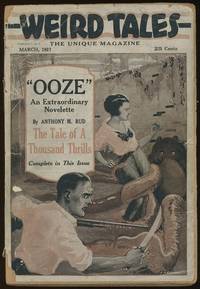
192332048Chicago: Rural Publishing Corporation 1923. Text paper tanned but supple light edge wear creasing closed tear to right front edge paper loss at spine ends not affecting title lettering or date cover appears to have been separated and re-glued small loss at upper and lower left corners a good copy. 32048. Octavo single issue pictorial wrappers. Pulp Magazine. The first issue of this important 20th century magazine. Includes stories by Anthony M. Rud Otis Adelbert Kline R.T.M. Scott Joel Townsley Rogers Howard Ward and many others. Reference: Tymm and Ashley Science Fiction Fantasy and Weird Fiction Magazines pp. 727-736. Rural Publishing Corporation unknown
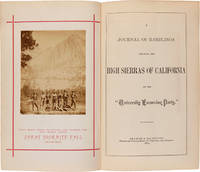
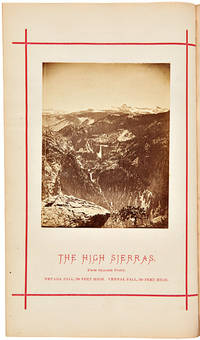
187538698San Francisco: Francis & Valentine 1875. 103pp. plus nine original mounted albumen photographs. Inscribed on front fly leaf. Original blue cloth front board gilt. Small tear in lower outer corner of mount of second photograph not approaching printed border.<br/> <br/>Provenance: Signed by one of the members of the University Excursion Party Everett Pomeroy "Compliments of Everett B. Pomeroy"<br/> <br/>A beautiful book with superb original photographs depicting the range of northern California's natural splendor.<br/> <br/>This copy is signed by one of the members of the University Excursion Party Everett Pomeroy "Compliments of Everett B. Pomeroy" and is quite rare. Everett Pomeroy was one of five graduates who received a B.A. from the University of California in 1871 the school's second graduating class. Pomeroy went on to earn a Master's degree in 1875 and was also a member of the California state National Guard. In 1875 President Grant appointed him United States Attorney for Arizona Territory. A rare photographically-illustrated account of a tour of Yosemite and the High Sierras by one of the pioneer founders of the University of California. Joseph Le Conte studied with Louis Agassiz at Harvard before going to California to serve as professor of geology and he was among the charter members of the Sierra Club. This work describes Le Conte's first expedition with students of the University into the Sierras and the text wonderfully conveys Le Conte's enthusiasm for the region and its natural beauty. While in Yosemite the group visited James Hutchings's hotel and met John Muir who accompanied the group to Lake Tenaya Tuolumne Meadows Mount Dana over Tioga Pass and down to Mono Lake. In his autobiography he describes his first years in California as "very active ones for me the wonderful new country so different from any that I had previously seen the climate the splendid scenery the active energetic people and the magnificent field for scientific and especially for geological investigations." "A record of an excursion by Prof. Le Conte and nine members of one of the early classes of the university. It is stated that but 20 copies were printed" - Cowan. The actual number of copies printed was almost certainly higher perhaps as many as 120 twelve for each member of the party. The images are captioned on the mounts as follows: 1 ".Great Yosemite Fall" frontispiece group portrait of the party. 2 "The Grizzly Giant." 3 "The High Sierras." 4 "The Gates of the Valley." 5 "Bridal Veil Fall." 6 "The Heart of the Sierras. Lake Tenaya." 7 "Day-Dawn in Yosemite. The Merced River." 8 ".North Dome South Half Dome." 9 "Montgomery St. San Francisco. Where our trip ended." The photographs are very handsomely composed and printed images of Yosemite and the High Sierra in very good condition. Farquahar speculates that the photographs "must have been procured from one or more of the professional photographers who operated in Yosemite Valley." The source of the photographs was likely J.J. Reilly a professional photographer active in the Yosemite Valley at the time.<br/> <br/>Cowan 1914 p.137; Farquhar 14a; Currey & Kruska 230; Howes L175 "aa." Kurutz California Books Illustrated with Original Photographs p.16 and item 27; Zamorano Select 64.;Cox Classics 64; Robinson High Sierra Classics 1; Rocq 16596; Eberstadt 124:38. Francis & Valentine unknown books
1875WRCAM41643CSan Francisco: Francis & Valentine 1875. 103pp. plus nine original mounted albumen photographs. Original blue cloth front board gilt. Cloth a bit soiled moderate wear at spine ends and corners. Inscribed on front fly leaf see below. Small tear in lower outer corner of mount of second photograph not even approaching the printed border. Very nice tonality in the photographic prints. Very clean internally. Very good. This copy is signed by one of the members of the University Excursion Party Everett Pomeroy "Compliments of Everett B. Pomeroy" and is quite rare thus. This firm has handled five copies of this book - and noticed several others in the market - and this is the first association copy we have seen. Everett Pomeroy was one of five graduates who received a B.A. from the University of California in 1871 the school's second graduating class. Pomeroy went on to earn a Master's degree in 1875 and was also a member of the California state National Guard. In 1875 President Grant appointed him United States Attorney for Arizona Territory. <br> <br> A rare photographically-illustrated account of a tour of Yosemite and the High Sierras by one of the pioneer founders of the University of California. Joseph Le Conte studied with Louis Agassiz at Harvard before going to California to serve as professor of geology and he was among the charter members of the Sierra Club. This work describes Le Conte's first expedition with students of the University into the Sierras and the text wonderfully conveys Le Conte's enthusiasm for the region and its natural beauty. While in Yosemite the group visited James Hutchings's hotel and met John Muir who accompanied the group to Lake Tenaya Tuolumne Meadows Mount Dana over Tioga Pass and down to Mono Lake. In his autobiography he describes his first years in California as "very active ones for me the wonderful new country so different from any that I had previously seen the climate the splendid scenery the active energetic people and the magnificent field for scientific and especially for geological investigations." "A record of an excursion by Prof. Le Conte and nine members of one of the early classes of the university. It is stated that but 20 copies were printed" - Cowan. The actual number of copies printed was almost certainly higher perhaps as many as 120 twelve for each member of the party. <br> <br> The images are captioned on the mounts as follows: <br> <br> 1 ".Great Yosemite Fall" frontispiece group portrait of the party. <br> <br> 2 "The Grizzly Giant." <br> <br> 3 "The High Sierras." <br> <br> 4 "The Gates of the Valley." <br> <br> 5 "Bridal Veil Fall." <br> <br> 6 "The Heart of the Sierras. Lake Tenaya." <br> <br> 7 "Day-Dawn in Yosemite. The Merced River." <br> <br> 8 ".North Dome South Half Dome." <br> <br> 9 "Montgomery St. San Francisco. Where our trip ended." <br> <br> The photographs are very handsomely composed and printed images of Yosemite and the High Sierra. Farquhar speculates that the photographs "must have been procured from one or more of the professional photographers who operated in Yosemite Valley." The source of the photographs was likely J.J. Reilly a professional photographer active in the Yosemite Valley at the time. <br> <br> A beautiful book with superb photographs depicting the range of northern California's natural splendor. COWAN 1914 p.137. FARQUHAR 14a. CURREY & KRUSKA 230. HOWES L175 "aa." KURUTZ CALIFORNIA BOOKS ILLUSTRATED WITH ORIGINAL PHOTOGRAPHS p.16; item 27. ZAMORANO SELECT 64. COX CLASSICS 64. ROBINSON HIGH SIERRA CLASSICS 11. ROCQ 16596. EBERSTADT 124:38. Francis & Valentine hardcover books
154525180Vinegia: Figlioli di Aldo Aldus 1545. A very early and rare printing of Castiglione by Aldus in the original folio format mirroring the 1528 printing. Elaborate Aldine device impressed on the title and at the end on the verso of the colophon leaf. Dedication to Michel de Selva vescovo di Viseo. Folio handsomely bound in fine Italian vellum. 122 ff. pp. A beautifully preserved copy handsome and clean. RARE ALDINE EDITION OF THE CLASSIC LANDMARK IL CORTEGIANO. Castiglione’s great work is one of the most famous books of the Italian Renaissance and represents the highest level of committment to the prince and the new political and social order. The Courtier is the prototype of the courtesy book written as conversation between members of the court. At the time of its composition Castiglione was at the court of Guidobaldo de Montefeltre and Elizabetta Gonzaga at Urbino together with Bembo Giuliano de' Medici Federico Fregoso and other Renaissance luminaries; members of that court feature as speakers in the conversation. <br> Castiglione after serving the Sforzas at Milan and the Gonzagas at Mantua came to the Court of Urbino in 1504 where de Montefeltre and his consort Elizabetta Gonzaga were the center of the most brilliant court in Italy which counted among its members Bembo Bibbiena G. de’Medici and many other eminent men. This brilliant book is based on Castiglione’s experience of life among these dazzling figures.<br> ‘The Courtier’ depicts the ideal aristocrat and it has remained the perfect definition of a gentleman ever since. It is an epitome of the highest moral and social ideas of the Italian Renaissance and is written in the form of a discussion between members of the court. The fundamental idea that a man should perfect himself by developing all his faculties goes back to Aristotle’s ETHICS and many of the Aristotelian virtues reappear---honesty magnanimity and good manners. The ideal man should also be proficient in arms and games be a scholar and connoisseur of art; he should develop graceful speech and cherish a sense of honour. Relations between the prince and the courtier forms of government and rules for the conduct of a lady are also discussed and the book ends with the celebrated pronouncement on platonic love by Bembo.<br> This Renaissance ideal of the free development of individual faculties and its rules of civilized behaviour formed a new conception of personal rights and obligations in Europe. The book was translated into most European languages and between 1528 and 1616 no less than one hundred and eight editions were published. It had great influence in Spain where traces of it can be found in DON QUIXOTE and in France in Corneille’s writings. But its most potent influence was probably in England. Its influence can be seen in Shakepeare Spenser Ben Jonson Sir Philip Sidney Robert Burton and Shelley. It had a great impact on the development of English drama and comedy.<br> The beautiful and highly important printings of the house of Aldus are exceptional and revered in their own right. This one of the most exceptional of Italian Renaissance works published by the great Renaissance printer of Italy. Figlioli di Aldo (Aldus) hardcover
1528007941Firenze Florence: Li Heredi di Philppo di Giunta 1528. Second Edition. Full Vellum. Very Good. This second edition the first edition octavo in size was issued the same year as the genuine first edition which was published in Venice. 8vo. 158 by 102 mm. Unpaginated 220 leaves. Decorative vignette or device on title page with two seraphs on side of large fleur-de-lys. Same device in somewhat fainter print on final leaf with no other printing on page. Full vellum is contemporary or early at least with yapp edges. Leather straps used to create raise bands on spine also exposed deliberately on boards by joints. Title written by hand on spine. Two vellum leaves both narrow strips in front and rear. Both of these vellum pieces have ancient printed matter in Latin or very old and now faint hand-writing. Also some ancient hand-writing on final leaf some of it upside down. Part of title "Conteg" written on lower fore-edge. The vellum boards are a limp vellum and they now curve out as typical of vellum. The rear board is detached from the text block. The vellum has a moderate amount of soiling but not a level that should be concerning. It is an amount one would expect for a binding of this age and might be regarded almost as desirable "seasoning". Some of this will submit favorably to a cleaning even with a simple eraser if one so desires. The first and last leaves are somewhat gritty but overall the pages are comparatively clean and the text is entirely legible. [Li Heredi di] Philppo di Giunta unknown
154719132Vinegia: Figlioli di Aldo Aldus 1547. Early Printing by Aldus. Elaborate Aldine device Impressed on the titlepage and at the end on the verso of the colophon leaf. Dedication to Michel de Selva vescovo di Viseo. 8vo bound in 17th century stiff vellum red morocco lettering label gilt. ff. 5 195 8. A fine example with the title label with a bit of chipping and with some light loss. RARE ALDINE EDITION OF THE CLASSIC LANDMARK IL CORTEGIANO. Castiglione’s great work is one of the most famous books of the Italian Renaissance and represents the highest level of commitment to the prince and the new political and social order. The Courtier is the prototype of the courtesy book written as conversation between members of the court. At the time of its composition Castiglione was at the court of Guidobaldo de Montefeltre and Elizabetta Gonzaga at Urbino together with Bembo Giuliano de' Medici Federico Fregoso and other Renaissance luminaries; members of that court feature as speakers in the conversation. <br> Castiglione after serving the Sforzas at Milan and the Gonzagas at Mantua came to the Court of Urbino in 1504 where de Montefeltre and his consort Elizabetta Gonzaga were the center of the most brilliant court in Italy which counted among its members Bembo Bibbiena G. de’Medici and many other eminent men. This brilliant book is based on Castiglione’s experience of life among these dazzling figures.<br> ‘The Courtier’ depicts the ideal aristocrat and it has remained the perfect definition of a gentleman ever since. It is an epitome of the highest moral and social ideas of the Italian Renaissance and is written in the form of a discussion between members of the court. The fundamental idea that a man should perfect himself by developing all his faculties goes back to Aristotle’s ETHICS and many of the Aristotelian virtues reappear---honesty magnanimity and good manners. The ideal man should also be proficient in arms and games be a scholar and connoisseur of art; he should develop graceful speech and cherish a sense of honour. Relations between the prince and the courtier forms of government and rules for the conduct of a lady are also discussed and the book ends with the celebrated pronouncement on platonic love by Bembo.<br> This Renaissance ideal of the free development of individual faculties and its rules of civilized behaviour formed a new conception of personal rights and obligations in Europe. The book was translated into most European languages and between 1528 and 1616 no less than one hundred and eight editions were published. It had great influence in Spain where traces of it can be found in DON QUIXOTE and in France in Corneille’s writings. But its most potent influence was probably in England. Its influence can be seen in Shakespeare Spenser Ben Jonson Sir Philip Sidney Robert Burton and Shelley. It had a great impact on the development of English drama and comedy.<br> The beautiful and highly important printings of the house of Aldus are exceptional and revered in their own right. This one of the most exceptional of Italian Renaissance works published by the great Renaissance printer of Italy. Figlioli di Aldo (Aldus) hardcover
2378Engraved vignettes on titles depicting the lemniscate & 16 folding engraved plates. xxiv 528 pp.; xii 536 pp. Two vols. Large 4to mid-19th cent. half-vellum & marbled boards occasional minor stains entirely uncut. Pesaro: Stamperia Gavelliana 1750. First edition of a rare work containing the important collected writings of Fagnano 1682-1766 Italian nobleman and mathematician. Many of the texts printed here appear for the first time. Fagnano's advances in algebra and geometry were very far-reaching and his work on the rectification of the lemniscate made him according to Legendre the true founder of the theory of elliptic functions. This breakthrough was of great importance and was employed in the recent proof of Fermat's last theorem. "In algebra Fagnano suggested new methods for the solution of equations of the second third and fourth degrees. He also organized in a rational manner the knowledge that scientists had of imaginary numbers establishing for them a special algorithm that was far better than BombeIli's primitive one. "In geometry Fagnano formulated a general theory of geometric proportions that is more noteworthy than the countless writings published previously that were intended to illustrate book V of Euclid's Elements. Much more important however is his work on the triangle for which he may well be considered the founder of the geometry of the triangle. "'The most important results achieved by Fagnano however were in analytical geometry and in integral calculus."-D.S.B. IV pp. 515-16. "In his study of the rectification of the lemniscate Fagnano introduced ingenious analytic transformations that laid the foundation for the theory of elliptic integrals and his work was to lead to elliptic functions. Fagnano collected many of his published works and a few unpublished ones and produced the two volume treatise Produzioni matematiche in 1750. In 1751 Euler was asked to examine Produzioni matematiche and he found in this treatise relations between special types of elliptic integrals that express the length of an arc of a lemniscate which were quite unexpected to him. Generalising Fagnano's results Euler went on to create a general theory of these integrals in particular giving the famous addition formula for elliptic integrals. Fagnano had proved the duplication formula a particular case of the addition formula for the integrals. "In fact Fagnano had proved remarkable properties of the lemniscate including the fact that its arcs may be divided in equal parts using a ruler and compass construction. "Fagnano made many other major contributions but his mathematical work was not without controversy. He was involved in priority disputes with Nicolaus I Bernoulli and not surprisingly the big dispute of the day which was between the supporters of Newton and those of Leibniz."-The MacTutor History of Mathematics Archive on-line. hardcover books
192332049Indianapolis IN: Rural Publishing Corporation 1923. Text paper mildy tanned vertical crease to front cover series of small holes along left edge-likely from being bound at some point a little paper loss to spine ends some rubs to spine edge a good to very good copy. 32049. Octavo single issue pictorial wrappers. Pulp Magazine. The second issue of this important 20th century magazine. Includes stories by Howard Ward Anthony M. Rud Otis Adelbert Kline Francis Grierson Ted Olson and many others. Reference: Tymm and Ashley Science Fiction Fantasy and Weird Fiction Magazines pp. 727-736. Rural Publishing Corporation unknown
1875WRCAM41643ASan Francisco: Francis & Valentine 1875. 103pp. plus nine original mounted albumen photographs. 20th-century three-quarter morocco and blue cloth spine gilt. Spine sunned. Frontispiece photograph with three small stains and the final two photographs exhibiting some moderate fading else quite clean internally. A very good copy. A rare photographically illustrated account of a tour of Yosemite and the High Sierras by one of the pioneer founders of the University of California. Le Conte studied with Agassiz at Harvard before going to California to serve as professor of geology and he was among the charter members of the Sierra Club. This work describes Le Conte's first expedition with students of the University into the Sierras and the text wonderfully conveys Le Conte's enthusiasm for the region and its natural beauty. In his autobiography he describes his first years in California as "very active ones for me the wonderful new country so different from any that I had previously seen the climate the splendid scenery the active energetic people and the magnificent field for scientific and especially for geological investigations." "A record of an excursion by Prof. Le Conte and nine members of one of the early classes of the university. It is stated that but 20 copies were printed" - Cowan. The actual number of copies printed was almost certainly higher perhaps as many as 120 twelve for each member of the party. <br> <br> A beautiful book with superb photographs depicting the range of northern California's natural splendor. The images are captioned on the mounts as follows: <br> <br> 1 ".Great Yosemite Fall" frontispiece group portrait of the party. <br> <br> 2 "The Grizzly Giant." <br> <br> 3 "The High Sierras." <br> <br> 4 "The Gates of the Valley." <br> <br> 5 "Bridal Veil Fall." <br> <br> 6 "The Heart of the Sierras. Lake Tenaya." <br> <br> 7 "Day-Dawn in Yosemite. The Merced River." <br> <br> 8 ".North Dome South Half Dome." <br> <br> 9 "Montgomery St. San Francisco. Where our trip ended." HOWES L175. COWAN 1914 p.137. FARQUHAR 14a. CURREY & KRUSKA 230. KURUTZ CALIFORNIA BOOKS ILLUSTRATED WITH ORIGINAL PHOTOGRAPHS 27. ZAMORANO SELECT 64. Francis & Valentine hardcover books
189724<i>This book is over 122 years old. <br />"The Raven"</i> in particular—Poe investigates the loss of ideal beauty and the difficulty in regaining it. These pieces are usually narrated by a young man who laments the untimely death of his beloved. <i>"To Helen"</i> is a three stanza lyric that has been called one of the most beautiful love poems in the English language. The subject of the work is a woman who becomes in the eyes of the narrator a personification of the classical beauty of ancient Greece and Rome. <i>"Lenore"</i> presents ways in which the dead are best remembered either by mourning or celebrating life beyond earthly boundaries. In <i>"The Raven"</i> Poe successfully unites his philosophical and aesthetic ideals. In this psychological piece a young scholar is emotionally tormented by a raven's ominous repetition of "Nevermore" in answer to his question about the probability of an afterlife with his deceased lover. Charles Baudelaire noted in his introduction to the French edition of <i>"The Raven"</i>: "It is indeed the poem of the sleeplessness of despair; it lacks nothing: neither the fever of ideas nor the violence of colors nor sickly reasoning nor drivelling terror nor even the bizarre gaiety of suffering which makes it more terrible." Poe also wrote poems that were intended to be read aloud. Experimenting with combinations of sound and rhythm he employed such technical devices as repetition parallelism internal rhyme alliteration and assonance to produce works that are unique in American poetry for their haunting musical quality. In <i>"The Bells"</i> for example the repetition of the word "bells" in various structures accentuates the unique tonality of the different types of bells described in the poem.Poe's stature as a major figure in world literature is primarily based on his ingenious and profound short stories poems and critical theories which established a highly influential rationale for the short form in both poetry and fiction. Regarded in literary histories and handbooks as the architect of the modern short story Poe was also the principal forerunner of the "art for art's sake" movement in nineteenth-century European literature. Whereas earlier critics predominantly concerned themselves with moral or ideological generalities Poe focused his criticism on the specifics of style and construction that contributed to a work's effectiveness or failure. In his own work he demonstrated a brilliant command of language and technique as well as an inspired and original imagination. Poe's poetry and short stories greatly influenced the French Symbolists of the late nineteenth century who in turn altered the direction of modern literature. It is this philosophical and artistic transaction that accounts for much of Poe's importance in literary history.<br /><br />This book contains the first collection of Poems Poems and Tales. See Pictures Houghton Mifflin Company hardcover
184586861Société belge de librairie, Hauman et cie | Bruxelles 1845 - 1846 | 9.70 x 15.30 cm | 8 tomes en 4 volumes reliés
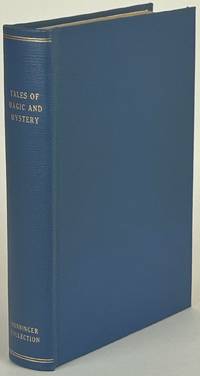
192731906Camden NJ: Personal Arts Company Publishers 1927-1928. Issues slightly trimmed for binding otherwise quite fine with little tanning to text paper mostly cream colored. At the base of the spine is stamped "Dunninger Collection." A lovely presentation. 31906. Octavo five issues pictorial wrappers bound in blue boards with gold stamping to spine. A bound volume of all five issues that were noted magician Joseph Dunningers copy with his signed name and also inscribed and signed by editor/author Walter Gibson to Joe Dunninger. Gibson wrote several books about magic for Dunninger they were lifelong friends. This is likely a presentation volume to Dunninger. Tales of Magic and Mystery was a short lived magazine which published stories and articles about magic and the occult as well as some short fiction. The March 1928 issue published the H. P. Lovecraft short story "Cool Air." Other authors of fiction include Frank Owen Miriam Allen de Ford Archie Binns Robert Leslie Bellem and others. Gibson wrote most non-fiction material under his own name and also using the pseudonyms Alfred Maurice and Bernard Perry. Personal Arts Company, Publishers unknown
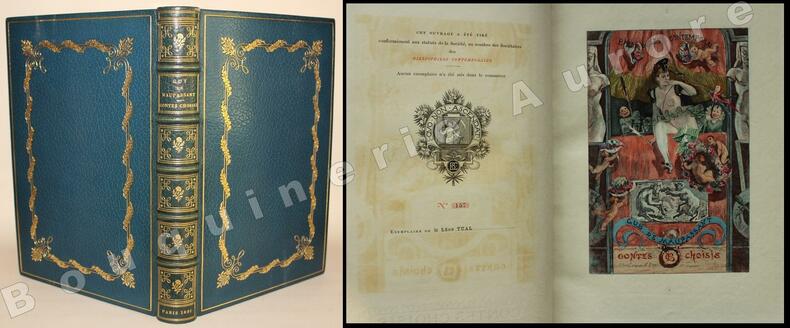
1891137671891 P., aux frais et pour les sociétaires des Bibliophiles de l'Académie des Beaux-livres, 1891-1892, 10 ouvrages en un volume grand in-8° (265 x 176), plein maroquin bleu, filet doré en bordure des plats encadrant au centre un cadre composé d'un double filet doré autour duquel s'enroule une guirlande florale, fleur dorée aux angles, dos à nerfs orné, 5 filets dorés en encadrement à l'intérieur, ornés de roses dorées aux angles, doublures et gardes de soie grise à décor floral, tranches dorées sur témoins, étui (CHAMBOLLE-DURU).Dos légèrement passé, superbe exemplaire par ailleurs.
194863455(Paris-Barcelona), Editions Albor, (1948). Gr.-4° (34 x 25,5 cm). Mit faksimilierter Schrift u. 4 Orig.-Kaltnadelradierungen von Pablo Picasso. 32 nn. Bll. (dav. 7 weiß). Lose Bogen in OKart.-Umschlag zwischen Holzdeckeln m. dem eingravierten Titel u. Bindebändern.
1874AMO-4512Paris, A. Barraud, 1874. [Damase Jouaust imprimeur]. 2 volumes in-8 (22 x 14 cm) de XLVI-xij-268-(1) et xj-320 pages. Reliure plein maroquin bleu nuit doublé de maroquin rouge, dos à nerfs richement ornés aux petits fers dorés, large décor de dentelle dorée en encadrement intérieur des plats, filet doré perlé sur les coupes, gardes de papier peigne. Reliure signée DAVID, BÉNARD doreur. RÉIMPRESSION DE L’ÉDITION DITE DES FERMIERS GÉNÉRAUX (1762) ILLUSTRÉE DE 85 ESTAMPES D’APRES LES CUIVRES ORIGINAUX. Édition de bibliophilie tirée à 1.004 exemplaires. CELUI-CI, UN DES 100 EXEMPLAIRES SUR PAPIER DE CHINE.
191889560Nrf | Paris 1918 | 12.8 x 19.5 cm | Relié
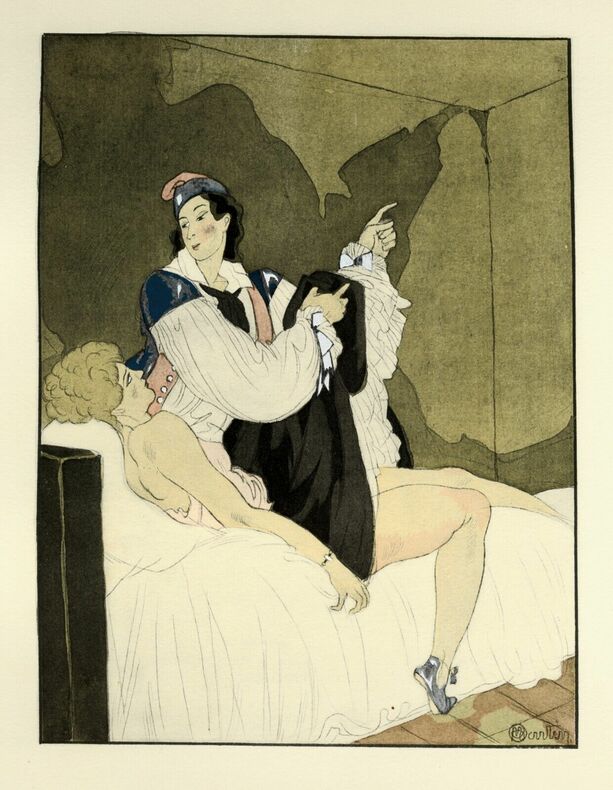
1930AMO-4515Librairie de France, 110, Boulevard Saint-Germain, Paris, 1930 2 volumes grands in-4 (28,5 x 13 cm) brochés de (6)-XXI-249-(6) et (6)-361-(1) et (17) pages d'introduction signée André Fontainas. Avec 64 illustrations hors-texte de Charles Martin dont 32 rehaussées en couleurs au pochoir à l'aquarelle, les 32 autres étant en noir. Les aquarelles originales de l'artiste ont été reproduites par la photogravure (non interprétées donc). Couvertures imprimées en brun et bleu à rabats. Le texte est imprimé en noir avec encadrements, ornements et décors imprimés en bleu ciel. Exemplaire encore protégé par son papier cristal d'origine et dans son emboîtage spécial en papier bleu titré imprimé. Partiellement non coupé (presque entièrement). Petites amorces de fente du papier au dos du premier volume, sans aucune gravité. Beau papier d'Arches fort resté bien blanc sans rousseurs. Le tirage a été de 3.000 exemplaires. Celui-ci est un des 350 exemplaires sur papier d'Arches. Il a été tiré 15 ex. sur Japon, 50 ex. sur Hollande, 350 ex. sur Arches, 1500 ex. sur vélin pur fil Lafuma et 1500 ex. sur vélin d'alfa Navarre. Notre exemplaire porte le numéro CCCXVII. Notre exemplaire contient livré à part la suite des 15 eaux-fortes libres tirées à très petit nombre. Elles sont tirées en noir sur papier d'Arches également. Notre exemplaire contient livré à part la suite complète des 64 hors-texte (32 coloriés et 32 en noir). Enfin, notre exemplaire contient livré à part 8 aquarelles originales ayant servies à l'impression de l'ouvrage (dont une seule est signée et est l'aquarelle définitive ayant servie au clichage pour l'impression) et une esquisse d'une illustration de la suite libre. Soit un total de 9 oeuvres originales de l'artiste présentes avec cet exemplaire.
17111Paris, éditions Vialetay, 1958-1959. 2 vol. in-folio, 127 pp. + 129-253 pp., en feuilles, couverture originale illutrée, chemise et étui cartonnés de l'éditeur (petits frottements, minuscules manques ou fentes et légère insolation des étuis et chemises, trois petites taches sur la couverture du 1er vol.).
177612401Venice: s.n. 1776. Modern vellum mostly uncut. <p> The paintings 181 drawings 1211 and books 350 owned by Francesco Algarotti a true Enlightenment figure. He was a widely recognized philosopher a popularizer of Newtonianism an intimate of Frederick II of Prussia and art advisor to Augustus III Elector of Saxony. Francesco's wide ranging love affairs involved i.a. John Hervey 2nd Baron Hervey 1696-1743 and Lady Mary Wortley Montagu 1689-1762. On his death his collections passed to and were augmented by his brother Bonomo 1706-76 whose daughter put this catalog to press. Its authorship is attributed to architect Giannantonio Selva 1753-1819 and conservator and curator Pietro Edwards 1744-1821. A French translation appeared immediately and a German version in 1780.<br /> The paintings and drawings are organized by artist giving birth and death dates and principal places of activity. Predominantly Italian 15th- to 18th-century the paintings are carefully described the support and dimensions noted and an aesthetic judgement historical note or scholarly reference often added. Handled summarily the drawings - even those of Michelangelo - are designated watercolor red crayon pen and ink etc. with those on colored paper so indicated. The books cover architecture lives of artists curiosity cabinets views coins and medals anatomy travel guides archaeology perspective monuments pattern books color.<br /> Internally fresh some scattered red crayon marginal marks.<br /> ¶Dall'Orto "Algarotti Francesco" in Who's Who in Gay and Lesbian History edd. Aldrich & Wotherspoon I: 16-8; Schlosser-Magnino La Letteratura artistica 564.</p> s.n. unknown
1797127555à Paris, Imprimé au Louvre par P. Didot l'aîné. An V. M. DCC. XCVII 1797 Grand in-4 32,5 x 24 cm. Reliure de l’époque plein maroquin rouge à long grain, dos à nerfs encadrés de roulettes et de fers dorés, plats à encadrement néoclassique, contreplats encadrés d’une frise néoclassique, tranches dorées, XX-331 pp., orné de 5 belles planches sous serpentes, gravées par Nicollet, Blot, Alex. Tardieu, Marais, et J. Mathieu d'après des dessins de Gérard. Bel exemplaire avec léger frottis et rousseurs marginales.
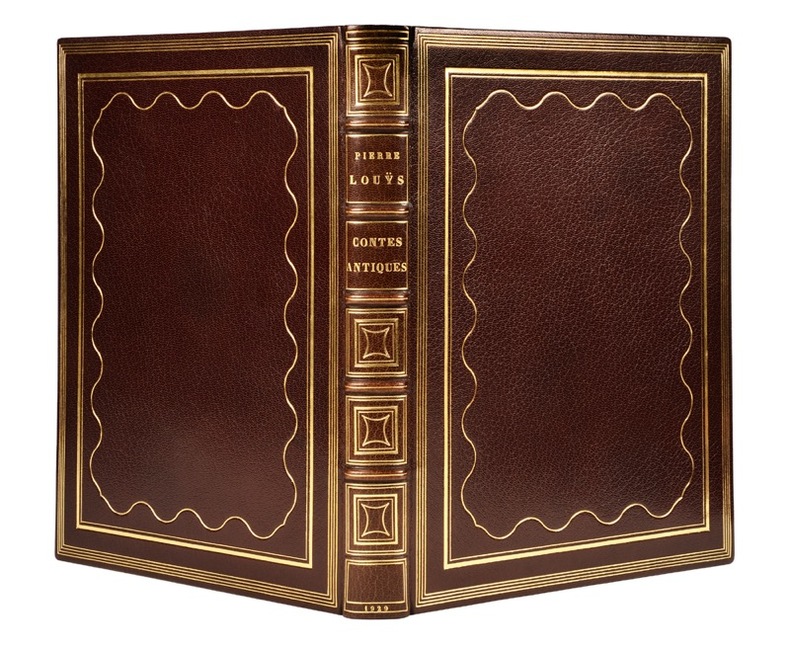
192921637Paris, Editions du Bois Sacré, 1929 ; grand in-4°, maroquin bordeaux, dos à nerfs soulignés d’un filet doré, auteur et titre en majuscules dorées, caisson décorés, date en queue ; plats décorés d’un grand filet ondulé d’encadrement, entouré d’un double filet maigre et gras, le tout encadré d’un quadruple filet doré fin, filet doré sur les coupes, tête dorée, bordure intérieure avec cinq filets dorés et un filet gras à froid encadrant une pièce de soie moire grenat, gardes de même, doubles gardes marbrées et dorées, couverture et dos conservés, étui bordé (Adrien Lavaux)
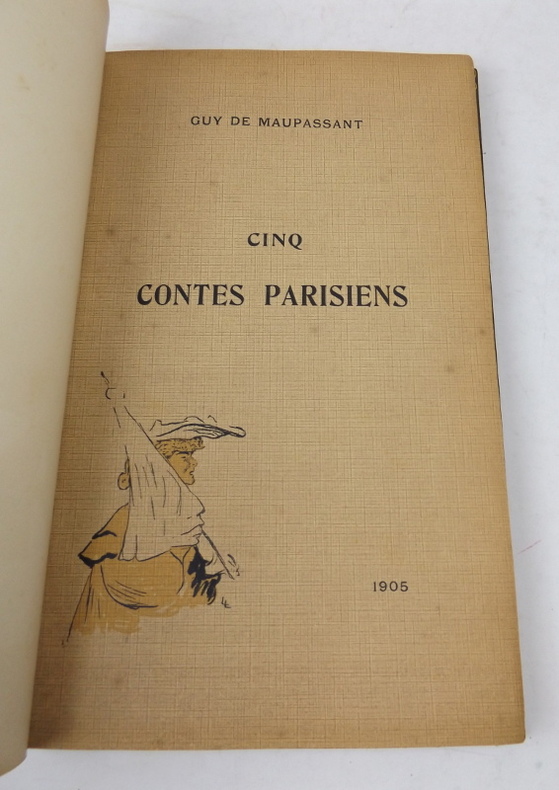
1905bf5204Les Cent Bibliophiles Reliure signée 1905 In-8, maroquin marron, avec filets d'or sur les plats et rappel du motif sur le dos à 4 nerfs, tranches dorées,couverture et dos conservés. Toutes tranches dorés. Contres plats décorés de décors art déco mosaïqués. Gardes en tissu vert moiré, ce tissu est également présent aux contres plats. Somptueuse reliure signée par Marius Michel. Tirage unique de 130 exemplaires numérotés, livre peu commun, voir rare. Ce titre contient les contes suivant : l'inconnue, Imprudence, La confidence, Sauvée et La Patrone. La plupart de ces contes ont été publié la première fois vers 1885. Illustrations Louis Legrand ; magnifique exemplaire. Livraison a domicile (La Poste) ou en Mondial Relay sur simple demande.
195694179Paris Cercle Grolier 1956 1 vol. relié in-4, plein vélin crème, dos lisse avec auteur et titre en lettres dorées, plats ornés de deux dessins originaux pointillistes en couleurs, bordure intérieure, doublures et gardes de tissu tramé gris, tête dorée, non rogné, couvertures et dos muet conservés, chemise demi-vélin et étui bordé, 117 pp. Édition illustrée de 25 eaux-fortes de Mario Avati. Tirage unique à 220 exemplaires numérotés sur grand vélin de Rives, celui-ci - exemplaire nominatif d'Ernest Simon - est enrichi d'une suite signée des gravures sur japon nacré, du menu illustré d'une eau-forte et d'un beau dessin original signé, version préparatoire de la gravure qui illustre la page 57, "Le convive des dernières fêtes". L'exemplaire est surtout conservé dans une reliure décorée par Avati de deux magnifiques dessins originaux aux encres de couleurs : un visage que fait sourire un joueur de violon sur le premier plat, une chouette perchée sur un arbre en médaillon du second plat. Le peintre a inscrit en page de garde cet ex-dono autographe signé : "à Ernest Simon qui a bien voulu me présenter au cercle Grolier, afin de me permettre d'illustrer ces quelques contes, ce 27 mars 1957, en toute sympathie, Avati". Exemplaire unique, en parfait état.