388 résultats
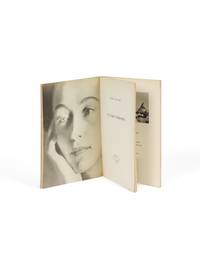
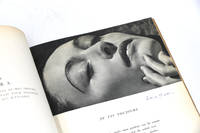
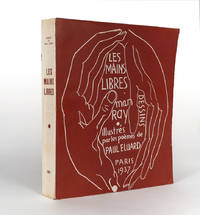
193721205811937. Paris: Jeanne Bucher 1937 4to. Original pictorial red and white wrappers lettered in red to spine; pp. 176 30 with pictorial title and 66 full-page illustrations by Man Ray; pages partially uncut; very minor creasing to lower corners and spine a little frayed otherwise near fine copy; author's presentation inscription to half-title 'a Georges Mouton tres amicalement Paul Eluard' see below.First edition number 319 of 650 copies printed on Chester verge of a total edition of 675 copies presented by Eluard to the Surrealist writer Georges Mouton. Les mains libres is the second collaborative work between Man Ray a pioneer of the Surrealist movement and Paul Eluard poet and one of the movement's founders. During the 1930s Man Ray made numerous drawings in Paris and the South of France. He shared them with Eluard who requested to keep them temporarily. Adhering to the Surrealist tradition the poet 'illustrates' the images not the opposite: upon Man Ray's return Eluard had paired each drawing with a poem. This collaboration resulted in the publication of Les mains libres featuring fifty-four illustrations by Man Ray facing as many poems by Eluard and three appendices 'Sade' 'Portraits' and 'Details' which include Man Ray's portraits of Pablo Picasso Andre Breton and Eluard. Provenance: This copy was presented by Eluard to the writer Goerge Mouton. Connected to Surrealist circles in the 1930s Mouton was a member of the Contre-Attaque group led by Georges Bataille and Andre Breton during 1935-1936. unknown
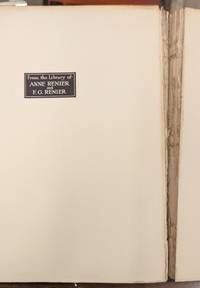
1937106371Editions Jeanne Bucher 1937. Softcover. Good/No jacket. #68/650cc. Wraps pulling away from the text block. Binding is a little loose. Pages clean. <br /> <br /> Bookplate inside front cover of Anne Renier and Fernand Renier a formidable duo who collected books in the thirties but ramped up their interest in children's books in the fifties. In 1970 the Reniers donated their collection of 80000 children's books and toys to the Victoria and Albert Museum. Editions Jeanne Bucher unknown
19371704521937. MAN RAY. Les Mains Libres. By Paul Eluard. 208 pp. with 66 reproductions of drawings by Man Ray. 4to 280 x 225 mm. bound in the original illustrated wrappers in a new slipcase with morocco backed chemise. Paris: Editions Jeanne Bucher 1937. A pristine copy of this celebrated collaboration between Man Ray and Paul Eluard inscribed by Man Ray to Souzouki. Man Ray had moved to Paris in 1921 and in the 1930s was one of André Breton's surrealist circles. Unlike most illustrated books where the pictures illustrate the text this book uses the poems to illustrate the drawings which are important documents of Man Ray's non-photographic output. One of 650 printed on Chester Vergé of a total edition of 675 copies. From Manet to Hockney 104. unknown
191831297Paris: Les Cahiers idéalistes français 1918. Fine. Les Cahiers idéalistes français Paris 1918 15 x 20 cm broché First edition of this idealistic and internationalist French review published in a small number of copies. Copy uniformly foxed on the margins the covers are detached from the volume the back cover shows uniform foxing throughout. Contributions by Renan La guerre entre la France et l'Allemagne article published September 15 1870 M. Loumaye; H. Dalby P. Eluard Pour vivre ici; G. Pillement; A. Domin; Brenn; E. Dujardin Au Président Wilson. Handsome interior condition. Les Cahiers idéalistes français unknown
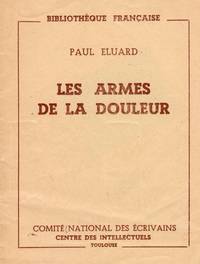
23098Toulouse Comité national des écrivains 1944. 1 plaquette 105 x 135 mm de 16 p. Agrafée. Couverture jaune. Première édition séparée de ce poème initialement paru en clôture du second volume de L’Honneur des poètes. Publié en mai 1944 aux Éditions de Minuit il est dédié « à la mémoire de Lucien Legros fusillé pour ses 18 ans » entré dans la clandestinité après sa participation le 16 avril 1942 à la protestation contre l'arrestation de Raymond Burgard professeur résistant du lycée Buffon. Arrêté par les brigades spéciales le 5 juin condamné aux travaux forcés le 25 il fut livré à l'occupant qui le condamna à mort le 15 octobre. Une semaine plus tard Éluard recevait une lettre du père du jeune homme le lui annonçant : « mon petit est condamné à mort mais je le sauverai » cité dans Minuit au coeur au coeur de Minuit p. 43. Il y échouera : avec quatre camarades du lycée Buffon son fils sera fusillé le 8 février 1943. Éluard écrira « Les Armes de la douleur » pour lui et « Daddy des ruines » le père du jeune martyr son « camarade des deux guerres ». Les poèmes « À celles dont ils rêvent » « Courage » et « Bêtes et méchants » suivent « Les Armes de la douleur ». Toulouse, Comité national des écrivains, 1944. 1 plaquette (105 x 135 mm) de 16 p. Agrafée. Couverture jaune. unknown
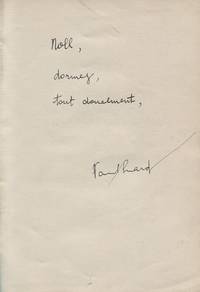
18243Paris Au sans pareil 10 janvier 1920. 1 vol. 140 x 200 mm de 44 p. et 2 f. Demi-chagrin havane à coins dos lisse titre doré en long tête cirée couvertures conservées reliure signée de Flammarion-Vaillant. . Édition originale. Illustré de 5 dessins hors-texte d'André Lhote. Un des 550 exemplaires sur vélin d'alfa n° 243. Envoi signé : « Noll dormez tout doucement Paul Éluard ». . Les Animaux et leurs hommes est le premier recueil de Paul Éluard où se manifeste l'influence de Dada marque sa véritable entrée dans le groupe Dada parisien son premier manifeste littéraire rédigé quelques mois après sa rencontre avec le futur chef de file du mouvement surréaliste André Breton. L'exemplaire est offert à un compagnon es-lettres Marcel Noll auquel Éluard avait déjà envoyé trois ans plus tôt Le Devoir et l'Inquiétude avec cet envoi déjà onirique : « à Marcel Noll pour que la phrase prédominante s'abaisse au silence ». Le personnage reste pourtant mystérieux : partout présent dans les premières manifestations du mouvement surréaliste il collabore aux revues publiées par le groupe puis à L'Humanité. Avec Breton et Éluard il était très lié à Denise Lévy future compagne puis épouse de Pierre Naville - la cousine de Simone Kahn qu'épousera Breton en août 1921 - et dont il était éperdument amoureux. Marcel Noll est très présent dès 1922 dans le cercle d'amis qui fréquentent l'atelier de Simone et André Breton qui écrivent et voyagent ensemble. Une notice de Marguerite Bonnet pour les notes de l'édition Pléiade énumère la collaboration de Noll à La Révolution surréaliste n° 1 déc. 1924 à laquelle on doit ajouter celles des 15 juil. 1925 15 juin et 1er déc. 1926 et son rôle de gérant de la Galerie surréaliste en 1926. Dix ans plus tard Noll « aurait disparu en Espagne durant la guerre civile » Pléiade p. 1194-95. Aragon lui a dédié le chapitre III du Paysan de Paris 1926 ; Breton le poème « L'Aigrette » dans Clair de terre et dans Nadja 1928 Breton évoque sa visite un jour de 1926 « avec Marcel Noll au ‘marché aux puces' de Saint-Ouen. ». La notice du Maîtron Dictionnaire biographique du Mouvement ouvrier indique : « Noll est entré jeune en contact avec Breton et Éluard par l'intermédiaire de Denise Lévy née Kahn amatrice d'art qui habitait comme lui Strasbourg Haut-Rhin et était une cousine de Simone Breton. Le nom de Noll apparaît au sommaire de la revue La Révolution surréaliste dès le premier numéro 1924. Journaliste il écrit et signe parfois en 1925 la revue des revues dans les colonnes de L'Humanité. Faisant du courtage de tableaux il exerça des responsabilités à la Galerie surréaliste qui avait été ouverte en mars 1926. Il travailla plus tard à L'Humanité de Metz édition en langue allemande. Dans une lettre à Breton de 1932 il indique qu'il y donne des échos de l'activité surréaliste. . mort le 5 janvier 1937 sur le front de Madrid. » Paris, Au sans pareil, (10 janvier) 1920. 1 vol. (140 x 200 mm) de 44 p. et [2] f. Demi-chagrin havane à coins, dos lisse, titr unknown
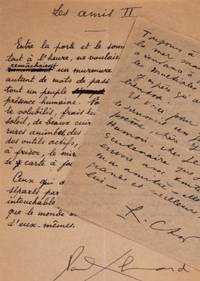
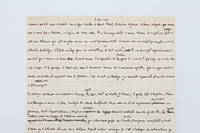
29423Le Cannet 19 janvier 1937. 1 page en 1 f. 160 x 250 mm encre noire. . Poème autographe signé. Éluard a inscrit la date sous sa signature : « chez René Char le 19-1-37 ». . « Entre la porte et le sommeil de ceux qui tout à l'heure ne voulaient pas dormir - remâchaient un murmure plein de petits os autant de mots de passe dans une veille fluide - un peuple dénaturé perpétue la présence humaine. Voici le liseron la capucine le volubilis frais échappés d'un déjeuner de soleil de beaux cuirs usés des fourrures animées des étoffes à reflet des chaises des outils actifs justifiés l'aspirine et le fer à friser le miroir et le paysage en forme de carte à jouer. ». Ce poème sera intégré par Éluard dans le recueil Les Mains libres qui a pour origine sa forte amitié avec Man Ray. L'oeuvre est construite en deux parties inégales précédées d'un frontispice dessin d'introduction et d'une préface du poète. La première partie comporte trente dessins et poèmes la seconde vingt-quatre ; chacune des parties se clôt par un dessin-poème : « La liberté » et « Les amis ». Ce dernier est d'une importance cruciale illustrant une valeur cardinale aux yeux de Man Ray comme d'Éluard. Son placement n'est pas anodin : c'est le dernier poème du recueil et le seul en prose narratif formé de deux strophes. Ce manuscrit nous apprend qu'il fut composé chez René Char lorsque Paul et Nusch Éluard lui rendirent visite au début de l'année 1937. Char est alors en convalescence avec Georgette à la villa Eden Park au Cannet quelques mois après une grave septicémie qui manqua de le tuer. Il signera peu après les pensées fulgurantes de Moulin premier publiées en décembre 1936 avant de rejoindre la région cannoise où le couple Éluard les rejoint : « nous vécûmes ensemble dans l'improvisation et l'aisance de l'amitié une quinzaine de jours » raconte Éluard. C'est lors de ce séjour que seront aussi composés les deux poèmes qui formeront l'édition posthume du recueil homonyme publié en 1960 chez Jean Hugues. [Le Cannet], 19 janvier 1937. 1 page en 1 f. (160 x 250 mm), encre noire. unknown
1981014815Paris: Éditions Hervas 1981. Book. Near Fine / Bel. Quality Paperback / Broché. tall 8vo / in-8o. Éditions Hervas Paperback
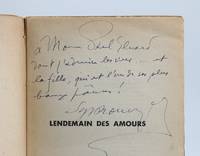
193983131Paris: Edgar Malfère 1939. Fine. Edgar Malfère Paris 1939 12 x 19 cm broché First edition a Service de Presse advance copy. Precious and handsome signed autograph inscription by Sylvain Bonmariage: ""A Monsieur Paul Eluard dont j'admire les vers. et la fille qui est l'un de ses plus beaux poêmes !"" ""To Monsieur Paul Eluard whose verses I admire. and whose daughter is one of his most beautiful poems!"" Edgar Malfère unknown
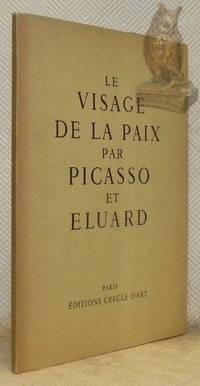
1951118496Paris : Editions du Cercle dÕArt 1951. 295x225mm. collation effectuÂŽ: 29 dessins n/b in texte dont un en couleurs brochÂŽ. Couverture ˆ rabats. Un des 2000 exemplaires sur papier vÂŽlin offset supÂŽrieur numÂŽrotÂŽ n.¡ 322 / 2000. Ce volume achevÂŽ dÕimprimer en octobre mil neuf cent cinquante-et-un a ÂŽtÂŽ tirÂŽ pour les lithographies sur les presses de Mourlot FrÂres la typographie est de lÕimprimerie Union ˆ Paris. Bloch 687. Cramer 62. Mourlot 203. TrÂs bel exemplaire. 284 Editions du Cercle dÕArt unknown
195148786Paris.: Cercle d'art. 1951. Original publisher's printed wrappers with titles to front cover in black. 4to. 285 x 228 mm. With original lithograph by Picasso and 29 lithographs after Picasso drawings printed by Mourlot. The édition de tête with Picasso's original lithograph.From the edition limited to 150 copies with the original lithograph; this copy exceptionally signed by Picasso in pencil and with the collector's mark WDB.The book published the 29 drawing Picasso made of variations on the theme of peace for the 30th Anniversary of the French Communist Party.Mourlot 203; Cramer 62. Cercle d'art. unknown
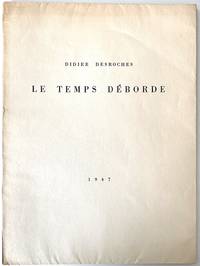
29983Paris Cahiers d'art 16 juin 1947. 1 vol. 180 x 245 mm non paginé. Broché. . Édition originale. Illustrée de 11 photographies de Dora Maar et Man Ray. Tirage à 500 258 en réalité exemplaires n° 106. . Ce recueil réunit quatorze poèmes répartis en deux ensembles séparés par la date fatale du 28 novembre 1946 jour de la mort soudaine de Nusch l'épouse du poète. Le texte inaugural d'une intensité bouleversante enregistre le drame : « Vingt-huit novembre mil neuf cent quarante-six. Nous ne vieillirons pas ensemble. Voici le jour en trop : le temps déborde. Mon amour si léger prend le poids d'un supplice. » Éluard choisit pour ce livre le pseudonyme de Didier Desroches dont il avait révélé l'existence à Gala quelques jours plus tôt le 25 novembre affirmant vouloir « recommencer entièrement sa vie poétique. J'en ai assez de mes poèmes que l'on achète de confiance pour la signature ». Nusch était la seule à partager ce secret ; la mort la frappant trois jours après le poète n'emploiera ce nom qu'une seule fois faisant de ce recueil un ultime hommage à sa muse et compagne de dix-sept années. Tirage annoncé à 500 exemplaires mais en réalité limité à 258 exemplaires seulement n° 106. Le papier nécessaire pour l'impression fut offert par Gallimard mais la pénurie de l'après-guerre empêcha un tirage complet : Éluard note lui-même dans l'exemplaire qu'il offre à Valentine Hugo que « l'on ne put tirer que 258 exemplaires et non 500 l'annonce l'achevé d'imprimer ». Paris, Cahiers d'art, (16 juin) 1947. 1 vol. (180 x 245 mm) non paginé. Broché. unknown
19472402Paris: Éditions Cahiers d’Art 1947. First edition. 48 pp. Plain wrappers with attached dust jacket. Some toning to cover extremities minor handling wear near fine.<br /> <br /> One of 500 numbered copies although Eluard noted that only 258 copies were printed due to a lack of paper. Eluard’s poignant tribute to his wife Nusch published a few months after her sudden and unexpected death. Illustrated with eleven exquisite photographs of Nusch by Man Ray and Dora Maar. Nusch had also been the subject of Man Ray’s camera in the similarly superlative Facile published ten years earlier. In 1965 Louis Aragon during a tribute to his friend mentioned his first encounter with the book: “He signed it with an invented name Didier Desroches because he had killed Paul Eluard… What he had shown me of Didier was of a confounding beauty. This little book which was to appear as the work of an unknown it is an understatement to say that in my eyes it surpasses all that Eluard signed with his name. I thought it then and I think it today.†A rare and beautiful book. Éditions Cahiers d’Art unknown
194791779Paris: Editions Cahier d'art 1947. Fine. Dora Maar Signs Her Own Work Editions Cahier d'art Paris 1947 18.50 x 24.50 cm broché First edition which supposedly had an issue of 500 numbered copies. Gallimard donated the paper required for the production of this book but only 258 copies could be printed rather than the 500 announced in the justification from a note by Paul Éluard. A slight crease to the covers slight marginal sunning primarily affecting the rear cover. Illustrated with 11 photographs of Nusch Éluard by Man Ray and Dora Maar. Le temps déborde is a collection of eleven poems published in 1947 a few months after the sudden and unexpected death of Paul Éluards wife Nusch. A poignant ode to their seventeen years of life together the work is illustrated with striking portraits of Nusch. This exceptional copy is signed by Dora Maar beneath or directly on each of her five photographs. We are aware of only one other copy signed by the photographer and none signed by Man Ray. A rare and beautiful copy. In 1965 paying tribute to his friend Aragon recalled his discovery of this masterpiece: He signed it with an invented name Didier Desroches because he had killed Paul Éluard. I let him talk. What he had shown me of Didier was of a confounding beauty. This slender book which was to appear as the work of an unknown to say merely that in my eyes it surpasses everything Éluard ever signed with his own name is to say too little. I thought so then and I think so today. The attribution of each photograph in the collection to either Man Ray or Dora Maar has long been a source of confusion. Strangely the question seems to attract little scholarly attention: as Mary Ann Caws notes Dora Maars portraits of the Surrealists muse were originally attributed to Man Ray since they were so clearly superb in their construction and realization These photographing women: The scandal of genius Angels of anarchy: women artists and surrealism 2009. This misattribution was also a consequence of the systematic erasure of Dora Maars photographic work which she abandoned at Picassos request. The two series by Dora Maar and Man Ray are further entwined by their shared style and by both artists fascination with Nusch. Audacious framing and subtle interplay of shadow and light reflect the two Surrealist photographers formal innovation. Beyond aesthetic alchemy the three of them were very close at the time of these photographs 1935-1938. For several years they all took part with their partners Ady Fidelin and Paul Eluard in late-summer gatherings in the rustic village of Mougins overlooking Cannes at the invitation of Picasso where they indulged in role play identity and couple exchanges Alicia Ortiz Dujovne Dora Maar. Some of the collections illustrations are well known: Man Rays Nusch with mirror his diptych with her eyes closed and open and the celebrated portrait by Dora Maar illustrating the poem LExtase with her carefully lit face floating in darkness supported only with her fingers an elusive expression in her eyes. In one unforgettable version of the same image Les années vous guettent The years lie in wait. Maar superimposes a silvery spiders web over Nuschs features Louise Baring Dora Maar: Paris in the time of Man Ray Jean Cocteau and Picasso. The resonance of the photograph is all the more powerful since Nusch died early of a heart attack just on the day she was to lunch with Dora Maar for whom it was an irreparable loss. Mary Ann Caws For other photographs attribution had remained uncertain notably the portrait of Nusch bare-breasted and draped in foliage illustrating En vertu de lamour: the absence of a signature supports the attribution to Man Ray. A sublime poetic and artistic tribute featuring the finest portraits of Nusch central figure in Man Ray and Éluards shared imagery and graceful model for Dora Maars most accomplished portraits at last restored to their right Editions Cahier d'art unknown
194483783s. l. Paris: S. n. Journal des débats 1944. Fine. S. n. Journal des débats s. l. Paris 1944 13.50 x 21 cm 2 pages 1/2 in-4 Autograph manuscript by the author 2½ pages in-8 published in the issue of 30 March 1944 of the Journal des Débats. Complete recto-verso manuscript in very dense handwriting containing numerous deletions corrections and additions. This is a review published on the occasion of the reissue of Horace Walpole's The Castle of Otranto with a preface by Paul Eluard. Accompanied by the complete typescript. The reissue by Éditions José Corti of Horace Walpole's The Castle of Otranto with a preface by Paul Eluard offered Maurice Blanchot the opportunity to set out his definition of the Gothic novel which thanks notably to the Surrealists was then enjoying a revival of interest: ""Le roman noir ne se confond pas simplement avec la littérature fantastique. S'il fait une large part au merveilleux ""de toute nature"" il a pour principal objet d'émouvoir la sensibilité par les ressources de la terreur. il veut secouer l'imagination. Il l'entraîne dans un mouvement frénétique qui ne lui laisse pas de repos. Il la provoque à tout croire hormis les dénouements heureux et les compromis agréables par des moyens dont le caractère conventionnel augmente encore la puissance. C'est un art méthodique qui connaît sa grossiéreté et en tire souvent des effets subtils et remarquables."" Blanchot then pursues an almost political analysis of the Gothic novelborn in the age of pre-revolutionary rationalism flourishing in the wake of 1789 before flagging under the Restoration. And he concludes: ""Horace Walpole est beaucoup plus qu'un précurseur. Avec ce volume fort mince il apparait vraiment comme l'auteur de milliers d'ouvrages qui sont nés de lui. Avec ce volume fort mince sic il est le plus fécond des écrivains."" Between April 1941 and August 1944 Maurice Blanchot published in the ""Chronique de la vie intellectuelle"" of the Journal des Débats 173 articles on recently published books. In a half-page of newspaper approximately seven in-8 pages the young author of Thomas l'obscur took his first steps in the field of literary criticism inaugurating a body of theoretical work that he would later develop in his numerous essays from La Part du feu to L'Entretien infini and L'Écriture du désastre. From the very first articles Blanchot demonstrated an acuity of analysis far surpassing the literary news that occasioned their writing. Oscillating between classics and moderns major writers and minor novelists he laid down in his columns the foundations of a critical thought that would shape the second half of the twentieth century. Transformed by writing and by the war Blanchot gradually broke in the exercise of a thought developed ""in the name of the other"" with the violent certainties of his youthful adherence to Maurras. Not without paradox he thus transformed literary criticism into a philosophical act of intellectual resistance to barbarism at the very heart of a newspaper that was ""openly maréchaliste"": ""Brûler un livre en écrire sont les deux actes entre lesquels la culture inscrit ses oscillations contraires"" ""Le livre"" in Journal des Débats 20 January 1943. In 2007 the Cahiers de la NRF under the direction of Christophe Bident brought together all the literary columns not yet published in volumes accompanied by a pertinent analysis of Blanchots critical work: ""romans poèmes essais donnent lieu à une réflexion singulière toujours plus sûre de sa propre rhétorique livrée davantage à l'écho de l'impossible ou aux sirènes de la disparition. . Non sans contradictions ni pas de côté et dans la certitude fiévreuse d'une uvre qui commence . ces articles révèlent la généalogie d'un critique qui a transformé l'occasion de la chronique en nécessité de la pensée."" C. Bident. Maurice Blanchots autograph manuscripts are of the utmost rarity. S. n.[ Journal des débats] unknown
1963104010Editions Seghers 1963. Paperback. <b>Livre en français</b>. Couverture souple. Reliure toile de l'éditeur. 206 pages. <i>ref. 104010</i> Editions Seghers paperback
19631353437Paris: Seghers 1963. Limited Edition #41/75. Octavo 207 pages; VG/VG-; loose signatures house in printed red wraps protected in publisher's glassine; glassine with some small chipping and wear; #41 of 75 copies of the deluxe edition on Vergé de Hollande; Unpublished texts presented and annotated by Robert D. Valette. Illustrated with various documents in black in and out of text; text in french; shelved case 0. 1353437. Shelved Dupont Bookstore. Seghers unknown
196355971Paris: Seghers 1963. Fine. Seghers Paris 1963 14.50 x 20.50 cm en feuilles sous chemise et étui First edition one of 135 numbered copies Hollandethis one 60 reserved for a club of bibliophiles the only large paper copy. Illustrations. A good copy. Seghers unknown
1983005646Colmar France: Braun et Cie Publisher 1983. Wraps. Good. Blue and white wraps. 48pp. With black and white photos and illustrations throughout including a painting by Edward Manet full page of the poet Stephane Mallarme. All text in French. A French art and literary magazine with this issue devoted primarily to poetry and containing photos of manuscripts of poems written by Max Jacob Jean Cocteau Paul Eluard Paul Valery Pierre Reverdy and others. GOOD condition. General fading to the covers with browning to the rear cover. Minor to moderate soiling mostly to the rear. Extremities scuffed with the spine chipped and worn. Minor creasing. Interior clean and solid. Braun et Cie, Publisher unknown
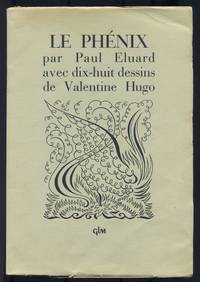
195226014Paris: GLM 1952. First edition. Hugo Valentine. Wrappers 65 pages illustrated with full-page black-and-white plates reproducing art by Valentine Hugo. One of 135 on velin de renage second paper total edition of 1425 numbered copies. Fine copy. GLM unknown
1952513198Paris: GLM 1952. Softcover. Near Fine. First edition. Illustrated by Valentine Hugo. Quarto. 65pp. Pictorial wrappers.Text in French. Lightly worn near fine. Limited to 1200 numbered copies sur velin blanc of a total edition of 1425 numbered copies. GLM unknown
194789327Paris: Gallimard 1947. Softcover. Octavo 19cm; beige paper wrappers; all edges untrimmed; 234pp. Text in French. Spine-tanned with modest shelf-wear and -soil and tiny pencilled notes to upper rear wrapper; Very Good. Collection of verse. 89327. Gallimard unknown
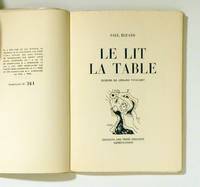
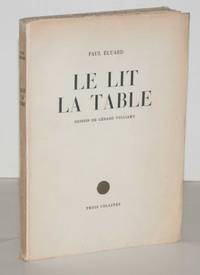
1946111700Genève-Paris: Trois Collines 1946. Softcover. Très bon exemplaire. gr.8°. mit zahlreichen Abbildungen auf Tafeln und im Text. französische Broschur Edition originale au tirage limité à 1120 dont 1000 exemplaires sur Vergé Bouffant crème numérotés celui-ci N° 361 après 20 sur Grand Vélin blanc et 10 exemplaires h.c. et 100 exemplaires h.c. numérotés de 1001-1100. Premier volume de la collection "Le Point d'Or" dirigée par Paul Éluard. Gérard Vulliamy est le gendre de Paul Eluard. Frankreich; 20. Jahrhundert; Surrealismus Collection "Le Point d'Or" Trois Collines, paperback
194616304Genevé Switzerland: Trois Collines. Very Good. 1946. Limited Edition. Paperback. This is number 577 of 1000 printed on cream laid paper. Cover is French folded paper over card. This edition is one of several books illustrated by Gérard Vuilliamy featuring twelve full page drawings. There is rubbing at upper spine and a small chip about 4 mm from base of spine. Top edge of front has wear over the crease for about an inch near front corner and spine corner resulting in a tear visible only on close examination. There is also a short tear in the top edge of the inner panel. First blank page has initials E. M. V. and date December 25th 1946 in pencil at bottom edge. Pages otherwise clean and unmarked. ; Drawings; 8vo 8" - 9" tall; 95 pages . Trois Collines paperback
194418798Geneva: Editions des Trois Collines 1944. First edition. First edition a numbered copy on vergé paper. Bound by Joanne Sonnichsen a coptic-style binding utilizing the most ancient structure as an experimental modern binding with her own paste-paper boards the bottom edges strengthened with leather strips onlays of dyed vellum top edge sprinkled decorated paper endsheets clamshell box. The binding was made for an exhibition at the Museé de la Reliure in Granville France in 1997. The binder's article about her experiments with the coptic structure "Playing with Structure: A 4th-Century Form for a 20th-Century Binding"appeared in Bookways: A Quarterly for the Book Arts Nos. 13 & 14 October 1994-January 1995 pp. 70-72. Editions des Trois Collines unknown