LANGUAGE OF FLOWERSBiblio.com

25 590 résultats
165528459First or early editions. Various places and publishers 1655-1897 1655. See Beverly Seaton The Language of Flowers A History. University Press of Virginia 1995. A detailed description of the collection is available via pdf on our website on the catalogues page. The Language of Flowers phenomenon flourished for almost eighty years beginning in France in the early 19th century. As both potent and subtle symbols in Western culture flowers are found in religious texts poetry heraldic and emblematic literature from the classical period and early Christianity through medieval literature and the enlightenment. In the early 19th century books were written and published for the first time under titles such as Abécédaire de Flore ou Langage des Fleurs 1811 Oracles de Flore 1816 Emblemes de Flore et des Végéaux 1819 and Le Langage des Fleurs 1819. With those publications the language of flowers and its exploration of floral symbolism in communication - usually as a language of love and romance - gained acceptance and popularity. During its nascent years in France the language of flowers had a relatively limited affluent audience but once publishers saw the potential for profit and obtained the ability to print and illustrate books on a large scale they began to publish language of flowers texts in the popular formats of literary annuals gift books and almanacs. By 1830 the genre was widely available to a new world of fervent book buyers and readers in the working and middle classes. The vogue for language of flowers books was so prevalent that it became the subject of parodies and satires by among others Frederick Marryat and J. J. Grandville. Herman Melville was a devotee of symbolic flower language and referred to it in Mardi and Pierre and poems written to his wife Lizzie. The core of this collection of language of flowers titles was assembled by Doris Ann Elmore a French teacher in San Francisco and lifelong Francophile. The collection is unusual for its scope. The collection is for sale en bloc. First or early editions. Various places and publishers, 1655-1897 unknown
165528459First or early editions. Various places and publishers 1655-1897 1655. See Beverly Seaton The Language of Flowers A History. University Press of Virginia 1995. A detailed description of the collection is available via pdf on our website at www.brickrow.com on the catalogues page. The Language of Flowers phenomenon flourished for almost eighty years beginning in France in the early 19th century. As both potent and subtle symbols in Western culture flowers are found in religious texts poetry heraldic and emblematic literature from the classical period and early Christianity through medieval literature and the enlightenment. In the early 19th century books were written and published for the first time under titles such as Abécédaire de Flore ou Langage des Fleurs 1811 Oracles de Flore 1816 Emblemes de Flore et des Végéaux 1819 and Le Langage des Fleurs 1819. With those publications the language of flowers and its exploration of floral symbolism in communication - usually as a language of love and romance - gained acceptance and popularity. During its nascent years in France the language of flowers had a relatively limited affluent audience but once publishers saw the potential for profit and obtained the ability to print and illustrate books on a large scale they began to publish language of flowers texts in the popular formats of literary annuals gift books and almanacs. By 1830 the genre was widely available to a new world of fervent book buyers and readers in the working and middle classes. The vogue for language of flowers books was so prevalent that it became the subject of parodies and satires by among others Frederick Marryat and J. J. Grandville. Herman Melville was a devotee of symbolic flower language and referred to it in Mardi and Pierre and poems written to his wife Lizzie. The core of this collection of language of flowers titles was assembled by Doris Ann Elmore a French teacher in San Francisco and lifelong Francophile. The collection is unusual for its scope. The collection is for sale en bloc. <br/><br/> First or early editions. Various places and publishers, 1655-1897 unknown books
OH-15Shanghai China: Yinwen Yinshu Guan The official histories of China are compilated to the corpus of Twenty-five Histories Ershiwu Shi which comprise this 50-volume complete set. The 25 26 Official Dynastic Histories includes: Shiji Records of the Grand Scribe a universal history compiled by Sima Tan and his son Sima Qian ends in 93 BC Hanshu Book of Former Han compiled by Ban Gu in 83 AD Houhanshu Book of Later Han compiled by Fan Ye in 445 Sanguozhi Records of the Three Kingdoms compiled by Chen Shou in 289 AD Jinshu Book of Jin compiled under Fang Xuanlingin 648 Songshu Book of Liu-Song compiled by Shen Yue in 488 Nanqishu Book of Qi in the South compiled by Xiao Zixianin 514 Liangshu Book of Liang compiled under Yao Silian in 635 Chenshu Book of Chen compiled under Yao Silian in 636 Nanshi History of the South compiled by Li Yanshou in 659 comprising the history of Liu-Song Qi Liang and Chen dynasties Beishi History of the North compiled by Li Yanshou in 659 comprising the history of Northern-Wei Eastern and Western Wei Northern Qi and Northern Zhou; for the sixteen states of north China there is a kind of semi-official history called Spring and Autumn of the Sixteen Kingdoms Shiliu Guo Chunqiu; the biographies of these northern rulers can also be found in the Jinshu 101-130 Songshu 98-99 Nan-Qishu 59 Weishu 87 Beishi 93 Weishu Book of Northern Wei Tuoba compiled by Wei Shou in 554 Beiqishu Book of Northern Qi compiled by Li Baiyao in 636 Beizhoushu Book of Northern Zhou compiled under Linghu Defen in 636 Suishu Book of Sui compiled under Wei Zheng in 636 Jiutangshu Old Book of Tang compiled by Liu Xu in 945 Jiuwudaishi Old History of Five Dynasties compiled by Xue Juzheng in 974 Xintangshu New Book of Tang compiled under Ouyang Xiu in 1061 Xinwudaishi New History of Five Dynasties compiled under Ouyang Xiu in 1072 for the ten states of south China there is a kind of semi-official history called Spring and Autumn of the Ten Kingdoms Shi Guo Chunqiu published by Wu Renchen in 1793 Songshi History of Song compiled under Tuo Tuo Toktoghan in 1345 Liaoshi History of Khitan-Liao compiled under Tuo Tuo Toktoghan in 1344 Jinshi History of Jurchen-Jin compiled under Tuo Tuo Toktoghan in 1344 Yuanshi History of Yuan compiled under Song Lian in 1370 Xinyuanshi New History of Yuan compiled by Ke Shaomin in 1920 Mingshi History of Ming compiled under Zhang Tingyu in 1739 Qingshigao Draft to a History of Qing compiled under Zhao Erxun in 1927 another semi-official history of the Qing dynasty is Qingdai Tongshi compiled under Xiao Yishan . Green cloth hardcover texts. Gilt spine and embossed title on front cover. Date of publication not stated presumed to be circa 1960's. Each volume is approximately 750 pp. in length. Text in Chinese. Heavy item. . No Stated Edition. Cloth. Fine/ . 4to - over 9¾" - 12" tall. . Yinwen Yinshu Guan Hardcover
In-folio, two volumes. Later vellum over pasteboards with handwritten title on spine, slightly stained. Leaves [70], pp.583; pp. 772, ll.[6]. Roman, italic and Greek character. With a full-page woodcut portrait of Mattioli, 3 printer's devices and over 900 three-quarter-page figures (cm. 22x16) engraved in wood in the text, depicting plants, herbs, animals, insects and distillation procedures, of which two are colored by contemporary hand. Edit16 CNCE 35759 - Nissen BBI 1395 - Pritzel 5985 - Adams D 675 - Hunt 145.
In-folio, pp. [8], xxvi, [4], 152, con numerosi caratteri cinesi xilografati nel testo, e una grande tavola pieghevole; con l’aggiunta di una seconda carta T1 (pagg. 71-72) con una coppia di caratteri cinesi corretti al recto, rilegata dopo l'errata a p. 140; due vecchi timbri al titolo; leggermente imbrunito, leggermente più imbrunito alle ultime carte; ottimo esemplare in vitello screziato francese coevo, dorso dorato; lievi abrasioni ai piatti; parte inferiore del dorso un po' usurata. RARA PRIMA EDIZIONE DI UNA DELLE PRINCIPALI OPERE SULLA LINGUA CINESE DEL PIONIERE STUDIOSO ORIENTALE FRANCESE E SECONDA GRAMMATICA SULLA LINGUA DA PUBBLICARE IN EUROPA. 'Fourmont è stato uno dei primi studiosi occidentali a tentare di comprendere il più accuratamente possibile il sistema dei dizionari cinesi e il pensiero che una volta che uno studioso avesse compreso i vari sistemi, sarebbe stato in grado di lavorare da solo. In effetti, a quel tempo gli europei non avevano altro modo per imparare il cinese se non consultare i dizionari e lavorare dal noto all'ignoto. Sfortunatamente, i dizionari di Fourmont non furono mai stampati, e non si trovano nemmeno in forma manoscritta, ad eccezione di un dizionario storico e geografico... 'Le Meditationes possono essere considerate un manuale da usare insieme ai dizionari che Fourmont intendeva pubblicare, ed è solo nella prospettiva di questo progetto più ampio che si può giudicare la sua parola. L'assenza dei dizionari spiega perché è difficile usare il libro di testo. Abel Rémusat, nel diciannovesimo secolo, avrebbe qualificato questo lavoro come accademico ma oscuro, e i suoi avversari sostenevano che Fourmont avesse scritto qualcosa di non veramente utile.' Fourmont attribuiva così tanta importanza alla lettura dei dizionari da criticare la grammatica cinese di Prémare, la Notitia Linguae Sinicae, ricevuta alla Bibliothèque du Roi il 12 maggio 1730, perché non insegnava al lettore come identificare i caratteri o come usare i dizionari cinesi. Era sbalordito dal fatto che un'autorità in cinese come Prémare non prestasse attenzione alle radici cinesi nella sua grammatica e non poté perdonare l'omissione. D'altra parte, secondo Lundbaek, la Notitia Linguae Sinicae di padre de Prémare era troppo avanzata per essere compresa da uno studioso relativamente inesperto. In effetti, padre de Prémare aveva una conoscenza della pedagogia della lingua cinese migliore di Fourmont. La sua opera è composta da frasi scelte dai Classici, che lo studente doveva imparare per familiarizzare con i personaggi e il loro uso. Inoltre, Prémare, per quanto riguarda l'ideologia, era molto più attratto dal metodo di classificazione radicale esposto da Mei Yingzuo. Ogni studioso proiettava la propria preoccupazione nella lingua straniera, e ognuno aveva la sua mistica. “Tuttavia, la familiarità con le radici aiuta a comprendere il significato dei caratteri, e un metodo di classificazione per l'enorme numero di caratteri è considerato di grande utilità. In tal senso Fourmont promuoveva un mezzo pratico di accesso al cinese per il lettore europeo» (Cécile Leung, Etienne Fourmont. (1683-1745), Oriental and Chinese Languages in Eighteenth Century France, pp. 203-204). Fourmont divenne professore di arabo al Collège de France nel 1715. Nel 1713 fu eletto membro dell'Accademia delle iscrizioni, nel 1738 membro della Royal Society di Londra e nel 1742 membro di quella di Berlino. Morì a Parigi l'8 dicembre 1745. In-folio, pp. [8], xxvi, [4], 152, with numerous Chinese characters in woodcut in the text, and one large folding table; an additional cancel of leaf T1 (pages 71-72) with a couple of Chinese characters corrected on recto, bound in after the errata on p. 140; two old stamps to title; a little light browning, slightly heavier to the last leaves; a very good copy in contemporary French mottled calf, spine gilt; minor abrasions to covers; tail of spine a little worn. SCARCE FIRST EDITION OF ONE OF THE MAJOR WORKS ON THE CHINESE LANGUAGE BY THE PIONEERING FRENCH ORIENTAL SCHOLAR, AND THE SECOND GRAMMAR ON THE LANGUAGE TO BE PUBLISHED IN EUROPE. ‘Fourmont was one of the first Western scholars to attempt to understand as accurately as possible the system of Chinese dictionaries, and the thought that once a scholar understood the various systems, he would be able to work by himself. In fact, there was no other way for Europeans to learn Chinese at this time besides consulting the dictionaries and working from the known to the unknown. Unfortunately, Fourmont’s dictionaries were never printed, and are not even to be found in manuscript form, except of a historical and geographical dictionary … ‘The Meditationes can be considered a handbook to be used in conjunction with the dictionaries that Fourmont intended to publish, and it is only in the perspective of this larger project that his word can be judged. The absence of the dictionaries explains why it is difficult to use the text-book. Abel Rémusat would, in the nineteenth century, qualify this work as scholarly but obscure, and his adversaries contended that Fourmont wrote something not really useful. ‘ Fourmont placed so much importance on reading dictionaries that he criticized Prémare’s Chinese grammar, the Notitia Linguae Sinicae, which was received at the Bibliothèque du Roi on May 12, 1730, on the ground that it did not teach the reader how to identify characters or how to use Chinese dictionaries. He was shocked that such an authority on Chinese as Prémare did not pay attention to Chinese radicals in his grammar, and could not forgive the omission. On the other hand, according to Lundbaek, Father de Prémare’s Notitia Linguae Sinicae was far too advanced for the relatively young scholar to understand. As a matter of fact, Father de Prémare had a better grasp of Chinese language pedagogy than Fourmont. His work is made up of sentences chosen from the Classics, which the student was supposed to learn in order to familiarize himself with the characters and their usage. Moreover, Prémare, as far as ideology was concerned, was much more attracted to the method of radical classification as set out by Mei Yingzuo. Each scholar was projecting his own preoccupation into the foreign language, and each had his own mystique. ‘Nevertheless, familiarity with the radicals helps to understand the meaning of the characters, and a method of classification for the enormous number of characters is considered to be of greatest utility. To that extent Fourmont was promoting a practical means of access to Chinese for the European reader’ (Cécile Leung, Etienne Fourmont. (1683-1745), Oriental and Chinese Languages in Eighteenth Century France, pp. 203-204). Fourmont became professor of Arabic in the Collège de France in 1715. In 1713 he was elected a member of the Academy of Inscriptions, in 1738 a member of the Royal Society of London, and in 1742 a member of that of Berlin. He died at Paris on 8 December 1745.
Shanghai: C. Fink, Deutsche Druckerei und Verlagsanstalt, 1902-1906. Exceedingly scarce consecutive and nearly-complete run of the noteworthy and pioneering German illustrated monthly magazine, produced by Carl Fink, one of the foremost journalists and publishers in China who is regarded as the most important German in China during the period. The lot consists of the first three volumes; within these 11 of the 12 issues are present and complete. Edited and published by Carl Fink, at the German printing and publishing house in Shanghai. 8vo. Volumes 1 to 3, nearly complete with the exception of only one quarterly issue. Altogether 1219 pages of text with profuse illustration, plus title pages, frontispieces, additional photographic plates. Features some zincograph photos, and some coloured and gilted artistic frontis illustrations. All ads are present in the first seven issues. All text is in German. The seven earlies issues in original boards, illustrated paper over cloth, titled in German to recto, Chinese symbol to verso. A lovely circa mid-century binding houses five issues, one of which is a duplicate of the issues in original binding, this volume half calf over marbled boards, spine tooled and titled in gilt. Minor wear to boards, otherwise in very good condition, most pleasing with several issues in original binding, crisp and clean internally, exceedingly scarce to find so many consecutive numbers. Sets this complete are not found even in libraries.
First and only edition, small folio (305 x 190 mm), [12], xix, [1], 705, [1]pp., woodcut title page vignette in Arabic, woodcut head- and tail-pieces, several leaves folding, a couple of minor repairs to inner margin of title, recent half calf to style, marbled boards, spine tooled in gilt, red morocco spine label lettered in gilt, a handsome copy with text clean and fresh. This volume 'forms a complete treatise in itself, since the it exhausts the Science of Arabic Inflexion'?Preface. All published, the intended second volume of Arabic "syntax" never made it to print.
L3 box788 b1<p>The Encyclopedic Dictionary of the Chinese Language 中文大辭典 In Traditional Chinese Revised Edition Complete 10 Volumes. Editing Committee of The Encyclopedic Dictionary of the Chinese Language Editor in Chief: Dr. Chang Chi-yun. Published by China Academy in 1973 Republic of China 62. Red cloth hardcover complete 10 volumes total 17608 pages.</p> China Academy hardcover
Manuscript record of the unexpected arrival of the British HMS Mariner led by Commander Charles Mitchell Mathison in Japan, in 1849, with interest in making surveys around Edo (Tokyo), four years prior to Commodore Perry's arrival, and during Japan's period of isolation (Sakoku) during which most foreigners were prohibited entry in to the country and locals prohibited exit; containing also a description of Japanese castaway Otokichi who was on the British vessel, disguised as a Chinese to evade capital punishment, who later assisted Admiral James Stirling in establishing the 1854 Anglo-Japanese Friendship Treaty. Text is in Japanese. 8vo. 44 pages in manuscript, plus title page, on 23 unpaginated double leaves. Traditional karitoji binding ("semi-bound" meaning title page and contents without a book cover) string-stitched at spine, fukurotoji style ("bound-pocket" with folded leafs bound into spine), and opening from left to right. Complete in a single volume, measuring approximately 24 x 17 cm. A scant few ink marks to rear leaf margin, indication of some burrowing, unobtrusive to legibility, otherwise in very good condition, beautifully preserved, clean and bright, an exceedingly scarce work. Certainly an assertive manoeuvre, for the British to show up unannounced in the harbour of Edo, Japan was in the state of Sakoku ("locked country"), the isolationist foreign policy of the Tokugawa shogunate under which relations and trade between Japan and other countries were severely limited, and nearly all foreign nationals were barred from entering Japan, while common Japanese people were kept from leaving the country. The long-standing policy had been in place for over two centuries, since 1603, and would last a few more years after the departure of HMS Mariner. It was Commodore Perry in 1853, and his equally brazen arrival with his American Black Ships, that would force the opening of Japan to American trade through a series of treaties called the Convention of Kanagawa, ultimately ending the island's declaration of Sakoku, and facilitating other trade relations with Western nations. On 14 October, 1854, the first limited Anglo-Japanese Friendship Treaty was signed by Admiral Sir James Stirling and representatives of the Tokugawa shogunate (Bakufu). Yamamoto Otokichi (1818-1867), who was onboard HMS Mariner disguised as a Chinese interpreter during the ship's attempted entry in Japan, later played an instrumental role in establishing this treaty, providing Stirling with intel on language and culture during the negotiations. On 26 August 1858, the Anglo-Japanese Treaty of Amity and Commerce was signed by the Scotsman Lord Elgin and representatives of the Tokugawa shogunate for Japan, after the Harris Treaty was concluded. Britain obtained extraterritorial rights on Japanese with the British Supreme Court for China and Japan, in Shanghai. A British iron paddle schooner named Enpiroru was presented to the Tokugawa administration by Bruce as a present for the Emperor from Queen Victoria. A scarce compilation of records from the Japanese perspective on a pre-Perry interaction between Bakufu authorities and a British ship, with references to Otokichi. This manuscript collates four Japanese reports of the British ship the HMS Mariner, which arrived in Japan from Shanghai in May of 1849 to make a topographical survey of the area around Edo (modern-day Tokyo), led by Commander Charles Mitchell Mathison, who had entered the Royal Navy on 5 August 1819. The event marks a very early British appearance at Japan, also pre-dating by four years the imposing arrival of Commodore Perry and his American Black ships also intent on making surveys. The first record briefly describes the layout of the Mariner and the aim of its visit to Japan. It also mentions the considerable Japanese language abilities of the Chinese interpreter on board who explained things in a way that is easy to understand, he in fact being the Japanese castaway Yamamoto Otokichi (1818-1867). The second section records foreign ship sightings from daimyo with guardhouses on the Miura Peninsula. [daimto were the most powerful landholding magnates holding the largest sections of land] The third report describes the meeting of Commander Mathison and the Bakufu intendant Egawa Tarozaemon (1801-1855), a dispute over a map of Japan, and Japanese observations of the ship and the crew. The last report is a copy of Isenokami Abe's (Masahiro Abe: 1819-1857) message to the bugyo (magistrates) and metsuke (censors/inspectors) in which, with HMS Mariner in mind, he expresses concern about the increase in the number of foreign ship arrivals in recent years and the abandoning of the Edict to Repel Foreign Ships. Abe notes that if the edict is enforced again, while there is no illegality on the part of the foreign ships, a dispute could arise, thus cautioning the noble families on the coast to prepare defenses. [Only a few years after the arrival of HMS Mariner, Isenokami would play a major role in the signing of the Convention of Kanagawa, as a result of pressure from the Perry Expedition.]
New York City, Frankfurt, Stockholm, etc., 1961-1966. Substantial archive of documents concerning the publication and production of several notable literary works and theatrical plays by Peter Ulrich Weiss, including correspondence, draft agreements, contracts signed with leading publishers and producers, as well as some programmes and peer reviews, being the working files of his New York agent, Joan Daves. Together with 3 LP record box sets of the first and complete Broadway original cast music recording for the Marat/Sade play. Octavo and Folio documents and letters, ranging in size and number of pages, some signed in the original. Most are in English; some are in German; the lot neatly contained in four ring binders. The vast majority of the documents date to the 1960s, with a scant few being later including a letter regarding a special television production in 1979 with NBC. Occasional wear to extremities, otherwise in very good condition, beautifully preserved, clean and bright. A generous and comprehensive archive chronicling the work and partnership of a leading literary agent in the rise of German-American publishing, and one of her notable German writers. Provenance: From the desk of Weiss' literary agent for the US, Joan Daves. Joan Daves (1919-1997) was a leading literary agent with her own agency in New York, whose client list boasts six Nobel Prize winners including Martin Luther King, Jr. Daves had a profound effect on the very existence of German literature in America. Born Liselotte Davidson in Berlin, she escaped Nazi Germany by fleeing to Paris and England before emigrating to the United States in 1940. Her agency, established in 1948, handled the original works of several American authors. She handled Martin Luther King, Jr.'s literary property from 1957 until her death. Of great emphasis with her firm was the representation of several major German publishers, such as Suhrkamp, Piper, S. Fischer Verlag and others. It was the prime time of German writers such as Peter Weiss, Uwe Johnson, Max Frisch, Heinar Kipphardt, Hans Magnus Enzensberger, and Hermann Hesse. In the mid-1960s, communication with German publishers was quite different from today. A shipment of galleys was prepared with a 'by sea mail' label. When the New York Times printed the date and time the next ship would leave the harbor, delivery of the parcels of documents to that specific ship was requested. Peter Ulrich Weiss (1916-1982) was a German author, playwright, and experimental filmmaker, who gained celebrity fame on Broadway in the 1960s. He is particularly known for his plays "Marat/Sade" of 1963/65 which is largely represented in the present archive and which was enormously successful, for "The Investigation" of 1965, and for his later novel "The Aesthetics of Resistance" (1971-81). In the 1960s Weiss also embraced and promoted politically controversial groups, standing for revolutionary Cuba, standing against US intervention in Vietnam, and joining Sweden's eurocommunist party. Manuscript
[20], 644 pages. Index. Twenty-six black and white photographic plates. Leather binding. "Comprising a history of Egypt, with a comprehensive and authentic account of the antiquity of masonry resulting from many years of personal investigation and exhaustive research in India, Persia, Syria and the Valley of the Nile." - title page. After first receiving the Light in India, the author was moved to "investigate, to the fullest extent, the meaning and purport of the numerous hieroglyphic inscriptions, symbols and characters found upon the ancient tombs and temples, so that the Masonic Fraternity might understand, appreciate and apply the teachings of the hierophants and sages of bygone days." - Preface. Chapters: Alexandria - the Antiquity of Masonry; Ruined Temples - Masonry and Masonic Symbols; Ancient Cities - Soirian Myth - Karma; the Nile - Origin of the Name Free Mason - Scottish Rite Philosophy; Ancient Mysteries - Scottish Rite philosophy; Suez Canal - The Druses, Their Manners and Customs; Agriculture - Irrigation - Lotus - Papyrus; The Supreme Architect of the Universe; Mosques - Tombs - Massacre of Mamelukes - Heliopolis; Esoteric Teaching of the Scottish Rite - Brain and Thought; Pyramids - Sphinx - Tombs; Solomon - Death of Hiram - Cross - Swastica; Mummification - Transmigration - Re-incarnation; Sixteen Saviours - Lost Knowledge; The Golden Fleece - Roman Eagle - Masonic Apron - What it Teaches; Pyramids of Sakkarah - Lisht - Medum - The Fayum - Labyrinth; Sun Worship - Zodiac - Masonic Allegories; A Voyage up the Nile - Description of Tombs and Temples - Pro Doric Columns; Ineffable degrees - Thoughts on Ecclesiastes - I.N.R.I. - Voyaging up the Nile - examining Tombs and Temples - Paintings - Sculptures; Masonic teachings - Hindu beggar - Roman Catholicism; Thebes - Colossi - Der-El-Bahari - Luxor - Karnak; Ceremonies - Initiation - Blue Lodge - Transmigration - Mystery Language; The Gawazee - exploring Temples and tombs - Philae and its ruins - Nubia; Jewish Traditions and customs - Cable tow - Ceremonies of ancient Initiation - book of the Law; Circumsision - upon what the Ancient Craftsmen were obligated - the lost word. All edges gilt. Protected frontis portrait of author. Ornately embossed boards. Raised bands to spine. Partially rubbed gilt lettering and decoration upon back strip. Marbled endpapers. Hinges intact internally, open or opening externally. Front board partially detached. Somewhat above-average wear to boards. Unmarked. A worthy original copy of this monumental work. 12" x 9.5" x 2.5". 11 pounds. Book
197143436Paris.: Daniel Templon 1971. Loose sheets as issued bound in plain card wrappers with a sliding plastic spine. 4to. 280 x 223 mm. 'Olivet Discourse' from Art & Language. From the edition limited to 40 numbered copies initialled by each of the artists on the title.Germano Celant - Book as artwork 1960/1972. p.84; Printed Matter; Die Sammlung Marzona in der Kunstbibliothek. The Marzona Collection at the Kunstbibliothek. Staatliche Museen zu Berlin p. 90. Daniel Templon unknown
2 Vols., small folio (305 x 190 mm), xxxiii, [3], 49-458; [4], 582, [2]pp., text in English and Persian, occasional marginal pencil notes, title page and terminal leaf to both volumes browned, staining to inner upper corner of leaves to start and end of volume two, later vellum-backed marbled boards, title in manuscript to spines. One of the most extensive Persian grammars written in English. "Matthew Lumsden (1777?1835), orientalist, was fifth son of John Lumsden of Cushnie, Aberdeenshire, and a cousin of Sir Harry Burnett Lumsden (1821?1896), army general. After education at King's College, Aberdeen, he went to India as assistant professor of Persian and Arabic in the College of Fort William, and in 1808 succeeded to the professorship. In 1812 he was appointed secretary to the Calcutta Madrasa, and superintended various translations of English works into Persian then in progress. From 1814 until 1817 he had charge of the East India Company's press at Calcutta, and in 1818 he became secretary to the stationery committee."?(Oxford DNB). Provenance: John L. Platts? signature in pencil to title page.
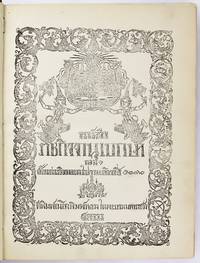
18765677Bangkok: Royal Publishing House 1876. Together good plus. Two volumes. 448; 442pp. Large quarto. First volume in contemporary quarter sheep and pebbled boards; second volume in later library buckram. Even tanning heavier to second volume. Scattered chipping small closed tears worming and moisture damage to second volume. A substantial and complete two-year run of the Royal Gazette a rare landmark Thai newspaper. "The Royal Gazette was first published in 1858 during the reign of King Rama IV. It was launched because ‘the traditional practice of manually copying various announcements was slow’. The content included government announcements legal regulations and statements that countered misinformation in relation to government news as well as notifications of births and deaths. It was distributed to various ministries and provinces coming to be regarded as the first newspaper published by the Thai people" -- Suveeranont.<br /> <br /> The first version of the gazette lasted for about a year before it was discontinued but the paper was revived in 1874 by King Rama V also known as King Chulalongkorn. The present volumes represent the first two years of this second incarnation of the Royal Gazette complete with forty-eight issues each. Royal Publishing House unknown
Very Good Turkish, Ottoman (1500-1928) Original wrappers. Foolscap 8vo. (18 x 13 cm). In Ottoman script (Old Turkish with Arabic letters). 112 p. On the first page, written 'copies without seals are fake', and this copy is with a seal. Slightly faded and chipped on extremities. Foxing on first pages. Uncut marginal extremities Otherwise a good copy. Exceedingly rare first edition of the first Ottoman voyage to Cape of Good Hope and first-hand travel account of the Ottoman qadi Abubakr Effendi (1814-1880) of South Africa and Mozambique, who was sent in 1862 by Sultan Abdulaziz at the British Queen Victoria's request in order to teach and assist the Muslim community of the Cape Malays. The presence of the Muslim population in South Africa dates back to the 16th century, South Africa and the Cape of Hope have become a colony of Western countries such as Portugal, the Netherlands, and the United Kingdom. The Ottoman Empire was interested in the Far East, Javanese, and South African regions in the 16th century and then tried to establish a relationship. The direct relationship between the Ottoman Empire and South Africa in the 19th century, upon the request of the Muslim people and England, was formed through Abubakr Effendi. The Muslims in conflict with various religious issues have found the remedy by consulting a scholar from the Ottoman Empire through England. After all, Abubakr Effendi reached Cape Town in 1862 and tried to resolve the conflicts among the Muslim people. (Abubakr Effendi: An Ottoman Scholar in South Africa in the Nineteenth Century: Yilmaz, Yusuf). "Abubakr Efendi was sent to Cape Town by Ottoman Sultan Abdulaziz. When chaos reigned in the Islamic society because of the imams who declared themselves as leaders in the region, Muslim leaders in Cape of Good Hope conveyed their letters to the Queen of England in 1862 declaring that they needed a religious leader. Since they had not been educated for years, they had forgotten their Java language and could not read their own books. They sent a letter to the Queen of England, informing them that help could be sought from the Ottoman court, the center of Muslim countries in the period. The issue was refused in the Parliament and the Ottoman Ambassador Musurus Pasha was offered it to the Ottoman Sultan. Abubakr Effendi's mission was to prevent Muslims in Cape of Good Hope to clash with each other and teaching them authentic Islamic knowledge free of superstition. Although Abubakr Efendi had some Arabic translators in his service, he still learned English and African languages in a short time and wrote books in order to benefit the Muslims there. On the fifteenth day he set foot on the continent, he opened a madrasah called the "Ottoman School" and enrolled three hundred students in twenty days. He traveled to Mauritius and Mozambique. He wrote his famous book 'Bayan al-Din' (a sort of catechism) in Afrikaan in Arabic letters. Then he married Rukiye Hanim, but they divorced after a while since they had to communicate by using an English and Arabic dictionary. Then he married James Cook's nephew Tahota Saban Cook. In his memoir, Ömer Lütfi wrote down all the travels of Abubakr Efendi for two years. Abubakr Efendi stayed in South Africa for 22 years and died there." (140 yillik miras: Güney Afrika'da Osmanlilar: Uçar, Ahmet). Abubakr Efendi first traveled to London and then to South Africa by a ship with his assistant Omar Lutfi. He established the first Ottoman School in Cape Town and then wrote his work Bayan Al-Din in Afrikaans with Arabic letters and distributed it to the Muslim population of South Africa. Four printed copies in OCLC: 427674106 (Three copies); 635151131 (One copy). Özege 22397. First Edition. Extremely rare.
17700005130No place: Le chev de Berny 1770. Hardcover. Near Fine. 12mo 49pp. 3pp. of Table 3pp. with mss. borders inkspot and inked names on flyleaf flyleaf and title leaves nicked at top edge parchment-backed sprinkled boards <br/><br/>This is a UNIQUE MSS. executed by Chevalier de Berny who after a military career became the master of a writing academy in Brussels. Rather few of his works have survived. These love poems are addressed to Louise Madame Messiery M. Le Baron de H . It incoporates French masonic ideas including p. 3 "L'Amour recu Franc macon" and p. 48 in "Reflexion sur L'Amour". Le chev de Berny hardcover
1878027250Breslau: S. Schottlaender 1878. First Edition 1st Printing. 1/4 Leather. Very Good. 88 Pp; 170 Pp. Watered Endpapers. Very Scarce Early Book By German Science Fiction/Utopian Literature Pioneer Kurd Lasswitz 1848-1910. "As The First Major Sf Writer In German He Holds The Same Place In Germany As Do H. G. Wells In England And Jules Verne In France. He Taught Philosophy For Many Years At The Gymnasium Ernestinium In Gotha And It Is Symptomatic Of 19Th-Century Gerrman Intellectual Culture That He Irradiated His Fiction With Theoretical Speculation; There Is Not Kl Fiction Without A Lesson. William N. Fischer Claims On Kl's Behalf That Many Of His Ideas Directly Prefigure Later Critics' Use Of Terms Like 'Extrrapolation' And 'Analogue'.The Seriousness Of His Didactic Impulse Can Be Seen In The Strong Emphasis He Places In His Fiction On Establishing A Plausible Imaginary World Whose Hypothetical Nature Will Be Governed And Given Verisimilitude By Resemblance To Scientific Method Evident In Its Realization. Unsurprisingly The Stories That Embody These Overriding Concerns Tend To Be More Effective As Broad Technological And Scientific Canvases Than As Studies In Character; The Tales Collected In Bilder Aus Der Zukunft Read Consequently Almost Like Illustrated Tours Of Various 'Superior Terrestrial Cultures Located In The Future." John Clute In The Science Fiction Encyclopedia. "Many Inferences About The Future Can Be Drawn From The Historical Course Of Civilization And The Present State Of Science; And Analogy Offers Itself To Fantasy As An Ally". William B. Fischer In Science Fiction Studies 1978. A Well-Worn Copy Spine Leather Entirely Perished Recently Re-Backed To Style Preserving Original Marbled Endpapers Publisher's Internal Cloth Hinges Still Holding. Very Scarce With Only A Few Examples Shown In Institutional Holdings Indexed In Worldcat. From The Collection Of Sf Collector/Dealer/Publisher Forrest Ackerman. <br/> <br/> S. Schottlaender hardcover
184333039Paris: Victor Masson; Matthieu Bonafous; Felix-Edouard Gurrin-Menevill. Very Good with no dust jacket. 1843. First Edition. Hardcover. Plates; Natural History; Nature; Science; Maritime; Voyages; Color lithos; 4to 11" - 13" tall; 134 107 pages; SOUVENIRS D'UN VOYAGE DANS L'INDE EXECUTE DE 1834 A 1839 COLOR PLATES OUVRAGE ENRICHI DE TRENTE-CINQ PLANCHES. Delessert's voyage to India. 8 uncolored lithographed plates of Indian landscapes and cities; 27 engraved zoological plates all but 4 hand-colored; folding engraved map is present in back. Half title. 2 parts in one volume. Large 8vo later 19th-century 1/2 morocco gilt spine ends and raised bands rubbed cover corners worn; occasional marginal fingersoiling half-title and title chipped along fore edge plate 5 in part 1 badly foxed stain in blank lower outer corner of plate 10 in part 2. Paris 1843 . Contents generally VG with plate colors bright. First edition. Nissen ZBI 1067; Vicaire III 119. French Language text. . Victor Masson; Matthieu Bonafous; Felix-Edouard Gurrin-Menevill hardcover
1872036246Munich / Berlin: Friedrich Bruckmann 1872. 1st Edition Reprint. Hardcover. Very Good . 97 Pp With Mounted Plates. Red Cloth Heavily Embossed In Gilt Beveled Edges With Double Borders Embossed In Blind All Edges Gilt Cloth Endpapers. Bookplate Of Leopold Duke Of Albany. Inscription On Second Free Endpaper From Queen Victoria Of England To Her Son Leopold "For Dear Leopold From Illegible Two Words Dea---- ---A---A Shortened Name Used By Queen Victoria Osborne January 1 1873." Leopold Was Then A Student At Oxford. A Fine New Year's Gift With What May Be Viewed As Exceptionally Romantically Maternal Germanic-Victorian Plates. <br/> <br/> Friedrich Bruckmann hardcover
1911030666Madrid: Imprenta Espanola / Fernando Fe / Victoriano Suarez 1911. 1st Edition 1st Printing. Soft cover. Near Fine. 291 Pp 1 Pp Advertisement For The Author's Works. Original Beige Wrappers Printed In Black Priced 3 Pesetas On Spine. Inscribed By Unamuno To The Cervantes Scholar Rudolph Rodolfo Schevill And Dated In Salamanca Vi/11 June 1911 The Year Of Publication. Covers With Slight Browning More Browning To Spine Water-Staining At Upper Right Corner Edges Of Rear Cover To 1/4" Deep But No Traces Elsewhere On Covers Or Pages. Contents Fine Pages Unopened Still Attached At Top. A Book Of Poetry Noted By Some As Containing The Finest Sonnets In The Spanish Language. <br/> <br/> Imprenta Espanola / Fernando Fe / Victoriano Suarez paperback
Large manuscript watercoloured map to illustrate the village of Ashinazawa Tamayamababa and its environs (in present-day Morioka, Iwate Prefecture), showing lands used by samurai of the ruling Nanbu Clan for raising and breeding horses, also highlighting three mountains in relief by way of tipped-in folding cutouts. Place names and text is in Japanese. Signed in manuscript by a Samurai named Sakura Baba, as well as three other notable officials. Map measures approximately 135 x 82 cm. Some creasing, otherwise in very good condition, a very unique manuscript painted map from the feudal Morioka Domain. The village shown is Ashinazawa Tamayamababa, situated within 30 km from Morioka, which was then the Morioka Domain (Morioka-han), a tozama feudal domain of Edo period, under the rule of the Nanbu Clan (Nanbu-shi) of samurai whose territory spanned most of northeastern Honshu in the Tohoku region. [Today, Morioka (Morioka-shi) is the capital city of Iwate Prefecture located in the Tohoku region of northern Japan. Ashinazawa is considered part of the Morioka district.] Ashinazawa Tamayamababa is also near, only 90 km, from Kakunodate (in present-day Akita Prefecture), also a former castle town and samurai stronghold. While Kakunodate Castle no longer remains, the town is famous for its samurai tradition and its hundreds of weeping cherry trees (shidarezakura). Apart from the loss of its castle, Kakunodate remains remarkably unchanged since its founding in 1620. The town was built with two distinct areas, the samurai district and the merchant district. Once home to 80 families, the samurai district still has some of the best examples of samurai architecture in all of Japan. Among the hills and near the village, some rather expansive horse-breeding fields are drawn on the map, presumably belonging to or at least managed by the Nanbu-shi samurai who signed the document. The horses would have been used by samurai warriors for military equestrianism, including bajutsu (a distinct form of martial art), for yabusame (mounted archery), and other practices of skilled battle on horse-back. Three mountains illustrated two-dimentionally, are all stratovolcanos forming part of the Ou Mountain range in the Tohoku region of northern Honshu. They appear to be illustrating Mount Iwate - the active volcano situated only 22 km from Ashinazawa, Mount Hachimantai - the highest peak in the Ou Mountains and only 46 km from Ashinazawa, and the active stratovolcano Akita-Komagatake located some 70 km from Ashinazawa. In red paint, several roadways are delineated, one of them reaching and following the summit line of one of the mountains. At the head of one of these roads, is a drawing of a cherry blossom trees, and an inscription which likely reads 'sakura', the term for of a group of cherry blossom trees, collectively. The flow of the Kakkonda and Shizukuishi rivers into the Kitakami is traced from the hills. In the distance, on the opposite side of the mountain ranges, a larger river is drawn, depicting the wider Tama River, which would eventually lead to Lake Tazawa. The Akita-Komagatake region is exceptionally lush, with several hundred species of alpine flora and would surely be an excellent place for horses to graze. Mount Hachimantai is especially characterized with hot springs, possibly being used as a source of warm water for cleaning or healing. In general, the vast region would be superb as a horse breeding ground. Horsemanship was an important duty and respected skill of the samurai. There were two classes of Samurai, and only upper-class samurai were allowed horses, although the lower class samurai who could find a way to possess their own horse, did so, with the belief that every samurai should have the honour and the benefit. Being on horse-back aided in part to best perform archery, spearmanship, and swordsmanship in battle. Horse-mounted samurai often fought by charging their horses at their opponent, in some cases causing a collision that would unbalance or even injure the other's steed.
Woodblock "kawaraban" broadside illustrating the arrival of Commodore Perry's four American vessels at Uraga in 8 July 1853, featuring a prominent stylized portrait of Perry himself and one of his formidable "black ships". All text is in Japanese. Thin hand-made laid paper measuring approximately 35,5 x 27cm. Small tears at folds and margins, some professional repair to verso, otherwise in very good condition, with clear imagery. A pleasing example of an uncommon variant. A contemporary broadside to alert Japanese civilians of the arrival of Commodore Perry's formidable American vessels. News was travelling fast by word of mouth along the coast and trade routes, and also began being illustrated with the "kawaraban" - broadsides with woodblock prints - for distribution. Naturally, Edo commoners were curious to learn about the imposing vessels that suddenly appeared within sight of their city.] The Japanese named the American vessels "kurofune" (black ships) for the colour of the hulls which were covered in tar and for the black smoke from the coal-fired steam engines. four "Black Ships"
Very Good Serbo-Croatian Paperback. Roy. 8vo. (23 x 15 cm). In Aljamiado (Serbo-Croatian in Arabic letters), Arabic, and Persian with an introduction in Arabic. The third revised edition of the Waqf Directorate in Sarajevo. 104 p., 4 unnumbered b/w plates. "Ilmihal" [i.e. Catechism] recommended to all who want to know and learn Islamic ceremonies and practice. Learn how to pray, what are basic principles of the Islamic faith, what are the Islamic duties, what are the Islamic holidays, what constitutes proper Islamic behavior, and lots more. This extremely rare catechism book printed in Sarajevo in Croatian with Arabic letters (Aljamiado). This book is one of the late examples of Aljamiado literature beginning in early Andalusia and constitutes one of the rarest examples of the Ottoman book tradition. Aljamiado or Aljamía texts are manuscripts that use the Arabic script for transcribing European languages, especially Romance languages such as Mozarabic, Portuguese, Spanish or Ladino, and Bosnian with its Arebica script. According to Anwar G. Chejne, Aljamiado or Aljamía is "a corruption of the Arabic word ?ajamiyah (in this case it means foreign language) and, generally, the Arabic expression ?ajam and its derivative 'Ajamiyah are applicable to peoples whose ancestry is not of Arabian origin". During the Arab conquest of Persia, the term became a racial pejorative. In linguistic terms, the Aljamía is the use of the Arabic alphabet to transcribe a Romance language. It was used by some people in some areas of Al-Andalus as an everyday communication vehicle, while Arabic was reserved as the language of science, high culture, and religion. The systematic writing of Romance-language texts in Arabic scripts appears to have begun in the fifteenth century, and the overwhelming majority of such texts that can be dated belong to the sixteenth century. A key aljamiado text was the mufti of Segovia's compilation Suma de los principales mandamientos y devediamentos de nuestra santa ley y sunna, of 1462. In later times, Moriscos were banned from using Arabic as a religious language and wrote in Spanish on Islamic subjects. Examples are the Coplas del alhichante de Puey Monzón, narrating a Hajj, or the Poema de Yuçuf on the Biblical Joseph (written in Aragonese). Aljamiado played a very important role in preserving Islam and the Arabic language in the life of the Moriscos. After the fall of the last Muslim kingdom on the Iberian peninsula, the Moriscos (Andalusian Muslims in Granada and other parts of what was once Al-Andalus) were forced to convert to Christianity or leave the peninsula. They were forced to adopt Christian customs and traditions and to attend church services on Sundays. Nevertheless, some of the Moriscos kept their Islamic belief and traditions secretly through the usage of Aljamiado. In 1567, Philip II of Spain issued a royal decree in Spain, which forced Moriscos to abandon using Arabic on all occasions, formal and informal, speaking and writing. Using Arabic in any sense of the word would be regarded as a crime. They were given three years to learn the language of the Christian Spanish, after which they would have to get rid of all Arabic written material. Moriscos translated all prayers and the sayings of their prophet Mohammed into Aljamiado transcriptions of the Spanish language while keeping all Qur'anic verses in the original Arabic. Aljamiado scrolls were circulated amongst the Moriscos. Historians came to know about Aljamiado literature only in the early nineteenth century. Some of the Aljamiado scrolls are kept in the Spanish National Library in Madrid. The word aljamiado is sometimes used for other non-Semitic languages written in Arabic letters. For example, Bosnian and Albanian texts written in Arabic script during the Ottoman period have been referred to as aljamiado. However, many linguists prefer to limit the term to Romance languages, instead of using Arebica to refer to the use of Arabic script for Slavic languages... Not in OCLC.
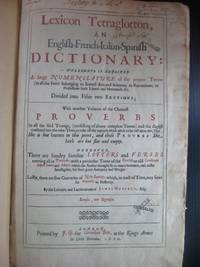
1660148London: Printed by J.G. for Cornelius Bee 1660. First Edition . Hardcover. Fair. Rare First Edition of one of the most important works in the history of lexicography and a major source of the plagiarized proverbs Benjamin Franklin published in Poor Richard's Almanac. A fair copy. Ex-library: white numbers on spine blindstamp numbers and 'cancelled' stamp on title page ghost of what was probably a pocket on the rear endpapers. Very old full-leather binding with 'Howell's Dictionary' on the title piece. Boards worn; corners extremely worn past leather to boards; boards once detached and now only reattached by several strips of cloth which are fairly loose. Ffep heavily chipped with 1864 owner's name reinforced at the foreedge. There is no half-title first leaf is title page; two owner's names or notations Anglesey Dec. 5 1663 and Stanford 1693. Obverse of title page blank; follows 3pp dedicatory 'To His Majesty Charles the Second'; another blank page is followed by the marvelous frontispiece which faces the introductory 'Poems by the Author.' A 6pp preface addressed 'to the tru Philologer' ends with a publisher's notice apologizing in advance for the inevitable errors in this first impression. There is some penciled marginalia in the preface and first few pages of the dictionary; there are also ink notes much older but nothing in the dictionary after the first 6 pages. Page 7 has piece torn from the foreedge with a few words lost. Text browning few pages much more than most others but everywhere legible. Dictionary followed by the phrasebook with sections on anatomy hunting architecture etc. Section on Navigation again has inked marginalia. The penciled underlines and check marks also appear occasionally. The first page of Section 50 of this part has a piece torn from foreedge but no loss of words. The title page for this section dated 1659 is bound in after the contents. The Proverbs or Paroimiographia section follows also with a title page dated 1659. Apparently Franklin lifted proverbs from this section and published them in the same order he was filling space in his Almanac and never intended or supposed that they would be ascribed to him. Full sub-title: Whereunto is Adjoined a large Nomenclature of the proper Terms in all the four belonging to several Arts and Sciences to Recreations to Professions both Liberal and Mechanick &c. Divided into Fiftie Two Sections;With another Volume of the Choicest Proverbs in all the said Toungs consisting of diverse compleat Tomes and the English translated into the other Three to take off the reproach which useth to be cast upon Her That She is but barren in this point and those Proverbs She hath are both flat and empty. Moreover There are sundry familiar Letters and Verses running in all Proverbs with a particular Tome of the British or old Cambrian Sayed-Sawes and Adages which the Author thought fit to annex hereunto and make Intelligible for their great Antiquity and Weight: Lastly there are five Centuries of New Sayings which in tract of Time may serve for Proverbs to Posterity. <br/> <br/> Printed by J.G. for Cornelius Bee hardcover
18800267-05[ca. 1880]. [Album of views in Egypt]. 40 lose Orig.-Albumen-Photographien auf Kartons kasch. 21,5 x 27,5 cm. (Plattengr.). Ln.-Flügelmappe d. Zt. m. Deckelgoldprägung.