25 643 résultats
194070467Duke University Press. Good. 1940. Paperback. FREE UPGRADE to Courier/Priority Shipping Upon Request - IN STOCK AND IMMEDIATELY AVAILABLE FOR SHIPMENT - Pages 1- 155 - Quarterly journal devoted to research in American literature-- Among the articles in this issue: "Emerson and the Idea of Progress"; "How Cooper Became a Novelist"; and "Archibald Alison and William Cullen Bryant". -- with a bonus offer-- . Duke University Press paperback
195070464Duke University Press. Good. 1950. Paperback. FREE UPGRADE to Courier/Priority Shipping Upon Request - IN STOCK AND IMMEDIATELY AVAILABLE FOR SHIPMENT - Pages 397- 539; with index pages i - viii - Quarterly journal devoted to research in American literature-- Among the articles in this issue: "Emerson and Mysticism"; "Christopher Pearse Cranch: The Case History of a Minor Artist in America"; and "A Glance a Lowell's Classical Reading". -- with a bonus offer-- . Duke University Press paperback
195370465Duke University Press. Good. 1953. Paperback. FREE UPGRADE to Courier/Priority Shipping Upon Request - IN STOCK AND IMMEDIATELY AVAILABLE FOR SHIPMENT - Pages 429 - 592; with index pages i - ix - Quarterly journal devoted to research in American literature-- Among the articles in this issue: "Emerson and the James Family"; "Emerson and the Wisconsin Lyceum"; "A Sheaf of Emerson Letters"; and "A Cut Version of 'What Maisie Knew'". -- with a bonus offer-- . Duke University Press paperback
194370277Duke University Press. Good. 1943. Paperback. FREE UPGRADE to Courier/Priority Shipping Upon Request - IN STOCK AND IMMEDIATELY AVAILABLE FOR SHIPMENT - Pages 361 - 477 - Quarterly journal devoted to research in American literature-- Among the articles in this issue: "Emerson's Translation of Persian Poetry from German Sources"; "O'Henry's Case Reconsidered"; and "The Poetry of E. E. Cummings". Cummings". -- with a bonus offer-- . Duke University Press paperback
199730543Rochester Vermont U.S.A.: Inner Traditions. New. 1997. Paperback. 0892816589 . FREE UPGRADE to Courier/Priority Shipping Upon Request - IN STOCK AND IMMEDIATELY AVAILABLE FOR SHIPMENT - BRAND NEW FLAWLESS COPY NEVER OPENED -- 304 pages. "Ficino 1433-99 a philosopher translator and commentator on Plato and founder of the Platonic Academy of Florence was one of the most influential thinkers of the Renaissance. Artists such as Michelangelo and Raphael writers such as Spenser and Milton and rulers such as the Medici were influenced by Ficino's neoplatonic theology of love. Despite that little of his work is easily available for modern readers. This selection of Ficino's letters edited by British instructor Salaman goes a long way toward making him more accessible. The letters ranging in topics from virtue the soul and love and friendship to astrology are really miniature essays summarizing Ficino's views. Also included are textual notes and biographies of the correspondents. This book is a profound service both to the student of Renaissance culture and to those interested in spirituality." from Library Journal -- with a bonus offer-- . Inner Traditions paperback
200350533London England: Shepheard - Walwyn. New. 2003. Hardcover. 0856831921 . FREE UPGRADE to Courier/Priority Shipping Upon Request IN STOCK AND IMMEDIATELY AVAILABLE FOR SHIPMENT - Flawless copy brand new pristine never opened - 242 pages. -- with a bonus offer-- . Shepheard - Walwyn hardcover
198885229Modern Language Association of America. New. 1988. Paperback. 0873523792 . FREE UPGRADE to Courier/Priority Shipping Upon Request - IN STOCK AND IMMEDIATELY AVAILABLE FOR SHIPMENT - Text pristine & unmarked tight to the spine - 248 pages. -- with a bonus offer-- . Modern Language Association of America paperback
198411760Modern Language Association of America. As New. 1984. Paperback. 0873521323 . FREE UPGRADE to Courier/Priority Shipping Upon Request - IN STOCK AND IMMEDIATELY AVAILABLE FOR SHIPMENT - AS NEW THE TEXT BLOCK IS PRISTINE CLEAN UNMARKED AND IN EXCELLENT CONDITION - - -- with a bonus offer-- . Modern Language Association of America paperback
194753667Berkeley CA: Univesity of California Press. As New. 1947. Hardcover. FREE UPGRADE to Courier/Priority Shipping Upon Request IN STOCK AND IMMEDIATELY AVAILABLE FOR SHIPMENT - AS NEW THE TEXT BLOCK IS PRISTINE CLEAN UNMARKED AND IN EXCELLENT CONDITION - - 443 pages. -- with a bonus offer-- . Univesity of California Press hardcover
2014103976Gallery. New. 2014. Paperback. 0947830472 . FREE UPGRADE to Courier/Priority Shipping Upon Request - IN STOCK AND IMMEDIATELY AVAILABLE FOR SHIPMENT - Flawless copy brand new pristine never opened - -- with a bonus offer-- . Gallery paperback
Historically significant and exceedingly scarce nineteenth century Japanese treatise on sericulture (the making of silk), by the man who remembered as "the father of modern sericulture and silkworm rearing methods", describing and illustrating his then revolutionary methods for better nurturing of the silk worms from which the fine thread is harvested, and ultimately producing higher quality silk, the inventions having become the standard for the industry and still employed today, produced in woodblock print. 8vo. 3 volumes, 278 pages combined, plus publisher's details to yellow frontis leaf in first volume. The complete text, illustrated with 10 pages of wood printed illustrations, two of which are fully hand coloured, and two being partially hand coloured. Traditional karitoji binding ("semi-bound" meaning title page and contents without a book cover) string-stitched at spine, fukurotoji style ("bound-pocket" with folded leafs bound into spine), and opening from left to right. Black paper covers, with title label to front, the first volume with a red ink stamp to publisher's detail leaf. All text is in Japanese. Together the volumes measure approximately 14,5 x 22 x 3 cm. Minor wear to boards, otherwise very good and original condition, internally bright, a pleasing historic work dealing with silk production in Japan. Tajima Yahei (1822-1898) was an influential silk farmer in the early Meiji period, whose legacy is that of a tremendously prosperous impact on the sericulture industry of Japan, with his development of a ventilation theory and method which proved to be highly successful and subsequently laid the foundations for modern sericultural production, and the most efficient design of a sericulture space. He had a small laboratory where he researched silkworm hybridization and silkworm diseases with the aid of a microscope, which was unusual in Japan at the time. Yahei's experiments in creating an ideal sericulture space led to his invention of a new sericulture theory and technique, the seiryo-iku. He concluded that sericulture is best carried out in a space with efficient cross ventilation, which includes a roof system and openings on four walls. He perfected these procedures at his own home, the farmhouse known as 'omoya' built in 1863, referred to today as the Tajima Yahei Sericulture Farm (Tajima Yahei kyu-taku), which is located in the Sakaishima neighborhood of the city of Isesaki, in the southern part of Gunma Prefecture. Silkworm growers travelled from far and wide to observe and learn the techniques and processes developed and implemented on this revolutionary farm. Yahei was also involved in exporting silkworm eggs and earned large profits from it. Yahei's techniques later became a foundation for the secchu-iku theorized by Takayama Chogoro, founder of Takayama-sha Sericulture School, which acted as a training centre and formal education institution for sericulture. Yahei also became one of the leading figures who developed the village of Shimamura through his achievement in sericulture. Born in 1822 as Tajima Kuniyasu and Yahei (the second), throughout his childhood, he travelled to advanced sericulture areas with his father in order to gain skills and experience in silkworm breeding, production and sales. Yahei's silkworm farm is one of the earliest examples of architecture specifically designed to improve sericulture.
Invaluable manuscript chronology of the earliest ships entering the port of Shimoda after the implementation of the Japanese-American treaty which opened up foreign trade with the previously isolationist nation, covering two years from February 1854 to February 1856, presented in the meticulous hand of a contemporary observer who compiled firsthand information as well as his own, together with a manuscript drawing of a Dutch sea captain in naval attire, made by Kitajima Toen. Manuscript: 8vo. 30 pages plus titled cover, string-tied at center of spine with rolled up paper, opening from left to right, measuring approximately 17 x 24 cm. Text is in Japanese, with occasional annotations in red ink. Drawing: Single leaf measuring approximately 24 x 33 cm, titled and signed in manuscript, with red ink stamp. Some creasing and indication of burrowing, otherwise in very good and original condition, clean and bright internally, an invaluable log of the earliest trade activity from the onset of the Convention of Kanagawa. With precise details, the writer keeps a record of vessels from America, Russia and France, arriving at Edo Bay, beginning with the return of Commodore Perry in February 1854 for the signing of what would be the Kanagawa Treaty, and continuing for two full years, featuring descriptions of the ships including dimensions and armament, repairs and supplies procured, captains' names and crew sizes, and their activities in Shimoda. This document is not only an invaluable historical log of the first and most significant foreign vessels to interact with Japan during the formative years of the Unequal Treaties, it may have been used in the Japanese study of foreign ships for their own benefit. Immediately after bowing to the demands of the powerful Western ships and their commanders, an active assimilation of Western technological advances in warships ensued in the Japanese Navy. In 1855 Japan acquired its first steam driven warship, and in 1857 its first screw driven warship. Japanese Naval students were sent abroad to naval schools in England, France, the Netherlands, and the like. By the end of the Tokugawa Shogunate in 1867, its navy would possess eight western-style steam warships. The first vessels mentioned in the manuscript are from Perry's daunting and expanded 'Black Ships' fleet, including the Mississippi which had been one of the original four, as well the Vandalia, the Southampton, the Powhatan, and the Supply, the latter of which joined the squadron after the actual landing on 8 March. The Russian vessels being described in 1854, include the Russian Imperial Navy flagship frigate 'Diana' commanded by Vice-Admiral Euphimy Vasil'evich Putiatin, and possibly his former flagship frigate 'Pallada' which had been performing survey missions around the Japanese coast since 1853 and whose crew was transferred to Diana upon her arrival. The crew members of the Diana are listed by name, including her Imperial Navy officers, a cook, a waiter, and an interpreter. The earliest French vessel to arrive after Commodore Perry's successful treaty implementation, was a cruiser that arrived in Shimoda in February 1855, being 'Le Lion' which also landed at the Ryukyu Islands with the French missionaries from the 'Missions Étrangères de Paris', Girard, Furet and Mermet, hoping to discuss their interests in evangilizing. Catholicism was strictly forbidden in Japan. They also landed at Naha, the main port of Okinawa, on 26 February. The cruiser was denied any official communication as a formal agreement did not exist between France and Japan. On this voyage, Father Louis Théodore Furet, an apostolic missionary, carried out instrumental observations at Nafa [Naha, Okinawa] on the Ryûkyû Islands. A set of the meteorological manuscripts by Father Furet was given to Jean Barthe, the physician onboard the French frigate 'La Sibylle', who forwarded them to the 'Académie des Sciences' in Paris and to the 'Société Météorologique de France'. Meteorological observations were also carried out by Jean Barthe from 'La Sibylle'. Although negotiations were denied, the two French warships were permitted at the port of Hakodate, in Hokkaido, and members of the crew of La Sibylle who suffered severely from dysentery and scurvy received medical aid and food in a Buddhist temple. In Spring 1855, France sent an embassy under Commander-in-Chief of the French Oriental Naval Force, Captain Nicolas Francois Guerin, commanding the French warship 'La Virginie', in order to obtain similar advantages to those of other Western powers. Guerin is known for playing the primary role on behalf of the French, in pressing for, obtaining the first negotiations, and then signing a Treaty of Amity between France and the Ryûkyû Kingdom.

Bound in Continental full vellum. The engraved title depicting the author showing a geometrical drawing to William Prince of Orange. Engraved title. (6),475 pp. and 70 double-page engraved plates. Bottom Margin of title page with old owners name clipped. This was the largest work hitherto published on fortification, and it is specially interesting for containing 29 plans of European fortresses. It was originally published in Latin the year before and a French translation appeared the same year as this German edition. (Willems, Les Elzevier No 1064). - Sotheran Second Suppl. No 20981 (French edition) - Brunet II:788. - Klaus Jordan No 911. - Sloos, Warfare and the Age of Printing, 8029
181346988London, Robert Baldwin, 1813 a. 1814. 8vo. 2 contemp. hcalf. Marbled boards. Spines lacks and boards detached. In: ""Annals of Philosophy"" or Magazine of Chemistry, Mineralogy, Mechanics... By Thomas Thomson"". Vol. II and Vol. III. Entire volumes offered. Berzelius' papers: pp. 276-284, 357-368 (the first paper in vol. II), pp. 443-454 (vol. II) a. pp. 51-62, 93-106, 244-257 a. 353-364. (vol. III). Internally fine and clean.
181346988London Robert Baldwin 1813 a. 1814. 8vo. 2 contemp. hcalf. Marbled boards. Spines lacks and boards detached. In: "Annals of Philosophy; or Magazine of Chemistry Mineralogy Mechanics. By Thomas Thomson". Vol. II and Vol. III. Entire volumes offered. Berzelius' papers: pp. 276-284 357-368 the first paper in vol. II pp. 443-454 vol. II a. pp. 51-62 93-106 244-257 a. 353-364. vol. III. Internally fine and clean. <br/><br/><em> First printing of these milestone papers in the history of chemistry where Berzelius introduced his famous chemical symbolism whereby an element is generally represented by the first letter of its Latin name or in the event of elements having the same first letter by the first two letters. Even though his atomic symbols were introduced in 1813 see the note on p. 359 in the first paper it was quite a few years before Berzelius's symbols were adopted by the chemistry community. But once accepted they became the new international language of chemistry.Berzelius "contributed more to the development of the atomic theory and to the setting up of accurate values of the atomic weights than did any other worker of the time. Of his contributions moreover to the development of the atomic theory and the advancement of chemical science not the least valuable was the introduction of a chemical symbolism which with slight modification is in use at the present day. By giving his symbols a quantitative meaning - the symbol of an element representing one atomic proportion by weight - it was possible "to show briefly and clearly the number of elementary atoms in each compound and after the determination of their relative weights present the results of each analysis in a simple and easely retained manner". This symbolism was speedily adopted on the Continent but in England only after some considerable time."Findlay "A Hundred Years of Chemistry" p. 14.Parkinson "Breakthroughs" 1813 C. - Leicester & Klickstein "A Source Book in Chemistry" p. 258 ff. - Holmberg 1813:28 a. The volume contains other notable papers THOMAS THOMSON "On the Discovery of the Atomic Theory" pp. 329-338. and JOHN DALTON "Remarks on the Essay of Dr. Berzelius on the Cause of Chemical Proportions" pp. 174-180 Vol. III. </em> hardcover
In-4°, (24cc), 344pp, 32pp, buone condizioni, legatura in pergamena, prima edizione. Esempi di idiomi grammaticali arabi, presi da varie fonti, libro pubblicato per la prima volta a Padova nel 1687. Agapito dalla Val di Fiemme era un francescano ed un professore di arabo al seminario di Padova. In-4°, (24cc), 344pp, 32pp, good condition, vellum binding, first edition. Examples of Arabic grammatical idioms collected from various sources, first published at Padua in 1687. Agapitus a Valle Flemmarum was a Franciscan and professor of Arabic at the seminary in Padua.
1892006542London: T. Fisher Unwin 1892. Book. Very Good. Decorative Cloth. HOLOGRAPH LETTER SIGNED. First Trade Edition. 4to - over 9¾" - 12" tall. The First Trade Edition there was also a limited edition of 100 copies. Very Good in the original salmon cloth with black decorations to boards; title in red on front and spine Unwin monogram likewise on rear. Color frontispiece. Spine darkened and red title dulled 3" tear top edge half-title page light foxing to end pages period interesting bookplate front pastedown. From the collection of the Richard M. Dorson Memorial Library Folklore Institute Indiana University the only library indicators being its stamp verso of frontispiece and blindstamp to title page. With RARE and important three page ALS tipped to front end page sent from Leland at the Hotel Victoria Florence Italy to Mr Sampson noted linguist John Sampson possiby dated 1899 with "99" after heading. "Dear Mr Sampson I have written and sent you separately by this mail that which I contribute to our book." He then discusses his wishes for the Preface and Introduction before adding "The Tinkers. This is quite unfinished. It needs a great deal from you. Please note that I have got some queer items as to the Tinkers of old times." In the next paragraph he mentions Shelta Shelta Thari being an esoteric language spoken by the tinkers which Leland had discovered in 1876. He goes on to ask "Can you send me an Old Irish alphabet' and later "I hope it will not take you long to put together what you and Professor Meyer will give" referring to Professor Kuno Meyer a German scholar distinguished in the field of Celtic philology and literature. Then an address in Hamburg Germany where he can be reached after June and "Sincerely Charle G. Leland". While I can find no book that these three men published together Sampson and Meyer did much work later to carry forward research and knowledge of the Shelta language and customs. A quite fascinating correspondence and ASSOCIATION COPY. T. Fisher Unwin Hardcover
1965217990Halle u.a. Verlag d. Buchhandlung d. Waisenhauses u.a. 1869-1965. Verschied. gebunden, darunter 3 Doppelbde. Einbde. bzw. Rücken beschäd., fleckig oder beschabt. Jg. 69 in OKart. u. unaufgeschn. Bde. teils m. St. a. od. verso Tit. od. Vorsatz. Seiten teilw. gebräunt od. braunfleckig. Bd. 1 ohne Rücken. Bd. 17 u. 73 vereinzelt m. Anstreich.
16211162551621 Lutetiae. Ex officina & Typis Gulielmi Lebe - CI . I C. XXI (1621) - In-12, demi-basane brune (reliure postérieure), faux-nerfs, filets et titre en doré au dos - 247 pp. - Ouvrage en latin
18756269Oxford Clarendon Press. 1875. First Edition. Hardcover. Very Good in No Dust Jacket dust jacket. Bookplates of scholar Gilbert Bagnani on inner covers of volumes. Books have rubbing to boards. Light bumping to corners. Minor shelfwear. Very light foxing. Bound in attractive dark red boards with gilt lettering.; Published from 1875-88.; 6 Volume Set COMPLETE. Scholia Graeca in Homeri Iliadem . Oxford Clarendon Press hardcover
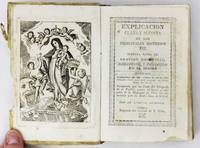
18356232Puebla: Imprenta del Hospital de S. Pedro 1835. Good plus. 2653pp. plus engraved frontispiece. Contemporary limp vellum edges sprinkled blue with one fore-edge loop closure intact. Some biopredation to vellum heavier to rear wrapper. Light tanning and scattered foxing internally with some minor worming in lower gutter margins not affecting text. An extensive bilingual catechism on the "principal mysteries of our holy faith" one of two editions printed in Puebla in 1835. The question-and-answer text printed in Spanish and Nahuatl on facing pages provides basic explanations of the central tenets and practices of Catholicism. An engraved frontispiece depicts "La Madre Santissima del Lumen" the Holiest Mother Mary of the Light in her usual appearance holding the baby Jesus and surrounded by Angels.<br /> Palau 85329. Pilling 1251. Sabin 23424. Imprenta del Hospital de S. Pedro unknown
1885023087New York: D. Appleton and Company 1885. SEE PHOTOS. From the library of Thomas Alva Edison genius of technology who held over 1000 patents including the electric light phonograph and motion picture projector. This book bears his "Library of Thomas A. Edison" engraved bookplate believed to be the earliest of several Edison bookplates and found only in volumes he acquired in the 19th century for personal use. SEE PHOTOS. Because so many important scientific journals were published in German in those days a German language dictionary was an essential reference tool in the laboratory. Laid in loose is a printed authentication slip from Edison's youngest son Theodore M. Edison. Bound in contemporary brown cloth with a dark brown leather spine stamped in shiny gold. SEE PHOTOS. First Edition. Oversize Hardcover. Fine condition. xvi 852pp. ii 522pp. Great Packaging Fast Shipping. D. Appleton and Company Hardcover
18691785New York: American Bible Society 1869. Very good plus. 65; 47pp. 12mo. Contemporary black morocco stamped in gilt and blind. Corners and spine ends rubbed. Light toning to text. A handsomely bound copy of two books of the Pentateuch printed in Dakota by the American Bible Society. The translator Thomas Williamson 1800-1879 was a doctor and missionary who worked with the Dakota Indians in Minnesota and helped develop the first written alphabet and grammar of the Dakota language. During the Sioux Uprising of 1862 he and his family were protected by Christianized members of the tribe who subsequently helped them escape to safety. He was instrumental in convincing President Lincoln to pardon twenty-five of the men who had been taken prisoner following the revolt and after Lincoln's death he advocating with Andrew Johnson for the pardon and release of the remaining men. The present two works are the first and only stand-alone editions of Exodus and Leviticus in Dakota published by the Bible Society thought they often are bound together as here. The translations appeared again in 1872 in an edition that also included Genesis and Deuteronomy; the entire Bible in Dakota was completed and published in 1879. Scarce. Ayer Dakota 28 Exodus. Pilling Proof Sheets 4160. Pilling Siouan p.78. American Bible Society unknown books
1949008338New York: Rand McNally & Co. 1949. RARE lithograph wall chart for the device called the "Structural Differential" which Alfred Korzybski patented in 1925 as a means to aid in visualizing the process he called "abstracting". This was to be used as a training device in general semantics a field of study Korzybski is credited with founding. The chart is Near Fine rubbed lower right mounted on two stained wooden dowels with ribbon hanger 18" wide by 38" high. Korzybski's work in semantics heavily influenced science fiction authors such as A.E. Van Vogt Robert A. Heinlein Poul Anderson and H. Beam Piper as well as L. Ron Hubbard and Joseph W. Campbell. His most famous quote "The map is not the territory" comes from this longer quote "A map is not the territory it represents but if correct it has a similar structure to the territory which accounts for its usefulness." Science and Sanity Korzybski 1931. OCLC locates no copies; no sales records at RBH. . First Printing. Banner. Near Fine. 18"w x 38"h. Rand McNally & Co. books
197718545E. J. Brill. 1977. First Edition. Hardcover. Very Good in No Dust Jacket dust jacket. All volumes are in VG or better condition. Leather bindings with slipcases. Spines sunned and discolored.; V1: 1987 xxxvii 349 pp 199 pl; V2: 1982 xxxi 278 pp 219 pl; V3: 1977 xxviii 198 pp 302 pl; V4: 1978 xxiii 142 pp 111 pl; V5: 1986 xxiv 226 pp 168 pl; V6: 1989 xxix 224 pp 146 pl; V7: 1977 xv 67 pp 115 pl.; 7 Volume Set. COMPLETE. Études Préliminaires Aux Religions Orientales Dans L'Empire Romain; 1-7 . E. J. Brill hardcover