Haldane, J.B.S.MareMagnum

25 643 résultats
True first edition copy. The first American edition, published by Harper & Brothers, issued in 1938. - Baumgarten p.94. The only children's book written by Haldane, a prominent geneticist credited with coining the term clone. Enigmatic online videographer and purported AI expert Quinn Michaels posits that this book contains vital hidden information conveyed in "spy language", most notably a transistor diagram incorporated into the illustration on page 123, despite the fact that it is commonly held that the transistor was not invented by a Bell Labs team until a decade later. For additional information on Michaels' intriguing analysis enter the title of this book plus the word 'analysis', into the most popular video website. 179 pages. Dust jacket not included. Bookplate and pencilled signature, dated 1937, of Swedish journalist and children's book critic Eva v. Zweigbergk [1906-1984] upon front endpaper. Above-average wear and fading to publisher's green cloth-covered boards. Binding intact with a modest lean. A worthy first edition copy of this fascinating work. Book
1871025478Paris: Gauthier-Villars 1871. First Edition . Original Blue Printed Wrappers. Very Good . 8 7/8" Tall. 40 Pp. Original Blue Printed Wrappers. Preserved Nicely In A Well Made Maroon Chemise And Slipcase With Morocco Spine Label Gilt. Inscribed And Signed By Pasteur " Hommage De L'autour / L. Pasteur" In Small Handwriting At Upper Right Of Front Cover. A Scarce Book In The Trade Particularly Scarce When Inscribed And Otherwise Unmarked As Here And A Very Early Inscription From Pasteur In Any Case. <br/> <br/> Gauthier-Villars unknown
19772092902141700539Rinsen Bookstore 1977. Soft Cover. Fine. Volume: 53 volumes Rinsen Bookstore paperback
1916SB-13568Tokyo, Kobunsha, 1916. 15, (546) pp. Green clothbound (original) volume with gold-embossed title along spine and blind-tooled publisher's mark on front. Illustrated endpaper with floral ornamentation. Famous study of Russian Orientalist, Sinologist and scholar of Japanese Studies Otto Julius Rosenberg (1888 - 1919) on a system of classification of Chinese characters. Rosenberg studied from 1906 to 1911 at the Institute of Oriental Studies of the University of St. Petersburg, lectured by, among others, the founder of the Russian school of Indology, Sergei Oldenburg (1863 - 1934). During a study stay in Bonn in 1909, Rosenberg befriended Hermann Jacobi (1850-1937), the greatest Indologist and Sanskrit scholar of that time. As part of an internship at the Department of Oriental Languages (SOS) at the Friedrich-Wilhelms-Universität two years later, he also befriended the German linguist and scholar of Japanese studies, Rudolf Lange (1850 - 1933). From 1912 to 1916 he studied Buddhist Literature and Tradition at the University of Tokyo. Here Rosenberg became acquainted with the then leading Buddhist Scholars of Japan. In the course of this stay, he explored the school of Zen Buddhism as one of the first Western scientists and also became an expert for Japanese and Chinese characters used in the writing of Chinese and Japanese. In 1924, his work "The problems of Buddhist philosophy" was published in German. Based on ideas of Russian Sinologist and Buddhologist Vasily Vasilyev (1818 - 1900), Rosenberg developed a method of classification of Chinese and Japanese characters. He published the results of his research in a dictionary which was published in English and Japanese and which formed the basis of the so-called "Four Corner Method", which is still employed today in the creation of Chinese and Japanese dictionaries. This volume is extremely rare and, according to the world's largest bibliographic database, WorldCat, it is only found in six libraries worldwide. The copy offered here was purchased from a Japanese private collection.
179021667Constantinople, de l’Imprimerie du palais de France, mars 1790 ; in-4°, demi-veau havane, dos à faux nerfs et titre doré (reliure un peu postérieure); XXXII, 462 pp., [1]f. de Faute à corriger.
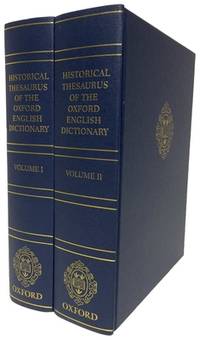
2009ABE-1675274264536OUP Oxford 2009 NEW & UNREAD. 45 YEARS IN THE MAKING. This is now VERY RARE INDEED. The Historical Thesaurus of the Oxford English Dictionary HTOED is a unique new resource charting the semantic development of the huge and varied vocabulary of English. It is the first comprehensive historical thesaurus ever produced for any language containing almost every word in English from Old English to the present day and is a magnificent resource for the historical study of the language. It is based on a detailed analysis of English as found in the second edition of the Oxford English Dictionary OED and also draws on A Thesaurus of Old English. Conceived and compiled by the English Language Department of the University of Glasgow over a period of some 45 years the Historical Thesaurus of the Oxford English Dictionary is a groundbreaking analysis of meaning in the history of English. Content and Structure The thesaurus organization follows a unique thematic system of classification with entries arranged in a comprehensive semantic hierarchy according to their meanings. Each individual synonym is presented in chronological order according to the first recorded date of the word's use in English as listed in the Oxford English Dictionary with earliest synonyms given first. There are three major sections in the HTOED reflecting the main activities and preoccupations of users of the language: I The external world II The mental world III The social world These in turn are divided into 354 major categories such as Food and drink Thought or War. Further categories and subcategories follow moving from the most general ideas to the most specific. Overall the HTOED contains around 800000 meanings organized into more than 236000 categories and subcategories. The semantic categories and subcategories are headed by phrases which define them and link to preceding sections. In the abridged example given here the headings and numbering show that Terms of endearment at the fourth level of the semantic hierarchy are part of Love which is classified within the higher category of Emotion which in turn comes under The mind. 02 The mind . 02.02 Emotion . 02.02.22 Love . 02.02.22.04 Terms of endearment . The HTOED contains obsolete historical and archaic vocabulary as well as the vocabulary of current English; it covers scientific technical and specialist terminology as well as slang dialect and informal language and regional varieties of English from all parts of the world. Each term is precisely entered into its place in this comprehensive hierarchy of meaning according to its meaning and date and is accessible either by browsing at any level of the hierarchy or by looking up a particular word in its alphabetical place via the Index. The Index itself lists nearly one million references and ensures a comprehensive lookup and accessibility of the full text. The final printed work is presented in two volumes: Volume 1 is the Thesaurus while Volume 2 is the alphabetical Index listing the synonyms in Volume 1. Readers may thus approach the content of the Thesaurus in different ways: either by looking up a single lexical item in the Index and being directed to the appropriate section in the main Thesaurus or by browsing by semantic category directly and seeing words in their context of both historical development and the overall organization of meaning. There is an Introductory essay by the Editors and a Foreword written by Lord Randolph Quirk together with a specially commissioned fold-out chart showing the principal levels of the semantic classification. Readership The HTOED is a unique resource for scholars of all types - linguists and language specialists historians literary commentators etc. - as well as being a fascinating resource for everyone with an interest in the English language and its historical development. It is the ideal complement to the OED itself allowing the OED to be accessed and its contents viewed in wholly new way. 1st Edition. Hardcover. As New. OUP Oxford hardcover
1892006542London: T. Fisher Unwin 1892. The First Trade Edition there was also a limited edition of 100 copies. Very Good in the original salmon cloth with black decorations to boards; title in red on front and spine Unwin monogram likewise on rear. Color frontispiece. Spine darkened and red title dulled 3" tear top edge half-title page light foxing to end pages period interesting bookplate front pastedown. From the collection of the Richard M. Dorson Memorial Library Folklore Institute Indiana University the only library indicators being its stamp verso of frontispiece and blindstamp to title page. With RARE and important three page ALS tipped to front end page sent from Leland at the Hotel Victoria Florence Italy to Mr Sampson noted linguist John Sampson possiby dated 1899 with "99" after heading. "Dear Mr Sampson I have written and sent you separately by this mail that which I contribute to our book." He then discusses his wishes for the Preface and Introduction before adding "The Tinkers. This is quite unfinished. It needs a great deal from you. Please note that I have got some queer items as to the Tinkers of old times." In the next paragraph he mentions Shelta Shelta Thari being an esoteric language spoken by the tinkers which Leland had discovered in 1876. He goes on to ask "Can you send me an Old Irish alphabet' and later "I hope it will not take you long to put together what you and Professor Meyer will give" referring to Professor Kuno Meyer a German scholar distinguished in the field of Celtic philology and literature. Then an address in Hamburg Germany where he can be reached after June and "Sincerely Charle G. Leland". While I can find no book that these three men published together Sampson and Meyer did much work later to carry forward research and knowledge of the Shelta language and customs. A quite fascinating correspondence and ASSOCIATION COPY. . HOLOGRAPH LETTER SIGNED. First Trade Edition. Decorative Cloth. Very Good/No Jacket As Issued. 4to - over 9¾" - 12" tall. T. Fisher Unwin Hardcover books
1857CHINESEL007987London Mission Press Shanghai. 1857. First edition. Octavo. pp viii 264 2 errata. Recently rebound in blue cloth gilt.Very good indeed. Rare - even the second edition of 1864 is scarce. London Mission Press, Shanghai. hardcover
1958401356Baltimore, Hopkins, 1880-1958. Hlwd. u. in Heften. Teilw. St. a. Tit. Fehlen: Bd. 11 S. 265/266; 62 H. 1 u. 3; 63 H. 1; 68 H. 1; 69 TI u. H. 3-4; 71 H. 1 u. 3.
15531214091553 Lutetia, Cura ac diligentia Caro Stephani, Cum privilegio Regis - M.D.LIII (1553) - Edition princeps - Grand in-octavo, reliure plein veau, dos à cinq nerfs, caissons et fleurons dorés, titre doré - Ex-libris sur l'intérieur du premier plat "Ex-Libris Antoni Marioe Dumas Rectoris de Chauffaille" - 611 pages - Texte sur deux colonnes - Ouvrage en latin
Very Good Turkish, Ottoman (1500-1928) Original wrappers. Foolscap 8vo. (17 x 12 cm). In Ottoman script (Old Turkish with Arabic letters). 152 p. Roumi: 1324 = Gregorian: 1906. Taken from a volume including multiple books. Spine is restored. A very good copy. First and only edition of this early and extensively rare book including a first-hand account of the topography and descriptions of Hejaz, Mecca, and other parts of Arabian Peninsula such as Taif and Yemen by Sadiq Sherif, who was the first person to take photographs of Mecca, Medina, and the Hajj in 1880 and 1881 as well. Sadiq Sherif was the grandson of Serif Abdulmuttalib, the Emîr of Mecca. This book written by Sherif was dedicated to 'the Progress and Union Society' [i.e. Ittihad ve Terakki Cemiyeti]. The book describes the way of administration and territorial division of Hejaz after giving some information of its geography, borders, tribes and natives, mountains, rivers, crops and products, and animals of this Ottoman 'vilâyat' [i.e. province]. Sherif gives detailed information on how and when the Ottoman Empire ruled Hejaz, the location of Mecca city, its borders, physical and social geography, crops in Mecca and around, its flora, fauna, demographic structure, 'nahiyes', Kâba's construction, and its history, sacred places around, Masjid-i Haram and other masjids, cemeteries, mountains, gifts by Ottoman caliphs to Kaba, 'Taif' area, people who were 'Emîr' of Mecca from the period of Mohammad, Wahhabism and its birth, etc. At the last, Sherif gives place to his personal letter (layihâ) including 49 articles. The letter was about the reforms that Hejaz needs and it was sent to the Ottoman 'sadâret' [i.e. prime ministry]. (Source: History of geographical literature during the Ottoman Empire, Edited by Ihsanoglu). Muhammad Sadiq Sherif Bey was the first person to take photographs of Mecca, Medina, and the Hajj in 1880 and 1881. Sadiq Bey trained as a military engineer after completing his studies in Cairo and at the École Polytechnique in Paris. It is not known when, or from whom, Sadiq Bey learned to take photographs but it was most probably through one of the resident photographers in Egypt. In 1861, prompted by the need to carry out more extensive military land surveys of the area between Wajh and Medina, Sadiq Bey made his first journey to Arabia. He took a camera along with his surveying equipment and took his very first photographs of Medina. In a series of articles published in the Egyptian Military Gazette in 1877, he refers to his early photography at Medina describing the use of a 'photographia'. Sadly, however, none of the photographs from this first journey has survived. In 1880 he was appointed as the treasurer of the Mahmal, the ornate cloth to cover the Ka'ba brought each year on a special litter to Mecca. He accompanied the Mahmal to Medina and Mecca from September 1880 until January 1881. Again equipped with his camera, he succeeded in producing the series of photographs that are now considered some of the earliest known photographs of the region, those of the Ka'ba, taken under great secrecy. Sadiq Bey published various accounts of his travels in Arabia in military journals, through the Emiry Grand Press in Cairo, but the 1880/81 series of photographs appear to have been issued separately for wider distribution through the Société Khédiviale de Géographie. The society's secretary, Dr. Frederic Bonola, advertised sets of photographs for sale. In January and April 1880 Sadiq Bey gave a talk and report to the society on his earlier 1861 expedition, and on 20 May 1881 he presented a report on his recent journey to Mecca; detailed accounts were published in the society's bulletins, numbers 9/10 and 12. (Source: Christie's). Özege 11888.; Karatay, TM II: 695.; MKAHTBK, II: 991.; OCLC 248374684 / 4082352.
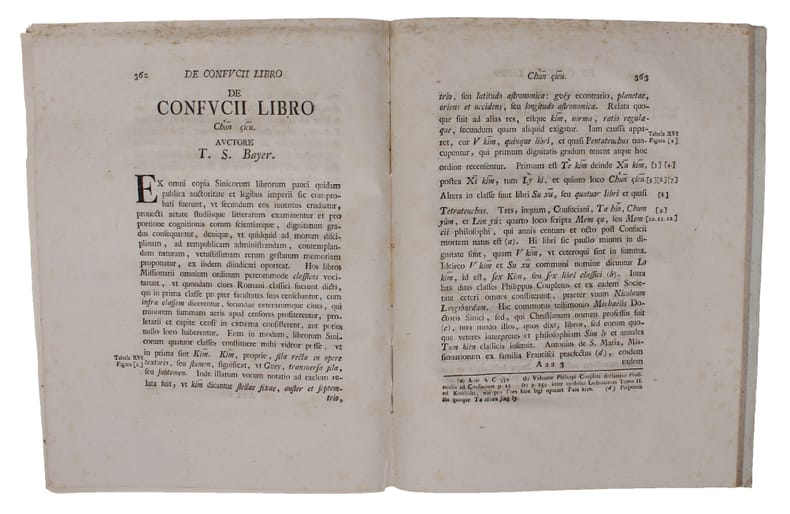
174050862Petropoli, St. Petersburg, Typis Academiae, 1740. 4to. No wrappers. In: ""Classes Tertia continens Historica. Commentarii Academiae Scientiarum Imperialis Petropolitanae"", Tomus VII ad Annos 1734 & 1735. The whole section of ""Historica""offered. Title-page to Tome VII (with engraved vignette), halftitle (to the section) a. pp. 345-426, 6 engraved plates. Bayer's paper: pp. 362-426 and 5 engraved plates with numerous chinese characters. Clean and broad-margined.
174050862Petropoli St. Petersburg Typis Academiae 1740. 4to. No wrappers. In: "Classes Tertia continens Historica. Commentarii Academiae Scientiarum Imperialis Petropolitanae" Tomus VII ad Annos 1734 & 1735. The whole section of "Historica"offered. Title-page to Tome VII with engraved vignette halftitle to the section a. pp. 345-426 6 engraved plates. Bayer's paper: pp. 362-426 and 5 engraved plates with numerous chinese characters. Clean and broad-margined. <br/><br/><em>First printing in part of the first Western translation of any part of Confusius' influential Chun Cieu being the fourth volume of his works. "The title Chun Cieu Chunqiu signifies the Spring and Autumn. He discourses like an historian of the expditions of diversr princes of their Virtues and Vices of the fatigues they underwent. The title is an emblematic title because that states flourish when their Princes are endowed wit Virtue and Wisdom which is represented by the Spring and that on the contrary they fall like the leaves and are utterly destroyed when their Princes are dispirated or are wicked which is represented by the Autumn."James Legge.The section also comprises Bayer. Elementa Calmucia. 1 pp. and 1 engraved plate numerous characters and Bayer. De Venedis et Eridano Fluvvio. Pp. 346-361. </em> unknown
18972092902144200899Not Available 1897. Soft Cover. Fine. The book is in fine condition. Not Available paperback
20062110502151108277Not Available 2006. Soft Cover. Fine. Volume: 115 Not Available paperback
Hardcovers in good condition. Thirty - four volumes. Texts in Spanish. Facsimile editions of the original first editions, published to mark the sesquicentennial celebration of the death of Simon Bolivar. Some jackets are lightly marked, scored, edge worn and nicked. One centimetre tear on rear upper edge of volume 14 jacket. Light bumps, marks and waterstains on some boards and hardcover spines. Text is partially faded on some spines. Minor marks on a few page blocks. Light creases and bumps on some pages. Five centimetre tear and overhanging edge on page 359 of volume 17. Light marks on early pages of volume 18. Minor stain on BEP of volume 28. Texts remain clear throughout. Bindings remain intact. HCW Used
Very Good French Original handsome leather bindings. Demy 8vo. (22 x 14 cm). In French and Ottoman script. 4 volumes set: ([vi], [2], 784, 125 p., [vi], 1372 p.; [xxx], [2], 1097 p., [vi], 1320 p.). Slight foxing on pages, faded on boards, otherwise a very good set. Ex-libris of Izzet Gündag Kayaoglu. First edition of the complete set of this early dictionary from French to Turkish and from Turkish to French, published in Paris, in London Oriental Translations Committee Printer. Bianchi visited Istanbul at the beginning of the 19th century and prepared dictionary and phrasebooks in Turkish after he had returned to his country. One of his most significant works occurs to be this dictionary. What makes this dictionary noteworthy among other his works is the fact that Turkish words are written together in both Arabic and Latin characters. Turkish words with Arabic letters are written as to stereotyped pronunciation in the work. Therefore, they do not indicate the changes in the language. Bianchi reflects the pronunciation of writing in Turkish letters with Latin characters; and thus, the differences between spelling and pronunciation are highlighted. Thomas-Xavier de Bianchi (1783-1864), born in Paris on June 25, 1783, was the younger brother of the Austrian Field Marshal de Bianchi, Duke of Casalanza. He studied at the Central School of the department of Seine-et-Marne and followed, in Paris, oriental language courses at the College de France and at the Imperial Library under Sylvestre de Sacy. In 1807, he was appointed a pupil at the French school of young people of language in Constantinople, then directed by the scholar Ducaurroy and completed his improvement in Arabic, Persian and Turkish. Sent to Izmir in 1811, he was second there, and then the first dragoman of the Consulate General, and was noted for his dedication during the plague epidemic of 1812. In 1816, he was appointed assistant to the King's secretary-interpreters in Paris and was in charge to accompany the Persian envoy to Louis XVIII in 1819. In 1829, he was sent on a mission to the last day of Algiers, Hussein-pasha. The following year, France intervened in Algeria. He was appointed secretary-interpreter in the title and served as professor of Turkish at the School of Oriental Languages until 1842. After his retirement, he devoted himself to lexicographical and bibliographical work. He was an officer of the Legion of Honor, decorated with the Nichan-Iftikhar, as a member of the Imperial Academy of Constantinople. Tout exemplaire de ce Dictionnaire qui ne serait pas revetu de la signature de l'un des auteurs et editeurs sera repute contrefaçon, et poursuivi cmme tel, en vertu de la loi du 19 juillet 1793. [i.e. Any copy of this Dictionary which does not bear the signature of one of the authors and publishers will be deemed to be counterfeit, and prosecuted as such, under the law of July 19, 1793].
19942090202122801697Rinsen Shobo 1994. Soft Cover. Fine. Number of books: 18 Rinsen Shobo paperback
Hardcover in acceptable condition. No jacket. Text in German. Fold-out frontispiece. Boards are marked and lightly scored. Leading corners, edges and spine are bumped and worn. Front leading edge is split in places. Cover on spine sides and ends is chipped. Three centimetre tear on spine head. Pages are lightly marked and tanned. Binding is slightly exposed on pastedown hinges and throughout pages, but remains intact. Contents are clear throughout. HCW Used
197143454New York.: New York Cultural Center for Art & Language Press. 1971. Publisher's printed white wrappers stapled. Slight staining to covers and with discreet ex-library stamp to inner front cover. 4to. 28 x 22 cm. Artist book published in an edition of 200 numbered copies signed by both artists on verso of title page.Ten ethical propositions made by Baldwin and Atkinson are considered in depth.Germano Celant - Book as artwork 1960/1972. p.84. New York Cultural Center for Art & Language Press. unknown
1983217993Marburg u. Frankfurt, Elwert u. Diesterweg, 1894-1983. Gebunden, meist Hlwdbde. 9 Jgg. in Heften. N.F. Jg. 1960 in 2 Halbbdn. St. a. mehr. Tit. Einbde. zum Teil fleckig. Jg. 1963 H. 7 lose beigelegt. Fehlt: Bd. 51 H. 3 u. Tit. u. Inhaltsverz. zu N.F. Jg. 1958, 1960-1961, 1964.
1880027837Paris: Derveaux 1880. 1st Edition 1st Printing. Soft cover. Very Good. Xvi 89 Pp 1 Pp Catalog At End. Simply Bound With Brown Binder's Tape Spine And Brown Card Wrappers Two Preliminary Blanks Two Final Blanks. Pages Square And Unworn No Marks. Small Area Of Light Damp-Spotting At Part Of Top And Bottom Of Most Pages No Waviness To Pages. Émile Jean-Marie Gautier 1853 - 1937 Was An Anarchist And Later A Journalist. He Coined The Term "Social Darwinism". He Obtained A Doctorate In Law. He Became A Disciple Of Jules Vallès. Gautier Attended The Anarchist Congress That Met In London From 14 July 1881. Other Delegates Included Peter Kropotkin Errico Malatesta Saverio Merlino Louise Michel And Marie Le Compte. While Respecting "Complete Autonomy Of Local Groups" The Congress Defined Propaganda Actions That All Could Follow And Agreed That "Propaganda By The Deed" Was The Path To Social Revolution. He Was Implicated During The Trial Of Peter Kropotkin And On 19 January 1883 Was Sentenced By The Criminal Court Of Lyon To Five Years In Prison. On 15 August 1885 He Was Pardoned. Renouncing Political Activism Gautier Worked At Various Newspapers Including L'écho De Paris Where He Met Octave Mirbeau And Le Figaro Where He Published "Documentary Chronicles". These Were Published As A Collection In 1992 Under The Title Les Étapes De La Science Steps Of Science. According To The Historian Of Social Thought Mike Hawkins Emile Gautier Was The First To Use The Term "Social Darwinism" In His Pamphlet Of The Same Name Published In 1880 In Paris. He Became A Well-Known Popular Science Writer. His 1902 Fleur De Bagne Prison Flowers Written With His Childhood Friend Marie-François Goron Was An Ancestor Of Techno-Thrillers And Crime Dramas With Science Themes. <br/> <br/> Derveaux paperback
193970463Duke University Press. Good. 1939. Paperback. FREE UPGRADE to Courier/Priority Shipping Upon Request - IN STOCK AND IMMEDIATELY AVAILABLE FOR SHIPMENT - TEXT PRISTINE UNMARKED - Pages 123 - 246 - Quarterly journal devoted to research in American literature-- Among the articles in this issue: "Channing and Transcendentalism"; "Poe and the Chess Automaton"; "Abraham Lincoln's Rhetoric"; and "The First English Plays in New Orleans". -- with a bonus offer-- . Duke University Press paperback
195170466Duke University Press. Very Good. 1951. Paperback. FREE UPGRADE to Courier/Priority Shipping Upon Request - IN STOCK AND IMMEDIATELY AVAILABLE FOR SHIPMENT - TEXT PRISTINE UNMARKED -- Pages 395 - 574; with index pages i - ix - Quarterly journal devoted to research in American literature-- Among the articles in this issue: "Promotheus 1900"; "Emily Dickinson and Sir Thomas Browne"; and "The Birth and Death of A Satirist: Eugene Field and Chicago's Growing Pains". -- with a bonus offer-- . Duke University Press paperback
196070462Duke University Press. Very Good. 1960. Paperback. FREE UPGRADE to Courier/Priority Shipping Upon Request - IN STOCK AND IMMEDIATELY AVAILABLE FOR SHIPMENT - TEXT PRISTINE UNMARKED - Pages 125 - 252 - Quarterly journal devoted to research in American literature-- Among the articles in this issue: "The Earliest Poems of Edward Taylor"; "The Time-Scheme in 'The Portrait of a Lady' "; and "William Gilmore Simms and the Kentucky Tragedy". -- with a bonus offer-- . Duke University Press paperback