25 643 résultats
1752002066Paris: Durand Pissot 1752. Hardcover. Very Good. Title page continued: "Un Mémoire sur la Maniere de faire le Saffre; Le Secret des Vraies Porcelaines de Chine & de Saxe. Ouvrages ou l'on trouvera la maniere de faire le Verre & le Crystal d'y porter des Couleurs d'imiter les Pierres Prétieuses de préparer & colorer les Emaux de faire la Potasse de Peindre sur le Verre de préparer des Vernis de composer des Couvertes pour les Fayances & Poteries d'extraire la Couleur Pourpre de l'Or de contrefaire les Rubis de faire le Saffre de faire & peindre les Porcelaines &c. Traduits de l'allemand par M. D." 4 lv 1 629 3 p. 16 leaves of copperplate engravings including the frontispiece most folded; 26 cm. Contemporary full calf with six spine compartments between raised bands. Orange leather spine label in second compartment with gilt-tooled title; gilt-tooled decoration in other compartments. All page edges red. Woodcut head pieces and in-text illustrations. Contents: Sol sine Veste ou Trente Experiences pour Tirer la Couleur Pourpre de l'Or by J.C. Orschall -- Helioscopium Videndi sine Veste Solem Chymicum -- Sol non sine Veste ou L'Invincibilité de l'Or by Christophe Grummet -- De la Vitrification des Vegetaux -- Chapitre XI du Livre de Mr. Henckel qui a pour titre Flora Saturnizans -- Secret des Vraies Porcelaines de la Chine et de Saxe. Baron von d'Holbach translated several early works on glassmaking including works by Antonio Neri Christopher Merret and Johannes Kunckel. In Very Good Condition: front joint starting to separate from tail; slight loss of leather at head and tail of spine; light cracking on spine; corners rubbed. Pages and plates are clean and bright. Durand, Pissot hardcover
First edition, 8vo (230 x 145 mm), vii, [2], vi-xxviii, 427, [1]pp., some light spotting, rebound in half calf, marbled boards, spine gilt, morocco title label. William Yates (15 November 1792 - 3 July 1845) was an English Baptist missionary and orientalist. After joining the Baptist Missionary Society he sailed for India and arrived in Calcutta in 1815. From there "He continued to Serampore to join William Carey (1761?1834), who had been sent out by the same society in 1792, and under his direction began to study Sanskrit and Bengali. Almost immediately he began to help with the mission's publications."?(Oxford DNB.)
19102080402107100238Geisha-do 1910. Soft Cover. Fine. The book is in fine condition. Geisha-do paperback
1975LN-1Taipei Taiwan: Ch'eng Wen Publishing 1975. Classic comprehensive reference text authored by the renown Chinese linguist Herbert Giles contains a compilation of biographical data spanning the past 400 years through the present date of publication This publication is a complete unabridged reprint of the original 1898 edition. Includes the surname and personal name by which the individuals are formally known; Emperors and their dynasties; tables for Chinese characters for place-names dynasties etc. and an index. At the end of the text is a full alphabetical listing of the literary and fancy names coupled in some cases with the surnames and of the canonisations. Text in Chinese and English. 1022 pp. Prior owner's name on front endpaper. Gilt spine. Corners slightly bumped. Minimal shelfwear. Heavy item. Reprint. Hard Cover. Fine. 4to - over 9¾" - 12" tall. Ch'eng Wen Publishing Hardcover
18994002642Moscow: Sinodalnaya Typografija 1899. Fine. Octavo iv 114 paginated in Old Slavonic; old quarter sheep with marbled boards. <p><p>Rare: evangelical text translated into the Aleut language and printed in Cyrillic prepared by Ivan Veniaminov-Popov 1797-1879 the great Orthodox missionary to the northern Pacific. Veniaminov was educated in Irkutsk and as a young man he was selected for the Orthodox mission to Unalaska arriving there in 1822 with his wife and children. While there had been some successful conversions already the Church feared that Christian and indigenous beliefs had become merged. The scope of the missionary project soon expanded to include the entire Alaskan peninsula and surrounding islands a vast and often inhospitable geographical area. For ten years Veniaminov was an intrepid traveller often using small craft and kayaks to visit coastal settlements and travelling on foot through rugged mountainous regions. In 1832 he was appointed to a relatively sedentary position at Sitka as minister to the Tlingit of the Northwest Coast.</p> <p>Veniaminov was a skilled linguist fluent in several dialects; he prepared this evangelical text in the Aleut language which was first published by the Moscow Synod in 1840 and later in 1899 the present edition. Both editions are rare. As a pioneer apostle to the frozen north Veniaminov was canonized Saint Innocent and holds a cherished place in the history of the Orthodox Church.</p> </p> . Sinodalnaya Typografija unknown
17848660Berlin, George Jacques Decker, 1784. In-4 de [2]-52-87 pages, demi-vélin blanc à coin, dos lisse, titre estampé en noir (reliure moderne).
1967217798Berlin, Dümmler, 1852-1967. Hldr., Hlwd. u. in Heften. Teils m. Rgoldpräg. Einbde. teils etwas berieben. Wennige Einbde. stockfl. Vors. teils m. leimschatt. Ecken. Mehr. Bde. m. Bleistiftanstreich. Meist m. Rsign. u. gest. Bibl.-Ex.
Paperback Like New. Ships from publishers directly but must allow a minimum of 20 - 25 business days shipping time.
171918448The Hague: Printed for Isaac Vaillant 1719. Small 8vo. pp. 16 293 11 with English and French on facing pages. Rebound in contemporary paperboards with white spine paper and hand-written spine label. Internally crisp and clean with only very minimal foxing and browning. First bilingual edition also published in the same year in English only. Dufresny dedicates the book to his pupil John Merrill junior to whom he was teaching French. Included in the book are 179 jests and sayings with the English version on the left hand side and the French translation opposite. Attractive red and black title page. OCLC lists three copies only . First Edition. Very Good. Printed for Isaac Vaillant hardcover
Very Good Turkish, Ottoman (1500-1928) A fine half leather bdg. with marbled boards. Two volumes in one. Cr. 8vo. (20 x 14 cm). The text in Ottoman script (Old Turkish with Arabic letters) with bilingual titles in Ottoman Turkish and French on frontispieces and title pages. 2 volumes set: (248 p.; 270, [1] p., the first volume has Columbus' engraved portrait frontispiece, the second has Amerigo Vespucci's portrait). Hegira: 1310 = Gregorian: 1893. First and only edition of this very rare book, which is the first Turkish original work on the history of the discovery of America printed for the Quadricentennial of the Discovery. With this book, Christopher Columbus and Amerigo Vespucci quickly became popular among Ottoman readers (soon after Iranian readers with a translation of the first volume only), and immediately among other Middle Eastern readers, and thus the first comprehensive and original text describing Colombus and the discovery of America appeared in the Middle East and Islamic world. It's been published in Istanbul under the title "The history of the discovery and conquest of America". The first volume is on Christopher Columbus, and the second volume is on Amerigo Vespucci, their lives and travels. Andreas Kopassis Efendy (1856-1912) was one of the few Ottoman Greeks proficient in the Ottoman literary language. Cretan Kopassis is an intriguing figure who made a remarkable career serving the Ottoman state. At the time of the publication, he was a member of the State Council (Sura-yi Devlet). He displayed quite an extraordinary interest in scholarly research and he seems to have been one of the first to have studied Ottoman "tahrir defterleri" [i.e. Ottoman tax registers]. This could be called a translation in a sense. Kopassis makes no reference to preceding translations, nor does he refer to Robertson's history of America. His main source was a more recent equally "classic" work on Christopher Columbus, Washington Irving's "History of the life and voyages of Christopher Columbus" (first published in 1828). Another source referred to by Kopassis is J. H. Campe's "Entdeckung von Amerika" (first published in 1781). His educational background is evident particularly in the introductory chapter where ample references are made to Pliny, Ptolemy, and Plato's Timaios which contain allusions to Atlantis. In his takri (Introduction) to this work, Kemalpasazade Said Bey (1848-1921) praised the author for his elegant prose. Sultan Abdülhamid awarded the order of merit (liyâkât) in gold to the author. In the same year (1315=1895), an aide-de-camp at the Iranian Ministry of War, Muhibb-i 'Âli Khan, translated the first volume into Persian. At the turn of the century, Christopher Columbus had become a very popular figure for Ottoman readers of all ages...". (Source: STRAUS, JOHANN: Nineteenth-century Ottoman Americana.; "Frontiers of the Ottoman Imagination: Studies in Honour of Rhoads Murphey."). Only one copy in OCLC 777274675 (Leiden University Library). Not in American libraries.; Özege 19857.
1943218055Berlin, Calvary & Co. 1892-1943. 4°. Hlwd. St. a. Tit. Rücken meist stockfl., teils leicht beschäd. Einige Vors. leicht fleckig. Einige m. St. u. Sign. Und einige Jgg. ungebunden (in losen Lagen). Fehlen: Jg. 16 H. 33-34; 30 H. 3, 8, 43; 33 Textverl. S. 1658-64; 45 H. 4-5; 49 TI; 64 H. 22-27.
19096260Clarendon Press. 1909. Hardcover. Very Good in No Dust Jacket dust jacket. Former classics scholar's bookplate on inner cover John H. Betts. Corners bumped. Light scratches to boards. Edgewear to bottom of spine. Small stamped 'J' on inner back cover.; Volume I: The Hieroglyphic and Primitive Linear Classes with an Account of the Discovery of the Pre-Phoenician Scripts their Place in Minoan Story and their Mediterranean Relations. With Plates Tables and Figures in the Text. 13 full pages of plates at end.; Volume 1 Only.; 1; 302 pages . Clarendon Press hardcover
1810biblio1361<p>This is a fair copy of the 1810 London edition the 10th. The covers have come unhinged but this two volume monumental work remains completely restorable.</p><p>Photos on request.</p> Rivington, et al hardcover
A numbered (278) and printed document granting financial compensation to a slave owner in Suriname, by the Dutch government, signed in the original by numerous parties including the Gouverneur de Kolonie Suriname [Governor of Suriname] Van Lansberge, the Administrateur van Financienvan Het Ministerie van Kolonien te s-Gravenhague [Finance Administrator for the Ministry of the Colonies, at The Hague], and the recipient of the funds who is not only a slave owner but well-known chirurgeon A.D. Charlouis. Text is in Dutch. With steel engraved colonial coat of arms, official ink stamps, the embossed stamp of the "Klein Kolonie Suriname" government. Single leaf measuring approximately 26,5 x 13 cm. Very good condition, beautifully preserved, a scarce and historical slavery document with notable signature. The present document is interesting, as is was made almost two years after the official abolition of slave ownership in Suriname, which reveals the lengthy time period over which this process was stretched. The government's primary concern was not the freedom of the enslaved people; it was the preservation of the plantation economy, lest there be a mass exodus of workers leaving the plantations. The latter was cited as the reason and justification for the mandatory employment contract which accompanied 'free status' of a slave. Chirurgeon Andries Daniel Charlouis (Emden, Lower Saxony 1820 - Paramaribo, Suriname 1880) is the recipient of this compensation. Historical evidence reveals that he had more slaves than what is represented with this document, and that he released them gradually. He was well-known in the field of medical science, particularly for his studies on medicinal matters and the indigenous people of South America; his name appears in numerous medical journals of the period. Reinhart Frans Cornelius van Lansberge (1804-1873), whose signature authorizes this document, was the Governor-General of Suriname from 1 August 1859 to 29 June 1867. Slavery was abolished in the Dutch West Indies during his governorship. Previous to this post, he was Governor of Curacao from 1855 to 1859, and formerly Dutch Consul-General Venezuela. Doctor Charlouis, whose original signature is found to verso, received 1935 guilders with this promissory note effective 15 August 1865. This figure represents the release of approximately 6 slaves. A manuscript annotation to upper left margin, penned in a West Germanic language, refers to the abolition act: "Opheffing der slavernij... 1863" [Elimination of slavery... 1863]. Red ink annotations reveal that this document was registered on 16 September 1865, and signed by a Geregistreerde referendaris J.C. Jaunen [registered secretary]. Additional annotations to the upper margin suggest that the funds were cashed in on 16 October 1865 "Betaalbaar te Amsterdam" [paybale to Amsterdam]. Also interesting to note, two of the signed annotations to verso, those of Charlouis and a witness, make reference to German plantation owner, banker Wilhelm Eduard Ruhmann at Paramaribo. As such, this transaction was most likely transacted at Surinaamsche Bank which had been founded earlier the same year, and the funds dispatched from there to the Dutch government in The Netherlands. The Netherlands abolished the Atlantic slave-trade in 1814. However, localized slavery continued for over half a decade. Slavery was finally abolished in Suriname and the Dutch West Antilles on 1 July 1863 with the Emancipation Act. On that day, about 35,000 slaves in Suriname and 12,000 slaves on the Dutch islands in the Caribbean were given their freedom, or rather a modified version of freedom. Freed men in Suriname come under state supervision for ten years with a mandatory employment contract on the plantations. The slave owners received financial compensation from the government upon releasing their slaves to this system. The Dutch government paid 300 guilders per slave to the owner for the "lost property". (In the Dutch East Indies, payments were far lower, 50 to 350 guilders depending on the age of the slave). The abolition of slavery was referred to as 'emancipation'. Parties were organized in which King William III was presented as a key figure and benefactor of the freed slaves.
An outstanding illustrative work to record the details of traditional Japanese samurai attire, produced by Imaizumi Sadasuke, a scholar of the Kokugaku movement which emphasized Japanese classical studies who evidently researched the works of the eighteenth century noble Heizo Sadatake Ise. Woodblock print. The complete work. 8vo. 2 volumes, opening from left to right, 40 pages combined, with 35 woodcut images, all of which are beautifully hand-painted in full colour. Text is in Japanese. Each volume with red ink stamp to margin of first leaf, and title noted in manuscript to bottom fore-edge. In publisher's original yellow striped paper boards, each volume with title slip to front. Traditional karitoji binding ("semi-bound" meaning title page and contents without a book cover) string-stitched at spine, fukurotoji style ("bound-pocket" with folded leafs bound into spine), and opening from left to right. Each volume measures approximately 18 x 25 x 1 cm. Indication of additional small label removed from covers, otherwise in very good and original condition, a stellar work with vivid, meticulously coloured, woodcut illustration, internal crisp and clean. Striking woodcut illustrations of samurai clothing, painted with such meticulous detail to bring depth and vibrant colour, each featuring explanatory text, numerous styles are shown. Variants between the social classes are explained, ranging from lower samurai with simple garments and accoutrements such as banners and ogi (folding fan), to upper officers whose kimono was made of the highest quality decorative fabric and who carried various military arms including the katana (curved sword), the tachi (traditional sword). We also see the shaku - a narrow board held in the right hand when one wears sokutai - traditional ceremonial court dress. Based on the hand-painted manuscript scroll produced in Anei 8 (1779) by Japanese noble and scholar Heizo Sadatake Ise, and his famous guidebook for samurai, the present work serves as a vestige of hereditary eminence. Imaizumi Sadasuke (1863-1944), sometimes seen as Imaizumi Teisuke, was a Kokugaku scholar, an educator and shintoist of the Meiji, Taisho and Showa periods.
An outstanding work to illustrate the correct way for Japanese noblewomen to wear formal attire in the Japanese Court - the Nyokan's jyunihitoe, written by Imaizumi Sadasuke, a scholar of the Kokugaku movement which emphasized Japanese classical studies who evidently researched the works of the eighteenth century noble Heizo Sadatake Ise. Woodblock print. The complete work. 8vo. 1 volume, opening from left to right, 15 pages, with 14 woodcut images, all of which are beautifully hand-painted in full colour and captioned in margins. Text is in Japanese. In publisher's original brown paper boards, with title slip to front. Traditional karitoji binding ("semi-bound" meaning title page and contents without a book cover) string-stitched at spine, fukurotoji style ("bound-pocket" with folded leafs bound into spine), and opening from left to right. Volume measures approximately 18 x 25 x 0,5 cm. Chips and indication of burrowing to covers, otherwise in very good and original condition, a stellar work with vivid, meticulously coloured, woodcut illustration, internally crisp and clean. Striking woodcut illustrations of jyunihitoe - the official dress worn by female court officials and ladies-in-waiting of Imperial Japan, for approximately 1000 years from the Heian period to the Edo period, painted with meticulous detail to bring depth and vibrant colour. During the Heian period (794-1185) women could hold court offices of substantial responsibility, managing the affairs of the Emperor. Female palace attendants were employed by the Imperial Bureau of Palace Attendants from among the court aristocracy, but were required to have sufficient education in Chinese classics to be accepted. Women who held official positions and served in the Court of Japan from the Heian to the Edo period were called Nyokan (Nyobo, Kyujyo). The most famous is Murasaki Shikibu, who is considered the author of Tale of Genji. The imperial court offices were reserved for members of the court aristocracy and the ladies-in-waiting or 'palace attendants' were commonly educated members of the nobility. Female palace attendants were divided in two classes, which in turn had several ranks, signifying their task. The first class consisted of the nyokan, or ladies-in-waiting who held court offices: naishi-kami (shoji) naishi-suke (tenji) and naishi-no-jo (shoji). The second class were the female palace attendants: myobu, osashi, osue and nyoju. The ladies-in-waiting worked as personal assistants, tending to the Emperor's wardrobe, assisting the emperor's baths, serving meals, performing and attending court rituals. Ladies-in-waiting could be appointed as concubines, consorts or even Empresses by the Emperor or the heir to the throne. The function of a lady-in-waiting as potential concubine was abolished in 1924.
Fascinating illustrative work which explains the significance of the colour details for the attire of the especially notable Japanese samurai who gained an official title in government - the Bukekani, written by Imaizumi Sadasuke, a scholar of the Kokugaku movement which emphasized Japanese classical studies, drawing information and art from a manuscript written in Bunka 13 (1816) by Honma Hyakuri who wrote several works on Japanese textiles for court attire. Woodblock print. The complete work. 8vo. 2 volumes, opening from left to right, 54 pages combined, replete with hand-painted full colour woodcut images. Text is in Japanese. Each volume with red ink stamp to margin of last leaf, and title noted in manuscript to bottom fore-edge. In publisher's original yellow striped paper boards, each volume with title slip to front. Traditional karitoji binding ("semi-bound" meaning title page and contents without a book cover) string-stitched at spine, fukurotoji style ("bound-pocket" with folded leafs bound into spine), and opening from left to right. Each volume measures approximately 18 x 25 x 0,5 cm. Indication of additional small label removed from covers, otherwise in very good and original condition, a stellar work with vivid, meticulously coloured, woodcut illustration, internal crisp and clean. The various components and the significance of specific colours for the garments of a bukekani, the latter being an elite class of samurai who had been chosen for an official role in the Japanese Imperial Court, are illustrated and described in these volumes. Among these samurai, there were also classes, denoted by colour and ornamentation of their costume. The rank and position of each samurai would be easily discernable by not only by the colour of clothing they donned, but also by the colour and design detail with which their accoutrements were adorned. Such meticulous detail was highly significant. Numerous elements of the official attire are shown with woodcut illustrations, each featuring explanatory text. Accoutrements include ogi or sensu (folding fan), footwear, headwear, belts and sashes, as well as some military arms including the katana (curved sword), the tachi (traditional sword), the hirao (hanging strap), and even a shitozutsu (portable urinal). "Bukekani" was the title given to samurai who were appointed to official positions. The term derives from the following: "Buke" refers to the collection of various powers which support the authority of a bakufu (Japanese feudal government headed by a shogun), and this word sometimes also refers to a Shogun family or general samurai. "Kani" was an official rank system in the Japanese Government. The purpose of the Kani official rank system was to avoid the heredity of government positions and to employ the most suitable person for each position by appointing him a position in connection with his Ikai. Imaizumi Sadasuke (1863-1944), sometimes seen as Imaizumi Teisuke, was a Kokugaku scholar, an educator and shintoist of the Meiji, Taisho and Showa periods.
First Edition. Thick Folio, 32.5 cm.[vii], 288, 39, [vi] pp. Eight continuous-tone heliogravure photo plates (4 double-page) with original tissue guards plus 15 other helopgravure photographic plates including "Chart of the De Veer" (Amsterdam 1598), plus more than 140 heliotype photographs in text - many a la vignette, 8 partly colored maps including 4 large fold-outs and 2 large folding charts including Voyages into the Kara Sea 1870-1907 and Itinerary of the Belgica in the Barents and Kara Seas. Pages are heavy-weight paper stock. This Scarce publication is made Rare by being a Presentation Copy Inscribed by the Duke on a front blank leaf [translation]: "To Madame Renée Lanit Maur, affectionately and devotedly yours, Philippe." Publisher’s original pictorial wrappers with infold flaps and photograph of the "Belgica" in the ice of the front cover, titles in red and black on front cover and spine. Wrappers are aged, rubbed and a bit of chipping at the edges. The pages are in near fine condition and with no tears. This is a very impressive Arctic publication in its content and quality of production. Sold as is in its original state and signed by Duc d’ Orleans. Not in Arctic Bibliography. A quality production of superb heliogravure plates and photographic images throughout. The narrative is in French by the duc d’ Orleans of a voyage to the eastern Arctic in the "Belgica" under the command of Adrien de Gerlache de Gomery, who had sailed to the Antarctic in the same ship in 1898-99. Though Gerlache commanded the ship, Orleans owned it. Orleans had sailed with Gerlache in the "Belgica" to Greenland in 1905. Two years later they headed northeast for the Barents and Kara Seas to conduct studies in oceanography and natural science. The "Belgica" took five days in crossing the Barents Sea, July 8-12, 1907. On July 13 she entered the Matochkin Shar and emerged into the Kara Sea on the 15th. Next day, the ship ran into heavy ice in which she was imprisoned. She drifted slowly towards the south end of Novaya Zemlya, went through the Vaigatch gateway, and was finally released in the Sea of Murmanske on August 20. From here Gerlache sailed north along Novaya Zemlya’s west shore towards Frans Josef Land and on September 1 reached latitude 78ºN. He and Orleans tried to get farther north, but the ice kept driving them back. On the 4th on September they gave up and sailed through the Barents Sea to Norway, where they arrived on September 12th. Heliogravure is similar to photogravure where a film positive is exposed and copied onto light-sensitive gelatinized paper, which is adhered to a copper plate that is then etched in a ferric chloride bath, resulting in a plate, which, when printed, gives a continuous tone image that is very sharp and strong.
Hardcover. No jacket. Two volume set. First edition. Text is in French. Several marks on boards. Leading corners, edges and spine ends are lightly bumped. Lettering plate on spine of volume 2 is slightly chipped. Page blocks are marked. Foxing in the volumes. Hinge of volume 2 is reinforced with tape on pastedowns. Page 3 and 293 of volume 1 have small chips on lower edges. Tears on lower edges of page 17 and 159 of volume 2. Some pages have pencil underlining and annotations. Bindings are intact, contents are clear. AM Used
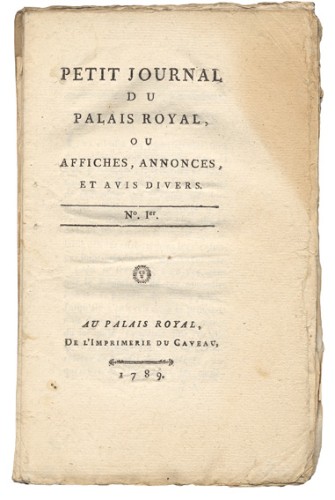
178911113Au Palais Royal, de l'Imprimerie du Caveau, 1789 ; in-8, broché ; N°1, 4, 5, 6 sur les six numéros parus au total (32 ; 19 ; 24 ; 28 pp.).
In-8°; pp. 164, (2), legatura in mezza pergamena con tassello e titolo in oro al dorso. il nome dell’autore, Cesare Beccaria Bonesana (Milano 1738 - 1794) , è in fondo alla dedica a Carlo. La seconda parte dell’opera annunciata nella lettera al lettore uscirà solo nel 1809. L’opera, qui in edizione originale e in forma organica, fu il frutto di alcuni studi e ricerche che Beccaria pubblicò sul la rivista il “Caffè”, e che avevano come oggetto la libertà dello stile dall’autorità della tradizione letteraria. In quest’opera l’autore teorizza il rinnovamento dei generi letterari e la maggiore aderenza delle parole alle cose. Ex libris Avv. Queirolo. Firpo II, p. 512. retorica lingua italiana italian language discorso stile style illuminismo milano critica letteraria linguistica beccaria milano
[2bl] 144 [2bl] pp., cart.cover (marbled plates, corners bit bumped), 21cm., 2 library stamps on title page and at verso of blanco page 4, few foxing, Good condition, OCLC: 457754870, very rare first (and most probably only) edition of this work [being an attempt to establish a universal language. The Hungarian author Endre Rethy, born in 1779 in Freystädl, was professor in Greek language at the Königliche Akademie in Raab, Hungary], T77107, [Content; Thesis I: Introductio in linguam universalem, II: Vocis humanae explicatio ejusque divisio, III: Linguae universalis origo, IV: Linguae universalis in linguas particulares transformatio, V: Linguarum particularium ad linguam universalium reductio, VI: Dotium linguae universalis explanatio, VII: Vocabularum linguae universalis ejusque objectorum classificatio, VIII: Vocabularum linguae universalis significatio]
1821T77107Viennae, Typis Antonii Strauss 1821 [2bl] 144 [2bl] pp., cart.cover (marbled plates, corners bit bumped), 21cm., 2 library stamps on title page and at verso of blanco page 4, few foxing, Good condition, OCLC: 457754870, very rare first (and most probably only) edition of this work [being an attempt to establish a universal language. The Hungarian author Endre Rethy, born in 1779 in Freystädl, was professor in Greek language at the Königliche Akademie in Raab, Hungary], T77107, [Content; Thesis I: Introductio in linguam universalem, II: Vocis humanae explicatio ejusque divisio, III: Linguae universalis origo, IV: Linguae universalis in linguas particulares transformatio, V: Linguarum particularium ad linguam universalium reductio, VI: Dotium linguae universalis explanatio, VII: Vocabularum linguae universalis ejusque objectorum classificatio, VIII: Vocabularum linguae universalis significatio]
8vo, [16], 632, [78] pp., lprinter's woodcut device on title showing a sea horse holding a mast on the top of which is perched a crane, and above the crane are the words "Discite Ivsticiam Moniti", contemporary ink signature on fly-leaf and erased early signature on title touching 2 letters, occasional ink underscoring, some light damp staining, later vellum with yapp fore-edges, upper cover slightly marked, a very good copy. Bibliographie des oeuvres d'Erasme, pp.299-300; Not listed in Bibliotheca Erasmiana Bruxellensis.
Very Good Turkish, Ottoman (1500-1928) Original wrappers. No bdg. Wear spine, dispersed pages. Roy. 8vo. (24 x 17 cm). In Ottoman script (Old Turkish with Arabic letters). 197, 6 p., 5 panoramic folded huge b/w plates (Including the photographic plts.; 1-) Turkish Convention May, 13, 1923, Detroit, Mich by Photo Craft Byallen -23x39 cm-; 2-) [Among the Young Turks in Detroit, -23x106 cm-; 3-) In the White House with the President, -23x106 cm-; 4-) Islamic Society in the US, -32x40 cm-; 5-) Among the Young Turkish people in Chicago, -23x26 cm-). First and only edition of this exceedingly rare travel account of America by Dr. Mehmed Fuad [Umay], (1885-1963), who was a Turkish doctor and the founder of Himâye-i Etfâl [i.e. Society for the Protection of Orphans], a society that was established in 1921 to provide orphanages to children of the deceased soldiers in the Turkish War of Independence; began visiting many of the Turkish colonies in the US, giving lectures and raising a considerable amount of money for the establishment of these orphanages in Turkey. On 21 March 1923, Fuad Bey was granted permission from the Grand National Assembly of Turkey to go to the US in order to raise funds among the Ottoman immigrants for immediate war relief. Thus, for the first time, humanitarian action became an organized effort by fostering diaspora mobilization. Fuad Bey arrived in Ellis Island on 6 April 1923 on a ship named SS Aquitania and headed to the Ottoman Welfare Association at 35 Rivington Street. In the first meeting held by the Ottoman Welfare Association for the benefit of Turkish Orphan Society, Fuad Bey notes that a total of USD 17,500 was raised in just six hours. To those who donated over USD 1,000, a personally autographed picture of Mustafa Kemal was given by Fuad Bey. He visited the Turkish colonies in Wisconsin, Illinois, Michigan, New York, New Jersey, Massachusetts and Rhode Island. He lectured about the Turkish War of Independence (1919-1922) and the success of the struggle, and many Turkish and Kurdish workers residing in these cities donated their life savings to support the construction of orphanages and the reconstruction of the entire country. Fuad's visit to Peabody, Massachusetts aroused exceptional excitement among the Turkish and Kurdish immigrants. It was the first chance for the Muslim Anatolian immigrants to manifest their national pride and attachment to the homeland. At the same time, their socioeconomic achievement was evidenced with the arrival of Fuad Bey in Peabody in an auto decorated with a large American flag and followed by a dozen autos filled with Turks, the machines decorated with American and Turkish flags.". A day before his arrival, the Turks refrained from work and "went around with badges in honor of his coming. Mehmed Fuad noted that there were around 600 Turks when he visited Peabody in 1923. Despite their small number, they had established Kizilay [i.e. Turkish Red Crescent] society. After being shown some of the tanneries in Peabody and Salem, Fuad gave an address to the Turks and Kurds at the Peabody Institute. The scene was described as: "All the Turks in town were present. They made a spectacle of the doctor's visit, many of them taking a day off. They wore badges in his honor and displayed in front of the Institute the American and Turkish flags. Great enthusiasm was shown. Baskets of roses were carried down the aisles and the flowers were bought at any price, bunches of money being put in the baskets. It was said that USD 8,000 was raised among the Turks of this city for Dr. Fuad Bey to take back with him.". Fuad Bey visited Peabody for a second time on 14 August 1925, as he came for the National Conference of Social Workers held in Denver, Colorado in June, 1925. When he arrived in Massachusetts, he was met by a delegation of Turkish people from [.]". (Source: Ottoman Immigrants and the Formation of Turkish Red Crescent Societies in the United States). No printed copy in OCLC.; Özege 727.; TBTK 11126.