25 643 résultats
Lot of 6 issues of Germany's first published aviation magazine, Der Flieger, published by the founder Kurt Tucholsky during the Great War, these issues featuring flying aces such as the Red Baron Manfred von Richthofen and leading tactical pioneer of aerial formations Oswald Boelcke, and notable events taking place in the air and on the frontlines of the Great War. Octavo. Illustrated field newspapers, issues number 19, 22, 23, 34 from 1917, issue number 29 dated May 1918, and issue number 1 dated October 1918 Text is in German. Magazines vary slightly in size, the smallest measuring approximately 26 x 35 cm and the largest measuring approximately 27 x 38 cm. Some chips and small tear at extremities, otherwise in very good condition, nicely preserved. Der Flieger was published by Kurt Tucholsky (1890-1935), who became one of the most important journalists of the Weimar Republic. Der Flieger was a field newspaper, now remembered as the oldest German aviation monthly periodical. From 1915 to 1917 Tucholsky served in the artillery flying school East I in Alt-Autz. From 26 November 1916 to November 1918 he published the field newspaper Der Flieger. Tucholsky was one of the most important journalists of the Weimar Republic Early issues of Der Flieger are exceedingly scarce. The present lot features Richthofen's 75th victory described by one of the very first men with whom Richthofen shared the details only two hours after the bold action, not long before he lost his own life in combat, an account of how in 1916 Oswald Boelcke earned the award "Pour le Mérite" along with Max Immelmann, an aviator's aerial view of Verdun shortly after the great battle of 1917, and more. Richthofen's 75th victory, a most notable attack which earned him a prestigious chivalry award, is recounted by one of the very first men who heard the details firsthand from the gallant aviator himself - only a couple of hours after the incident. Flying Ace Manfred von Richthofen, the famed Red Baron, is featured in the issue of 12 May 2018 with an article titled "Wie Richthofen seinen 75. abschoß [How Richthofen Shot Down his 75th." Richthofen had died in air combat only six weeks earlier on 21 April 1918, being the highest-scoring ace of the war, eventually being credited with 80 official victories. The account is written by a Lieutenant Lampel, who had only just met the famous ace for the first time on 2 April 1918. Only a couple of hours earlier Richthofen had claimed his 75th victory, by taking the lives of 19-year-old Second Lieutenant E.D. Jones and Second Lieutenant R.F. Newton. Flying ace Oswald Boelcke is featured with a portrait sketch on the front of the October 1918 issue, which is followed by an article describing the event that earned him the prestigious award "Pour le Mérite" being the second Great War aviator to receive the honor, immediately after and on the same day as Max Immelmann. Published for German aviators and frontline fighters alike, the issues center on matters timely and relevant to those who were directly involved in the monarch's scheme for economic and political domination of central Europe and the creation of a German colonial empire.
Rudolf Diesel's retained copy of his own signed manuscript letter to Samuel Breslauer, concerning the installation of a gas engine. Text is in German. 4to. Two single leafs, 2 pages of text on onion skin paper measuring approximately 30 x 24 cm. Minor age-toning, otherwise in very good condition. In this correspondence, Diesel describes alterations being made to the design of his first prototype, making comments on the compressor, transmission, and the lighting system (ignition), among other things. The second prototype, described here, would be built by October the same year. The specific plan for this engine model is noted in the upper margin: Plan F.B.930. Rudolf Christian Karl Diesel (1858-1913), needing no introduction, was a German inventor and mechanical engineer who is world-famous for having invented the Diesel engine. At the time of this letter, Diesel was diligently working on altering and perfecting his 1893 engine design. This design would later be known as the diesel engine. The first prototype Motor 150/400, had been completed 12 July 1893. Initial tests proved it to be a successful concept. By October 1895, after the first prototype had been converted into the second prototype Motor 220/400. After testing, and always seeking to improve, again it was decided that a completely new engine had to be designed from scratch. On 20 February 1896, Krupp, Maschinenfabrik Augsburg, and Diesel, decided to start the development of the new engine. The new engine was supposed to be a 250 mm bore engine with a 400 mm stroke. On 5 March 1896, Diesel filed a patent application for supercharging; on 26 March, it was decided to build the new engine with a supercharger. In order to improve the efficiency of the development process, a new design bureau was built directly into Diesel's Augsburg testing laboratory. Several young engineers worked there, including Imanuel Lauster. On 30 April 1896, after Lauster had completed the drawings, the workshop at Augsburg began making parts for the engine. The first successful Diesel engine Motor 250/400, designed by Rudolf Diesel, was officially tested in 1897 by German industrial engineer Moritz Schröter. Schröter concluded, "we are beholding a quite marketable machine that has been thoroughly designed with great attention to every single detail." At this time, several firms bought licences for building legal copies of the Motor 250/400. It is now on display at the German Technical Museum in Munich. The recipient of the correspondent is Samuel Breslauer (1870-1942), a lawyer, journalist and editor, who rose to be head of the Politics department for the Berlin newspaper "Berliner Lokal Anzeiger", a daily newspaper with one of the highest national circulations of its time. Breslauer is remembered as one of the numerous Jews who were captured and deported camp during the holocaust. Surely his public role would have made him an immediate target by the German extremist leader. In August 1942, Breslauer and his wife Bertha were taken to the Theresienstadt concentration camp where they both died, she within four days.
A rare nineteenth century Japanese tutorial on sericulture (the making of silk), including details on the silk worms from which the fine thread is harvested, produced in woodblock print. 8vo. 3 volumes, 209 pages combined, with publisher's details to red frontis leaf. The complete text, including 31 full page wood printed illustrations - the first three being beautifully hand coloured. Traditional karitoji binding ("semi-bound" meaning title page and contents without a book cover) string-stitched at spine, fukurotoji style ("bound-pocket" with folded leafs bound into spine), and opening from left to right. Yellow paper covers, titled in manuscript ink to verso. Each volume with a red ink stamp to the first text leaf. All text is in Japanese. Each volume measures approximately 15 x 22 cm. Housed together in purpose-made three-panel folding portfolio, blue cloth boards with working bone clasps, measuring approximately 16,5 x 23 x 3,5 cm. Ink blemishes to two of the illustrations, quite likely a printing mishap, minor age-toning primarily to boards, otherwise very good and original condition, a pleasing historic work dealing with silk production in Japan. Beginning with three lovely hand-coloured woodcut illustrations, the first volume describes the coveted miniscule Bombyx mori that creates the delicate strands that are used to produce the world's finest fabric. It goes on to explain the process, how to lay the eggs on a sheet of paper, the importance of harvesting mulberry leaves to feed the larvae, transferring grown silkworms to other bamboo mats to feed them, and the multiple tools needed for the job at hand. Fieldwork is the focus of the second and largest volume, which demonstrates the arduous task of planting and maintaining a mulberry plantation, which will ultimately determine the health of the silkworms and one's profitability. In the third volume, we see men gathering twigs and women loosely weaving these into safe-havens for the silkworms to settle comfortable. The cocoons are placed on round trays, and eventually the silkworm moth fly away after hatching. Various stages of preparing the thread are shown, for example stretching the silk floss hand-spinning the thread from cocoons sitting in a pan of boiling water. A merchandising scene concludes the illustrations.
Very Good Turkish, Ottoman (1500-1928) Lithographed Edition. First and Only Edition of this first Turkish book exclusively related to America. This very rare work (both in scarce institutional holdings and market rarity) is the first book in Turkish to describe the discovery and conquest of America. Thus, it is an important and early source on America in the Islamic world. "The first treatise [in Turkish] dedicated exclusively to America" (Strauss). It is printed in a format that is specific to the early printing period of the Ottoman Empire and is written in a tâliq script and has the appearance of a manuscript. It has neither a preface nor a proper title. The heading (serlevha) on the first page which is placed in a decorative floral design reads: "First chapter: On the Islands Discovered by the Venetian and Genoese seafarers, and, secondly, on the discovery of America by Christopher Columbus". It also contains the mandatory praise of the ruler, i.e., Sultan Abdülmecid, and indicates that it was "translated and transferred from some selected writings (ba'z-i evrâk-i müntahabe)". The dramatic events of the discovery and of the different conquests by the Spaniards are vividly described in plain and simple language. Though it is not free from clichés adopted from Western sources, the darker aspects of the European expansion are not omitted. Particular interest is devoted to the fauna and flora of the American continent. The modern territorial divisions of the American continent, and briefly, its political history, are dealt with in a special chapter at the end of the book. This chapter comprises information about both North and South America from the Polar Regions (Arazi-i kutbiyye) and "Russian America" (Amerika-i Rusiyye) to the Banda Oriental (Banda) or the Cisplatine Republic (Çisplatin) and the Province of Patagonia (Patakonya Eyaleti). It takes into account the latest developments. The last event referred to is General Soulouque's takeover in Haiti. "[.] ?in Santa Domingo (Sen Domeng), i.e., the island of Haiti, a general from the Negro people appeared in the Frankish year of 1847 and beat the Spaniards and the French. Assuming the title of 'king', he is known today as Faustin I." (p. 54). In fact, General Soulouque (Emperor of Hayti, (1782-1867)) had assumed the title of 'Emperor' in 1849. His reign lasted until 1859. (Source: Nineteenth-Century Ottoman Americana by Johann Strauss). Original wrappers. Occasionally slight stains on some pages and chipped on front cover, otherwise a very good copy. Roy. 8vo. (23 x 16 cm). In Ottoman script (Turkish with Arabic letters). 56 p. Litho. Only two copies in OCLC: (University of California, Los Angeles & Library of Congress, Karl Süssheim Collection, no. 1717.): 948879228.; TBTK 4412 / 5557.; Özege 1591 / 22639.
Full Tilte: J.R. Wellsted's Reisen in Arabien. [J.R. Wellsted's Travels in Arabia.] Halle (Saale): Verlag der Buchhandlung des Waisenhauses, 1842. "...Deutsche Bearbeitung herausgegeben mit berichtigenden und erlaeuternden Anmerkungen und einem Excurs über himjaritische Inschriften von E. Rödiger." [German translation edited with corrections and explanatory notes and an excursus on Himyaritic inscriptions by E. Rödiger.] 2 vol. bound together. 8vo. xiv, 312; vi, 412 pages, respectively. First and only German edition. Text is in German. The complete work, with title pages, half-titles, 1 meteorological data chart, and 2 extra-large fold-out maps with multiple insets featuring inscriptions recorded by Wellsted. Brown cloth boards titled in gilt to front and spine, patterned endpapers. Minor age-toning, otherwise in very good condition, exceedingly scarce original maps printed the year of Wellsted's passing. Wellsted conducted the first European exploration of Oman and was the first to penetrate the interior. A successor Samuel Miles who travelled the country forty years later, said that even then, Wellsted's map of Oman was the most trustworthy delineation of the country. Wellsted's exceedingly scarce 1838 map of Oman and his illustrations of Himyaritic Inscriptions found on of the South Coast of Arabia, are here contained in a contemporary and also scarce work. The map of Oman charts Wellsted's route to the interior and along the coast in 1835-36, including dates of arrival and discovery, placing numerous villages Beouin encampments, and springs, also illustrating geographical features encountered by Wellsted and his travel companion Lieutenant Whitelock.
Very good condition German hardcover with fold out map, no dust jacket. Light crease along the length of the spine, and page block is tanned and foxed. A few of the pages are lightly marked. Pages and text are otherwise clear and bright throughout. LW Used
1930ZB262778National Federation of Modern Language Teachers Associations 1930. volumes 16-58 60-82 1930-1998 partly bound ex library good PRICE IS FOR THE LOT. - If you are reading this this item is actually physically in our stock and ready for shipment once ordered. We are not bookjackers. Buyer is responsible for any additional duties taxes or fees required by recipient's country. Photos available upon request. National Federation of Modern Language Teachers Associations unknown
182643113(London, W.Nicol, 1826). 4to. No wrappers as extracted from ""Philosophical Transactions"" 1826 - Part III. Pp. 250-265 and 4 engraved plates. Some faint dampstains to plates. One plate with a small tear, no loss. the same plate some creasing at upper part, verso of plate somewhat soiled. Page 261 with some marginal brownspots and some soiling. The other leaves clean and fine.
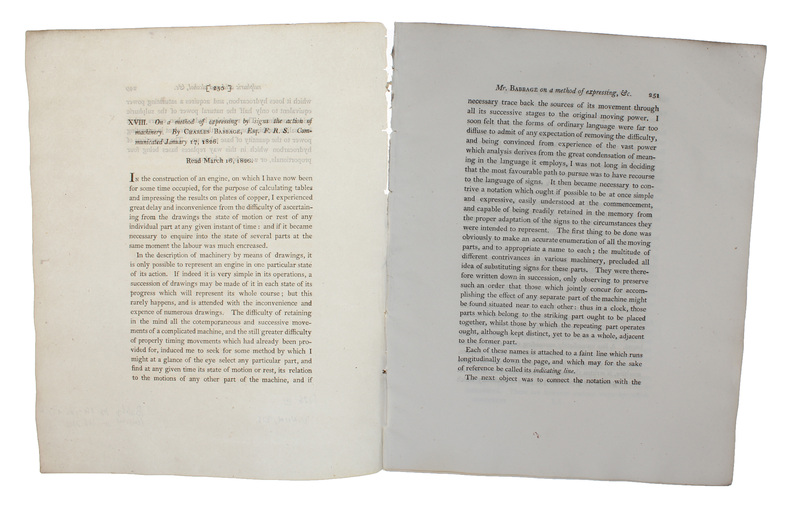
182643113London W.Nicol 1826. 4to. No wrappers as extracted from "Philosophical Transactions" 1826 - Part III. Pp. 250-265 and 4 engraved plates. Some faint dampstains to plates. One plate with a small tear no loss. the same plate some creasing at upper part verso of plate somewhat soiled. Page 261 with some marginal brownspots and some soiling. The other leaves clean and fine. <br/><br/><em>First appearance of a main paper in the history of Computing Science in which Babbage set forth some of the basic principles that guide modern computers."Babbage's first publication of his system of mechanical notation that enabled him to describe the logic and operation of his machiness on paper as they would be fabricated in metal. Babbage later stated that: "Without the aid of this language I could not have invented the Analytical Engine; nor do I belive that any machinery of equal complexity can ever be contrived without the assistance of that or of some other equivalent language. The Difference Engine No.2.is entirely described by its aid." .Babbage considered his mechanical notation system to be one of his finest inventions and thought it should be widely implemented. It was a source of frustartion to him that no other machine designerr adopted it probably because no ther engineer during Babbage's time attermpted to build machines as logically and mechanically complex as Babbage's. More than one hundred years later in the 1930s when development in logic were applied to switching systems in the earliest efforts to devwelop electromechanical calculators. Ckaude Shannon demonstrated that Boolean algebra could be applied to the same types of problems for which Babbage had designed his mechanical notation system."Hook & Norman No. 37.Together with Babbage's paper comes a paper by J.F.W. Herschel "On the parallax of the fixed stars" pp. 266-280. </em> unknown
19892081402109801058Not Available 1989. Soft Cover. Fine. Number of books: 3 Not Available paperback
Twelve volume set of graphic erotica by numerous artists bound in red leather (possibly leatherette) with embossed strip tease occurring successively on the cover of each book. Gilt lettering and numbered spine. Each book is 9 X 11 3/4 " and 240 pages with color and b&w art: mostly in comic format with some individual plates and occasional photos. Volumes #8 and 12 suffer light damage: # 8 shows a tear at the top of spine, # 12 has a chewed corner at lower back cover, damaged area about 1" . Otherwise all other volumes, all bindings, all pages are Near Fine, showing very little edge wear if at all. The set includes an advertising brochure of 16 pages with color and b&w illustrations in a loose-leaf folder as well as a copy of what appears to be a monthly "Rombaldi Club" newsletter/flyer from January 1988 (#11) that came with the monthly volume a customer subscribed to. This is on newsprint and is Fine. The collection contains more than 50 individual artists. Each volume has a theme that is introduced in a multi-page illustrated format by Jacky Goupil and then proceeds to the individual artists with an intro for each of them with biographical info, etc. Themes include Great Masters, Imagination, Bizarre, & Humor Artists include: Guido Crepax [with the work Hello Anita (1980) & Emmanuelle (1978)] Magnus [ Les 110 pilules] Milo Manara [Le declic] [Glamour book] Lucques [Zone erogne] Claeys [Whisky's dreams] Jean-Claude Servais [Yriacynthe (1980)] Leroi-Levis [Les perles de l'amour] Michel Bridenne [Saison des amours] Belom [ Et que ca saute] Lucques [Encyclopedie aphrodisiaque] Michel Pichon [Trop plein d'amour] Claude Serre [Vice compris] Gerard Lauzier [Les sextraordinaires aventures de Zizi et Peter Panpan] Maurice Sinet -- Sine [Erotissine] Tetsu [Drole de vie] Roger Brunel [Pastiches] Alain Voss [Parodies] Philippe Cavell [Fanny Hill] Alex Varenne [Carre noir sur dames blanches] Rene Giffey [Libertinage] Jean-Claude Forest [Barbarella] From the advertising brochure: Les Chefs-d'Oeuvre de la Bande Dessinee Erotique, c'est une collection aunique au monde, aussi rare que precieuse, totalement inedite. Jamais une telle collection n'a reuni un nombre aussi impressionnant de grands artistes. Veritable piece de collection-neur, elle a sa place dans la bibliotheque de tout amateur passionne et de chaque bibliophile averti. Pour cette grande collection, les Editions Rombaldi ont cree une edition pariculierement raffinee, d'une sobre elegance; reliure en Reluskin rubis jaspe, avec sure le plat, une pin-up dessinee tout specialement pour Rombadi par Milo Manara et gravee au balancier, rehussee de pates de couleurs. A fur et a mesure de la reception des volumes, vous pourrez suivre les etapes successives d'un suggestif strip-tease. Le dos de chaque volume, discret et de bon gout, permet de placer cette collection tout naturellament dans votre bibliotheque. Pages de garde noires -- 12 volumes de format 23 X 30 cm, 240 pages par volume, plus de 10,000 dessins en couleurs ou en noir et blanc, imprimes sur un beau papier. Chaque volume comporte une importante preface exclusive richement documentee, redigee par Jack Goupil, grand specialiste de la Bande Dessinee Erotique. L'ensemble de ces prefaces constituera une veritable encyclopedie de l'erotisme dessine. En outre, chaque auteur es presente en un ou deux pages: vous saurez ainse "a qui vous aves a faire! De tres nombreux artistes de renom figurent dans cette exceptionnelle collection de 12 volumes: Gerard Lauzier, Lucques, Pichon, Belom, Claude Serre, Michel Bridenne, Jean-Claude Forest, G. Levis, Georges Pichard, Milo Manara, magnus, Guido Crepax, Paul Cuvelier, Eric Stanton, Carlo, Philippe Cavell, Jim, Jean-Claude Servais, Philippe Caza, Wojtek Siudmak, Rene Giffey, Vittorio Giardino, Jean-Claude Claeys, Paul Gillon, Varenne, Aslan, Liberatore, etc. Tous les grands dessinateurs de bandes dessinees, du mone entier, y sont representes: Francais, Belges, italiens, Americaains, Espagnols, Japonais, Polonais. Text is in French. Heavy set will require extra shipping charges.
20082092902140902291Shuei Publishing Great Japan Map 2008. Soft Cover. Fine. Number of books: 40 Shuei Publishing Great Japan Map paperback
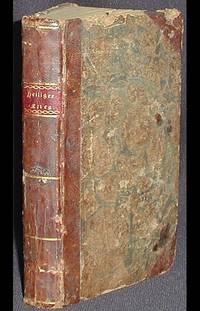
1795002473Baltimore: Samuel Saur 1795. Hardcover. Very Good -. 8 304 p.; 17 cm. Signatures: pi4 A-2B6 2C2 12mo. Contemporary half calf; red morocco spine label with gilt-tooled decoration and title: Heiliger Krieg. Marbled paper over boards. Woodcut head-pieces and tail-pieces. Evans 28371; Bötte & Tannhof First Century of German Language Printing in the U.S.A. 964. Translation of: The Holy War. "Nunmehro aber allen die lieber unter Christo ein seliges als unter dem Satan ein unseliges Leben führen wollen im Hoch-deutschen nachgeführt." Pages 198-201 are substituted for pp. 150-153 which are lacking this mistake in binding is found in some copies but not all. Errors in pagination found in all copies: pp. 97-240 are misnumbered 98-241. Errors in signing found in all copies: B3 missigned B5 L3 missigned J3 N3 missigned R5 T2 missigned T3 T3 is missigned T5 U2 is not signed and U3 is missigned U2. Small label on front free endpaper verso with initials in pencil: Mgh. Lacking frontispiece found in some copies. Otherwise in Very Good- Condition: edges are rubbed; corners bumped particularly upper front corner; leather separated for 2 cm. from tail along front joint and 1 cm. across spine; light foxing and occasional soiling throughout. A solid copy of this scarce German translation of John Bunyan's The Holy War. Samuel Saur hardcover
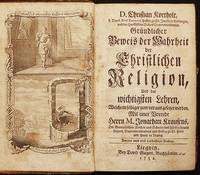
1752003364Liegnitz Legnica: David Siegert 1752. Hardcover. Very Good -. 3 titles bound together: 14 296 p.; 14 221 5 p.; 29 3 p.: 2 frontispieces both signed Boetius; 17 cm. Signatures: 8 -8 A-S8 T4; -8 A-O8 P4; A-B8 8vo. Contemporary half calf with five spine compartments between raised bands. Dark brown speckled paper over boards. Simple decorations on page edges. Woodcut head- and tail-pieces. Small inscription on front free endpaper dated 1754. Contents: 1 Kortholt Christian. Gründlicher Beweis der Wahrheit der Christlichen Religion und der Wichtigsten Lehren Welche in Selbiger zum Voraus gesetzet werden; mit einer Vorrede Herrn M. Jonathan Krausens Liegnitz: David Siegert 1752 Zweyte und viel verbesserte Auflage. 2 Sherlock Thomas. Gerichtliches Verhör der Zeugen der Auferstehung Jesu Worinnen nicht nur des berüchtigten Woolstons Einwürffe die er in seinem so genanten sechsten Discours angeführet; Sondern auch diejenigen welche so wohl er als andere in Schrifften hervor gebracht gantz unpartheyisch erwogen werden; Aus dem Englischen übersetzet; Nebst einer Vorrede von des Verfassers Leben und historischer Nachricht von Thomas Woolstons Schicksal Schriften und Streitigkeiten versehen von M. Johann Adam Schier Leipzig: J.G. Lowe 1748 Dritte und vermehrte Auflage. Former owner's name on p. 1: Wilhelm Waller. 3 Sherlock Thomas. Des Bischofs zu Londen D. Thomas Sherlocks merckwürdiges und vortreffliches Pastoral-Schreiben darinnen Er den jeziger Zeit verderbten geistlichen Zustand der Einwohner der Stadt Londen umständlich beschreibet und selbige zu einer wahren Besserung und Busse eifrig und getreulich ermahnet; Aus dem Englischen übersetzt Leipzig und Onoltzbach: Jacob Christoph Posch 1750. In Very Good- Condition: binding is rubbed; loss at ends of spine; spine and joints are cracking; stain along fore-edge of Gerichtliches Verhör title page; otherwise clean and tight. The first work Kortholt's Gründlicher Beweis der Wahrheit der Christlichen Religion is very scarce. The second and third works are very scarce translations into German of Sherlock's Tryall of the Witnesses of the Resurrection of Jesus and his Letter to the Clergy and People of London and Westminster on Occasion of the Late Earthquakes. David Siegert hardcover
186047825New York: American Bible Society 1860. Very Good. New York: American Bible Society 1860 but ca. 1861-62. First Edition. Octavo; bound in black cloth with spine stamped in gilt; edges sprayed red; new endpapers; 408pp. collated and complete. Corners bumped; minor shelfwear and rubbing; binding sound; tape remnants to front endpapers; minor creasing; a Very Good or better copy. <br /> <br /> First Edition of the first complete New Testament published in the Cherokee language. Individual books and portions had been printed from the 1820s onward primarily by Cherokee printer and journalist Elias Boudinot and missionary Samuel Worcester. This edition nearly entirely in the Cherokee alphabet with English titles at the foot of the first page of each book. Uncommon in retail. <br /> <br /> Pilling pp. 40 - 41; Darlow & Moule 2448. American Bible Society unknown
82228France 19th c. 12 x 18 inches on stiff flexible board. Generally very attractive original condition. Oblong folio. unknown
1870530Montreal 1870. About very good. 17pp. Quarto. Original plain wrappers bound into contemporary buckram gilt spine label. Light foxing and wear to buckram. Front hinge cracking front endpaper detaching. Two chips at fore-edges of final two leaves not affecting text otherwise internally clean. Accomplished in a neat legible hand. A fascinating if somewhat eccentric manuscript essay on South American linguistic history and its supposed connections to Gaelic languages by a Scottish-Canadian professor at the Presbyterian College of Montreal. John Campbell was principally a professor of church history but was also a serious student of anthropology philology and linguistics and published numerous articles and monographs on a wide variety of subjects. Campbell was born in Edinburgh and immigrated to Montreal via London and Toronto in the 1870s where he was appointed to a professorship in 1873. His wide-ranging publications include scholarly and polemical essays in various academic journals a volume of children's story sermons and a novel set in the Muskoka region of Ontario. His most well-known work was a two volume ethnographic study entitled "The Hittites" in which he claimed that the people were descendants of the Japanese Basques and Peruvians among others. "Later critics with reason considered him an academic dilettante" - Canadian Dictionary of Biography. The present work continues such grandiose thinking and claims a linguistic and genealogical link between the Aymara peoples of Peru and Bolivia and the Celts. Through the comparison of selected words in Aymara Quechua Gaelic and Welsh complete with several tables and appendices Campbell argues that "The large number of words identical in form and meaning in the two languages suffice to establish the common origin of Celts and Aymaras." The essay continues to make additional comparisons with Quechua and cites the research of Hyde Clark as the inspiration for its line of inquiry. Campbell likely prepared this essay as one of his many contributions to Canadian academic journals. In an article he published in the journal of the Royal Society of Canada at the turn of the 20th century he states that 'Some years previous I pointed out a large Celtic element in the dialects of Peru and notably in that of the Aymaras." Hyde Clark references Campbell's theories in this area in his own book "The Khita and Khita-Peruvian Epoch" published in 1877. Nevertheless we are unable to locate a published version of this essay. A strange yet enthusiastic work asserting a tenuous theory of native Peruvian language. unknown books
1871WRCAM27691Victoria: T.N. Hibben & Company 1871. 26pp. Original printed wrappers. Minor soiling to covers else very good or better. The earliest citation for the Chinook Jargon is George Gibbs' 1863 edition for the Smithsonian Institution but even there the preface cites an earlier version furnished by a B.R. Mitchell of the U.S. Navy also for the Smithsonian. The present edition is most likely a reprint of the first Hibben edition around 1871. As trading developed throughout the Pacific Northwest this little volume was in high demand. It was reprinted over fifty times this being one of the earlier editions. PILLING CHINOOKAN pp.21-23 32-33. T.N. Hibben & Company unknown books
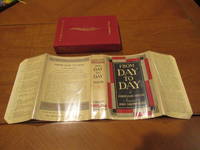
1931019569New York: The Viking Press 1931. First American Edition . Hardcover. Fine/Near Fine DJ. 292 Pp. Red Cloth. First American Edition 1931 Date On Title Page. A Fine Copy In A Lightly Used Dj No Names Or Marks No Chipping Not Price-Clipped $2.50 One 1/2 Completely Closed Tear At Edge Another 3/16". Per Wikipedia Ferdynand Goetel 1890 - 1960 Was A Polish Novelist Playwright Essayist Screen Writer And Political Activist; Member Of The Prestigious Polish Academy Of Literature From 1935; President Of The Polish Pen Club As Well As The Union Of Polish Writers In Interwar Poland. He Established A Prominent Place In Polish Literary Circles Between The Wars And Was The Recipient Of The "Golden Laurel" Awarded By The Polish Academy Of Literature For His Contributions To Polish Literature. He Was Forced To Leave Poland After World War Ii Due To His Involvement In The German Investigation Of The Katyn Massacre And Died In Exile In London. He Moved Back To Warsaw In 1912 But Was Arrested And Interned By The Russian Authorities At The Outbreak Of World War I As He Was An Austrian Citizen In Russian-Ruled Poland. The Russian Authorities Sent Him To An Internment Camp At Tashkent In Turkestan Where He Was Put To Work On Road And Bridge Construction. After The Russian Revolution He Served With The Red Army In The Caucasus For A While An Experience He Subsequently Used As The Basis For His 1922 Novel Kar Chat About The Russian Civil War In The Caucasus. In December 1919 With The Situation In Russia Deteriorating And His Newly Married Wife Jadwiga Pregnant He Decided To Make An Escape To Poland. The Journey Took The Couple Fourteen Months Via Persia Afghanistan India And England Before They Arrived Back In The Now Independent Republic Of Poland In January 1921. Goetel's Experiences In Russia Prompted Him To Become A Staunch Anti-Communist. The Events Of His Internment Exile And Escape Were Described In His Memoir Przez Plonacy Wschód Across The Burning East 1923 And In His 1929 Novel From Day To Day About The Russian Internment Camp. He Was Elected President Of The Polish Pen Club From 1926-33 And Also Served As President Of The Trade Union Of Polish Writers. In 1936 He Was Accepted As A Member Of The Polish Academy Of Literature. During The Inter-War Years Goetel Wrote A Number Of Novels And Travel Books That Were Well Received. From Day To Day Was Translated Into A Number Of Languages And Was Filmed By Józef Lejtes. He Also Wrote For The Theatre; His Play Samuel Zborowski About The 1584 Beheading Of Samuel Zborowski Was Performed In Warsaw At Teatr Polski In 1929 With Marian Jednowski In The Title Role And Kazimierz Junosza-Stepowski As King Stefan Batory. Goetel Joined The Polish Resistance Movement Armia Krajowa Ak Or Home Army In World War Ii And Was Temporarily Imprisoned In Pawiak By The Ss. He Has Sometimes Been Described As The Last Victim Of Katyn. He Was Blacklisted In Communist Poland And Driven Out Of The Country In 1945 With An Arrest Warrant Issued Against Him By The Secret Police Because The Germans Arranged For Him To Participate In The Original Katyn Delegation On Behalf Of The Ak And Also Because In His Postwar Writings He Demanded Justice For The Victims Of Katyn. Goetel Was Proposed As A Witness For The Katyn Delegation By Lawyer Ludwig Fischer The German Governor Of Warsaw But Ultimately The Polish Delegation Refused To Help The Nazi Propaganda Efforts Any Further And Secretly Informed The Polish Government-In-Exile About Their Findings. The First Arrest Warrants Against Goetel Were Issued In July 1945. For The Next Several Months He Stayed In Hiding At The Carmelites Convent In Kraków And Then In December 1945 Escaped To Italy On A False Passport. He Joined The Army Of General Anders And At The Conclusion Of World War Ii Went To London. He Lived There Until His Death In 1960. In Exile He Wrote Mostly Memoirs And Fiction Based On His Own Life Experiences. <br/> <br/> The Viking Press hardcover
2019ABE-1621427540325Max Ernst Museum 2019 RARE Moebius Edition Hardback NOW OUT OF PRINT NEW & UNREAD still sealed. The first ever Moebius retrospective in English and some German:This lavishly illustrated large format hardback retrospective has over 270 pages of the fullest and most exceptional art produced by Jean Henri Gaston Giraud. better known as the formidable Science Fiction Bandes Dessinées and Western artist Moebius. This long overdue art book contains page after page of Moebius's incredible work including production work for films such as James Cameron's 'Abyss' rarely seen artwork for the San Francisco Sony Metreon centre where four artists including Maurice Sendak were commissioned to design entire floors illustrations for a version of Dante's Divine Comedy work inspired by Salvador Dali collaborations with comic artist Geof Darrow rarely seen images of Arzach exclusive artwork for posters abstract paintings beautiful reproductions of pages from 'Inside Moebius' 'La Faune de Mars' '40 Days in the Desert' 'Blueberry' 'The Long Tomorrow' 'L'Incal' and the Hermès Collection. In short this art book is comparable only to 'Transe Forme' the book published by Fondation Cartier in 2010 which became an instant collectors item the main difference of course being that this book contains detailed essays in English. The book includes: full biography with rarely seen personal photos of Giraud's time in Mexico Venice and during his military service in Algeria. detailed bibliography section dedicated to Moebius's very own words relating to his major projects including Arzach 40 Days Self Portraits and Abstraction. a four page full colour fold-out of Moebius's mural designed for the Beffroi de Montrouge a Cultural Centre in Paris. A magnificent celebration of this major artist whose work will surely be rated above the absurdists who currently dominate ART thinking. This man has imagination enormous skill and wit. A worthy addition to any history of art. OUT OF PRINT & RARE. Special Edition. Hardcover. New. Max Ernst Museum hardcover
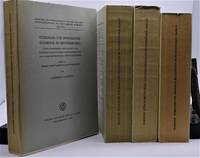
1963008958Wiesbaden Germany: Franz Steiner Verlag GMBH 1963. Published 1963-65-67-75. Four volumes in original printed wrappers text in German xlviii 557 v 671 670 640 pages. Near Fine pages uncut slight toning to spines small corner crease to wrappers. Interiors are pristine unopened and unread. SCARCE in current commerce. A heavy and bulky set they will require additional postage for priority and international mail. Please inquire. . First Edition. Printed Wrappers. Near Fine. Thick 8vo. Franz Steiner Verlag GMBH paperback books
19862081402109703570Not Available 1986. Soft Cover. Fine. The book is in fine condition. Not Available paperback
Hardcover in good condition. No jacket. First edition (1968). Text in German. Six centimetres by thirteen centimetres. A collection of slogans published for the 1968 protests of the German Student Movement. Metal binding designed for revolutionary purposes: either to tear away posters or as a weapon. 'Notwehrtauglich' sticker on front inside cover. Metal covers are marked and worn. Edges remain sharp. Page block and pages are lightly tanned and foxed. One centimetre tear on rear inside cover. Text is clear throughout. Binding is sound. HCW Used
Hardcover, complete 3-volume set, fully bound in brown leather with gilt decorations and black title pieces to spines, and page block dyed red. Text in Latin and Ancient Greek. 701, 564, 1090pp respectively. Extremely rare and rather old, these books are in good condition for their age. Leather is scuffed and scored on the front and rear boards, spine strips are chipped and flaky in places, board edges and corners are rubbed and worn. Bindings of volumes I&III are a little loose and part of the title piece of volume II has come away completely. Undated gift inscription penned to FEP of volume I, all other pages are free from any extraneous markings. Toning to page edges and foxing to internal pages. One or two pages are creased at their corners. Text remains clear and bright. AD Used
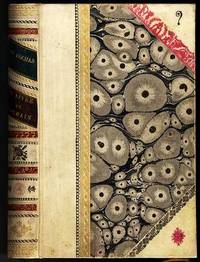
188425481Paris: Raoul Marchand. Near Fine with no dust jacket. 1884. Hardcover. French Art; FINE Binding; Decorative Binding; We fit archival quality clear acrylic covers for additional protection whenever possible. ; Color Illustrations; 8vo 8" - 9" tall; Rochas Albert de. Albert de Rochas. Le Livre De Demain. Blois: Raoul Marchand 1884. 8vo. Three-quarter decorated vellum & marbled boards. Binding lightly soiled contents about fine. Lacking 1 etching of 4 lacking 8 pages printed on gray paper includes 1 silhouette of 4. All other leaves present. #118 of 250 signed by Rochas and the Publisher. Examples of French poetry and short prose printed on 44 different types of paper in a diverse array of colors - blue aquamarine varying shades of orange yellow brown brick patterns cream-colored and others. Each portion of text surrounded by decorative border pages occasionally heightened in gold and silver various typefaces many printed in various color inks wth ornately illustrated borders. 2 photolithograph plates 4 etched plates 4 pages of chromatic circles 8 full-page silhouettes. An elegant 19th century example of the Book Arts. 11 mounted paper samples. Laid in limitation sheet bound in marker ribbons . Raoul Marchand, hardcover