658 résultats
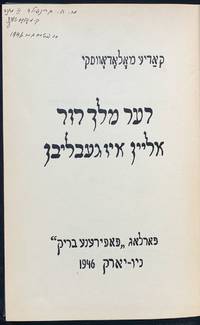
194643238New York: Papirene Brik 1946. First edition. Original boards. 8vo 156 pages 24 cm. In Yiddish. Title appears in English as “Only King David Remained.â€<br> <br> Inscribed by Molodowsky on title page in year of publication<br> <br> Early post-war book of poems by Kadya Mololdowsky that is composed of poems about the Holocaust and that “draw upon traditional Jewish literary responses to catastrophe.†Contains some of Molodowsky’s most well regarded poems.<br> <br> Kadya Molodowsky was a major figure in the Yiddish literary scene in Warsaw from the 1920s through 1935 and in New York from 1935 until her death in 1975. A teacher in the Yiddish schools in Warsaw as a young woman she was best known for her children's poems.<br> <br> In the United States she wrote for the Yiddish press and founded and edited a journal Sviva Surroundings which she published for three decades. Living in Israel 1948-52 she founded and edited a journal Heym. She published six major books of poems 1927-1965 novels short stories plays and essays. Recurrent themes in her work include the lives of Jewish women and girls Jewish tradition in the face of modernity Israel and the Holocaust.<br> <br> SUBJECTS: Yiddish poetry. David King of Israel -- Poetry. David King of Israel. Poetry. OCLC: 19314664.<br> <br> Clean copy with book stamp from “Emil Gorovets’s Library.†Very Good Condition. An attractive inscribed work by a leading female Yiddish writer. YID-48-47-LEXCCM!-’gg. New York: Papirene Brik unknown
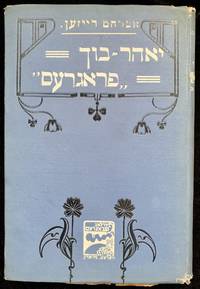
190443110Varsha Warsaw: Ferlag "Progress 1904. First edition. Original illustrated printed boards 8vo 162 32 pages plus 7 unnumbered leaves of plates with illustrations. 22 cm. In Yiddish. Title translates as “Yearbook ‘Progress’: A Journal for Literature Science and Criticism.â€<br> “Abraham Reisen was a Yiddish poet short-story writer playwright and editor…While he was still a teenager his talent was recognized by Shalom Aleichem and I.L. Peretz who arranged for the publication of his earliest poems. After some years in Minsk Warsaw Krakow and Berlin he settled permanently in New York in 1914. Influenced by Heinrich Heine whom he translated into Yiddish he was one of the first Yiddish poets to make use of folksong material. His poetry though mostly written in conventional quatrains is suffused by a refined sensibility that adumbrates the writing of Di Yunge.†Jewish Virtual Library<br> â€In 1900 Yakov Lidski founded "Progress" publishing house. Its name clearly communicated its goal. This publishing company considered to be the first to deal with modern Yiddish literature published a series of original and translated popular science books along with translated European literature and original Yiddish literature. The first editor of the publishing house was poet Avrom Reyzen.†Wikipedia. <br> SUBJECTS: Yiddish literature. Jews -- Poland -- Periodicals. OCLC: 21651882<br> Wear to spine some page separation toning and markings. About Good Condition. YID-46-28-GGLEX-’cc. Varsha [Warsaw]: Ferlag "Progress unknown
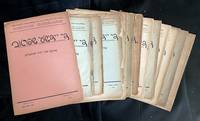
193042139Kiev: Katedr far Yidisher Kultur ba der Ukr. Visnshaftl. Akademye Filologishe Sektsye 1930. Paper Wrappers. 1st edition. Original printed publisher’s color paper wrappers 4to large ca 72-116 columns ca 36-58 pages per issue. 28 cm. In Yiddish. Title translates roughly as “The Yiddish Language.†Succeeded in 1931 by “Afn shprakhfront.â€Di Yidishe Shprakh was a “Yiddish linguistic journal published in Kiev from 1927 to 1930. A bimonthly journal Di yidishe shprakh The Yiddish Language was published by the cooperative publishing house Kultur-lige and was the main philological publication of the Kiev Yiddish academic center. Its editor was the veteran Yiddishist Nokhem Shtif a founder of YIVO who had returned to Kiev from Germany in 1926. The journal’s inaugural issue March–April 1927 was published under the auspices of the Central Yiddish Bureau of the Ukrainian Commissariat for Education. With the next issue Di yidishe shprakh was an organ of the Chair and from July to October 1929 it was an organ of the Institute for Jewish later Proletarian Jewish Culture at the Ukrainian Academy of Sciences. Initially defined as a 'journal for practical Yiddish linguistics' from May to June 1927 it appeared as simply a 'journal for Yiddish linguistics. 'Shtif distinguished three language registers: the vernacular of the old generation partly represented in the works of Sholem Aleichem and predecessors; the highbrow language of modern writers such as Dovid Bergelson; and the contemporary 'culture language' most notably of the press. Although Shtif sought to target speakers of the mass 'culture language' the journal’s circulation hovered around 500 copies read mainly by Yiddish teachers.Apart from Shtif who published articles on various language-planning problems the most active contributors to Di yidishe shprakh were Ber Slutski Ayzik Zaretski Elye Falkovitsh Lipe Reznik and Shimen Dobin. In early 1929 Moscow literary critic Aron Gurshteyn criticized the journal for its purist approach to language planning. In the July–October 1929 issue Shtif published his article 'Di sotsyale diferentsiatsye in yidish' The Social Differentiation in Yiddish heralding an intensification of Soviet linguists’ anti-Hebraist campaign. That issue of Di yidishe shprakh adopted completely reformed Soviet spelling omitting for example final consonant letters.Although the last—twenty-fifth—issue of the journal was dated November–December 1930 it included materials from the First All-Union Yiddish Language Conference convened in Kiev from 8 to 13 February 1931 that issue is present here. Published under the imprint of the Central Publishing House this issue also signaled the demise of the remaining vestiges of the Kiev Kultur-lige. Yoysef Liberberg’s article 'Far parteyishkayt in der yidisher visnshaft-arbet' For a Party Approach to Yiddish Linguistics marked a full break with YIVO scholars particularly with YIVO director Max Weinreich whom Liberberg ridiculed for presenting Yiddish as an emanation of the Ashkenazic Jews’ soul. The Yiddish Language Conference decided to change the name of the journal. Between 1931 and 1939 it appeared sporadically under the title Afn shprakhfront On the Language Front reflecting its new more aggressive and politically charged approach' Gennady Estraikh in YIVO Encyclopedia of Jews in Eastern Europe 2010. For more see David Shneer “Yiddish and the Creation of Soviet Jewish Culture 1918–1930†Cambridge and New York 2004. SUBJECTS: Yiddish language -- Periodicals. Title also listed on covers in Russian “Ievreis'ka Mova†and German “Jiddische Sprachâ€. OCLC: 22840298. Most holdings in OCLC appear to be fragmentary. Covers are browning and fragile as expected but are otherwise very well preserved with very little edgewear. Internal text pages are also toning but remain relatively strong as pulp paper. Very important journal scarce in this degree of completeness Note that Estraikh suggests a circulation of only 500!. B YID-43-5-E. Kiev: Katedr far Yidisher Kultur ba der Ukr. Visnshaftl. Akademye, Filologishe Sektsye unknown
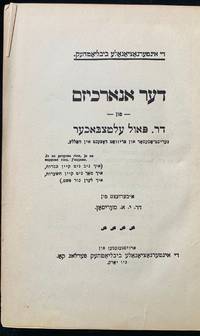
190943139New York: Internatsyonale bibliothek Verlag ko 1909. First edition. Original boards 8vo 347 pages 21 cm. In Yiddish. Title translates as “Anarchism.â€<br> Translation of Paul Eltzbacher’s “Anarchism†into Yiddish. In it he covers seven anarchist figures: Godwin Proudhon Stirner Bakunin Kropotkin Tucker and Tolstoy. Includes bibliographical references.<br> “Jacob Abraham Maryson was a Jewish–American anarchist doctor essayist and Yiddish translator. Maryson was among the few Pioneers of Liberty who could write in English. He was among the Pioneers who launched the Varhayt in 1889 the first American anarchist periodical in Yiddish….Maryson contributed to a variety of other Yiddish publications and became known as ‘the Kropotkin of the Jewish anarchist movement’. During Fraye Arbeter Shtime's hiatus in the late 1890s Maryson assisted in the cultural and literary journal Di Fraye Gezelshaft. Beginning in 1911 he edited the anarchist periodical Dos Fraye Vort. Maryson organized the Kropotkin Literary Society to print Yiddish translations of European thinkers. Maryson handled some of the group's most challenging translations including Marx's Das Kapital Stirner's The Ego and His Own and Thoreau's Civil Disobedience. He also translated John Stuart Mill's On Liberty. Maryson later wrote The Principles of Anarchism in 1935.†Wikipedia.<br> SUBJECTS: Anarchism. OCLC: 19304220<br> Very Good Condition. YID-48-3-. New York: Internatsyonale bibliothek Verlag ko unknown
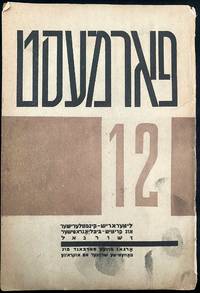
193543308Kharkov: Ukrmelukhenatsmindfarlag 1935. First edition. Original illustrated paper wrappers 8vo 156 pages.Includes illustrations. 21-23 cm. In Yiddish. Title translates roughly as “Challenge: A Literary Artistic and Critical Bibliographical Journal.â€<br> At the time the only Yiddish literary periodical in Ukraine.<br> Farmest 1933–1937 was a monthly Yiddish literary magazine published in Kharkhiv Ukraine by the Ukrainian Committee for Soviet Writers.<br> “Edited by the poet Itsik Fefer 1900–1952 it was continued in Sovetishe literatur: Literarish-kinstlerisher un kritish-bibliografisher zhurnal Soviet Literature: Literary-Artistic and Critical-Bibliographical Journal; 1938–1941.<br> In 1927 Fefer was a founding member of the Jewish Section of the All-Ukrainian Union of Proletarian Writers and from 1928 one of the editors of its Kharkov-based journal Prolit Proletarian Literature. He also coedited the nonproletarian Kharkov journal Di royte velt The Red World from 1929. From 1933 to 1937 he edited the Kiev periodical Farmest Challenge; known as Sovetishe literatur Soviet Literature between 1938 and 1941 which replaced Prolit and Di royte velt and was thereafter the only Yiddish literary periodical in Ukraine.†YIVO. Avrom Gontar was also involved in the collective and editorial committee. <br> The editor Itsik Fefer 1900–1952 “began writing poems in 1918 and in 1922 joined Vidervuks New Growth in Kiev a group of young Yiddish literati whose mentor was Dovid Hofshteyn. That same year the appearance of Fefer’s small collection Shpener Splinters established him as a rising literary star. His poetry amalgamated the Kultur-lige poets’ revolutionary romanticism with the propagandist objectives of the workers’ movement.<br> Fefer was known for his literary credo of proste reyd simple speech a concept he formulated in 1922. In the early 1920s poetry particularly avant-garde poetry swamped the literary pages of Soviet Yiddish periodicals. This phenomenon worried editors and critics who were wary of the fact that Yiddish readers usually could not identify with this style of literature. All Yiddish readers by contrast could understand Fefer’s proste reyd.<br> In 1927 Fefer was a founding member of the Jewish Section of the All-Ukrainian Union of Proletarian Writers and from 1928 one of the editors of its Kharkov-based journal Prolit Proletarian Literature. He also coedited the nonproletarian Kharkov journal Di royte velt The Red World from 1929†Gennady Estraikh.<br> For more see: Gennady Estraikh “The Kharkiv Yiddish Literary World 1920s–Mid-1930s†East European Jewish Affairs 32.2 2002: 70–88; Chone Shmeruk “Yiddish Literature in the U.S.S.R.†in The Jews in Soviet Russia since 1917 ed. Lionel Kochan pp. 242–280 London and New York 1970.<br> SUBJECTS: Yiddish literature -- Ukraine -- Periodicals. Yiddish literature. OCLC: 35051038.<br> Pages toning as expected some sunning and stains to cover Good Condition. BYID-46-2A-LGG-’excc. Kharkov: Ukrmelukhenatsmindfarlag unknown
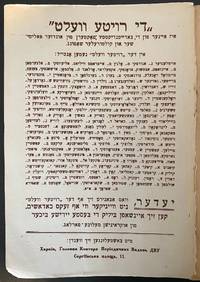
193017315Kharkov Ukraine: Ukrinishn Melukhe-Farlag 1930. 1st edition. Original Paper Wrappers lacks front wrapper 8vo 160 pages. 21 cm. In Yiddish. Di Royte Velt was a monthly Yiddish literary magazine which began publication in 1924. <br> “The Yiddish literary journal Di royte velt The Red World published in 1924-33 in Kharkiv Kharkov in Russian then the Ukrainian capital was one of the strongholds of 'anti-Litvakovism'. In general terms the story of Di royte velt represents an insightful chapter in the history of Soviet Yiddish literary life of the 1920s and 1930s.<br> In 1924 there arose the question of moving the Yiddish literary centre from Kiev to Kharkiv and of launching a Kiev-based Yiddish literary journal. This matter was discussed in a special memorandum of the Press Department of the Central Committee of the Ukrainian Communist Party. The head of the department M. Ravitsh-Cherkasky was Jewish. Motl Kiper the head of the Ukrainian Jewish Section backed this proposal arguing that Yiddish literature would benefit immensely from the capital's proletarian environment where it would liberate itself from the nationalist and Yiddishist hang-ups of Kiev.<br> In reality the Kharkiv Jewish proletariat was more acculturated than elsewhere in Ukraine: only 36 per cent of Kharkiv Region's Jewish trade unionists were Yiddish-speakers compared with 89 per cent in the Berdichev Region 55 per cent in the Kiev Region and 42 per cent in the Odessa Region.<br> It was no easy matter to create overnight a literary centre in a city which had a number of journalists but no literary lions. Moshe Taitsh for instance had been transferred to Moscow to reinforce the editorial staff of Der emes.<br> For all that the apparatchiks' initiative resulted in creating in Kharkiv a new Yiddish literary journal Di royte velt.<br> The first editors of Di royte velt were Henekh Kazakevich and M. Ravitsh-Cherkasky. While the latter was a king for a day in Yiddish literatureKazakevich was a remarkable figure in Soviet Yiddish journalism….<br> The first issue of the new journal appeared in September 1924 with a print-run of 2000. It was labelled a 'political-social literary-scientific bi-weekly journal'. Indeed the first issue contained only two literary works: a poem by Itsik Fefer and a story by Shmuel Persov. The other materials were devoted to theatre politics cosmology and literary criticism. Significantly the journal stressed its international character. <br> Among its potential contributors we find the names of the editors and writers of the New York communist Yiddish daily Frayhayt Freedom Moshe Olgin Morris Vinchevsky Shakhne Epshtein Moshe Kats and Moshe Nadir. Also it was announced that the Vilna-based Boris Kletskin publishing house was preparing for publication books by four Soviet writers listed among the journals' contributors: Arn Kushnirov Moshe Khashtshevatsky Ezra Finninberg and Nokhum Oislender†Gennady Estraikh 2002: 'The Kharkiv Yiddish literary world 1920s-mid-1930s'East European Jewish Affairs 32: 2 70 — 88; for Estraikh’s extensive discussion of the importance of Di Royte Velt see the full article at https://www.yiddishweb.com/wp-content/uploads/2018/01/Kharkiv-Yiddish_Estra ikh.pdf. <br> SUBJECTS : Yiddish literature -- Periodicals. OCLC: 10594044. <br> Lacks Yiddish cover and 1st 2 leaves. Russian cover is present. YID-47-6. Kharkov [Ukraine]: Ukrinishn Melukhe-Farlag unknown
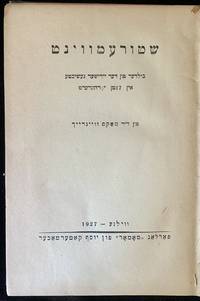
192743261Vilne: Tamar 1927. First edition. Original boards. 8vo 220 pages 21 cm. In Yiddish. Title translates as “Storm Winds: Images from Yiddish History in the 17th Century.â€<br> Max Weinreich’s historical work on Jews in Europe in the 17th Century focusing on the Chmelnitski pogroms.<br> “While Weinreich was first and foremost a linguist other topics he wrote about included psychology he translated Freud into Yiddish sociology economics theater studies literary history education ethnography and philosophy. He had a second career as a writer of popular articles in the Yiddish Forward frequently under the unlikely pseudonym Sore Brener. His linguistic interests included the history of linguistics orthography grammar he coauthored an early Yiddish grammar etymology and the etymological components of Yiddish dialectology stylistics and the influence of traditional Jewish culture in all its facets on the development of the Yiddish language.<br> In 1925 on the initiative of the linguist Nokhem Shtif the Yidisher Visnshaftlekher Institut Yiddish Research Institute; YIVO was founded in Berlin and began its work in Vilna; its first headquarters was located in a room in Weinreich’s apartment. Weinreich quickly became the driving force behind the new institute which was originally to have been known as an academy but Weinreich insisted on institute. Although YIVO may not have been Weinreich’s brainchild it was his child in every other way even after it acquired its own building on Wiwulski Street in Vilna.†<br> SUBJECTS: Jews -- Poland -- History -- Persecutions. Chmelnicki massacres. Blood accusation -- Lithuania -- Vilnius. Blood accusation. Jews -- Persecutions. History. OCLC: 649090568. OCLC lists 8 copies worldwide AJHS SUNY- Albany YIVO AJU Stanford Harvard NYBC Penn<br> Spine separation and some markings but text block is in good condition. Good Condition. Important and somewhat scarce. YID-48-62-BX'L-’emccgg. Vilne: Tamar unknown
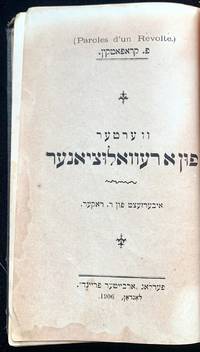
190643219London: "Arbayter fraynd 1906. First Yiddish edition. Period boards 8vo xiii 426 pages 19 cm. In Yiddish. Title translates as “Words from a Revolutionary.â€<br> Translation of “Paroles d'un re´volte´.†Includes translation of the forewords by the author and Elise´e Reclus. Includes bibliographical references.<br> “During his long exile Kropotkin wrote a series of influential works the most important being ‘Paroles d’un révolté’ 1885; “Words of a Rebelâ€.Kropotkin’s aim as he often remarked was to provide anarchism with a scientific basis. In Mutual Aid which is widely regarded as his masterpiece he argued that despite the Darwinian concept of the survival of the fittest cooperation rather than conflict is the chief factor in the evolution of species. Providing abundant examples he showed that sociability is a dominant feature at every level of the animal world. <br> Among humans too he found that mutual aid has been the rule rather than the exception. He traced the evolution of voluntary cooperation from the primitive tribe peasant village and medieval commune to a variety of modern associations—trade unions learned societies the Red Cross—that have continued to practice mutual support despite the rise of the coercive bureaucratic state. The trend of modern history he believed was pointing back toward decentralized nonpolitical cooperative societies in which people could develop their creative faculties without interference from rulers clerics or soldiers.â€<br> SUBJECTS: Anarchism. OCLC: 19303211.<br> Spine is taped.Tight binding but text block is clean and intact. Good Condition YID-48-40-LXCCGG-’e. London: "Arbayter fraynd unknown
1st edition. Original Cloth, 8vo, 480 + 380 pages. In Yiddish. The chronicle of Bialystok: basic material for the history of the Jews in Bialystok until the period after the First World War. Very Good Condition(YIZ-10-1)
1st edition. Original Cloth, 8vo, 480 + 380 pages. In Yiddish. The chronicle of Bialystok: basic material for the history of the Jews in Bialystok until the period after the First World War. OCLC: 10792576. Very Good Condition(YIZ-10-1)
1st edition. Original Cloth, 8vo, 380 pages. In Yiddish. The chronicle of Bialystok: basic material for the history of the Jews in Bialystok until the period after the First World War. Very Good Condition(YIZ-10-1A)
195715099Paris, Les Editeurs français réunis, 1957 1 volume In-8° (13,5 x 21,3 cm) Broché sous couverture au 1er plat orné d'une grande photo. 175p. Bon état.
N°141, 35è année, de septembre 1957, de la revue mensuelle "Europe". Au sommaire, dossier sur l'historien d'art Elie Faure (1873-1937); suivi d'un article sur la littérature yiddisch avec traductions de 3 poèmes de Dora TEITELBOIM et de 2 nouvelles d'E. KAGANOWSKI, d'un article sur l'auteur dramatique Louis-Benoît Picard (1769-1828) avec extraits de ses pièces, d'une nouvelle de Luc MONAY, de lettres de 1916 de Jean-Richard BLOCH, et des chroniques habituelles d'actualité. Français
1st edition. Original boards. 8vo. 32, 32, 64 pages. 24 cm. In Yiddish with some English. Title translates to The Jewish Workers Voice. Published by one of the two Jewish organizations making up the Farband. The NJWA was founded in 1912 as a Jewish mutual aid program. Its official organ was the Yidishe Kempfer or Jewish Fighter, edited by Baruch Zuckerman (Wikipedia, 2018) . SUBJECTS: Periodicals - Socialism. OCLC lists 6 copies worldwide (OCLC: 36938329) . Light wear to boards. Binding is starting. Contents very good. Original wrappers are bound in. Overall Very Good Condition. (YID-41-12)
1st edition. Original boards. 8vo. 32 pages each. 24 cm. In Yiddish with some English. Title translates to The Jewish Workers Voice. Published by one of the two Jewish organizations making up the Farband. The NJWA was founded in 1912 as a Jewish mutual aid program. Its official organ was the Yidishe Kempfer or Jewish Fighter, edited by Baruch Zuckerman (Wikipedia, 2018) . SUBJECTS: Periodicals - Socialism. OCLC lists 6 copies worldwide (OCLC: 36938329) . Light wear to boards. Contents very good. Overall Very Good Condition. (YID-41-10)
1st edition. original cloth, 8vo. 303 pages. Inscribed by author in year of publication on front end paper. Illustrated. In Yiddish. Unusual design where illustrated "cover" is instead mounted as front pastedown, as issued. SUBJECT (S) : Jews South Africa Johannesburg history; Johannesburg (South Africa) ethnic relations. lightly bumped corners, Very Good condition. (YIZ-8-4)
Original Cloth. 16mo. 180 pages. 15 cm. First edition. Inscribed by Peretz Hirschbien, Colorado, 1918; . In Yiddish. On the Morningstar, a work of drama composed by poems by Peretz Hirshbeyn (18801948) , the acclaimed playwright, novelist, journalist, travel writer, and theater director. OCLC lists 20 copies. Subjects: Yiddish Literature. Hinges starting, light stain to back page, otherwise fresh and clean. Good condition. (YID-18-5)
8vo; 424 pages; 21 cm. . In Yiddish. Special issue to "Unser Weg". "The extermination of the Jews of Kowno (Kaunas) " on copyright page. Includes index, portraits, music and 18 pages of photo plates. The US Holocaust Memorial Museum keeps their copy in their Rare Book Collection. Pages tanned. Ex-library Lacks front wrapper, but text pages and internal binding remain solid. Good condition thus (YIZ-1-3)
8vo; 424 pages; 1st edition. Original Blue CLoth21 cm. . In Yiddish. Special issue to "Unser Weg". "The extermination of the Jews of Kowno (Kaunas) " on copyright page. Includes index, portraits, music and 18 pages of photo plates. The US Holocaust Memorial Museum keeps their copy in their Rare Book Collection. Pages tanned. Very Good condition (YIZ-3-11)
8vo; 424 pages; 1st edition. Original Blue CLoth21 cm. . In Yiddish. Special issue to "Unser Weg". "The extermination of the Jews of Kowno (Kaunas) " on copyright page. Includes index, portraits, music and 18 pages of photo plates. The US Holocaust Memorial Museum keeps their copy in their Rare Book Collection. Pages tanned. Hinges starting, some wear to boards, Good condition (YIZ-3-11A)
8vo; 424 pages; 21 cm. . In Yiddish. Special issue to "Unser Weg". Errata slip inserted. "The extermination of the Jews of Kowno (Kaunas) " on copyright page. Includes index, portraits, music and 18 pages of photo plates. The US Holocaust Memorial Museum keeps their copy in their Rare Book Collection. Missing front cover. Small tears and pieces missing to back cover. Ex-library with label on spine and bookplate in back. Edgewar to title page, small tears to first 8 pages. Pages tanned. INSCRIBED BY THE AUTHOR. Backstrip missing pieces. Corner of back cover torn off, no text affected. Pages lightly tanned. Good condition. (YIZ-3-10)
1st edition. Original cloth in dust jacket. 8vo. 231 pages. Illustrated. In Yiddish. SUBJECT (S) : Jews Lithuania history; Haskalah Lithuania history. SERIES: Dos Poylishe Yidntum ; ; bd. 70; Variation: Poylishe Yidntum ; ; bd. 70. Born in Warsaw, Shatzky [1893-1956] received his doctorate in 1922 for a dissertation on 19th-century Polish-Jewish history. During World War I he served as an officer in the Polish Legion. From 1913 on he wrote Polish articles and reviews on Jewish literary and historical subjects. He came to write mainly in Yiddish after 1922, the year he settled in the U. S. Where he was one of the founders of the U. S. Section of YIVO. From 1929 until his death he was librarian of the New York State Psychiatric Institute. Shatzky's range was extraordinarily wide: Spinoza, psychiatry, theater, music, folklore, literature, language, and other areas. His principal field, however, was Eastern European Jewish history, and his major work was his history of Warsaw Jewry. He was an indefatigable and often querulous reviewer of scholarly works; the quality and accuracy of his own historical scholarship has often been questioned. (Prager, EJ) Has tanned dust jacket and sewn in ribbon bookmark. Very good condition in good jacket. (YIZ-8-5)
1st edition. Original cloth in dust jacket. 8vo. 231 pages. Illustrated. In Yiddish. SUBJECT (S) : Jews Lithuania history; Haskalah Lithuania history. SERIES: Dos Poylishe Yidntum ; ; bd. 70; Variation: Poylishe Yidntum ; ; bd. 70. Born in Warsaw, Shatzky [1893-1956] received his doctorate in 1922 for a dissertation on 19th-century Polish-Jewish history. During World War I he served as an officer in the Polish Legion. From 1913 on he wrote Polish articles and reviews on Jewish literary and historical subjects. He came to write mainly in Yiddish after 1922, the year he settled in the U. S. Where he was one of the founders of the U. S. Section of YIVO. From 1929 until his death he was librarian of the New York State Psychiatric Institute. Shatzky's range was extraordinarily wide: Spinoza, psychiatry, theater, music, folklore, literature, language, and other areas. His principal field, however, was Eastern European Jewish history, and his major work was his history of Warsaw Jewry. He was an indefatigable and often querulous reviewer of scholarly works; the quality and accuracy of his own historical scholarship has often been questioned. (Prager, EJ) Has tanned dust jacket and sewn in ribbon bookmark. Very good condition in very good jacket. A gorgeous copy (YIZ-8-5) x
1st edition. Original publisher's cloth, large 8vo, 652 pages. Includes illustrations, facsimiless, portraits; 25 cm. In Yiddish. SUBJECT (S) : Jews -- Poland -- Luków (Siedlce) Holocaust, Jewish (1939-1945) . Added title page: "Sefer Lukow. " Partly also in Hebrew. Includes bibliographical references (p. 56-57) . OCLC lists 11 copies worldwide. Inside hinges repaired Good Condition. (YIZ-6-11) xx
1st edition. Original publisher's cloth, large 8vo, 652 pages. Includes illustrations, facsimiless, portraits; 25 cm. In Yiddish. SUBJECT (S) : Jews -- Poland -- Luków (Siedlce) Holocaust, Jewish (1939-1945) . Added title page: "Sefer Lukow. " Partly also in Hebrew. Includes bibliographical references (p. 56-57) . OCLC lists 11 copies worldwide. wear and some discoloration to boards, Good Condition. (YIZ-6-12) xx