658 résultats
1st edition. Original paper wrappers. 8vo. 63, 47, 48 , 133 pages, 27 cm. In Yiddish. Title translates to Chicago: A Literary Monthly Journal. SUBJECTS: Yiddish - periodicals. OCLC lists 9 copies worldwide (OCLC: 34385123) . Light edge wear to wrappers and some chipping. Front wrapper repaired for May 1932 issue. Some pencil markings. Pages browning. Overall Very Good Condition. (YID-40-80)
Buenos Ayres [Buenos Aires]: Farlag Perl, 1942. Paper Wrappers, 8vo, 80 pages. Yiddish Monthly. Anthology of articles on ancient and modern Judaism. Continued on into at least 1971 (we located an issue Nr. 343) SUBJECT(S) : Judaism -- Periodicals. Jews -- Periodicals. OCLC lists 7 holdings worldwide. Paper browning at edges, otherwise Very Good Condition. (Y-44)
IN HEBREW AND YIDDISH. 28x22.5 cm. 505 pages. Gilt hardcover. Cover slightly rubbed. Ex library copy with usual marks. Else in good condition.
RARE! A tri-lingual edition of the Passover Haggadah from the 1930s, with numerous traditional and modern b/w illustrations and a colorful illustrated cover. 245x190mm, 62 unnumbered pages. Illustrated softcover. Cover worn and slightly stained. Cover edges slightly torn. Spine torn and mostly missing; front cover taped to back cover. Binding loose. Pages detached. Pages browning and slightly bumped at edges. Despite the aforementioned wear, this rare Haggadah from the vibrant Jewish community of interbellum Warsaw is in good condition for reading.
225X150, soft cover, edges are torn, aging stains on cover, yellowing pages, else in fair+ condition.
225x150, soft cover, worn and yellowing cover, yellowing pages, dedication on first page, else in fair++ condition.
225x150, soft cover, worn and yellowing cover, yellowing pages, else in fair++ condition.
225x155, soft cover, worn cover and spine, cover with aging stains, front cover has a tear, yellowing pages, else in fair+ condition.
Varshe [Warsaw]: Farlag "di Velt", 1928. Paper Wrappers, 8vo, 95 pages. Monthly Bundist periodical ran from Vol. I, Nr, 1 (Oct. 1927) to 1932. 23 cm. In Yiddish. Unobtrusive Bund rubber stamp on some volumes. For example, Levin (1977) reports that it was in UNZER TSAYT that the very first reports of the Bund's split over the National Question with the Russian Social Democrats were published (in 1927). The Bund in Poland, here providing its unique Polish Jewish Socialist anti-Zionist perspective. The General Jewish Labour Bund in Lithuania, Poland and Russia (Yiddish: algemeyner yidisher arbeter-bund in lite, poyln un rusland), generally called The Bund or the Jewish Labour Bund, was a secular Jewish socialist party.... founded in Vilnius on October 7, 1897 ..In 1917 the Polish part of the Bund, which dated to the times when Poland was a Russian territory, seceded from the Russian Bund and created a new Polish General Labor Bund which continued to operate in Poland in the years between the two world wars .The Bund sought to unite all Jewish workers in the Russian Empire into a united socialist party, and also to ally itself with the wider Russian social democratic movement to achieve a democratic and socialist Russia. The Russian Empire then included Lithuania, Latvia, Belarus, Ukraine and most of present-day Poland, areas where the majority of the world's Jews then lived. They hoped to see the Jews achieve a legal minority status in Russia. Of all Jewish political parties of the time, the Bund was the most progressive regarding gender equality, with women making up more than one-third of all members. The Bund actively campaigned against anti-Semitism. It defended Jewish civil and cultural rights and rejected assimilation. However, the close promotion of Jewish sectional interests and support for the concept of Jewish national unity (klal yisrael) was prevented by the socialist universalism of the Bund. The Bund avoided any automatic solidarity with Jews of the middle and upper classes and generally rejected political cooperation with Jewish groups that held religious, Zionist or conservative views. Even the anthem of the Bund, known as "the oath" (di shvue in Yiddish), written in 1902 by Sh. An-ski, contained no explicit reference to Jews or Jewish suffering. At the heart of the vision of the future of the Bund was the idea that there is no contradiction between the national aspect on the one hand and the socialist aspect on the other. As a strictly secular organization, the Bund renounced the Holy Land and the sacred language (Hebrew) and chose to speak Yiddish .In its early years the Bund had remarkable success, gaining an estimated 30,000 members in 1903 and an estimated 40,000 supporters in 1906, making it the largest socialist group in the Russian Empire . the Bund was a founding collective member at the RSDLP's first congress in Minsk in March 1898. For the next 5 years, the Bund was recognized as the sole representative of the Jewish workers in the RSDLP, although many Russian socialists of Jewish descent, especially outside of the Pale of Settlement, joined the RSDLP directly .The Bund generally sided with the party's Menshevik faction led by Julius Martov and against the Bolshevik faction led by Vladimir Lenin during the factional struggles in the run-up to the Russian Revolution of 1917 .In the Polish areas of the [Russian] empire, the Bund was a leading force in the 1905 revolution. At that time the organization probably reached the height of its influence. It called for an improvement in living standards, a more democratic political system and the introduction of equal rights for Jews. At least in the early stages of the first Russian Revolution, the armed groups of the "Bund" were likely the strongest revolutionary force in Western Russia. During the following years, the Bund went into a period of decay .The Bund eventually came to strongly oppose Zionism, arguing that emigration to Palestine was a form of escapism. The Bund did not advocate separatism. Instead, it focused on culture, rather than a state or a place, as the glue of Jewish nationalism. . The Bund also promoted the use of Yiddish as a Jewish national language and to some extent opposed the Zionist project of reviving Hebrew. The Bund won converts mainly among Jewish artisans and workers, but also among the growing Jewish intelligentsia. It led a trade union movement of its own. It joined with the Poalei Zion (Labour Zionists) and other groups to form self-defense organisations to protect Jewish communities against pogroms and government troops. During the Russian Revolution of 1905 the Bund headed the revolutionary movement in the Jewish towns, particularly in Belarus and Ukraine ..In 1921, the Communist Bund [in the USSR] dissolved itself and its members sought admission to the Communist Party....Many former Bundists, like Mikhail Liber and David Petrovsky, perished during Stalin's purges in the 1930s. The Polish Bundists continued their activities until 1948. During the latter half of the 20th century the Bundist legacy was represented through the International Jewish Labor Bund, a federation of local Bundist groups around the world .Among the exiled Bundists who went on with Socialist politics in America was Baruch Charney Vladeck (18861938), elected to the New York Board of Aldermen as a Socialist in 1917 [and] 1937 [and] manager of The Jewish Daily Forward Moishe Lewis (18881950)....the father of David Lewis (19091981), a leader of the New Democratic Party in Canada .David Dubinsky (18921982), though never formally a member of the party, had joined the bakers' union, which was controlled by the Bund, and was elected assistant secretary within the union by 1906 ..He later became a member of the Socialist Party of America, helped found the American Labor Party in 1936 and was from 1932 till 1966 the leader of the International Ladies' Garment Workers' Union ..under the name Max Goldfarb, David Petrovsky (18861937) was a member of the Central Committee of the Jewish Socialist Federation of America, a member of the Socialist Party of America, and the labor editor of The Forward (Wikipedia). SUBJECT(S) : Jews -- Poland -- Periodicals. Jewish labor unions -- Periodicals. Socialism and Judaism -- Periodicals. Yiddish literature -- Poland -- Periodicals. OCLC Number: 642969688. OCLC lists only 4 runs (Arizona State, Stanford, LOC, U of Washington), all of which appear to be incomplete. Nr. 3-4 was printed as Nr. 3 (Dec. 15, 1927), but then has Nr. 4 (Dec. 20, 1927) on a superimposed lable--not sure if Nr. 3 actually existed or in what form. Interestingly, evey copy of this issue that we have ever seen has had pages 1-6 removed, perhaps by the publisher and related to the re-issuing as a later number. We offer pages 1-6 here in facimile. Good Condition. (Y-1-10) xx
Original Paper Wrappers, 8vo, ca. 100 pages. Monthly Bundist periodical ran from Vol. I, Nr, 1 (Oct. 1927) to 1932. 23 cm. In Yiddish. Unobtrusive Bund rubber stamp. Levin (1977) reports that it was in UNZER TSAYT that the very first reports of the Bund's split over the National Question with the Russian Social Democrats were published (in 1927). The Bund in Poland, here providing its unique Polish Jewish Socialist anti-Zionist perspective. The General Jewish Labour Bund in Lithuania, Poland and Russia (Yiddish: algemeyner yidisher arbeter-bund in lite, poyln un rusland), generally called The Bund or the Jewish Labour Bund, was a secular Jewish socialist party.... founded in Vilnius on October 7, 1897 ..In 1917 the Polish part of the Bund, which dated to the times when Poland was a Russian territory, seceded from the Russian Bund and created a new Polish General Labor Bund which continued to operate in Poland in the years between the two world wars .The Bund sought to unite all Jewish workers in the Russian Empire into a united socialist party, and also to ally itself with the wider Russian social democratic movement to achieve a democratic and socialist Russia. The Russian Empire then included Lithuania, Latvia, Belarus, Ukraine and most of present-day Poland, areas where the majority of the world's Jews then lived. They hoped to see the Jews achieve a legal minority status in Russia. Of all Jewish political parties of the time, the Bund was the most progressive regarding gender equality, with women making up more than one-third of all members. The Bund actively campaigned against anti-Semitism. It defended Jewish civil and cultural rights and rejected assimilation. However, the close promotion of Jewish sectional interests and support for the concept of Jewish national unity (klal yisrael) was prevented by the socialist universalism of the Bund. The Bund avoided any automatic solidarity with Jews of the middle and upper classes and generally rejected political cooperation with Jewish groups that held religious, Zionist or conservative views. Even the anthem of the Bund, known as "the oath" (di shvue in Yiddish), written in 1902 by Sh. An-ski, contained no explicit reference to Jews or Jewish suffering. At the heart of the vision of the future of the Bund was the idea that there is no contradiction between the national aspect on the one hand and the socialist aspect on the other. As a strictly secular organization, the Bund renounced the Holy Land and the sacred language (Hebrew) and chose to speak Yiddish .In its early years the Bund had remarkable success, gaining an estimated 30,000 members in 1903 and an estimated 40,000 supporters in 1906, making it the largest socialist group in the Russian Empire . the Bund was a founding collective member at the RSDLP's first congress in Minsk in March 1898. For the next 5 years, the Bund was recognized as the sole representative of the Jewish workers in the RSDLP, although many Russian socialists of Jewish descent, especially outside of the Pale of Settlement, joined the RSDLP directly .The Bund generally sided with the party's Menshevik faction led by Julius Martov and against the Bolshevik faction led by Vladimir Lenin during the factional struggles in the run-up to the Russian Revolution of 1917 .In the Polish areas of the [Russian] empire, the Bund was a leading force in the 1905 revolution. At that time the organization probably reached the height of its influence. It called for an improvement in living standards, a more democratic political system and the introduction of equal rights for Jews. At least in the early stages of the first Russian Revolution, the armed groups of the "Bund" were likely the strongest revolutionary force in Western Russia. During the following years, the Bund went into a period of decay .The Bund eventually came to strongly oppose Zionism, arguing that emigration to Palestine was a form of escapism. The Bund did not advocate separatism. Instead, it focused on culture, rather than a state or a place, as the glue of Jewish nationalism. . The Bund also promoted the use of Yiddish as a Jewish national language and to some extent opposed the Zionist project of reviving Hebrew. The Bund won converts mainly among Jewish artisans and workers, but also among the growing Jewish intelligentsia. It led a trade union movement of its own. It joined with the Poalei Zion (Labour Zionists) and other groups to form self-defense organisations to protect Jewish communities against pogroms and government troops. During the Russian Revolution of 1905 the Bund headed the revolutionary movement in the Jewish towns, particularly in Belarus and Ukraine ..In 1921, the Communist Bund [in the USSR] dissolved itself and its members sought admission to the Communist Party....Many former Bundists, like Mikhail Liber and David Petrovsky, perished during Stalin's purges in the 1930s. The Polish Bundists continued their activities until 1948. During the latter half of the 20th century the Bundist legacy was represented through the International Jewish Labor Bund, a federation of local Bundist groups around the world .Among the exiled Bundists who went on with Socialist politics in America was Baruch Charney Vladeck (18861938), elected to the New York Board of Aldermen as a Socialist in 1917 [and] 1937 [and] manager of The Jewish Daily Forward Moishe Lewis (18881950)....the father of David Lewis (19091981), a leader of the New Democratic Party in Canada .David Dubinsky (18921982), though never formally a member of the party, had joined the bakers' union, which was controlled by the Bund, and was elected assistant secretary within the union by 1906 ..He later became a member of the Socialist Party of America, helped found the American Labor Party in 1936 and was from 1932 till 1966 the leader of the International Ladies' Garment Workers' Union ..under the name Max Goldfarb, David Petrovsky (18861937) was a member of the Central Committee of the Jewish Socialist Federation of America, a member of the Socialist Party of America, and the labor editor of The Forward (Wikipedia). SUBJECT(S) : Jews -- Poland -- Periodicals. Jewish labor unions -- Periodicals. Socialism and Judaism -- Periodicals. Yiddish literature -- Poland -- Periodicals. OCLC Number: 642969688. OCLC lists only 4 runs (Arizona State, Stanford, LOC, U of Washington), all of which appear to be incomplete. Use wear, paper brwoning but not fragile. Good Condition. (y-1-11)
Original Paper Wrappers, 8vo, ca. 100 pages. Monthly Bundist periodical ran from Vol. I, Nr, 1 (Oct. 1927) to 1932. 23 cm. In Yiddish. Unobtrusive Bund rubber stamp. Levin (1977) reports that it was in UNZER TSAYT that the very first reports of the Bund's split over the National Question with the Russian Social Democrats were published (in 1927). The Bund in Poland, here providing its unique Polish Jewish Socialist anti-Zionist perspective. The General Jewish Labour Bund in Lithuania, Poland and Russia (Yiddish: algemeyner yidisher arbeter-bund in lite, poyln un rusland), generally called The Bund or the Jewish Labour Bund, was a secular Jewish socialist party.... founded in Vilnius on October 7, 1897 ..In 1917 the Polish part of the Bund, which dated to the times when Poland was a Russian territory, seceded from the Russian Bund and created a new Polish General Labor Bund which continued to operate in Poland in the years between the two world wars .The Bund sought to unite all Jewish workers in the Russian Empire into a united socialist party, and also to ally itself with the wider Russian social democratic movement to achieve a democratic and socialist Russia. The Russian Empire then included Lithuania, Latvia, Belarus, Ukraine and most of present-day Poland, areas where the majority of the world's Jews then lived. They hoped to see the Jews achieve a legal minority status in Russia. Of all Jewish political parties of the time, the Bund was the most progressive regarding gender equality, with women making up more than one-third of all members. The Bund actively campaigned against anti-Semitism. It defended Jewish civil and cultural rights and rejected assimilation. However, the close promotion of Jewish sectional interests and support for the concept of Jewish national unity (klal yisrael) was prevented by the socialist universalism of the Bund. The Bund avoided any automatic solidarity with Jews of the middle and upper classes and generally rejected political cooperation with Jewish groups that held religious, Zionist or conservative views. Even the anthem of the Bund, known as "the oath" (di shvue in Yiddish), written in 1902 by Sh. An-ski, contained no explicit reference to Jews or Jewish suffering. At the heart of the vision of the future of the Bund was the idea that there is no contradiction between the national aspect on the one hand and the socialist aspect on the other. As a strictly secular organization, the Bund renounced the Holy Land and the sacred language (Hebrew) and chose to speak Yiddish .In its early years the Bund had remarkable success, gaining an estimated 30,000 members in 1903 and an estimated 40,000 supporters in 1906, making it the largest socialist group in the Russian Empire . the Bund was a founding collective member at the RSDLP's first congress in Minsk in March 1898. For the next 5 years, the Bund was recognized as the sole representative of the Jewish workers in the RSDLP, although many Russian socialists of Jewish descent, especially outside of the Pale of Settlement, joined the RSDLP directly .The Bund generally sided with the party's Menshevik faction led by Julius Martov and against the Bolshevik faction led by Vladimir Lenin during the factional struggles in the run-up to the Russian Revolution of 1917 .In the Polish areas of the [Russian] empire, the Bund was a leading force in the 1905 revolution. At that time the organization probably reached the height of its influence. It called for an improvement in living standards, a more democratic political system and the introduction of equal rights for Jews. At least in the early stages of the first Russian Revolution, the armed groups of the "Bund" were likely the strongest revolutionary force in Western Russia. During the following years, the Bund went into a period of decay .The Bund eventually came to strongly oppose Zionism, arguing that emigration to Palestine was a form of escapism. The Bund did not advocate separatism. Instead, it focused on culture, rather than a state or a place, as the glue of Jewish nationalism. . The Bund also promoted the use of Yiddish as a Jewish national language and to some extent opposed the Zionist project of reviving Hebrew. The Bund won converts mainly among Jewish artisans and workers, but also among the growing Jewish intelligentsia. It led a trade union movement of its own. It joined with the Poalei Zion (Labour Zionists) and other groups to form self-defense organisations to protect Jewish communities against pogroms and government troops. During the Russian Revolution of 1905 the Bund headed the revolutionary movement in the Jewish towns, particularly in Belarus and Ukraine ..In 1921, the Communist Bund [in the USSR] dissolved itself and its members sought admission to the Communist Party....Many former Bundists, like Mikhail Liber and David Petrovsky, perished during Stalin's purges in the 1930s. The Polish Bundists continued their activities until 1948. During the latter half of the 20th century the Bundist legacy was represented through the International Jewish Labor Bund, a federation of local Bundist groups around the world .Among the exiled Bundists who went on with Socialist politics in America was Baruch Charney Vladeck (18861938), elected to the New York Board of Aldermen as a Socialist in 1917 [and] 1937 [and] manager of The Jewish Daily Forward Moishe Lewis (18881950)....the father of David Lewis (19091981), a leader of the New Democratic Party in Canada .David Dubinsky (18921982), though never formally a member of the party, had joined the bakers' union, which was controlled by the Bund, and was elected assistant secretary within the union by 1906 ..He later became a member of the Socialist Party of America, helped found the American Labor Party in 1936 and was from 1932 till 1966 the leader of the International Ladies' Garment Workers' Union ..under the name Max Goldfarb, David Petrovsky (18861937) was a member of the Central Committee of the Jewish Socialist Federation of America, a member of the Socialist Party of America, and the labor editor of The Forward (Wikipedia). SUBJECT(S) : Jews -- Poland -- Periodicals. Jewish labor unions -- Periodicals. Socialism and Judaism -- Periodicals. Yiddish literature -- Poland -- Periodicals. OCLC Number: 642969688. OCLC lists only runs (Arizona State, Stanford, LOC, U of Washington), all of which appear to be incomplete. Very light wear, a beautiful set! Very Good Condition. (Y-1-12) xx
Original boards. 8vo; 53, 75 pages; Some text in English, some in Yiddish. Nice book Co-sponsored by the Emma Lazarus Federation, the Furrier Joint Council of N. Y. & the Joint Board of the Fur Dressers & Dyers Unions. Bumps to edges. Very Good Condition. (HOLO2-127-6)
IN ENGLISH AND YIDDISH. 25.5x17 cm. 65+107 pages. Softcover. Cover and spine slightly yellowing and rubbed. Spine slightly worn. Binding slightly visible between few pages. Pencil inscription on few pages - NO damage to text. PAGES 31-32 MISSING! Else in good condition.
1st edition. Original boards. 8vo. 80 pages, includes maps, 22 cm. In Yiddish. Title translates to Jews after the War: Report from the First Conference of the Jewish Labor Committee. The Jewish Labor Committee was founded in 1934 in response to the rise of Nazism in Europe. Today, it works to maintain and strengthen the historically strong relationship between the American Jewish community and the trade union movement, and to promote what they see as the shared social justice agenda of both communities (Wikipedia, 2018). OCLC 937355974.SUBJECTS: Holocaust Reconstruction (1939-1951) -- Jews. Very Good Condition. (YID-40-84)
Varsha [i. E. Warsaw] & Paris: Tsukunft, 1946-49. Paper Wrappers, 4to (tabloid format) , 24 pages each issue. Many issues include photos or illustrations on cover. This Yiddish Socialist bi-monthly newspaper for Young people ran from Dec. 1, 1922 until sometime in 1949, in various formats at different times. Very interesting vision of a postwar world of Jewish Socialism by the surviving rememnant in Poland, clearly expressing the Bund position of Dokeit ("thereness") , remaining to build Jewish life within a socialist framework with other nationalities, rather than Zionism; this even on Polish soil in the immediate of the aftermath of the Shoah. SUBJECT(S) : Jewish socialists -- Poland -- Periodicals. Jewish youth -- Poland -- Periodicals. Jews -- Poland -- Periodicals. OCLC lists only 1 holding (NYPL) . Newsprint, so paper is brown, but for the most part very solid. What wear there is is at the extreme margins, with, no text loss (Y-28A)
Varsha [i. E. Warsaw]: Tsukunft, 1946. Paper Wrappers, 4to (tabloid format) , 24 pages. Photos on cover. This Yiddish Socialist bi-monthly newspaper for Young people ran from Dec. 1, 1922 until sometime in 1948, in various formats at different times. Very interesting vision of a postwar world of Jewish Socialism by the surviving rememnant in Poland, clearly expressing the Bund position of Dokeit ("thereness") , remaining to build Jewish life within a socialist framework with other nationalities, rather than Zionism; this even on Polish soil in the immediate of the aftermath of the Shoah. SUBJECT(S) : Jewish socialists -- Poland -- Periodicals. Jewish youth -- Poland -- Periodicals. Jews -- Poland -- Periodicals. OCLC lists only 1 holding (NYPL) . Newsprint, so paper is brown, but for the most part very solid. What wear there is is at the extreme margins, with, no text loss (Y-28A)
Varsha [i. E. Warsaw] & Paris: Tsukunft, 1946-49. Paper Wrappers, 4to (tabloid format) , 24 pages each issue. Many issues include photos or illustrations on cover. This Yiddish Socialist bi-monthly newspaper for Young people ran from Dec. 1, 1922 until sometime in 1948, in various formats at different times. Very interesting vision of a postwar world of Jewish Socialism by the surviving rememnant in Poland, clearly expressing the Bund position of Dokeit ("thereness") , remaining to build Jewish life within a socialist framework with other nationalities, rather than Zionism; this even on Polish soil in the immediate of the aftermath of the Shoah. 1946 saw only one issue, as reflected by the running issue numbers, in paranteses following the issue number for 1947, above. SUBJECT(S) : Jewish socialists -- Poland -- Periodicals. Jewish youth -- Poland -- Periodicals. Jews -- Poland -- Periodicals. OCLC lists only 1 holding (NYPL) . Newsprint, so paper is brown, but for the most part very solid. What wear there is is at the extreme margins, with, no text loss (Y-28A) Price per issue
Varsha [i. E. Warsaw]: Di Welt, 1925-26. Paper Wrappers, 8vo (pamphlet format) , ca. 36 pages each issue. This Yiddish Socialist Monthly/Semimonthly magazine for Young people ran from Dec. 1, 1922 until sometime in 1948. In addition to these issues from 1925-26 out of Warsaw, the journal was later published instead in Lodz and Paris, and was edited, in succession, by L. Hechtman, J. Mendelsohn, J. Gutgold, & L. Blit. SUBJECT(S) : Jewish socialists -- Poland -- Periodicals. Jewish youth -- Poland -- Periodicals. Jews -- Poland -- Periodicals. OCLC lists only 1 holding (NYPL) . Very Good Condition. (Y-27) Price is per issue
Varsha [i. E. Warsaw]: Di Welt, 1927-37. Paper Wrappers or Cloth, 4to (tabloid format) , 16 pages each issue. Partially Bound in Cloth. Many with photos or Socialist Realism illustrations on cover. This Yiddish Socialist bi-monthly newspaper for Young people ran from Dec. 1, 1922 until sometime in 1948, in various formats at different times. In addition to these issues from 1922-1937 out of Warsaw, the journal was later published instead in Lodz and Paris, and was edited, in succession, by L. Hechtman, J. Mendelsohn, J. Gutgold, & L. Blit. Issues present here are: 1927 [1(38) - 24(60) ]; 1928[1(61) - 24(84) ]; 1929 [ 2(86) -5(89) , 7(91) -10(94) , 12(96) , 13(97) , 16(100) , 18(102) , 19(103) , 21(105) , 22(106) , 25(109) ]; 1930 [2(111) -14(123) , 20(129) ]; 1934 [21(232) ]; 1931[7 (141) , 16(15) , 17(151) ]; 1937[6 (299) ]. SUBJECT(S) : Jewish socialists -- Poland -- Periodicals. Jewish youth -- Poland -- Periodicals. Jews -- Poland -- Periodicals. OCLC lists only 1 holding (NYPL) . Bound volume (1927-1928) has heavily worn boards. All are printed on newsprint, so paper is brown, sometimes fragile, sometimes not, generally not split at the binding but sometimes so. In any case, all wear is at the extreme margins, with, remarkably, no text loss whatsoever. (Y-28)
Varsha [i. E. Warsaw]: Di Welt, 1922. Paper Wrappers, 4to (tabloid format) , 16 pages. This Yiddish Socialist bi-monthly newspaper for Young people ran from Dec. 1, 1922 until sometime in 1948, in various formats at different times. The journal was later published in Lodz and Paris, and was edited, in succession, by L. Hechtman, J. Mendelsohn, J. Gutgold, & L. Blit. SUBJECT(S) : Jewish socialists -- Poland -- Periodicals. Jewish youth -- Poland -- Periodicals. Jews -- Poland -- Periodicals. OCLC lists only 1 holding (NYPL) . Newsprint, so paper is brown & fragile, butall wear is at the extreme margins, with, remarkably, no text loss whatsoever. (Y-28)
Nrs. 75(1928, Nr. 15); 92 (1929, Nr 8), 103 (1929, Nr. 19), 105 (1929, Nr. 21), 106 (1929, Nr. 22), 112 (1930, Nr 3), 114 (1930, Nr. 5), 115 (1930, Nr. 6), 118 (1930, Nr. 9), 119 (1930, Nr. 10), 120 (1930, Nr. 11), & 129 (1930, Nr. 20). Varsha [i. E. Warsaw]: Di Welt, 1929-30. Paper Wrappers, 4to (tabloid format) , 16 pages each issue. Many with photos or Socialist Realism illustrations on cover. This Yiddish Socialist bi-monthly newspaper for Young people ran from Dec. 1, 1922 until sometime in 1948, in various formats at different times. In addition to these issues from 1929-1930 out of Warsaw, the journal was later published in Lodz and Paris, and was edited, in succession, by L. Hechtman, J. Mendelsohn, J. Gutgold, & L. Blit. Issues present here are: SUBJECT(S) : Jewish socialists -- Poland -- Periodicals. Jewish youth -- Poland -- Periodicals. Jews -- Poland -- Periodicals. OCLC lists only 1 holding (NYPL) . Newsprint, so paper is brown, but solid, not split at the binding. In any case, all wear is at the extreme margins, with, remarkably, no text loss whatsoever. Good Condition(Y-28) . Price is per issue
a61093London 1904-1905. 45 issues of thisYiddish anarchist weekly bound in one volume. 4to. about 370pp. hardcover with new paper spine. Good corners of the binding are worn. The leaves are browned and a bit fragile. Issues 46 47 and 48 are chipped at the top corner with some loss of text all other issues are intact. Very scarce. hardcover
Milano, Rizzoli, 1990, 16mo (cm. 18 x 11) brossura con copertina illustrata a colori, pp. 184 (I classici BUR, 763). Firma di possesso.
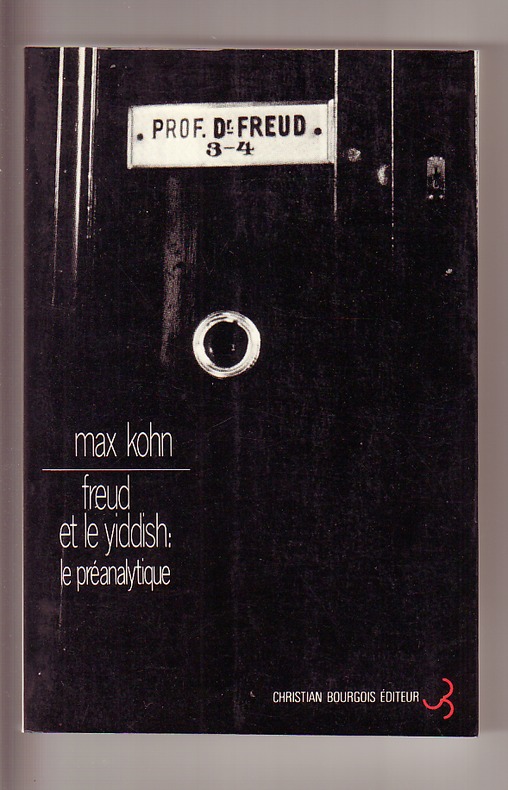
1982PSYCHAAAAHH0320Paris, Christian Bourgois éditeur, 1982, 13 x 20, 382 pages cousues sous couverture rempliée illustrée.