63 résultats
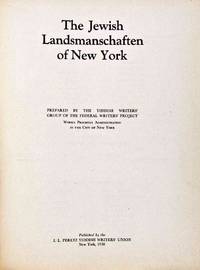
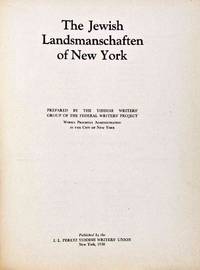
193842985Nyu York New York: Aroysgegeben fun Y.L. Perets shrayber fareyn 1938. First edition. Original printed leather binding 4to 397 3 pages. Includes illustrations and facsimiles. 29 cm. In Yiddish. Title translates as “The Jewish Mutual Aid Societies of New York.â€<br> Research project led by the Works Progress Administration which contains articles about the history and activities of Jewish mutual aid societies in New York. Contains reviews of landmanshaft publications as well as a directory of all landsmanshaftn in the New York. <br> “Landsmanshaftn are societies formed by Jewish immigrants from the same villages towns and cities in Central and Eastern Europe. The landsmanshaft became a dominant form of Jewish social organization in the late 1800s. The many types of landsmanshaftn include religious and socialist organizations as well as American-style fraternal orders. Landsmanshaftn provided immigrants with formal and informal social networks and members helped one another with financial needs such as medical care and burial plots. In 1938 a Federal Works Progress Administration WPA project identified 2468 landsmanshaftn in New York City. The number of landsmanshaftn began to decline in the 1950s though some societies continue to exist today.†Center for Jewish History<br> SUBJECTS: Jews -- New York State -- New York. Fraternal organizations -- New York State -- New York. Jews. OCLC: 1018012020.<br> Wear to spine and inside hinges Good Condition. YIZ-23-32S-CCLEX. Nyu York [New York]: Aroysgegeben fun Y.L. Perets shrayber fareyn unknown
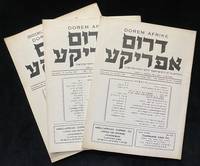
199042134Yohanesburg Johannesburg South Africa: Dorem Afrikaner Yidisher Kultur Federatsye 1990. Paper Wrappers. 1st edition. Original wrappers. 8vo. Approximately 32 pages each 23 cm. In Yiddish withs some English advertisements. Title translates to "South Africa." South Africa's most well-known Yiddish journal published in Johannesburg from 1948-1991. Interesting period covered here the tumult of the late 60s. SUBJECTS: Jews -- Periodicals. Yiddish literature -- Periodicals. OCLC: 01800240. Very Good Condition.Price per issue please specify YID-33-48AXX-EL. Yohanesburg [Johannesburg, South Africa]]: Dorem Afrikaner Yidisher Kultur Federatsye unknown
193843069Nyu York New York: Aroysgegeben fun Y.L. Perets shrayber fareyn 1938. First edition. Original printed leather binding 4to 397 3 pages. Includes illustrations and facsimiles. 29 cm. In Yiddish. Title translates as “The Jewish Mutual Aid Societies of New York.â€<br> Research project led by the Works Progress Administration which contains articles about the history and activities of Jewish mutual aid societies in New York. Contains reviews of landmanshaft publications as well as a directory of all landsmanshaftn in the New York. <br> “Landsmanshaftn are societies formed by Jewish immigrants from the same villages towns and cities in Central and Eastern Europe. The landsmanshaft became a dominant form of Jewish social organization in the late 1800s. The many types of landsmanshaftn include religious and socialist organizations as well as American-style fraternal orders. Landsmanshaftn provided immigrants with formal and informal social networks and members helped one another with financial needs such as medical care and burial plots. In 1938 a Federal Works Progress Administration WPA project identified 2468 landsmanshaftn in New York City. The number of landsmanshaftn began to decline in the 1950s though some societies continue to exist today.†Center for Jewish History<br> SUBJECTS: Jews -- New York State -- New York. Fraternal organizations -- New York State -- New York. Jews. OCLC: 1018012020.<br> Slight wear on spine. Good Condition. YIZ-23-32S-CCLEX. Nyu York [New York]: Aroysgegeben fun Y.L. Perets shrayber fareyn unknown
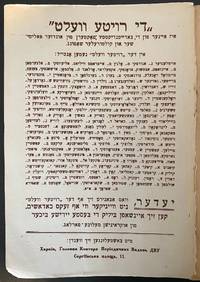
193017315Kharkov Ukraine: Ukrinishn Melukhe-Farlag 1930. 1st edition. Original Paper Wrappers lacks front wrapper 8vo 160 pages. 21 cm. In Yiddish. Di Royte Velt was a monthly Yiddish literary magazine which began publication in 1924. <br> “The Yiddish literary journal Di royte velt The Red World published in 1924-33 in Kharkiv Kharkov in Russian then the Ukrainian capital was one of the strongholds of 'anti-Litvakovism'. In general terms the story of Di royte velt represents an insightful chapter in the history of Soviet Yiddish literary life of the 1920s and 1930s.<br> In 1924 there arose the question of moving the Yiddish literary centre from Kiev to Kharkiv and of launching a Kiev-based Yiddish literary journal. This matter was discussed in a special memorandum of the Press Department of the Central Committee of the Ukrainian Communist Party. The head of the department M. Ravitsh-Cherkasky was Jewish. Motl Kiper the head of the Ukrainian Jewish Section backed this proposal arguing that Yiddish literature would benefit immensely from the capital's proletarian environment where it would liberate itself from the nationalist and Yiddishist hang-ups of Kiev.<br> In reality the Kharkiv Jewish proletariat was more acculturated than elsewhere in Ukraine: only 36 per cent of Kharkiv Region's Jewish trade unionists were Yiddish-speakers compared with 89 per cent in the Berdichev Region 55 per cent in the Kiev Region and 42 per cent in the Odessa Region.<br> It was no easy matter to create overnight a literary centre in a city which had a number of journalists but no literary lions. Moshe Taitsh for instance had been transferred to Moscow to reinforce the editorial staff of Der emes.<br> For all that the apparatchiks' initiative resulted in creating in Kharkiv a new Yiddish literary journal Di royte velt.<br> The first editors of Di royte velt were Henekh Kazakevich and M. Ravitsh-Cherkasky. While the latter was a king for a day in Yiddish literatureKazakevich was a remarkable figure in Soviet Yiddish journalism….<br> The first issue of the new journal appeared in September 1924 with a print-run of 2000. It was labelled a 'political-social literary-scientific bi-weekly journal'. Indeed the first issue contained only two literary works: a poem by Itsik Fefer and a story by Shmuel Persov. The other materials were devoted to theatre politics cosmology and literary criticism. Significantly the journal stressed its international character. <br> Among its potential contributors we find the names of the editors and writers of the New York communist Yiddish daily Frayhayt Freedom Moshe Olgin Morris Vinchevsky Shakhne Epshtein Moshe Kats and Moshe Nadir. Also it was announced that the Vilna-based Boris Kletskin publishing house was preparing for publication books by four Soviet writers listed among the journals' contributors: Arn Kushnirov Moshe Khashtshevatsky Ezra Finninberg and Nokhum Oislender†Gennady Estraikh 2002: 'The Kharkiv Yiddish literary world 1920s-mid-1930s'East European Jewish Affairs 32: 2 70 — 88; for Estraikh’s extensive discussion of the importance of Di Royte Velt see the full article at https://www.yiddishweb.com/wp-content/uploads/2018/01/Kharkiv-Yiddish_Estra ikh.pdf. <br> SUBJECTS : Yiddish literature -- Periodicals. OCLC: 10594044. <br> Lacks Yiddish cover and 1st 2 leaves. Russian cover is present. YID-47-6. Kharkov [Ukraine]: Ukrinishn Melukhe-Farlag unknown
67203E-363. Very Good. Hardcover. Hardcover. 8vo. Published by Harper & Row New York 1966. Xi 90 pgs. Illustrated. First Edition/First Printing. DJ has light shelf-wear present to the DJ extremities lower right corner of the DJ is clipped but price is still present to the top of the front flap. Bound in decorated cloth boards with titles present to the spine and front board. Boards have light shelf-wear present to the extremities. No ownership marks present. Text is clean and free of marks. Binding tight and solid. Nobel laureate Isaac Bashevis Singer introduces readers to the village of Chelm in this Newbery Honor Book. Chelm is a village of fools. The most famous foolsthe oldest and the greatestare the seven Elders. But there are lesser fools too: a silly irresponsible bridegroom; four sisters who mix up their feed in bed one night; a young man who imagines himself dead. Here are seven magical folktales spun by a master storyteller that speak of fools devils schlemiels and even heroeslike Zlateh the goat. ; 8vo 8" - 9" tall . hardcover
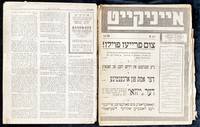
194542269New York Der Komitet 1945. Paperback. 1st edition. Paper Wrappers Folio Road Atlas size 35 cm 32 pages. "Unity." <br> Yiddish Communist bimonthly from May 1944-Jan 15 1945 then monthly through 1947 for writers artists and scientists a periodical certainly read by many of those swept up in the Atom Spy witchhunts 10 years later. <br> "Aroysgegebn fun Komitet fun Yidishe shrayber kinstler un visnshaftler in Amerike." Preceded by periodical of the same name also published in New York in 1942. Important issues from the early post war period. <br> <br> SUBJECTS : Jewish communists -- United States -- Periodicals. <br> <br> January issue missing front cover which is pages 1-2; February issue has detached covers but complete. Good strong white paper. Good Condition Thus B Y-37D. New York, Der Komitet paperback
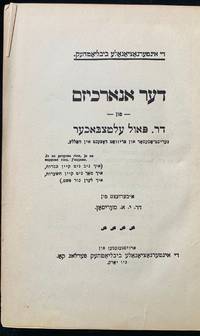
190943139New York: Internatsyonale bibliothek Verlag ko 1909. First edition. Original boards 8vo 347 pages 21 cm. In Yiddish. Title translates as “Anarchism.â€<br> Translation of Paul Eltzbacher’s “Anarchism†into Yiddish. In it he covers seven anarchist figures: Godwin Proudhon Stirner Bakunin Kropotkin Tucker and Tolstoy. Includes bibliographical references.<br> “Jacob Abraham Maryson was a Jewish–American anarchist doctor essayist and Yiddish translator. Maryson was among the few Pioneers of Liberty who could write in English. He was among the Pioneers who launched the Varhayt in 1889 the first American anarchist periodical in Yiddish….Maryson contributed to a variety of other Yiddish publications and became known as ‘the Kropotkin of the Jewish anarchist movement’. During Fraye Arbeter Shtime's hiatus in the late 1890s Maryson assisted in the cultural and literary journal Di Fraye Gezelshaft. Beginning in 1911 he edited the anarchist periodical Dos Fraye Vort. Maryson organized the Kropotkin Literary Society to print Yiddish translations of European thinkers. Maryson handled some of the group's most challenging translations including Marx's Das Kapital Stirner's The Ego and His Own and Thoreau's Civil Disobedience. He also translated John Stuart Mill's On Liberty. Maryson later wrote The Principles of Anarchism in 1935.†Wikipedia.<br> SUBJECTS: Anarchism. OCLC: 19304220<br> Very Good Condition. YID-48-3-. New York: Internatsyonale bibliothek Verlag ko unknown
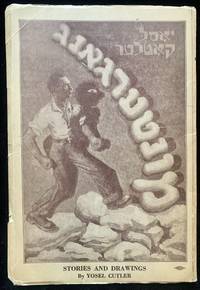
193443320Nyu York New York: Farlag Signal 1934. Original illustrated paper wrappers 8vo 190 pages including illustrations. 20 cm In Yiddish. The title translates as “Underground†or “Success.â€<br> Nazi-era Poetry and fiction by Yosl Cutler with illustrations by the author. <br> “A mish-mosh of wildly creative stories and illustrations by Yosl Cutler one of the most original and unique characters in Yiddish cultural life. Includes one of the first Yiddish science fiction stories ‘Afn shtern mars’ On the Planet Mars as well as a great deal of left wing political work in prose poem and cartoon.†Yiddish Book Center. <br> “Cutler was born in Troyanets Volhynia. He studied in religious elementary school. He was orphaned in his youth and at age eleven he became a server in a tavern. He mastered sign painting and in 1911 departed for the United States. He pursued his study of painting and in 1925 he created with the artists Zuni Maud and Jack Tworkov a Yiddish marionette theater called “Modicut†which proved successful in the United States and Europe but didn’t last long because of the great expenses involved. Under the influence of Moyshe Nadir in 1922 he began writing poetry humorous sketches stories and short plays… Of his short plays that were published in journals: Di sokhrim fun fefer Merchants of pepper; Der kindermark The children’s market; and Mayn filozofisher vesher My philosophical laundry; among others. In book form: Muntergang Success New York 1934 190 pp. ‘Yosl Kotler worked in three realms’ wrote M. Olgin ‘which merged into one: writer of humor cartoonist and marionette operator.’ He died in Memphis.†Leksikon Fun Der Nayer Yidisher Literatur<br> SUBJECTS: Yiddish wit and humor. Jewish wit and humor. Short stories Yiddish. Yiddish drama. OCLC: 23578196<br> Clean copy with some worn edges. Good Condition YID-48-75-MLX-’ggecc. Nyu York [New York]: Farlag Signal unknown
1926biblio39295New York: Boni and Liveright; First Edition 1926. 145 pp 2 pp musical score. Good Hardcover no dj. DarkCyan cloth. Remnant of the Spine title label. No Wear to the cover. Soiled Endpapers. Clean Unmarked text. Strong Tight binding and hinges. 7.8"x5.25"x0.9". be27491. Boni and Liverigh hardcover
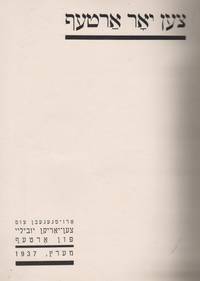
193735363New York; Posy-Shoulson Press 1937. 1st edition. Original Wraps. 4to. 4 171 2 23 pages. 28 cm. In Yiddish with English section and title page: Ten years Artef; published for the tenth anniversary of the Artef March 1937. <br> Extensively illustrated publication for the tenth year anniversary of the radical Yiddish theatre company Artef:<br> "the radical Yiddish dramatic troupe based in New York during the heyday of the Yiddish theater in America. Begun in the mid-1920s as a study group of amateur worker-actors at one time there were nine separate studios with over 120 students in the 1930s the troupe went professional putting on at least two and often three new plays per season. With such plays as Jacob Mostel 's Strike Shmuel Godiner 's Jim Kooperkop Avrum Vevioka 's Diamonds and Maxim Gorky 's Egor Bulychev and Dostigaev and Others Artef spread propaganda to the masses. Ideologically Artef was far left; its hope was a Communist society here in America. As a troupe its role was 'agit-prop' to agitate and propagandize to serve as the cultural representative of radical workers. In fact most of its tickets were pre-sold through worker unions and at least in its early years Artef gave presentations at political events.<br> Its first large-scale production was Mass Play and Ballet of the Russian Revolution which appeared at the Lenin memorial celebration in Madison Square Garden on January 21 1928. <br> Artef 's greatest artistic and commercial successes were connected with the talented productions of director Benno Schneider. Schneider who had been active in the Zionist Habima troupe in Moscow wed aesthetic excellence to revolutionary ideology with his interpretation of Aristocrats an adaptation of Sholem Aleichem 's Mentshn. Incidentally Schneider earned such a positive reputation with Artef that he received offers to direct on Broadway a promotion that cost the radical Yiddish theater dearly. <br> The end of the Artef was gradual and its causes were closely associated with the reduced role of Yiddish in American life. But there were bright lights before the darkness. During the 'days of the Popular Front ' when the Communists formed associations with less radical leftist parties the Artef attracted a larger audience which led to an optimistic expansion that later was responsible for huge financial losses. The darkness occurred at the end of the thirties when the number of Yiddish speakers began to diminish. The last performance of the Artef was on July 7 1941." Review by Dr. Brian Horowitz of 'Yiddish Proletarian Theatre: The Art and Politics of the Artef 1925–1940 ' written by Edna Nahshon. <br> Many of the actors and directors in Artef went on to establish solid careers on Broadway Hollywood and for those blacklisted overseas. <br> Bound in brown velour wraps with gilt title. Heavily illustrated. <br> Subjects: Arbeiter theatre verband New York. Jewish theater. Theater - New York State - New York. Artef - Anniversaries etc. <br> OCLC: 19310798. <br> Light wear to edges of wraps otherwise clean and fresh. Good condition. B YID-22-9-LEBWW. New York; Posy-Shoulson Press unknown
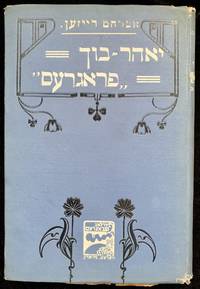
190443110Varsha Warsaw: Ferlag "Progress 1904. First edition. Original illustrated printed boards 8vo 162 32 pages plus 7 unnumbered leaves of plates with illustrations. 22 cm. In Yiddish. Title translates as “Yearbook ‘Progress’: A Journal for Literature Science and Criticism.â€<br> “Abraham Reisen was a Yiddish poet short-story writer playwright and editor…While he was still a teenager his talent was recognized by Shalom Aleichem and I.L. Peretz who arranged for the publication of his earliest poems. After some years in Minsk Warsaw Krakow and Berlin he settled permanently in New York in 1914. Influenced by Heinrich Heine whom he translated into Yiddish he was one of the first Yiddish poets to make use of folksong material. His poetry though mostly written in conventional quatrains is suffused by a refined sensibility that adumbrates the writing of Di Yunge.†Jewish Virtual Library<br> â€In 1900 Yakov Lidski founded "Progress" publishing house. Its name clearly communicated its goal. This publishing company considered to be the first to deal with modern Yiddish literature published a series of original and translated popular science books along with translated European literature and original Yiddish literature. The first editor of the publishing house was poet Avrom Reyzen.†Wikipedia. <br> SUBJECTS: Yiddish literature. Jews -- Poland -- Periodicals. OCLC: 21651882<br> Wear to spine some page separation toning and markings. About Good Condition. YID-46-28-GGLEX-’cc. Varsha [Warsaw]: Ferlag "Progress unknown
19461116373New York: Jewish Encyclopedic Handbooks Central Yiddish Culture Organization CYCO. Fine maroon leatherbound 2 volume set gilt all edges Volume 1 has 430 pp with B/W illustrations; Volume 2 has 430 pp with B/W illustrations. . Fine. Leather Bound. 1946. Jewish Encyclopedic Handbooks Central Yiddish Culture Organization (CYCO hardcover
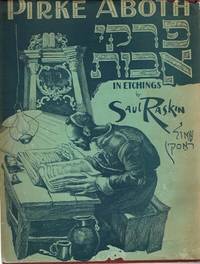
19387471NY: Academy Photo Offset Inc. Very Good in Good dust jacket. 1938. First Edition Thus. 1. Hard Cover. Publisher's full burgundy cloth Hebrew lettering gilt on cover. title page in color. Illustrated with fine etchings by Saul Raskin Text in English and Hebrew. Covers very lightly soiled Hebrew inscriptions on ffep very mildly shelf-worn else fine. The dust jacket now in Mylar is moderately chipped with some loss at the head of the spine. All of the etchings are in bright clean condition. VERY GOOD/VERY GOOD. . Etchings. 4to 11" - 13" tall. 124 2 pp . Academy Photo Offset, Inc. hardcover
192936164Vilne: Vilner Farlag B. Kletskin 1929. Hardcover. g. Quarto. Vol. 2: 8 516 XXVII. Black buckram with gold lettering on front. Blind stamp borders on spine with red text boxes. Blind stamp symbol and lettering on back boards. Brown decorative endpapers b/w photographic facsimile plates and cuts throughout. Includes articles about the history of Yiddish theater Slavic influences on Yiddish burial customs early German thief jargon and Yiddish surnames in Ukraine. Additional title pages and summaries in English. Slight wearing on edges and ends. Top of spine torn. Slight age toning. Binding and interior in good condition. Text in Yiddish. Vilner Farlag B. Kletskin hardcover
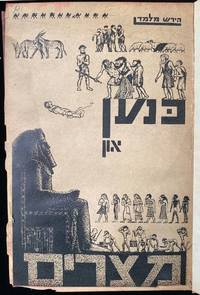
193042782Rige Riga: Yungbukh 1930. 1st edition. Period boards with original covers bound in. 8vo. 157 pages 21 cm. In Yiddish with Latvian "front" cover and title page at rear. Title translates as "Canaan and Egypt: A Novel." <br> Wonderfully illustrated cover bound in featuring cartoonish drawings of Canaanites and Egyptians. Two volumes in one: 1. Yoysef in Mitsroyim and 2. Yosef der reter fun Mitsroyim. <br> <br> SUBJECTS: Yiddish fiction. OCLC: 503648109. OCLC lists 8 copies worldwide including copies of an undated edition which we assume to be a later reprint. <br> <br> Ex-library with usual marks. Paper brown and somewhat fragile old dampstain to lower edge of boards extending into margins of first and last leaves. Original bound-in covers have come loose. Good condition thus. B YID-33-27-L-'ccex. Rige [Riga]: Yungbukh unknown
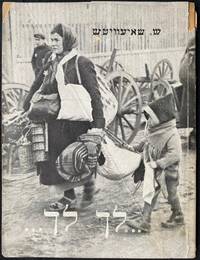
194613981Lodzsh: Tsentraler Yidisher Historisher Komisye baym Tsentral-Komitet fun Poylishe Yidn 1946. 1st edition. Later cloth with original dramatic photgraphic cover mounted on front 8vo 70 1 pages 1 l. includes facsimiles. 21 cm. Poems. "Oysgabes fun Der Tsentraler Yidisher Historisher Komisye baym Tsentral-Komitet fun Poylishe Yidn. Serye yidishe literatur 1." <br> A committee dedicated to recording the fate of Polish Jews published this book length poem by Simkhah Szajewics. Written in the Lodz Ghetto it appeared immediately after the war in 1946; Szajewicz perished in a concentration camp in 1944" from the permanent exhibit at the National Yiddish Book Center which houses their copy in their Rare Book Collection. <br> The book actually includes two long poems: "Lekh-lekha" and "Friling 702 " as well as letters and other related material. <br> See David Roskies interesting reflection on this work and it's stunning photographic cover at jtsa.edu/torah/go-forth-the-grammar-of-remembrance. <br> For more about the author-poet see Chava rosenfarb's essay on Shayevitch in Tablet Magazine at tabletmag.com/sections/arts-letters/articles/the-last-poet-of-lodz. SUBJECTS: Jews -- Persecutions -- Poland -- Lódz. Holocaust Jewish 1939-1945 -- Poetry. Jews -- Correspondence. Expertly rebound in attractive black cloth with the original photographic front cover mounted on the front. Very Good Condition. B HOLO2-110-36-CCALX-'emm H-40-10. Lodzsh: Tsentraler Yidisher Historisher Komisye baym Tsentral-Komitet fun Poylishe Yidn unknown
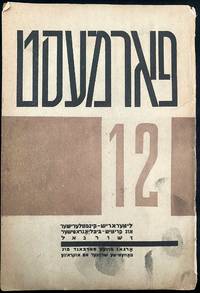
193543308Kharkov: Ukrmelukhenatsmindfarlag 1935. First edition. Original illustrated paper wrappers 8vo 156 pages.Includes illustrations. 21-23 cm. In Yiddish. Title translates roughly as “Challenge: A Literary Artistic and Critical Bibliographical Journal.â€<br> At the time the only Yiddish literary periodical in Ukraine.<br> Farmest 1933–1937 was a monthly Yiddish literary magazine published in Kharkhiv Ukraine by the Ukrainian Committee for Soviet Writers.<br> “Edited by the poet Itsik Fefer 1900–1952 it was continued in Sovetishe literatur: Literarish-kinstlerisher un kritish-bibliografisher zhurnal Soviet Literature: Literary-Artistic and Critical-Bibliographical Journal; 1938–1941.<br> In 1927 Fefer was a founding member of the Jewish Section of the All-Ukrainian Union of Proletarian Writers and from 1928 one of the editors of its Kharkov-based journal Prolit Proletarian Literature. He also coedited the nonproletarian Kharkov journal Di royte velt The Red World from 1929. From 1933 to 1937 he edited the Kiev periodical Farmest Challenge; known as Sovetishe literatur Soviet Literature between 1938 and 1941 which replaced Prolit and Di royte velt and was thereafter the only Yiddish literary periodical in Ukraine.†YIVO. Avrom Gontar was also involved in the collective and editorial committee. <br> The editor Itsik Fefer 1900–1952 “began writing poems in 1918 and in 1922 joined Vidervuks New Growth in Kiev a group of young Yiddish literati whose mentor was Dovid Hofshteyn. That same year the appearance of Fefer’s small collection Shpener Splinters established him as a rising literary star. His poetry amalgamated the Kultur-lige poets’ revolutionary romanticism with the propagandist objectives of the workers’ movement.<br> Fefer was known for his literary credo of proste reyd simple speech a concept he formulated in 1922. In the early 1920s poetry particularly avant-garde poetry swamped the literary pages of Soviet Yiddish periodicals. This phenomenon worried editors and critics who were wary of the fact that Yiddish readers usually could not identify with this style of literature. All Yiddish readers by contrast could understand Fefer’s proste reyd.<br> In 1927 Fefer was a founding member of the Jewish Section of the All-Ukrainian Union of Proletarian Writers and from 1928 one of the editors of its Kharkov-based journal Prolit Proletarian Literature. He also coedited the nonproletarian Kharkov journal Di royte velt The Red World from 1929†Gennady Estraikh.<br> For more see: Gennady Estraikh “The Kharkiv Yiddish Literary World 1920s–Mid-1930s†East European Jewish Affairs 32.2 2002: 70–88; Chone Shmeruk “Yiddish Literature in the U.S.S.R.†in The Jews in Soviet Russia since 1917 ed. Lionel Kochan pp. 242–280 London and New York 1970.<br> SUBJECTS: Yiddish literature -- Ukraine -- Periodicals. Yiddish literature. OCLC: 35051038.<br> Pages toning as expected some sunning and stains to cover Good Condition. BYID-46-2A-LGG-’excc. Kharkov: Ukrmelukhenatsmindfarlag unknown
195932876New York: Celia Adler Foundation / Shulsinger Bros. Linotyping & Publishing Co 1959. Very Good/Very Good. New York: Celia Adler Foundation / Shulsinger Bros. Linotyping & Publishing Co. 1959. First Edition. Two octavo volumes 23.5cm; 688pp. Black and white photographs. Photo-illustrated dust jackets; blue cloth boards. Yiddish-language text throughout. Dust jackets show mild chipping with a few short tears along edges; general rubbing and sun-fading. Old damp-marks to board edges of both volumes causing discoloration to cloth but no structural damage. Bindings sound. Glue residue to endpapers of volume II else unmarked and still a Very Good set of this uncommon autobiography of "The First Lady of Yiddish Theater." Adler was known for creating leading roles in Yiddish versions of many classic plays and was the first actor to portray a Holocaust survivor in her brother Luther's 1946 Broadway production A Flag is Born. Scarce. Celia Adler Foundation / Shulsinger Bros. Linotyping & Publishing Co unknown
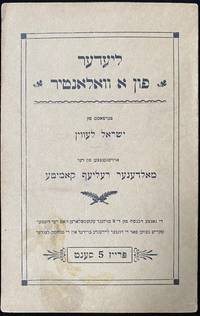
191942896No Place Malden MA: Maldener Relief Komite 1919. No Date 1919. 1st Edition. Original printed paper wrappers 8vo 14 pages. 21 cm. In Yiddish. Title translates as “Verses of a Volunteer.†No city or date listed but clearly published during or immediately after WW I with the Leksikon suggesting Malden MA 1919 OCLC suggests Boston the location of the printer and a clearly incorrect date of 1900 perhaps intending "1900s". Malden the poet’s home town just outside of Boston and clearly the home of the "Maldener Relief Komite" makes much more sense making this is the first documented yiddish publication in Malden MA north of Boston.<br> "The poet dedicated the entire income of 5 thousand copies to the brothers suffering from hunger in the countries at war†Translated from the front cover. Includes 4 poems: Der Volontir; Ikh Zukh a Vort; Nach der Milhome; Hazkharot Neshimot. The final poem is “in memory of the fallen Jewish heroes in all the war-torn lands.â€<br> Israel Levine 1878-1970 “was born in a village in Minsk district Byelorussia. In 1895 he arrived in the United States lived in various cities worked as a teacher in Talmud Torahs and was secretary for Mizrachi in the town in which he lived Malden Massachusetts. <br> He debuted in print in 1904 in Fraye arbeter-shtime Free voice of labor in New York with a poem entitled ‘Funken shpritsn’ Sparks fly and from that point he went on to contribute poetry and translations from Tanakh and from ethical books to: Yidishes tageblat Jewish daily newspaper Forverts Forward Dos yudishe folk The Jewish people Di varheyt The truth and Idisher kemfer Jewish fighter—in New York; Idishe shtime Jewish voice in Boston; and more. He published in book form: Lider fun a volontir Poems of a volunteer Malden 1919 16 pp.; Sefer naim zemirot tehilim Naim Zemirot on Psalms translated into a poetic form with short prefaces by Dr. Meir Vaksman and Aharon Kaminska Jerusalem 1934 19 pp†Khayim Leyb Fuks in Leksikon Fun Der Nayer Yidisher Literatur<br> OCLC: 19307496. OCLC lists 4 copies worldwide YIVO Brandeis Harvard NYBC none outside the northeast. A few stains & discoloring Very Good Condition an excellent copy. Scarce. B YID-45-9XX-LE-’. No Place [Malden, MA]: Maldener Relief Komite unknown
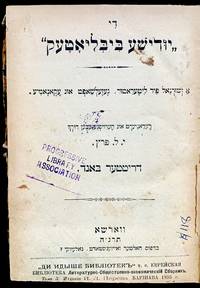
189543079Warsaw: Izdanie I.L. Perets 1895. First edition period boards 8vo 179 pages. 23 cm. In Yiddish. Title translates as “The Jewish Library: A Journal for Literature Society and Economics.â€<br> Third volume of semiannual publication edited by I.L. Peretz. Di Yudishe Bibliotek was published periodically between 1891 and 1904. This issue includes belle-lettres poetry and scientific essays.<br> “To encourage Jews toward a wider knowledge of secular subjects Peretz for several years wrote articles on physics chemistry economics and other subjects for Di yudishe bibliotek which he also edited.†Encyclopedia Britannica.<br> Yitskhok Leybush Peretz 1852-1915 is one the best known Yiddish and Hebrew authors of the 19th century. Peretz was one of the three classic Yiddish writers with S. Y. Abramovitsh and Sholem Aleichem and the founder of Yiddish modernism. In the first decade of the 20th century he was at the center of an active literary circle in Warsaw. <br> SUBJECTS: Yiddish literature -- Poland -- Periodicals. Jews -- Poland -- Periodicals. Jews. Yiddish literature. OCLC: 992802478. <br> Ex-library with usual markings and normal wear and age to pages but otherwise in good condition. Good Condition. YID-46-19-GGLEX-’cc. Warsaw: [Izdanie I.L. Perets] unknown
1912224381912. Schwartz Isidor Publisher. Vi Azoy Tsu Veren a Sitizen. / The Citizen: A Guide to Naturalization. All Important Questions and Answers Printed in Hebrew and Yiddish Also Translations in Plain English Which You are to Know When Applying for Your Final Citizen Papers. Brooklyn: Aroysgegeben fun Isidor Schwartz / Published by Isidor Schwartz n.d. after 1912. Only edition. 31 page. Text in English and Yiddish both transliterated and Hebrew script. 6" x 4.5. Stapled pamphlet in printe wrappers.<br /> <br /> An immigrant-era Yiddish-English naturalization guide for Jewish immigrants preparing to become U.S. citizens published by Isidor Schwartz in Brooklyn. This vernacular instructional manual contains sample questions and answers in three formats: English Yiddish in Hebrew script and transliterated English in Latin script referred to on the cover as "Jewish-English". Designed for oral preparation it walks new arrivals through both general and localized questions commonly asked at the naturalization interview particularly for applicants in New York. Questions range from general American civics-"How does a bill become a law"-to specific regional knowledge-"What is the capital of New York State" and "How many stars has the American flag" The answer is noted as "Forty-eight stars" dating the publication to after Arizona and New Mexico's 1912 admission but before Alaska and Hawaii. The phrasing used-"We vote for the candidate who is in our opinion best fitted to occupy the office he wishes to be elected to"-illustrates the pamphlet's focus on simplified phonetic civic literacy.<br /> <br /> A vital artifact of Jewish immigrant life and Americanization in the early 20th century this pamphlet exemplifies how Jewish community publishers mediated state bureaucracies for recent arrivals. Yiddish language guides like this one offered more than instruction-they were part of the infrastructure of mutual aid and cultural transition particularly within New York's dense immigrant communities.<br /> <br /> Fragile condition with moderate chipping and edgewear to front and rear wrappers including some closed tears and loss at corners; interior pages clean and legible. Overall good condition. A scarce and historically significant publication supporting Jewish American integration during a peak period of Yiddish-speaking immigration; OCLC locates only 8 institutional holdings worldwide. unknown
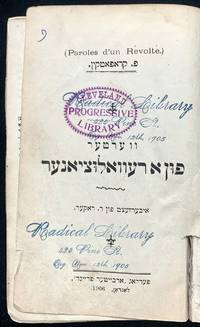
190643217London: "Arbayter fraynd 1906. First Yiddish edition. Period boards 8vo xiii 426 pages 19 cm. In Yiddish. Title translates as “Words from a Revolutionary.â€<br> Translation of “Paroles d'un re´volte´.†Includes translation of the forewords by the author and Elise´e Reclus. Includes bibliographical references.<br> “During his long exile Kropotkin wrote a series of influential works the most important being ‘Paroles d’un révolté’ 1885; “Words of a Rebelâ€.Kropotkin’s aim as he often remarked was to provide anarchism with a scientific basis. In Mutual Aid which is widely regarded as his masterpiece he argued that despite the Darwinian concept of the survival of the fittest cooperation rather than conflict is the chief factor in the evolution of species. Providing abundant examples he showed that sociability is a dominant feature at every level of the animal world. <br> Among humans too he found that mutual aid has been the rule rather than the exception. He traced the evolution of voluntary cooperation from the primitive tribe peasant village and medieval commune to a variety of modern associations—trade unions learned societies the Red Cross—that have continued to practice mutual support despite the rise of the coercive bureaucratic state. The trend of modern history he believed was pointing back toward decentralized nonpolitical cooperative societies in which people could develop their creative faculties without interference from rulers clerics or soldiers.â€<br> SUBJECTS: Anarchism. OCLC: 19303211.<br> Ex-library with early 19th Century left-wing library markings see photos. Good- Condition YID-48-41-LXCCGG-’e. London: "Arbayter fraynd unknown
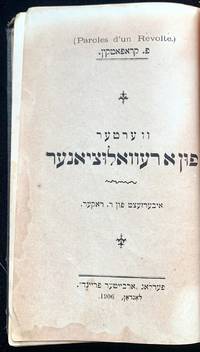
190643219London: "Arbayter fraynd 1906. First Yiddish edition. Period boards 8vo xiii 426 pages 19 cm. In Yiddish. Title translates as “Words from a Revolutionary.â€<br> Translation of “Paroles d'un re´volte´.†Includes translation of the forewords by the author and Elise´e Reclus. Includes bibliographical references.<br> “During his long exile Kropotkin wrote a series of influential works the most important being ‘Paroles d’un révolté’ 1885; “Words of a Rebelâ€.Kropotkin’s aim as he often remarked was to provide anarchism with a scientific basis. In Mutual Aid which is widely regarded as his masterpiece he argued that despite the Darwinian concept of the survival of the fittest cooperation rather than conflict is the chief factor in the evolution of species. Providing abundant examples he showed that sociability is a dominant feature at every level of the animal world. <br> Among humans too he found that mutual aid has been the rule rather than the exception. He traced the evolution of voluntary cooperation from the primitive tribe peasant village and medieval commune to a variety of modern associations—trade unions learned societies the Red Cross—that have continued to practice mutual support despite the rise of the coercive bureaucratic state. The trend of modern history he believed was pointing back toward decentralized nonpolitical cooperative societies in which people could develop their creative faculties without interference from rulers clerics or soldiers.â€<br> SUBJECTS: Anarchism. OCLC: 19303211.<br> Spine is taped.Tight binding but text block is clean and intact. Good Condition YID-48-40-LXCCGG-’e. London: "Arbayter fraynd unknown
194643433Lodzsh: Tsentraler Yidisher Historisher Komisye baym Tsentral-Komitet fun Poylishe Yidn 1946. 1st edition. Original dramatic photgraphic covers 8vo 70 1 page 1 leaf. Includes facsimiles. 21 cm. In Yiddish. Poems. "Oysgabes fun Der Tsentraler Yidisher Historisher Komisye baym Tsentral-Komitet fun Poylishe Yidn. Serye yidishe literatur 1." <br> "Published by a commission The Central Jewish Historical Commission dedicated to recording the fate of Polish Jews published this book length poem by Simkhah Szajewics. Written in the Lodz Ghetto it appeared immediately after the war in 1946; Szajewicz perished in a concentration camp in 1944" from an exhibit at the National Yiddish Book Center which houses their copy in their Rare Book Collection. <br> The book includes two long poems: "Lekh-lekha" and "Friling 702 " as well as letters and other related material. <br> See David Roskies' interesting reflection on this work and it's stunning photographic cover at <br> jtsa.edu/torah/go-forth-the-grammar-of-remembrance. <br> For more about the author-poet see Chava rosenfarb's essay on Shayevitch in Tablet Magazine at <br> tabletmag.com/sections/arts-letters/articles/the-last-poet-of-lodz. <br> SUBJECTS: Jews -- Persecutions -- Poland -- Lódz. Holocaust Jewish 1939-1945 -- Poetry. Jews -- Correspondence. Crease and wear to wrapper and foot and crown of spine see photo better condition than usually found attractive. Good Condition. B HOLO2-110-36A-CCALX-'emm H-40-10. Lodzsh: Tsentraler Yidisher Historisher Komisye baym Tsentral-Komitet fun Poylishe Yidn unknown
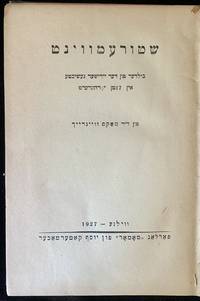
192743261Vilne: Tamar 1927. First edition. Original boards. 8vo 220 pages 21 cm. In Yiddish. Title translates as “Storm Winds: Images from Yiddish History in the 17th Century.â€<br> Max Weinreich’s historical work on Jews in Europe in the 17th Century focusing on the Chmelnitski pogroms.<br> “While Weinreich was first and foremost a linguist other topics he wrote about included psychology he translated Freud into Yiddish sociology economics theater studies literary history education ethnography and philosophy. He had a second career as a writer of popular articles in the Yiddish Forward frequently under the unlikely pseudonym Sore Brener. His linguistic interests included the history of linguistics orthography grammar he coauthored an early Yiddish grammar etymology and the etymological components of Yiddish dialectology stylistics and the influence of traditional Jewish culture in all its facets on the development of the Yiddish language.<br> In 1925 on the initiative of the linguist Nokhem Shtif the Yidisher Visnshaftlekher Institut Yiddish Research Institute; YIVO was founded in Berlin and began its work in Vilna; its first headquarters was located in a room in Weinreich’s apartment. Weinreich quickly became the driving force behind the new institute which was originally to have been known as an academy but Weinreich insisted on institute. Although YIVO may not have been Weinreich’s brainchild it was his child in every other way even after it acquired its own building on Wiwulski Street in Vilna.†<br> SUBJECTS: Jews -- Poland -- History -- Persecutions. Chmelnicki massacres. Blood accusation -- Lithuania -- Vilnius. Blood accusation. Jews -- Persecutions. History. OCLC: 649090568. OCLC lists 8 copies worldwide AJHS SUNY- Albany YIVO AJU Stanford Harvard NYBC Penn<br> Spine separation and some markings but text block is in good condition. Good Condition. Important and somewhat scarce. YID-48-62-BX'L-’emccgg. Vilne: Tamar unknown