63 résultats
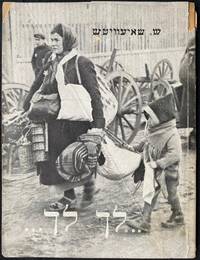
194643433Lodzsh: Tsentraler Yidisher Historisher Komisye baym Tsentral-Komitet fun Poylishe Yidn 1946. 1st edition. Original dramatic photgraphic covers 8vo 70 1 page 1 leaf. Includes facsimiles. 21 cm. In Yiddish. Poems. "Oysgabes fun Der Tsentraler Yidisher Historisher Komisye baym Tsentral-Komitet fun Poylishe Yidn. Serye yidishe literatur 1." <br> "Published by a commission The Central Jewish Historical Commission dedicated to recording the fate of Polish Jews published this book length poem by Simkhah Szajewics. Written in the Lodz Ghetto it appeared immediately after the war in 1946; Szajewicz perished in a concentration camp in 1944" from an exhibit at the National Yiddish Book Center which houses their copy in their Rare Book Collection. <br> The book includes two long poems: "Lekh-lekha" and "Friling 702 " as well as letters and other related material. <br> See David Roskies' interesting reflection on this work and it's stunning photographic cover at <br> jtsa.edu/torah/go-forth-the-grammar-of-remembrance. <br> For more about the author-poet see Chava rosenfarb's essay on Shayevitch in Tablet Magazine at <br> tabletmag.com/sections/arts-letters/articles/the-last-poet-of-lodz. <br> SUBJECTS: Jews -- Persecutions -- Poland -- Lódz. Holocaust Jewish 1939-1945 -- Poetry. Jews -- Correspondence. Crease and wear to wrapper and foot and crown of spine see photo better condition than usually found attractive. Good Condition. B HOLO2-110-36A-CCALX-'emm H-40-10. Lodzsh: Tsentraler Yidisher Historisher Komisye baym Tsentral-Komitet fun Poylishe Yidn unknown
1939292576Prepared by the Yiddish Writers' Guild of the Federal Writers' Project 1939. Hardcover . Good. 206 pp. slight library number on spinetear to crown of spine work is in Yiddish aisle 215 oclc 19314860 Prepared by the Yiddish Writers' Guild of the Federal Writers' Project, hardcover
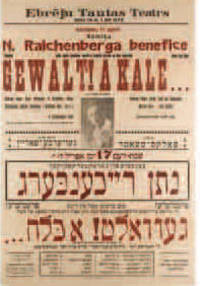
51-1032Latvia: 1920s-1930s. A Collection of 8 Yiddish Theater posters from the 1920s and 1930s. Yiddish Latvian poster of the Ebreju Tautas Teatrs Jewish people Theater. Letter press in red and black on fine paper mounted on canvas. 91 x 60.5 cm. Riga Spiestuve vards 1930 announcement of an event on Saturday April 17 d. j.: Bene_ z of the character comedian Natan Reichenberg. Premiere! For the first time in Riga the large entertaining equipment operetta with completely new vocal pieces help! A bride. The comic role of "Kivele Feldsher" Akiva the medics the Bene_ acquires ziant. -Printed in Latvian and Yiddish language with photographic print. -Paper browned minimal fold marks on the outer edge. -Rare poster.Yiddish Latvian poster of the Rigas teatris zidu minoritates Riga Jewish minorities Theater. Letterpress in red and black on fine paper. 71 x 53.5 cm. Riga SP. extra 1925. announcement of the _ eaterstücks the Jewish robber on November 26. -Printed in the Latvian and Yiddish languages. -Paper slightly tanned with vertical folding kl. Defects especially upper-right corner on the outer edge with small tears. -Very rare poster.Yiddish Latvian poster of the Rigas teatris zidu minoritates Riga Jewish minorities _ Theater. Letter press in red and black on fine paper. 71 x 50 cm. Riga SP. extra 1925. announcement of different theatrical works: A man an unlucky guy. -The curly haired blonde -In life tri_ all . -The Jewish Bandit November 17-22. -Printed in the Latvian and Yiddish languages. -Paper minimally tanned with vertical and horizontal folding Small Defects minimal _ square on the outer edge with small tears. -Very rare poster.Yiddish Latvian poster of the Rigas teatris zidu minoritates Riga Jewish minorities Theater. Letterpress in red and black on fine paper. 106 x 71 cm. Riga SP. extra 1933 announcement of solemn Erö_ regulation IX season on Saturday Sept. 30 Sunday 1 Oct 1933 8.30 evening. Performed by: Genia Schalit Nina Talini oSIP Runitsch in the well-known piece of David Golder. In four acts by A. Nemirowskaja. -With 2 dates. -Printed in the Latvian and Yiddish languages. -Paper minimally tanned partly with resounding mount tracks with vertical and horizontal folds & light Abklatsch small. Defects somewhat spotted and knicked. -Very rare poster. Latvian Yiddish poster. Woodcut on fine green paper. 66 x 51 cm. Daugavpils Latvia Pilsetas spiestuve litogra_ Yes 1920s. The translated content of the poster: Sunday August 15 7: 00 the Dünaburger Trade Association invites in the Riga road 42 in the Novonowitsch-Hall to a meeting on the election of the municipal administration. Speaker are: Al Kopelowski A. Bulavko Sch. Heller Salman Barak N. Magid and others. "Dealer! Come numerous. Dealers and sellers. Bear in mind that your list is the list of 5 the Listedes of trade association."- printed in the Latvian and Yiddish languages. -Paper with vertical & horizontal folds and knicks-Rare poster.Latvian Yiddish poster. Woodcut in blue on fine paper. 93 x 62.5 cm. Daugavpils Latvia Pilset. spiestuvelitogra _ Yes 1920s. Election poster: David challenge the dealer! 'Remember - no voice of the dealer for a different list than the list 5 vote for the list of dealers no. 5' - 3 languages printed in Yiddish Russian and Latvian. -Paper with vertical & horizontal folding some with red marks. Knicks and small tears -Rare poster.Latvian Yiddish poster. Woodcut on fine Orange paper. 49.5 x 31.5 cm. Daugavpils Latvia Pilsetas spiestuve litogra_ Yes 1920s. The translated content of the poster: Agudat Israel Daugavpils. Taking place on Monday August 17 8 o'clock in the evening. A folk Assembly in Klingmann Hall Riga Street 42. The elections. Asked to show! -Printed in the Latvian and Yiddish languages. -Paper with horizontal folds tears and stains-Rare poster.Images of all the posters are available Latvia: 1920s-1930s unknown
1964N5079Tel Aviv Israel: Di Goldene Keyt -Perets Publ House 1964. Original Cloth. Very Good. 8vo. 42812pp Yiddish text. Titleßpage also in English. Hinges at bottom of back covers 2 cm slightly open. Some foxing on covers. Otherwise a very good copy. <br/> <br/> Di Goldene Keyt -Perets Publ House hardcover
1927228396Vilno: Yiddish Scientific Institute 1927. Stiff Wrapper. Good . VII 84 pp. in English and Yiddish Covers the years 1925-1927 "The spiritual uprising of the masses of the Jewish people.has called into being new cultural necessities." Yiddish Scientific Institute unknown
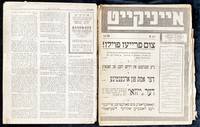
a61093London 1904-1905. 45 issues of thisYiddish anarchist weekly bound in one volume. 4to. about 370pp. hardcover with new paper spine. Good corners of the binding are worn. The leaves are browned and a bit fragile. Issues 46 47 and 48 are chipped at the top corner with some loss of text all other issues are intact. Very scarce. hardcover
1972134064tel avivIsrael: Hakibbutz Hameuchad pub. Very Good in Very Good dust jacket. 1972. First English Edition. Hardcover. 5x8". VERY GOOD CONDITION IN VERY GOOD UNCLIPTNOPR ICE DUST JACKET clean solidbright; WHITE & BLACK TITLES ON RED & YELLOW CLOTH HARD COVERS. DJ DUPLICATES COVERS.BLACK ENDPAPERS. ep has 3x4" B&W photo of man author tipped in. .GHETTO FIGHTERS' HOUSE archives material. ; 230pg pages; First published in POLAND in 1949. Dramatic memoir of conditions and heroic activies in WARSAW GHETTO REVOLT. biography with names of many ."Changing the attitud of the mojority.who had at first intended to go voluntarily to the camps" URBANGUERILLA WARFARE. STREET FIGHTING. UNDERGROUND ORGANIZATION . Hakibbutz, Hameuchad pub hardcover
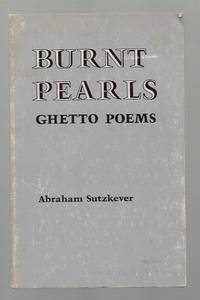
1981019682Oakville Ontario: Mosaic Press/Valley Editions 1981. Book. G/VG-. Trade Paperback. First Thus. Trade size gray paperback with black and white titles. Book has a remainder mak on the bottom closed page edges with light edge wear and rubs along the spine. Interior is clean tight and unmarked. Yiddish poetry by Abraham Sutzkever during World War II and his time in the Vilna Ghetto. 51 pages. Mosaic Press/Valley Editions Paperback
feb122284Used. For more details please contact me unknown
feb123153Used. For more details please contact me unknown
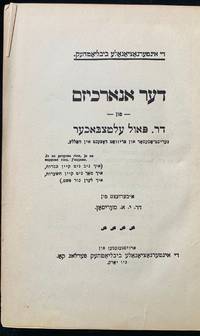
190943139New York: Internatsyonale bibliothek Verlag ko 1909. First edition. Original boards 8vo 347 pages 21 cm. In Yiddish. Title translates as “Anarchism.â€<br> Translation of Paul Eltzbacher’s “Anarchism†into Yiddish. In it he covers seven anarchist figures: Godwin Proudhon Stirner Bakunin Kropotkin Tucker and Tolstoy. Includes bibliographical references.<br> “Jacob Abraham Maryson was a Jewish–American anarchist doctor essayist and Yiddish translator. Maryson was among the few Pioneers of Liberty who could write in English. He was among the Pioneers who launched the Varhayt in 1889 the first American anarchist periodical in Yiddish….Maryson contributed to a variety of other Yiddish publications and became known as ‘the Kropotkin of the Jewish anarchist movement’. During Fraye Arbeter Shtime's hiatus in the late 1890s Maryson assisted in the cultural and literary journal Di Fraye Gezelshaft. Beginning in 1911 he edited the anarchist periodical Dos Fraye Vort. Maryson organized the Kropotkin Literary Society to print Yiddish translations of European thinkers. Maryson handled some of the group's most challenging translations including Marx's Das Kapital Stirner's The Ego and His Own and Thoreau's Civil Disobedience. He also translated John Stuart Mill's On Liberty. Maryson later wrote The Principles of Anarchism in 1935.†Wikipedia.<br> SUBJECTS: Anarchism. OCLC: 19304220<br> Very Good Condition. YID-48-3-. New York: Internatsyonale bibliothek Verlag ko unknown
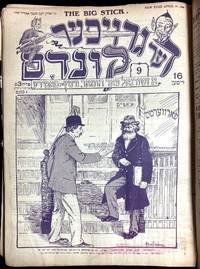
190942930New York: Ferlag "Kibets 1909. 1st Edition. Original publisher’s binding Folio newspaper. Complete first volume Starting with Vol I Nr 1 of “Der Kibitser†Dec. 15 1908 renamed and renumbered first as Vol I Nr 1 Jan 22 1909 of “Der Groyser Kibetser The big kibetzer†with the following issue of Feb 5 numbered as "3" to correctly follow from the first issue and then with Vol I Nr 6 March 19 1909 onward as “Der Groyser Kundes The Big Stick†or “The Big Prankster.†Incidentally the other set of this volume we examined also did not have a Nr 2 so we are confident this is complete as issued. <br> One centerfold cartoon by Zuni Maud see image features "Der Kaptialistisher Tayfel"--the Capitalist Devil–holding back a "mother" by the hair to stop her from interfering as "baby's milk-bottle" is drained off by the "milk-trust" cat. <br> The caption reads "The Capitalist Devil: - to the mother: Never mind madam all in English in Hebrew letters you go to the factory the milk-trust will take good care of your baby."<br> This cartoon-laden periodical was a New York City Yiddish language satirical bi- weekly which ran from 1908 until 1927.<br> The humor paper was issued biweekly this volume for its first 20 months and then weekly after that. OCLC also references another Vol I Nr 1 from April 15 1908 a special S´imhes` Toyreh Simchas Torah issue but this may have been a one-off. <br> Founded by the humorist Yosef Tunkel or Der Tunkeler his pen name meaning 'The Dark One' the paper was taken on by Jacob Marinoff when Tunkel left to work for an established paper in Warsaw. The paper consciously set itself up in opposition to the serious Yiddish-language press of the time such as the socialist Forverts.Naturally more traditional religious Judaism did not escape its satire: The later 1915 "Christmas" edition included a parodic conversation between Jesus and the prophet Elijah. <br> Despite its irreverent attitude to everything it also published poetry by Di Yunge "The Young Ones" poets such as Moyshe-Leyb Halpern and Zuni Maud. At its height it had a circulation of 35000 but folded in 1927 due to flagging sales. Der Groyer Kunds is highlighted in this recent talk by Yiddish comics scholar Eddie Portnoy on the reactions in the Yiddish press to restrictions on Jewish immigration to the US: https://www.yiddishbookcenter.org/collections/archival-recordings/recorded- programs/ybcr-nybc-ybcr-1048/door-slams-shut-reactions-yiddish-press-immigr ation .<br> SUBJECTS: Yiddish wit and humor -- Periodicals. OCLC: 28297536. Most holdings appear to be fragmentary and do not include these issues. Issue 18 with torn cover. In final issue the bottom margin suffers some loss to the final leaves none to the dramatic front cover though. Damaged boards are loose and most issues are coming loose though the quality paper used has remaind strong and bright much better than standard newsprint would have. Important graphic Yiddish humor from the great migration period. Dramatic and displayable! BK5 YID-43-9A-LEX. [New York]: Ferlag "Kibets unknown
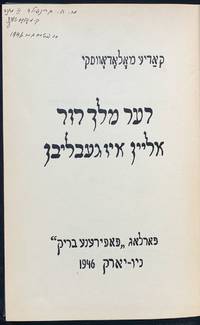
194643238New York: Papirene Brik 1946. First edition. Original boards. 8vo 156 pages 24 cm. In Yiddish. Title appears in English as “Only King David Remained.â€<br> <br> Inscribed by Molodowsky on title page in year of publication<br> <br> Early post-war book of poems by Kadya Mololdowsky that is composed of poems about the Holocaust and that “draw upon traditional Jewish literary responses to catastrophe.†Contains some of Molodowsky’s most well regarded poems.<br> <br> Kadya Molodowsky was a major figure in the Yiddish literary scene in Warsaw from the 1920s through 1935 and in New York from 1935 until her death in 1975. A teacher in the Yiddish schools in Warsaw as a young woman she was best known for her children's poems.<br> <br> In the United States she wrote for the Yiddish press and founded and edited a journal Sviva Surroundings which she published for three decades. Living in Israel 1948-52 she founded and edited a journal Heym. She published six major books of poems 1927-1965 novels short stories plays and essays. Recurrent themes in her work include the lives of Jewish women and girls Jewish tradition in the face of modernity Israel and the Holocaust.<br> <br> SUBJECTS: Yiddish poetry. David King of Israel -- Poetry. David King of Israel. Poetry. OCLC: 19314664.<br> <br> Clean copy with book stamp from “Emil Gorovets’s Library.†Very Good Condition. An attractive inscribed work by a leading female Yiddish writer. YID-48-47-LEXCCM!-’gg. New York: Papirene Brik unknown
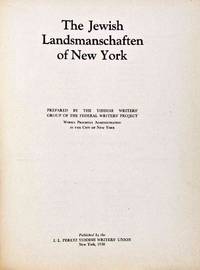
193842985Nyu York New York: Aroysgegeben fun Y.L. Perets shrayber fareyn 1938. First edition. Original printed leather binding 4to 397 3 pages. Includes illustrations and facsimiles. 29 cm. In Yiddish. Title translates as “The Jewish Mutual Aid Societies of New York.â€<br> Research project led by the Works Progress Administration which contains articles about the history and activities of Jewish mutual aid societies in New York. Contains reviews of landmanshaft publications as well as a directory of all landsmanshaftn in the New York. <br> “Landsmanshaftn are societies formed by Jewish immigrants from the same villages towns and cities in Central and Eastern Europe. The landsmanshaft became a dominant form of Jewish social organization in the late 1800s. The many types of landsmanshaftn include religious and socialist organizations as well as American-style fraternal orders. Landsmanshaftn provided immigrants with formal and informal social networks and members helped one another with financial needs such as medical care and burial plots. In 1938 a Federal Works Progress Administration WPA project identified 2468 landsmanshaftn in New York City. The number of landsmanshaftn began to decline in the 1950s though some societies continue to exist today.†Center for Jewish History<br> SUBJECTS: Jews -- New York State -- New York. Fraternal organizations -- New York State -- New York. Jews. OCLC: 1018012020.<br> Wear to spine and inside hinges Good Condition. YIZ-23-32S-CCLEX. Nyu York [New York]: Aroysgegeben fun Y.L. Perets shrayber fareyn unknown
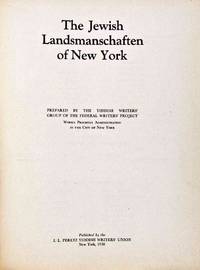
193843069Nyu York New York: Aroysgegeben fun Y.L. Perets shrayber fareyn 1938. First edition. Original printed leather binding 4to 397 3 pages. Includes illustrations and facsimiles. 29 cm. In Yiddish. Title translates as “The Jewish Mutual Aid Societies of New York.â€<br> Research project led by the Works Progress Administration which contains articles about the history and activities of Jewish mutual aid societies in New York. Contains reviews of landmanshaft publications as well as a directory of all landsmanshaftn in the New York. <br> “Landsmanshaftn are societies formed by Jewish immigrants from the same villages towns and cities in Central and Eastern Europe. The landsmanshaft became a dominant form of Jewish social organization in the late 1800s. The many types of landsmanshaftn include religious and socialist organizations as well as American-style fraternal orders. Landsmanshaftn provided immigrants with formal and informal social networks and members helped one another with financial needs such as medical care and burial plots. In 1938 a Federal Works Progress Administration WPA project identified 2468 landsmanshaftn in New York City. The number of landsmanshaftn began to decline in the 1950s though some societies continue to exist today.†Center for Jewish History<br> SUBJECTS: Jews -- New York State -- New York. Fraternal organizations -- New York State -- New York. Jews. OCLC: 1018012020.<br> Slight wear on spine. Good Condition. YIZ-23-32S-CCLEX. Nyu York [New York]: Aroysgegeben fun Y.L. Perets shrayber fareyn unknown
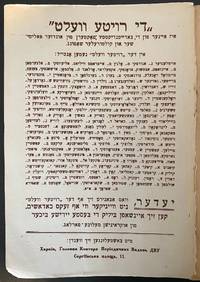
193017315Kharkov Ukraine: Ukrinishn Melukhe-Farlag 1930. 1st edition. Original Paper Wrappers lacks front wrapper 8vo 160 pages. 21 cm. In Yiddish. Di Royte Velt was a monthly Yiddish literary magazine which began publication in 1924. <br> “The Yiddish literary journal Di royte velt The Red World published in 1924-33 in Kharkiv Kharkov in Russian then the Ukrainian capital was one of the strongholds of 'anti-Litvakovism'. In general terms the story of Di royte velt represents an insightful chapter in the history of Soviet Yiddish literary life of the 1920s and 1930s.<br> In 1924 there arose the question of moving the Yiddish literary centre from Kiev to Kharkiv and of launching a Kiev-based Yiddish literary journal. This matter was discussed in a special memorandum of the Press Department of the Central Committee of the Ukrainian Communist Party. The head of the department M. Ravitsh-Cherkasky was Jewish. Motl Kiper the head of the Ukrainian Jewish Section backed this proposal arguing that Yiddish literature would benefit immensely from the capital's proletarian environment where it would liberate itself from the nationalist and Yiddishist hang-ups of Kiev.<br> In reality the Kharkiv Jewish proletariat was more acculturated than elsewhere in Ukraine: only 36 per cent of Kharkiv Region's Jewish trade unionists were Yiddish-speakers compared with 89 per cent in the Berdichev Region 55 per cent in the Kiev Region and 42 per cent in the Odessa Region.<br> It was no easy matter to create overnight a literary centre in a city which had a number of journalists but no literary lions. Moshe Taitsh for instance had been transferred to Moscow to reinforce the editorial staff of Der emes.<br> For all that the apparatchiks' initiative resulted in creating in Kharkiv a new Yiddish literary journal Di royte velt.<br> The first editors of Di royte velt were Henekh Kazakevich and M. Ravitsh-Cherkasky. While the latter was a king for a day in Yiddish literatureKazakevich was a remarkable figure in Soviet Yiddish journalism….<br> The first issue of the new journal appeared in September 1924 with a print-run of 2000. It was labelled a 'political-social literary-scientific bi-weekly journal'. Indeed the first issue contained only two literary works: a poem by Itsik Fefer and a story by Shmuel Persov. The other materials were devoted to theatre politics cosmology and literary criticism. Significantly the journal stressed its international character. <br> Among its potential contributors we find the names of the editors and writers of the New York communist Yiddish daily Frayhayt Freedom Moshe Olgin Morris Vinchevsky Shakhne Epshtein Moshe Kats and Moshe Nadir. Also it was announced that the Vilna-based Boris Kletskin publishing house was preparing for publication books by four Soviet writers listed among the journals' contributors: Arn Kushnirov Moshe Khashtshevatsky Ezra Finninberg and Nokhum Oislender†Gennady Estraikh 2002: 'The Kharkiv Yiddish literary world 1920s-mid-1930s'East European Jewish Affairs 32: 2 70 — 88; for Estraikh’s extensive discussion of the importance of Di Royte Velt see the full article at https://www.yiddishweb.com/wp-content/uploads/2018/01/Kharkiv-Yiddish_Estra ikh.pdf. <br> SUBJECTS : Yiddish literature -- Periodicals. OCLC: 10594044. <br> Lacks Yiddish cover and 1st 2 leaves. Russian cover is present. YID-47-6. Kharkov [Ukraine]: Ukrinishn Melukhe-Farlag unknown
189843426New York: N.M. Shaikewitz 1898. First edition staple binding 4to 29-31 pages each issue 30 cm. In Yiddish. <br> Three issues of Di Tsayt a monthly Yiddish language publication published in New York. The journal ran from 1897-1898. Singerman S582; Freidus p. 282 Weissberger 56. <br> "Menahem Mendel Dolitzky was a Hebrew and Yiddish poet and novelist. Born in Bialystok he received a traditional Orthodox education and as a teenager became interested in the ideas of the Haskalah.He served as a Hebrew teacher in various towns and in 1881 was an eyewitness to pogroms in southern Russia which had a profound effect on him.<br> .In 1892 when the Jews were expelled from Moscow Dolitzki emigrated to New York and was warmly received by the small band of Hebrew maskilim in the U.S. He began publishing descriptions of the persecution of Jews in Russia in the journal Ha-Ivri mainly in poetic form.Despite the efforts of the Hebraists in the U.S. to assist him he found no way of making a living from Hebrew writing. After working at various jobs he finally took up writing for the daily Yiddish press turning out serialized novels which catered to the popular reader" EJ. <br> <br> SUBJECTS: Jews -- New York State -- New York -- Periodicals. Yiddish literature -- Periodicals. Jews. Yiddish literature. OCLC: 50546431. OCLC and Singerman together locate 4 complete holdings Harvard NYPL YIVO HUC and one of vol I only Yale. <br> <br> Lacks original outer paper wrappers some toning Good Condition Scarce YID-48-109. [New York: N.M. Shaikewitz] unknown
193042139Kiev: Katedr far Yidisher Kultur ba der Ukr. Visnshaftl. Akademye Filologishe Sektsye 1930. Paper Wrappers. 1st edition. Original printed publisher’s color paper wrappers 4to large ca 72-116 columns ca 36-58 pages per issue. 28 cm. In Yiddish. Title translates roughly as “The Yiddish Language.†Succeeded in 1931 by “Afn shprakhfront.â€Di Yidishe Shprakh was a “Yiddish linguistic journal published in Kiev from 1927 to 1930. A bimonthly journal Di yidishe shprakh The Yiddish Language was published by the cooperative publishing house Kultur-lige and was the main philological publication of the Kiev Yiddish academic center. Its editor was the veteran Yiddishist Nokhem Shtif a founder of YIVO who had returned to Kiev from Germany in 1926. The journal’s inaugural issue March–April 1927 was published under the auspices of the Central Yiddish Bureau of the Ukrainian Commissariat for Education. With the next issue Di yidishe shprakh was an organ of the Chair and from July to October 1929 it was an organ of the Institute for Jewish later Proletarian Jewish Culture at the Ukrainian Academy of Sciences. Initially defined as a 'journal for practical Yiddish linguistics' from May to June 1927 it appeared as simply a 'journal for Yiddish linguistics. 'Shtif distinguished three language registers: the vernacular of the old generation partly represented in the works of Sholem Aleichem and predecessors; the highbrow language of modern writers such as Dovid Bergelson; and the contemporary 'culture language' most notably of the press. Although Shtif sought to target speakers of the mass 'culture language' the journal’s circulation hovered around 500 copies read mainly by Yiddish teachers.Apart from Shtif who published articles on various language-planning problems the most active contributors to Di yidishe shprakh were Ber Slutski Ayzik Zaretski Elye Falkovitsh Lipe Reznik and Shimen Dobin. In early 1929 Moscow literary critic Aron Gurshteyn criticized the journal for its purist approach to language planning. In the July–October 1929 issue Shtif published his article 'Di sotsyale diferentsiatsye in yidish' The Social Differentiation in Yiddish heralding an intensification of Soviet linguists’ anti-Hebraist campaign. That issue of Di yidishe shprakh adopted completely reformed Soviet spelling omitting for example final consonant letters.Although the last—twenty-fifth—issue of the journal was dated November–December 1930 it included materials from the First All-Union Yiddish Language Conference convened in Kiev from 8 to 13 February 1931 that issue is present here. Published under the imprint of the Central Publishing House this issue also signaled the demise of the remaining vestiges of the Kiev Kultur-lige. Yoysef Liberberg’s article 'Far parteyishkayt in der yidisher visnshaft-arbet' For a Party Approach to Yiddish Linguistics marked a full break with YIVO scholars particularly with YIVO director Max Weinreich whom Liberberg ridiculed for presenting Yiddish as an emanation of the Ashkenazic Jews’ soul. The Yiddish Language Conference decided to change the name of the journal. Between 1931 and 1939 it appeared sporadically under the title Afn shprakhfront On the Language Front reflecting its new more aggressive and politically charged approach' Gennady Estraikh in YIVO Encyclopedia of Jews in Eastern Europe 2010. For more see David Shneer “Yiddish and the Creation of Soviet Jewish Culture 1918–1930†Cambridge and New York 2004. SUBJECTS: Yiddish language -- Periodicals. Title also listed on covers in Russian “Ievreis'ka Mova†and German “Jiddische Sprachâ€. OCLC: 22840298. Most holdings in OCLC appear to be fragmentary. Covers are browning and fragile as expected but are otherwise very well preserved with very little edgewear. Internal text pages are also toning but remain relatively strong as pulp paper. Very important journal scarce in this degree of completeness Note that Estraikh suggests a circulation of only 500!. B YID-43-5-E. Kiev: Katedr far Yidisher Kultur ba der Ukr. Visnshaftl. Akademye, Filologishe Sektsye unknown
1938297232Peretz Yiddish Writer's Union 1938. Hardcover . Good. 397 pages in Yiddish tears to spine and side of spine covers worn stained black mark on yiddish copy right page Peretz Yiddish Writer's Union hardcover
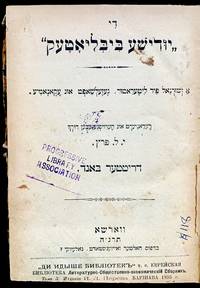
189543079Warsaw: Izdanie I.L. Perets 1895. First edition period boards 8vo 179 pages. 23 cm. In Yiddish. Title translates as “The Jewish Library: A Journal for Literature Society and Economics.â€<br> Third volume of semiannual publication edited by I.L. Peretz. Di Yudishe Bibliotek was published periodically between 1891 and 1904. This issue includes belle-lettres poetry and scientific essays.<br> “To encourage Jews toward a wider knowledge of secular subjects Peretz for several years wrote articles on physics chemistry economics and other subjects for Di yudishe bibliotek which he also edited.†Encyclopedia Britannica.<br> Yitskhok Leybush Peretz 1852-1915 is one the best known Yiddish and Hebrew authors of the 19th century. Peretz was one of the three classic Yiddish writers with S. Y. Abramovitsh and Sholem Aleichem and the founder of Yiddish modernism. In the first decade of the 20th century he was at the center of an active literary circle in Warsaw. <br> SUBJECTS: Yiddish literature -- Poland -- Periodicals. Jews -- Poland -- Periodicals. Jews. Yiddish literature. OCLC: 992802478. <br> Ex-library with usual markings and normal wear and age to pages but otherwise in good condition. Good Condition. YID-46-19-GGLEX-’cc. Warsaw: [Izdanie I.L. Perets] unknown
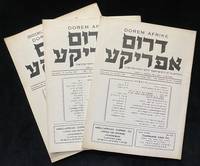
199042134Yohanesburg Johannesburg South Africa: Dorem Afrikaner Yidisher Kultur Federatsye 1990. Paper Wrappers. 1st edition. Original wrappers. 8vo. Approximately 32 pages each 23 cm. In Yiddish withs some English advertisements. Title translates to "South Africa." South Africa's most well-known Yiddish journal published in Johannesburg from 1948-1991. Interesting period covered here the tumult of the late 60s. SUBJECTS: Jews -- Periodicals. Yiddish literature -- Periodicals. OCLC: 01800240. Very Good Condition.Price per issue please specify YID-33-48AXX-EL. Yohanesburg [Johannesburg, South Africa]]: Dorem Afrikaner Yidisher Kultur Federatsye unknown
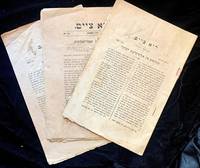
194542269New York Der Komitet 1945. Paperback. 1st edition. Paper Wrappers Folio Road Atlas size 35 cm 32 pages. "Unity." <br> Yiddish Communist bimonthly from May 1944-Jan 15 1945 then monthly through 1947 for writers artists and scientists a periodical certainly read by many of those swept up in the Atom Spy witchhunts 10 years later. <br> "Aroysgegebn fun Komitet fun Yidishe shrayber kinstler un visnshaftler in Amerike." Preceded by periodical of the same name also published in New York in 1942. Important issues from the early post war period. <br> <br> SUBJECTS : Jewish communists -- United States -- Periodicals. <br> <br> January issue missing front cover which is pages 1-2; February issue has detached covers but complete. Good strong white paper. Good Condition Thus B Y-37D. New York, Der Komitet paperback
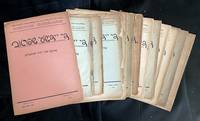
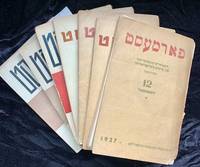
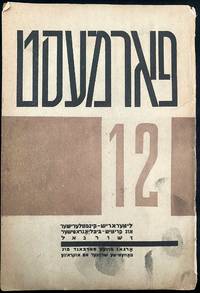
193743101Kharkov: Ukrmelukhenatsmindfarlag 1937. First edition. Original illustrated paper wrappers 8vo issues range from 129-196 pages each. Includes illustrations. 21-23 cm. In Yiddish. Title translates roughly as “Challenge: A Literary Artistic and Critical Bibliographical Journal.â€<br> At the time the only Yiddish literary periodical in Ukraine.<br> Farmest 1933–1937 was a monthly Yiddish literary magazine published in Kharkhiv Ukraine by the Ukrainian Committee for Soviet Writers. “Edited by the poet Itsik Fefer 1900–1952 it was continued in Sovetishe literatur: Literarish-kinstlerisher un kritish-bibliografisher zhurnal Soviet Literature: Literary-Artistic and Critical-Bibliographical Journal; 1938–1941.<br> In 1927 Fefer was a founding member of the Jewish Section of the All-Ukrainian Union of Proletarian Writers and from 1928 one of the editors of its Kharkov-based journal Prolit Proletarian Literature. He also coedited the nonproletarian Kharkov journal Di royte velt The Red World from 1929. From 1933 to 1937 he edited the Kiev periodical Farmest Challenge; known as Sovetishe literatur Soviet Literature between 1938 and 1941 which replaced Prolit and Di royte velt and was thereafter the only Yiddish literary periodical in Ukraine.†YIVO. Avrom Gontar was also involved in the collective and editorial committee. <br> The editor Itsik Fefer 1900–1952 “began writing poems in 1918 and in 1922 joined Vidervuks New Growth in Kiev a group of young Yiddish literati whose mentor was Dovid Hofshteyn. That same year the appearance of Fefer’s small collection Shpener Splinters established him as a rising literary star. His poetry amalgamated the Kultur-lige poets’ revolutionary romanticism with the propagandist objectives of the workers’ movement.<br> Fefer was known for his literary credo of proste reyd simple speech a concept he formulated in 1922. In the early 1920s poetry particularly avant-garde poetry swamped the literary pages of Soviet Yiddish periodicals. This phenomenon worried editors and critics who were wary of the fact that Yiddish readers usually could not identify with this style of literature. All Yiddish readers by contrast could understand Fefer’s proste reyd.<br> In 1927 Fefer was a founding member of the Jewish Section of the All-Ukrainian Union of Proletarian Writers and from 1928 one of the editors of its Kharkov-based journal Prolit Proletarian Literature. He also coedited the nonproletarian Kharkov journal Di royte velt The Red World from 1929†Gennady Estraikh.<br> For more see: Gennady Estraikh “The Kharkiv Yiddish Literary World 1920s–Mid-1930s†East European Jewish Affairs 32.2 2002: 70–88; Chone Shmeruk “Yiddish Literature in the U.S.S.R.†in The Jews in Soviet Russia since 1917 ed. Lionel Kochan pp. 242–280 London and New York 1970.<br> SUBJECTS: Yiddish literature -- Ukraine -- Periodicals. Yiddish literature. OCLC: 35051038.<br> Some pages brittle some wear to spines. Overall Good Condition. Rare. YID-46-2-LGG-’excc. Kharkov: Ukrmelukhenatsmindfarlag unknown
193543308Kharkov: Ukrmelukhenatsmindfarlag 1935. First edition. Original illustrated paper wrappers 8vo 156 pages.Includes illustrations. 21-23 cm. In Yiddish. Title translates roughly as “Challenge: A Literary Artistic and Critical Bibliographical Journal.â€<br> At the time the only Yiddish literary periodical in Ukraine.<br> Farmest 1933–1937 was a monthly Yiddish literary magazine published in Kharkhiv Ukraine by the Ukrainian Committee for Soviet Writers.<br> “Edited by the poet Itsik Fefer 1900–1952 it was continued in Sovetishe literatur: Literarish-kinstlerisher un kritish-bibliografisher zhurnal Soviet Literature: Literary-Artistic and Critical-Bibliographical Journal; 1938–1941.<br> In 1927 Fefer was a founding member of the Jewish Section of the All-Ukrainian Union of Proletarian Writers and from 1928 one of the editors of its Kharkov-based journal Prolit Proletarian Literature. He also coedited the nonproletarian Kharkov journal Di royte velt The Red World from 1929. From 1933 to 1937 he edited the Kiev periodical Farmest Challenge; known as Sovetishe literatur Soviet Literature between 1938 and 1941 which replaced Prolit and Di royte velt and was thereafter the only Yiddish literary periodical in Ukraine.†YIVO. Avrom Gontar was also involved in the collective and editorial committee. <br> The editor Itsik Fefer 1900–1952 “began writing poems in 1918 and in 1922 joined Vidervuks New Growth in Kiev a group of young Yiddish literati whose mentor was Dovid Hofshteyn. That same year the appearance of Fefer’s small collection Shpener Splinters established him as a rising literary star. His poetry amalgamated the Kultur-lige poets’ revolutionary romanticism with the propagandist objectives of the workers’ movement.<br> Fefer was known for his literary credo of proste reyd simple speech a concept he formulated in 1922. In the early 1920s poetry particularly avant-garde poetry swamped the literary pages of Soviet Yiddish periodicals. This phenomenon worried editors and critics who were wary of the fact that Yiddish readers usually could not identify with this style of literature. All Yiddish readers by contrast could understand Fefer’s proste reyd.<br> In 1927 Fefer was a founding member of the Jewish Section of the All-Ukrainian Union of Proletarian Writers and from 1928 one of the editors of its Kharkov-based journal Prolit Proletarian Literature. He also coedited the nonproletarian Kharkov journal Di royte velt The Red World from 1929†Gennady Estraikh.<br> For more see: Gennady Estraikh “The Kharkiv Yiddish Literary World 1920s–Mid-1930s†East European Jewish Affairs 32.2 2002: 70–88; Chone Shmeruk “Yiddish Literature in the U.S.S.R.†in The Jews in Soviet Russia since 1917 ed. Lionel Kochan pp. 242–280 London and New York 1970.<br> SUBJECTS: Yiddish literature -- Ukraine -- Periodicals. Yiddish literature. OCLC: 35051038.<br> Pages toning as expected some sunning and stains to cover Good Condition. BYID-46-2A-LGG-’excc. Kharkov: Ukrmelukhenatsmindfarlag unknown
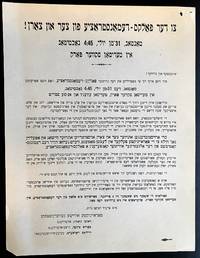
194443416No Place New York Fereynigte Yidishe Geverkshaftn United Hebrew Trades 1944. 1st edition broadside single-sided flyer 4to. In Yiddish. <br> <br> Translation: "ALL OUT TO THE PUBLIC DEMONSTRATION OF GRIEF AND RAGE!<br> Monday July 31st 4:45 PM<br> in Madison Square Park<br> <br> Sisters and brothers!<br> We invite you to participate in the great public demonstration that will take place<br> Monday July 31 4:45 p.m.<br> in Madison Square Park Madison Avenue and 24th Street<br> <br> Millions of Jews were murdered by the Nazis in all parts of Europe. Young and old women and men were driven into gas and death chambers and destroyed. In the current hour the greatest danger for those still alive in the Nazi countries.<br> The Hitlerian beast which conquered and humiliated countries and murdered millions of people is ready to strangle and murder the surviving remnants of the Jewish people. Hundreds of thousands of Jews from Hungary are now in danger of death the tens of thousands of Jews left alive in Poland in France in Belgium in the Czech Republic where they are under Hitler's rule.<br> <br> In order to express our grief and anger to cry out our grief and appeal for help to the United Nations at the last moment a public demonstration is called by the Rescue Committee of the General Jewish Conference.<br> <br> We cannot and must not remain silent. People must help save the survivors. Come express your feelings desires and demands! It is demanding that the United Nations do everything possible to stop the death march! It is demanded that all those who are guilty of the murders will be brought to justice!<br> The Nazi victims who are now struggling between death and life must know that we are with them.<br> At a conference of representatives of the trade union organizations called by the Jewish Labor Committee it was decided to actively participate in the great national demonstration. We must do everything we can so that the demonstration will be imposing and effective.<br> <br> Leave the store no later than 4 o'clock. Marched to the site of the demonstration in Madison Square Park. Overtime is not allowed on this day.<br> With Trade Union Regards<br> United Hebrew Trades<br> Reuven Guskin President<br> Maurice Tigel Vice-President<br> William Wolpert Executive Secretary"<br> <br> <br> The rally was covered by the Jewish Telegraphic Agency JTA the next day:<br> <br> "Tens of thousands of Jews and non-Jews crowded Madison Square Park today at an open-air mass-demonstration in behalf of the Jews of Hungary and other parts of Nazi Europe sponsored by the 64 affiliated agencies of the American Jewish Conference with the cooperation of the American Jewish Committee and other national organizations.<br> Speakers at the demonstration included Assistant U. S. Attorney General Norman M. Littell who is secretary of the National Committee Against Persecution of Jews; Dr. Stephen S.Wise president of the American Jewish Congress and co-chairman of the American Jewish Conference; Judge Joseph M. Proskauer president of the American Jewish Committee; Henry Monsky president of B'nai B'rith and co-chairman of the American Jewish Conference; Adolph Held president of the Jewish Labor Committee and many other noted Jewish and Christian leaders.<br> The huge mass-meeting in which Jews from all walks of life participated adopted a declaration stating that it is not yet too late 'to save thousands upon thousands' of Jews for the day of liberation. The meeting appealed in the first instance to President Roosevelt and the Government of the United States and through them to the United Nations and to the neutral states." <br> <br> The original JTA covers including a full list of the demands from the rally and other details can be viewed at www.jta.org/archive/huge-open-air-demonstration-in-new-york-demands-rescue-of-jews-from-europe<br> <br> Leading national Jewish organizations organized this July 31 1944 Madison Square Park mass rally to demand Allied action against the Nazi slaughter of European Jews. <br> New York had at the time the world's biggest Jewish population with a Jewish community of around 2 million. The city had hosted numerous similar rallies over the previous decade all focused on building opposition to Hitler and support for the struggling Jews of Europe. <br> <br> Beginning on March 4 1934 "One year after Hitler's ascension to power in Germany tens of thousands of New Yorkers gathered at Madison Square Garden to hear the words of Rabbi Stephen Wise. 'Despite the oceanic tragedy which has befallen us' Wise pronounced 'we Jews tonight joining in the chorus of civilization indict Hitlerism as humans as members of civilized society before the high court of human judgment.' <br> Wise's words resonated for audience members attending the rally that March night. Over the course of the evening they heard from a chorus of voices representing the American public self-identifying across different racial religious and ideological lines. Framed as a 'court' the speakers at the rally gathered to indict Hitler for his crimes against civilization an intentionally pointed term that would offend Nazi ideologues claiming to protect civilization through Aryan supremacy. This mock trial was part of a larger trend of American Jewish protest performances staged during the Third Reich that intended to garner support for the rescue of European Jews.<br> On March 27 the AJCongress American Jewish Congress successfully staged a rally titled Stop Hitler Now to an audience of twenty thousand Jews in Madison Square Garden. Outside of the Garden thirty-five thousand people stood protesting and ten thousand more marched through Brooklyn in solidarity. Simultaneous protests also occurred in major cities across the country. The United Press estimated that one million protesters participated in the nationwide demonstration that day. <br> In retaliation to the American uproar Hitler threatened a one-day boycott against German Jewish businesses to be resumed three days later if 'international protests' did not cease. Wise after speaking with Undersecretary William Phillips at the State Department agreed to a brief silence on the matter" Gonzalez Maya. Imagining the "Day of Reckoning": AmericanJewish Performance Activism during the Holocaust. Masters Thesis UMass-Amherst 2023. https://hdl.handle.net/20.500.14394/33069 <br> We could locate no recorded examples of this flyer anywhere using OCLC ArchiveGrid or a google search. <br> <br> Staple hole in upper right corner margin slight corner loss to lower left margin no text affected in either case light toning about Very Good Condition. Rare and displayable Holo2-163-30. No Place [New York], Fereynigte Yidishe Geverkshaftn [United Hebrew Trades] unknown