63 résultats
193735363New York; Posy-Shoulson Press 1937. 1st edition. Original Wraps. 4to. 4 171 2 23 pages. 28 cm. In Yiddish with English section and title page: Ten years Artef; published for the tenth anniversary of the Artef March 1937. <br> Extensively illustrated publication for the tenth year anniversary of the radical Yiddish theatre company Artef:<br> "the radical Yiddish dramatic troupe based in New York during the heyday of the Yiddish theater in America. Begun in the mid-1920s as a study group of amateur worker-actors at one time there were nine separate studios with over 120 students in the 1930s the troupe went professional putting on at least two and often three new plays per season. With such plays as Jacob Mostel 's Strike Shmuel Godiner 's Jim Kooperkop Avrum Vevioka 's Diamonds and Maxim Gorky 's Egor Bulychev and Dostigaev and Others Artef spread propaganda to the masses. Ideologically Artef was far left; its hope was a Communist society here in America. As a troupe its role was 'agit-prop' to agitate and propagandize to serve as the cultural representative of radical workers. In fact most of its tickets were pre-sold through worker unions and at least in its early years Artef gave presentations at political events.<br> Its first large-scale production was Mass Play and Ballet of the Russian Revolution which appeared at the Lenin memorial celebration in Madison Square Garden on January 21 1928. <br> Artef 's greatest artistic and commercial successes were connected with the talented productions of director Benno Schneider. Schneider who had been active in the Zionist Habima troupe in Moscow wed aesthetic excellence to revolutionary ideology with his interpretation of Aristocrats an adaptation of Sholem Aleichem 's Mentshn. Incidentally Schneider earned such a positive reputation with Artef that he received offers to direct on Broadway a promotion that cost the radical Yiddish theater dearly. <br> The end of the Artef was gradual and its causes were closely associated with the reduced role of Yiddish in American life. But there were bright lights before the darkness. During the 'days of the Popular Front ' when the Communists formed associations with less radical leftist parties the Artef attracted a larger audience which led to an optimistic expansion that later was responsible for huge financial losses. The darkness occurred at the end of the thirties when the number of Yiddish speakers began to diminish. The last performance of the Artef was on July 7 1941." Review by Dr. Brian Horowitz of 'Yiddish Proletarian Theatre: The Art and Politics of the Artef 1925–1940 ' written by Edna Nahshon. <br> Many of the actors and directors in Artef went on to establish solid careers on Broadway Hollywood and for those blacklisted overseas. <br> Bound in brown velour wraps with gilt title. Heavily illustrated. <br> Subjects: Arbeiter theatre verband New York. Jewish theater. Theater - New York State - New York. Artef - Anniversaries etc. <br> OCLC: 19310798. <br> Light wear to edges of wraps otherwise clean and fresh. Good condition. B YID-22-9-LEBWW. New York; Posy-Shoulson Press unknown
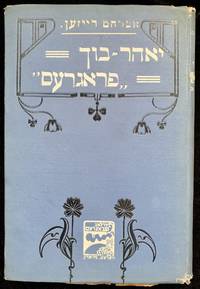
190443110Varsha Warsaw: Ferlag "Progress 1904. First edition. Original illustrated printed boards 8vo 162 32 pages plus 7 unnumbered leaves of plates with illustrations. 22 cm. In Yiddish. Title translates as “Yearbook ‘Progress’: A Journal for Literature Science and Criticism.â€<br> “Abraham Reisen was a Yiddish poet short-story writer playwright and editor…While he was still a teenager his talent was recognized by Shalom Aleichem and I.L. Peretz who arranged for the publication of his earliest poems. After some years in Minsk Warsaw Krakow and Berlin he settled permanently in New York in 1914. Influenced by Heinrich Heine whom he translated into Yiddish he was one of the first Yiddish poets to make use of folksong material. His poetry though mostly written in conventional quatrains is suffused by a refined sensibility that adumbrates the writing of Di Yunge.†Jewish Virtual Library<br> â€In 1900 Yakov Lidski founded "Progress" publishing house. Its name clearly communicated its goal. This publishing company considered to be the first to deal with modern Yiddish literature published a series of original and translated popular science books along with translated European literature and original Yiddish literature. The first editor of the publishing house was poet Avrom Reyzen.†Wikipedia. <br> SUBJECTS: Yiddish literature. Jews -- Poland -- Periodicals. OCLC: 21651882<br> Wear to spine some page separation toning and markings. About Good Condition. YID-46-28-GGLEX-’cc. Varsha [Warsaw]: Ferlag "Progress unknown
19461116373New York: Jewish Encyclopedic Handbooks Central Yiddish Culture Organization CYCO. Fine maroon leatherbound 2 volume set gilt all edges Volume 1 has 430 pp with B/W illustrations; Volume 2 has 430 pp with B/W illustrations. . Fine. Leather Bound. 1946. Jewish Encyclopedic Handbooks Central Yiddish Culture Organization (CYCO hardcover
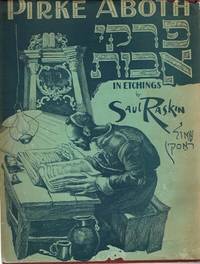
19387471NY: Academy Photo Offset Inc. Very Good in Good dust jacket. 1938. First Edition Thus. 1. Hard Cover. Publisher's full burgundy cloth Hebrew lettering gilt on cover. title page in color. Illustrated with fine etchings by Saul Raskin Text in English and Hebrew. Covers very lightly soiled Hebrew inscriptions on ffep very mildly shelf-worn else fine. The dust jacket now in Mylar is moderately chipped with some loss at the head of the spine. All of the etchings are in bright clean condition. VERY GOOD/VERY GOOD. . Etchings. 4to 11" - 13" tall. 124 2 pp . Academy Photo Offset, Inc. hardcover
1926biblio39295New York: Boni and Liveright; First Edition 1926. 145 pp 2 pp musical score. Good Hardcover no dj. DarkCyan cloth. Remnant of the Spine title label. No Wear to the cover. Soiled Endpapers. Clean Unmarked text. Strong Tight binding and hinges. 7.8"x5.25"x0.9". be27491. Boni and Liverigh hardcover
194542269New York Der Komitet 1945. Paperback. 1st edition. Paper Wrappers Folio Road Atlas size 35 cm 32 pages. "Unity." <br> Yiddish Communist bimonthly from May 1944-Jan 15 1945 then monthly through 1947 for writers artists and scientists a periodical certainly read by many of those swept up in the Atom Spy witchhunts 10 years later. <br> "Aroysgegebn fun Komitet fun Yidishe shrayber kinstler un visnshaftler in Amerike." Preceded by periodical of the same name also published in New York in 1942. Important issues from the early post war period. <br> <br> SUBJECTS : Jewish communists -- United States -- Periodicals. <br> <br> January issue missing front cover which is pages 1-2; February issue has detached covers but complete. Good strong white paper. Good Condition Thus B Y-37D. New York, Der Komitet paperback
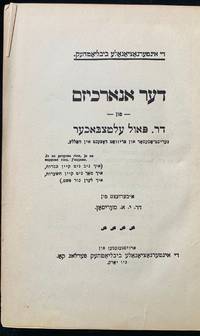
190943139New York: Internatsyonale bibliothek Verlag ko 1909. First edition. Original boards 8vo 347 pages 21 cm. In Yiddish. Title translates as “Anarchism.â€<br> Translation of Paul Eltzbacher’s “Anarchism†into Yiddish. In it he covers seven anarchist figures: Godwin Proudhon Stirner Bakunin Kropotkin Tucker and Tolstoy. Includes bibliographical references.<br> “Jacob Abraham Maryson was a Jewish–American anarchist doctor essayist and Yiddish translator. Maryson was among the few Pioneers of Liberty who could write in English. He was among the Pioneers who launched the Varhayt in 1889 the first American anarchist periodical in Yiddish….Maryson contributed to a variety of other Yiddish publications and became known as ‘the Kropotkin of the Jewish anarchist movement’. During Fraye Arbeter Shtime's hiatus in the late 1890s Maryson assisted in the cultural and literary journal Di Fraye Gezelshaft. Beginning in 1911 he edited the anarchist periodical Dos Fraye Vort. Maryson organized the Kropotkin Literary Society to print Yiddish translations of European thinkers. Maryson handled some of the group's most challenging translations including Marx's Das Kapital Stirner's The Ego and His Own and Thoreau's Civil Disobedience. He also translated John Stuart Mill's On Liberty. Maryson later wrote The Principles of Anarchism in 1935.†Wikipedia.<br> SUBJECTS: Anarchism. OCLC: 19304220<br> Very Good Condition. YID-48-3-. New York: Internatsyonale bibliothek Verlag ko unknown
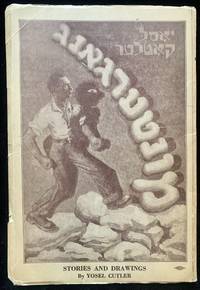
193443320Nyu York New York: Farlag Signal 1934. Original illustrated paper wrappers 8vo 190 pages including illustrations. 20 cm In Yiddish. The title translates as “Underground†or “Success.â€<br> Nazi-era Poetry and fiction by Yosl Cutler with illustrations by the author. <br> “A mish-mosh of wildly creative stories and illustrations by Yosl Cutler one of the most original and unique characters in Yiddish cultural life. Includes one of the first Yiddish science fiction stories ‘Afn shtern mars’ On the Planet Mars as well as a great deal of left wing political work in prose poem and cartoon.†Yiddish Book Center. <br> “Cutler was born in Troyanets Volhynia. He studied in religious elementary school. He was orphaned in his youth and at age eleven he became a server in a tavern. He mastered sign painting and in 1911 departed for the United States. He pursued his study of painting and in 1925 he created with the artists Zuni Maud and Jack Tworkov a Yiddish marionette theater called “Modicut†which proved successful in the United States and Europe but didn’t last long because of the great expenses involved. Under the influence of Moyshe Nadir in 1922 he began writing poetry humorous sketches stories and short plays… Of his short plays that were published in journals: Di sokhrim fun fefer Merchants of pepper; Der kindermark The children’s market; and Mayn filozofisher vesher My philosophical laundry; among others. In book form: Muntergang Success New York 1934 190 pp. ‘Yosl Kotler worked in three realms’ wrote M. Olgin ‘which merged into one: writer of humor cartoonist and marionette operator.’ He died in Memphis.†Leksikon Fun Der Nayer Yidisher Literatur<br> SUBJECTS: Yiddish wit and humor. Jewish wit and humor. Short stories Yiddish. Yiddish drama. OCLC: 23578196<br> Clean copy with some worn edges. Good Condition YID-48-75-MLX-’ggecc. Nyu York [New York]: Farlag Signal unknown
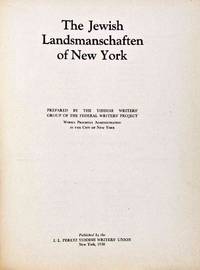
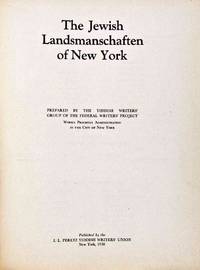
193842985Nyu York New York: Aroysgegeben fun Y.L. Perets shrayber fareyn 1938. First edition. Original printed leather binding 4to 397 3 pages. Includes illustrations and facsimiles. 29 cm. In Yiddish. Title translates as “The Jewish Mutual Aid Societies of New York.â€<br> Research project led by the Works Progress Administration which contains articles about the history and activities of Jewish mutual aid societies in New York. Contains reviews of landmanshaft publications as well as a directory of all landsmanshaftn in the New York. <br> “Landsmanshaftn are societies formed by Jewish immigrants from the same villages towns and cities in Central and Eastern Europe. The landsmanshaft became a dominant form of Jewish social organization in the late 1800s. The many types of landsmanshaftn include religious and socialist organizations as well as American-style fraternal orders. Landsmanshaftn provided immigrants with formal and informal social networks and members helped one another with financial needs such as medical care and burial plots. In 1938 a Federal Works Progress Administration WPA project identified 2468 landsmanshaftn in New York City. The number of landsmanshaftn began to decline in the 1950s though some societies continue to exist today.†Center for Jewish History<br> SUBJECTS: Jews -- New York State -- New York. Fraternal organizations -- New York State -- New York. Jews. OCLC: 1018012020.<br> Wear to spine and inside hinges Good Condition. YIZ-23-32S-CCLEX. Nyu York [New York]: Aroysgegeben fun Y.L. Perets shrayber fareyn unknown
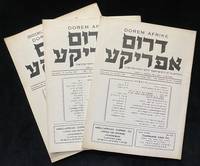
199042134Yohanesburg Johannesburg South Africa: Dorem Afrikaner Yidisher Kultur Federatsye 1990. Paper Wrappers. 1st edition. Original wrappers. 8vo. Approximately 32 pages each 23 cm. In Yiddish withs some English advertisements. Title translates to "South Africa." South Africa's most well-known Yiddish journal published in Johannesburg from 1948-1991. Interesting period covered here the tumult of the late 60s. SUBJECTS: Jews -- Periodicals. Yiddish literature -- Periodicals. OCLC: 01800240. Very Good Condition.Price per issue please specify YID-33-48AXX-EL. Yohanesburg [Johannesburg, South Africa]]: Dorem Afrikaner Yidisher Kultur Federatsye unknown
193843069Nyu York New York: Aroysgegeben fun Y.L. Perets shrayber fareyn 1938. First edition. Original printed leather binding 4to 397 3 pages. Includes illustrations and facsimiles. 29 cm. In Yiddish. Title translates as “The Jewish Mutual Aid Societies of New York.â€<br> Research project led by the Works Progress Administration which contains articles about the history and activities of Jewish mutual aid societies in New York. Contains reviews of landmanshaft publications as well as a directory of all landsmanshaftn in the New York. <br> “Landsmanshaftn are societies formed by Jewish immigrants from the same villages towns and cities in Central and Eastern Europe. The landsmanshaft became a dominant form of Jewish social organization in the late 1800s. The many types of landsmanshaftn include religious and socialist organizations as well as American-style fraternal orders. Landsmanshaftn provided immigrants with formal and informal social networks and members helped one another with financial needs such as medical care and burial plots. In 1938 a Federal Works Progress Administration WPA project identified 2468 landsmanshaftn in New York City. The number of landsmanshaftn began to decline in the 1950s though some societies continue to exist today.†Center for Jewish History<br> SUBJECTS: Jews -- New York State -- New York. Fraternal organizations -- New York State -- New York. Jews. OCLC: 1018012020.<br> Slight wear on spine. Good Condition. YIZ-23-32S-CCLEX. Nyu York [New York]: Aroysgegeben fun Y.L. Perets shrayber fareyn unknown
193017315Kharkov Ukraine: Ukrinishn Melukhe-Farlag 1930. 1st edition. Original Paper Wrappers lacks front wrapper 8vo 160 pages. 21 cm. In Yiddish. Di Royte Velt was a monthly Yiddish literary magazine which began publication in 1924. <br> “The Yiddish literary journal Di royte velt The Red World published in 1924-33 in Kharkiv Kharkov in Russian then the Ukrainian capital was one of the strongholds of 'anti-Litvakovism'. In general terms the story of Di royte velt represents an insightful chapter in the history of Soviet Yiddish literary life of the 1920s and 1930s.<br> In 1924 there arose the question of moving the Yiddish literary centre from Kiev to Kharkiv and of launching a Kiev-based Yiddish literary journal. This matter was discussed in a special memorandum of the Press Department of the Central Committee of the Ukrainian Communist Party. The head of the department M. Ravitsh-Cherkasky was Jewish. Motl Kiper the head of the Ukrainian Jewish Section backed this proposal arguing that Yiddish literature would benefit immensely from the capital's proletarian environment where it would liberate itself from the nationalist and Yiddishist hang-ups of Kiev.<br> In reality the Kharkiv Jewish proletariat was more acculturated than elsewhere in Ukraine: only 36 per cent of Kharkiv Region's Jewish trade unionists were Yiddish-speakers compared with 89 per cent in the Berdichev Region 55 per cent in the Kiev Region and 42 per cent in the Odessa Region.<br> It was no easy matter to create overnight a literary centre in a city which had a number of journalists but no literary lions. Moshe Taitsh for instance had been transferred to Moscow to reinforce the editorial staff of Der emes.<br> For all that the apparatchiks' initiative resulted in creating in Kharkiv a new Yiddish literary journal Di royte velt.<br> The first editors of Di royte velt were Henekh Kazakevich and M. Ravitsh-Cherkasky. While the latter was a king for a day in Yiddish literatureKazakevich was a remarkable figure in Soviet Yiddish journalism….<br> The first issue of the new journal appeared in September 1924 with a print-run of 2000. It was labelled a 'political-social literary-scientific bi-weekly journal'. Indeed the first issue contained only two literary works: a poem by Itsik Fefer and a story by Shmuel Persov. The other materials were devoted to theatre politics cosmology and literary criticism. Significantly the journal stressed its international character. <br> Among its potential contributors we find the names of the editors and writers of the New York communist Yiddish daily Frayhayt Freedom Moshe Olgin Morris Vinchevsky Shakhne Epshtein Moshe Kats and Moshe Nadir. Also it was announced that the Vilna-based Boris Kletskin publishing house was preparing for publication books by four Soviet writers listed among the journals' contributors: Arn Kushnirov Moshe Khashtshevatsky Ezra Finninberg and Nokhum Oislender†Gennady Estraikh 2002: 'The Kharkiv Yiddish literary world 1920s-mid-1930s'East European Jewish Affairs 32: 2 70 — 88; for Estraikh’s extensive discussion of the importance of Di Royte Velt see the full article at https://www.yiddishweb.com/wp-content/uploads/2018/01/Kharkiv-Yiddish_Estra ikh.pdf. <br> SUBJECTS : Yiddish literature -- Periodicals. OCLC: 10594044. <br> Lacks Yiddish cover and 1st 2 leaves. Russian cover is present. YID-47-6. Kharkov [Ukraine]: Ukrinishn Melukhe-Farlag unknown
67203E-363. Very Good. Hardcover. Hardcover. 8vo. Published by Harper & Row New York 1966. Xi 90 pgs. Illustrated. First Edition/First Printing. DJ has light shelf-wear present to the DJ extremities lower right corner of the DJ is clipped but price is still present to the top of the front flap. Bound in decorated cloth boards with titles present to the spine and front board. Boards have light shelf-wear present to the extremities. No ownership marks present. Text is clean and free of marks. Binding tight and solid. Nobel laureate Isaac Bashevis Singer introduces readers to the village of Chelm in this Newbery Honor Book. Chelm is a village of fools. The most famous foolsthe oldest and the greatestare the seven Elders. But there are lesser fools too: a silly irresponsible bridegroom; four sisters who mix up their feed in bed one night; a young man who imagines himself dead. Here are seven magical folktales spun by a master storyteller that speak of fools devils schlemiels and even heroeslike Zlateh the goat. ; 8vo 8" - 9" tall . hardcover
1970AM005New York: Farrar Straus & Giroux 1970. First Edition Stated. Cloth. Very Good /very good. Shimin Symeon. Unpaginated approx. 36p. Signed by author on book plate on front pastedown. Jacket edges worn. Book plate states "Commemorating the dedication of the Isaac Bashevis Singer Library of Camp Hess Kramer May 6 1979." Author awarded Newbery Honors for Zlateh the Goat and Other Stories 1967 and When Shlemiel Went to Warsaw and Other Stories 1969. Black & brown illustrations. 12-1/4"x10-1/4" <br/><br/> Farrar, Straus & Giroux hardcover
1981019682Oakville Ontario: Mosaic Press/Valley Editions 1981. Book. G/VG-. Trade Paperback. First Thus. Trade size gray paperback with black and white titles. Book has a remainder mak on the bottom closed page edges with light edge wear and rubs along the spine. Interior is clean tight and unmarked. Yiddish poetry by Abraham Sutzkever during World War II and his time in the Vilna Ghetto. 51 pages. Mosaic Press/Valley Editions Paperback
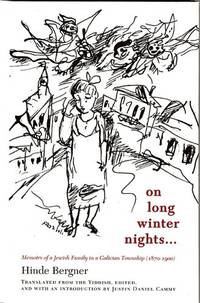
2005L3 box729 a5<p>On Long Winter Nights…: Memoirs of a Jewish Family in a Galician Township 1870–190 Harvard Center for Jewish Studies. By Hinde Bergner; Translated from the Yiddish edited and with an introduction by Justin Daniel Cammy. 2005 by Harvard University Center for Jewish Studies Harvard University Press. Hardcover 122 pp.</p> Harvard University Center for Jewish Studies, Harvard University Press. hardcover
feb123153Used. For more details please contact me unknown
1939292576Prepared by the Yiddish Writers' Guild of the Federal Writers' Project 1939. Hardcover . Good. 206 pp. slight library number on spinetear to crown of spine work is in Yiddish aisle 215 oclc 19314860 Prepared by the Yiddish Writers' Guild of the Federal Writers' Project, hardcover
1964N5079Tel Aviv Israel: Di Goldene Keyt -Perets Publ House 1964. Original Cloth. Very Good. 8vo. 42812pp Yiddish text. Titleßpage also in English. Hinges at bottom of back covers 2 cm slightly open. Some foxing on covers. Otherwise a very good copy. <br/> <br/> Di Goldene Keyt -Perets Publ House hardcover
1938218650New York : Yiddish Scientific Institute 1938. First Edition. Hardback. Very good copy in the original gilt-blocked cloth. Spine bands worn with some fraying. Panel edges somewhat dulled and rubbed as with age. Bumped corners. Rear hinge starting. Minor library marks. Remains quite well-preserved overall.; 8vo 8"" - 9"" tall; 348 pages; Description: 1v. 348p. 1 port; 23cm. Subjects: Jewish studies -- Science -- History -- Language -- Yiddish culture -- United States. Notes: Added title page and table of contents in English. Language: Hebrew. New York : Yiddish Scientific Institute hardcover
193855712New York: I. L. Peretz Yiddish Writers' Union 1938. First edition Ex-Library. Hardcover. Good- to good condition. Quarto. 397 3pp. Original light brown clpthe with black lettering on cover and spine. Title pages in Yiddish and English. Scarce work being a survey of immigrant societies in New York. Includes essays on landsmanshaft history and activities as well as survey results in Yiddish; also contains the Directory of Organizations in English. A comprehensive survey of Jewish support groups organized by the community. Text in Yiddish with some English. Biding with some light wear along edges slightly pronounced at head and tail of spine lightly rubbed. Library sticker on spine library bookplate on inside front cover. Blind-stamped on title-page. Lightly starting after title page starting at second back endpaper before English title page. Typed note describing content on free endpaper. Libary barcode on inside back cover. Block lightly age-toned. I. L. Peretz Yiddish Writers' Union hardcover
193828020New York: I. L. Peretz Yiddish Writers' Union 1938. First edition. Hardcover. g. Quarto. 397 3pp. Rebacked with blue library tape over original cloth with Yiddish lettering on front cover. Title pages in Yiddish and English. Scarce work being a survey of immigrant societies in New York. Includes essays on landsmanshaft history and activities as well as survey results in Yiddish; also contains the Directory of Organizations in English. Age-wear on binding with original spine replaced by library blue tape and heavy rubbing along edges. Previous owner's stamps on both endpapers. Age-toning along paper margin. Text in Yiddish with some English. Binding in overall fair interior in good condition. I. L. Peretz Yiddish Writers' Union hardcover
74096E-091. Hardcover. Very Good. Hardcover. 8vo. Published by Harper & Row New York 1966. Xi 90 pgs. Illustrated. First Edition/First Printing. DJ has light shelf-wear present to the DJ extremities lower right corner of the DJ is clipped but price is still present to the top of the front flap. Bound in decorated cloth boards with titles present to the spine and front board. Boards have light shelf-wear present to the extremities. No ownership marks present. Text is clean and free of marks. Binding tight and solid. Nobel laureate Isaac Bashevis Singer introduces readers to the village of Chelm in this Newbery Honor Book. Chelm is a village of fools. The most famous fools—the oldest and the greatest—are the seven Elders. But there are lesser fools too: a silly irresponsible bridegroom; four sisters who mix up their feed in bed one night; a young man who imagines himself dead. Here are seven magical folktales spun by a master storyteller that speak of fools devils schlemiels and even heroes—like Zlateh the goat.; 8vo 8" - 9" tall . hardcover
196528615New York: Harper & Row 1965. First Edition; First Printing. Hardcover. Very Good in a Very Good dust jacket edges taped. Harper & Row hardcover
64208974McGill-Queen's University Press pp. xxv 362 . Hardback. New. McGill-Queen's University Press hardcover