658 résultats
1374691Paris: ORT, Somogy, 2006 in-4, 96 pages, carte, 58 illustrations. Cartonnage, jaquette, avec défauts minimes. Ouvrage publié à l'occasion de l'exposition présentée au Musée d'art et d'histoire du Judaïsme.
Original Cloth. 8vo. VI, 133 pages. 24 cm. First edition. In German. 'Bousset's Religion of Judaism: critically examined from the New Testament Period. ' A critique of the Protestant theologian Wilhelm Bousset's 'Religion des Judentums', also published in 1903. Felix Perles (18741933) , rabbi and scholar. Felix was drawn into the Zionist movement in Vienna and in 1899 he became rabbi at Koenigsberg. Felix Perles had wide scholarly interests: Bible criticism, Hebrew and Aramaic lexicography, apocryphal and pseudepigraphical literature, medieval Hebrew poetry, liturgy, Jewish dialects, and abbreviations. His best-known works are his critique of W. Bousset's Religion des Judentums im neutestamentlichen Zeitalter (1903) , and the collection of essays, Juedische Skizzen (1912, 1920) . - 2008 EJ. Attractively bound in period cloth with original wraps pasted on top. Subjects: Judaism - History. Die Religion des Judentums im neutestamentlichen Zeitalter (Bousset) . Christentum. Judentum. Bousset, Wilhelm, 1865-1920. Religion des Judentums im neutestamentlichen Zeitalter. Dedication inscription on title page, light pencil marks on some pages, otherwise very fresh and clean. Very good + condition. (GER-43-36)
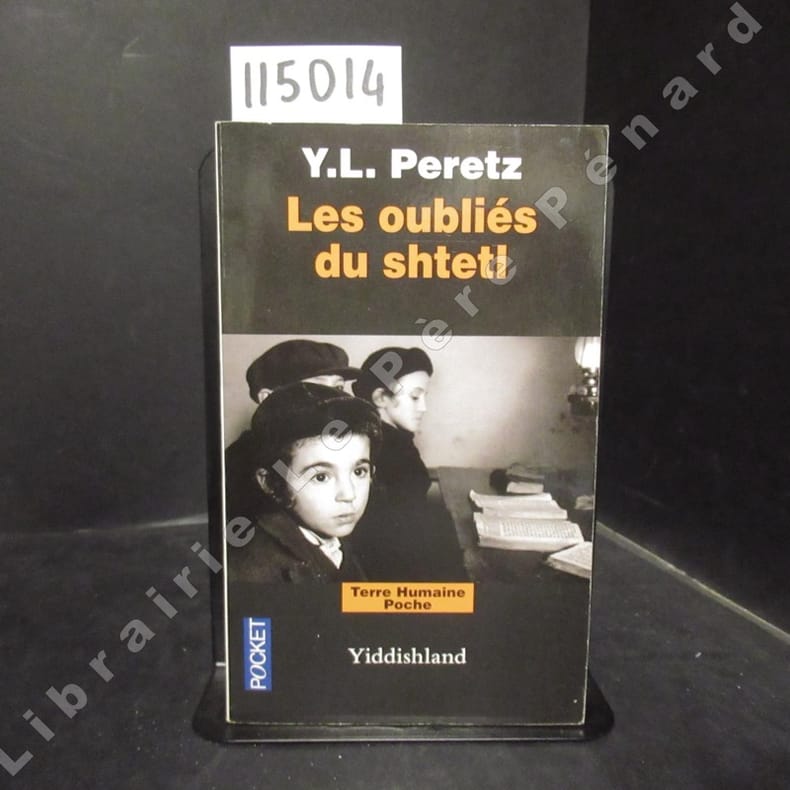
20101150142010 Editions Pocket, Collection "Terre Humaine Poche" dirigée par Jean Malaurie - 2010 - In-12, broché, couverture illustrée en N&B - 537 p. - Petit cahier de reproductions photographiques en N&B en milieu d'ouvrage
16', 229pp. hardcover. worn cover and edges, spine on edges slightly damaged. stamp and previous owners name on title page, yellowing pages, else in fair+ condition.
Softbound. 8vo. 112 pages. 22 cm. Second edition. Reprint, originally published: Riga, 1932. In German. The Emergence of the Jewish Labor Movement in Russia. Subjects: Jews - Soviet Union. Working class - Soviet Union. Joden. Arbeidersbeweging. OCLC lists 23 copies. Light shelf wear to edges, otherwise clean and fresh. Very good condition. (EE-5-46)
In 8°, br. edit. ill., pp. 238,(2); copia molto buona (Coll. "Faretra", 26). (ban 03)
Milano, Feltrinelli, 2002, 8vo brossura con copertina illustrata, pp. 230.
Hardback. 8vo. 671 pages. 23 cm. First edition. In Hebrew. Added title page: The "He-Halutz" movement in Poland, 1917-1929. The He-Haluts was a Zionist pioneering movement in Poland. The founders of He-? Aluts believed that no political or propaganda accomplishment would benefit Zionism in the long run unless it were complemented by deeds of personal fulfillment, which became a primary objective in the organizations overall ideology. In other words, to actually implement the principles of He-? Aluts, the individual was expected both to identify with the Histadrut (Labor Federation) and to live on a cooperative kibbutz in Palestine. On an ideological level, the basic foundations of the He-? Aluts movement were consolidated in 1917. Based on a combination of universal socialist and nationalist concepts, they drew ideological influence from the Tseire Tsiyon party. He-? Aluts continued to evolve in Russia even after the change of regime. The fundamentals of agricultural training farms and links with the budding kibbutz movement in Palestine were laid down. The Fourth Aliyah (19241929) marked the first test of the populist concept, since at the time of the Third Aliyah (19191923) the previous immigration waveHe-? Aluts had still been in an amorphous ideological phase and had been a marginal factor in Diaspora public affairs. When He-? Aluts held its world conference in 1923, the movement numbered only 7, 000 registered members, but membership increased to tens of thousands within a year and a half. This massive growth led to a change in the organizations social structure. High-school students and middle-class youth were now replaced with thousands of working-class youngsters and unemployed individuals, including members of Zionist Socialist parties. (YIVO Encyclopedia; He-Haluts; article written by Israel Oppenheim) . Israel Oppenheim is Professor Emeritus of the History of the Jewish People, Ben-Gurion University of the Negev, Beersheba. Subjects: Labor Zionism - Poland - History. Jews - Poland - History - 20th century. Histadrut he-H? Aluts be-Polin. Poland - Ethnic relations. Light soiling to outer edges, previous owners name in pen on inside endpage; otherwise very clean and fresh. Very good condition. (EE-5-32)
1938132057Philadelphia: Jewish Publication Society of America 1938. 1st edition. Nice copy. octavo. hardback in original cloth 392pp. Interesting Yiddish novel of Polish Jews against a background of Polish national liberation Jewish Publication Society of America hardcover
IN YIDDISH. 22x14.5 cm. 186 pages. Hardcover. In good condition.
IN YIDDISH. 23x15.5 cm. 64 pages. Hardcover. In good condition.
Softbound. 8vo. IX, 177 pages. 23 cm. First edition. With frontispiece map and 8 illustrations. Scholarly examination of Romania's treatment of its Jewish population with an emphasis on nineteenth-century politics (Congress of Berlin) and intellectual decisions that affected twentieth-century policies - especially Romania's attitude towards Germany. Subjects: Antisemitism - Romania - History. Nationalism - Romania - History - 19th century. Nationalisme. Antisemitisme. Antisemitismus Geschichte (1877-1900) Antisémitisme - Roumanie - 19e siècle. Congrès de Berlin (1878) . Romania - Politics and government - 19th century. Romania - Ethnic relations. Light wear to wraps, otherwise fresh and clean. Good + condition. (EE-5-17)
New York, N. Y. : American Representation of the General Jewish Workers' Union of Poland, No Date (1956? ) . Paper Wrappers, 8vo, 39 pages. Yiddish Monthly of the Bund in America, originally beginning in Feb 1941. 25 cm. In Yiddish. Light wear, Good Condition (Y-21-C)
1st edition. Paper Wrappers, 8vo, aprox. 48 pages each issue. Monthly, originally beginning with No. 1 (Febru'ar 1941) . 25 cm. In Yiddish. Nrs. 110/111, 239, 240, 311/312 (70th birthday of the Bund, special issue), 317, 327, 384, 386, 387, 394, 395, 433, 435, 436, 476, 592/593, 1978 (Nrs. 10, 11/12) 1979 (Nr 12), 1987 (Nr. 10-"90 yor Bund" special issue). The monthly journal of the Bund in America, here providing its unique Polish Jewish Socialist anti-Zionist perspective. The General Jewish Labour Bund in Lithuania, Poland and Russia (Yiddish: algemeyner yidisher arbeter-bund in lite, poyln un rusland), generally called The Bund or the Jewish Labour Bund, was a secular Jewish socialist party.... founded in Vilnius on October 7, 1897 ..In 1917 the Polish part of the Bund, which dated to the times when Poland was a Russian territory, seceded from the Russian Bund and created a new Polish General Labor Bund which continued to operate in Poland in the years between the two world wars .The Bund sought to unite all Jewish workers in the Russian Empire into a united socialist party, and also to ally itself with the wider Russian social democratic movement to achieve a democratic and socialist Russia. The Russian Empire then included Lithuania, Latvia, Belarus, Ukraine and most of present-day Poland, areas where the majority of the world's Jews then lived. They hoped to see the Jews achieve a legal minority status in Russia. Of all Jewish political parties of the time, the Bund was the most progressive regarding gender equality, with women making up more than one-third of all members. The Bund actively campaigned against anti-Semitism. It defended Jewish civil and cultural rights and rejected assimilation. However, the close promotion of Jewish sectional interests and support for the concept of Jewish national unity (klal yisrael) was prevented by the socialist universalism of the Bund. The Bund avoided any automatic solidarity with Jews of the middle and upper classes and generally rejected political cooperation with Jewish groups that held religious, Zionist or conservative views. Even the anthem of the Bund, known as "the oath" (di shvue in Yiddish), written in 1902 by Sh. An-ski, contained no explicit reference to Jews or Jewish suffering. At the heart of the vision of the future of the Bund was the idea that there is no contradiction between the national aspect on the one hand and the socialist aspect on the other. As a strictly secular organization, the Bund renounced the Holy Land and the sacred language (Hebrew) and chose to speak Yiddish .In its early years the Bund had remarkable success, gaining an estimated 30,000 members in 1903 and an estimated 40,000 supporters in 1906, making it the largest socialist group in the Russian Empire . the Bund was a founding collective member at the RSDLP's first congress in Minsk in March 1898. For the next 5 years, the Bund was recognized as the sole representative of the Jewish workers in the RSDLP, although many Russian socialists of Jewish descent, especially outside of the Pale of Settlement, joined the RSDLP directly .The Bund generally sided with the party's Menshevik faction led by Julius Martov and against the Bolshevik faction led by Vladimir Lenin during the factional struggles in the run-up to the Russian Revolution of 1917 .In the Polish areas of the [Russian] empire, the Bund was a leading force in the 1905 revolution. At that time the organization probably reached the height of its influence. It called for an improvement in living standards, a more democratic political system and the introduction of equal rights for Jews. At least in the early stages of the first Russian Revolution, the armed groups of the "Bund" were likely the strongest revolutionary force in Western Russia. During the following years, the Bund went into a period of decay .The Bund eventually came to strongly oppose Zionism, arguing that emigration to Palestine was a form of escapism. The Bund did not advocate separatism. Instead, it focused on culture, rather than a state or a place, as the glue of Jewish nationalism. . The Bund also promoted the use of Yiddish as a Jewish national language and to some extent opposed the Zionist project of reviving Hebrew. The Bund won converts mainly among Jewish artisans and workers, but also among the growing Jewish intelligentsia. It led a trade union movement of its own. It joined with the Poalei Zion (Labour Zionists) and other groups to form self-defense organisations to protect Jewish communities against pogroms and government troops. During the Russian Revolution of 1905 the Bund headed the revolutionary movement in the Jewish towns, particularly in Belarus and Ukraine ..In 1921, the Communist Bund [in the USSR] dissolved itself and its members sought admission to the Communist Party....Many former Bundists, like Mikhail Liber and David Petrovsky, perished during Stalin's purges in the 1930s. The Polish Bundists continued their activities until 1948. During the latter half of the 20th century the Bundist legacy was represented through the International Jewish Labor Bund, a federation of local Bundist groups around the world .Among the exiled Bundists who went on with Socialist politics in America was Baruch Charney Vladeck (18861938), elected to the New York Board of Aldermen as a Socialist in 1917 [and] 1937 [and] manager of The Jewish Daily Forward Moishe Lewis (18881950)....the father of David Lewis (19091981), a leader of the New Democratic Party in Canada .David Dubinsky (18921982), though never formally a member of the party, had joined the bakers' union, which was controlled by the Bund, and was elected assistant secretary within the union by 1906 ..He later became a member of the Socialist Party of America, helped found the American Labor Party in 1936 and was from 1932 till 1966 the leader of the International Ladies' Garment Workers' Union ..under the name Max Goldfarb, David Petrovsky (18861937) was a member of the Central Committee of the Jewish Socialist Federation of America, a member of the Socialist Party of America, and the labor editor of The Forward (Wikipedia). All Good-Very Good Condition (Y-21-B) Price is per issue.
Original Wraps. 8vo. 48 pages. 23 cm. First edition. In Yiddish. Workmens Circle School Almanac, celebrating the middle school graduating class of 1931. Issued by the Central Committee of New York Workmens Circle schools. Pages 28-48 contains advertisements and fraternal greetings to the graduating class from over a dozen locals of the I. L. G. W. U. And branches of the workmens circle. With articles on Literature in the Workmens Circle middle school; student essays on the history of the progressive movement in America, on Upton Sinclair and his works, a song, and on the relation between the workmens circle school and youth circles. Includes group photograph. Subjects: Jews - Education - United States. Workmen's Circle (U. S. ) . None on OCLC. Wraps bumped around edges, otherwise fresh and clean. Very good condition. (YID-18-31) Xx
1992100147316Julliard 1992 188 pages in8. 1992. Broché. 188 pages.
8vo. 156 pages. In Yiddish. First edition. SUBJECT (S) : Literature, Jewish. Samuel Niger was the pseudonym of Samuel Charney (1883-1955) . A Zionist influenced by Adah Ha-Am and a Russian socialist revolutionary, he joined the Zionist-Socialist Workers Party, and was repeatedly arrested and tortured by Russian authorities. Though his first literary efforts were in Russian and Hebrew, his mature work was written mostly in Yiddish. In 1908, he, with A. Veiter and S. Gorelik, founded Literarishe Monatshriften, which became very popular and influential after the Czernowitz Yiddish Conference. In 1912, after three years in Europe, he began editing DiYidishe Velt. After being imprisoned by Polish legionaires in 1919, Niger left for the United States. In New York, he worked for Der Tog, a Yiddish daily; beginning in 1920, he worked for the paper for 35 years, becoming the most revered and feared Yiddish critic of his generation. Outside of strictly literary work, Niger worked with the YIVO Institute for Jewish Research from its inception, a and helped found the Congress for Jewish Culture. (Liptzin, EJ) Edgeworn, publisher's stamp on flyleaf, good condition. (HEB-4-10)
IN HEBREW. 240X160 mm. 583 pages. Gilt hardcover. Ex-Library copy with usual marks. Cover slightly rubbed and slightly stained. Cover edges and corners slightly bumped. Spine slightly bumped and slightly faded. Spine edges slightly worn. Binding partly visible between few pages. Pages slightly yellowing. Few pages slightly age stained - no damage to text. Else in good condition. PLEASE NOTE: This item is overweight. We may ask for extra shipping costs.
1st edition. Cloth, 8vo, 1116 pages, 24 cm. In Yiddish. A selection of testimonies, chronicles, letters, wills, inscriptions, poems, music, legends, stories and essays pertaining to Jewish martyrdom today and in bygone days. SUBJECT (S) : Jews -- Persecutions. Added Title: Kiddush Hashem. Samuel Niger was the pseudonym of Samuel Charney (1883-1955) . A Zionist influenced by Adah Ha-Am and a Russian socialist revolutionary, he joined the Zionist-Socialist Workers Party, and was repeatedly arrested and tortured by Russian authorities. Though his first literary efforts were in Russian and Hebrew, his mature work was written mostly in Yiddish. In 1908, he, with A. Veiter and S. Gorelik, founded Literarishe Monatshriften, which became very popular and influential after the Czernowitz Yiddish Conference. In 1912, after three years in Europe, he began editing DiYidishe Velt. After being imprisoned by Polish legionaires in 1919, Niger left for the United States. In New York, he worked for Der Tog, a Yiddish daily; beginning in 1920, he worked for the paper for 35 years, becoming the most revered and feared Yiddish critic of his generation. Outside of strictly literary work, Niger worked with the YIVO Institute for Jewish Research from its inception, a and helped found the Congress for Jewish Culture. (Liptzin, EJ) Light wear, Good Condition. (yiz-20-13/ny-1-1)
8vo; 361 pages; Includes 25-page bibliography & 14-page index. Very light wear, Very Good Condition (Comhist 3-3)
8vo; 719 pages; 1st Yiddish. edition. Original cloth in illustrated dust jackets. "The epic of the Jews in Warsaw. A collection of reports and biographical sketches of the fallen. " In Yiddish. Robinson & Friedman # 2003 Vol II serves as a biographical dictionary of the fighters. This first Yiddish edition of Volume I is an expansion and revision of the two Hebrew editions published in 1946 & 1947. The English title page is not an accurate translation of the Yiddish title. The correct translation would be: "Destruction and uprising of the Jews in Warsaw: Reports and biographical sketches." An important work in its most desireable edition. Dust jacket for Vol I has small label on base of spine with clear tape; Very Good Condition in about Very Good- Jacket. Beautiful set. (H-43-5A)
Original publishers cloth in dramatic modernist color illustrated dust jacket designed by Zuni Maud with illustrations on front and rear; 8vo, 243 pages. 23 cm. In Yiddish. SUBJECT (S) : Yiddish literature -- 20th century. Illustrator Zuni Maud (born 1905) was an Artist, cartoonist, puppeteer, playwright, writer and poet. [He] Studied at the Cooper Union Art School, Baron de Hirsch Art School and National Academy of Art, New York. [and] Did illustrations for *Der kibitser* and stage and costume design for productions by Maurice Schwartz in the Yiddish Art Theater. Contributed articles to Der kundes (N. Y. ) , Jewish Daily Forward (N. Y. ) , Di tsayt (N. Y. ) , Kinderland (N. Y. ) , Kinder zshurnal (N. Y. ) , Frayhayt (N. Y. ) . [He was the] Illustrator of a number of books. In 1925, together with Yosel Cutler, [he] founded the Modicot marionette theater. [He] Wrote plays, children's stories and poems (YIVO, 2018) . Author Yitzchak Rayz (1885-1943) , better known by his pen name Moyshe Nadir was an American Yiddish language writer and satirist . In 1898, at the age of 13, Rayz immigrated to New York and adopted the Americanized name Isaac Reiss. Within a few years his work was published widely in the New York Yiddish press, under a variety of pseudonyms, including Rinnalde Rinaldine, Dilensee Mirkarosh, Der Royzenkavalir, Doctor Hotzikl, and, finally, Moishe Nadir. The name Nadir is a Yiddish expression meaning here you are or that's for you, but can also mean take this and choke on it. As a teenager, he wrote for Der Groyser Kundes (The Big Prankster) and later co-edited Der Yiddisher Gazlon (The Yiddish Bandit) with Jacob Adler. He wrote for an assortment of Communist Yiddish publications including the Frayhayt (Freedom) newspaper and its successor Morgn Frayhayt (Morning Freedom) and the magazines Der Signal (The Signal) and Der Hammer (The Hammer) . When his sharp-tongued theater reviews caused him to be banned from theatrical productions, he resorted to attending plays in disguise. His own plays were performed by Maurice Schwartzs Yiddish Art Theater, Zuni Maude and Yosl Cutlers Modicut puppet theater, Artef (Arbeter Teater Faraband, Workers Theater Alliance) and the Federal Theater Project. Among his better known poems are the erotic Vilde Royzen (Wild Roses, 1915) and his 1932 Rivington Strit (Rivington Street) . After a long association with the Frayhayt and the Morgn Frayhayt, Rayz began to distance himself from the Communist cause with the onset of the show trials in the Soviet Union and publicly broke with the Morgn Frayhayt in the wake of the Molotiv-Ribbentrop Pact. He set out his reasons in Di, vos blayben mit der Morgn Frayhayt (Those who stay with the Morgn Frayhayt) in response to Morgn Frayhayt editor Moissaye Olgins Di vos gayen avek (Those who leave) . Rayz discusses his relationship to the Communist Party in his posthumous Moyde Ani (Wikipedia, 2019) . Very Good Condition in dust jacket which shows some edgewear affecting some letters on the spine. Very Good in Good Jacket. (yid-41-92)
Original Wraps. 8vo. 30 pages. 22 cm. Edition. In German. 'Achdus (Unity) from Mendelssohn to Lob. ' Treatise on Mortiz Loeb and the influence of Moses Mendelssohn. From the Association of Orthodox Jews in Germany. Subjects: Judaism - Germany. Mendelssohn, Moses, 1729-1786 - Influence. Loeb, Moritz A. , 1875-1950. OCLC lists three copies (HUC, Deutsche Natl Biblio; Natl Libr Israel) . Small tear to wrap, light soiling throughout, otherwise fresh. Good + condition. (GER-43-33)
brossura A cura di Rudi Assuntino. In brossura condizioni ottime.
Brossura commerciale datata, comuni sgualciture e minime sbucciature da contatto segnano la copertina in cartonato millerighe, con patinato ombrato da polvere da scaffale, fogli e tagli in calda tonalità avorio, in buina parte puliti e ben preservati, cura di Rudi Assuntino, trascrizioni musicali di C. Montanaro, trascrizione dallo yiddish, trad. e glossario di Laura Quercioli Mincer. N. pag. 221. USATO