GROSSMAN David -MareMagnum

658 résultats
Milano, Mondadori, 2009, 8vo brossura con copertina illustrata, pp. 781.
IN HEBREW. THIS VOLUME ONLY. SIGNED BY AUTHOR. 245X175 mm. ix+167 pages. Hardcover. In good condition.
IN HEBREW AND YIDDISH WITH ENGLISH SYNOPSIS. TWO VOLUME SET. 170X245 mm. (IX+167\309) pages. Hardcover. Cover corners slightly bumped. Spine edges slightly bumped. Pen inscription on first white page. Else both volumes in good condition.
TWO VOLUME SET. IN HEBREW. [BOTH VOLUMES]: 24.5x17 cm. [167+V]+[309] pages. Hardcover. Spine edges slightly bumped. [VOLUME TWO]: Cover slightly bumped. [SUMMARY]: Else both volumes in good condition.
1964N5079Tel Aviv Israel: Di Goldene Keyt -Perets Publ House 1964. Original Cloth. Very Good. 8vo. 42812pp Yiddish text. Titleßpage also in English. Hinges at bottom of back covers 2 cm slightly open. Some foxing on covers. Otherwise a very good copy. <br/> <br/> Di Goldene Keyt -Perets Publ House hardcover
New English Paperback. Pbo. Demy 8vo. (21 x 14 cm). In English. 576 p., ills. "At an early age, I started questioning myself, wondering what there was beyond becoming wealthy. When I reached 65, I wrote an essay. It's title was "The Ability to Become Redundant." As I advance in age, the time I had left became more limited while the number of books waiting to be read on my shelves increased. I needed to find a solution to this contradictory situation. I needed to change my lifestyle. I reduced the time I wasted sleeping to the minimum. Transferring my business responsibilities to the younger generation sooner would address this situation. I took rapid steps in that direction. It was a great source of pride for me to see professionals who had absorbed the principles set from the beginning by the founders. It value this more and more. I see becoming redundant as the crowning of my life." Now when I look back as a man who has reached 85, I believe I have covered quite a distance. Life isn't as long as one thinks. Time flows and passes. What is left behind is what you've done, the causes you have struggled for. Don't forget that what we call life is not about the years you have spent, it is made of what you've experienced. Everything starts small, it starts with small steps. Unexpected obstacles appear at unexpected moment, obstacles emerge in front of you and you are being tested. Of course, there are opportunities too. Your character and your attitude develop as a result of what you've experienced. It is good that I realised early, after I had earned some money, that owning more money wasn't very important. It is good that I made success appear ordinary, that I diversified my assets. It is good that I pursued my quest and confronted the question "what will I strive for in my life?". It is good that I always sought respectability. It is good that I met Üzeyir Garih. It is good that in time I left the business to professionals. It is good that I embarked on the way to become redundant. It is good that I freed myself and relieved myself of my burdens. It is good that I wasn't raised with a single identity. It is good that I turned to my social responsibilities. It is good that I thought, and expressed my opinions courageously. It is good that I didn't pay attention to threats. It is good that I questioned myself and the society, that is you. It is good that I said: "let's cleanse ourselves of our sins". It is good that I became an "early crowing rooster". I live every day with the aim of becoming a more perfect and a more useful human being.".
First edition. Period boards. 8vo, 92 pages, 20 cm. In Yiddish. Title translates to A Provincial Newspaper. Miriam Karpilove (1888-1956) was one of the most prolific and widely published women writers of Yiddish prose. Her short stories and novels explore issues important in the lives of Jewish women of her generation. Frequent themes are the upbringing of girls and women in Eastern Europe, the barriers they encounter when they seek secular education, and the conflicts they experience upon immigration to North America. (Kellman, JWA, 2016) Over the course of her life, Karpilove lived in Minsk, Palestine, NYC, and finally Connecticut. OCLC lists 19 copies worldwide. Ex-library with usual markings. Some light water stains to top margins. Overall in Very Good Condition with few markings. (YID-23-13)
Softbound. 8vo. IX, 177 pages. 23 cm. First edition. With frontispiece map and 8 illustrations. Scholarly examination of Romania's treatment of its Jewish population with an emphasis on nineteenth-century politics (Congress of Berlin) and intellectual decisions that affected twentieth-century policies - especially Romania's attitude towards Germany. Subjects: Antisemitism - Romania - History. Nationalism - Romania - History - 19th century. Nationalisme. Antisemitisme. Antisemitismus Geschichte (1877-1900) Antisémitisme - Roumanie - 19e siècle. Congrès de Berlin (1878) . Romania - Politics and government - 19th century. Romania - Ethnic relations. Light wear to wraps, otherwise fresh and clean. Good + condition. (EE-5-17)
210X150 mm. 136 pages. Hardcover. Cover worn and yellowing. Binding partly visible between inner cover and pages. Few pages slightly stained - no damage to text. Pages slightly yellowing. Else in good condition.
Enlarged and revised edition, small 8vo (170 x 124mm), [2], 156, 4pp., orig. cloth-backed printed boards.
1st edition. Original paper wrappers in protective cardboard binder. 8vo. 16 pages, 21 cm. In Yiddish with some Russian on title page. Title translates to A Little Chrestomathy. Chrestomathy refers to the selection of literary passages from a foreign language assembled for studying the language. Features passages by Y.L. Perets, Mendele Mokher Sefarim, and Avrom Reizen. SUBJECTS: Yiddish language study. OCLC: 233376695/58407193. OCLC lists three copies worldwide (NLI, YIVO, Harvard). Pages browning. Very good condition. Scarce. (YID-33-4-+)
15X23 cm. xiv+315 pages. Softcover. Top of front cover slightly chafed. Cover edges slightly chafed. Stain spine's bottom. Pen signature on first white page. Else in good condition.
Five volumes bound in six (Volume 4 is in two parts). 8vo. Original full gray cloth bindings, spines lettered in gold. Hardbound set. First edition was in 1930. Very good. JUDAICA BOX 1 3 3 139A37~Waxman, Meyer.
pp. x, 250. Tall 8vo. Original full cloth binding. Original priced dust jacket. Second printing. Hardbound. Very good. The etymology of Jewish names in a concise dictionary format. Useful reference. GENEALOGY 2
Paper wrappers; 8vo. 38 pages. OCLC lists twelve copies worldwide. Some cover soil. Very good condition. (W-62)
Paper wrappers; 8vo. 38 pages. OCLC lists 12 copies worldwide. Cover chipped, bottom corner bumped, good condition. (ComHist-10-16)
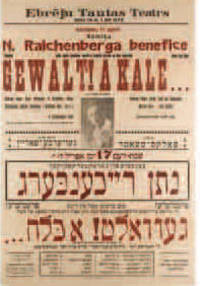
51-1032Latvia: 1920s-1930s. A Collection of 8 Yiddish Theater posters from the 1920s and 1930s. Yiddish Latvian poster of the Ebreju Tautas Teatrs Jewish people Theater. Letter press in red and black on fine paper mounted on canvas. 91 x 60.5 cm. Riga Spiestuve vards 1930 announcement of an event on Saturday April 17 d. j.: Bene_ z of the character comedian Natan Reichenberg. Premiere! For the first time in Riga the large entertaining equipment operetta with completely new vocal pieces help! A bride. The comic role of "Kivele Feldsher" Akiva the medics the Bene_ acquires ziant. -Printed in Latvian and Yiddish language with photographic print. -Paper browned minimal fold marks on the outer edge. -Rare poster.Yiddish Latvian poster of the Rigas teatris zidu minoritates Riga Jewish minorities Theater. Letterpress in red and black on fine paper. 71 x 53.5 cm. Riga SP. extra 1925. announcement of the _ eaterstücks the Jewish robber on November 26. -Printed in the Latvian and Yiddish languages. -Paper slightly tanned with vertical folding kl. Defects especially upper-right corner on the outer edge with small tears. -Very rare poster.Yiddish Latvian poster of the Rigas teatris zidu minoritates Riga Jewish minorities _ Theater. Letter press in red and black on fine paper. 71 x 50 cm. Riga SP. extra 1925. announcement of different theatrical works: A man an unlucky guy. -The curly haired blonde -In life tri_ all . -The Jewish Bandit November 17-22. -Printed in the Latvian and Yiddish languages. -Paper minimally tanned with vertical and horizontal folding Small Defects minimal _ square on the outer edge with small tears. -Very rare poster.Yiddish Latvian poster of the Rigas teatris zidu minoritates Riga Jewish minorities Theater. Letterpress in red and black on fine paper. 106 x 71 cm. Riga SP. extra 1933 announcement of solemn Erö_ regulation IX season on Saturday Sept. 30 Sunday 1 Oct 1933 8.30 evening. Performed by: Genia Schalit Nina Talini oSIP Runitsch in the well-known piece of David Golder. In four acts by A. Nemirowskaja. -With 2 dates. -Printed in the Latvian and Yiddish languages. -Paper minimally tanned partly with resounding mount tracks with vertical and horizontal folds & light Abklatsch small. Defects somewhat spotted and knicked. -Very rare poster. Latvian Yiddish poster. Woodcut on fine green paper. 66 x 51 cm. Daugavpils Latvia Pilsetas spiestuve litogra_ Yes 1920s. The translated content of the poster: Sunday August 15 7: 00 the Dünaburger Trade Association invites in the Riga road 42 in the Novonowitsch-Hall to a meeting on the election of the municipal administration. Speaker are: Al Kopelowski A. Bulavko Sch. Heller Salman Barak N. Magid and others. "Dealer! Come numerous. Dealers and sellers. Bear in mind that your list is the list of 5 the Listedes of trade association."- printed in the Latvian and Yiddish languages. -Paper with vertical & horizontal folds and knicks-Rare poster.Latvian Yiddish poster. Woodcut in blue on fine paper. 93 x 62.5 cm. Daugavpils Latvia Pilset. spiestuvelitogra _ Yes 1920s. Election poster: David challenge the dealer! 'Remember - no voice of the dealer for a different list than the list 5 vote for the list of dealers no. 5' - 3 languages printed in Yiddish Russian and Latvian. -Paper with vertical & horizontal folding some with red marks. Knicks and small tears -Rare poster.Latvian Yiddish poster. Woodcut on fine Orange paper. 49.5 x 31.5 cm. Daugavpils Latvia Pilsetas spiestuve litogra_ Yes 1920s. The translated content of the poster: Agudat Israel Daugavpils. Taking place on Monday August 17 8 o'clock in the evening. A folk Assembly in Klingmann Hall Riga Street 42. The elections. Asked to show! -Printed in the Latvian and Yiddish languages. -Paper with horizontal folds tears and stains-Rare poster.Images of all the posters are available Latvia: 1920s-1930s unknown
419pp. 25 cm. Hardcover Very good condition good
1st edition. Original illustrated paper wrappers, 16mo (small) , 63 pages, 17 cm. Includes portrait of the author (tipped in as published) . A rare Yung Vilne publication. The cover makes use of an interesting period modernist font and design; the title page uses a different but striking constructivist layout and font as well. hil'e getseykhnt? , Roz'e Sutskever ; portret? , Bentye Mikt? Om. Rosa Sutzkever was one of the best-known artists of Vilna, and had trained at the Art Academy there (Bogen, 1991) and was part of Yung Vilna. Yung-Vilne (Young Vilna) , was a Yiddish literary group, introduced in the daily Vilner Tog in 1929 with the headline: Young Vilna Marches into Yiddish Literature. It aroused excitement through its miscellanies (Yung-Vilne, 193436) , its contributions to local and international Yiddish journals, and individual books of verse and fiction. Principal members included poets Chaim Grade , Shimshon Kahan, Peretz Miransky, Abraham Sutzkever , Elkhanan Wogler, and Leyzer Wolf , prose writers Shmerke Kaczerginski and Moyshe Levin, and artists Bentsie Mikhtom and Rokhl Sutzkever. Dozens more were associated with the group, whose members were united by generation, place, a shared humanistic orientation, and the encouragement of local intellectuals like Zalman Rejzen and Max Weinreich . A Yung-Vilne evening in the Vilna ghetto, the participation of several members in the partisan underground, and the accomplishments of Grade and Sutzkever as leading postwar Yiddish writers assure that Yung-Vilne will be remembered as one of the great incubators of Jewish creativity in interwar Poland (Lipzin & Cammy, 2007) . OCLC lists 11 copies worldwide (NYBC, HUC, McGill, TAU) . Title penned on spine, paper toning, touch of wear to corner, about Very Good Condition. Rare, important, and attractive (Yid-29-35)
1st edition. Original paper wrappers in protective library binder. 8vo. 22 pages, 23 cm. In Yiddish. Title translates to "A Selection of Yehoash's Letters." Solomon Blumgarten, known by his pen name Yehoash, is one of the best known Yiddish poets of the 19th and 20th centuries. In 1923, The New York Times referred to him as one of Yiddish literature's greatest living poets and most skilled raconteurs" (Wikipedia). SUBJECTS: Authors, Yiddish -- Correspondence. OCLC: 872501808. Ex-library with no markings. Very good condition. Surprisingly scarce. (YID-33-40-LXE)
First edition. Original Printed Wrappers, 8vo, 6, 8, 12, 32 pages ; 26 cm. In Yiddish. Title translates as, A Bouquet of Flowers: In Four Parts. Singerman 4953. Contents: 1. Ale Lider fun Akaydes Yitshak, fun A. Goldfaden; 2. Kupleten un Folks Lider, fun M. Avramovits [Max Avramovich]; 3. Ale Lider fun Kuzari, fun Prof. Hurvits; & Anekdoten, fun G. Broyda. Abraham Goldfaden, (18401908), was a Yiddish poet, dramatist, composer, and father of the Yiddish theater. Born in Staro Konstantinov, Ukraine, he received not only a thorough Hebrew education but also acquired a knowledge of Russian, German, and secular subjects. To avoid the draft, Goldfaden was sent to a government school at 15 and there came under the influence of his teacher Abraham Ber Gottlober, a Hebrew writer who was also a lover of Yiddish. Graduation from this school in 1857 permitted Goldfaden to enter the rabbinical seminary at Zhitomir, which trained rabbis, teachers, and Jewish officials for government service. Under the guidance of sympathetic teachers, including such leaders of the Haskalah movement as E. Z. Zweifel, H. S. Slonimsky, and Gottlober, he was encouraged to compose Hebrew lyrics. The first of these were published in 1862 in Ha-Meliz. A year later Goldfaden's first Yiddish poems appeared in Kol Mevasser. In 1865 Goldfaden published a booklet of his Hebrew songs Zizim u-Ferahim. In 1866, the year of his graduation as a teacher, his first collection of Yiddish songs Dos Yudele offered rich material for badhanim and folksingers. It was followed by a supplementary booklet Di Yudene (1869). In 1875 he joined a former classmate Isaac Joel Linetzki in founding and editing in Lemberg a short-lived humorous magazine Der Alter Yisrolik. Goldfaden then went to Rumania where he came in contact in Jassy with the Broder Singers, who were singing and acting out Yiddish songs, including his own, in wine cellars and restaurant gardens. He then conceived the idea that the dramatic effect of the songs and impersonations could be heightened if they would be combined with prose dialogues and woven into an interesting plot. He gathered a few singers and rehearsed with them scenarios composed by himself. The first performances in October 1876 initiated the professional Yiddish theater. Encouraged by the enthusiastic reception accorded his performances in Jassy, Goldfaden engaged wandering minstrels and cantors' assistants as additional actors, toured other Rumanian cities, including Bucharest, and then went to Odessa. By 1880 his troupe was giving performances throughout Russia and his phenomenal success was encouraging theatrical ventures by other enterprising actors and librettists. The Yiddish theater expanded and flourished until 1883, when the Russian government, fearing this new mass medium, banned performances in Yiddish. This action compelled authors, actors, and producers to migrate to other lands. Yiddish theaters were established in Paris, London, and New York. In 1887 Goldfaden was invited by some of his actors who had moved to New York to join them, but when he arrived he encountered severe competition from producers who had preceded him and from scriptwriters who were even more prolific than he. He found Europe more congenial and returned to produce and direct performances of his plays in London, Paris, and Lemberg. He returned to the United States in 1903 and spent his last five years in New York. Many of Goldfaden's 60 plays - not all of them published - continued to be adapted by actors and producers and entered into the permanent repertoire of the Yiddish theater. His characters from Schmendrik and Kuni Lemel to Hotzmakh, the good-natured peddler, and Bobbe Yakhne, the malevolent witch, have been real figures to several generations of theatergoers. (EJ, 2007).OCLC: 41454623. OCLC and Singerman together list 3 copies worldwide (Harvard, NYPL, NLI), with the NYPL copy described as defective. Scarce. Our copy: Paper brown, old damps stains, edgewear. Good- Condition. (YID-42-14)
[English and Yiddish] [4 volume set].21.5X28 cm.XLII+128+62+238+XII+265+11+XIIIÌÌ+285Ì+45 Pages. Gilt Hardcover. In good condition. PLEASE NOTE: This item is overweight. We may ask for extra shipping costs.
SIGNED BY AUTHOR. 22x15.5 cm. 347+145 pages. Hard cover with gilt lettering. Pen inscription on first page. Else in very good condition.
230X155 mm. 164+XXVII pages. Cover corners slightly wrinkled. Else in good condition.
23x15 cm. 164+XXVII pages. Softcover. In good condition.