658 résultats
IN YIDDISH. 17.5x24.5 cm. 82 pages. Hardcover. Spine slightly wrinkled. Spine's bottom slightly folded and chafed. Else in good condition.
20116964Stock 2011 340 pages in8. 2011. Broché. 340 pages. L'historien Simon Epstein examine l'année 1930 trois ans avant l'arrivée d'Hitler au pouvoir pour dresser un panorama mondial de la condition juive. En s'appuyant sur des archives communautaires et la presse de l'époque il réfute l'idée que les Juifs étaient passifs ou peu conscients de leur judaïté démontrant au contraire qu'ils conciliaient clairement leur identité religieuse et leur citoyenneté nationale
230x155 mm. 169 pages. Softcover. Sticker on front cover. In good condition.
1939292576Prepared by the Yiddish Writers' Guild of the Federal Writers' Project 1939. Hardcover . Good. 206 pp. slight library number on spinetear to crown of spine work is in Yiddish aisle 215 oclc 19314860 Prepared by the Yiddish Writers' Guild of the Federal Writers' Project, hardcover
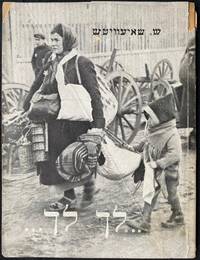
194643433Lodzsh: Tsentraler Yidisher Historisher Komisye baym Tsentral-Komitet fun Poylishe Yidn 1946. 1st edition. Original dramatic photgraphic covers 8vo 70 1 page 1 leaf. Includes facsimiles. 21 cm. In Yiddish. Poems. "Oysgabes fun Der Tsentraler Yidisher Historisher Komisye baym Tsentral-Komitet fun Poylishe Yidn. Serye yidishe literatur 1." <br> "Published by a commission The Central Jewish Historical Commission dedicated to recording the fate of Polish Jews published this book length poem by Simkhah Szajewics. Written in the Lodz Ghetto it appeared immediately after the war in 1946; Szajewicz perished in a concentration camp in 1944" from an exhibit at the National Yiddish Book Center which houses their copy in their Rare Book Collection. <br> The book includes two long poems: "Lekh-lekha" and "Friling 702 " as well as letters and other related material. <br> See David Roskies' interesting reflection on this work and it's stunning photographic cover at <br> jtsa.edu/torah/go-forth-the-grammar-of-remembrance. <br> For more about the author-poet see Chava rosenfarb's essay on Shayevitch in Tablet Magazine at <br> tabletmag.com/sections/arts-letters/articles/the-last-poet-of-lodz. <br> SUBJECTS: Jews -- Persecutions -- Poland -- Lódz. Holocaust Jewish 1939-1945 -- Poetry. Jews -- Correspondence. Crease and wear to wrapper and foot and crown of spine see photo better condition than usually found attractive. Good Condition. B HOLO2-110-36A-CCALX-'emm H-40-10. Lodzsh: Tsentraler Yidisher Historisher Komisye baym Tsentral-Komitet fun Poylishe Yidn unknown
8' black hardcover. cover worn. fron cover and spine detached from spine. pages slightly yellowing. inscription on first white page. else in fair+ condition.
1375381Warszawa (Varsovie): Haoved, 1923 in-8, (22,5 x 15 cm), 205 pages. Broché, couv. défraîchie avec petits manques, assez bon. Texte en yiddish..
Original Wraps. 8vo. 155 pages. 22 cm. First edition. In German with some Hebrew. 'Agudas Yisroel'; Reports and materials. Compiled by the Provisorischen Comité der "Agudas Jisroel" zu Frankfurt a. M. Contents: Die Vorgeschichte der "Agudas Jisroel" by A. Weyl - Die Versammlung zu Frankfurt a. M. Am 29. Oktober 1911 (Protokoll) - Die Kattowitzer Konferenz am 27. Und 28. Mai 1912 (contains reports from the Conference, the Program of the Agudas Yisroel, etc. ) - Zustimmungskundgebungen zur Gründung der "Agudas Jisroel" - Auszüge aus Zustimmungsschreiben hervorragender Persönlichkeiten (in Hebrew) - Stimmen der Presse zur Gründung der "Agudas Jisroel. " This collection of reports can be assumed to be one of the earliest publications of the Agudat Yisroel after its founding. The Agudat Yisrael is a political movement of Orthodox Jewry, founded at a conference in Kattowitz (Upper Silesia; today Katowice, Poland) in May 1912. The 300 delegates at the Kattowitz conference faced the complex and challenging task of overriding very real differences among traditional communities in Germany, Russia, Poland, Lithuania, Hungary, and elsewhere. The goal in forming Agudas Yisroel was to create an overarching, 'ecumenical' Orthodox identity to be shared by all these communities, represented by one organization. A compromise view prevailed, and individual communities were allowed to make their own decisions at local and regional levels. Though some steps were taken to set up a larger organization, including plans for establishing a world body of Agudas Yisroel to be called the Kenesiyah Gedolah (Great Assembly) , the outbreak of World War I made plans to convene such a conference in August 1914 impossible. Consequently, the first international assembly did not take place until 1923. - YIVO Encyclopedia. Subjects: Orthodox Judaism - Congresses. Agudat Israel. OCLC lists 11 copies. Wraps heavily soiled, detached, with some chipping to edges. Pages aged, with minor chipping at top; otherwise fresh. Fair condition. (GER-43-13)