3 889 résultats
21270Paris Librairie de Firmin-Didot et Cie 1884 grand in 8 (29x21) 1 volume reliure plein chagrin marron orné de l'éditeur (Engel, d'après Souze), dos lisse orné, plats entiérement ornés d'un très fin décor géométrique orientaliste doré et argenté, tranches dorées, XV et 705 pages, avec de nombreuses illustrations dont 10 chromolithographies, 4 cartes et 366 gravures dont 70 grandes planches, quelques rares rousseurs éparses. Le milieu et la race (L'Arabie. Les Arabes. Les Arabes avant Mahomet); Les origines de la civilisation arabe (Mahomet, Naissance de l'empire Arabe; Le Coran; Les conquêtes des arabes); L'empire des Arabes (Les Arabes en Syrie; Les Arabes à Bagdad; Les Arabes enen Perse et dans l'Inde; Les Arabes en Égypte; Les Arabes dans l'Afrique Septentrionale; Les Arabes en Espagne; Les Arabes en Sicile, en Italie et en France; Luttes du christianisme contre l'islamisme, les croisades); Les moeurs et les institutions des Arabes (Les Arabes nomades et sédentaires des campagnes; Les Arabes des villes, moeurs et coutumes; Institutions politiques et sociales des Arabes; Les femmes en Orient; Religion et morale); La civilisation des Arabes (Origines des connaissances des Arabes, leur enseignement et leur méthode; Langue, philosophie, littérature et histoire; Mathématiques et astronomie; Sciences géographiques; Sciences physiques et leur applications; Sciences naturelles et médicales; Les arts Arabes; L'architecture Arabe; Commerce des Arabes, leurs relations avec divers peuples; La civilisation de l'Europe par les Arabes, leur influence en Occident et en Orient); La décadence de la civilisation arabe (les successeurs des Arabes, influence des européens en orient; Causes de la grandeur et de la décadence des Arabes, état actuel de l'islamisme). Très bel exemplaire ( Photographies sur demande / We can send pictures of this book on simple request )
In-folio, (8), 369pp, (1), legatura in pergamena coeva, titolo manoscritto al dorso; rilegato con Tractatus tres de balneis Patavinis e con Tractatus de modo componendi Medicinas, & de dosi earum, e Antidotarium. Medico di origine veneta morto nel 1460, esercitò a Padova anche come insegnante presso la locale e prestigiosa Università di medicina, dove dai documenti risulta professore dal 1422 al 1441. La sua opera Consilia, stampata nei primi decenni del secolo successivo, è molto conosciuta e apprezzata. Viene anche ricordato per l’attività di chirurgo ed esperto di anatomia: si dice che abbia eseguito personalmente quattordici dissezioni complete. Trattandosi di uno studioso quattrocentesco, i suoi interessi botanici sono strettamente legati alla sua attività di medico nella preparazione dei medicamenti che provenivano per la maggior parte dal mondo vegetale. Il prestigio dei Consilia durerà per alcuni secoli e molti saranno gli autori di medicina che attingeranno alle sue informazioni scientifiche e alla struttura del libro, organizzato sapientemente nella discussione di 305 casi clinici comprendenti tutta la materia medica conosciuta, chirurgia e anatomia comprese. In-folio, (8), 369pp, (1), contemporary vellum binding, handwritten title on the spine; bound with Tractatus tres de balneis Patavinis and with Tractatus de modo componendi Medicinas, & de dosi earum, and Antidotarium. Doctor of Venetian origin who died in 1460, he also practiced in Padua as a teacher at the local and prestigious University of Medicine, where the documents prove him as professor from 1422 to 1441. His work Consilia, printed in the first decades of the following century, is well known and appreciated. He is also remembered for his activity as a surgeon and anatomy expert: he is said to have personally performed fourteen complete dissections. Being a fifteenth-century scholar, his botanical interests are closely linked to his activity as a doctor in the preparation of medicines that mostly came from the plant world. The prestige of the Consilia will last for a few centuries and many medical authors will draw on its scientific information and on the structure of the book, expertly organized in the discussion of 305 clinical cases including all known materia medica, surgery and anatomy included.
28181Imprimerie de La République, An III. In-8 en demi-chagrin avec dos à nerfs et caractères dorés. Discours préliminaire de 22 pages puis 136 pages de la Grammaire Arabe de Volney avec tableaux et Proverbes Arabes. Les " Poésies d'Abd El-Kader, Ses Règlements Militaires " ont été reliés en fin d'ouvrage et comptent 68 pages,dont 60 en langue arabe. Demi-chagrin XIXème.Tableaux.Bon état.Qques piqûres.
1948356161948 Guise - Maslahat al-Misbaha al-Misriya - 1948 - 2 volumes in-folio - Reliure plein chagrin vert - Plats ornés de calligraphies arabes - coiffes, coins et coupes usées au premier volume - petites taches à quelques pages du tome 1 - Bon exemplaire -
186890434E. Maillet Challamel | Paris 1868 | 14 x 22.5 cm | Relié
- Fisher, son, & co., London 1836, Pet. in-4 (21x28,5cm), 3 volumes reliés. - Edition originale, abondamment illustrée de 2 cartes et de 121 gravures sur acier par Bartlett, dont 3 titres gravés avec vignettes. Volume 1 : 38, Volume 2 : 37, Volume 3 : 46. Impression sur vélin teinté, planches sur velin fort. Plusieurs graveurs ont participé à la réalisation de cet ouvrage : Jorden, sand, finsbury, Higham, Finden... Cartonnage de l'éditeur réalisée en demi chagrin vert aux plats de percaline vert sapin gauffrés. Dos lisse orné d'une plaque spéciale avec divers ornements, une femme vêtue à l'orientale, un croissant et 2 chameaux. Plats repoussés d'une grande plaque décorative formée d'entrelacs de fruits et de fleurs, eux-mêmes composant 4 médaillons avec cavaliers, caravane, chameaux... et d'un grand fer central : une urne flanquée de 2 chameaux. Dos éclaircis uniformément. Traces de frottement sur les dos. Le long du mors supérieur du tome 2, manque de percaline sur 2,5cm. Coins repliés. Une tache blanchâtre sur le plat supérieur du tome 1 (un cercle de 8mn de diamètre). Des zones décolorées sur 2 plats. P.43 au tome 2, une déchirure en marge. Les 2 dernières planches du tome 2 avec trace de mouillure sur un coin. Ensemble frais mais quelques rousseurs sur les titres gravés, au dos de quelques planches et sur certaines planches, notamment à la fin du tome 2. Bel exemplaire. Ex-libris Bibliothèque Castletown dans le premier tome. Second ex-libris dans les 2 autres tomes : Thomas Conolly. Composé de 121 vues du Moyen-orient, scènes animées avec des personnages en costumes, on y voit des représentations de Damas, Jerusalem, Tripoli, Jaffa, Acre, Alexandrie, les temples, les antiquités, les rivières et les sites remarquables. Toutes les gravures sont finement exécutées et, bien que marquées par un souci réaliste et naturaliste, engendrent une perception romantique et exotique du monde arabe. [ENGLISH DESCRIPTION ON DEMAND]
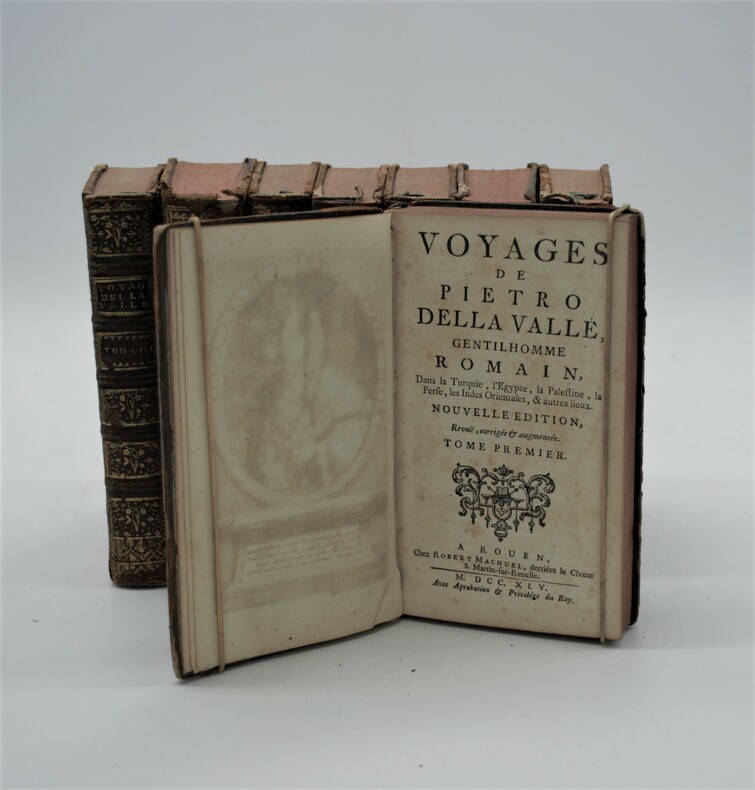
1745PHO-885Paris & Rouen , Nyon & Machuel ,1745. 8 volumes in-12 (170x100), plein veau époque , dos à nerfs avec pièces de titre et tomaison , tranches rouges , défauts d’usage (coiffes arasées , coins usés , reliures frottées , manque au dos Tome 7, etc) , Édition illustrée des portraits de l'auteur et de sa femme morte durant le voyage et 5 plans H.T. et une planche.
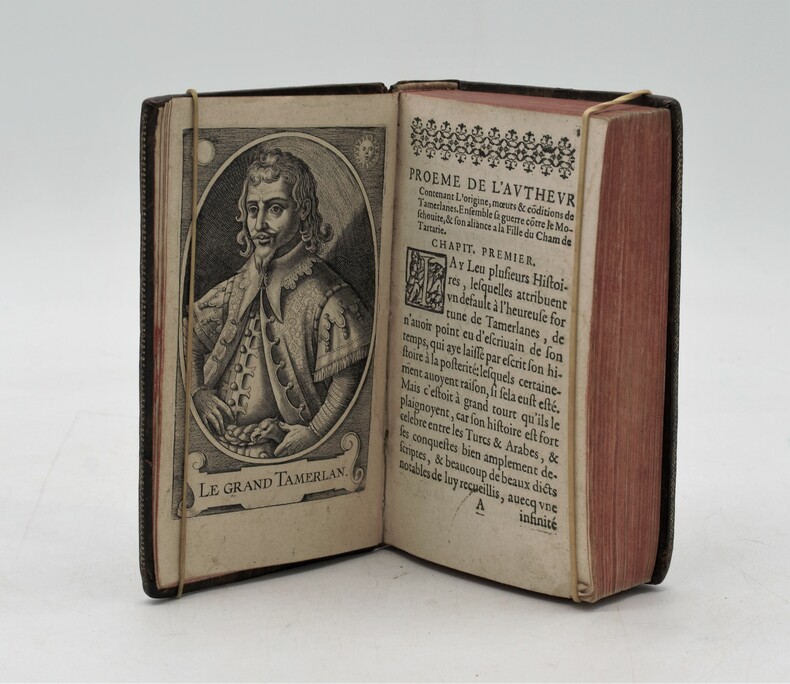
1602PHO-1223Bruxelles , Rutger Velpius, 1602 in-8, [3] ff. n. ch. (titre, au lecteur, dédicace), 504 pp., avec un portrait-frontispice, veau brun marbré, dos à nerfs cloisonné et fleuronné, tranches rouges , titre remonté, bon exemplaire. (reliure de l'époque).
Very Good English Original dark green cloth bdg. Brief title and "Stirps Arabica Vicit" with a saber and crescent moon gilded on the front board. A very good copy. 4to. (30 x 24 cm). In English. 66 p., 5 engraved plates. First and only edition of this handsome and illustrated book of the first Arabian horses presented by Ottoman Sultan Abdulhamid II, bred by Huntington in North America. Arabian horse breeding in North America properly began with the world tour taken by General Ulysses S. Grant after he served as president of America, it is that in March of 1878 the General and his son Jesse arrived in Istanbul (Constantinople ), after the day the Grants toured the private stables of Sultan Abdul Hamid II are distinctly contradictory. Randolph Huntington was an American horse breeder who demonstrated the possibilities inherent in the Arab horse for the purpose of developing a new breed of saddle and road horses. During his first years on the farm, he bought and sold many colts and fillies as coach horses in New York City. He soon came to recognize the value of the Clay stock in that community which was largely the result of the breeding of a horse called Henry Clay which was brought to the nearby Genesee valley and whose stock was distributed through the valley. On May 31, 1879, there arrived in America two very fine stallions which were presented to General U.S. Grant by the Sultan of the Ottoman Empire. These stallions were named Leopard and Linden Tree. It is generally acknowledged that Linden Tree was a Barb-Arabian while Leopard was a pure Arabian. Prior to the time that these horses arrived in America, the very favorable results from inbreeding to produce typical Clay horses were shown to be practical. After seeing the stallions, Leopard and Linden Tree, Randolph Huntington at once started negotiations to breed three virgin Clay mares to each of these stallions. He hoped thereby to improve the road horse quality of his horses. In the following years, he called them Clay-Arabs. Since Huntington wanted to breed only virgin mares. Leopard was a Seglawi Jedran, desert-bred by the Anazeh, foaled in 1873 and presented by Jedaan Ibn Mheyd of the Fedaan Anazeh to the Turkish governor of Syria. (Some accounts list Ibn Mheyd as the breeder, while Carol Mulder, with typical caution, makes the distinction that we only know he presented the horse) The governor then presented the horse to Abdul Hamid II, who in turn gave him to General Grant.
1936ABC_46032London: printed and published at Her Majesty's Stationary Office 1936. Original publisher's printed paper wrappers in later blue paper wrappers. Folio. Printed in English and Arabic. British government publication of an interpretership examination for Arabic translation. It provides the examination questions that officers in the Royal Air Force had to answer correctly to pass as an interpreter of Arabic. The work contains several questions that include translating Arabic texts printed in Arabic type.Library stamp on foot of front cover title-page and pp. 8 and 9: "Liverpool Public Libraries". In good condition.l Consolidated List of Government Publications 1936 p.147; not in WorldCat. printed and published at Her Majesty's Stationary Office, unknown
184890552Imprimerie Nationale | Paris 1848 | 13 x 21 cm | Relié
189390856Imprimerie Nationale | Paris 1893 | 14 x 22.7 cm | Relié
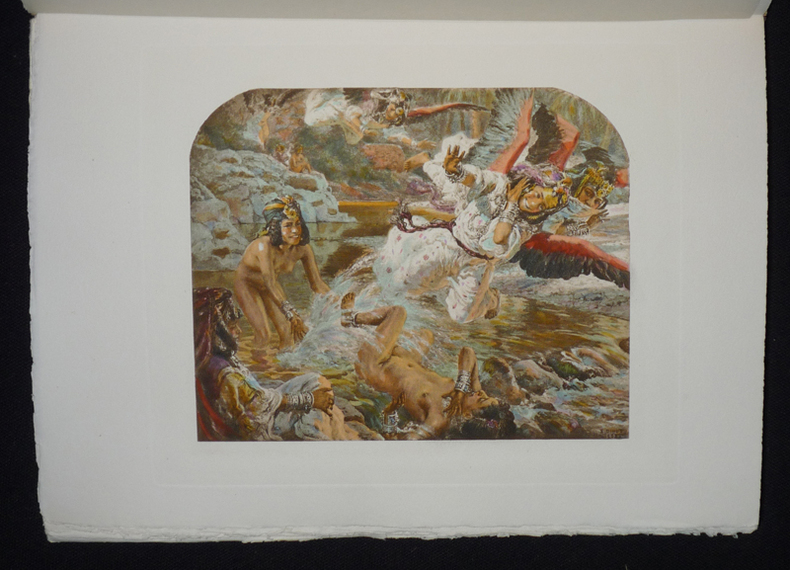
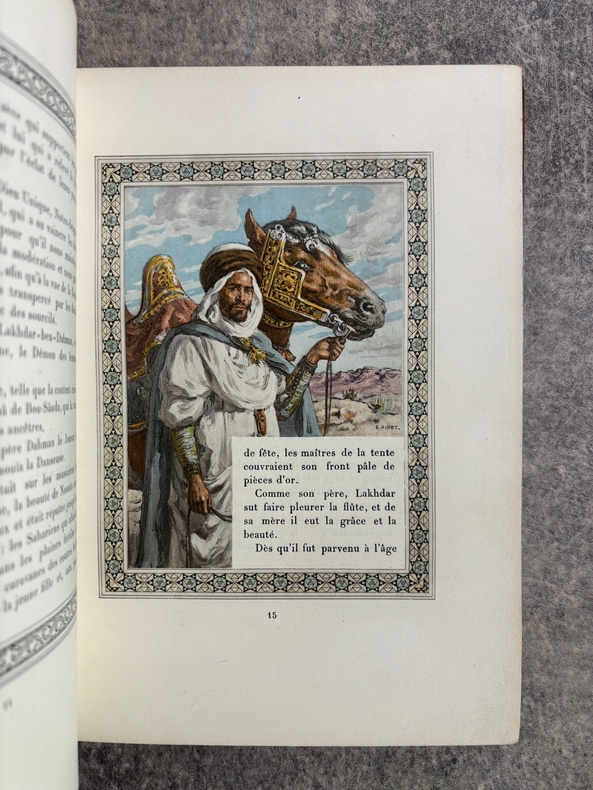
1906ys3303L'Edition d'art H. Piazza Sélection Abraxas-libris Broché sous emboitage 1906 In-8 (17 x 23,4 cm), broché sous emboîtage, couverture rempliée, 222 pages, 1 de 348 exemplaires sur vélin, superbes compositions en couleurs de E. Dinet commentées par Sliman Ben Ibrahim Bamer ; légères pliures au dos, par ailleurs intérieur très frais, bel exemplaire. Livraison a domicile (La Poste) ou en Mondial Relay sur simple demande.
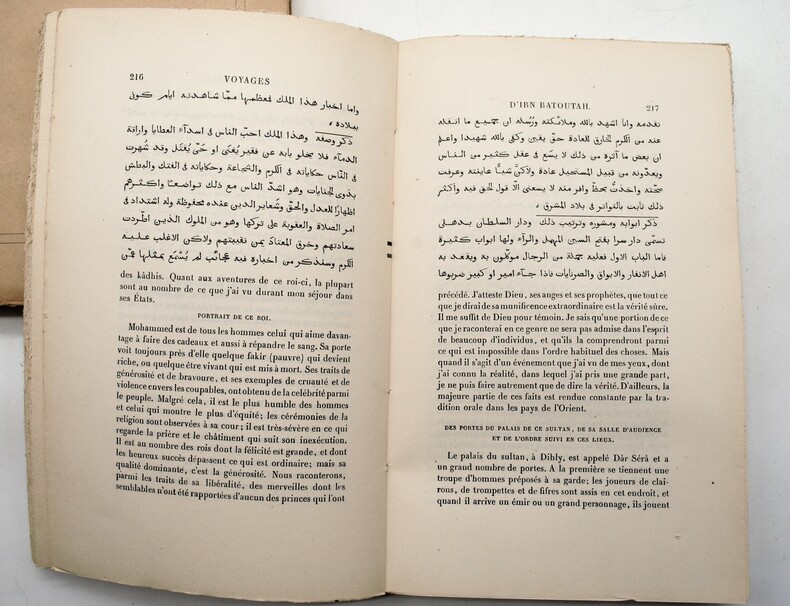
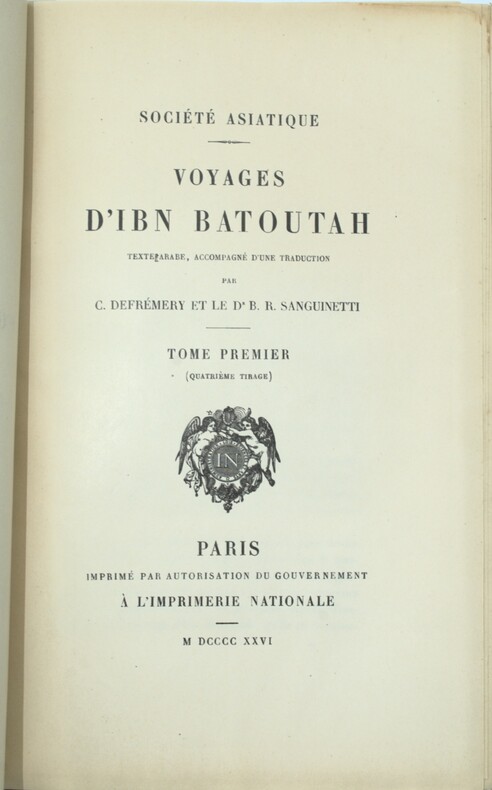
1922PHO-1091A l'Imprimerie Nationale, Paris, Ernest Leroux et Paul Geuthner Éditeur, 1922-1949. . Édition bilingue: Texte arabe avec traduction française en regard. 5 volumes In-8° de: Tome I (4e tirage,1927) 2ff-XLVI & 443pp. Tome II (5e tirage,1949), XIV & 465 pp. Tome III (5e tirage, 1949), XXVI & 476 pp. Tome IV (4e tirage, 1922), 479 pp. Le Tome V, constitue l'index ,(3e tirage , 1927) 91 pp.. Broché avec couverture éditeur .
19023834PARIS. L’EDITION D’ART. H. PIAZZA, EDITEUR. 1902. IN-8 (17,5 X 23,5 X 3 CENTIMETRES ENVIRON) DE 175 ET (5) PAGES, RELIURE D’EPOQUE 1/2 MAROQUIN HAVANE A COINS, DOS LISSE ORNE D’UN DECOR MOSAIQUE, TITRE DORE SUR ETIQUETTE MAROQUIN VERT, TETE DOREE, COUVERTURE ILLUSTREE EN COULEURS CONSERVEE (KAUFFMANN-HORCLOIS RELIEUR). ILLUSTRE DE 52 COMPOSITIONS EN OR ET EN COULEURS, DONT 6 A PLEINE PAGE. CHAQUE PAGE DE TEXTE ENCADREE D’UN DECOR GEOMETRIQUE EN NOIR OU EN COULEURS. PREMIER TIRAGE LIMITE A 300 EXEMPLAIRES NUMEROTES. UN DES 260 SUR PAPIER VELIN A LA CUVE, CELUI-CI HORS COMMERCE, IMPRIME POUR M. E. GRENINGAIRE. “LE PLUS RARE DES OUVRAGES DE DINET” (CARTERET. IV. 141). EX-LIBRIS GRAVE “E. BRUELL”. TRES BEL EXEMPLAIRE.
Very Good Turkish, Ottoman (1500-1928) Original map. Oblong atlas folio. (57 x 77 cm). In Ottoman script. Folded. Stains on the upper side. Slightly chipped margins. Filistin haritasi. Scale: 1/250.000. Erkilet was an officer of the Ottoman Army and the general of the Turkish Army. In fall 1941 he, along with General Ali Fuad Erden, visited the occupied territories in Ukraine (including Crimea) on the invitation of Gerd von Rundstedt. From there he and other Turkish officers flew to Rastenburg to meet Hitler in person. In 1943 he published his essays on that trip under the title "What I Saw on the Eastern Front". Being a staunch Turanist, he was briefly detained for Panturkic activities in 1948 together with some other prominent Turanists.
Very Good Turkish, Ottoman (1500-1928) Original wrappers. Demy 8vo. (21 x 14 cm). In Ottoman script (Old Turkish with Arabic letters). 83 p. Chipped on extremities of pages and cover, minor stains on edges. Otherwise a good copy. First and only edition of this first work in book form on Baku and Azerbaijani oil. After the occupation of the Republic of Azerbaijan by the Red Army, many Azerbaijani intellectuals such as Mehmed Emin Resûlzâde (1884-1955) sought refuge in Turkey, established a publishing house called "Milli Azerbaycan Nesriyâti" [i.e. National Azerbaijan Publication] in 1928, Istanbul, and to make the voice of Azerbaijanis heard in exile to influence world public opinion. This book was published as the 9th publication of this publishing house. It was printed in Orhaniye Printing house in 1928 and was actually composed of the articles written by the author in the "Azeri-Turk" magazine. The first article appeared in the issue dated 15 August 1928, with other articles following it. The book, in which Mehmed Emin Rasülzade also penned a presentation, consists of the chapters: The Role of Oil in the World War, Azerbaijan at the Genoa Conference, Azerbaijan at the Hague Conference, the American Rivalry in Britain, A Common Front against the Bolsheviks, the Pursuits of the Oil Competition. Compiled from Mehdiyev's articles, is not only a propaganda work against the Russian occupation but also the first in-depth work written on Baku and Azerbaijan oil. Many sources in the text are referenced in footnotes. Mehdiyev says that world politics is shaped by the economy and oil is the most important factor in this context. In addition to expressing how important it is for the First World War, he also makes predictions about how oil will shape world politics in the future. According to Mehdiyev, whoever dominates the world's oil reserves will be the strongest state in the world. Based on M. Fanning, Mehdiyev states that Azerbaijani and Baku oil has an estimated 8 million barrels of resource rather than Mexican, American, Turkish, and Iranian oil. Only one paper copy in Bogaziçi University's Library in Turkey according to the OCLC: 82001141.; Özege 1960.
Very Good Turkish Original silver gelatin photographic print mounted on cardboard. 53x42 cm (Photo size: 38x30 cm). Signed by Yildiz Moran. Yildiz (Vahid) Moran Arun was born on 24 July 1932, in Istanbul. She is the youngest of three children born to Nemide Moran and Ahmet Vahid Moran. Her father, Ahmet Vahid Moran, was a military officer who served in important positions both at home and abroad. He was the writer of Turkey's very first English-Turkish dictionary printed in Latin script in 1924. In 1950, Yildiz Moran quit her high school education during her final year at Robert College and, following the guidance of her uncle, the art historian Mazhar Sevket Ipsiroglu, went to Great Britain to study photography. After completing her education at Bloomsbury Technical College (1950-52) and Ealing Broadway Technical College, she began to work for John Vickers, the acclaimed photographer of The Old Vic. Moran combined her technical and theoretical knowledge with the practical experience she gained at the studio and stage shoots. She had the opportunity to meet famous artists of the time. The exhibitions and works she saw during her time in Great Britain helped her develop her photographic vision. Following her internship period, she began to make a living taking portrait and lobby photographs. She opened her first exhibition in 1953 in Cambridge. In 1954, she held four more exhibitions in London. All these shows attracted much attention. In her first exhibition, her entire collection was sold. She went traveling in Europe. After making a photo book on Spain and Portugal, she returned to Turkey in 1954. Between 1955 and 1962, she held five solo exhibitions. In 1963, she married Özdemir Asaf (Halit Özdemir Arun) and gave birth to three children in four years. She dedicated the rest of her life to her children. She opened her last exhibition in 1970, in Istanbul. After that, she only took part in retrospective exhibitions. She quit her professional photography career and began to work as a translator and dictionary writer. Between 1981 and 1987, she prepared the complete works of Özdemir Asaf for publication and translated some of his poetry and prose into English. In 1982, the Istanbul State Academy of Fine Arts Photography Institute awarded her with honorary membership on account of her contributions to the art of photography. Lyrically conveying a universal language through her own perspective, Moran became a school in herself with her "timeless" photographs. Turkey's first academically-trained photographer, Yildiz Moran is renowned for the new vision and aesthetic she introduced into photography and considered to be one of the best photographers of all time. Masterfully combining the tradition of the East with the aesthetic of the West, she left behind a legacy of black and white photographs beautifully composed to capture the world of light and shadow reflecting on people and lands. Considering the conditions in the world of photography in the 1950s and 1960s, it is a great achievement that she defined at the age of 20 her passion for photography as the foundation of her life, became the first academically-trained woman photographer in her country, acquired in-depth knowledge of the discipline and combined this knowledge with her talent and hard work. "The camera must be like an extension of your being so that it doesn't create an obstruction between you and your subjects. Anything that has poetry in it is the subject of photography. My only intention has always been to photograph what was universal while staying true to the concept embodied by my subject." Besides her portraits, landscapes, and abstract details, she is also known for her photographs reflecting the lives of the Anatolian people. As a woman photographer traveling in Anatolia, she accessed otherwise inaccessible environments, moments, and perspectives; and, with profound respect, she conveyed the purity of the people she met there and allowed us... (Biography: Merih Akogul).
Very Good Turkish Original silver gelatin photographic print mounted on cardboard. 53x42 cm (Photo size: 38x30 cm). Signed by Yildiz Moran. Yildiz (Vahid) Moran Arun was born on 24 July 1932, in Istanbul. She is the youngest of three children born to Nemide Moran and Ahmet Vahid Moran. Her father, Ahmet Vahid Moran, was a military officer who served in important positions both at home and abroad. He was the writer of Turkey's very first English-Turkish dictionary printed in Latin script in 1924. In 1950, Yildiz Moran quit her high school education during her final year at Robert College and, following the guidance of her uncle, the art historian Mazhar Sevket Ipsiroglu, went to Great Britain to study photography. After completing her education at Bloomsbury Technical College (1950-52) and Ealing Broadway Technical College, she began to work for John Vickers, the acclaimed photographer of The Old Vic. Moran combined her technical and theoretical knowledge with the practical experience she gained at the studio and stage shoots. She had the opportunity to meet famous artists of the time. The exhibitions and works she saw during her time in Great Britain helped her develop her photographic vision. Following her internship period, she began to make a living taking portrait and lobby photographs. She opened her first exhibition in 1953 in Cambridge. In 1954, she held four more exhibitions in London. All these shows attracted much attention. In her first exhibition, her entire collection was sold. She went traveling in Europe. After making a photo book on Spain and Portugal, she returned to Turkey in 1954. Between 1955 and 1962, she held five solo exhibitions. In 1963, she married Özdemir Asaf (Halit Özdemir Arun) and gave birth to three children in four years. She dedicated the rest of her life to her children. She opened her last exhibition in 1970, in Istanbul. After that, she only took part in retrospective exhibitions. She quit her professional photography career and began to work as a translator and dictionary writer. Between 1981 and 1987, she prepared the complete works of Özdemir Asaf for publication and translated some of his poetry and prose into English. In 1982, the Istanbul State Academy of Fine Arts Photography Institute awarded her honorary membership on account of her contributions to the art of photography. Lyrically conveying a universal language through her own perspective, Moran became a school in herself with her "timeless" photographs. Turkey's first academically-trained photographer, Yildiz Moran is renowned for the new vision and aesthetic she introduced into photography and is considered to be one of the best photographers of all time. Masterfully combining the tradition of the East with the aesthetic of the West, she left behind a legacy of black and white photographs beautifully composed to capture the world of light and shadow reflecting on people and lands. Considering the conditions in the world of photography in the 1950s and 1960s, it is a great achievement that she defined the age of 20 her passion for photography as the foundation of her life, became the first academically-trained woman photographer in her country, acquired in-depth knowledge of the discipline and combined this knowledge with her talent and hard work. "The camera must be like an extension of your being so that it doesn't create an obstruction between you and your subjects. Anything that has poetry in it is the subject of photography. My only intention has always been to photograph what was universal while staying true to the concept embodied by my subject." Besides her portraits, landscapes, and abstract details, she is also known for her photographs reflecting the lives of the Anatolian people. As a woman photographer traveling in Anatolia, she accessed otherwise inaccessible environments, moments, and perspectives; and, with profound respect, she conveyed the purity of the people she met there and allowed us... (Biography: Merih Akogul).
- Imprimerie royale, Paris 1845, 9,5x15cm, 2 volumes reliés en 1. - Edition originale de la traduction française, des corrections, des additions et des éclaircissements, établis par Joseph Toussaint Reinaud en 1845, d'après le texte arabe imprimé en 1811 par les soins de Louis Langlès. Reliure à la bradel en plein papier marbré, plats de couverture conservés, reliure signée Thomas Boichot. Très rare exemplaire sans rousseur. [ENGLISH DESCRIPTION ON DEMAND]
Good Turkish, Ottoman (1500-1928) Original full leather bdg. in traditional Ottoman style. Repaired skillfully. 4to. (29 x 18 cm). In Ottoman script. 2 volumes set in one: ([15], 327 p.; [6], 315 p.). Vasif tarihi. Mahasin ül-âsâr ve hakayik ül-ahbâr. 2 volumes set. Özege 22519. Extremely rare. First Edition. In the late eighteenth century the Ottoman Empire experienced a time of profound crisis, political as well as intellectual, moral, and ideological. This dissertation explores the mental and moral climate of the period through the work of Ahmed Vasif Efendi, a statesman, ambassador, intellectual, and author of one of the century's largest histories, and also through his personal development as a reformer. Divided into five chapters, each treating a distinct aspect of Vasif's thought, this dissertation argues that Ottoman elites after 1774 responded to growing foreign and domestic challenges with not only military reform but a broad re-evaluation of subjects like war, peacemaking, moral rule, and human agency in history. It suggests these debates, including a basic disagreement over the legitimate place of human reason and action across life's many spheres, indicate a vital if fractured response to the crisis, and an incipient breakdown in certain storied intellectual frameworks.
1922PHO-1362A l'Imprimerie Nationale, Paris, Ernest Leroux et Paul Geuthner Éditeur, 1922-1949. . Édition bilingue: Texte arabe avec traduction française en regard. 5 volumes In-8° de: Tome I (4e tirage,1927) 2ff-XLVI & 443pp. Tome II (4e tirage,1914), XIV & 465 pp. Tome III (4e tirage, 1914), XXVI & 476 pp. Tome IV (4e tirage, 1922), 479 pp. Le Tome V, constitue l'index ,(3e tirage , 1927) 91 pp.. Broché avec couverture éditeur ,tome 1,4 et annexe non coupé , étiquettes au dos et cachets (tome 2 et 3) , manque au dos tome 3.
1653P2-6E-2Lugdini Batavorum, Bonaventurae & Abraham Elseviriorum, 1653. In-folio, plein veau époque, dos à nerfs. 16pp-1f-2922 colonnes, texte sur 2 colonnes, première édition. Notes manuscrites sur le titre et dans quelques marges, rousseurs, mouillures sur 20pp à l’index, maque de pp à l’index, petits trous de vers en marge. Jacobus Golius, mathématicien et orientaliste, étudia l’Arabe avec Erpenius, qui lui succéda en tant que professeur d’Arabe à l’université de Leide en 1625. Puis il prit la chaire des mathématiques dans la même université. Son dictionnaire Arabe-Latin restera la grande référence jusqu’au XIX siècle.
184570157Imprimerie Royale | Paris 1845 | 9.50 x 15 cm | 2 volumes reliés en 1
198077800S. n. | s. l. s. d. [circa 1980] | 16 x 21.50 cm | une feuille