6 567 résultats
1879007033Edinburgh: William Paterson 1879. Half Morocco. Very Good. 4to. 25 by 16 cm. With etched plates. Cloth on boards worn and rubbed. Leather generally bright and attractive. Clean and tight within. William Paterson unknown
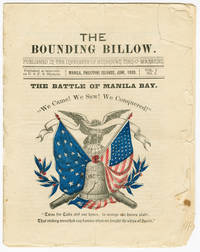
1898WRCAM56306Manila Philippines 1898. 16pp. printed in double columns. Color illustration on front wrapper uncolored map on rear wrapper. Original pictorial self-wrappers. Rear wrapper detached but present. Central vertical fold wrappers with chips and tears in edges upper outer corner of front wrapper repaired with tape on verso. Good. One of three issues of this scarce Spanish- American War periodical published on board Dewey's flagship Olympia in Manila Bay. There was a total of seven numbers of this naval periodical the first two published in Nagasaki the third in Yokohama the fourth in Hong Kong and numbers five to seven in Manila. The present issue entirely devoted to the Battle of Manila Bay is among the most desirable and contains American accounts and a translated Spanish account of the battle several poems and a map of the scene of action made by a sailor "with a couple of sail needles." The magazine was written and edited by Apprentice First Class Louis Stanley Young and printed by Harry B. Glover on paper captured from the "Commandancia General del Arsenal de Cavite." Young a former printer himself improvised a print shop in a torpedo room on board the Olympia. An illustration of the Liberty Bell two flags an American eagle etc. is printed on the front wrapper in black red and blue. "A historic piece one of major proportions" - Moebs. MOEBS AMERICA'S NAVAL HERITAGE 136. unknown books
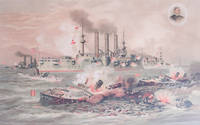
189840301Philadelphia: J. Hoover & Sons 1898. Image 27 x 17 1/2 inches. Framed and glazed. Image 27 x 17 1/2 inches. Schley was selected "at the opening of the Spanish-American War to command the Flying Squadron at Hampton Roads.when Cevera's ships reached Martinique the Flying Squadron.at 9:35 July3 1898 the Spanish ships emerged from the harbor of Santiago and turned westward Schley's flagship the Brooklyn westernmost of the blockading line."<br/><br/>Xanthus Russell Smith 1839-1929 comes from a Family of Philadelphia Artists. He was the som of Russell Smith. J. Hoover & Sons unknown books
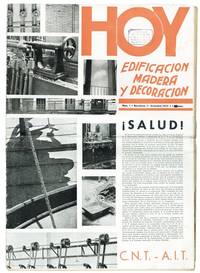
193735126Barcelona: Comité Regional en Cataluña de los Industrias de la Edificación Madera y Decoración C.N.T - A.I.T. 1937. First Edition. Large folio 49cm. Staple-bound pictorial paper wrappers; 23pp; illus. Horizontal fold; partial perforation at bound edge; creasing to corners with marginal soil to wrappers and a few chips to contents; a sound Good or better example. The unlikeliest of publishing endeavors during the depredations of wartime: an avant-garde large-format lavishly illustrated journal of architecture and decorative arts issued no less under the auspices of an anarchist workers federation. The editors intended to usher in a new era of progressivism and modernism following the defeat of the fascist rebels in the July Barcelona uprising of 1936 ".aquel magnifico y revolucionario 19 de julio tan digno y decisivo; no solo como fin de etapa sino tambien como prologo de una etapa nueva repleta de posibilidades consequidas ya en parte ye en parte perfiladas no siempre malogradas." and the magazine fashioned itself upon the model of such avant-garde revolutionary journals as the Soviet Union's USSR in Construction and the American Labor Defender with bold photo-montage layouts and modernist typography. The timing was not propitious. By December 1937 the Republic was mired in an increasingly hopeless civil war and the glorious New Era that had seemed so certain in July of 1936 was now a rapidly fading hope. The magazine appears to have lasted for only a single issue before folding; today it is extremely rare with no examples in North America and only two physical locations noted in European institutions via COPAC and OCLC Biblioteca Nacional and Bibliotheque Nanterre. BNE attributes editorship to the avant-garde graphic artist DarÃo Carmona de la Puente but this information does not appear to derive from the publication itself which makes no editorial attribution. Comité Regional en Cataluña de los Industrias de la Edificación Madera y Decoración, C.N.T - A.I.T. unknown books
In -8°. Due voll. rilegati insieme, pp. 64; 96, pergamena coeva
185675Barcelone, Imprenta del Gobierno, 13 juin 1820 placard in-folio (42 x 31 cm), texte sur deux colonnes, en feuille.
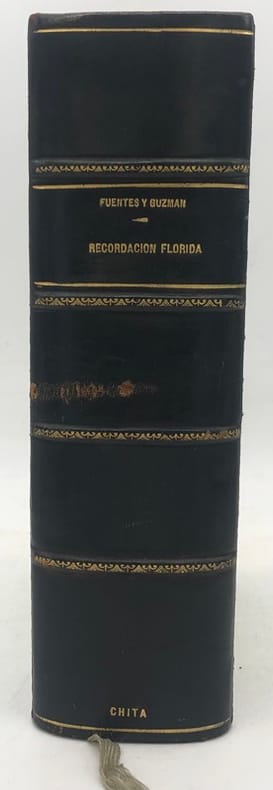
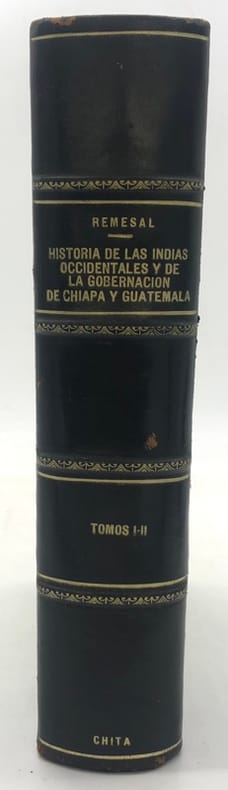
212204Guatemala, Imprimerie nationale, 1932-1933 3 tomes en un fort vol. in-4, XX pp., un f. n. ch., 426 pp., pp. 3-459, pp. 3-516, un f. n. ch., avec des illustrations dans le texte et 6 planches dépliantes hors texte, manquent les feuillets de titre des tomes II et III, demi-basane noire, dos à faux-nerfs orné de filets et guirlandes dorés (reliure de l'époque).
212199Guatemala, Imprimerie nationale, avril 1932-décembre 1932 2 tomes en un fort vol. in-4, 530-620 pp., demi-basane noire, dos à nerfs orné de filets et guirlandes dorés (reliure de l'époque). Cachets.
Features: The "White Avengers" - III; A German Venice; Hassoo the Traitor; A Record Trip in the Yoho Valley; The Raiding of Robben Island; A Lonely Trans-African Tramp - II; A Bolt from the Blue; Across America on an Automobile; How I became a Lion-Tamer; The Bird-Charmer of Paris; The Strange Story of John Evans; On Foot to Thibet (Tibet) - I; The Stronghold of the Snakes; My Spanish Servants; The Mystery of the Cross-Marked Trail; Sword-Fishing; Caught in a Death-Trap; The Haunted House by the Creek; On Foot to Thibet (Tibet) - II; At Sea with a Lioness; A Railway Race with Robbers; Through the Copland Pass; The Tale of the Tiger-People; The Voyage of the "Vaskapu"; Two Remarkable Walking Competitions; The Story of Vasili the Fisherman; "Up a Tree"; A Lonely Trans-African Tramp - III; "Dead or Alive"; In Search of a Treasure Island; The Fairy-Tale Castle; Trooper Lovelace, T.T.P. - III; In the Far North-West - II; The Medicine Wagon; A Wonderer in Asia Minor - II; The "Bandit Hunters" - The Disappearing Islands; The "Mountain Mystery"; A Californian Rabbit-Drive; Two Bachelor Girls in Madeira; A Home in a Tree-Top; The Great Feuds of Kentucky - I; With Pen and Camera in Nigeria - III; The Legend of Manaia; The "Boy Police"; Amidst Snow and Swamp in Central Africa - I; Christopher the Bear; The Monkey Gods of India; How We Settled the Tie; The Last Fire-Dance of the Sabobas; The Story of Kusanga; A Training School for Cowboys; Trooper Lovelace, T.T.P. - IV; The Hold-Up at Hugo; On the Trail in Texas and New Mexico - I; Peasants at Play; The Great Feuds of Kentucky - II; An Open-Air School in France; The Grey Scourge; Mistletoe Farming; The Bear and the Barrel; The Hut in the Jungle; The Romance of Seal-Hunting; The Haunted Ferry; A City inside a Palace; What Happened to Ferguson; Christmas in Many Lands; The Great Feuds of Kentucky - III; Amidst Snow and Swamp in Central Africa - II; The Squatter's Cup; Riding on the Sea; On the Trail in Texas and New Mexico - II; Down the Wire; The Alligator Pool; A Race with a Flood; A Maori Wedding; My Debut at Kimberley; The Wild Ponies of Exmoor; The Quest for the "Biggest Bear"; Fun on a Liner; Two Ladies and a Pony-Cart in Central Japan - I; Captured by Filipinos - I;; The Dog-Derby of the Far North; My Turkish Wife; Into Unknown Papua - I; The Strike; The "Servant Problem" in East Africa; A Battle with Ice-Floes. Average wear. Binding intact. A sound copy. Book
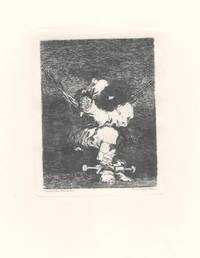
Acquaforte e bulino, circa 1810/15. Il titolo dell’opera è tratto da una scrittura a mano in una prova di stampa dell’opera che Goya include nell’album dei “Disastri della guerra” che donò al suo amico Ceán Bermúdez e che ora è conservato al British Museum di Londra. Il disegno preparatorio dell’opera è conservato al Prado di Madrid. Esemplare nel terzo stato di quattro, inserito nella Gazette des Beaux-Arts (1867); si tratta della prima vera edizione dell’opera, conosciuta altrimenti solo attraverso due prove di stampa. "A seated prisoner raises his clasped hands, both fastened with chains, in a gesture of supplication. We cannot see his features since his face is hidden beneath his long, dark hair. His feet are fastened in large shackles. Both the chains and the shackles are of considerable size, underlining their importance in any interpretation of the print. In fact, just as the title of the etching shows, the painter is comparing the excessive zeal employed in preventing the prisoner from escaping to the brutality of the crime he is accused of. It is possible that the way in which the prisoner is secured in this work by Goya was habitual at the time, an idea which is supported by certain passages of Forensic Discourses (Discursos forenses), by Juan Meléndez Valdés (Ribera del Fresno, Badajoz, 1754- Montpellier, 1814), whose portrait Goya painted in 1797. This book, published in Madrid in 1821, speaks of the cumbersome chains and shackles used to hold one María Vicente, put to death on the 23rd April 1798. Goya could well have known of her story: "But it is said that Doña María Vicente must have been treated, as the noblewoman that she is, in a very different manner, and not locked in shackles; and even thus fettered it was the judge's responsibility to examine their state and quality beforehand, to order them put on correctly". The painter has made extensive use of the etching technique here, building up the background with short, horizontal lines, whilst leaving large areas on the prisoner's clothing untouched and white, underlining his innocence. This etching would have been made at the same time as two others: The custody of a prisoner does not call for torture and If he is guilty, let him die quickly. In these images, Goya openly expresses his repulsion of the way in which prisoners were treated, as well as his opposition to the death penalty, echoing the ideas of Cesare Beccaria (Milan, 1738- Milan, 1794). In the pages of the work entitled Dei deliti e delle pene, published between 1763 and 1764, the Milanese talks of the need to modify the penal system, to lessen the severity of punishments and to seek out mechanisms for preventing crime. It is possible that these etchings also contributed to the debate on the abolition of torture which was being discussed in the Courts of Cádiz. Goya reiterates this same topic in some of the prints in his Disasters of War series, such as no. 15, And it can't be helped, no. 31, That's tough!, no. 32, Why?, no. 34, On account of a knife, no. 35, One can't tell why and no. 36, Not in this case either. Despite the gritty subject matter, the figure depicted in this etching possesses great dignity, recalling some earlier precedents which Goya may have been familiar with. One of these is an anonymous print based on Interior of a Prison (16th century, Museum of Fine Arts, Boston), by Giulio Romano (Rome, 1499-Mantua, 1596). When he was making this print, Goya may also have had in mind the disturbing, gloomy ambience of the prisons of Giambattista Piranesi (Mogliano Veneto, Treviso, 1720- Roma, 1778)." (cfr. https://fundaciongoyaenaragon.es/eng/obra/tan-barbara-la-seguridad-como-el-delito/712). Tomás Harris ritiene che la matrice di rame si trovi in una collezione privata di Parigi. Bibliografia Harris 26 III/IV; Delteil 31. Etching and engraving, circa 1810/15. The title of this work is taken from the handwritten title of a state proof that Goya included in the album of his Disasters of War prints which he gave to his friend Ceán Bermúdez and which is now in the British Museum, London. The preparatory drawing for this etching is in the Prado Museum, Madrid. Example of the third state of four, form the Gazette des Beaux-Arts (1867), firts edition of this work, before known only for proof states. "A seated prisoner raises his clasped hands, both fastened with chains, in a gesture of supplication. We cannot see his features since his face is hidden beneath his long, dark hair. His feet are fastened in large shackles. Both the chains and the shackles are of considerable size, underlining their importance in any interpretation of the print. In fact, just as the title of the etching shows, the painter is comparing the excessive zeal employed in preventing the prisoner from escaping to the brutality of the crime he is accused of. It is possible that the way in which the prisoner is secured in this work by Goya was habitual at the time, an idea which is supported by certain passages of Forensic Discourses (Discursos forenses), by Juan Meléndez Valdés (Ribera del Fresno, Badajoz, 1754- Montpellier, 1814), whose portrait Goya painted in 1797. This book, published in Madrid in 1821, speaks of the cumbersome chains and shackles used to hold one María Vicente, put to death on the 23rd April 1798. Goya could well have known of her story: "But it is said that Doña María Vicente must have been treated, as the noblewoman that she is, in a very different manner, and not locked in shackles; and even thus fettered it was the judge's responsibility to examine their state and quality beforehand, to order them put on correctly". The painter has made extensive use of the etching technique here, building up the background with short, horizontal lines, whilst leaving large areas on the prisoner's clothing untouched and white, underlining his innocence. This etching would have been made at the same time as two others: The custody of a prisoner does not call for torture and If he is guilty, let him die quickly. In these images, Goya openly expresses his repulsion of the way in which prisoners were treated, as well as his opposition to the death penalty, echoing the ideas of Cesare Beccaria (Milan, 1738- Milan, 1794). In the pages of the work entitled Dei deliti e delle pene, published between 1763 and 1764, the Milanese talks of the need to modify the penal system, to lessen the severity of punishments and to seek out mechanisms for preventing crime. It is possible that these etchings also contributed to the debate on the abolition of torture which was being discussed in the Courts of Cádiz. Goya reiterates this same topic in some of the prints in his Disasters of War series, such as no. 15, And it can't be helped, no. 31, That's tough!, no. 32, Why?, no. 34, On account of a knife, no. 35, One can't tell why and no. 36, Not in this case either. Despite the gritty subject matter, the figure depicted in this etching possesses great dignity, recalling some earlier precedents which Goya may have been familiar with. One of these is an anonymous print based on Interior of a Prison (16th century, Museum of Fine Arts, Boston), by Giulio Romano (Rome, 1499-Mantua, 1596). When he was making this print, Goya may also have had in mind the disturbing, gloomy ambience of the prisons of Giambattista Piranesi (Mogliano Veneto, Treviso, 1720- Roma, 1778)." (cf. https://fundaciongoyaenaragon.es/eng/obra/tan-barbara-la-seguridad-como-el-delito/712). Tomás Harris believes that the plate for this etching may be in a private collection in Paris. Literature Harris 26 III/IV; Delteil 31. Harris 26, III/IV; Delteil 31.
A portfolio of five color etchings, each signed and numbered by the artist. Printed on fine wove paper. Folio. Loose as issued in paper folding case. Fine and bright. Edition limited to 92 copies.
1778PHO-2329Paris, Panckouke, 1778. 2 volumes in-4 (26,5 x 21 cm), 2ff.- xx- 540pp., 2ff.-553pp.-1f., relié demi-basane époque, dos lisses ornés avec titre et tomaison. Coins usés, débuts de fentes, déchirures sans manque aux 4 cartes, quelques rousseurs. Avec 4 cartes (Golfe du Mexique, Amérique méridionale, Mexique, Amérique du sud) et 1 gravure.
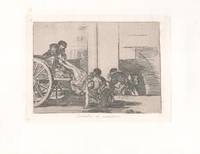
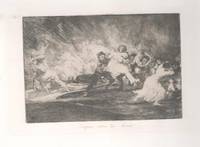
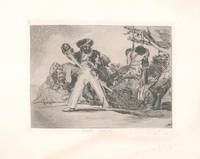
76-0143Madrid: Real Academia 1903. Etching aquatint and drypoint on wove paper. 23.5 x 33 cm sheet. Limited edition to 100. Very Good light specks of foxing in the margins.Ref.: Harris 184; Delteil 183. Madrid: Real Academia, 1903. unknown
76-0144Madrid: Real Academia 1903. Etching aquatint and drypoint on wove paper. 24 x 33 cm sheet. Limited edition to 100. Very Good light specks of foxing in the margins.Ref.: Harris 161; Delteil 160. Madrid: Real Academia, 1903. unknown
76-0145Madrid: Real Academia circa 1906. Etching aquatint and drypoint on laid paper. 23.5 x 32 cm sheet. Very Good light toning in the margins.Ref.: Harris 151; Delteil 160. Madrid: Real Academia, [circa 1906]. unknown
76-0142Madrid: Real Academia 1903. Etching aquatint and drypoint on wove paper. 23.5 x 33 cm sheet. Limited edition to 100. Good light specks of foxing throughout.Ref.: Harris 188; Delteil 187. Madrid: Real Academia, 1903. unknown
76-0146Madrid: Real Academia circa 1906. Etching aquatint and drypoint on laid paper. 23.5 x 32 cm sheet. Very Good.Ref.: Harris 136; Delteil 135. Madrid: Real Academia, [circa 1906]. unknown
76-0147Paris: Gazette des Beaux Arts Vol. XXII page 196 1867. Etching and burin on laid paper. 26 x 17 cm sheet. First Edition Posthumous impression with letters masked. Printed by Delatre Pars. Very Good.Ref.: Harris 26; Delteil 312. Paris: Gazette des Beaux Arts, Vol. XXII, page 196, 1867. unknown
0805495916-8-1B&H Español. Concise Reprint. Very Good. It's a well-cared-for item that has seen limited use. The item may show minor signs of wear. All the text is legible with all pages included. It may have slight markings and/or highlighting. B&H Español unknown
48963Madrid.1830.6 vols.in-8.En espagnol.2 tomes:Origenes del teatro espanol.2 tomes: Comedias originales.1 tome:Traducciones dramaticas.1 tome:Obras sueltas. Demi-reliures XXème.Ouvrages en très bon état.Dos légèrement insolés.
18643Paris A l'Emblème du Secrétaire 1938 in 4 (26x19,5) 4 volumes brochés sous couvertures rempliées, [4], 315 pages; [1] 330 pages; [2] 347 pages; [4] 371 pages. Avec 288 dessins dont 48 hors texte, coloriés au pochoir par Beaufumé, Jon et Raynal. Avec 288 dessins de Dubout, dont 48 hors-texte, coloriés au pochoir par Beaufumé, Jon et Raynal. Première édition illustrée par Dubout. Tirage limité à 2144 exemplaires numérotés, celui-ci un des 1800 exemplaires numérotés sur vélin Bulky. Bel exemplaire ( Photographies sur demande / We can send pictures of this book on simple request )
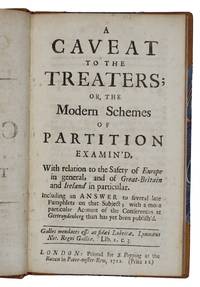
1711AQ26623London: Printed for S. Popping 1711. 8 88pp. Modern half-calf marbled paper boards contrasting red morocco lettering-piece. Minor shelf-wear. Half-title browned. The sole edition of a pamphlet variously attributed to Bishop of Chichester Francis Hare 1671-1740 and physician and satirist William Wagstaff 1683/4-1725 demonstrating 'the Danger of leaving the House of Bourbon in possession of the whole Spanish Monarchy or of any considerable part of it' occasioned by the peace negotiations March-July 1710 held at Geertruidenberg in the United Provinces between representatives of Louis XIV and the Dutch in an attempt to conclude the War of the Spanish Succession and written partly in response to three contemporary pamphlets; The ballance of Europe: or an enquiry into the respective dangers of giving the Spanish monarchy to the Emperour as well as to King Philip; Reasons why this nation ought to put a speedy end to this expensive war; and An essay at a plain exposition of that difficult phrase a good peace - all commonly ascribed to Daniel Defoe 1660-1731. ESTC T56742. First edition. 8vo. Printed for S. Popping hardcover
Quarto in offwhite printed stiff paper wraps; 34, 120, 64, 174, 27, 9, 57 and 16 pp (various pagings; total of 501 pages) 23 cm, bib. Very scarce. In Spanish. Only "380 ejemplares" printed--colophopn. Review copy. Series: Centro Intercultural de DocumentaciÛn. CIDOC cuaderno.; no. 60. "Tupamaros, also known as the MLN-T (Movimiento de LiberaciÛn Nacional-Tupamaros or Tupamaros National Liberation Movement), was a left-wing urban guerrilla group in Uruguay in the 1960s and 1970s. The MLN-T is inextricably linked to its most important leader, Ra˙l Sendic, and his brand of social politics. JosÈ Mujica, who later became president of Uruguay, was also a member." -- Wikipedia || Movimiento de LiberaciÛn Nacional (Uruguay) Movimiento de LiberaciÛn Nacional (Uruguay) Movimiento de LiberaciÛn Nacional (Uruguay) Uruguay -- Politics and government -- 1904- Uruguay.
Hardcover black quartos with gilt title on spine. 3 volumes, b/w plates, 24 cm.Includes bibliographical references and index. In Spanish. Scarce in cloth. || Series: Sociedad de bibliofilos madrileÒos. t. 7-9; || Spanish fiction -- Classical period, 1500-1700. Picaresque literature, Spanish -- Early works to 1800. Women in literature. || At head of title: Licenciado Francisco LÛpes de Ubeda./ Seal of the society on t.p. and, enlarged, on last leaf./ Includes reproduction of original t.p.: Libro de entretenimiento, de la Picara Ivstina, en el qual debaxo de graciosos discursos, se encierran prouechosos auisos ... Compvesto por el licenciado Francisco de Vbeda, natural de Toledo. Medina del Campo, C. Lasso Vaca, 1605./ Vol. 3: Estudio crÌtico, glosario, notas y bibliografÌa, por Julio Puyol y Alonso.
Quarto in black boards in glossy illus. black DJ; illus.; 210 p., 29 cm. In Spanish and some English.