6 567 résultats
Two decorated wooden panels, painted in polychrome tempera, gold gilt, and gesso, with a leather spine. 330 x 250 mm. Elaborately decorated on one board with four armorial shields, surrounded by incised stamps on gilt fields and gilt floral sprays on a blue field. The text below the shields reads: "INVENTARIO DELLE COSE DEL LA SAGRESTIA DEL DUOMO EDE LALTRE COSE MOBILI DELU OPARA RIFATTO LASICO DA VOLTA AL TENPO DEL UENE RABILE UOMO FRANCESCHO DI PAOLO TADDEI ANNO D. 1475." [Roughly translated: Inventory of the things in the sacristy of the Duomo Ede. Taken from the last by the incomparable Frances Taddei in the year 1475. The front board has a lovely Rennaisance Madonna and Child, with "Samis de Petris" below. This de may have been an attempt to attribute the painting to the artist Sano di Pietro. Beveled edges. Brass bosses at each corner. Very good. RARE. A contemporary of the famed "Spanish Forger", Icilio Federico Joni (1866-1946) was born in Siena. As a young man he worked in the shop of a gilder and art restorer. He began, as a sideline, to produce imitations of fifteenth century Sienese painted wooden panel book covers. He based these tempera painted wooden panels on the Tavolette in the Archivio di Stato, which he probably never saw in person. It is quite clear from his autobiography (1932) that he was proud of his skill and his brilliant imitations of the ancient art of Siena. He considered them original art rather than 'forgeries'. There are probably no more than twenty examples of his work extant today. From the Bridwell Library, SMU: "A skilled producer of imitation "Gothic" altarpieces, he received a commission c. 1890 to create a book cover in imitation of those found on Siena's Tavole di Biccherna, the elaborately gilt and painted fourteenth-century tax registers. Without ever seeing a real Biccherna, he established a lucrative business of faking Biccherna covers. Joni later boasted of incidents in which the local police were alerted to books purportedly stolen from Siena Cathedral or the state archives, only to discover that they were by Joni. A number of book collectors were deceived by Joni's creations, and several of his works were published as Gothic originals. Today, Joni's forgeries are highly valued in their own right. In his autobiography Joni discussed his methods for antiquing the covers by mixing soot, turmeric, chrome yellow, and gilding gesso with gum arabic to produce the patina on the gold. The bosses were bathed in ammonia and the clasp plates were dipped in iodine, "which rusted them in just the right way." Note that Joni's boards are simply glued onto a rough leather spine; he apparently did not know how to replicate a fifteenth-century sewing structure." Research in America has clarified Joni's role as a restorer in such works as Piermatteo d'Amelia's Annunciation (Gardner Museum) and the half-length figures in Fra Angelico's Annunciation (Mrs E. Ford Collection). **PRICE JUST REDUCED! Front Case 1/R
Acquaforte, acquatinta brunita e bulino, 1799. Dalla rara prima edizione di dodici della serie detta Los Caprichos, tavola 15. Magnifica prova, particolarmente nitida, impressa su carta vergata coeva, con usuali ampli margini, piccoli strappi di carta alle estremità dei margini, per il resto in perfetto stato di conservazione. La serie chiamata Los Caprichos, è composta da ottanta incisioni. Questa prima edizione del 1799, l’unica a non essere pubblicata postuma, è impressa su soffice carta vergata di gran qualità ed è stampata usando un delicato inchiostro seppia. Curata in fase d’edizione dallo stesso artista, la serie fu commercializzata e dopo poco tempo ritirata dal mercato. Infatti, a causa dei numerosi soggetti che ironizzavano sulla società spagnola di fine secolo, il Goya subì una censura. Per questo ne sono stimati solo circa 300 esemplari. L’interpretazione dei soggetti rappresentati su queste lastre, sempre enigmatiche, è spesso controversa - First edition -Etching, burnished aquatint and engraving, 1799. From the rare first edition (of twelve) of Los Caprichos, plate 15. A very fine impression, showing a good contrast, on contemporary paper, with usual wide margins, small tears at left white margin, otherwise in perfect condition. The series called Los Caprichos, consists of eighty etchings. This first edition of 1799, the only one not to be published posthumously, is imprinted on soft laid paper of great quality and is printed using a delicate sepia ink. Cured in phase edition by the same artist, the series was marketed and before long withdrawn from the market. In fact, because of the many subjects that mocked the Spanish society of the century, Goya suffered censorship. For this it is estimated only about 300 copies. The interpretation of the subjects represented on these plates, always enigmatic, is often controversial. The title can be translated into: Pretty teachings. Harris 50, Delteil 52.
Acquaforte, acquatinta brunita e bulino, 1799.Dalla rara prima edizione di dodici della serie detta Los Caprichos, tavola 54.Magnifica prova, particolarmente nitida, impressa su carta vergata coeva, con usuali ampli margini, in perfetto stato di conservazione.La serie chiamata Los Caprichos, è composta da ottanta incisioni. Questa prima edizione del 1799, l’unica a non essere pubblicata postuma, è impressa su soffice carta vergata di gran qualità ed è stampata usando un delicato inchiostro seppia. Curata in fase d’edizione dallo stesso artista, la serie fu commercializzata e dopo poco tempo ritirata dal mercato. Infatti, a causa dei numerosi soggetti che ironizzavano sulla società spagnola di fine secolo, il Goya subì una censura. Per questo ne sono stimati solo circa 300 esemplari. L’interpretazione dei soggetti rappresentati su queste lastre, sempre enigmatiche, è spesso controversa In questo soggetto Goya affronta il tema del mondo alla rovescia. Nella scena ci sono tre personaggi, il centro dell'attenzione è l'uomo che sta mangiando, e che cerca di evitare tutti gli sguardi, vergognandosi dei tratti osceni del suo viso. L'artista ha chiaramente indicato il suo pensiero disegnando la cintura di un paio di pantaloni sopra la testa del personaggio. I nasi sono una presenza notevole sul viso, e nel linguaggio popolare "nasi" è un chiaro eufemismo sessuale. Il modo in cui il viso è costruito, in modo che sopracciglia, occhi e naso evochino l'apparato genitale maschile, rafforzerebbe lo stesso senso. Altri commenti insinuano che la figura, nel piano superiore, con i suoi grandi pugni serrati, stia commettendo sodomia con la figura che tiene il vaso da cui mangia l'uomo vergognoso. L'anno 1799 è uno dei momenti chiave nella vita e nel lavoro di Francisco de Goya. Oltre ad essere nominato primo pittore da camera di Goya, a godere di un crescente prestigio come ritrattista e ad inaugurare la cappella di San Antonio de la Florida, che aveva decorato, il 6 febbraio il Diario de Madrid pubblicò un annuncio in cui venivano messe in vendita le ottanta stampe che compongono la serie dei Caprichos. Bellissimo esemplare. Al verso timbro di collezione HENRI MARIE PETIET (Saint-Prix, Seine-et-Oise, 1894-1980), editore, libraio e mercante di stampe a Parigi (Lugt 5031). - The rare first edition -Etching, burnished aquatint and engraving, 1799.From the rare first edition (of twelve) of Los Caprichos, plate 54.A very fine impression, showing a good contrast, on contemporary paper, with usual wide margins, perfect condition.The series called Los Caprichos, consists of eighty etchings. This first edition of 1799, the only one not to be published posthumously, is imprinted on soft laid paper of great quality and is printed using a delicate sepia ink. Cured in phase edition by the same artist, the series was marketed and before long withdrawn from the market. In fact, because of the many subjects that mocked the Spanish society of the century, Goya suffered censorship. For this it is estimated only about 300 copies. The interpretation of the subjects represented on these plates, always enigmatic, is often controversial. In this print Goya approaches the theme of the world upside down. In the scene there are three characters, being the focus of attention the man who is eating, and tries to avoid all eyes, ashamed of the obscene features of his face. The artist has clearly indicated his thinking by drawing above the character's head the waistband of a pair of pants. The noses take on a notable presence on the face, and in popular language "noses" is a clear sexual euphemism. The way the face is constructed, so that eyebrows, eyes and nose evoke the male genital apparatus, would reinforce the same sense. Other comments insinuate that the figure, in the upper plane, with his large clenched fists, is committing sodomy with the figure holding the vessel from which the shameful man eats. The year 1799 is one of the key moments in the life and work of Francisco de Goya. In addition to being named first chamber painter, enjoying a growing prestige as a portrait painter and the inauguration of the chapel of San Antonio de la Florida, which he had decorated, on February 6 the announcement of the sale of the eighty prints that form the series of the Caprichos was published in the Diario de Madrid. Here, Goya focuses his social criticism on the bestiality of a deformed man whose head emerges from his breeches. Among the slight variations between the print and the preparatory drawing, the most striking is that, in the former, he wears his trousers, but in the latter, he does not. As a result, the latter came to be known as The satire of man’s lechery. Moreover, this is the only drawing in the series to mix red-ink wash with pen. Valentín Carderera’s handwritten commentaries on the Caprichos, which are in both the Biblioteca Nacional and the Museo del Prado, further clarify this subject. The first reads: Men with large noses also tend to have large arrows [here, “arrow” is a euphemism for penis] and fat gandumbas [testicles]. As they are often sodomites, this one is depicted with his breeches on his head, with his pudenda hanging out as he lies on top of a poor devil and pulls up his skirts. The second commentary completes the information: There are men whose face is the most indecent part of their body, and it would be good if those whose face is that disgraceful and ridiculous would stick it in their breeches. Example from the HENRI MARIE PETIET (Saint-Prix, Seine-et-Oise, 1894-1980) collection (Lugt 5031). Harris 1964, 89.
Unread. As new. Number 216 of limited edition of 350 copies. Signed by co-author R.E. Gosnell. "Few publications, if any, of similar size and excellence have been produced in Canada." - From Editor's Foreword. Part I includes 210 pages and eighteen chapters which constitute "a survey of events from the earliest times down to the Union of the Crown Colony of British Columbia with the Dominion of Canada." Part II is "a history, mainly political and economic, of the Province since Confederation up to the present time." Part I is preceded and followed by dozens of tissue-protected black and white portraits of individuals influential in the early history of the province, complete with their brief biographies upon the tissue. Part II comprises eighteen chapters over 226 pages plus 5 pages of addenda followed by dozens of tissue protected portraits of "some of the men conspicuous as present day factors in development." Top edge gilt. Gilt lettering upon backstrip. Marbled endpapers. Exceptionally clean, bright, and unmarked with zero wear. Brown suede exterior appears as fresh as the day it was applied over 100 years ago. This majestic fourteen pound tome measures 13" x 10.5" x 4". A magnificent acquisition for any serious collector of British Columbia history. A better copy will not be found. [Lowther 1607, Hale 2523, Edwards & Lort 3177, Strathern 495] Book
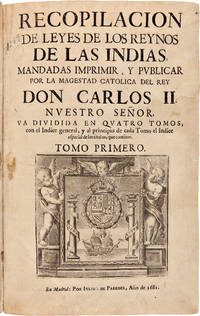
1681WRCAM40803Madrid 1681. Three volumes of four. 5299; 3298; 3302 leaves. Lacks the fourth volume and one preliminary leaf in first volume. Folio. Later sheepskin leather labels. Binding rubbed at extremities. Light soiling to titlepages titlepage of first volume backed with paper. Minor soiling to text; some heavier dampstaining to first volume. Overall very good. The first comprehensive compilation of the laws of the Spanish Indies. Antonio RodrÃÂguez de León Pinello compiled it by 1635 but it circulated only in manuscript until Fernando Jiménez de Paniagua brought it up to date and saw the work through the press in 1681. Prior to the publication of this massive work it was common practice for lawyers and courts in the various legal districts of the New World i.e. audiencias to compile in manuscript the laws in force in order that they might be used as precedents. Upon publication of this code the number of precedents did not decrease but increased: the courts continued to accept the cases and laws in the old local manuscript compilations as well as those on point and laws contained in the Recopilación. In sum this is a major work for all collections of international and Hispanic specific law. SABIN 68386. PALAU 252516. EUROPEAN AMERICANA 681/135. hardcover books
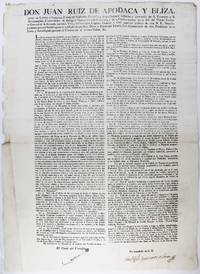
18203330Mexico City: July 11 1820. About very good. Large double-sheet broadside approximately 23.5 x 17 inches. Two sheets joined at central horizontal fold. Five chips at left edge not affecting text and some additional minor edge wear; otherwise light toning and dust soiling. Two contemporary manuscript signatures at foot; contemporary duty stamps on blank verso. Fascinating and otherwise unrecorded broadside that dictates the organization and process for the 1820 election of Mexican deputies to the Spanish Cortes during the second and last period of constitutional monarchy in Mexico. Colonial Mexico first achieved some representation in the Spanish government under the liberal Constitution of 1812 which lasted for two years before being revoked by Ferdinand VII upon his return to power in 1814. The reinstatement of the liberal constitution and the Cortes of Cadiz in 1820 however was not enough to prevent Mexico from obtaining full independence one year later. This broadside promulgated in Mexico on July 11 1820 by the colonial Viceroy Juan Ruiz de Apodaca y Eliza announces the renewed representation via regional elections to select Provincial Deputies for the Cortes and contains eight articles delineating the process by which these elections are to be held. In brief these articles order representation be apportioned according to the population as approximated from the 1792 census; divides Mexico into provinces for the purposes of the election; and places parameters on representation for each province. In all a very interesting window onto the formation of the brief final period of Spanish colonial rule in Mexico. July 11 unknown
In -4°, pp. (16), 557, (9) - errore di numerazione alle pp. 120-23; antiporta incisa in rame; legatura in pelle con fregi in oro alle armi di Benedetto XIV. Tagli dorati. Calf binding with golden ornaments, gilt edges.
In-4°, prima edizione, copertina morbida, pp. 191, con due disegni a colori e due in b/n, esemplare perfetto. Poesie scritte tra il 1929-1930, inedite fino a quel momento, pubblicate durante l’esilio forzato in Messico, accompagnate dal poema ‘El crimen fue en Granada’ di Antonio Machado e dello scritto in prosa ‘Federico Garcia Lorca. La muerte vencida’ di José Bergamin. Presenti quattro disegni del poeta. First edition, 191pages, with four drawings (2bw and 2 colours), fine edition, soft cover.Poetries written between 1929 and 1930, published during Garcia Lorca’s exile in Mexico; additional poems ‘El crimen fue en Granada’ by Antonio Machado and ‘Federico Garcia Lorca. La muerte vencida’ by José Bergamin
In -4°, pp. (28), 156, (26), all’antiporta ritratto inciso da Blondeau; pergamena coeva con titolo manoscritto al dorso. Prima e unica edizione di questa singolare biografia: Sebastian de Aparicio, nato in Spagna nel 1502 e morto in Messico nel 1600, fu beatificato nel 1789 da Pio VI: al di là dell’interesse di retaggio religioso Aparicio, che partì per il nuovo mondo nel 1530, è considerato il primo allevatore di bestiame e il primo “charro” (per estensione il primo “cowboy”) nella storia d’America. Diventato ricco (grazie all’attività di colono, agricoltore, e all’estrazione di metalli, soprattutto argento), e due volte vedovo, si dedicò alla vita ascetica fino a essere ammesso all’ordine francescano, col patto che i suoi beni venissero donati al primo monastero delle Clarisse in Messico (dove sarebbe stato ospitato prima di venir ordinato frate e unirsi alla comunità francescana di Puebla). First and only edition of this unique biography: Sebastian de Aparicio, born in Spain in 1502 and dead in Mexico in 1600, was canonized in 1789 by Pius VI. Beyond the religious interest, Aparicio is considered the first “cowboy” of America (or “charro”, in spanish): he became rich thanks to his agricultural activity (and also for his activity in mines, especially silver ones) he was the first to raise livestock on ground, in America: between his dowries the one to tame savage animals. He left his large fortune to a claires monastry in order to be received in the franciscan order.
1701ABC_48243Amsterdam 1701. Small 4to ca. 20 x 15 cm. Nicolas Chevalier Contemporary limp vellum with the manuscript title on the spine and a paper shelf mark label at the foot. With a general title and 2 divisional titles for ad 6 and ad 11 all with a woodcut vignette further with 2 hand-coloured engraved maps 1 folding engraved plate and several woodcut initials. 12 parts in 1 volume. 134 pp. Collection of very rare pamphlets and printed letters published under a collective title on the actual political circumstances of Northern Europe in the years 1699-1701 especially in connection with the death of the Spanish King Charles II born in 1661 in 1700 leading to the War of the Spanish Succession 1701-1714. The work includes 2 maps of Flanders and a folding plate of the Battle of Narva which took place on 30 November 1700. Although the pamphlets and letters were printed separately the present collection appears to be very rare as we have not been able to find any other copies with the same contents.Charles died childless. His possessions would go to one of his brothers-in-law: the French King Louis XIV 1638-1715 or the German Emperor Leopold I 1640-1705. Both had agreed already beforehand that they would divide Charles heritage to avoid disturbance of the European balance of power. In his last will however Charles had appointed the grandson of Louis XIV as his successor named from now on Philip V of Spain 1683-1746. The Treaty of The Hague affirmed this in 1701. With the deaccession stamp of the "Bibliothèque municipale de Nîmes" on the title page and its shelf mark label at the foot of the spine. The vellum at the foot of the spine with a tear the boards are somewhat stained. The leaves are occasionally browned and foxed. Otherwise in good condition.l Cf. Knuttel no. 14.510 ad 1 14.543 ad 6 14.588-14.589 ad 9 14.538 ad 10 and 14.538 a comparable collective title page with the imprint "Amsterdam Daniel de la Feuille 1701" with various texts ca. 78 pp.; STCN 317179241 1 copy the same general title page but with only 3 letters all different from ours. hardcover
188015998Madrid: Published by the Spanish Admiralty 1880. Engraving. Printed on wove paper. In excellent condition. Image size: 24 x 37 1/4 inches. A wonderful sea chart of the Mississippi Delta produced by the Spanish Admiralty at the close of the nineteenth century.<br/> <br/>This is an impressive sea chart of the Mississippi Delta produced by the Spanish Admiralty in 1880. The coast line is clearly mapped out with little detailing except for the soundings around the Delta. There are two compasses and a number of lighthouses identified along the shoreline. The chart uses the surveys conducted by the U. S. Coast Survey which were carried out between 1853 and 1877. It is a wonderful chart of this important area and superb collector's piece for anyone interested in early maps of the Americas. Published by the Spanish Admiralty unknown books
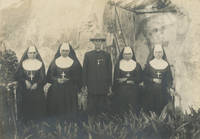
1900List518Most Cuba or Jacksonville 1900. Silver gelatin or albumen photographs various sizes ranging from 3 x 3 to 6 x 8 most captioned to verso. With handwritten manuscript four leaves discussing various diseases. The Spanish-American War was the first war in which nurses formed their own dedicated units as well as the first war in which they were accepted within military hospitals. While no nurses died in battle 153 died during the war from disease. Nurses were responsible for both treating soldiers as well as maintaining sanitary conditions within the camps. Conditions were often poor leading some to work until they were too sick to continue. <br /><br /> The current collection of photographs documents the experiences of a Mrs. Waters who was originally from Groton Massachusetts. The collection begins with a couple early photographs including a portrait as a young woman and a cyanotype of one of Waters' leprosy patients at Johns Hopkins Hospital in Baltimore. The next section shows Waters' training in Jacksonville Florida with either the Fourth or Seventh Army Corps at what was called Camp Cuba Libre both Corps trained there in 1898. The photographs of Jacksonville show life around the military camp and environs with some notable photographs of African-American inhabitants of the region. Three photographs quite notably show the Congregation of American Sisters a small group of American Indian nuns led by Reverend Francis Craft. The photographs taken in Cuba are notable for their portrayal of local life. Several photographs of military installations are taken around the "trocha" or line established by General Valeriana Weyler from Mariel to Majana. Another notable photograph is a cabinet card of a large group of nurses taken by the Havana photographer R. Testar. <br /><br /> The group overall shows very early photographic records of military nurses in training as well as a scarce photographic record from a woman in a combat situation. The photographs are generally well preserved in very good to excellent condition with some light fading. Accompanying the photographs is a four page manuscript essay presumably by Waters discussing leprosy as well as the booklet Spanish Phrase Book for American Soldiers and Sailors published by the National Relief Commission of Philadelphia. <br /><br /> Offered in partnership with Daniel / Oliver Gallery. books
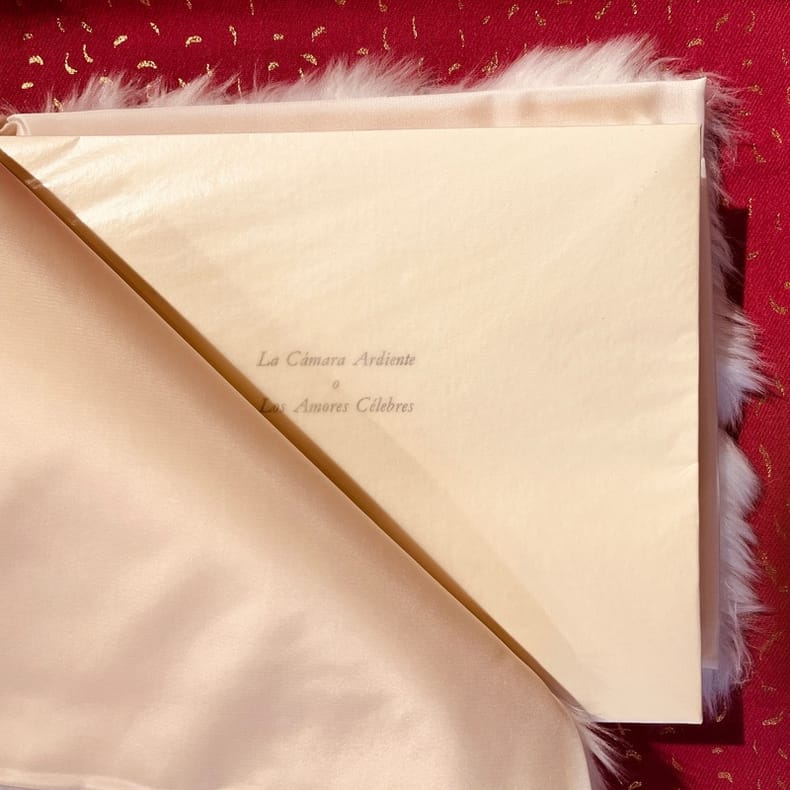
197720185Barcelone, Editorial Gustavo Gili, 1977. Grand in-8 oblong, en feuilles sous couverture rempliée, couverture en fourrure blanche, sous emboîtage en Plexiglas.
1911030666Madrid: Imprenta Espanola / Fernando Fe / Victoriano Suarez 1911. 1st Edition 1st Printing. Soft cover. Near Fine. 291 Pp 1 Pp Advertisement For The Author's Works. Original Beige Wrappers Printed In Black Priced 3 Pesetas On Spine. Inscribed By Unamuno To The Cervantes Scholar Rudolph Rodolfo Schevill And Dated In Salamanca Vi/11 June 1911 The Year Of Publication. Covers With Slight Browning More Browning To Spine Water-Staining At Upper Right Corner Edges Of Rear Cover To 1/4" Deep But No Traces Elsewhere On Covers Or Pages. Contents Fine Pages Unopened Still Attached At Top. A Book Of Poetry Noted By Some As Containing The Finest Sonnets In The Spanish Language. <br/> <br/> Imprenta Espanola / Fernando Fe / Victoriano Suarez paperback
1787135132Madrid: En la Imprenta Real 1787. First nationwide Spanish census First edition of Spain's first nationwide census the census of 1787. The first census in Spain was undertaken in Castile as early as 1594 and there was a census of the Spanish Empire in 1776 but this was the first which embraced the whole country. It is sometimes known as the Census of Floridablanca after the reformist prime minister Count Floridablanca under whom it was undertaken from 1785 to 1787. The 43 tables list the regions of Spain alphabetically from Andalucia to Valencia but also include the Balearic and Canary Islands. The data accounts for the number of persons their ages religious affiliation and social status. The final population count is 10409879. Although the census did display modern demographic techniques the attempts to classify the population on class and occupation proved too rudimentary - servants were not classified in any consistent way and the scope of the hidalgo class varied considerably from region to region. Even so the census was a considerable demographic achievement and remains studied in modern Spanish demography; it is considered more accurate than the subsequent Spanish census of 1797. Quarto 301 x 225 mm. With 43 printed tables and large printed folding table at rear. Contemporary quarter sheep smooth spine ruled in gilt with green calf label marbled paper sides edges speckled red. Inked number "153" to title page. Scuffing and wear around extremities contents clean leaf a4 creased minor paper faults to tables XVIII and XXVIII 6 cm closed tear to map. A nice unrestored example. Goldsmiths' 13352; Palgrave I 242. unknown
1760WB19204Spain 1760s. Hardcover. Very Good. 4to. Contempoary vellum. Wonderful manuscript on paper consisting of several sections each illustrated with hand-drawn folding diagrams many of which quite intricate. This work can be assuredly connected to Jesuit professor Cristiano Riegen of the Reial Academia de Ciencies Exactes in Madrid as there are several mentions of his name in each work. The manuscript is one that clearly took great effort and the drawings are finely executed. <br/><br/> hardcover
Un disegno originale dell'Autore in copertina (ogni volume reca un disegno diverso). Stampato in occasione del sessantesimo compleanno del poeta Stampato dall'Arte Grafica Bartolomé U. Chiesino S.A. di Buenos Aires. 8vo. pp. 14. Bella dedica e firma autografe dell'Autore (Inscribed and signed by the Author). Ottimo (Fine). . Prima ed. di 29 es. numerati e firmati dall'A.. . Empujan, en fin, vientos de libertad marina a la poesía de Rafael Alberti llevándola a explorar todos los espacios de la historia, de la mitología o de la experiencia humana: ''Yo te miraba, oh Cádiz, bahía de los mitos / ... / Canas de antigüedad, tus estelares fábulas, / tus solares historias, / oh gaditano mar de los perdidos / Atlantes, vesperales jardines de la espuma, / islas desvanecidas del Ocaso!'' Los pobres pescadores que salen del Guadalete hacia el mar son los mismos que arribaban a Tarsis en busca de oro y plata y estaño. El mar resume la historia y el mar compendia el sueño. &iquest;Qué escenario mejor podría soñarse para el encuentro amoroso de Venus y Príapo que el escenario del mar de Cádiz? Uno de los más formidables poemas amorosos de la literatura universal, de ese Diálogo entre Venus y Príapo, acontece en esa bahía: "Amor! La noche se desvae. / Nos baña el mar. (Oh luz!. El mundo canta. / Cae la luna... El viento...)"
61898BBo.J. (Joan Miro, geboren am 20. April 1893 in Barcelona, gestorben am 25. Dezember 1983 in Palma. Spanisch-katalanischer Maler, Grafiker, Bildhauer und Keramiker).
18504251850. 8vo. 215 x 160 mm. 8 ½ x 6 ¼ inches. 306 leaves chapters separated by blanks. 19th century leather backed marbled paper boards; inner hinge cracked edges bumped some abrasion to the head of the spine; sound. Beautifully written manuscript volume containing an extensive discussion of library management and practices written by an anonymous Spanish author in the middle of the 19th century. This dissertation organized in 70 chapters begins with a discussion of the library profession and its importance to civil society. His first chapters describe the "Archive" with reference to Spanish monastic governmental and diplomatic collections that have been preserved. He focuses his attention on Aragon Mallorca Navarra and Santiago. He turns to France to furnish some interested information on the archives in Paris before getting into the chapters on classification of materials and the creation of inventories. After nearly 200 leaves of text on the subject of archives the authors turns his attention to libraries. From the beginning he takes a historical approach focusing his attention on both books and manuscripts mentioning the collections at Cambridge University. Paleography is a subject he spends some time describing and then he moves into the history of printing typography Gutenberg and the spread of printing to Spain. The final dozen chapters are devoted to the rules for managing a library lessons in classification and inventory control. He quotes from both DeBure and Brunet in his lessons on cataloguing. A rather remarkable piece of work thought to be unpublished. An examination of both United States and Spanish national collections turned up no reference to this anonymous piece of library scholarship. unknown books
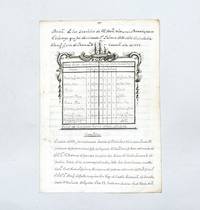
1779154781Spain: 1779. Visually appealing manuscript offering a valuable insight into the Spanish naval empire in the Caribbean Fascinating official service record of don Francisco Ximenez Parrado an officer of the Spanish Navy who served during the War of Jenkin's Ear 1739-48. This detailed account signed by Parrado enumerates his services from 1721 to 1779 listing naval campaigns many of them in the Americas. During his career Parrado participated in a range of operations; coastal patrols surveys and some significant naval engagements particularly against the British. In 1729 Parrado joined the Fuerte 60 under don Domingo Justiniani which sailed from Cadiz on 19 December in company with the two-decker frigate Nuestra Señora del Carmen 54. En route to Cartagena the two ships passed Tobago the coasts of Trinidad Margarita Cumana and Caracas. Once at Cartagena they commenced cruising the coasts of Terra Firme Spain's mainland possessions from the Caribbean to the Gulf of Mexico in search of illicit traders. In less than a year they had captured some six frigates and seven sloops carrying contraband off the coast of Venezuela. During the Summer of 1736 Parrado was in the Conquistador under don Blas de Lezo which was under repair in Spain before its embarkation for Cartagena early in 1737 with 1891 tons of cargo and brigadier don Jose Ambrosio the new governor of Chile aboard. The Conquistador remained at Cartagena on coast guard duties until she was scuttled by de Lezo during the battle of Cartagena in 1741 as part of the blockade of Vice-Admiral Edward Vernon's massive invasion assault. British failure here was to prove one of the pivotal moments of the War of Jenkins's Ear. Parrado is shown as having stayed in Cartagena until 1744 after which it seems he joined don Benito Antonio de Espinola in Havana taking part in the 1745 commissioning voyage of the Santa Teresa de Jesus 64 better known as the Dragon. The manuscript details an engagement in that year with an unnamed British vessel of 60 guns "quese avisto diferentes vezes frente del Puerto" "had been seen several times outside the port ". The Dragon's main mast was split and she was forced the quit the battle. The document also notes Parrado's presence in Tortuga Cabo de San Antonio Puerto Rico and Havana during 1746. The record details Parrada's career under four headings: Empleos "Employments" Campañas "Campaigns" outlined in chronological order Comiciones en que fue Empleado "Commissions in which he was employed" and Funciones en la America "Dutiess in America". Parrado seems to have occupied seven different positions during his career showing a clear ascent through the ranks ; Marinero Agregado a los Pilotos "Sailor attached to the pilots" Arnillero "Gunsmith" with a note that he continued in his role with the pilots Pilotín "Pilot's Assistant" Segundo Piloto "Second pilot" Primer Piloto "First pilot" Alférez de Navío "Frigate lieutenant" a junior watch officer and Teniente de Fragata "First lieutenant" a full lieutenant. Parrado later became the principal teacher at the School of Navigation in Cartagena. This fascinating document offers some welcome insight into a single career during a time of considerable conflict taking place on a world-wide stage. 4 pp. manuscript in neat clearly legible hand on a single bifolium elaborately engraved cartouche to the first page incorporating a three-master atop and enclosing a tabulated manuscript summary of Parrado's postings and positions. Light toning and minor staining. A very good example. Clowes The Royal Navy vol. 3. unknown
193452881London: H.R.G. Jefferson et al 1934-1939. NOTE: Other identified publishers all London include: Unthanks Bookshop; R. Bishop; William Massey. Beginning in July 1938 title changes to "World News and Views." <br /> <br /> Collection of two hundred forty-nine quarto issues in original staple-bound self-wrappers. Each issue 27cm x 21cm; most issues ca 20pp numbered sequentially. General wear occasional creasing or small losses; some copies marked as "File Copies;" some with red pencil annotations presumably for publication; a few issues with ink pressure stamp of the Los Angeles Workers Library. With the exception of a few issues in 1934 the journal was printed on high-quality newsprint; the run is well-preserved Very Good overall and fully readable.<br /> <br /> The periodical was issued irregularly from one to as many as three issues per week; our run collates as follows: <br /> <br /> Vol. 14 1934: 28-14161719-232629-3234-3638-4043-455760-63 32 issues<br /> Vol. 15 1935: 1-58-3136383944474850555658596163646668-72 49 issues<br /> Vol. 16 1936: 1246-3032-384042-58 53 issues<br /> Vol. 17 1937: 248-242642444547-5355-57 47 issues<br /> Vol. 18 1938: 1-35-81012-2325273031333436-4044-47525456-60 38 issues <br /> Vol. 19 1939: 2-91415181920-2628-3235-4155 30 issues. Beginning in 1918 immediately following the Russian Revolution International Press Correspondence usually called by its acronym INPRECOR became the Communist International's principal international organ for distributing "official" news of the global spread of Marxist ideology. The paper was issued in four languages English French Spanish and German and at its height no fewer than one and as many as three issues per week appeared. The chief audience was the editorial staffs of COMINTERN-aligned newspapers where many of INPRECOR's articles would be republished verbatim. Thus INPRECOR served as a de facto press service for the left-wing media in Europe North and Latin America.<br /> <br /> In our experience cohesive runs of INPRECOR in any size are unusual; this collection represents a veritable treasure-trove of official COMINTERN policy during the Popular Front period especially valuable for its day-by-day coverage and interpretation of events in Spain before during and after the Civil War and for documenting the rise of fascism across the European continent. Our run ends in August 1939 on the eve of Germany's invasion of Poland and the outbreak of the Second World War. Between that date and 1934 despite occasional lacunae the issues offered here provide a clear and compelling narrative of the sweep of world events leading to the World War and an intimate view of the communist left's response to those events. <br /> <br /> Even individual issues are somewhat scarce in commerce. Earlier issues of INPRECOR have been digitized by the Marxist Internet Archive ending in 1934. Much of the run is available in microfiche produced by the Communist Party of Great Britain but the imaging is of legendarily poor quality basically illegible in many places. Holdings for physical issues are spotty per WorldCat with many institutions holding small samples or partial runs. H.R.G. Jefferson [et al] unknown
18122890London: Carpenter & Son 1812 Book. Very Good. Hardcover. 5 volumes. First English edition translated from the Spanish by G. A. Thompson. Quarto. Approx. 550pp. per volume. Collated complete. Early 20th century three-quarter polished tan calf marbled boards. Small contemporary engraved bookplate. Corners show light wear. Ex-library copy withdrawn with bookplate to front and rear endpapers perforated library stamp to title pages and a few unobtrusive ink library stamps. Light foxing to preliminary and end leaves. Overall a very good set generally very clean. Originally published at Madrid 1786-89 this great work is a valuable and comprehensive geographical historical and commercial gazetteer of the Americas. It covers the entire history of the Americas and is particularly rich in data relating to the Spanish possessions with particularly extensive sections on Chili Mexico Peru Venezuela etc. It also includes numerous entries dealing with Canada and the United States. The general section on "Nueva España New Spain is very well covered and begins with "A spacious kingdom of North America the limits of which toward the north are unknown.". California is covered giving a great deal of statistical information and includes a list of the missions of "New California" founded up to 1803. Appended is a vocabulary of provincial terms largely Spanish forming a catalogue of American plants birds and animals. A supplement provides the text of the Treaty of Peace between the United Kingdom and the United States War of 1812. "Thompson's edition for its additions etc. is infinitely superior to the original." Sabin. Sabin: 683. Carpenter & Son hardcover
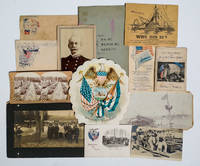
21688On February 15 1898 a mysterious explosion destroyed the battleship USS Maine while it was anchored in Havana Harbor killing 260 men and helping to propel the United States into war with Spain. Although the cause of the explosion was unclear American newspapers were quick to allege that the ship had been brought down by a Spanish bomb. Led by William Randolph Hearst in the New York Journal and Joseph Pulitzer in the New York World the press demanded action. Hearst's headline "Remember the Maine!" became a rallying cry that helped turn American public opinion strongly in favor of war with Spain. By April President McKinley had given into to additional pressure from hawkish senators and his own vice-president Theodore Roosevelt and war was declared. Although brief the Spanish-American War had important consequences. It ended Spain's colonial empire in the Western Hemisphere and secured the position of the United States as a Pacific power. "U.S. victory in the war produced a peace treaty that compelled the Spanish to relinquish claims on Cuba and to cede sovereignty over Guam Puerto Rico and the Philippines to the United States. The United States also annexed the independent state of Hawaii during the conflict. Thus the war enabled the United States to establish its predominance in the Caribbean region and to pursue its strategic and economic interests in Asia" Office of the Historian U.S. State Department.<br/><br/>This collection consists of approximately 120 items including original photographs printed and real photo postcards stereoviews commemorative programs patriotic covers postal stamps calling cards song sheets lithographs and other ephemera showing the Maine as she appeared before the disaster the wreckage and salvage efforts the funeral service and burials of the victims first at Cristobal Colon Cemetery in Havana later at Arlington National Cemetery and some of the myriad ways in which the Maine was memorialized and mythologized in American popular culture. Original photographs and real photo postcards capture the ship and crew prior to the disaster crowds of sailors lined up to pay their respects to the victims the coffins being transported the cemetery dotted with freshly dug graves elaborate floral wreaths and memorials and salvage efforts in the immediate aftermath of the disaster and in 1911 when the ship was raised before being towed out to sea to its final resting place at the bottom of the ocean. The wide reach of the patriotic feelings aroused by the disaster can be seen in two cabinet cards of young children wearing U.S.S. Maine hats as well as on items that have no military or national connection e.g. a high school commencement program a blotter advertising corsets yet bear images of the Maine or the "Remember the Maine" slogan. On envelopes and stationery we see images of Uncle Sam punching a Spainiard an eagle dubbed "the New Bird in Havana Harbor" and troops walking toward a ship under the heading "On to Cuba." A mendicant uses the Maine as his theme on a card handed out to solicit alms; a song by a writer of sensational crime broadsides is reported to have been "composed and written during the indecision of the U.S. Government" and urges "Let's show all foreign powers Aye the haughty sons of Spain they will brook no insult like the Sinking of the Maine." A particularly unusual item is an envelope illustrated with an image of the remains of the ship captioned "WHO DID IT" containing illustrated sheets of tissue with instructions to blow them up via a small "fuse" on the back. In all an illuminating collection that helps demonstrate the impact of both the incident and how it captured the popular imagination -- such that many Americans still recognize the "Remeber the Maine!" rallying cry today even if they no longer know what it represents. unknown books
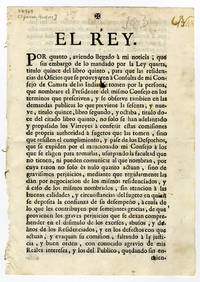
1758WRCAM37969Madrid 1758. 3pp. Folio. Dbd. Maltese cross at head of title. Contemporary and later manuscript annotations in ink and later pencil annotation on first page. Accomplished in manuscript with additional manuscript annotations. Manuscript inscription on blank verso of final printed page. Extremely light dampstaining in margins occasional minor soiling and ink stains the latter touching a few letters. Very good. A rare proclamation by Ferdinand VI King of Spain demanding that earlier laws regarding the appointment of judges in the Spanish Indies be observed. The decree states that disregard of these laws and guidelines in the past has been a great injustice causing injury to royal interests and to the general population. This proclamation was to be sent to the viceroys and audiencias throughout the Spanish Indies. This copy accomplished in manuscript at Aranjuez Spain on August 20 1758 is signed by Juan Emanuel Crespo with the inscription "Yo El Rey" and the annotation "Por mandado del Reyno exo. señor." A manuscript inscription on the blank verso of the final printed page dated December 4 1759 confirms that the decree had been reviewed by the President the fiscal and other high-ranking officials in Santiago de Chile. Not in OCLC Medina BHA or Palau. unknown books
1811905505London: Printed For Lackington Allen And Co; F.C. & J Rivington; Longman Hurst And Co Cadell And Davies; J. Mawman; Vernon Hood & Sharpe; E Jeffery R.H. Evans ; And Gale And Curtis. 1811 Four Full Leather Bound Volumes In Very Good Condition. Each Volume Has An Unobtrusive Previous Owner's Stamp Front And Rear The Stamp Is Very Faint Watered Down Ink And Sometimes Is Hard To See. The Are No Other Marks Than These. Volume One Shows A Little Foxing On The Title Page As A Result Of The Frontispiece Which Does Not Appear To Have Been Tissue Protected. Each Volume Is Tight And Solid Original Bindings Vol 1 & 2 Have The Pace Ribbon Still Intact Volume 3'S Ribbon Is Missing And Vol 4 Has The Ribbon But No Longer Attached. Each Volume Has Decorative Watermarked Eps. Solid Brown Leather Boards With Some Age Marks On All And A Small Scuff To The Vol 1 Rear Board. Some Rubbing To Board Edges . Fine Line Gilt Border Still Bright On All Volumes. 4 Banded Spines Still Solid However The Gilt Though Still Visible Is Faded And The Stamped Titles Have No Remaining Gilt. Hardly Any Wear To Spine Ends. Watermarked Block Edges With Gilt Decorative Design On All Board Edges Still Present. A Delightful Collectors Set Printed For Lackington, Allen And Co; F.C. & J Rivington; Longman Hurst And Co, Cadell And Davies; J. Mawman; Vernon, H hardcover