GARCILASSO DE LA VEGA, l’Ynca, BAUDOIN Jean (trad.)Livre Rare Book
6 567 résultats
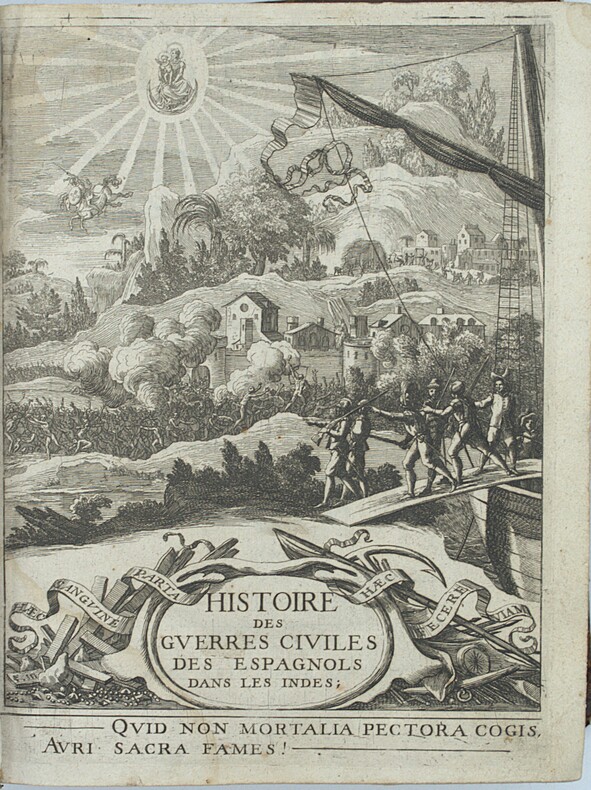
1658PHO-2397Paris ,1658. Chez Siméon Piget. 2 tomes en 1 volume in-4 (25x19cm), 16fnch.-631pp-9fnch./555pp.-10ffnch., relié veau époque, dos manquant mais corps solide, coins usés, vieille mouillure claire par intermittence.
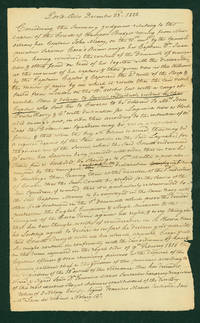
182121602<p>This fascinating archive consists of 27 manuscript documents in English and one in Spanish from litigation between the Baltimore owners of the merchant ship <i>Budget</i> and insurance companies that underwrote its voyage from England to South America. This conflict occurred against a backdrop of the collapse of Spain's American empire as various areas in Central and South America asserted their independence many under the leadership of Simón BolÃvar. The ship carrying weapons and supplies destined for Simón BolÃvar's rebels was captured by a Spanish privateer and condemned in Puerto Rico. The insurance companies refused to pay on their policies leading to two important cases on maritime law neutral rights and the responsibilities of insurance companies.</p> <b>INSURANCE NEUTRALITY SHIPPING SPANISH EMPIRE.</b>Archive of Evidence in <i>Thompson and Bathurst v. Maryland Insurance Company and Thompson and Bathurst v. Phoenix Fire Insurance Company</i> cases 1821-1824. 28 documents 41 pp. most 7¾ x 9¾ in.<p><b>Historical Background</b></p><p>In October 1822 Baltimore merchants Hugh Thompson and Matthew Bathurst insured their ship <i>Budget</i>and its cargo for $5000 with the Maryland Insurance Company and another $5000 with the Phoenix Fire Insurance Company for a voyage from London England to two ports on the "Spanish Main" Spanish colonies in Central America and on the northern coast of South America then back to the United States. The <i>Budget</i> was transporting "munitions of war" from London to the blockaded port of La Guaira Venezuela on the coast ten miles north of Caracas for Simón BolÃvar's rebels in Spanish America.</p><p>On December 1 1822 the Spanish privateer <i>Cora</i> under the command of Captain Don Juan Esiga captured the <i>Budget</i> and had it condemned as a prize of war at a court in Puerto Rico. <i>The Budget's</i>captain John Meany purchased the ship back billing Thompson and Bathurst for doing so. The merchants applied for payment from their insurers in March 1823. By May Thompson and Bathurst had turned over the <i>Budget</i> and its cargo to the Maryland Insurance Company and demanded payment. The insurers demanded more documentation especially of the condemnation proceedings in Puerto Rico. In August the insurance companies returned the copies of the proceedings in Puerto Rico to the ship's owners "to be translated into English." In March 1824 the insurers denied the claims.</p><p>On March 17 1824 the merchants sued the insurance companies in the Baltimore County Court for having "broken their covenant." Chief Judge Stevenson Archer ruled in favor of Thompson and Bathurst. However both the plaintiffs and the defendant's objected to parts of the decisions and filed cross-appeals to the Court of Appeals of Maryland.</p><p>In December 1832 Judge Thomas Beale Dorsey of Maryland's Court of Appeals concurred with the county court's refusing exceptions presented by the insurance companies and dissented on the exceptions offered by merchants. The Court of Appeals therefore ruled in favor of the ship's owners and entered judgment for "a total loss."</p><p><b>Excerpts:</b></p><p>Insurance Policy No. 8881 with the Maryland Insurance Company October 10 1822:</p><p>"<i>Touching the adventures and perils which we the assurers are contented to bear and take upon us in this voyage; they are of the Seas Men of War Fires Enemies Pirates Rovers Thieves Jettisons Letters of Mart and Counter Mart Surprisals Takings at Sea Arrests Restraints and Detainments of all Kings Princes or People of what Nation Condition or Quality soever Barratry of the Master and Mariners and all other Perils Losses and Misfortunes that have or shall come to the hurt detriment or damage of the said vessel or any part thereof.</i>"</p><p>Translation of Order of Francisco Marcos Santaella December 23 1822:</p><p>"<i>Having seen this summary judgment relating to the capture of the transport corvette called the Budget going from New Orleans under the orders & command of her Capt. & supercargo Mr. John Meany the first of the present month by the Spanish Privateer schooner called the Cora or Good Friends armed in this place and under command of her captain Don Juan Esija; taking into consideration the contents of the ships papers & from others found on board together with the declarations taken or made at the time of capture and those which have been made before this tribunal by the captains captor & captured second mate of the corvette and the prize master all tending to show that that vessel sailed from London on the 11th day of October last with a cargo of munitions of War belonging to particular individuals residing in that capitol who destined it for Caracas to be delivered to Messrs. Jones Pawly Harry and C<u>o</u> in Laguira at that time a port blockaded by the enemy in order that pursuant to the particular intention of M<u>r</u> Zeas the Columbian Squadron sh<u>d</u>be placed upon a respectable footing; and for this purpose was to be fitted out the Brigantine New Orleans & to make a regular deposit of said articles at the s<u>d</u> Laguira for the general use of the service where the s<u>d</u>corvette made efforts to enter the said captain bearing orders in case he found the place actually blockaded to carry her into S<u>t</u> Martha a port also occupied by the Insurgents and comprehended in the same declaration of blockade where she sh<u>d</u> be discharged and the cargo left to the judgment of the said individuals of Caracas; that the same Corvette sh<u>d</u> be offered for the service of s<u>d</u> Squadron whenever it shd be found needful that it shd be particularly recommended for the said Capt Meany to be employed in the marine service; with various other particulars which the said document contained and showing the decided protection which the European English and Anglo Americans afford to the insurgents of the continent contrary to all right and how much more worthy would it have been to have refrained out of respect for a short time.</i>"</p><p>Also the original order in Spanish December 23 1822 with a certification by Judah Lord "<i>Commercial Agent of the United States of America for Port Rico</i>" January 2 1823.</p><p>Thompson and Bathurst to President and Directors of Maryland Insurance Company March 12 1823:</p><p>"<i>Having received advise from Captain Maney that he had purchased the Ship Budget after her having been condemned and drawn on us for amount of Cost & Disbursements; we wish to know if we may calculate on receiving from you the amount insured in your Office at the stipulated time expressed in your Policy; say 90 days from proof of loss</i>"</p><p>Thompson and Bathurst to President and Directors of Maryland Insurance Company May 7 1823:</p><p>"<i>We abandoned to you on the 6<u>th</u> February last the Ship & Freight of Ship Budget insured in your Office by Policy N<u>o</u>8881 and at same time handed you a Certified Copy of the Condemnation of said Ship at Porto Rico. The Period of time required by your Policy for payment of Loss after proof thereof having now expired we beg leave to call upon you for the amount thereof.</i>"</p><p>President John Hollins of Maryland Insurance Company to Thompson and Bathurst May 24 1823:</p><p>"<i>Your letter of the 21st Inst has had the attention of a full board of Directors who have instructed me to inform you that they will advance to you $4498.75 on receipt of your & R. Oliver Esqrs joint note at six months bearing interest at the expiration of which time or sooner if convenient you are required to produce to this Company the following documents relative to the Ship Budget Viz The proceedings of the Court at Porto Rico The Log book or authenticated copy thereof The Charter Party or copy authenticated upon receipt of which & their proving satisfactory an adjustm<u>t</u> of the loss shall take place.</i>"</p><p>President John Hollins of Maryland Insurance Company to Thompson and Bathurst March 4 1824:</p><p>"<i>The board of Directors have instructed me to inform you that they do not consider the Company answerable for the claim you make for the ship Budget & freight insured by policy No 8881 this opinion they have formed from advice given by Mr Wirt & Mr Purviance who have had the case under their consideration.</i></p><p>"<i>I am also instructed to say to you that if your note in favor of Messs Rob. & Jno Oliver & by them endorsed for $4498.75 with interest & cost of protest be not taken up & paid at the Bank of Baltimore where it now lays on or before the 10th Inst it will be handed to Mr Purviance to be put in suit against you & those Gentlemen we hope you will prevent this unpleasant business but if not you will know the blame will not be chargeable to this Company.</i>"</p><p>Thompson and Bathurst to President and Directors of Maryland Insurance Company March 9 1824:</p><p>"<i>we are sorry to learn you still seem determined not to admit your liability for the Loss on the Ship Budget condemned at Porto Rico.</i>"</p><p>"<i>We had hoped that the very clear and decided opinions handed you of Mess<u>rs</u>Ogden & Binney Lawyers considered as the best informed in this Country on Marine Insurance would have removed all doubts & have been conclusive on that subject.</i>"</p><p>"<i>It is extremely unpleasant to us being under the necessity of resisting the payment of our Note which our Counsel have advised us to do; at same time we feel confident the result will prove we are in the right & justifiable in doing so.</i>"</p><p><b>Matthew Bathurst</b> 1778-1847 and <b>Hugh Thompson</b> 1760-1826 were partners in a general mercantile business in Baltimore Maryland.</p><p><b>John Meany</b> 1770-1841 was a sea captain in the merchant service and then a merchant and ship-owner in Philadelphia. For many years Hugh Thompson employed him.</p><p><b>John Hollins</b> 1760-1827 was a banker in Liverpool before immigrating to Baltimore where he became a successful merchant. He was president of the Maryland Insurance Company from 1802 to 1827 and he held a variety of local offices.</p><p><b>Simón BolÃvar</b> 1783-1830 was born in Caracas and educated in Spain and France. He joined the group of patriots that seized Caracas in 1810 and proclaimed independence from Spain. He went to Great Britain in search of aid but could get only a promise of British neutrality. When he returned to Venezuela and took command of a patriot army he recaptured Caracas in 1813 from the Spaniards. The Spaniards forced BolÃvar to retreat from Venezuela to New Granada now Colombia also at war with Spain. He took command of a Colombian force and captured Bogota in 1814. The patriots however lacked men and supplies and new defeats led BolÃvar to flee to Jamaica. In Haiti he gathered a force that landed in Venezuela in 1816 and took Angostura now Ciudad BolÃvar. He also became dictator there. BolÃvar marched into New Granada in 1819. His forces decisively defeated the Spaniards at Boyacá in 1819 liberating the territory of Colombia. He then returned to Angostura and led the congress that organized the original republic of Colombia now Ecuador Colombia Panama and Venezuela. BolÃvar became its first president on December 17 1819. BolÃvar crushed the Spanish army at Carabobo in Venezuela on June 24 1821. Next he marched into Ecuador and added that territory to the new Colombian republic. After meeting with another great liberator José de San Martin in 1822 BolÃvar became dictator of Peru in February 1824. His army won a victory over the Spaniards at Ayacucho in December 1824. Upper Peru became a separate state named Bolivia in BolÃvar's honor in 1825. He stepped down as president of Gran Colombia in January 1830 and died of tuberculosis eleven months later.</p> books
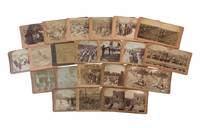
1898231301898. Spanish-American War stereoview archive circa 1898-1899 documenting how the war was pictured through mass-produced photographic views that followed U.S. mobilization battlefield action occupation and military life across both Cuba and the Philippines. These stereoviews preserves the visual system by which the war was circulated to American audiences showcasing camp organization troop movement burial hospital care naval power and overseas deployment. Particularly notable is the archive's coverage of the Rough Riders the Santiago campaign in Cuba and U.S. presence in Manila and Malate showing how stereoview photography helped normalize the war's expansion from anti-Spanish conflict into a broader American imperial presence.<br /> <br /> Archive of 21 stereoviews Various publishers. Spanish-American War stereoview archive. Cuba the Philippines and the United States circa 1898-1899. each measuring 3" x 7". The views are drawn from multiple phases and theaters of the war including camp and drill scenes in the United States embarkation and troop arrivals at Tampa battlefield and occupation imagery from Cuba and extensive and some grisly scenes from Manila and surrounding areas in the Philippines. Captions and images show soldiers in formation cavalry drill military reviews naval artillery hospital interiors encampments burial grounds and troops in active position. Cuban views include Morro Castle after bombardment dead and wounded on the battlefield of Santiago U.S. soldiers preparing to invade Cuba and troops dining near Cabañas Fortress. Philippine views include a departure for Manila American pickets routing a Filipino reconnoitering party the 18th Infantry engaged by Filipino outposts volunteers awaiting orders under the tropical sun Army Hospital Manila and "Our Boys in Camp at Malate P.I." One stereoview identifies Roosevelt's Rough Riders in the mobilization phase linking the archive to one of the war's most publicly mythologized units.<br /> <br /> As a group the stereoviews demonstrate the process by which the Spanish-American War was framed not simply as a short military victory over Spain but as a sustained structure of U.S. troop deployment and occupation extending from Cuba into the Philippines. The Manila and Malate scenes are especially important in this regard since they place American soldiers within the opening phase of the Philippine conflict where U.S. military presence quickly moved beyond liberation rhetoric into imperial control. The archive's mixture of battlefield casualties camp routine naval spectacle and celebratory review scenes shows how stereoscopic publishing converted war into a domestic viewing experience while reinforcing the legitimacy of American expansion abroad. Wear to mounts some toning; overall very good condition. A strong cross-theater visual archive of the Spanish-American War and the emergence of U.S. imperial power in Cuba and the Philippines. unknown
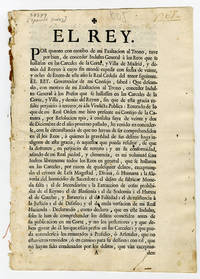
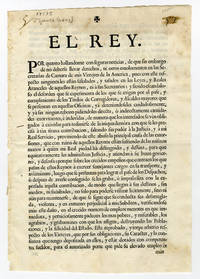
1760WRCAM37579Madrid 1760. 5pp. plus integral blank leaf inscribed. Folio. Dbd. Maltese cross at head of titlepage. Contemporary manuscript inscription and later pencil inscription at top of first page. Accomplished in manuscript at Buen Retiro Spain on Dec. 28 1770. Signed by Juan Manuel Crespo with additional annotation on last page of printed text and additional inscription on verso of last page of text. Integral blank leaf with manuscript note related to the cedula on recto and verso. Very good. A rare detailed royal cedula issued by Charles III King of Spain ordering a general pardon of accused individuals to be enacted throughout the Spanish Indies. Citing earlier royal proclamations issued previously by Charles III concerning clemency for prisoners this cedula reprints texts of decrees from January and February 1760. While most prisoners were to receive pardons a long list of exceptions based on the Jan. 28 cedula is provided. These included those accused of secular and religious treason killing a priest counterfeiting money arson blasphemy sodomy robbery falsehoods and duelling. Numerous other details regarding the earlier clemencies are also provided. The present royal amnesty was to be distributed to the viceroys presidents audiencias governors and other judges throughout the Indies in order that this resolution by properly executed. <br> <br> This copy accomplished in manuscript at Buen Retiro on Dec. 28 1770 is signed by Juan Manuel Crespo with the additional annotation: "Yo El Rey. Por mandado del Rey Nuestro Señor." A manuscript inscription on the blank verso of the final printed page dated Feb. 27 1762 confirms that the decree had been reviewed two days earlier by the President and other high officials in Santiago de Chile. A manuscript note in a separate hand on the recto and verso of the integral blank leaf provides additional information about the receipt of the document in Santiago in 1762. <br> <br> A rare and highly informative proclamation regarding royal pardons to be enacted throughout the Spanish New World and in Spain. Not in OCLC Medina BHA or Palau. unknown books
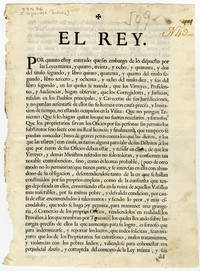
1758WRCAM37576Madrid 1758. 3pp. Folio. Dbd. Maltese cross at head of title. Contemporary manuscript inscription in ink and later pencil inscription at top of first page. Accomplished in manuscript see below with additional inscription on p.3. Additional manuscript inscription on blank verso of final printed page. Extremely light dampstaining in margins occasional light soiling. Very good. A rare royal cedula issued by Ferdinand VI King of Spain confirming earlier published laws stating that viceroys presidents and audiencias are to ensure that corregidores and justices reside in the principle towns and headquarters of their jurisdictions. The decree also states that the judges are not to be absent from their principle residences except under special circumstances when a license is issued indicating the precise cause for the absence and the length of time the judge will be away. In addition the judges can not name their own "lieutenants" or assistants nor can the viceroys presidents and audiencias name judges' assistants without royal approval. This copy accomplished in manuscript at Villaviciosa Spain on Sept. 7 1758 is signed by Juan Manuel Crespo with the additional inscription "Yo El Rey" and the annotation "Por mandado del Reyno exo. señor." A manuscript inscription on the blank verso of the final printed page dated Dec. 4 1759 confirms that the decree has been reviewed by the President and other high- ranking officials in Santiago de Chile. <br> <br> A rare proclamation regarding colonial judges in Spanish dominions throughout the New World. Not in OCLC Medina BHA or Palau. unknown books
1759WRCAM37578Madrid 1759. 3pp. Folio. Dbd. Maltese cross at head of title. Contemporary manuscript inscriptions in ink at top of first page. Accomplished in manuscript at Villaviciosa Spain on Feb. 18 1759 signed by Juan Manuel Crespo with additional inscription on p.3. Light dampstaining in margins occasional light soiling. Very good. A rare royal cedula issued by Ferdinand VI King of Spain confirming that the Secretaries of vice-royal chambers throughout the Americas do not have the rights privileges and emoluments held by governors corregidores and alcalde mayores. The decree refers to past abuses of power and finance by secretaries which were harmful to the realm and directs viceroys presidents and governors to ensure that secretaries officials and other dependents do not assume privileges which are not appropriate to their position. This copy accomplished in manuscript at Villaviciosa Spain on Feb. 18 1759 is signed by Juan Manuel Crespo with the inscription: "Yo el Rey. Por mandado del Rey Nuestro Señor." In addition the inscription notes that this printed text is a copy of the royal cedula located in the books of the Secretary of Peru located in Madrid as of March 31 1759. <br> <br> A rare proclamation regarding the limits of compensation for particular royal officials in Spanish dominions throughout the New World. Not in OCLC Medina BHA or Palau. unknown books
188015998Madrid: Published by the Spanish Admiralty 1880. Engraving. Printed on wove paper. In excellent condition. Image size: 24 x 37 1/4 inches. A wonderful sea chart of the Mississippi Delta produced by the Spanish Admiralty at the close of the nineteenth century.<br/> <br/> This is an impressive sea chart of the Mississippi Delta produced by the Spanish Admiralty in 1880. The coast line is clearly mapped out with little detailing except for the soundings around the Delta. There are two compasses and a number of lighthouses identified along the shoreline. The chart uses the surveys conducted by the U. S. Coast Survey which were carried out between 1853 and 1877. It is a wonderful chart of this important area and superb collector's piece for anyone interested in early maps of the Americas. Published by the Spanish Admiralty unknown
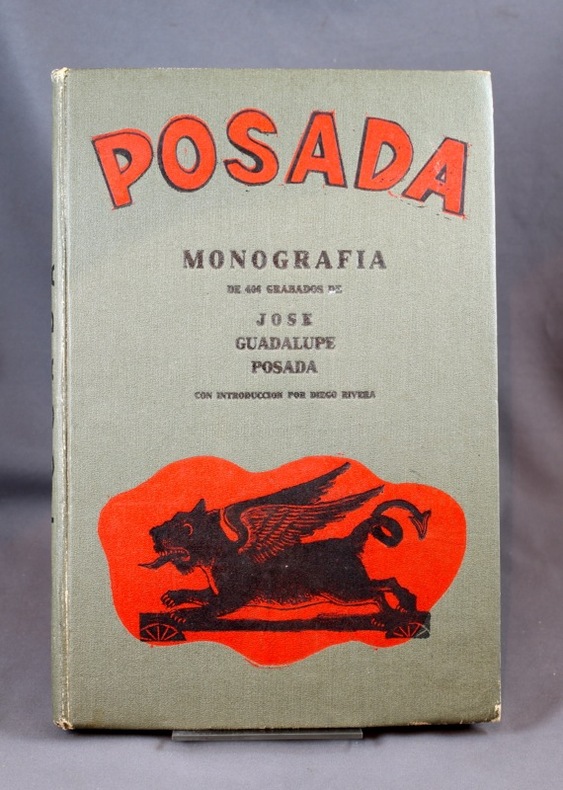
19304653Mexico, Mexican Folkways (Frances Toor, Paul O’Higgins et Blas Vanegas Arroyo), 1930. In folio de[8]-208-[8] pages, pleine percaline verte, illustration en rouge et noir sur le premier plat, imprimé sur papier vergé.
RGW19242AEtching and aquatint from L'Art on laid paper small tear professionally repaired This is one of the additional plates for 'The Proverbios' series. This edition impression was published in 1877 in volume 2 of L'Art with the title Que Guerrero Quel Guerrier. The man running in mock terror from the scarecrow figures slaps his backside to entertain the crowd. unknown
keith-richards-in-exile-v<p>Harman B/W Digital Fibre. Limitation of only 20<br>First ever printing. Hand numbered.<br>Spanish Tony Media estate stamp to verso.<br>Spanish Tony Sanchez facsimile signature to bottom right recto.<br>Taken early 1970s printed 2024.</p><p><span>All prices are unframed. If you would like your print to be framed do get in touch.</span></p> unknown
mick-jagger-and-keith-ric<p>Harman B/W Digital Fibre. Limitation of only 20<br>First ever printing. Hand numbered.<br>Spanish Tony Media estate stamp to verso.<br>Spanish Tony Sanchez facsimile signature to bottom right recto.<br>Taken 1972 printed 2024.<br></p><p><span>All prices are unframed. If you would like your print to be framed do get in touch.</span></p> unknown
20757Paris A l'Emblème du Secrétaire 1938 in 4 (26,5x19,5) 4 volumes brochés sous couvertures rempliées, [4], 315 pages; [1] 330 pages; [2] 347 pages; [4] 371 pages. Avec 288 dessins dont 48 hors texte, coloriés au pochoir par Beaufumé, Jon et Raynal. Avec 288 dessins de Dubout, dont 48 hors-texte, coloriés au pochoir par Beaufumé, Jon et Raynal. Tirage limité à 2144 exemplaires, celui-ci un des 56 exemplaires de collaborateurs, celui-ci nominatif imprimé sur royal Vidalon avec une suite en noir des 48 hors-texte. Notre exemplaire est enrichi d'un envoi autographe signé de Dubout et d'un petit dessin en couleurs. Très bel exemplaire ( Photographies sur demande / We can send pictures of this book on simple request )
In -4°, pp. (108), 216, 196-199, (8), 229-326, capilettera, testatine e finali; pergamena coeva con lacci e titolo manoscritto al dorso. Qualche foro di tarlo che non incide sul testo. Vari errori di segnatura e numerazione delle pagine. Prima edizione di quest’opera del maggiore poligrafo e scienziato del Perù in epoca colonialista. Il libro si distingue per una vasta incoerenza delle segnature, per l’uso esteso dei capilettera di tipo “factotum”, caratteristiche entrambe dell’editore, Antonio José Gutierrez de Cevallos che possedeva la tipografia “extra muros de Santa Cathalina e fu attivo in città fino al 1750. Pedro Peralta Barnuevo (1663-1743) era rettore della Università di San Marcos e con evidenza scrisse questi dieci sermoni sulla Passione di Cristo per presentarli a una platea universitaria: si distinguono infatti per il ritmo narrativo del testo. Il lavoro è preceduto da un saggio di genealogia sulla famiglia Moscoso, una delle più influenti famiglie del Nuovo mondo, ed è ricco di informazioni storiche e politiche circa questa e altre importanti famiglie messicane, peruviane e spagnole. Vari errori di numerazione e segnatura ma libro completo. The first edition of this work by the major writer and scientist of Peru, at time. The book is interesting under a typographic point of view, because of the extended use of “factotum” initials and a wide incoherence in signatures, both typical of its publisher, Antonio José Gutierrez de Cevallos. The author was dean of San Marcos university and he wrote these ten speeches about Christ passion towards an academic audience. The work is introduced by a genealogic essay about Moscoso family, one of the most important in the New World, rich of historic and politic information about Peru and spanish colonies. Many page number and signature mistakes, but the book is complete.
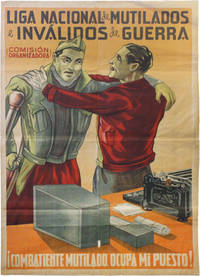
193852890Madrid: Gráficas Reunidas U.H.P. 1938. Original illustrated poser offset printed in colors on beige stock measuring 68.5cm x 100cm 27" x 39.25". Light wear and toning to extremities a few old folds smoothed-out with several tiny nicks and small edge tears a few tiny splits at intersection of folds and a small loss toward lower margin just above the lettering; an unrestored Very Good example unbacked. <br /> <br /> The first in a series of four propaganda posters produced by Gráficas Reunidas for the Liga Nacional de Mutilados e Inválidos de Guerra LNMIG the National League of War Wounded and Invalids founded in Madrid in 1937. "The creation of this association was the first tangible outcome of the organizational efforts made by wounded Republican veterans. According to their provisional programme their key concern was to remain 'useful' útiles to the war effort and provide 'unconditional help to the government'. It was stated that the association should 'educate and re-educate the disabled veterans in physical and cultural terms. As a consequence of the efforts made by the LNMIG on behalf of disabled veterans the government gave preference to the war wounded to fill vacant menial jobs such as janitors messengers and the like" cf.Matthews James. Spain at War: Society Culture and Mobilization 1936-44. The poster created by an anonymous artist depicts a wounded soldier supporting himself with a crutch being embraced by a typist above text reading "Wounded soldier take my place!" translation mine. OCLC notes a single holding at the Biblioteca Universitat de Barcelona. CARULLA 1.268. Gráficas Reunidas U.H.P. unknown
1898WRCAM54953Puerto Principe Cuba 1898. Broadside 16 1/4 x 12 1/4 inches. Toned old folds and creases minor edge chipping short closed tear slight fold separations. Very good. A very rare possibly unique surviving example of a Cuban broadside dating from the month after the conclusion of the Spanish- American War. The war ceased with a truce between the United States and Spain on August 12 1898; the official end of the war came a few months later on December 10 when the two parties signed the historic Treaty of Paris. Here on September 10 in the interim between truce and treaty the outgoing Spanish colonial governor of the south- central Cuban city of Puerto Principe present-day Camagüey Emilio March y Garcia calls for reinforcement of the truce agreement that would ensure free and open commercial trade in the region in the face of continuing interference by Cuban insurgents. March y Garcia claims that the Cuban revolutionaries are illegally detaining people interrupting the cattle trade trampling property rights carrying arms in flagrant disregard for the law and more. The ARIZONA REPUBLICAN published an English translation of this proclamation in its September 26 1898 issue. The translation reads: <br> <br> "I hereby inform the commanders of insurgent bands who are pillaging in the neighborhood of this city; who not observing the agreement between the Spanish and American governments with regard to the freedom of commercial relations are illegally detaining the country people; who are obliging the land owners to procure special passes and permits in order to put in order their plantations and will not allow them either to sell their cattle under the absurd pretext that the estates are the property of the nominal Cuban state and that its government alone can distribute and sell them and turn their products to what uses it sees fit thus trampling under foot the rights of property whereas on the part of this government the most absolute liberty in making contracts has been allowed and will be allowed in the future thus demonstrating the respect it has for the rights of all persons within its jurisdiction. I must call to notice with real sorrow that if these towns are suffering almost the horrors of starvation it is the result of the measures adopted by the chiefs of the insurgent bands who are impeding free traffic by forbidding the entry of all kinds of provisions especially cattle into the towns. In view of what I have already explained I consider it necessary to publish the following warnings: Article 1. I repeat my order of August 23 last permitting free entry and exit to all towns of this province subject to my authority and the most absolute freedom of trade between all the inhabitants of the province. Article 2. The prohibition to enter towns with arms remains in force and whoever is found with arms in his possession will be punished in accordance with the laws." <br> <br> Don Emilio Augusto March y Garcia Mesa was a career Spanish military commander who spent at least three stretches of time in Cuba the last as military governor of Puerto Principe during the Spanish defeat in the Spanish- American War. He also served as the colonial governor of Puerto Rico and general captain of Arago the Balearic Islands and the Canary Islands. <br> <br> The present broadside is exceedingly rare and quite possibly unique with no copies listed in OCLC and no records at auction. unknown books
A bibliophile edition of selections from Berceo's masterpiece, ILLUSTRATED WITH 9 FULL-PAGE HORS-TEXTE MIXED ETCHINGS BY ASCENSION BIOSCA AFTER SANDRA ESCOHOTADO AND FERNANDO CANO. Each etching is SIGNED AND JUSTIFIED BY BIOSCA IN PENCIL. From a total edition of 89 numbered copies, all printed on fine, thick wove paper, this is ONE OF ONLY 40 COPIES WITH THE ETCHINGS PRINTED IN BLACK. Large folio. Loose as issued in wraps. Housed in publisher's attractive silk folding case. Prospectuses laid in. FINE AND BRIGHT. New.
1932016152Paris Galerie Georges Petit 1932 In-4 Broché, couverture rempliée
Opera tratta dai "Los Caprichos", per la prima volta pubblicati nel 1799. Prova della quinta edizione di dodici, stampata dalla calcografia di Madrid, circa 1883. Acquaforte, acquatinta brunita e puntasecca, in perfetto stato di conservazione. La serie chiamata Los Caprichos è composta da ottanta incisioni, la cui prima edizione [l’unica a non essere pubblicata postuma] venne alla luce nel 1799. Curata in fase d’edizione dallo stesso artista, la serie fu commercializzata e dopo poco tempo ritirata dal mercato. Infatti, a causa dei numerosi soggetti che ironizzavano sulla società spagnola di fine secolo, il Goya subì una censura. L’interpretazione dei soggetti rappresentati su queste lastre, sempre enigmatiche, è spesso controversa Plate 1: portrait of the artist wearing hat, bust-length to left; Fifth Edition c.1883 impression. 1799 Etching, aquatint, drypoint and burinFrom the fifth edition of twelve of the so-called "Los Caprichos" series, edited by the Madrid Calcografia [circa 1883].A very good impression, with good contrast, printed on contemporary paper, customary margins, in very good conditions. The series called Los Caprichos, consists of eighty etchings. This first edition of 1799, the only one not to be published posthumously, is imprinted on soft laid pape. Cured in phase edition by the same artist, the series was marketed and before long withdrawn from the market. In fact, because of the many subjects that mocked the Spanish society of the century, Goya suffered censorship. The interpretation of the subjects represented on these plates, always enigmatic, is often controversial. Harris 36, Delteil 38.
Variazioni su di un tema di Romano BILENCHI. Versione di Mario LUZI. Con tre illustrazioni di Gian Luigi Giovanola. Testo a fronte. Alle ultime pagine un componimento autografo scritto a penna dall'Autore dedicato a Picasso, datato Roma, XII 1960, intitolato ''Picasso. Tauromaquia (La pique cassée)''. (With a hand-written poem by Guillen written in blue ink on 3 pages, dedicated to Picasso, dated Rome XII-1960) Volume n. 3 della collana "Poeti stranieri tradotti da poeti italiani". Libro a cura di Vanni Scheiwiller e impresso a Milano dalla Tipografia U. Allegretti di Campi il 9 febbraio 1961. 16mo. pp. 28. Dedica e firma autografe dell'Autore, datata Roma 27/II/1961 (Inscribed and signed by the Author, dated Rome 27/II/1961). Ottimo (Fine). . Prima edizione di 1000 es. numerati. .
In -4°, pp. (40), 146, (6), pergamena coeva, difetti al dorso. Prima edizione. Nato a Saragozza, l’autore insegnò a Napoli e Roma prima di partire per Cuba, dove avrebbe passato la vecchiaia. Il libro, interessante e curioso, si occupa di prostituzione e della sua accettabilità dottrinaria, argomento rispetto al quale l’autore è fortemente contrario. Lo scritto replica a un manoscritto (poi stampato a Catania, “Resolutio theologica moralis in qua occasione cuiusdam casus occurrentis afferitur et propugnatur, licite permitti posse Meretrices”, 1677) del francescano Giovanni dell’Olmo, che difendeva il diritto delle prostitute a entrare nelle dimore nobiliari napoletane. La polemica svela molto sui costumi del sesso a pagamento all’epoca. Born in Saragoza, the author was a professor in Naples and Rome before leaving to Cuba. This curious book deals with prostitution and its doctrinaire acceptability (that the author is strongly against to). This work replies to a manuscript (then printed in Catania, “Resolutio theologica moralis in qua occasione… licite permitti posse meretrices”, 1677) of a franciscan preacher, Giovanni dell’Olmo, who supports permission to prostitutes to enter in neapolitan noble palaces. This controversy reveals many facts about prostitution at time.
1914T91037Barcelona, Institut d'Estudis Catalana 1914-1937 Colletion of 22 volumes (in total 24 volumes have been published ever, this collection lacks only vol.3 & 19), together more than 3700pp. with some illustrations in text and some folding maps and plates out-of-text, 24cm., most texts are in Catalan, uniform hardcover bindings with spine in green leather and title in gilt (except for vols.23-24: brown leather), few stamps (at blanco front endpaper and on titlepage), some traces of humidity on volumes 1 and 5 and 9 and 18 (mainly on cloth boards), good condition, rare and almost complete set, [contains a.o. Volume XII (1924): AMADES J. & ROIG E.: Vocabulari de l'Art de la navigacio i la pesca (116pp. with illustrations), vol.XIV (1926): ROIG E. & AMADES J.: Vocabulari de la pesca (83pp. with ills.), Vol.XV (1927): AMADES J.: Essers fantastics (80pp. with some ills.), vol.20 (1932): GRIERA A.: La casa catalana (pp.13-332 with ills. & plates out of text), vol.21 (1935): Indexs generals dels vint primeirs volums (xii + 356pp.), vol.22 (1934): AMADES J.: Vocabulari dels vells oficis de transport i llurs derivats (pp.59-239 with ills.), etc.], total weight is 15kg., T91037
Colletion of 22 volumes (in total 24 volumes have been published ever, this collection lacks only vol.3 & 19), together more than 3700pp. with some illustrations in text and some folding maps and plates out-of-text, 24cm., most texts are in Catalan, uniform hardcover bindings with spine in green leather and title in gilt (except for vols.23-24: brown leather), few stamps (at blanco front endpaper and on titlepage), some traces of humidity on volumes 1 and 5 and 9 and 18 (mainly on cloth boards), good condition, rare and almost complete set, [contains a.o. Volume XII (1924): AMADES J. & ROIG E.: Vocabulari de l'Art de la navigacio i la pesca (116pp. with illustrations), vol.XIV (1926): ROIG E. & AMADES J.: Vocabulari de la pesca (83pp. with ills.), Vol.XV (1927): AMADES J.: Essers fantastics (80pp. with some ills.), vol.20 (1932): GRIERA A.: La casa catalana (pp.13-332 with ills. & plates out of text), vol.21 (1935): Indexs generals dels vint primeirs volums (xii + 356pp.), vol.22 (1934): AMADES J.: Vocabulari dels vells oficis de transport i llurs derivats (pp.59-239 with ills.), etc.], total weight is 15kg., T91037
190237237v. p. 1902. Maroon half-leather binding with black cloth boards. General wear with spotting to boards which are bowed. A VG copy. 201 numbered pages of lined paper. 9-7/8" x 7-5/8" <br/><br/>The 'Kilpatrick' began life as the SS Michigan beginning service in September 1891 as a cargo vessel with limited passenger accomodation. In 1898 she was sold to the US government to act as a military transport during the war. She was capable of hauling 840 men and 800 horses. While not an active participant in the Spanish American war she did subsequent duty in transport service to the PI as this log documents. Capt Rogers begins his entries Saturday Dec. 31st 1898 noting relief of Cap. Jeffreys taking command of U.S.A.F. Michigan departing for Havana at 9 pm. The final entry is Sept. 2nd 02 noting position/course details of a "Manila to Frisco" run. This log a first-hand account of the ship's life recording location etc. Details of the Captain's or crew's life are for the most part absent. That being said it is a unique historical document that provides daily facts of the ship it's activities & its location. hardcover books
1703139168London: Printed and sold by John Nutt 1703. Planting colonies in the Spanish Americas First edition preceding the second edition of that year with an added postscript. Published in the third year of the War of the Spanish Succession 1701-1714 the anonymous author proposes that in return for the support of Britain and the Netherlands for the claim of the Emperor of Austria to the Spanish crown Spain's territories in America should be ceded to the two mercantile powers. They propose a confederation which will share the treasure from the Spanish mines keeping it out of the hands of a single monarch and in so doing preserve the balance of power in Europe. They moreover support extending the war to the Spanish West-Indies at that stage untouched by the conflict and offer proposals to plant colonies there. They respond to critics who would argue that such attempts at joint control of the American mines and territories would engender war between Britain and the Netherlands as trade brings peace and also reject the arguments that American wealth flowing into the mercantile nations would weaken the nation as was believed to be the case in Spain. The polemic nonetheless offers a stark realpolitik view of world politics and of the war treating as irrelevant the moral questions of stripping the territories of their nominal ally Habsburg Spain rather than the official war aims of taking French territories and stemming the growth of Bourbon power. A scarce treatise with ESTC locating six copies for this issue and a further two copies of the second edition Library Hub and Worldcat adding several more yet still absent from many prominent institutional collections and untraced in auction records. Small quarto 205 x 162 mm. Disbound pamphlet with remnants of original spine the pages numbered in an 18th-century hand 589-654 from its original place in the sammelband vol. Lightly browned and foxed top two cords mostly gone but bottom two holding light worming at foot not affecting text tiny hole affecting one letter to pp. 25/26. A very good copy without chipping or repairs. Alden 703153; European Americana 703/53; ESTC T193661; Kress S2261. Not in Sabin. unknown
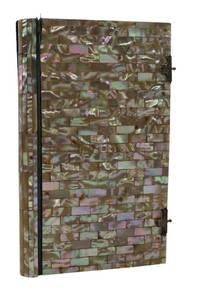
1895AQ31138París: Librería A. Aimond 1895. 4 180pp. Contemporary tessellated mother-of-pearl two metal clasps incorporating a cruciform design. Housed in custom dark green cloth clamshell case. Green cloth joints starting. Leaves lightly browned modern book-label of Robin de Beaumont to verso of FFEP. A late nineteenth-century Parisian edition of the Catholic Liturgy of Hours in Spanish housed in an exceedingly elaborate and frustratingly unsigned contemporary nacre binding. . 12mo. Librería A. Aimond hardcover