2 965 résultats
8vo; aprox 1000 pages; Lacks the 3rd Volume (Fazit) as often found. Still a wonderful heavily illustrated resource. Absolutely Packed with Photos. Some wear to spine, Good Condition. (GER-10-33-DW)
196617184Jerusalem: Israeli Law Review Association 1966. Hardcover. vg. 4 volumes in 1. Large 8vo. 674pp. Serial publication bound in blue cloth with silver lettering to spine. Minor age wear. Text in English. Very good condition. Israeli Law Review Association hardcover
1st edition. Original paper wrappers. 8vo. 21 cm. In Hebrew. Title translates to The Awakener. Includes April (33 pages) , May (33 pages) , June (33 pages) July-August (73 pages) , September (36 pages) , October (37 pages) , November (36 pages) , Issue from 1907 (39 pages) . Not to be confused with the Tel Aviv reprint of the first year. Early Hebrew periodical which features many of the periods most well-known Hebrew writers. This periodical featured commentary on current affairs and literature, and greatly influenced the young Jews of the highly-influential Second Aliyah. (EJ, 2008) . The editor, Y. H. Brenner is considered a pioneer in modern Hebrew literature. Brenner (1881-1921) was initially from Russia, but escaped to London after deserting the Russian army during the Russo-Japanese war. It was in London that Brenner became instrumental in the Hebrew literature movement and Zionism. This culminated in his emigration to Palestine where he rose to prominence before his murder in the 1921 Jaffa riots. (Wikipedia, 2018) . SUBJECTS: Hebrew literature, Modern -- Periodicals. OCLC lists 15 copies worldwide (OCLC: 45947005) . Ex-library with no markings. Most issues are unbound with significant edge wear. Some loss of text in November issue, but others are Good. Overall Good- Condition. (YID-30-27)
New York: Yiddish Scientific Institute [YIVO], American Branch [Yidisher visnshaftlekher institut.; Amerikaner sektsie], 1927-29. Original Wraps, Large 8vo. In Yiddish. Four loose issues. This periodical survived only 2 volumes, ending with vol. 2, Nr. 1 in 1929. A quarterly devoted to the study of Yiddish literature, language, folklore and bibliography. SUBJECT(S): Yiddish philology -- Periodicals. Yiddish language -- Periodicals. OCLC: 122810294. OCLC lists 20 holdings worldwide. Not in Shunami. Binding repaired, good solid copy of this important Yiddish literary and linguistic journal. (CT-15-2A)
New York: Yiddish Scientific Institute [YIVO], American Branch [Yidisher visnshaftlekher institut.; Amerikaner sektsie], 1927. Modern Cloth, Large 8vo, 176 pages. In Yiddish. This periodical survived only 2 volumes, ending with vol. 2, Nr. 1 in 1929. Thus this set lacks only the final issue. A quarterly devoted to the study of Yiddish literature, language, folklore and bibliography. SUBJECT(S): Yiddish philology -- Periodicals. Yiddish language -- Periodicals. Ex-library with usual marks, some wear, Good Solid condition. (CT-15-2B)xx
1st edition. Later boards. 8vo. 40, 34 pages. 18 cm. In Hebrew and German. Title translates to Melodies of Israel after the Destruction. Frankl ( 1810-1894) was a famous Austrian-Jewish poet. He took part in the revolution of 1848, and his poems on liberty had considerable vogue. His lyrics are among his best work. He was secretary of the Jewish community in Vienna, and did a lasting service to education by his visit to the Orient in 1856. He founded the first modern Jewish school (the Von Lämmel Schule) in Jerusalem. His brilliant volumes Nach Jerusalem describing his eastern tour have been translated into English, as is the case with many of his poems. His collected poems appeared in three volumes in 1880 (Encyclopedia Britannica, 1911) . SUBJECTS: Hebrew poetry. OCLC lists 6 copies worldwide (OCLC: 19149881) . Ex-library with usual markings. Damp stains in margins. Overall good condition. Scarce. (RAB-65-15)
Period boards. 8vo, 44 pages, 17 cm. In Hebrew. Title translates to: The Reading of the Torah: For Explaining the Root of Reading and Its Use...with Beer Rehovot Letter. Explanation of the root of Kara and how it was used by the sages in the Talmud. The title page states that it will explain their intent in a clear language and explain the subject of yesh aim le-Mikra and aim le-Messorah, that is, whether a verse is to be understood as it is written or as it is read. It also addresses other issues in the Talmud built upon the structure of the Hebrew language. There are approbations from Rabbi Akiva Eger and from Rabbi Simha Wiel. An apologia from the author follows, and then the text, in a single column in rabbinic type. It begins with introductory material and continues, in the order of issues in the Talmud. After the discourses based on the Talmud is a strong refutation (33a-44b) on modifications to the accepted liturgy in the book Iggeret beit Tefillah by Isaac Satanof (1732-1804) . The latter was a Haskalah writer, who, in his book, classified every word that he explained as either "Hebrew" or "talmudic, " and proceeded to clarify this question at other opportunities as well. Satanof attempted to break out of the strict framework of biblical style, although he himself was very adept in the biblical style called melizah. Hence he demanded that new words be coined; in Iggeret Beit Tefillah he complains that the vocabulary of biblical Hebrew had not preserved its great lexical range. Rabbi Coeslin was also the author of Mesilol bedikduk Loshon ha-Kodesh. SUBJECTS: Masorah. Hebrew language -- Lexicography. Hebrew language -- Lexicography. Masorah. OCLC lists 9 copies worldwide. Ex-library with usual markings. Foxing to pages. Otherwise Great Condition. (HEB-48-51)
First edition. Period boards with black faux leather spine. 8vo. 220 pages, 19cm. In Hebrew. Title translates to Naval of the Land. Rabbi Moshe Kliers (1874-1934) , the former Chief Rabbi of Tiberias and a literary paean to the Holy City of Tiberias, recounts the history of its rabbis and yeshivas, synagogues and cemeteries, as well as the surrounding countryside, the Kinereth and the hot springs. Inscribed by the Rbabi Kliers to Rabbi Yehuda Edelson, of Denver, Colorado. SUBJECTS: Tiberias (Israel) -- History. Israel -- Tiberias. OCLC lists 8 copies worldwide. With stamp of previous owner. Small tear on final leaf, affecting a few letters. Overall Good- Condition. (HEB-49-11)
1st Hebrew edition. Original boards. 8vo. 232 pages, 19 cm. In Hebrew with additional German dedication page and occational word in German. 1st Hebrew edition of Goethes Faust. Title translates to Ben Avuyah: A Poem about the Merits of Life. Meir Letteris (1800-1871) was an Austrian Jewish scholar and the foremost poet of the Galician Haskala. He published a working translation of Goethes Faust using the character of Elisha ben Abuyah instead. Ben Abuyah was a controversial rabbi and religious authority from the period immediately following the destruction of the Second Temple. His views were considered heretical by the other Tannaim, leading to Talmud references to him falling under the name "The Other One. (Wikipedia, 2018) . Second title page notes (in German) : Goethe's Faust: eine tragoedie in eniner hebraeischen Umdichtung von Max Letteris. SUBJECTS: Hebrew drama -- Translations from German. OCLC lists 19 copies worldwide (OCLC: 41217024) . Ex-library with usual markings. Wear to boards. Very light soiling to tile page. Overall good+ condition. (RAB-65-17-LRX)
1st edition, original cloth, 8vo, xiii, 410 pages. Ex-library with usual marks, internally very good, Very Good Condition (AC-4-6)
Marbled later boards8vo. 168 pages. First edition. Volume 1 only. In Hebrew. SUBJECT (S) : Literature Jewish. OCLC lists 15 copies worldwide. Rosenthal (1843-1917) was born in Latvia. As a result of the pogroms of 1881 Rosenthal reached the conclusion that the solution to the Jewish problem in Eastern Europe lay in emigration from Russia and in agricultural settlement. In 1882, he and his followers established a Jewish settlement in the United States, in Louisiana. This settlement was destroyed by a flood, and he resettled in the Dakotas, and there was also unsuccessful. Rosenthal also edited a section of the Jewish Encyclopedia, and was the head of the New York public library's Slavonic department (Slutsky, EJ) . Ex library with usual markings and bookplate, edgeworn, very good condition. (AMR-16-10A) xx
Marbled later boards8vo. 168 pages. First edition. Volume 1 only. In Hebrew. SUBJECT (S) : Literature Jewish. OCLC lists 15 copies worldwide. Rosenthal (1843-1917) was born in Latvia. As a result of the pogroms of 1881 Rosenthal reached the conclusion that the solution to the Jewish problem in Eastern Europe lay in emigration from Russia and in agricultural settlement. In 1882, he and his followers established a Jewish settlement in the United States, in Louisiana. This settlement was destroyed by a flood, and he resettled in the Dakotas, and there was also unsuccessful. Rosenthal also edited a section of the Jewish Encyclopedia, and was the head of the New York public library's Slavonic department (Slutsky, EJ) . Ex library with usual markings and bookplate, edgeworn, very good condition. (AMR-16-10B)
Spine rebacked. 8vo. 168 pages. First edition. Volume 1 only. In Hebrew. SUBJECT (S) : Literature Jewish. OCLC lists 15 copies worldwide. Rosenthal (1843-1917) was born in Latvia. As a result of the pogroms of 1881 Rosenthal reached the conclusion that the solution to the Jewish problem in Eastern Europe lay in emigration from Russia and in agricultural settlement. In 1882, he and his followers established a Jewish settlement in the United States, in Louisiana. This settlement was destroyed by a flood, and he resettled in the Dakotas, and there was also unsuccessful. Rosenthal also edited a section of the Jewish Encyclopedia, and was the head of the New York public library's Slavonic department (Slutsky, EJ) . Edgeworn, flaking, good condition. (AMR-16-10C)
All 1st editions. 8vo. Pages 193-288 of a Hurwitz piece featured in Bet Talmud, 108 pages, and 64 pages, respectively. 23 cm. All in Hebrew. Titles translate to Beit Talmud: Released Monthly, Beit Eked: Collection of Articles and Poems, and The Hebrew Woman: Laws of Women related to family and society in the Times of the Holy Writings and the Talmud. A variety of Saul Hurtwitz works. Hurtwitz (18611922), Hebrew writer and critic, was born in Russia. He was a successful merchant and banker who, after losing his fortune in the Communist Revolution, moved to Berlin. It was there that he rose to prominence in the circle of émigré Hebrew writers and thinkers and was active in Zionist work. Together with H.N. Bialik he directed the Kelal publishing house. From his youth, Hurwitz contributed stories and articles to Hebrew journals, and in 1892 he published the literary magazine Beit Eked. (Jewish Virtual Library, 2018). SUBJECTS: Hebrew literature -- Periodicals; Jewish Women. OCLC lists 16 holdings worldwide of Bet Talmud (OCLC: 34351478). 8 copies for Ha Ivriyah veha-yehudia (OCLC: 122813769), and 8 for Bet Eked (OCLC: 174120954). Ex-library with no markings. Lacking back board. Front board is loose. Front wrapper of Beth Talmud is loose, heavily worn and chipped. Both other publications are in very good condition and well preserved. (RAB-64-41).
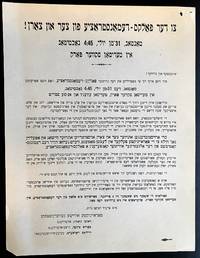
194443416No Place New York Fereynigte Yidishe Geverkshaftn United Hebrew Trades 1944. 1st edition broadside single-sided flyer 4to. In Yiddish. <br> <br> Translation: "ALL OUT TO THE PUBLIC DEMONSTRATION OF GRIEF AND RAGE!<br> Monday July 31st 4:45 PM<br> in Madison Square Park<br> <br> Sisters and brothers!<br> We invite you to participate in the great public demonstration that will take place<br> Monday July 31 4:45 p.m.<br> in Madison Square Park Madison Avenue and 24th Street<br> <br> Millions of Jews were murdered by the Nazis in all parts of Europe. Young and old women and men were driven into gas and death chambers and destroyed. In the current hour the greatest danger for those still alive in the Nazi countries.<br> The Hitlerian beast which conquered and humiliated countries and murdered millions of people is ready to strangle and murder the surviving remnants of the Jewish people. Hundreds of thousands of Jews from Hungary are now in danger of death the tens of thousands of Jews left alive in Poland in France in Belgium in the Czech Republic where they are under Hitler's rule.<br> <br> In order to express our grief and anger to cry out our grief and appeal for help to the United Nations at the last moment a public demonstration is called by the Rescue Committee of the General Jewish Conference.<br> <br> We cannot and must not remain silent. People must help save the survivors. Come express your feelings desires and demands! It is demanding that the United Nations do everything possible to stop the death march! It is demanded that all those who are guilty of the murders will be brought to justice!<br> The Nazi victims who are now struggling between death and life must know that we are with them.<br> At a conference of representatives of the trade union organizations called by the Jewish Labor Committee it was decided to actively participate in the great national demonstration. We must do everything we can so that the demonstration will be imposing and effective.<br> <br> Leave the store no later than 4 o'clock. Marched to the site of the demonstration in Madison Square Park. Overtime is not allowed on this day.<br> With Trade Union Regards<br> United Hebrew Trades<br> Reuven Guskin President<br> Maurice Tigel Vice-President<br> William Wolpert Executive Secretary"<br> <br> <br> The rally was covered by the Jewish Telegraphic Agency JTA the next day:<br> <br> "Tens of thousands of Jews and non-Jews crowded Madison Square Park today at an open-air mass-demonstration in behalf of the Jews of Hungary and other parts of Nazi Europe sponsored by the 64 affiliated agencies of the American Jewish Conference with the cooperation of the American Jewish Committee and other national organizations.<br> Speakers at the demonstration included Assistant U. S. Attorney General Norman M. Littell who is secretary of the National Committee Against Persecution of Jews; Dr. Stephen S.Wise president of the American Jewish Congress and co-chairman of the American Jewish Conference; Judge Joseph M. Proskauer president of the American Jewish Committee; Henry Monsky president of B'nai B'rith and co-chairman of the American Jewish Conference; Adolph Held president of the Jewish Labor Committee and many other noted Jewish and Christian leaders.<br> The huge mass-meeting in which Jews from all walks of life participated adopted a declaration stating that it is not yet too late 'to save thousands upon thousands' of Jews for the day of liberation. The meeting appealed in the first instance to President Roosevelt and the Government of the United States and through them to the United Nations and to the neutral states." <br> <br> The original JTA covers including a full list of the demands from the rally and other details can be viewed at www.jta.org/archive/huge-open-air-demonstration-in-new-york-demands-rescue-of-jews-from-europe<br> <br> Leading national Jewish organizations organized this July 31 1944 Madison Square Park mass rally to demand Allied action against the Nazi slaughter of European Jews. <br> New York had at the time the world's biggest Jewish population with a Jewish community of around 2 million. The city had hosted numerous similar rallies over the previous decade all focused on building opposition to Hitler and support for the struggling Jews of Europe. <br> <br> Beginning on March 4 1934 "One year after Hitler's ascension to power in Germany tens of thousands of New Yorkers gathered at Madison Square Garden to hear the words of Rabbi Stephen Wise. 'Despite the oceanic tragedy which has befallen us' Wise pronounced 'we Jews tonight joining in the chorus of civilization indict Hitlerism as humans as members of civilized society before the high court of human judgment.' <br> Wise's words resonated for audience members attending the rally that March night. Over the course of the evening they heard from a chorus of voices representing the American public self-identifying across different racial religious and ideological lines. Framed as a 'court' the speakers at the rally gathered to indict Hitler for his crimes against civilization an intentionally pointed term that would offend Nazi ideologues claiming to protect civilization through Aryan supremacy. This mock trial was part of a larger trend of American Jewish protest performances staged during the Third Reich that intended to garner support for the rescue of European Jews.<br> On March 27 the AJCongress American Jewish Congress successfully staged a rally titled Stop Hitler Now to an audience of twenty thousand Jews in Madison Square Garden. Outside of the Garden thirty-five thousand people stood protesting and ten thousand more marched through Brooklyn in solidarity. Simultaneous protests also occurred in major cities across the country. The United Press estimated that one million protesters participated in the nationwide demonstration that day. <br> In retaliation to the American uproar Hitler threatened a one-day boycott against German Jewish businesses to be resumed three days later if 'international protests' did not cease. Wise after speaking with Undersecretary William Phillips at the State Department agreed to a brief silence on the matter" Gonzalez Maya. Imagining the "Day of Reckoning": AmericanJewish Performance Activism during the Holocaust. Masters Thesis UMass-Amherst 2023. https://hdl.handle.net/20.500.14394/33069 <br> We could locate no recorded examples of this flyer anywhere using OCLC ArchiveGrid or a google search. <br> <br> Staple hole in upper right corner margin slight corner loss to lower left margin no text affected in either case light toning about Very Good Condition. Rare and displayable Holo2-163-30. No Place [New York], Fereynigte Yidishe Geverkshaftn [United Hebrew Trades] unknown
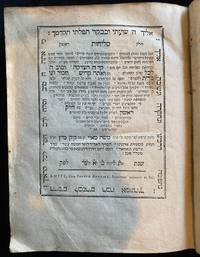
176542165Mets Metz Bi-defus Mosheh Mai 1765. Hardcover. 8vo; Hebrew Date 525. Period full leather with raised bands and interspersed gilt floral design and leather spine label 4to large 18 leaves i.e. 36 pages 152 leaves i.e. 304 pages 69 leaves i.e. 138 pages i.e. 478 pages total. 27 cm. In Hebrew and Judeo-German German in Hebrew script. Includes indexes. Vinograd Metz 10.<br> "In France Hebrew presses were established in Metz c. 1760 Strasbourg 1770 and later in Paris 1806" Jewish virtual library this being an early example of Hebrew printing in Metz. <br> SUBJECTS: Judaism -- Liturgy -- Texts. Repentance -- Prayers and devotions. Judai¨sme -- Liturgie -- Textes. <br> OCLC: 265896805. OCLC lists 6 copies worldwide British Library Loyola NYPL YIVO Stanford HUC. The British library holding lists an engraved frontis; however no other holdings nor auction records which we have seen ever list an engraved frontis so we assume that to either be a mistake or added later or a variant. <br> Some wear to leather boards as expected especially at corners but paper and binding remain clean and strong. About Very Good- Condition. A beautiful copy with attractive leather binding. BK5 Rab-66-33-'belccm. Mets [Metz] Bi-defus Mosheh Mai hardcover
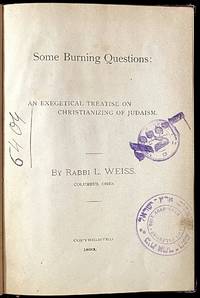
189342957Columbus Ohio: No Publisher The Author 1893. 1st edition. 8vo 87 pages 22 cm. Henry Marcus Leipziger's copy inscribed to him by the author. Singerman 4615. Errata slip tipped in. <br> Henry Marcus Leipziger 1854-1917 was an adult-education pioneer who "traveled to Europe and throughout the western United States examining educational systems. Upon his return to New York City Leipziger established the Hebrew Technical Institute. The Institute's objective was to educate Jewish boys in both intellectual and manual skills. Leipziger acted as director of the school from 1884 to 1891.<br> His papers are held in the NYPL archives. <br> From 1891-2896 he worked for the New York City Board of Education as Supervisor of Lecturers from 1890-1917. As such he organized an extremely popular series of free public lectures. Other positions he held were Assistant Superintendent of New York City Public Schools 1891-1896 Chairman of the Library Committee of Aguilar Free Library now part of the New York Public Library and vice president of the American Scenic and Historical Society.The National Institute of Social Science awarded Leipziger a gold medal for service to the community 1916" NYPL.<br> "Louis Weiss rabbi and scholar was born on February 17 1848 in Kotay Hungary. He received his rabbinical diploma from a school in Grosswardein Hungary. Weiss immigrated to the United States and in Chicago in 1876 he became a naturalized U.S. citizen. He served as rabbi for several congregations in the South and in Columbus Ohio 1894; Hamilton Ontario; Palestine Texas 1903-1905 and Braddock Pennsylvania 1905-1909" americanjewisharchives.org. <br> SUBJECTS: Judaism. <br> OCLC: 2082891. <br> Some wear to cover and spine some notes on second leaf and title page ex library with usual marks. Clean pages. Good condition. SBK AMR-68-4-B-'d. Columbus, Ohio: No Publisher [The Author] unknown
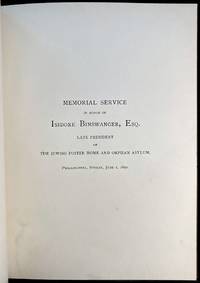
189042371New York: Press of Lehmaier & Bro 1890. paperback. 1st edition. Original publisher’s boards 8vo 39 unnumbered pages 1 photo plate portrait of Rabbi Binswanger. 22 cm. Prefatory poem signed in the print: F. B.i.e. Frances Binswanger. Singerman 4075. <br> Includes excerpts from obituaries that appeared in various periodicals. Isidore Binswanger 1820–1890 was a “U.S. businessman and communal leader. Binswanger was born in Wallerstein Bavaria. He immigrated to the United States in 1841 living first in Baltimore then in Philadelphia and finally in Richmond Virginia. In 1869 he became president of the Richmond Granite Company a position he held until shortly before his death. <br> Binswanger was chairman of the board and later president of the Hebrew Education Society in Philadelphia and president of the board of trustees of Maimonides College Hebrew Education Society. He was also active in various aid societies and helped organize relief measures in the early 1880s for Jewish immigrants from Russia. His three brothers Lewis Samuel and Harry S. settled in Richmond too where they also went into business and were active in local Jewish life†EJ.<br> SUBJECTS: Memorial service. Obituaries. Jews -- Pennsylvania -- Philadelphia -- Biography. Jewish businesspeople -- Service comme´moratif. Ne´crologies. Juifs -- Pennsylvanie -- Philadelphie -- Biographies. Gens d'affaires juifs -- Death and burial. <br> OCLC: 40128020. OCLC and Singerman together list 8 copies worldwide YU Wesleyan HUC HUC-LA Free Lib Phila Temple Penn AJHS only one at any Ivy League institution. <br> Jewish Institutional bookplate on front pastedown bookplate removed from rear pastedown edgewear to blank front endpaper no other marks inside some light wear to boards Very Good Condition B AMR-67-31-RBD!. New York: Press of Lehmaier & Bro unknown
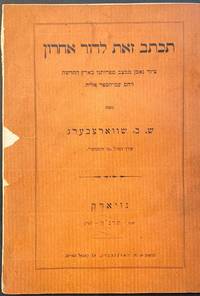
189842441Nuyork New York: Rozenberg 1898. paperback. 1st edition. Original orange printed wrappers 8vo 33 pages. 23 cm. In Hebrew. Title translates as: “Write This For The Last Generation: A Faithful Picture of the State of Our Literature in the New Land and the Attitude of the People of the Book To It.†<br> Extremely critical observations on the state of Hebrew literature and its readership in America by Schwarzberg 1865-1929 a Hebrew publisher and editor in Poland and the U.S. Singerman 5473. Goldman 1110. <br> "Schwartzberg published this pamphlet following the failure of Ner Hamerabi Goldman #908 a Hebrew periodical he edited." In it he “poured forth a bitter complaint against 'the people of the book' for their indifference to Hebrew and its literature . He draws a dark picture of the state of Hebrew culture and literature in this country" Waxman. Goldman notes that the work remains an important source on Ner Hamerabi. <br> “Schwarzberg who was born in Lipno Poland published Hebrew books at the close of the 19th century in Warsaw among them I. L. Peretz' Hebrew poems Ha-Ugav 1894. Arriving in the United States in 1897 he became editor of the Hebrew monthly Ner ha-Ma'aravi which appeared from 1895 to 1897. In 1898 he published a 33-page pamphlet Tikkatev Zot le-Dor Aharon "This Shall be Written for the Final Generation" a scathing attack on the attitude of the Jews toward the new Hebrew literature. <br> He fought Yiddishism and its standard-bearer Chaim Zhitlowsky. He also published a bibliography of the works of Senior Sachs†Eisig Silberschlag in EJ. Deinard 886; AJYB 1930-31 155; Not in Bibliography of the Hebrew Book 1470-1960. SUBJECTS: Hebrew literature Modern -- United States -- History and criticism. Litte´rature he´brai¨que moderne -- E´tats-Unis -- Histoire et critique. OCLC: 649820031. <br> OCLC: 649820031. OCLC lists 5 copies outside of Israel YIVO Am Jewish U Yale HUC YU. Spine rebacked touch of edgewear to orange wrapper which remains bright. About Very Good- Condition. Important. B AMR-67-38-DL-'b. Nuyork [New York]: Rozenberg unknown
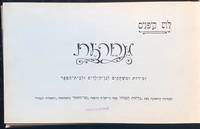
192343438Frankfurt am Main: Verlag "Omonuth" Omonut Omanut Omanuth 1923. 1st German-printed Edition. Original boards horizontal 8vo 1 score xv 177 pages. 13 x 21 cm. In Hebrew. Title translates as "Rhyme: Songs and Games for Kindergarten and School."<br> Book of songs for children written by Levin Kipnis. Includes musical settings unaccompanied for the poems by various composers. Hebrew text of each entire poem printed on page corresponding to strophic melody. Originally issued in Jerusalem and republished in this edition in Germany by the publishing house Omonuth.<br> "Kipnis was born in Ushomyr Volhynia.In 1913 he moved to Palestine to study at the Bezalel Academy of Art and Design. He later studied pedagogy for two years in Germany and thereafter became a teacher in Levinsky's Teacher's College in Tel Aviv 1923-1952. He debuted in print in 1911 with a poem in the children's magazine Heperaim The flowers and from that point published over one hundred Hebrew books for children and edited children's newspapers textbooks and the like. He is considered the founder of Hebrew-language children's literature in Israel. Leksikon fun der Nayer Yidisher Literatur<br> "A year after opening and before a single book had even been published Omanut closed its doors in Moscow and moved to Odessa a bustling port on the Black Sea located in the Ukraine and as yet untouched by the Revolution. Odessa was already a flourishing center of Jewish culture home to such luminaries of Modern Hebrew literature as Mendele Mocher Sforim and Chaim Nachman Bialik. But the events of 1917 sent even more Jewish writers and artists pouring in. With such a stable of local talent from which to draw Odessa was to prove fertile ground indeed for Omanut.<br> As the Bolsheviks advanced on the Ukraine Olamenu's female founder Shoshana Persitz relocated again this time to Frankfurt-am-Main in Germany. There she republished the beautiful picture books illustrated by the young art students in Odessa and also began publishing the polished Hebrew translations of world literature for children by which the press was to become famous. In 1925 Omanut left Europe altogether establishing itself once and for all in Tel-Aviv." LOC <br> SUBJECTS: Children's songs Hebrew. Singing games. Children's songs Hebrew. Singing games. OCLC: 18897325.<br> "Printed in Germany" stamp on title page. Some wear to spine and discoloration of cloth binding. Good Condition. GER-61-5-XX-'elggxcc. Frankfurt am Main: Verlag "Omonuth" [Omonut, Omanut, Omanuth] unknown
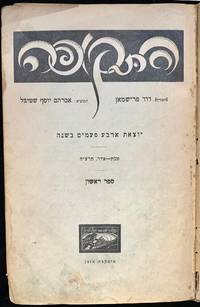
191843090Moskvah Moscow : A.Y. Shtibel 1918. First edition. Original boards 8vo 678 pages. 26 cm. In Hebrew. Title translates as “The Season.â€<br> Rare volume 1 published in the USSR of the quarterly literary magazine Ha-Tekufah. Includes essays by Simon Dubnow poetry short stories translations and articles.<br> Ha-Tekufah was a “Hebrew periodical devoted to literary scientific and social subjects which appeared first as a quarterly then as an annual intermittently between 1918 and 1950. Ha-Tekufah received the financial backing of Abraham Joseph Stybel a philanthropist who had placed David Frischmann in charge of launching Hebrew literary projects on an unprecedented large scale. Accordingly Frischmann established both the Stybel publishing house and launched Ha-Tekufah serving as the editor of both projects. The first volume of Ha-Tekufah appeared in Moscow early in 1918 before the Bolshevik regime had decided to suppress Hebrew literature. Frischmann published the works of the world's best authors and scholars. The literary standards of the periodical were high. Frischmann encouraged young authors for example Eliezer Steinman. In all respects and not least for its beautiful graphic work Ha-Tekufah was a rare phenomenon in Hebrew literature.†Jewish Virtual Library.<br> SUBJECTS: Hebrew literature Modern -- Periodicals. Hebrew literature Modern. OCLC: 25586768<br> Boards separated and pages edgeworn. Lacks backtrip spine covering. Good Condition internally. YID-46-7-’. Moskvah [Moscow] : A.Y. Shtibel unknown
17686'No. 2. Bon-Accord Rhymes and Ballads. Aberdeen: George Middleton Skene Square. 1878. Smith's entry in the Oxford DNB explains the background to this pamphlet explaining that he was 'commissioned to write some articles on biblical subjects for the ninth edition of the Encyclopaedia Britannica and the first two of these appeared in 1875—‘Angel’ in volume 2 and ‘Bible’ in volume 3. These articles marked a turning point in his career. The Bible was regarded by the Free Church of Scotland as ‘the supreme rule of faith and life’ and so anything that might seem to undermine its authority was bound to arouse opposition. An investigation by the college committee of the Free Church found that Smith's opinions as expressed in the article ‘Bible’ were hardly compatible with his position as a teacher of candidates for the ministry of the church but provided insufficient grounds to support a process for heresy. Smith maintained that he accepted that the Bible was the one sufficient and authoritative record of divine revelation and that his critical views were the fruit of studies carried out under the guidance of his teachers at New College Edinburgh. He therefore demanded that he be given a formal trial by libel indictment for his alleged heresies and errors. In the subsequent protracted proceedings in the various church courts Smith by sheer dialectical skill was able to beat back the attack on all points except the authorship and purpose of Deuteronomy. The libel proceedings were eventually terminated but a vote of no confidence in Smith was passed by the general assembly of 1881 and was followed by his summary removal from his chair.' 8pp. 12mo. Disbound without covers. In fair condition on aged paper with first and last leaf separated. Comprises a poem 'To the Publisher' dated by 'THE AUTHOR' to 15 April 1878; a poem titled 'The Heresy Hunters'; and another titled 'The Heretic Hunter's Song'. All three are written in lowland Scots. 'The Heresy Hunters' features references to 'The College' and 'SELBIE' as well as the stanza: 'Let dabbler DAVIES spit their spite And CRAVENS croak and BINNIES bite And slippery SLOANS and all unite They've neither pith Nor can nor calibre to fight Professor Smith.' 'The Heretic Hunter's Song' features references to 'Professor Smith' 'a wily loon' and 'Lawyer Davie' as well as 'Doctor Broon'. Pencil comment on line of poem in margin of p.7: 'But faith <he's roastin>'. Scarce: the only two copies found on COPAC at the National Library of Scotland and British Library. 'No. 2. Bon-Accord Rhymes and Ballads. ] Aberdeen: George Middleton, Skene Square. 1878. unknown
68870Jerusalem, Haifa, Academy, 1968, in 12 relié pleine toile de l'éditeur, 114 pages.
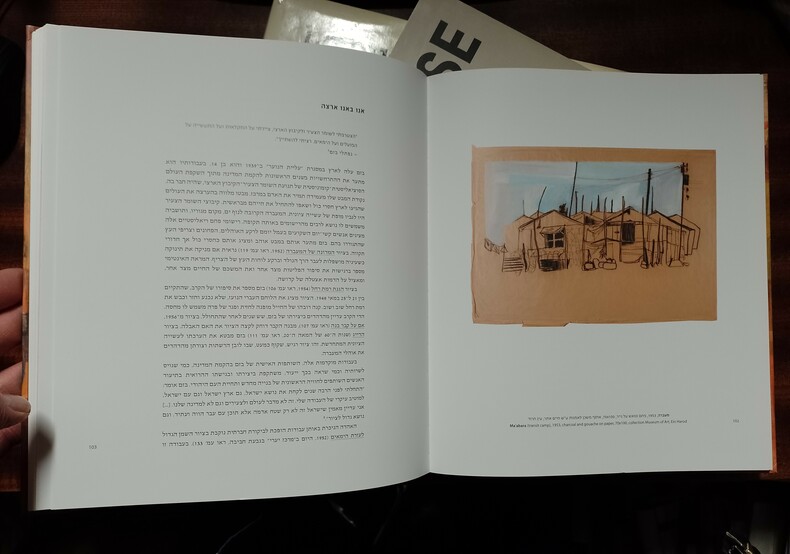
2012PEINTUR696661224Tel Aviv, Museum of Art, 2012, 24,5 x 28,5, 240 pages sous cartonnage éditeu illustré. Iconographie couleurs. Catalogue publié à l'occasion de l'exposition présentée du 28 décembre 2012 au 2 avril 2013. BILINGUE hébreu-anglais.
161018174Leiden 1610. 24mo in 8s 11 x 6 cm. Franciscus II Raphelengius Gold-tooled mottled calf ca. 1720 sewn on 4 cords each board with a small central flower ornament and a frame of double fillets the spine with a lozenge ornament in each of the 5 compartments a roll on each raised band and at the head and foot and further double fillets gold-tooled board edges mottled edges. With 4 letterpress title-pages for the Pentateuch early prophets major and minor prophets and Psalms etc. and decorations built up from arabesque typographic ornaments. Set in sephardic meruba Hebrew types unpointed with the imprints in semi-cursive rabbinical but the place of publication in meruba. 4 volumes bound as 1. 264; 227 1 blank; 238 2 blank; 287 1 blank pp. vols. 1-2 with arabic numerals 3-4 with Hebrew. A pocket-sized edition of the Hebrew Old Testament in four volumes volume 1 containing the Pentateuch or Torah volume 2 the early prophets Joshua Judges Samuel Kings volume 3 the later major Isaiah Jeremiah Ezekiel and minor prophets and volume 4 the Psalms Job Song of songs Ruth Lamentations Ecclesiastes Esther Daniel Ezra and Chronicles. It was produced by Franciscus II Raphelengius grandson of Christoffel Plantin and son of one of Europe's first great Hebrew scholars Plantin's son-in-law Franciscus I Raphelengius 1539-1597 who helped prepare Plantin's magnificent 1572 Polyglot Bible succeeded to the Leiden branch of Plantin's printing office and became professor of Hebrew at Leiden University. Plantin himself had produced the Dutch Republic's first Hebrew book there in 1585 and Raphelengius produced many more beginning in 1588.With occasional very minor foxing or faint discolouration but otherwise in very good condition. The spine and joints are worn with superficial cracks a repair at the head and a small tear at the foot and the sewing is slightly loose. A charming little Hebrew Bible from the first Dutch printing office to produce Hebrew books.l aleph.nli.org.il 001366023 4 copies; Darlow & Moule 5114; Fuks 25 2 copies; Steinschneider 386; WorldCat 8 or 9 copies. ABE CAT Bibles Sermons & Psalmbooks unknown