MareMagnum

2 965 résultats
Prag, S. Freund's Witw & Comp., 1865. Cloth, 16mo (pocket size), aprox. 200 pages. "Zweite auflage. Neue Taschen-Ausgabe." Nice pocket-sized collection of Bible commentaries. We were unable to locate a copy anywhere. Subject: Bible. O.T. Pentateuch - Commentaries. Heavy wear as one would expect, but complete, binding easily shored up. (RAB-54-7)
In -4°, 70, (1), b. Manca in Iccu
23x15 cm. 57 + 50 pages. Softcover. Cover slightly rubbed. Else in good condition.
39457Philadelphia, Cahan Printing Company 1909, 235x155mm, 28pages, paperback. Tab of quotation on the upper coverage. Tear of 2cm on lower coverage, otherwise book in good condition.
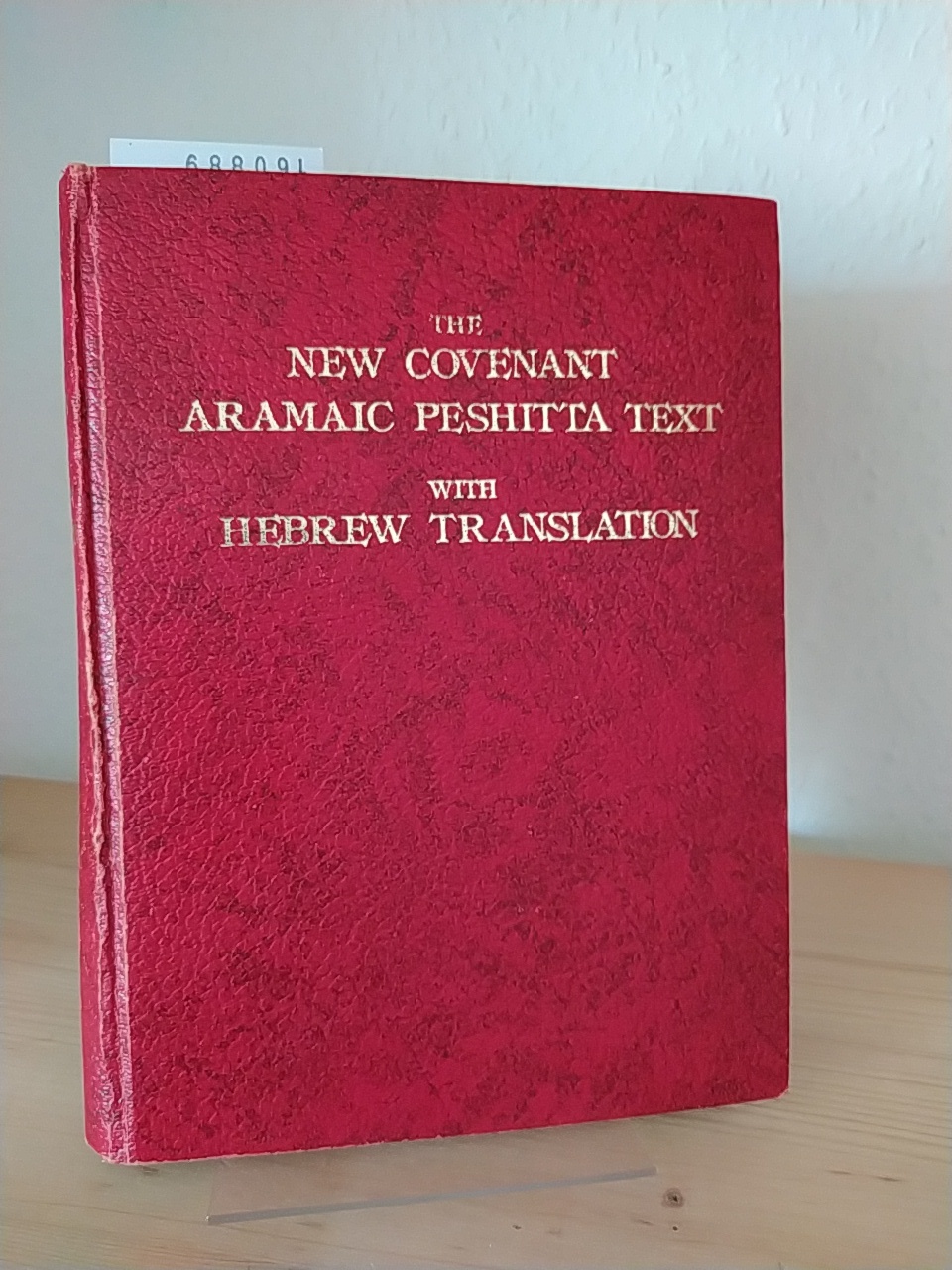
1986160889Jerusalem: The Bible Society 1986. V, 383 Seiten. Dünndruck. 8° (17,5-22,5 cm). Orig.-Kunstlederband mit goldgeprägtem Titel auf Deckel und Rücken. [Hardcover / fest gebunden].
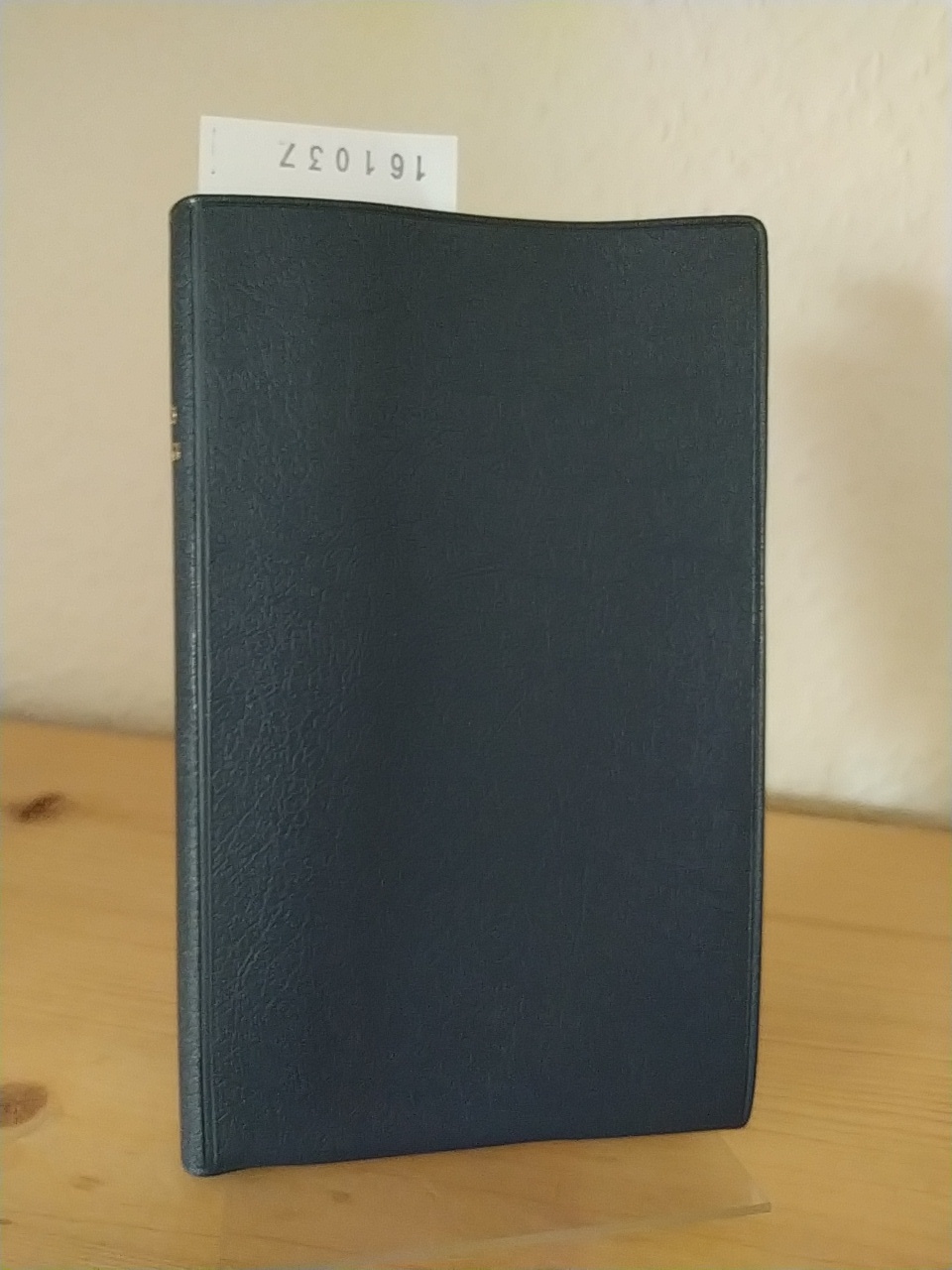
1976161037Jerusalem: United Bible Societies 1976. 645 Seiten. Dünndruckpapier. 8° (17,5-22,5 cm). Flexibler Kunstlederband mit Goldprägung und Lesebändchen. [Hardcover / fest gebunden].
19763128490Jerusalem: United Bible Societies 1976. 645 Seiten. Dünndruckpapier. 8° (17,5-22,5 cm). Flexibler Kunstlederband mit Goldprägung. [Hardcover / fest gebunden].
RARE comprehensive ENGLISH-FRENCH-ARABIC dictionary of computer terms. 250x175mm. 968 pages [+8]. Green leather Hardcover with gilt lettering on both covers and spine. Cover corners, upper and bottom edges bumped and slightly peeling. Spine edges bumped. Several tiny peeling-marks on spine front hinge and corners. Peeling-mark on front whitepage. Else in good condition. PLEASE NOTE: This item is overweight. We may ask for extra shipping costs.
THIS VOLUME ONLY. IN HEBREW. Contains B&W plates. 240x175 mm. 486 pages. Soft cover. Cover slightly yellowing. Cover corners and edges tattered. Spine yellowing and slightly water stained. Spine tattered. Spine edges tattered and rubbed. Pages slightly yellowing. Else in good condition.
8vo. 451 pages. Illustrated. In Hebrew. SUBJECT (S) : Hebrew literature. OCLC lists 2 copies worldwide (Yale, Florida Atlantic Univ) . Has dust jacket with small tears and reinforced with masking tape. Hinges starting, good condition. (HebLit-6-8)
Silver medallion with blue and white inlay, double-sided approximately 1 inch across. Medal awarded to Rae Neiman, with YWHA insignia and laurel leaves on front, engraved on rear: All Round Gym Champs 1916-1917 Rae Neiman. No stamps, but appears to be sterling. Light age patina, Very Good Condition. (women-4-14)
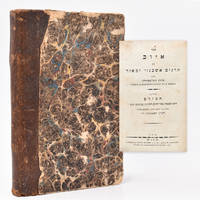
a104075Wien. 1808 . Large hardcover book entirely in Hebrew. 14-1/2 x 9-1/2 x 1 inch thick. Full leather. Remnants of paper spine labels. Leather is chipped and worn especially along one board edge. Delicate blue geometrically stamped end papers. Front inner hinge cracked ; rear inner hinge not cracked. Rouged page ends. Text clean; binding secure. Fairly Good. Owner stam pof Israelitschen Corporation Fraustdt and others. Pictures available on request. . hardcover
a104073Berlin 1764 Isaac Jacob Speirer. large hardcover book 14-3/4 x 9-1/2 x 2 inches thick. Wood boards with full leather cover on boards. Some metal nails. Had clasps at one point in time which are now gone. Backstrip is nearly all chipped away. Binding is secure; light even toning of text. Owner stamps of Rabbi Dr. A Cohn of Basel. Several other ink signatures and notations. Fully in Hebrew. Fair. Vol 3 of a 4 volume set. Pictures available on request. . hardcover
a1040741793. large hardcover book 14-3/4 x 9-1/3 x 1-1/2 inches thick. Papercovered boards. Black cloth spine. Ink mss title on slip of paper mounted on spine. Binding is secure hinges not cracked in or out; rouged page ends; two small tears/chips in black spine cloth; light even toning of text. Owner stamps of Rabbi Dr. A Cohn of Basel. Several other ink signatures and notations. In Hebrew. One end paper is fully covered with signatures and ink notes. Good. Vol 3 of a 4 volume set. Pictures available on request. . hardcover
Original Decorated Wrappers, 4to, 36 leaves. Includes 3 pages of photo plates. Includes English cover: 1933-OUR SCHOOL-1958. 25th ANNUAL SCHOOL JOURNAL. Text in Yiddish with on page (The P. T. A) in English. Ads mostly in English. No Copies on OCLC. Rare. (YID-20-2)
8vo; 1095 + 500 pages; Original Publisher's Cloth. Large 8vo. 1095, 500 pages. Volumes I & II are in English, Volume III is in Hebrew. Includes a bibliography of baron's works. Contents include: From Zudecha to Yahudi Mahallesi: The Jewish Quarter of Candia in the Seventeenth Century (by Zvi Ankori) ; Premiers Temoignages Epigraphiques Sur les Juifs en France (by Bernard Blumenkranz) ; The Hasmonean Revolution Politically Considered (by Martin A. Cohen) ; Christian Translators of Mamonaides' Mishne Torah into Latin (by Jacob Dienstag) ; H. M. Baratz and his View of Khazar Influence on the Earliest Russian Literature, Juridical and Historical (by Douglas Dunlop) ; Garcia de Orta--A Militant Marrano in Portuguese-India in the 16th Century (by Walter J. Fischel) ; Jewish Influence upon Arthurian Legends (by Kurt Leviant) ; Taamrat Emanuel's Note of Falasha Monks and Holy Places (by Wolf Leslau) ; The Attitudes of the Early Karaites towards Christianity (by Leon Nemoy) ; Hermann Cohen and Heinrich Graetz (by Erwin I. J. Rosenthal) ; A Frankish Document from Prague (by Gershom Scholem) ; East European Workers in Germany during World War I (by Zosa Szakowski) ; Young German Intellectuals on Romanticism and Judaism--Spiritual Turbulence in the Early19th Century (by Uriel Tal) ; Professing Jews in Post-Expulsion Spain and Portugal (by Yosef Hayim Yerushalmi) ; Unpublished Materials on the Relations of Austrian and German Jews to the Central Governments (by Arthur Zuckerman); etc. Nice, clean copies in Very good condition. (FEST1-119)
1609371891Geneva: Pierre de la Rouière 1609. In two columns. 28 184 283 1 84 203 1; 8 186 2 134 2pp. Folio 15 x 9-1/2 inches. Contemporary pigskin covers blocked in gilt and blind remnants of paper label on the spine gauffered edges lacks bosses and hinges and clasps worn at extremities and bottom of spine. Provenance: Johann Georg Feuchter of Jura-Weickersroda inscription on pastedown that the bible was purchased at an August 6 1728 auction for 4 florins and 30 groschen; General Theological Seminary blindstamp. In two columns. 28 184 283 1 84 203 1; 8 186 2 134 2pp. Folio 15 x 9-1/2 inches. Edited with introduction by Benito Arias Montanus 1527-1598 Spanish orientalist and editor of the Antwerp Polyglot a reprint of Plantin's similar edition. Darlow & Moole 5113 OT and 4662 NT Pierre de la Rouière unknown
1817353306Vienna: Anton Schmidt 1817. Portrait frontispiece engraved additional title. 8vo. Contemporary quarter calf and marbled boards the calf tooled in blind worn rear hinge cracked lacks rear pastedown frontispiece detached. Portrait frontispiece engraved additional title. 8vo. Includes commentary by Rashi and Beur. Anton Schmidt unknown
371476Amsterdam: Joseph Jacob and Abraham the sons of Solomon Proops 5522. Titled printed in red and black. 2 178 2 179-332 10 Introduction etc. 2 160 2 161-350pp. Publisher's introduction and other preliminaries misbound preceding the later Prophets. Folio 15-7/8x10 inches. Nineteenth or early 20th century half morocco and marbled paper boards rear joint splitting worn at joints and head and tail of spine. Foxing principally to the title tear to the final text leaf. Provenance: General Theological Seminary bookplate. Titled printed in red and black. 2 178 2 179-332 10 Introduction etc. 2 160 2 161-350pp. Publisher's introduction and other preliminaries misbound preceding the later Prophets. Folio 15-7/8x10 inches. Besides being the first bi-lingual edition in Hebrew and Spanish this edition is the first Hebrew book whose publication was financed by an American - Abraham Mendes de Castro 1689-1762 of Curaçao - intended for use in the West Indies with the sale proceeds to benefit the Jewish communities of Jerusalem and Hebron. Cowley 102; Darlow & Moule 5156; Zedner 102; not in Steinschneider or Roest Joseph, Jacob and Abraham, the sons of Solomon Proops unknown
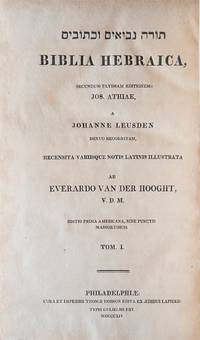
1814372931Philadelphia: Cura et Impensis Thomae Dobson edita ex aedibus Lapideis. Typis Gulielmi Fry 1814. First American edition. Text in Hebrew with notes in Latin. 6 296; 2 312 leaves. Half titles present in each volume. Uncut. 2 vols. 8vo. Original blue paper boards rebacked with plain paper. Provenance: Hugh Blair Grigsby booklabels. In a blue cloth folding box. First American edition. Text in Hebrew with notes in Latin. 6 296; 2 312 leaves. Half titles present in each volume. Uncut. 2 vols. 8vo. The first complete Hebrew Bible printed in America. Hebrew type was first used in the North American colonies in the Bay Psalm Book printed in 1640 in Cambridge. Over the next ninety-five years Hebrew type appeared in a handful of American imprints usually in brief examples of single words or short sentences. Paucity of appropriate type would continue to be a problem over the years that followed. The first Jewish Psalter was finally published in 1809 followed by this complete Bible five years later. "In 1812 Mr. Horwitz had proposed the publication of this edition of the Hebrew Bible the first proposal of the kind in the United States; early in 1813 be transferred his right and list of subscribers to Mr. Thos. Dobson who published soon afterwards the 1st volume" O'Callaghan. The title page indicates that this work is a reprinting of the second edition of the Joseph Athias Bible edited by Leusden with Latin notes by Everardo Van der Hought and that the Hebrew is printed without vowels. An important piece of American printing and of Jewish Americana. Darlow and Moule 5168a; Goldman 4; Rosenbach 171; Shaw and Shoemaker 30857; Singerman 236; M. Vaxer "The First Hebrew Bible Printed in America" Journal of Jewish Bib. 1940 vol. 2 pp. 20-26 Cura et Impensis Thomae Dobson edita ex aedibus Lapideis. Typis Gulielmi Fry unknown
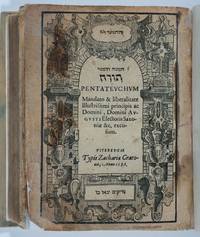
158653478Wittenberg: Zacharias Crato Krafft 1586. First edition. Hardcover. Very Good. Four parts quarto published between 1586 and 1587. Register continuous through parts 1 and 2; separate registers for parts 3 and 4. Collation in 4s: 1-65 blank 33.4; 1-30 lacks blank 30.4; 1-32 lacks 32.4 colophon. 506 leaves. Title within elaborate woodcut borders. Single-column text in vocalized Hebrew with cantillation; printed side-glosses. Separate Hebrew half-titles within woodcut borders for the latter three parts Former Prophets; Later Prophets; Hagiographa; names of the biblical books set in large font within woodcut cartouches. Later vellum. Title and following three leaves with marginal reinforcement slight text loss. Occasional mild embrowning else very good with bright half-titles. <br /> <br /> First Wittenberg edition of the complete Hebrew Scriptures with a concluding list of Haftaroth readings noting the Ashkenazi and Sefardi variations. Our copy is the variant with Hebrew and Latin title. A majority of the few surviving copies are bound with a Hebrew title and the publisher's information is taken from the colophon which provides a Jewish calendar date of 5347 = 1587. Vinograd notes that individual books and sections of the Hebrew Bible had been printed at Wittenberg since a quarto edition of the prophet Obadiah appeared in 1521. The title-page designs were re-used in the Hebrew bible published at Frankfurt am Oder in 1595. Each book closes with the Masora Finales printed in square type.<br /> <br /> Andreas Masch notes in his revised edition of Le Long's Bibliotheca Sacra 1778: "This edition of the Hebrew Bible is so rare and infrequent that it was omitted in the earlier edition of Le Long's work at Paris but it is known to Wolffius Bibliotheca Hebraea not in its entirety but only in respect of certain parts." One can speculate as to why the edition is rare but it may be worth noting that "when Hans and Friedrich Hartmann decided to start producing Hebraica in an effort to become the official printer for the univeristy of Frankfurt/Oder they were able to do so relatively quickly by hiring away five experienced workmen from Zacharias Croto's Wittenberg firm which was having financial difficulties" Burnett.<br /> <br /> Masch continues: "At the colophon is noted the year and the name of those at whose expense this Hebrew Bible was published: colophon info in Heb. and Latin The above example is therefore attributed to the liberality of the prince and to the expense of the two citizens of Wittenberg But the Rühilii brothers were not correctors of the work but citizens and senators of Witteberg whose name is quite famous in the history of the Germanic Bibles. The work came from the workshop of Zacharias Craton otherwise known as Kraft to whom we owe several editions of German Bibles. The title in both copies represents a gate in which above and below Ps. 118 com. 20. is printed. In accordance with the first Plantin edition the text was printed so as to match nearly page-for-page. It is composed of four parts with the five festival books added to the Pentateuch; but each part is decorated with a special title." Full title: חמשה חומשי תורה Pentateuchum mandato & liberalitate illustrissimi principis ac Domini Domini Augusti Electoris Saxoniae. Vitebergae: Typis Zacharia Cratonis Anno 1586. alternate Hebrew title: חמשה חומשי תורה × ×“×¤×¡ ×¢× ×¨×‘ העיון על ידי זכריה כר×טו.<br /> <br /> References: Benzing Buchdrucker 16/17 p. 471; Le Long/Masch I 1778 pp. 33-34; Steinschneider 277; VD16 ZV 29818 quarto; Vinograd 21. Not in: Adams; Darlow & Moule; Delaveau & Hillard. Cf. Burnett Christian Hebraism in the Reformation Era p. 204. Zacharias Crato [Krafft] hardcover
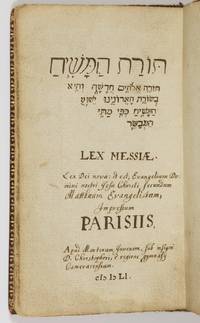
1700557661700. Very good-. Small octavo 14.1 by 8.5 cm. Manuscript in black and brown ink; 18-20 lines per page; text in vocalized Hebrew. 6 title and editor's preface 146 12 blank 10 notes. Lacks the first leaf which has been supplied in manuscript by a later owner. 19th-century limp morocco rubbed at extremities gilt dentelles marbled endleaves. Faint dampstain along bottom margin occasional smudges and mild stains else very good with crisp text.<br /> <br /> Early modern transcription of the Hebrew version of the Gospel of Matthew published in 1551 at Paris by Martin le Jeune with notes at the rear likely the work of a student. This edition was prepared by Jean Cinqarbres Quinquarboreus; 1514-1587 who jointly held the chair of King's Professor of Hebrew Literature at the University of Paris with Jean Mercier d. 1570. Lapide describes this as a "literal" edition and notes that the learned French bibliographer and father of the Oratory Jacques Le Long regarded it as the "true and authentic Gospel of Matthew." Like many of the surviving copies it lacks the Appendix which comprised the Seven Penetential Psalms Psalm CXIX Daniel's Prayer and the Ten Commandments. Apart from minor formatting changes e.g. breaks between chapters the text appears to be a faithful copy including vowel points and some of the additional cantillation marks the printed marginalia new Hebrew page numbers and Cinqarbres's dated preface. As the original version contains only 17 lines of text per page the transcription is not a page-for-page copy. Here the copiest appears quite fastidious in providing appropritate new catchwords! The Latin portion of the title however differs notably from the original which reads: Sanctum Domini nostri Iesu Christi Hebraicum Evangelium secundum Matthaeum.<br /> <br /> "In 1537 Sebastian Münster published his Hebrew version of the Gospel of Matthew at Basel the first printed edition of the New Testament in the so-called 'mother tongue of the evangelist' as he states in his preface" Lapide. Like the Paris edition of Hebrew Matthew upon which the present copy is based Münster entitled his version Torat ha-Mashiah The Teaching of the Messiah. While Münster's version of Matthew was long believed to be based on the 14th-century Hebrew translation by the Jewish polemicist Shem Tov ben Isaac ibn Shaprut more recent scholarship has called this attribution into question. "There are medieval Hebrew forms of Matthew that most scholars think of as retroversions from the Greek of canonical Matthew often made to serve in arguments between Christians and Jews. However some claim that these texts are a guide to the original Hebrew of Matthew French scholars like J. Carmignac and M. Dubarle have contributed to this thesis. Still other scholars think they can reconstruct the original Hebrew or Aramaic underlying the whole or parts of the Greek text of canonical Matthew on the assumption that the original was in Semitic. The vast majority of scholars however contend that the Gospel we know as Matthew was composed originally in Greek and is not a translation of a Semitic original" Brown.<br /> <br /> Provenance and annotations: The copiest has added notes following the main text comprising a Seder shel Miqra / Ordo Bibliorum in which the tripartite division of the Scriptures according to Jewish tradition is described. Then follows several pages of Hebrew terminology with biblical references and definitions in Latin. Along with one or two references to rabbinic literature an erudite reference to the Passover Haggadah notes Rabbi Judah's grouping of the ten plagues into three acronyms.<br /> <br /> At the head of the leaf inserted after Cinqarbres' preface is the note "When I bought this Mss. the first chapter from verse one unto verse 14 and part of verse 15. I filled in the missing verses. May. 18th. 1901. Llewellyn Saunderson 10 De Vesse Terrace Kingstown Co. Dublin" References: R. Brown Introduction to the New Testament 1997 p. 210; P. Lapide Hebrew in the Church Grand Rapids 1984 see Chap. IV "Modern Christian Hebraica" esp. pp. 53-58. Cf. Adams B1890 wanting the appendix; Darlow & Moule 5095: An independent edition of Shem Tob's version see no. 5088 which notes: The editor S. Münster obtained an imperfect MS. copy of St. Matthew's Gospel in Hebrew which had been made as early as 1385 for polemical purposes by Shem Tob b. Shaprut a Jew of Tudela in Castile. He revised and completed this for the press Basel: H. Petri 1537 adding a Latin translation of the Hebrew.; Delaveaux & Hillard 4644 noting Ibn Shaprut as the ulitmate source; Le Long/Masch 2 1781 p. 10. Schwarzfuchs Paris 212. Steinschneider 6591.26 under Münsterus.<br /> <br /> Full title noting original imprint: תורת המשיח תורת ××œ×”×™× ×—×“×©×” ×•×”×™× ×‘×©×™×¨×ª ×”××“×•× ×™× ×• ישוע המשיח כפי מתי המבשר <br /> Lex Messiae. Lex Dei nova: id est Evangelium Domini nostri Iesu Christi secundum Matthaeum Evangelistam Impressum Parisiis: apud Martinum Iuvenem sub insigni D. Christophori è regione gymnasii Cameracensium M.D.LI. 1551. unknown
179318880Leipzig: I. G. I. Breitkopf and Associates 1793. First edition. Hardcover. Good. Two volumes octavo 18.1 by 10.6 cm. xii 6 360 302; 352 404 pp. Title-pages and first-volume preface in Latin; half-titles for the Pentateuch Former Prophets Latter Prophets and Hagiographa. Main text in Hebrew. Contemporary green paper boards with title-labels edges stained red. Illustrated head pieces such as the heavens before Genesis and King David at prayer before Psalms. First volume covers slightly warped. Spines sunned. Library stamp on title and back pages. Minor worm tracing at first the 32 leaves vol. 2 resulting in the loss of a word or two along the line else a good or better ex-library copy.<br /> <br /> Complete Old Testament in Hebrew with traditional cantillation marks and scholarly footnotes indicating varying textual readings. Latin chapter headings summarize content. Preface in Latin by Johann Heinrich Meisner offers a history of the project. In the back is an appendix showing variant readings from the De Rossi Codex. There is also a chart giving the weekly readings from the Pentateuch and prophets. This Bible exemplifies early modern Protestant interest in being able to read the Old Testament in the original Hebrew. This was a product of their belief in sola scriptura that only the basis for religious authority was the Bible. <br /> <br /> Provenance: Stamps of the Franciscan monastery at Eggenfelden in Bavaria. References: Darlow & Moule 5163; Orme Bibl. Biblica pp. 238-9.<br /> <br /> Full title and imprint: Biblia Hebraica olim a B. Christiano Reineccio edita et ad optimorum codicum et editionum fidem recensita et expressa nunc denuo ad fidem recensionis Masoreticae cum variis lectionibus ex ingenti codicum copia a B. Kennicotto et I. B. de Rossi collatorum ediderunt D. Io. Christoph. Doederlein. et Joannes Henricus Meisner. Lipsiae: impensis I. G. I. Breitkopfii et Soc. MDCCXCIII. I. G. I. Breitkopf and Associates hardcover
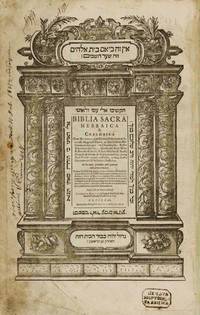
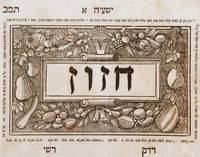
161948847Basel: Ludwig König 1619. First editions. Hardcover. Good. Seven parts in two volumes folio biblical texts and commentary in four parts continuously foliated; two supplemental sections each with separate foliation; Tiberias 1620 with separate pagination here bound after the second part - Vol. 1: 6 title and prelims 1-228 1 sect. title 234-441 1 blankff.; 6 sect. title and prelims 2 blank 114 2 blankpp. Vol. 2: 442-946; 8 Targum Yerushalmi; last leaf unfoliated; 67 Masora 1 blankff. Largely arranged in two columns of biblical texts in square font surrounded by commentaries in rabbinic Rashi font; text reads from right to left. This copy with collective Latin title surrounded by biblical quotations in Hebrew set within elaborate woodcut architectural borders. Hebrew sectional titles set within the same woodcut borders for the second and fourth parts with a plain letterpress half-title for the Five Megillot. The third sectional title for the Latter Prophets is lacking as are the Ashkenazi Haftarot readings not found in all copies. Apart from these lacks the Rabbinic Bible collates complete despite numerous errors in foliation throughout as per the detailed notes in Prijs Die Basler hebräischen Drucke. Opening word of each biblical book set in large one-third to one-half page cartouche vignettes with elaborate woodcut borders and surrounding letterpress Hebrew text. Main Latin title dated 1619 with the editor's Latin preface to the reader appearing at the verso. Jewish date chronogram for the second section Former Prophets dated 5378 1618/1619. Early twentieth-century black cloth boards worn at extremities gilt-lettered spine. Title moderately soiled re-inforced at gutter; neat old repairs to corners and fore-edge of title and next three leaves; old Russian stamp at bottom margin title manuscript entry in Russian along fore-edge dated 1837; intermittent mild to moderate marginal dampstains largely confined to corners and embrowning throughout both volumes somewhat more heavily in the first especially throughout Tiberias; top right corner of the opening leaf in vol. 2 repaired with loss of about 12 words surrounding title cartouche recto and some text in 9 lines of the commentary at the verso. Overall a good set with a notable chain of provenance. <br /> <br /> Sixth Rabbinic Bible in Hebrew: Mikra'ot Gedolot edited by Johann Buxtorf I 1565-1629 professor of Hebrew at the University of Basel and the foremost Christian Hebraist of his era with the assistance of the Jewish scholars Abraham Braunschweig who served as the principal corrector and Mordechai Gumplin of Posen. This was "a truly audacious undertaking for his time" Burnett From Christian Hebraism to Jewish Studies as no Christian scholar had yet attempted to edit the entire biblical corpus including the Aramaic versions Targumim and masoretic notes. Based mainly on the third Rabbinic Bible published by Daniel Bomberg at Venice in 1546-1548 the editor has carefully incorporated elements from two other Venetian editions. At the verso of the Latin title Buxtorf provides a detailed bibliographical excursus on the earlier Venetian editions and offers a tribute to Bomberg's industry by reprinting the colophon of the second Venetian Rabbinic Bible 1524-1525 at the conclusion of the masoretic appendix with text by the Hebrew grammarian and lexicographer Elijah Levita 1468 or 1469-1549 and a new introduction by Abraham Braunschweig. The design of the sectional titles and separate book title vignettes closely model those of the Venetian editions. "Buxtorf did not plan simply to reprint one of the existing Venice editions but rather to assemble the best features of them all into one work" and "to provide theologians with what he considered the most important tools for interpreting the Old Testament" Burnett. Buxtorf served in an official capacity as Basel's Hebrew censor charged with the oversight of all Jewish printing in the city and insuring that "no 'blasphemies' or slurs against Christians or Christianity appear in any book printed in Basel" Burnett. He carefully edited the Jewish commentaries in the Rabbinic Bible in accordance with this mandate "and removed many words and phrases which had escaped the attention of earlier censors" Burnett. <br /> <br /> The Rabbinic Bible contains the vocalized Masoretic text of the Hebrew Scriptures with accents and a vocalized Targum an Aramaic paraphrase of the biblical text: Onkelos for the Pentateuch; Jonathan b. Uzziel for the Prophets; and Targum Hagiographa for the Writings. The Hebrew and Aramaic versions are printed in square characters and presented in facing columns at the center of each page. The Jerusalem Targum of the Pentateuch appears as an appendix. In addition to the Aramaic paraphrases the Rabbinic Bible includes a massive scholarly apparatus of biblical commentaries by Rashi Ibn Ezra Baal ha-Turim Jacob b. Asher R. David Kimchi Radak R. Levi b. Gershon Ralbag Saadia Gaon and R. Isaiah along with the Masora a corpus of critical notes on the external form of the Biblical text compiled by Jewish scholars from late antiquity through the medieval era. As frequently occurs a copy of Buxtorf's work on the textual history of the Hebrew Bible Tiberias the 1620 first edition is bound-in. This work was made possible by the publication in 1538 of Elijah Levita's Masoret ha-Masoret a commentary on the Masora which Buxtorf translated into Latin for his own private use in 1593. "Buxtorf was concerned with the integrity of the consonantal text and the origin and integrity of the vowel points and accents of the Hebrew Bible from the very beginning of his scholarly career" and while he had earlier published a long excursus on the age of the vowel points and accents in his 1609 Thesaurus Grammaticus "Tiberias is Buxtorf's fullest and most impressive work on the history of the biblical text" Burnett. Intended as a reference work for Christian students and scholars interested in studying the Masora Buxtorf was also keen to refute the view advanced by Levita that the Hebrew vowel points were early medieval innovations. Our folio version of Tiberias was intended to accompany the Rabbinic Bible and has the same architectural borders at the title. König also published a quarto edition in the same year but only the folio version includes a critical commentary on the Masora in which Buxtorf proposes various corrections to the Masoretic notes. <br /> <br /> As noted at the title Buxtorf's faithful study and tireless labor studio fido et labore indefesso yielded notably long-lasting results: "The Basel rabbinical Bible became a standard tool for research among Christian scholars and would remain so. until the end of the nineteenth century" Burnett. A vast array of early modern scholars including Protestants like Johannes Drusius and John Selden as well as Roman Catholics like Robert Bellarmine and Andreas Masius owned a copy or two of the Rabbinic Bible. "Johannes Buxtorf's thoroughly censored "Christian" version of the Rabbinic Bible Basel 1618-19 only made it easier for Hebraists to own copies of their own" Burnett Christian Hebraism in the Reformation Era p.163.<br /> <br /> A note on the date of publication: "The actual printing began between the mid-August and mid-September of 1618. According to the colophon production ended on the 24 of Ab 5379 = August 4 1619 but since this date also appeared on the colophon of the Bomberg Biblia rabbinica edition of 1524-25 reprinted unchanged in the 1546-48 and 1568 editions it is suspect. Prijs suggested that the probable completion date was sometime during Ab of 5379 between July 12 and August 10 of 1619" Burnett. <br /> <br /> Provenance: from the library of acclaimed theologian and biblical scholar Brevard Childs with his entry at the free endpaper in the second volume. The earlier bookplate of judge Samuel Heller with his motto in Hebrew: Mi-kol melamdai hiskalti from all my teachers I have learned appears at the front paste-down. An old blue ink-stamp in Hebrew characters makes occasional appearances the text: Bet ha-Midrash ha-Gadol Minsk The Great Synagogue of Minsk. A Russian entry dated 1837 appears at the fore-margin of the main title along with an old ink stamp in Russian at the bottom margin the last word of which reads "Rabbina" References: Biblia Sacra: Burnett 7. Cowley 87. Darlow & Moule 5120 bound with the 1665 second edition of Tiberias cf. 5093. Davidson Otsar ha-shirah vol.1 p.406 no.8954. Prijs 219. Steinschneider 423 423b. VD17 23:675325G. S. Burnett Christian Hebraism in the Reformation Era Leiden: Brill 2012 p.163. Tiberias: Burnett 111. Prijs 222a. For detailed analyses of both works see: S. Burnett From Christian Hebraism to Jewish Studies Leiden: Brill 1996 pp.169-239 chaps. 6 & 7.<br /> <br /> Full Latin title: Biblia Sacra Hebraica & Chaldaica cum Masora quae critica Hebraeorum sacra est Magna & Parva ac selectissimis Hebraeorum interpretum commentariis Rabbi Salomonis Jarchi R. Abrahami Aben Esrae R. Davidis Kimchi R. Levi Gerson R. Saadie Gaon R. Jeschajae & Notis ex authore quem Baal Turim vocant collectis quibus textus grammaticè & historicè illustratur. In his nunc primum post quatuor editiones Venetas textus Chaldaicus qui Targum dicitur à deformitate punctationis & pravitate vocum innumeratum vindicatus; loca in Masora transposita deficientia pugnantia numeris depravata subsidio diversorum exemplarium & Concordantiarum Hebraicarum quantum fieri potuit reposita restituta & conciliata sunt ut in praefatione amplius declarabitur. Studio fido & labore indefesso Johannis BuxtofI linguae sanctae in Academia Basileensi Professoris Ord. Basileae: Sumptibus & typis Ludovici König 1619.<br /> <br /> Collation vol. 1 Rabbinic Bible: ital.a6 a-z8 A-E8 F4 G-Z8 Aa-Hh8 Ii9 Ii10 blank; 1 blank :3 1 blank A-N4 O5.<br /> <br /> Collation vol. 2 Rabbinic Bible: Kk-Rr8 Kk1 lacks Ss6 Tt10 Vv-Zz8 AA-PP8 QQ-TT6 VV9 VV10 blank XX-ZZ8 Aaa-Nnn8 Ooo3 Ooo4 blank PppTtt8 Vuu3 Vuu4 blank Xxx-Zzz8 AAaa-EEee8 8 A-G8 H6 I5 I6 blank. Ludwig König hardcover
161952679Basel: Ludwig König 1619. First edition in part. Hardcover. Good. Eight parts in three volumes folio biblical texts and commentary in four parts continuously foliated; three supplemental sections each with separate foliation; Tiberias 1655 with separate pagination here bound after the Haftarot - Vol. 1: 6 title and prelims 1-228 1 sect. title 234-441 1 blank ff. Vol. 2: 1 sect. title 442-705 3 blank 707 sect. title-837 1 blank ff. Vol. 3: 839 half-title-881 1 blank 883-946; 8 Targum Yerushalmi; last leaf unfoliated; 67 Masorah 1 blank; 1 title 2-36 Haftarot ff.; 8 title and prelims 108pp. Despite the gap in foliation between the first and second parts and numerous errors in foliation throughout the Rabbinic Bible collates complete with all blanks noted in Prijs Die Basler hebräischen Drucke and the Haftarot bound at the end. Largely arranged in two columns of biblical texts in square font surrounded by commentaries in rabbinic Rashi font; biblical texts read from right to left. This copy with collective Hebrew title surrounded by biblical quotations in Hebrew set within elaborate woodcut architectural borders; brief preface in Hebrew by Abraham Braunschweig at the verso. Hebrew sectional titles set within the same woodcut borders for the three other biblical sections and the Haftarot with a plain letterpress half-title for the Five Megillot. Opening word of each biblical book set in large one-third to one-half page cartouche vignettes with elaborate woodcut borders and surrounding letterpress Hebrew text. Main title Jewish date chronogram = 5378 1618-1619. Near-contemporary half calf over speckled boards worn and rubbed; spines with raised bands gilt morocco lettering pieces and old paper labels heavily faded. About two-thirds of the text embrowned ranging from minimal to moderately heavy; worm tracing in a 1- by 2-inch section at leaves 541-553 affecting text. A good complete set notably containing the Ashkenazi Haftarot readings not found in all copies.<br /> <br /> Sixth Rabbinic Bible in Hebrew: Mikra'ot Gedolot edited by Johann Buxtorf I 1565-1629 professor of Hebrew at the University of Basel and the foremost Christian Hebraist of his era with the assistance of the Jewish scholars Abraham Braunschweig who served as the principal corrector and Mordechai Gumplin of Posen. This was "a truly audacious undertaking for his time" Burnett as no Christian scholar had yet attempted to edit the entire biblical corpus including the Aramaic versions Targumim and masoretic notes. Based mainly on the third Rabbinic Bible published by Daniel Bomberg at Venice in 1546-1548 the editor has carefully incorporated elements from two other Venetian editions. At the verso of the Latin title Buxtorf provides a detailed bibliographical excursus on the earlier Venetian editions and offers a tribute to Bomberg's industry by reprinting the colophon of the second Venetian Rabbinic Bible 1524-1525 at the conclusion of the masoretic appendix with text by the Hebrew grammarian and lexicographer Elijah Levita 1468 or 1469-1549 and a new introduction by Abraham Braunschweig. The design of the sectional titles and separate book title vignettes closely model those of the Venetian editions. "Buxtorf did not plan simply to reprint one of the existing Venice editions but rather to assemble the best features of them all into one work" and "to provide theologians with what he considered the most important tools for interpreting the Old Testament" Burnett. Buxtorf served in an official capacity as Basel's Hebrew censor charged with the oversight of all Jewish printing in the city and insuring that "no 'blasphemies' or slurs against Christians or Christianity appear in any book printed in Basel" Burnett. He carefully edited the Jewish commentaries in the Rabbinic Bible in accordance with this mandate "and removed many words and phrases which had escaped the attention of earlier censors" Burnett. <br /> <br /> The Rabbinic Bible contains the vocalized Masoretic text of the Hebrew Scriptures with accents and a vocalized Targum an Aramaic paraphrase of the biblical text: Onkelos for the Pentateuch; Jonathan b. Uzziel for the Prophets; and Targum Hagiographa for the Writings. The Hebrew and Aramaic versions are printed in square characters and presented in facing columns at the center of each page. The Jerusalem Targum of the Pentateuch appears as an appendix. In addition to the Aramaic paraphrases the Rabbinic Bible includes a massive scholarly apparatus of biblical commentaries by Rashi Ibn Ezra Baal ha-Turim Jacob b. Asher R. David Kimchi Radak R. Levi b. Gershon Ralbag Saadia Gaon and R. Isaiah along with the Masora a corpus of critical notes on the external form of the Biblical text compiled by Jewish scholars from late antiquity through the medieval era. As frequently occurs a copy of Buxtorf's work on the textual history of the Hebrew Bible Tiberias the 1655 revised edition is bound-in. This work was made possible by the publication in 1538 of Elijah Levita's Masoret ha-Masoret a commentary on the Masora which Buxtorf translated into Latin for his own private use in 1593. While "Buxtorf was concerned with the integrity of the consonantal text and the origin and integrity of the vowel points and accents of the Hebrew Bible from the very beginning of his scholarly career." While he had earlier published a long excursus on the age of the vowel points and accents in his 1609 Thesaurus Grammaticus "Tiberias is Buxtorf's fullest and most impressive work on the history of the biblical text" Burnett. Intended as a reference work for Christian students and scholars interested in studying the Masora Buxtorf was also keen to refute the view advanced by Levita that the Hebrew vowel points were early medieval innovations. Our folio version of Tiberias was intended to accompany the Rabbinic Bible and has the same architectural borders at the title. König also published a quarto edition in the same year but only the folio version includes a critical commentary on the Masora in which Buxtorf proposes various corrections to the Masoretic notes. <br /> <br /> As noted at the title Buxtorf's faithful study and tireless labor studio fido et labore indefesso yielded notably long-lasting results: "The Basel rabbinical Bible became a standard tool for research among Christian scholars and would remain so. until the end of the nineteenth century" Burnett. A vast array of early modern scholars including Protestants like Johannes Drusius and John Selden as well as Roman Catholics like Robert Bellarmine and Andreas Masius owned a copy or two of the Rabbinic Bible. "Johannes Buxtorf's thoroughly censored "Christian" version of the Rabbinic Bible Basel 1618-19 only made it easier for Hebraists to own copies of their own" Burnett Christian Hebraism in the Reformation Era p.163.<br /> <br /> A note on the date of publication: "The actual printing began between the mid-August and mid-September of 1618. According to the colophon production ended on the 24 of Ab 379 = August 4 1619 but since this date also appeared on the colophon of the Bomberg Biblia rabbinica edition of 1524-25 reprinted unchanged in the 1546-48 and 1568 editions it is suspect. Prijs suggested that the probable completion date was sometime during Ab of 379 between July 12 and August 10 of 1619" Burnett. References: Biblia Sacra: Burnett 7. Cowley 87. Darlow & Moule 5120 like our copy bound with the 1665 second edition of Tiberias cf. 5093. Davidson Otsar ha-shirah vol.1 p.406 no.8954. Prijs 219. Steinschneider 423 423b. VD17 23:675325G. S. Burnett Christian Hebraism in the Reformation Era Leiden: Brill 2012 p.163. Tiberias: Burnett 114. Prijs 272a. For detailed analyses of both works see: S. Burnett From Christian Hebraism to Jewish Studies Leiden: Brill 1996 pp.169-239 chaps. 6 & 7. Ludwig König hardcover