22 324 résultats
1978007456Namur 1978 Faculté Universitaire Notre Dame De La Paix Soft cover 1° Edition
1968109341Berlin, Akad.-Vlg. 1968. M. 1 Kte. u. 10 Abb. VIII, 583 S. OBr. Umschl. teils angeschmutzt u. angerissen. (Berliner byzantinistische Arbeiten, Bd. 40)
17542306160124xbvkSpain, 1754. Calligraphic titlepage in a handpainted watarcolour frame; 5 sheets dedication ''A LA REYNA DEL CIELO MARIA SSA. EN SU SOLEDAD DOLOROSA SA MADRE DEL AMOR HERMOSO, y delicias de la celestial Syon, aunque max grande de penas y amanguras de la gracia, que en el dura, pero o lorioso campe de la soledad ...''; 1 blank sheet; 2 sheets ''TABLA DE LAS SANTAS ANACORETAS CONTENIDAS EN ESTE SEGUNDO TOMO DEL DESIERTO DELICIOSO''; 2 sheets 'PROTESTA . . .' etc.; 334* sheets Description of the Saints. - Vellum binding of the periodover 4 raised bands with manuscript title at spine and possibly younger frangments of ribbon clasps; 4to.(ca. 24 x 19 x 6 cm; ca. 1,47 kg.).
29753Paris Ministère d'Etat Affaires Culturelles 1964 in 8 (22x16) 1 volume broché, couverture illustrée en couleurs, 283 pages [2], avec de nombreuses illustrations en noir et blanc, et en couleurs. Catalogue de 360 numéros décrits. Catalogue de l'exposition présentée au Musée du Petit Palais du 17 juin au 25 septembre 1964. Bon exemplaire ( Photographies sur demande / We can send pictures of this book on simple request )
17147Paris Editions Atlas 1992 in 4 (29x22,5) 1 volume reliure cartonnée de l'éditeur, dos de skivertex noir titré en long, plat supérieur illustré en couleurs, 183 pages. Bel exemplaire
17138Paris Editions Atlas 1992 in 4 (29x22,5) 1 volume reliure cartonnée de l'éditeur, dos de skivertex noir titré en long, plat supérieur illustré en couleurs, 175 pages. Bel exemplaire
17141Paris Editions Atlas 1992 in 4 (29x22,5) 1 volume reliure cartonnée de l'éditeur, dos de skivertex noir titré en long, plat supérieur illustré en couleurs, 183 pages. Bel exemplaire
23196Toulouse Édouard Privat, Libraire-Editeur 1962 in 4 (24x19) 1 fort volume broché, couverture à rabats, portrait en frontispice, XXXI et 515 pages, avec des figures dans le texte, et 3 planches hors-texte. Textes de G. Béquignon, J. Bidez, M. Bieber, P. Cloché, P. Collart, R. Demangel, W. Dörpfeld, H. Grégoire, A. Mirambel, Ch. Picard, A. Aymard. Texte en français, anglais et allemand. Ex-dono autographe au Recteur Pierre Guillon. Bel exemplaire ( Photographies sur demande / We can send pictures of this book on simple request )
23190Gand Ecole des Hautes Etudes 1938 in 4 (26x19,5) 1 volume broché, couverture imprimée, 157 pages [1], avec 10 planches d'illustrations en noir et blanc hors-texte. Yves Béquignon: Sur l'itinéraire d'Apollon dans la suite pythique; Joseph Bidez: La découverte à Trèves d'une inscription en vers grecs célébrant le dieu Hermès; Pierre Demargne: Crète-Egypte-Asie. Perspectives d'hier et d'aujourd'hui; Robert Flacelière: Le fonctionnement de l'Oracle de Delphes au temps de Plutarque; Pierre de La Coste-Messelière: Frontons delphiques; Charles Picard: Néréides et Sirènes, Observations sur le folklore hellénique de la mer. Joint une carte d'hommage de l'Ecole des Hautes Etudes de Gand, avec un envoi autographe signé Pierre de la Coste-Messellière au Recteur Pierre Guillon. Annales de l'Ecole des Hautes Etudes de Gand, Tome II. Bel exemplaire ( Photographies sur demande / We can send pictures of this book on simple request )
30271Paris Académie d'Architecture 1960 in folio (36x27) 1 volume reliure toilée grège de l'éditeur, dos et plat supérieur titrés en lettres dorées (dos très légèrement insolé), 241 pages [2], avec de nombreuses illustrations en noir et blanc et en couleurs, dont planches hors-texte dépliantes, étui bordé. Henri Prost à la villa Médicis; Anvers; Maroc (Casablanca, Rabat, Meknès, Marrakech, l'oeuvre de Henri Prost vue par Lyautey); Côte d'Azur Varoise; Région parisienne; Istanbul; Annexes; Index alphabétique. Bel exemplaire ( Photographies sur demande / We can send pictures of this book on simple request )
23340Paris Editions E. de Boccard 1963 in 8 (23x14,5) 1 volume broché, 200 pages [1], et une carte dépliante hors-texte in fine. L'occident préromain; La gaule romaine; L'Italie du Nord, l'Europe centrale et septentrionale; L'Afrique du Nord; La Grèce et Chypre; Les Balkans, les Pays Danubiens, la Pologne; La Russie Pontique; L'Anatolie; Le Proche-Orient; Les pays Iraniens et Indiens, Israël. On joint un petit fascicule broché de 20 pages: Séances du 7 et 10 septembre 1963. Bel exemplaire ( Photographies sur demande / We can send pictures of this book on simple request )
182696801826 Gothae, Erfordiae, Guil. Hennings, 1826; très fort in-8°, plein cartonnage vert tendre de l'époque, titre imprimé en noir sur étiquette beige au dos; xxxix, 510pp. Texte en grec avec notes en latin. Importants Index (des épigrammes, des poetes, des mots, etc..). Collection : Bibliotheca Graeca. A, poetarum; vol. xx. Ex-libris gravé au 1er contreplat " Ex musaeo E. Phelippes-Beaulieux Nannetensis“ . Emmanuel Phélippes -Beaulieux (1829 -1874), nantais, fut avocat, desssinateur, graveur et secrétaire de la Société archéologique de Nantes.
a1053961 Sotheby. 28 April 1975 "Russian and Greek Icons and Russian works of Art"; 2 Christie's July 30 1979 "Russian and Greek Icons"; 3 ditto for 21 September 1979; 4 ditto for 3 Feb 1981. Fully bw illus. All VG to Fine. All sm4to wraps. Group of 4 individual pamphlets: . paperback
1758ST17496-017Paris: H. L. Guerin & L. F. Delatour Jean-Luc Nyon and Jean Neaulme 1758. FIRST EDITION. 608 x 445 mm. 24 x 17". xiv 56; 2 vi 28 pp. Two parts in one volume. <br/> Later early 20th century quarter sheep over marbled boards raised bands compartments gilt reddish-brown leather label with gilt lettering all edges untrimmed. With large woodcut vignette on title and 60 ENGRAVED PLATES by Le Bas Littret de Montigny Neufforge and Patte after Le Roy. Brunet III 103; Millard French 101. A little rubbing to corners and head and tail of spine leather a bit faded chafed and freckled in places but the binding entirely sound and still quite pleasing; very faint diagonal crease at lower corner of many leaves a handful of plates slightly browned one more noticeably so other minor issues but quite a fine copy internally--the vast majority of the contents clean and bright with deep impressions of the text with the engravings richly impressed and with vast margins.<br/> <br/> With engravings by the some of the most esteemed artists of the day this imposing work contains beautiful depictions of Greek ruins and monuments that proved extremely influential to the development of French Neoclassical architecture. The text is divided into two parts the first covering the history of various monuments and Le Roy's thoughts on the principles of architecture and the second primarily containing a discussion of the orders of columns--particularly the Doric order--as well as several reconstructions of ruined temples. According to Millard this work "breaks new ground in providing a synthesis of archaeological findings with a body of architectural theory developed and expanded from the important controversy of Claude Perrault and Francois Blondel i.e. quarrel of the Ancients and the Moderns. . . . Perhaps most important Le Roy's treatise provides the theoretical framework and many of the actual models for French neoclassical architecture." Although "Les Ruines" came under some criticism especially by British rivals James Stuart and Nicholas Revett it nevertheless "made a strong public impact" in the words of the Dictionary of Art Historians and "greatly influenced the architects of the day particularly Jacques-Denis Antoine Jean-Arnaud Raymond Alexandre-Théodore Brongniart and François-Joseph Bélanger." This was in no small part due to the exquisite plates that included many picturesque views engraved by talented artists such as Louis-Joseph Le Lorrain Pierre-Charles Le Mettay Claude-Antoine Littret de Montigny and Jacques Philippe Le Bas among others. The son of the horologer to Louis XV Julien-David Le Roy 1724-1803 was an architect art historian and archaeologist. He was a protégé of Jacques-François Blondel 1705-74 whom he later succeeded as professor at the Académie Royale d'Architecture. After winning the Prix de Rome in 1754 Le Roy spent time in Greece studying and measuring ancient architecture and developing many of the theories that he would eventually publish in the present work. H. L. Guerin & L. F. Delatour, Jean-Luc Nyon, and Jean Neaulme unknown
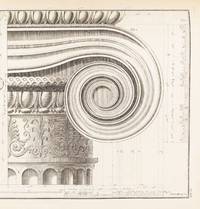
1768ST17496-011London: Chez l'auteur 1768. First Edition in French. 590 x 380 mm. 23 1/4 x 15". 52 2 pp. <br/> Modern brown quarter morocco over green linen boards brown morocco label with gilt lettering on smooth spine edges untrimmed. WITH 25 FULL-PAGE ENGRAVED PLATES OF GRECIAN RUINS and seven smaller engraved plates in text including one on dedication page. A Large Paper Copy. Fowler p. 157; Millard British 41; Blackmer 1065; Brunet III 1329. Head of spine partly torn but with no loss contents with not infrequent light marginal soiling though plates uniformly clean other minor imperfections but an excellent copy with greatly generous margins with deep impressions of the type and with strong impressions of the plates.<br/> <br/> This work is the first significant account of the ancient city of Paestum being in the words of Blackmer "larger and much more complete than any of the previous publications." Located in the Tyrrhenian Sea off the coast of southern Italy Paestum or Poseidonia in Greek was founded by Greek colonists in the sixth century B.C. and still contains beautifully preserved ruins from that period including temples an amphitheater and painted tombs. Abandoned in the Medieval period Paestum wasn't rediscovered by the West until the 18th century with the first modern publication of the site not appearing until 1764 when a suite of plans by G. P. M. Dumont appeared with no text based on the observations of Jacques-Germain Soufflot. As Millard indicates the genesis of the present publication has an extremely complex history we do not even know with certainty who wrote the text but we do know that engraver Thomas Major 1729-99 whom DNB calls "the first great English landscape engraver" was responsible for preparing the plates. Because he had no first-hand knowledge of the site Major relied on images by other artists including Antonio Joli Gaetano Magri Robert Mylne and Jacques-Germain Soufflot. The text was first published in English and then in French the same year. According to Fowler "this work . . . was an important eighteenth-century pioneer contribution to the knowledge of Greek architecture in England"; and Millard tells us that "the book was surprisingly well received by reviewers" in both England and France remaining "the standard reference to Paestum until 'Les Ruines de Paestum ou Posidonia' by C.-M. Delagardette was issued in 1798.". Chez l'auteur unknown
Top corners are bumped else book has Minor shelfwear. DJ spine slightly discolored. ; During the period 360-146 BC, the Greco-Roman world underwent the transition from independent city states and small regional powers to large and potent empires of the Hellenistic age. The essays in this volume consider various aspects of this central political transformation. Essays on Greco-Roman history of the period 360-146 BC are by students and colleagues of Ernst Badian. Nine chapters on the `Early Imperial History of Macedon, 360-300 BC' (Peter Green, Julia Heskel, Edward Harris, John Buckler, George Cawkwell, Eugene Borza, A. B. Bosworth, William Calder, Thomas Martin) ; five chapters on `Cultural Transitions in Athens and the Eastern Mediterranean in the Hellenistic Age' (Mogens Herman Hansen, Mortimer Chambers, Robert Wallace, Sarah Pomeroy, Erich Gruen) ; and seven chapters on `The Rise of Rome' (Kurt Raaflaub, Corey Brennan, William Loomis, Valerie Warrior, Jerzy Linderski, Judith Hallett, Walter Eder). ; Oklahoma Series in Classical Culture; 1.39 x 9.25 x 6.31 Inches; 498 pages
A couple of corners and top of spine are lightly bumped else book has Minor shelfwear. Top of DJ spine slightly creased. DJ in mylar. ; During the period 360-146 BC, the Greco-Roman world underwent the transition from independent city states and small regional powers to large and potent empires of the Hellenistic age. The essays in this volume consider various aspects of this central political transformation. Essays on Greco-Roman history of the period 360-146 BC are by students and colleagues of Ernst Badian. Nine chapters on the `Early Imperial History of Macedon, 360-300 BC' (Peter Green, Julia Heskel, Edward Harris, John Buckler, George Cawkwell, Eugene Borza, A. B. Bosworth, William Calder, Thomas Martin) ; five chapters on `Cultural Transitions in Athens and the Eastern Mediterranean in the Hellenistic Age' (Mogens Herman Hansen, Mortimer Chambers, Robert Wallace, Sarah Pomeroy, Erich Gruen) ; and seven chapters on `The Rise of Rome' (Kurt Raaflaub, Corey Brennan, William Loomis, Valerie Warrior, Jerzy Linderski, Judith Hallett, Walter Eder). ; Oklahoma Series in Classical Culture; 1.39 x 9.25 x 6.31 Inches; 498 pages
1609371891Geneva: Pierre de la Rouière 1609. In two columns. 28 184 283 1 84 203 1; 8 186 2 134 2pp. Folio 15 x 9-1/2 inches. Contemporary pigskin covers blocked in gilt and blind remnants of paper label on the spine gauffered edges lacks bosses and hinges and clasps worn at extremities and bottom of spine. Provenance: Johann Georg Feuchter of Jura-Weickersroda inscription on pastedown that the bible was purchased at an August 6 1728 auction for 4 florins and 30 groschen; General Theological Seminary blindstamp. In two columns. 28 184 283 1 84 203 1; 8 186 2 134 2pp. Folio 15 x 9-1/2 inches. Edited with introduction by Benito Arias Montanus 1527-1598 Spanish orientalist and editor of the Antwerp Polyglot a reprint of Plantin's similar edition. Darlow & Moole 5113 OT and 4662 NT Pierre de la Rouière unknown
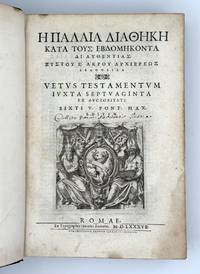
1587371783Rome: Franciscus Zanetti 1587. Text in Greek with short Latin notes at the end of each verse in two columns. Large engraved vignette on title with figures of Moses and Esdras on either side of the arms of Sixtus V. aâ´ A-3Sâ¶ 3Tâ¸. 8 783 1pp. Folio. Eighteenth century red morocco arms of the second Duke of Newcastle on the covers marbled endpapers gilt edges minor darkening to spine and wear to joints. Scattered minor dampstaining at lower outer corner of a few leaves. Provenance: Collegii Paris. Societas Jesu.early inscription on title; Douglass Maxwell Moffat booklabel with original invoice purchasing the volume from Davis & Orioli in 1940; General Theological Seminary bookplates. Text in Greek with short Latin notes at the end of each verse in two columns. Large engraved vignette on title with figures of Moses and Esdras on either side of the arms of Sixtus V. aâ´ A-3Sâ¶ 3Tâ¸. 8 783 1pp. Folio. Commissioned by Pope Sixtus V to assist the revisers who were preparing the Latin Vulgate edition ordered by the Council of Trent the "Sixtine" or "Roman" edition of the Septuagint was edited by Cardinal Antonio Carafa based on the Codex Vaticanus and became the standard for all the later editions of the Septuagint for three centuries after its publication. Darlow & Moule no. 4647; Adams B1246; BM STC Italian 1465-1600 p. 94 Franciscus Zanetti unknown
1653371930London: Roger Daniel 1653. Title in red and black. Engraved printer's device on the title state B. Text in two columns. 8 1279 1 pp. 4to 7-3/8 x 5-3/8 inches. Eighteenth century red morocco panelled in gilt spines gilt with black morocco lettering pieces marbled endpapers gilt edges. Provenance: Viscount Palmerston bookplate; General Theological Seminary bookplate. Title in red and black. Engraved printer's device on the title state B. Text in two columns. 8 1279 1 pp. 4to 7-3/8 x 5-3/8 inches. The rare first printing in England of the Septuagint the earliest translation of the Hebrew Old Testament into Greek the scarce printing in quarto format. The text is derived from the Sixtine text and edited by John Biddle 1615-1662 the Unitarian controversialist who was imprisoned by the Parliamentary Commissioners for his religious views. <br /> <br /> "Roger Daniel's version of the text of the Sixtine edition was prepared for the use of the scholars at Westminster School. This appeared in 1653 and was edited by the Socinian John Biddle. Its publication may have owed something to the interest in the Septuagint generated by Codex Alexandrinus and the frustration produced by the failure of Young's attempts to edit it" S. Mandelbrote "English Scholarship and the Greek Text of the Old Testament" p. 87.<br /> <br /> A rare issue from the same setting as the octavo edition imposed in quarto without rules separaring the columns. Wing 2nd ed. B2718A; ESTC R12599; Darlow & Moule 4692 Roger Daniel unknown
17867475Londini London: Excudebant A. Rivington & J. Marshall 1786. 12mo pp. 368 2 ads. Contemporary sheep spine divided by gilt rolls and rules red morocco label edges sprinkled red. A touch of spotting. Rubbed and a little marked some small sections of leather peeling. A scarce Greek New Testament recorded by ESTC in three North American institutions - Harvard Union Theological Seminary and Tennessee - and one private collection. ESTC N63834. Excudebant A. Rivington & J. Marshall hardcover
17997575Londini London: Apud G.G. & J. Robinson et al 1799. 12mo pp. 347 1. Half-title discarded. Contemporary sheep spine divided by gilt rules red morocco label edges sprinkled blue. Somewhat rubbed some areas of peeling and insect damage to rear board a little wear to extremities. Ownership inscriptions of Charles Kinloch to first few leaves dated 1802. A scarce London printing of the Greek New Testament: ESTC records just 5 copies. ESTC T176685. Apud G.G. & J. Robinson [et al] unknown
17517788Edinburgi Edinburgh: Apud Tho. & Wal. Ruddimannos 1751. 12mo pp. iv 402 frontispiece. Contemporary calf spine divided by raised bands between double gilt rules red morocco label. Somewhat rubbed joints starting some wear to extremities front flyleaf excised. Armorial bookplate of Sibbald to pastedown struck-through inscription of Charles Sibbald dated 1831 and of Donald Bruce to verso of frontispiece pencil notes to rear blanks. A pocket Greek New Testament printed by the Ruddimans. ESTC T94884; Darlow & Moule 4751. Apud Tho. & Wal. Ruddimannos hardcover
17632548Oxonii Oxford: E Typographeo Clarendoniano 1763. 8vo pp. iv 676. Near-contemporary tree calf spine elaborately gilt in compartments red morocco label marbled endpapers edges yellow. Some light toning and spotting. Expertly rebacked by Bernard Middleton with old backstrip laid down hinges relined. An attractive copy. In 1758 Baskerville proposed the casting of a new set of Greek types to the Oxford University Press and they ordered 2000 copies of this octavo New Testament plus 500 in quarto to be printed with the resulting type - which ended up being its only use. Negative critical reception may have contributed to its abandonment but Baskerville’s Greek face has recently been reassessed by Gerry Leonidas as an important predecessor of more modern types if perhaps not quite as elegant as that used by the Foulis press that had fallen afoul of an arbitrary typographic orthodoxy. Gaskell Add. 2; ESTC T94889; D&M 4756. E Typographeo Clarendoniano unknown
1642371830Paris: Ek basilikēs typographias Imprimerie Royale 1642. Engraved title by by Claude Mellan engraved head and tail pieces and initials. 2 453 3 pp. Extra-illustrated with a later English printed "Abbreviations and Connexions" leaf inserted after the title. Folio 15-1/2 x 10-5/8 inches. Late eighteenth or early nineteenth century red morocco gilt marbled endpapers gilt edges. Neatly rebacked. Cloth slipcase and chemise. Engraved title by by Claude Mellan engraved head and tail pieces and initials. 2 453 3 pp. Extra-illustrated with a later English printed "Abbreviations and Connexions" leaf inserted after the title. Folio 15-1/2 x 10-5/8 inches. Known as the Mazarin edition "since it appeared under the auspices of the great Cardinal" D&M it is the first edition of the Greek New Testament from the Imprimerie Royale founded just two years prior.<br /> <br /> Inserted before the engraved title page is a partly-printed certificate of the Collegium Mazarinaeum awarding this volume as a prize in Rhetoric to Philippus Matthaeus Guillot dated MDCC in manuscript i.e. 1700 and signed by the college's master P.-J. Le Chapelier Pierre-Jean le Chapelier de Mauron abbé de Ste Marie de Boquen in Brittany with the trace of a seal below. The College Mazarin or College des Quatre-Nations was established by bequest of Cardinal Mazarin 1602-1661 and opened its doors to students in 1688. Darlow & Moule 4687. Provenance: Philippus Matthaeus Guillot certificate his signature at foot of title engraving; Montagu Barton armorial bookplate; John Horatio Nelson gift inscription dated 1841; General Theological Seminary bookplate perforated stamp Ek basilikēs typographias [Imprimerie Royale] unknown