89 résultats
1774WRCLIT65781London: Printed by James Bettenham 1774. xx122pp. Quarto. Amateurish calf and boards. Subscriber's list pp.xvii-xx bound out of place in prelims moderate foxing early and late old tide-mark in lower quadrant at gutter throughout; just a sound copy. First edition thus. Edited by R. Lyon and revised by T. Rattray. The parallel texts in Greek are presented in four columns followed by translations of each in the same format. ESTC T21879. Printed by James Bettenham hardcover books
1739YRG-467Édition originale, petit in-12 (14cmx8cm), plein veau marbré, dos à cinq nerfs, titre et caissons richements ornés, dos restauré, toutes tranches marbrées, quelques rousseurs, manque de papier page 192 en marge intérieur, 304pp. Londres.
17534903DBErlangen, Leipzig, Gotthard Poetsch; Augsburg, Veithische Handlung, 1753, 1766, 1767. 8°. 19 cm. [15] Blatt, 240, [4] Blatt, 183, 190 Seiten. Halblederband der Zeit mit goldgeprägtem Rückentitel.
17672881Aurelianis, Typis Couret de Villeneuve, 1767. 1 vol. in-12 de V-231 pages, reliure moderne (fin XIXème). Demi-maroquin vert à coins, dos à nerfs, tranches dorées. Bel état.
17152883Londini, Ex Officina Jacobi Tonson & Johannis Watts, 1715. 1 vol. grand in-12 (110 x 185) de [30]-243 pages et [176 ff. ]. Plein veau marron, dos à nerfs richement orné, pièce de titre de maroquin havane, tranches rouges. Bel état.
1798A2696Paris, rue Saint-André-des-Arts, 1798 ; in-8, XX pp. + 378 pp. + 394 pp. + 388 pp., reliés plein-veau d’époque, dos lisse orné, pièces de titres rouges, toutes tranches dorées (état moyen surtout 3ème volume). Tibulle (Albius Tibullus) poète latin, né à Rome vers 44 avant J.-C., mort en 18 ou 19 avant J.-C., s'illustra avec ces Elégies. Il fut l'un des inventeurs de la poésie champêtre. Orné de 14 gravures. Bon état.
1771F94932Oxonii [Oxford], E typographeo Clarendoniano, impensis J. & J. Fletcher bibliopolarum 1771 xiv + 157 + 32pp. + [160]pp. of indices, engraved vignet on title page, 22cm., bilingual: Greek-Latin, 19th cy. leather binding intact but with some spots (traces of burning?) on boards, text clean with some occasional foxing, typographically interesting publication from the 18th cy. Greek school of Oxford university, [contains an introduction in Latin, the life of Plato (Vita Platonis) by Olympiodorus in Greek with Latin translation, Albini's introduction to Plato's dialogues in Greek with translation in Latin, and Plato's 3 dialogues: "Alcibiades primus sive natura humana", "Alcibiades secundus sive de precatione" & "Hipparchus sive lucri studiosus" - all in Greek-Latin // Variae mectiones // Index], uncommon, F94932
1779983821Lucian cianucian Greek Lucianos Latin Lucianus born AD 120 Samosata Commagene Syria now Samsat Tur.—died after 180 Athens Greece<br /><br />Danza Dialogo di Luiano con Annotazioni con annotazioni. <br /><br />In Firenze : nella stamperia di Gaspero Pecchioni 1779. Original edition. 8vo. Old wrappers iv 44 p. Some stains to titlepage. Very good copy. In this dialogue the Cynic Crato who has no in pantomimic dancing or those who go to see it is converted to its appreciation by his friend Lycinus.<br />This is a translation into Italian with notes of Lucian's famous dialogue on pantomime or "tragic dancing" in ancient Greece. In "tragic" dancing a dramatic plot is enacted by a masked and costumed dancer supported by an actor. The dancer's lines are spoken for him by someone else. There is also a chorus and for accompaniment the flute and the syrinx with various instruments of percussion. The work is dedicated to Antonio Muzarelli who was ballet master at the Burgtheater in Vienna at a time when ballet was detested by Emperor Joseph II although the art form was gaining some popularity due to the reforms of Jean-Georges Noverre 29 April 1727 – 19 October 1810 the a French dancer and balletmaster generally considered the creator of ballet d'action. The dialogue was probably written in Antioch in 162–165 a.d. when the Emperor Verus was there in compliment to him because of his interest in pantomime at a time when visual art was held inferior to literary art. This work underscores the legitimacy of dance because Lucian recognizes the intellectual character of dance. He emphasizes that a dancer must be able to express his or her ideas and sentiments through the intelligibility of movement and posture. Lucian's dialogue on dancing remains popular today due to its clever dialogue and clarity of argument. Rare: two OCLC locations one in North America: NYP Pecchioni books
173411158Lugduni Batavorum, apud Joannem van Abcoude, 1734. In-8 de [16]-871-17 pages, plein vélin blanc (plus tout à fait blanc), dos orné de fleurs de lys et roulettes dorées, plats ornés d'un légionnaire s'appuyant sur un boulier orné de la cigogne (armoiries de la Haye) ainsi que d'un hibou dorés, le tout surmontant la mention "Hagae Comitis", fleurs des lys dans les coins.
175931317ABNebst Pindars erster Ode. Zürich, Gessner, 1759. 8°. 115 S., (1) S. (Druckfehler). Mit gest. Titelvignette (Porträt) und eine gest. Schlussvignette. Späterer Pappband.
175931317ABZürich, Gessner, 1759. 8°. 115 S., (1) S. (Druckfehler). Mit gest. Titelvignette (Porträt) und eine gest. Schlussvignette. Späterer Pappband. + Wichtig: Für unsere Kunden in der EU erfolgt der Versand alle 14 Tage verzollt ab Deutschland / Postbank-Konto in Deutschland vorhanden +, 31317AB|31317AB_2 [2 Warenabbildungen] Nebst Pindars erster Ode.
1725AQ30436Trajecti ad Rhenum i.s. Utrecht: Apud Guilielmum vande Water et Jacobum van Poolsum 1725. In two volumes. 138 24 903 1; 2 928pp. Titles in red and black. Text printed in double columns. Contemporary gilt-tooled calf marbled edges. Extremities rubbed wear to head and foot of both spines Vol. I without lettering-piece lettering-piece of Vol. II chipped. Ink library stamps and recent bookplates of R. A. Levisson to both FFEPs scattered spotting. The Septuagint or the Koine Greek version of the Hebrew Bible is the earliest translation of the Hebrew Bible into Greek appearing between the first and third centuries before Christ in Alexandria. Embraced by the Catholic Church which includes many of the texts that Reformed churches ignore or consider Apocryphral the authorised Papal version of the Septuagint was first produced in Rome 1587 under the reign of Pope Sixtus V. A direct by-product of the Council of Trent the production of the Septuagint was the suggestion of Cardinal Pole who encouraged making available the Bible in Hebrew and Greek as well as the Latin vulgate in order to counter charges of the Reformers. This edition was compiled by German oriental philologist and reformed theologian David Mill 1692-1756 and was published simultaneously in Amsterdam. Darlow and Moule 4736. First Millius edition. 8vo. Apud Guilielmum vande Water et Jacobum van Poolsum unknown
1725L0823Amstelodami: Sumptibus Societatis David Millius. G : in Good condition without dust jacket. Covers rubbed. Loss to spine leather of volume 2. Occasional slight foxing. 1725. Seventh Edition. Brown hardback leather cover. 170mm x 100mm 7" x 4". 903pp; 928pp. Written in Greek. Bookplate of Montagu Burgoyne. Title page with small woodcut engraving. The second recognised edition from the Vatican in Rome. . Sumptibus Societatis [David Millius] hardcover
17091120591709 Franequerae, excudit Franciscus Halma, 1709, 2 tomes reliés en 1 fort volume in-4 de 200x245 mm environ, (22) ff. (faux-titre, frontispice, page de titre, Prolegomena, Subtexere heic potius), 1326 pages. Complet du frontispice de G. vander Gouwen et des 6 planches dépliantes. Plein velin d'époque au dos lisse muet, encadrement d'un double filet droit à froid, répliqué, sur les plats, petit fleuron central doré et quatre aux coins de l'encadrement intérieur, traces de lacets disparus. Manques en bordure des plats, plats tachés, une déchirure sur le dos, deux pages manuscrites au début de l'ouvrage, petite mouillure en bordure de quelques pages, quelques rousseurs, bon état pour le reste.
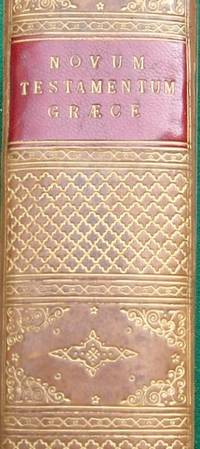
179312481BASKERVILLE'S GREEK TYPE <br />first edition thus in Baskerville type tall 8vo. in fours 676pp. printed on fine ie. thick paper attractive three-quarter sprinkled calf probably nineteenth century smooth spine very richly decorated in gilt in panels of contrasting and alternating design scarlet morocco label gilt marbled paper on sides and as endpapers half-title and last leaf a trifle dusty rear joint cracking else a fine fresh and bright copy. A particularly handsome copy. <br /><br />ESTC t94889 Darlow & Moule 4756<br />Only two books were printed in this type the octavo and quarto Testaments both in 1763. Edited by John Mill. 2000 copies printed. E Typographeo Clarendoniano hardcover
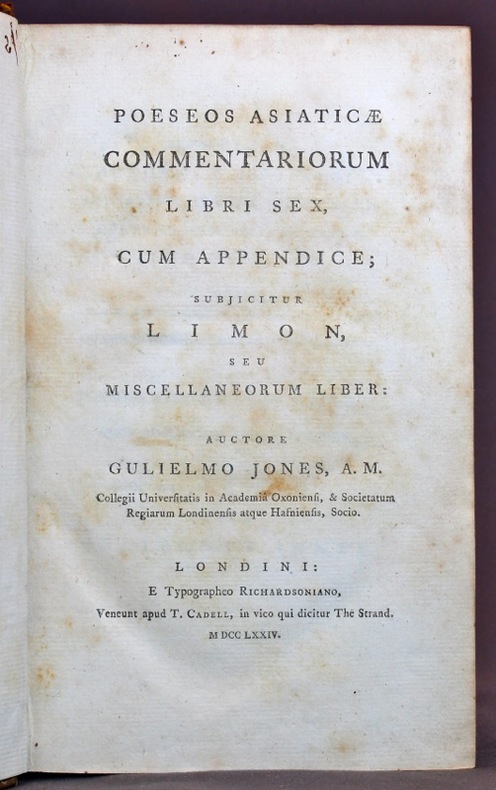
177415633Londini, E Typographeo Richardsoniano, veneunt Apud T. Cadell, 1774. In-8 de [2]-XXXI-[1]-542-[2] pages, plein veau beige, dos à nerfs joliment orné de filets et fleurons dorés, pièce de titre en maroquin rouge, roulette dorée sur les coupes.
17383893FBAmsterdam, verlegt von Janssonius van Waesberge, 1738. 2°. 42 x 28 cm. [10] Blatt, 865 Seiten. Pergamentband der Zeit auf 7 Bünden mit goldgeprägten Amsterdamer Wappen und Rollstempeldruck auf Rücken und Deckel. [5 Warenabbildungen]
1763DC8_2013e typographeo Clarendoniano sumptibus academiae Oxonii. Clarendon Press Oxford: . 1763 pp. 4 415 1. Small age and damp stains to the first and last 40 leaves or so. Wide margined. Large 4to. 300mm. All edges gold gilt. Early plain full vellum binding. Marbled endpapers. Hand lettered ownership of: J.M Hicks Winton September 1910. Sole quarto printing of the Greek New Testament using Baskerville type i.e. Greek type that Baskerville designed and cut himself. The text follows the 1707 edition by John Mill 1645-1707 with seven variations. This quarto edition was limited to 500 copies and is much scarcer than the 8vo edition issued around the same time. Gaskell - Add. 1; Darlow & Moule 4755. John Baskerville 1706-1775 was the greatest printer of his era. Born in Wolverley Hereford - Worcester England he became a writing master in Birmingham. He also carried on a successful japanning varnishing business there. In about 1750 he began to make experiments in letter founding and produced the wonderful series of types now named after him. His first book the Virgil of 1757 was also the first to be printed upon wove paper manufactured by a process that he invented. In 1758 he became printer to Cambridge University. There he designed other fonts including his remarkable Greek type. All of his books bear the marks of fine craftsmanship and a refined sense of design.PRICE JUST REDUCED! All other examples of this edition are priced on-line at over $1000.00! I held this in my own bible collection since 1995. It is a great bargain. SAFE ADD 1. Hardcover. Very Good. e typographeo Clarendoniano, sumptibus academiae, Oxonii. (Clarendon Press, Oxford): . hardcover
176334979Oxoni: E typographeo Clarendoniano 1763. 8vo in 4s 23.5 cm 9.25". 4 676 pp. <br><br>Sole octavo printing of the Greek New Testament using Baskerville type i.e. Greek type that Baskerville designed and cut himself; and indeed this pleasingly was printed from the only set of Baskerville type that survives to this day still at Oxford's Clarendon Press. The text was based on the Mill edition of the Greek N.T.; Darlow and Moule notes that while the text "generally reproduces that of Mill . . . Reuss notes seven variations." => An important example of 18th-century fine printing of the Bible.<br>Â Â Â Â This copy retains its half-title.<br>Â Â Â Â Provenance: The Howell Bible Collection Pacific School of Religion properly released. <br>Â Â Â Â <br>Â Â Â Â Gaskell enlarged ed. Add. 2; Darlow & Moule 4756. Contemporary acid-stained calf rebacked some time ago with morocco spine with gilt-stamped title and publication information; edges and extremities rubbed sides and spine with small scuffs. New endpapers with pencilled annotations; back pastedown with California bookseller's small ticket. No library markings. Title-page with tiny nick in upper edge. Pages very slightly age-toned with a very few scattered small spots otherwise crisp and clean. E typographeo Clarendoniano unknown books
1770370441 vol. in-8 reliure de l'époque demi-basane marron, Palaephatus De incredibilibus Graece. Iterum edidit recensuit indicemque verborum graecorum adiecit Ioh. Frid. Fischerus, Sumtu Ioh. Frid. Langenhemi, Lipsiae [ Leipzig ], 1770, viii-38 pp. et 29 ff. n. ch., texte grec, préface et index en latin / Meletemata e Disciplina Antiquitatis. Opera Friderici Creuzeri (3 Tomes - Complet) I : Anecdota graeca ex codicibus maxime Palatinis Depromta ; II : Commentationes et commentarii in Scriptores graecos ; III : Commentationes et commentarii in Scriptores graecos, In Bibliopolio Hahniano, 1817-1819, 118 pp. et 1 f. ; 1 f., 108 pp. ; iv-212 pp./ Symbolas ad emendandum et illustrandum Philostrati Librum De Vitis Sophistarum in Medium attulit Albertus Jahnius, Impensis C.A. Jenni Filii, Bernae [ Berne ], 1837, viii-146 pp. et 1 ff.
172334825Lipsiae: Sumptibus filii J. Friderici Gleditschii 1723. Folio cm ". 20 168 2 632 pp.; illus. <br><br>Based on John Mill's much-lauded 1707 edition of the Greek New Testament this is the second issue of Ludolph Küster's revised version originally published in 1710. A scholar from the Westphalia region of Germany Küster 16701716 specialized in paleography and Greek; this printing includes his preface and Prolegomena and extensive commentary in Latin below the main text. Using twelve new manuscripts in his research Küster significantly added to Mill's 16451707 collation.<br>Â Â Â Â The title-page printed in red and black features an => engraved vignette of the Virgin Mary enthroned above the Earth flanked by an eagle a lion a bull and an angel representing the Four Evangelists and there are => five additional large illustrative engraved vignettes functioning as headpieces in the text. Printed double-column and divided in the middle of each page by a paragraph of citations the text is dotted by a variety of woodcut floriated and historiated initials and factotum Greek capitals.<br>Â Â Â Â Provenance: Front pastedown with pencilled inscription "C.B.P.B. 1709" and with bookplate of Newton Theological Institution properly deaccessioned noting gift from library of Edward Cushing Mitchell D.D. class of 1853. <br>Â Â Â Â <br>Â Â Â Â Darlow & Moule 4735. Contemporary mottled sheep rebacked some time ago; scuffed and worn front joint starting from head and foot extremities rubbed and chipped. Front pastedown with inscription and bookplate as above; two text pages institutionally pressure-stamped. Offsetting to margins of first and last few leaves; waterstaining to inner portions of first 80 and a few final pages touching but not obscuring text on some pages and a small area of the first headpiece. One proud corner folded over several other corners bumped; scattered spots of light staining and ink smears not obscuring sense; occasional small edge nick. One early inked marginal annotation in English and Greek. Very readable and usable. Sumptibus filii J. Friderici Gleditschii unknown books
17632548Oxonii Oxford: E Typographeo Clarendoniano 1763. 8vo pp. iv 676. Near-contemporary tree calf spine elaborately gilt in compartments red morocco label marbled endpapers edges yellow. Some light toning and spotting. Expertly rebacked by Bernard Middleton with old backstrip laid down hinges relined. An attractive copy. In 1758 Baskerville proposed the casting of a new set of Greek types to the Oxford University Press and they ordered 2000 copies of this octavo New Testament plus 500 in quarto to be printed with the resulting type - which ended up being its only use. Negative critical reception may have contributed to its abandonment but Baskerville’s Greek face has recently been reassessed by Gerry Leonidas as an important predecessor of more modern types if perhaps not quite as elegant as that used by the Foulis press that had fallen afoul of an arbitrary typographic orthodoxy. Gaskell Add. 2; ESTC T94889; D&M 4756. E Typographeo Clarendoniano unknown
17257128Amsterdam, Sumptibus societatis, 1725. 2 volumes in-12 (99 x 158 mm), 69 ff. n. ch., 24 pp., 895 pp. chiffrées 903 ; 1 f. n. ch., 928 pp. Vélin, dos lisse avec titre à l'encre, tranches mouchetées et brunes, petites restaurations à l'angle de 3 ff. sans atteinte au texte (reliure de l'époque).
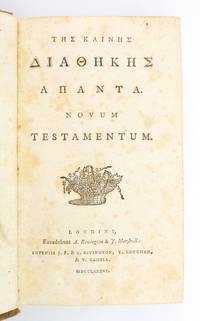
1786ST20133London: Excudebant A. Rivington & J. Marshall: Impensis J. F. & C. Rivington T. Longman & T. Cadell 1786. 175 x 105 mm. 7 x 4 1/4". 368 pp. 1 leaf ads. <br/> Contemporary brown "school cloth" rough linen raised bands. Front flyleaf with owner inscription of John Cutler dated Sept 21 1789 four lines of Latin doggerel threatening anyone who steals the book with hanging and two large copperplate trials of Cutler's signature. ESTC N63834. Not in Darlow & Moule. A little fraying at top and bottom of joints light foxing and toning throughout due to paper quality a couple of small ink stains but a surprisingly appealing copy the text extremely clean and the unsophisticated makeshift binding--remarkably--with no significant wear.<br/> <br/> This is an almost startling survival: an 18th century New Testament in Greek in its original utilitarian binding preserved in condition far better than what could be anticipated given the audience of generally uncareful pupils for which it was intended. Considering the usual depredations of school children the rough school cloth should have been worn to shreds long ago but against the odds it has fortuitously escaped hard use and now gives us a glimpse of an important element of the English schoolroom very close to its original condition. One particularly delightful aspect of our copy is the flamboyant declaration of ownership by a pupil called John Cutter who inked his name no fewer than four times in different styles and with calligraphic flourishes across the flyleaf. Cutter's neatly penned book curse threating any would-be thieves with hanging may have helped to preserve the book as it now exists. In fact there are few signs of use by any owner rightful or unlawful. The leaves are free from any markings and the insubstantial binding appears to have rarely left the shelf. Excudebant A. Rivington & J. Marshall: Impensis J. F. & C. Rivington, T. Longman, & T. Cadell unknown
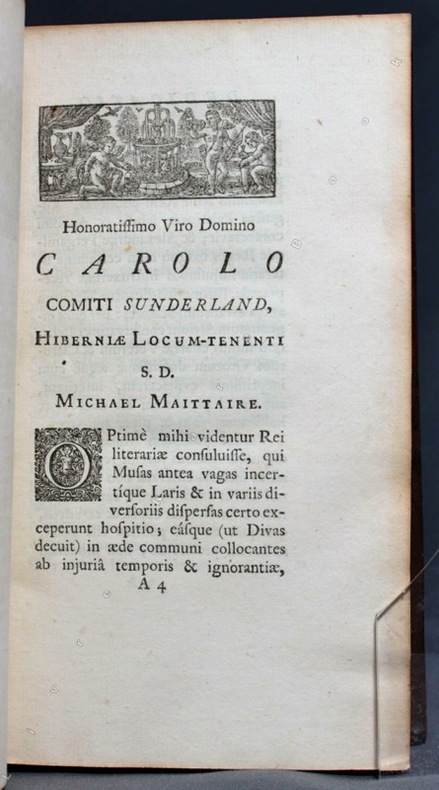
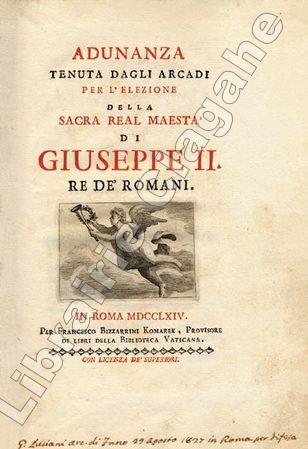
17644373Roma, 1764, per Francesco Bizzarini Komarek, Provisore di libri della Bibliotheca Vaticana ; grand in-8, plein vélin ivoire, titre manuscrit (reliure de l'époque) ; VIII, 120 pp., vignette de titre, lettrine et cul-de-lampe gravés, ouvrage entièrement imprimé en rouge et noir.