Magness JodiMareMagnum
Londres AlbertMareMagnum
L'ebreo Errante è Arrivato
8vo, br. ed. 22 cm. 216 pagine

Pali s.r.l. · Roma, IT10,00 €
445 résultats
8vo, cloth in dj, pp.265. Two thousand years ago, 967 Jewish men, women, and children?the last holdouts of the revolt against Rome following the fall of Jerusalem and the destruction of the Second Temple?reportedly took their own lives rather than surrender to the Roman army. This dramatic event, which took place on top of Masada, a barren and windswept mountain overlooking the Dead Sea, spawned a powerful story of Jewish resistance that came to symbolize the embattled modern State of Israel. The first extensive archaeological excavations of Masada began in the 1960s, and today the site draws visitors from around the world. And yet, because the mass suicide was recorded by only one ancient author?the Jewish historian Josephus?some scholars question if the event ever took place. Jodi Magness, an archaeologist who has excavated at Masada, explains what happened there, how we know it, and how recent developments might change understandings of the story. Incorporating the latest findings, she integrates literary and historical sources to show what life was like for Jews under Roman rule during an era that witnessed the reign of Herod and Jesus?s ministry and death. Featuring numerous illustrations, this is an engaging exploration of an ancient story that continues to grip the imagination today.
Very Good French Paperback. Samll 4to. (27 x 18 cm). In French. 16 p. La littérature Samaritaine (Supplement -Encyclopedie de l'Islam- a l'art Samaritains, Tome IV, Livrasion C). Samaritan literature. Gaster was a Romanian, later British scholar, the Hakham of the Spanish and Portuguese Jewish congregation, London, and a Hebrew and Romanian linguist. Moses Gaster was an active Zionist in Romania as well as in England, where in 1899 he helped establish the English Zionist Federation. He was the father of Jack and Theodor Gaster and the grandfather of Marghanita Laski. He was also son-in-law to Michael Friedländer and father-in-law to Neville Laski.
34248Turnhout , Brepols, 1997 Paperback, 358 p., 210 x 270 mm. ISBN 9782503506395.
34249Turnhout , Brepols, 1997 Paperback, 304 p., 255 betaradiographies, 210 x 270 mm. ISBN 9782503506401.
1909gm206Hinrichs J. C. Biblia Hebraica Broché 1909 In-8 -14.5x22.5 cm), broché, 1161 à 1221 pages, de droite à gauche, Biblia hebraica n°14 : Libri Danielis esrae et Nehemiae, ouvrage en hébreu ; coiffes et dos frottés, rares annotations, assez bon état. Livraison a domicile (La Poste) ou en Mondial Relay sur simple demande.
053278Lyon imprimerie de Ballanche 1812 in 8 (21,5x14) 2 volumes, couvertures d'attente de papier marbré de l'époque, XVI et 344 pages, 400 pages, non rognés, des petites rousseurs éparses. Bel exemplaire, tel que paru ( Photographies sur demande / We can send pictures of this book on simple request )
8vo, br. ed. 22 cm. 216 pagine
8vo, hardcover in dj. This book proposes that the idea of the Jews in European cultures has little to do with actual Jews, but rather is derived from the conception of Jews as Christianity's paradigmatic Other, eternally reenacting their morally ambiguous New Testament role as the Christ-bearing and -killing chosen people of God. Through new readings of canonical Russian literary texts by Gogol, Turgenev, Chekhov, Babel, and others, the author argues that these European writers?Christian, secular, and Jewish?based their representation of Jews on the Christian exegetical tradition of anti-Judaism. Indeed, Livak disputes the classification of some Jewish writers as belonging to "Jewish literature," arguing that such an approach obscures these writers' debt to European literary traditions and their ambivalence about their Jewishness. This work seeks to move the study of Russian literature, and Russian-Jewish literature in particular, down a new path. It will stir up controversy around Christian-Jewish cultural interaction; the representation of otherness in European arts and folklore; modern Jewish experience; and Russian literature and culture. About the Author: Leonid Livak is Associate Professor at the University of Toronto, where he teaches at the Department of Slavic Languages and Literatures and in the Centre for Jewish Studies. He is the author of How It Was Done in Paris: Russian Émigré Literature and French Modernism (2003).
8vo, 390pp. The straggly beard, the hooked nose, the bag of coins, and gaudy apparel - the religious artists of medieval Christendom had no shortage of virulent symbols for identifying Jews. Yet, hateful as these depictions were, the story they tell is not as simple as it first appears. Drawing on a wide range of primary sources, Lipton argues that these visual stereotypes were neither an inevitable outgrowth of Christian theology nor a simple reflection of medieval prejudices. Instead, she maps out the complex relationship between medieval Christians' religious ideas, social experience, and developing artistic practices that drove their depiction of Jews from benign, if exoticized, figures connoting ancient wisdom to increasingly vicious portrayals inspired by (and designed to provoke) fear and hostility. At the heart of this lushly illustrated and meticulously researched work are questions that have occupied scholars for ages-why did Jews becomes such powerful and poisonous symbols in medieval art? Why were Jews associated with certain objects, symbols, actions, and deficiencies? And what were the effects of such portrayals-not only in medieval society, but throughout Western history? What we find is that the image of the Jew in medieval art was not a portrait of actual neighbours or even imagined others, but a cloudy glass into which Christendom gazed to find a distorted, phantasmagoric rendering of itself.
8vo. br. ed bandelle sopraccop.fig. cm.14x22, pp.206, Con una postilla sul Midrash di David Del Vecchio,
8vo, ril. ed. sovracoperta, pp. 670. (Supercoralli). Figlio unico di un commerciante ebreo, Kurt Gerron ha avuto una vita sensazionale: prima studente di medicina, poi attore e regista di fama, tra i più celebri protagonisti del cinema degli anni Venti. Ma la sua carriera è destinata a infrangersi sotto la scure delle leggi razziali: sospeso da ogni incarico, nel 1944 è deportato a Theresienstadt, il ghetto "modello" dietro cui i nazisti celarono a lungo la verità su campi di concentramento. Non solo la sua carriera, ma l'intera esistenza di Gerron sembra giunta alla fine. Finché non riceve un'inaspettata proposta: dirigere un film di propaganda che racconti all'Europa la vita di quella "città". Rifiutare significa morire, accettare vuol dire rendersi complice dei propri aguzzini. E lui accetta, sperando in una possibilità di salvezza. Gli undici giorni di riprese saranno l'occasione per ripercorrere il passato: la guerra, il matrimonio, e soprattutto la carriera, gli incontri - Brecht, Marlene Dietrich, Max Reinhardt -, i film. Fino al drammatico epilogo, assurdo eppure inevitabile: appena terminate le riprese Gerron sarà trasferito ad Auschwitz e ucciso.
8vo, hardcover in dj, former owner's. signature, ow. very good. A history of Jews in sports shows how sports have aided Jewish immigrants in their struggle to enter the American mainstream, with anecdotes about Sandy Koufax, Mark Spitz, and many others. By the author of American Sport: A Documentary History.
8vo, br. ed. 264pp. Roma nel periodo delle leggi razziali. Come è possibile che Giulio Limentani, commediografo di successo, si trovi a seguire un proprio lavoro di scena in un teatro, nascosto in incognito in un angolo del loggione? E come riusciranno a vivere il loro amore i due quindicenni Colomba e Ferruccio, lei ebrea e lui figlio di un gerarca fascista? Infine un tragico dilemma: la classe dirigente ebraica di quegli anni è forse colpevole di aver sottovalutato il pericolo? E se è un figlio ad accusare di questa inadeguatezza il proprio padre?... Tre vicende diverse se pur collegate in cui Storia e Destino intrecciano il loro enigmatico gioco.
8vo, 628 pp. plates, hardcover, very good in a good dust jacket.
8vo, br. ed. 252pp. Quella del 1939 è un’estate felice per Esther Gutman. I primi amori, la scuola, il pattinaggio… La sua si direbbe un’ordinaria adolescenza a Lódz, la seconda città della Polonia, dove vive con i genitori e la sorella. Ma nel settembre dello stesso anno tutto cambia: con l’invasione nazista le condizioni per gli ebrei diventano sempre più dure. Così il padre, resosi conto che rimanere in città è diventato troppo rischioso, decide di raggiungere il fratello nel suo paese d’origine, Chmielnik. Qui, Esther conosce Ezjel Lederman, un giovane studente sionista dal carattere deciso e integerrimo. Tra loro nasce un’amicizia fatta di passeggiate nel ghetto e di lunghe chiacchierate alla ricerca di una normalità perduta, finché nell’ottobre del 1942 la situazione precipita. Il padre di Esther viene deportato in un campo di lavoro e anche Ezjel deve lasciarla: sta partendo insieme al fratello e ai genitori per rifugiarsi a casa degli Zal, una famiglia di cattolici polacchi. Un’informazione che le salverà la vita. Poco dopo, infatti, Esther decide di cercare aiuto proprio da loro, mentre la madre e la sorella vengono catturate dai nazisti. Non le rivedrà più. A oltre sessant’anni di distanza e dopo un matrimonio felice, Esther sente la necessità di rivivere in questo intenso memoir, arricchito dalle riflessioni del marito Ezjel, i ventidue mesi trascorsi nascosta nella fattoria degli Zal, fino alla liberazione da parte dell’Armata Rossa. E racconta poi di come insieme ai Lederman abbia trovato rifugio proprio in Germania per riuscire, infine, ad approdare avventurosamente negli Stati Uniti. Una storia di fuga e salvezza, narrata con lo sguardo limpido e pieno di speranza di una donna forte, capace di vedere la solidarietà e il coraggio anche in un tempo che non smette di atterrire per la sua tragicità.
1998Rel-ju-histoiredeshébreux-lebeau-1-1In-8,broché, 291 pages, intérieur frais, légèrement jauni sur les tranches. Bon état général. Taillandier. Paris.
Placchetta, in -8°, 16 pp. più tre tavole riproducenti caratteri tipografici ebraici e musicali.
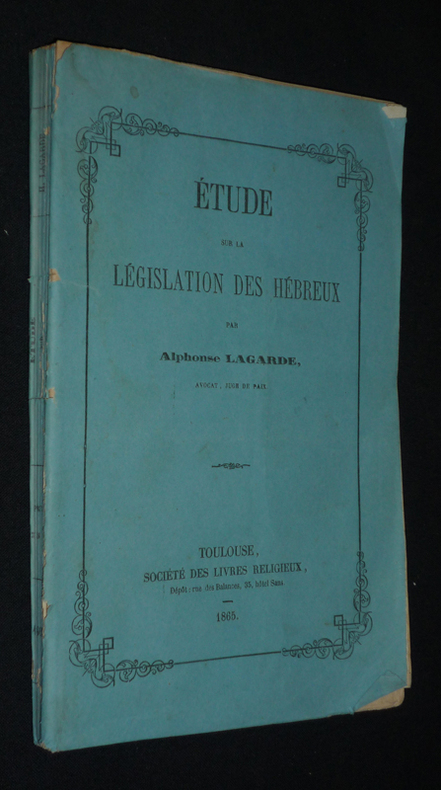
1865vd695Toulouse, Société des livres religieux Broché 1865 In-12 (11,7 x 18,5 cm), broché, 168 pages ; dos fendu, coins cornés, manque dans le coin inférieur du quatrième plat, en l'état. Livraison a domicile (La Poste) ou en Mondial Relay sur simple demande.
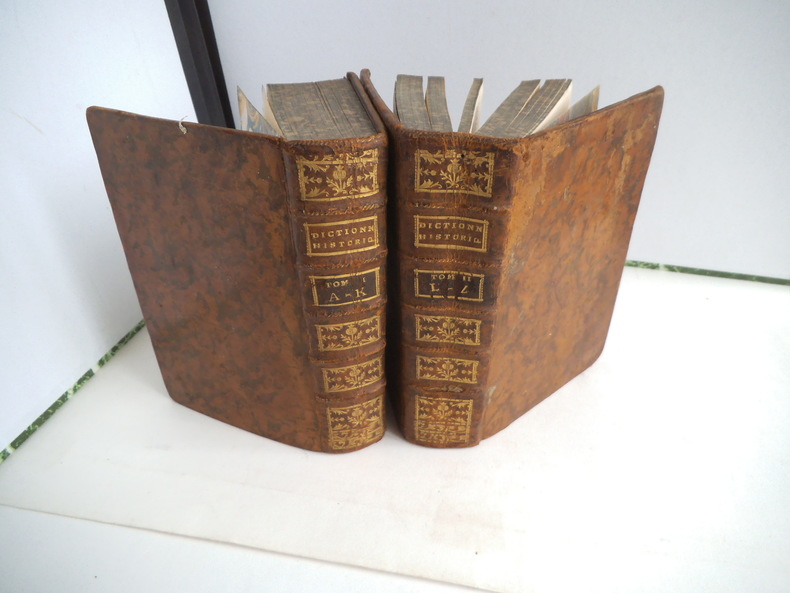
9650Contenant l’histoire des patriarches des princes hébreux, des empereurs, des rois et des grands capitaines, des dieux, des héros de l’antiquité payenne, des Pape, des saints pères, des évêques, et des cardinaux célèbres…des historiens ,orateurs, jurisconsultes, médecins des femmes savantes, des poètes, des peintres, des sculpteurs…et généralement de toutes les personnes illustres ou fameuses, de tous les siècles et de toutes les nations du Monde…Ouvrage utile pour l’intelligence de l’histoire ancienne et moderne et pour la connaissance des écrits et des actions des grands hommes illustres. Nouvelle édition corrigée et augmentée. Complet en deux volumes .2 tomes en 2 volumes in 12 plein cuir fauve raciné à nerfs, pièce de titre chagrin rouge, tomaison, filets roulette dorés. Tome 1 lettre A-K titre, XLVIII, IX table des hommes illustres, 835 pages. Texte sur 2 colonnes Tome 2: titre, 1 feuillet d’errata, 1003 pages, 1 page d’approbation, tranches rouges, chez la Veuve Didot 1760. Très bon état
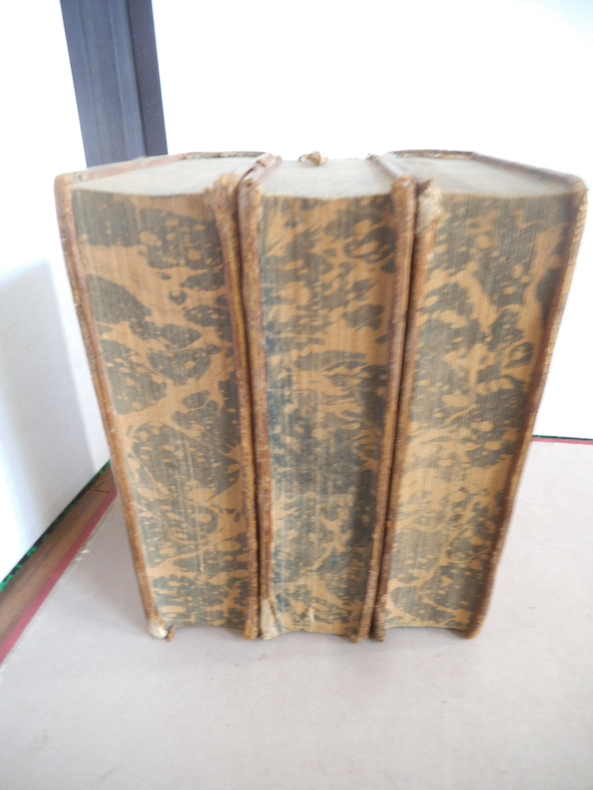
14516Dictionnaire Historique et bibliographique portatif Contenant l’histoire des patriarches des princes hébreux, des empereurs, des rois et des grands capitaines, des dieux, des héros de l’antiquité payenne, des Pape, des saints pères, des évêques, et des cardinaux célèbres…des historiens ,orateurs, jurisconsultes, médecins des femmes savantes, des poètes, des peintres, des sculpteurs…et généralement de toutes les personnes illustres ou fameuses, de tous les siècles et de toutes les nations du Monde…Ouvrage utile pour l’intelligence de l’histoire ancienne et moderne et pour la connaissance des écrits et des actions des grands hommes illustres. Trois tomes en trois volumes in 8 plein cuir fauve raciné à nerfs, titre, caissons, palmettes dorés. Filet doré sur coupes. Tranches marbrées 120x175mm. A paris du fonds de la Veuve DIDOT chez LE CLERC libraire 1777. Tome I : lettre A à -F -XII 700pages plus additions et corrections VI, plus correction et augmentation promises pour Janvier 1778. X. Tome II : lettres G à N- faux titre, titre, 1 feuillet d’approbation, 434 pages, corrections et augmentations survenues pendant l’impression III, additions et corrections autour de 1778 V Paris 1772 coins inférieurs émoussés. Tome III : Lettres Q à Z - 840 pages, additions et corrections du tome III 1779. XII. Table des articles du tome III Supplément au dictionnaire historique de LADVOCAT 8 pages. 1777. Texte sur 2 colonnes. Bon ensemble.
8vo grande, ril. ed. tela in sovracoperta, pp. 636, 11 cartine nel testo.
Paris: Presses Universitaires De France, 2002. Broche / Illustrated Softcover. Etat Neuf / As New/Edite Sans jaquette/No Jacket. 12mo Texte en francais. Text in french.
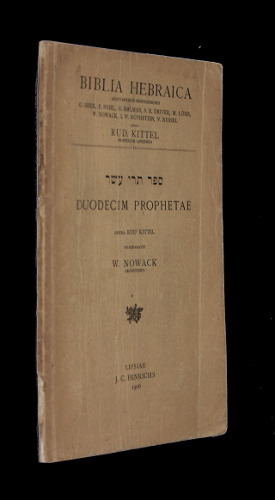
1906gm482Hinrichs J. C. Biblia Hebraica Broché 1906 In-8 -14.5x22.5 cm), broché, 831 à 907 pages, de droite à gauche, Biblia hebraica n°10 : Duodecim prophetae ; coiffes et dos frottés, manque de 3 cm au dos, assez bon état. Livraison a domicile (La Poste) ou en Mondial Relay sur simple demande.
Traduzione di Mantovani V. 8vo; br., pp. 164, cm 14,5x22. (I Narratori). Etgar Keret racconta sette anni della sua vita a Tel Aviv: la nascita del figlio, la storia della sorella ultraortodossa e dei suoi undici figli, i tassisti irascibili, i genitori superstiti dell'Olocausto, le movimentate tournée letterarie. e l'atteggiamento non banale da assumere quando suona la sirena dell'allarme antiaereo. Etgar Keret ci offre in queste cronache intime una sorprendente radiografia dei suoi contemporanei, un condensato di vita, humour ed emozione