MATTIOLI Pietro AndreaMareMagnum

26 128 résultats
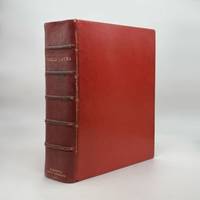
In-folio, two volumes. Later vellum over pasteboards with handwritten title on spine, slightly stained. Leaves [70], pp.583; pp. 772, ll.[6]. Roman, italic and Greek character. With a full-page woodcut portrait of Mattioli, 3 printer's devices and over 900 three-quarter-page figures (cm. 22x16) engraved in wood in the text, depicting plants, herbs, animals, insects and distillation procedures, of which two are colored by contemporary hand. Edit16 CNCE 35759 - Nissen BBI 1395 - Pritzel 5985 - Adams D 675 - Hunt 145.
1482372091Nuremberg: Anton Koberger 1482. Eighth edition of the Bible printed by Koberger his first was 1475. Date from the colophon at end of text on fol. 427. Text in black letter two columns 53 lines. Red initials rubricated throughout. Foliation irregular. Bound without first and last blanks. 460 of 462 leaves. 1 vols. Folio. Twentieth century orange morocco by Zaehnsdorf preserving earlier gauffered and gilt edges. Spine darkened from smoke minor rubbing. First leaf remargined at foot; some traces of damp and stains from old marginal tabs internally clean overall closed tear in fol. 388. Very good plus. Eighth edition of the Bible printed by Koberger his first was 1475. Date from the colophon at end of text on fol. 427. Text in black letter two columns 53 lines. Red initials rubricated throughout. Foliation irregular. Bound without first and last blanks. 460 of 462 leaves. 1 vols. Folio. ISTC ib00575000; GW 4250; Goff B575. Provenance: George Livermore Harvard bookplate recording 1859 deposit with ink release dated 1894; General Theological Seminary gift of Cornelius Vanderbilt and Dean Augustus Hoffman bookplates and blindstamps Anton Koberger unknown
185458Paris, 1619 fort vol. in-folio, [6] ff. n. ch. (titre, dédicace au clergé de Rouen, préface, titre de relais), 1104 pp., [8] ff. n. ch. d'index et de colophon, maroquin vieux rouge, dos à nerfs cloisonné et fleuronné, encadrement de triple filet doré sur les plats, armes au centre, double filet doré sur les coupes, tranches dorées sur marbrure, dentelle intérieure (rel. du XVIIIe s.). Petits frottements sur les nerfs.
1527318283Coloniae: Petrus Quentel excudebat 1527. First Protestant Bible printed in Latin. Title-page with large woodcut vignette of arms of Cologne lion and gryphon rampant with and three crowns; numerous illustrations by Anton Woensam and ornamental initials throughout. Ff. 8 CCCXXV 1 LXXXVII i.e. 85 5. 1 vols. Folio. Recent half calf and marbled boards. Title page soiled old remargining tissue repairs on verso; some marginal worming and soiling generally clean with generous margins. Stamps of Cambridge Public Library in ink or in blind on four leaves. First Protestant Bible printed in Latin. Title-page with large woodcut vignette of arms of Cologne lion and gryphon rampant with and three crowns; numerous illustrations by Anton Woensam and ornamental initials throughout. Ff. 8 CCCXXV 1 LXXXVII i.e. 85 5. 1 vols. Folio. The first Protestant Bible in Latin edited by Johan Rüdel Rudelius printed in Cologne by Peter Quentel or Quentell and notable for the wood engraved illustrations by Anton Woensam Anton von Worms particularly those at the head of each of the four gospels. Matthew faces an angle who is touching his stylus; a lion is seated beside Mark; a bull with Luke; and an eagle stands beside John.<br /> <br /> Quentel was the printer of Tyndale's quarto Cologne English New Testament known from a single surviving fragment in the Grenville Collection where this same illustration to Matthew appears. It is a reasonable inference that each of the four gospels would have carried an illustration. The project which had "'got as far as the letter K' the signature that would have taken the work well into Mark" ODNB was unfinished at the time of Tyndale's flight from Cologne in 1525. Quentel's print shop was raided but sheets of the first gospel translated from the original Greek and printed in English soon began to circulate in England. Tyndale settled in Worms where Schöffer completed an octavo printing of the first complete English New Testament in 1526 a facsimile of the Grenville fragment and its illustration were published in 1871.<br /> <br /> The blocks for the illustrations evidently survived the raid on the Quentel's shop and are used here at the head of each of the four gospels.<br /> <br /> A notable edition in the history of the printing of the Bible. Adams 1007; not in Darlow & Moule but see note to 6107; VD16 B2589.OCLC: 22847218 Petrus Quentel excudebat unknown
1527318283Coloniae: Petrus Quentel excudebat 1527. First Protestant Bible printed in Latin. Title-page with large woodcut vignette of arms of Cologne lion and gryphon rampant with and three crowns; numerous illustrations by Anton Woensam and ornamental initials throughout. Ff. 8 CCCXXV 1 LXXXVII i.e. 85 5. 1 vols. Folio. Recent half calf and marbled boards. Title page soiled old remargining tissue repairs on verso; some marginal worming and soiling generally clean with generous margins. Stamps of Cambridge Public Library in ink or in blind on four leaves. First Protestant Bible printed in Latin. Title-page with large woodcut vignette of arms of Cologne lion and gryphon rampant with and three crowns; numerous illustrations by Anton Woensam and ornamental initials throughout. Ff. 8 CCCXXV 1 LXXXVII i.e. 85 5. 1 vols. Folio. Cologne 1527 : Quentel's Protestant Bible in Latin. The first Protestant Bible in Latin edited by Johan Rüdel Rudelius printed in Cologne by Peter Quentel or Quentell and notable for the wood engraved illustrations by Anton Woensam Anton von Worms particularly those at the head of each of the four gospels. Matthew faces an angle who is touching his stylus; a lion is seated beside Mark; a bull with Luke; and an eagle stands beside John.<br/><br/>Quentel was the printer of Tyndale's quarto Cologne English New Testament known from a single surviving fragment in the Grenville Collection where this same illustration to Matthew appears. It is a reasonable inference that each of the four gospels would have carried an illustration. The project which had "'got as far as the letter K' the signature that would have taken the work well into Mark" ODNB was unfinished at the time of Tyndale's flight from Cologne in 1525. Quentel's print shop was raided but sheets of the first gospel translated from the original Greek and printed in English soon began to circulate in England. Tyndale settled in Worms where Schöffer completed an octavo printing of the first complete English New Testament in 1526 a facsimile of the Grenville fragment and its illustration were published in 1871.<br/><br/>The blocks for the illustrations evidently survived the raid on the Quentel's shop and are used here at the head of each of the four gospels.<br/><br/>A notable edition in the history of the printing of the Bible. Adams 1007; not in Darlow & Moule but see note to 6107; VD16 B2589.OCLC: 22847218 Petrus Quentel excudebat unknown books
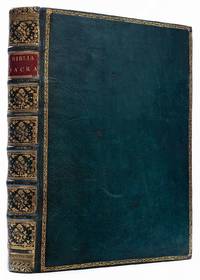
59948Lugdunum Lyon: Jean Mareschal 1532. Large folio 43.5 x 23 cm. ff.827624. Full eighteenth-century bluish green French morocco sides ruled with gilt foliate border spine with raised bands and lavishly gilt in compartments each with central fleuron device red morocco label lettered in gilt the edges of boards decorated with gilt roll marbled endpapers all edges gilt. Title-page printed in red and black along with the tables of canons. Latin text printed in double and triple column within printed border. Title-page with elaborate woodcut borders and vignette of St. Jerome in his study full-page woodcut illustration of God creating the earth at the head of the Old Testament captioned 'Opus sex dierum' three-quarter woodcut depicting the Nativity scene at the head of the New Testament half-page woodcut of King Solomon at the head of proverbs 112 woodcut vignettes and numerous additional woodcut initials in the text. Engraved bookplate of "L'Olivette" with "G.O." monogram to front pastedown the bookplate engraved by Silvain Guillot a Parisian armorial engraver to front pastedown along with a small library shelf mark. Title-page bears the old ownership inscription of the Jesuit College in Antwerp; in the same hand are an additional 5 instances of marginal annotations on ff. 2r 57v 141v 156v and 175v. Minor shelfwear internally generally very good but with some light occasional damp-staining four small marginal holes on E7 not affecting the text and some repairs to edges of the last few leaves overall a well-illustrated edition of the Vulgate in a superb French binding. Mareschal's Bible was the first to include the Third Book of Maccabees an addition which resulted in his later condemnation by the Council of Trent which declared the book to be apocryphal forcing him to flee to Switzerland and subsequently to take up permanent residence in Heidelberg. The woodcut of the Nativity scene is a close copy of Hans Springinklee's woodcut which first appeared in a 1517 prayer book before being used for the 1520 Lyon edition of the Bible Mortimer Harvard French 63 as well as Luther's 1524 German Translation of the Old Testament with a different artist's monogram. The smaller woodcuts are more simplistic copies of those found in other Lyon bibles from this time produced by Mareschal Crespin and Sacon such as Mortimer Harvard French 66 Crespin's 1529 Bible. USTC locates 15 copies all in Europe save for 2 copies in the UK. Adams 1012. Lugdunum [Lyon]: Jean Mareschal, 1532. hardcover
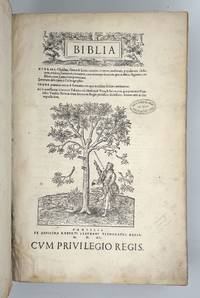
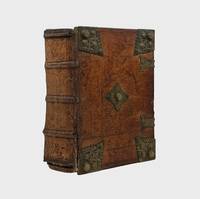
1540372229Paris: Ex officina Roberti Stephani typographi Regii 1540. Third edition and the first with these illustrations. Printer's device on title pages woodcut illustrations in text including 5 full-page ornamental initials. 10 268; 1 104 i.e. 103 error in pagination omitting leaf 83; 90; 92 ff. Collation: 10 a-z⸠A-I⸠K-LⶠAa10 Bb-Mm⸠NnⶠAA-KK⸠LL10 2a-2l⸠2mâ´. Early manuscript annotations. 1 vols. Folio 17x11-1/4 inches. Contemporary blindstamped pigskin over bevelled wooden boards title stamped on the upper cover lacks bosses hinges and clasps upper joint cracked darkening to spine other wear. Early vellum manuscript waste at inner hinges. Minor staining minor foxing a few scattered edge tears. Provenance: Christopher Jonas a Taubenheim early inscription mentioning commentary by Rabbi Moses ben Nahman Gerondi; Polling Monastery armorial bookplate; Duplum Bibliothecae Regiae Monacensis; General Theological Seminary stamps bookplate. Third edition and the first with these illustrations. Printer's device on title pages woodcut illustrations in text including 5 full-page ornamental initials. 10 268; 1 104 i.e. 103 error in pagination omitting leaf 83; 90; 92 ff. Collation: 10 a-z⸠A-I⸠K-LⶠAa10 Bb-Mm⸠NnⶠAA-KK⸠LL10 2a-2l⸠2mâ´. Early manuscript annotations. 1 vols. Folio 17x11-1/4 inches. The third and finest folio edition of Latin Vulgate Bible prepared by scholar/printer Robert Estienne 1503-59. Though the edition was entered into the Vatican's Index of Prohibited Books and is correspondingly scarce ultimately this text served as the foundation of the official Roman Vulgate. The illustrations of Noah's ark the Tabernacle of Moses and Temple of Solomon were widely copied.<br /> <br /> The general title page and the Prophetae are dated 1540; that of the New Testament is dated 1539; and that for the Hebraea Chaldaea Graeca & Latina Nomina . cum Interpretationis and Index is dated 1538. "The text was revised from additional MS sources; a list given at the end of the preface enumerates at least 16 MSS and 3 printed editions. This edition contains the first printing of the Prayer of Manasses in Greek and Latin. It is the text of this monumental edition which became the foundation of the official Roman vulgate ." Schreiber. The text of the Oratio Manassae is printed here for the first time leaf v8v.<br /> <br /> This is a tall and generally well preserved copy with good margins. Darlow & Moule 6117; Renouard pp. 48-9 no. 1; Copinger 275; Schreiber Estiennes 359; Adams B1022; Mortimer French 16th cent. 68 Ex officina Roberti Stephani typographi Regii unknown
5761In folio, relié d'ép. pl. peau, rel à 5 nerfs, deux pièces de titre, un filet d'encadrement sur les plats, fleuron central repoussé sur chaque plat, coiffes bonnes, mors solides. Ouvrage peu manié, bien conservé, intérieur trés frais. 32 pp ; Impression du dictionnaire sur 2 col. (1 à 1624) ; Notes de David Hoeschel : 2 col. : 1 à 104 ; Index Rerum... 23 pp ; 2 p
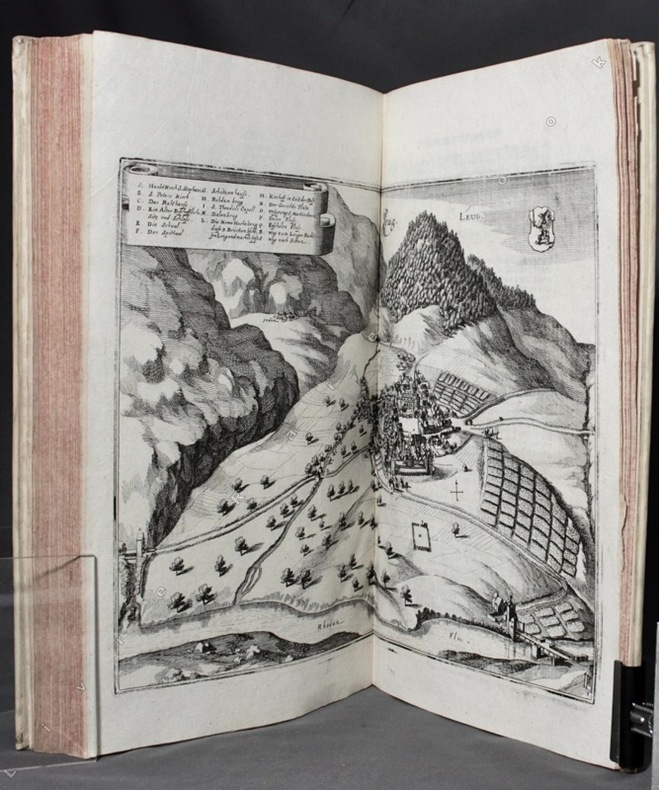
16548502Franckfurt am Mann, Merian, 1654. Grand in-4 de 90-[10] pages (A-L8; M6), plein vélin blanc, reliure du XVIIIe siècle de réemploi, exemplaire lavé, toutes les planches ont été proprement remontées sur onglet, sans un faux pli. Ex-libris gravé du XVIIIe siècle de Georg August Graf zu Erbach.
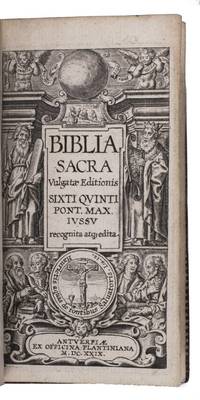
16291052Antwerp: Officina Plantiniana = Balthasar I Moretus grandson of Christophe Plantin 1629. Uniform gold-tooled goatskin morocco ca. 1700 sewn on 4 supports richly gold-tooled spines gold-tooled turn-ins and board edges the boards in a panel design each board with a double frame of triple fillets the inner 2 fillets in each frame closer together than the outer with an ornament stamped on the intersections of the fillets at the corners of both frames and a flower in each corner between the frames with its head toward the corner; the spine with the title - BIBLIASACRA or NOVVMTESTA - and volume - TOM. I. etc. - in the 2nd of 5 compartments INDEX in the 3rd compartment of volume VII and the other compartments filled with curls and dots: a style sometimes called grotesque gold-tooled turn-ins marbled pastedowns blue red white and yellow extensively swirled headbands in green and white gilt edges. Seven volumes with the ca. 1711 engraved armorial bookplate of Jean Le Normand 1662-1733 Bishop of Evreau and probably bound for him his bookplate probably removed from volumes II and III as bound. 24mo in 8s 11.5 x 7 cm. With a richly engraved general title page 6 volume title pages each with the same Plantin-Moretus woodcut compasses device a smaller woodcut compasses device plus 3 of 4 repeats 2 appear on the back of the colophon; each of the others on an otherwise blank leaf woodcut tailpieces woodcut decorated initials. Set in roman and italic types. The present copy with 3 extra letterpress divisional title pages perhaps specially printed for this copy when it was bound. 7 volumes bound as 9 Old Testament I-VII & New Testament I-II. A small Latin Vulgate bible printed by the Plantin-Moretus office in Antwerp the smallest-format edition of the Sixtine-Clementine authorized Catholic text. The first volume of the Old Testament has only the engraved general title-page while each of the remaining Old Textament volumes as printed has a separate volume title-page naming the books it covers including the volume with the apocrypha miscellaneos texts and the indexes. After the general title-page follow a preface to the reader the decree of the Council of Trent "Paulus Papa V. Ad futuram rei memoriam" Pope Paul V died in 1621 and a privilege dated Brussels 1611. The Old Testament also has prefaces to the books. The New Testament has no preliminaries except its title-page. In 1546 the Council of Trent ordered a revision of the Vulgate Latin Bible to establish an authorized Catholic text. Pope Sixtus V ordered the preparation of the new edition printed by the Vatican Press and published in 1590. The book has been variously described as 12mo 16mo and 24mo but it is in fact a 24mo in 8s. The three divisional titles possibly printed specially for this copy have vertical chainlines and may be in 18mo format. The binding stamps are finely cut and skilfully applied especially the curls on the spine so it is likely to have been executed by one of the great French binders of ca. 1700.With an owner's inscription on a free endleaf in volume IV as bound "ce livre apartient a monseigneur L'Evesque D'Evreux" presumably Jean Le Normand 1662-1733 Bishop of Evreux from 1711 to his death whose bookplate appears in 7 of the 9 volumes: the handwriting is old-fashioned for 1711 so the book could have come to Le Normand from an earlier Bishop of Evreux but perhaps he simply wrote in an old-fashioned style. The pagination of volume ii accidentally omits numbers 577-578 but no leaf is missing there. Very slightly browned with an occasional minor spot and with the library stamps on the letterpress title-pages abraded but still generally in very good condition. With small cracks in the hinges of 4 volumes minor wear on the board edges and corners and volume III as bound vol. ii as printed darkened but the binding is also otherwise in very good condition with the tooling clear and sharp. A lovely little Catholic bible beautifully bound ca. 1700 in French gold-tooled red morocco an unusually small format for a Catholic bible.l Darlow & Moule 6211 New Testament only; STCV 6650952; USTC 1003882; not in www.bibliasacra.nl. Officina Plantiniana [= Balthasar I Moretus, grandson of Christophe Plantin], hardcover
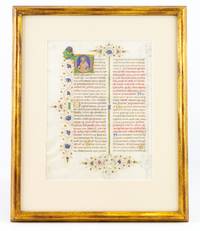
1441ST19880Italy Ferrara 1441-48. Visible leaf: 245 x 187 mm. 9 5/8 x 7 3/8"; Frame: 380 x 315 mm. 15 x 12 1/4". Double column 30 lines in a very fine rounded gothic hand a few lines of text in the same hand but smaller. <br/> Mounted and in a simple but pleasing gold frame. Visible side with rubrics in red one-line initials in burnished gold or painted blue one two-line initial in burnished gold on a pale pink ground with white tracery a lovely illuminated bar between the columns with a central plant knot AND SPROUTING IN UPPER AND LOWER MARGINS CLUSTERS OF FLOWERS AND LEAVES IN VARIOUS COLORS AS WELL AS GOLD BEZANTS outer margin with swirling penwork studded with gilt bezants running the length of the column each penwork swirl enclosing a painted and gilt flower with ONE FIVE-LINE HISTORIATED INITIAL DEPICTING ST. PAUL HOLDING A SWORD AND BOOK the initial painted pink with green leaves and a blue and green acanthus extension on a gilt ground. ◆Not examined outside of frame but in very fine condition: vellum slightly wavy text in the bottom margin just a bit faded but by all appearances A VERY CLEAN BRIGHT LEAF SPARKLING WITH GILT.<br/> <br/> Executed with great skill and delicacy and in sensitive Italianate colors highlighted especially by spring green and pink the present leaf is from a manuscript intended for a powerful aristocrat. It comes from the celebrated Breviary illuminated for the chapel of the Marquises of Este rulers of Ferrara and Mantua a manuscript commissioned by Leonello d'Este duke of Ferrara from 1441-50. Because the d'Este family kept excellent records we have confidence that this manuscript was done for Leonello by Giorgio d'Alemagna Bartolomeo de Benincà Guglielmo Giraldi and Matteo de' Pasti see Toniolo "La Miniatura a Ferrara dal Tempo di Cosmè Tura all'eredità di Ercole de' Roberti" 1998 pp. 19-20 and 76-77. The leaves show subtle variations in the style of the illuminations a result of work done by a team of artists doing variations on a theme. At one time in a Spanish library the manuscript was brought to Britain during the Peninsular War and came to be owned by the Rolls family later Lords Llangattock of Monmouth in Wales from whom it takes its name. By the time the work reached Britain most of the miniatures had already been cut out. The Breviary sold at Christie's on 8 December 1958 lot #190 to Goodspeed's of Boston who broke it up. The intact first quire of 10 leaves was purchased by Philip Hofer and given to Harvard cf. Wieck "Late Medieval and Renaissance Illuminated Manuscripts" p. 130 and fig. 74 and individual leaves appeared in 1967 in the catalogues of Folio Fine Art "the quality of the leaves is extremely high" Maggs Brothers "of a very high quality" and Alan Thomas "of exquisite quality". The present example is especially desirable for the portrait of St. Paul who is depicted holding a sword and book and whose carefully molded features reflect the growing interest in realistic portraiture in Renaissance Italy. unknown
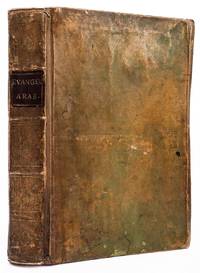
63499Romae Rome: Ex Typographia Medicea 1619. Folio 33.5x21 cm. pp. 4 9-462 2 with at recto the printer's letter repeated with the date of the 1591 original edition blank at verso. Contemporary green vellum spine with raised bands and gilt-decorated compartments red Morocco label marbled endpapers edges dyed red. Title printed in red and black with Medici's woodcut coat-of-arms printer's advice "Typographus lectori". With 149 text woodcuts by Leonardo Parassole c.1570-c.1630 after Antonio Tempesta 1555-1630 their monograms appearing on a number of the illustrations. The woodcuts are remarkable examples of Tempesta's work notable for their clarity of composition and their didactic narrative of the episodes depicted. Ex libris Luigi Bossi Milan 1758-1835 with his engraved heraldic bookplate to front pastedown along with T. Fenteman & Sons Leeds booksellers label to upper corner. Title-page lightly browned boards faded and discoloured some occasional light toning generally a very good copy printed on thick paper the woodcuts in strong impressions throughout. Rare 1619 reissue or of the original 1591 stock of the Arabic Medicean Gospels. The text lines are almost identical with those of the Arabic issue but now have an interlinear Latin version added which was prepared by Antonius Sionita. In 1584 the last year of the papacy of Gregory XIII who had constantly endeavoured to effect a union between the Church of Rome and the eastern Christians Cardinal Ferdinando de' Medici the brother and later the successor of the Grand Duke of Tuscany founded a printing press in Rome with a vast selection of oriental types cut by the French typographer Robert Granjon. Run by a versatile orientalist Giovan Battista Raimondi the press had various aims. One was to produce propaganda which would attract the eastern Christians to Roman Catholicism. Another was to corner the publishing market in an area where typography was prohibited and to make a financial profit from the sale in the east of books printed in Arabic. The third aim was to further European knowledge and to provide good editions of Arabic versions of certain standard non-religious texts. These included the writings of Avicenna al-Idrisi's geographical compendium al-Tusi's adaptation of Euclid's text on geometry and various works on Arabic grammar and syntax. The first major publication was the 1591 edition of the Gospels. This copy has an interlinear Latin translation but the work was also issued solely in Arabic. It contains 149 fine woodcut illustrations made by Leonardo Parasole mainly after designs by one of the best known Florentine artists of his day Antonio Tempesta who owed much of his fame to the frescoes he painted in the Vatican and in a number of Roman palaces. The woodcut in the Gospel of St Mark of the presentation of the head of John the Baptist to Salome Mark 6:28 by a man in Turkish dress reminds us of the common association between the great enemy of Christendom in the sixteenth century and the ancient heathens. The Arabic text is printed in Robert Granjon's famous large fount generally considered the first satisfactory Arabic printing type; as all early printed editions of the Arabic Gospels it is based on the Alexandrian Vulgate cf. Darlow/M. 1636. The Latin version is by Leonardo Sionita. The work begins with page 9 without a title-page or any preliminary matter at all: "the intended prefatory matter was apparently never published" Darlow/M. Darlow & Moule 1637 & 1643; Schnurrer Bibliotheca arabica 318; Brunet II 1122-23; Graesse II 531 Romae [Rome]: Ex Typographia Medicea, 1619. hardcover
1489371804Strasbourg: Johann Prüss 1489. Text in double columns 52 lines per column. 450 leaves with erratic pagination and collation. Two leaves present in early manuscript facsimile Interpretations of Hebrew Names leaves b2 and b7. Partially rubricated. Contemporary manuscript marginalia with chapter summaries in the lower margins throughout and shoulder notes in the OT with extensive annotation on the title. Folio. Early blindstamped pigskin later brass bosses and clasps joints splitting some loss at bottom of spine. Title mounted with paper losses at fore-edge and lower margins affecting the manuscript annotation but not the text. Cloth clamshell box. Text in double columns 52 lines per column. 450 leaves with erratic pagination and collation. Two leaves present in early manuscript facsimile Interpretations of Hebrew Names leaves b2 and b7. Partially rubricated. Contemporary manuscript marginalia with chapter summaries in the lower margins throughout and shoulder notes in the OT with extensive annotation on the title. Folio. The second Prüss Bible. Place of publication and printer from Goff publication date from colophon Kk5v. Not in Darlow and Moule. This copy from the famed bible collection of W. A. Copinger. See his lengthy bibliographic description in Incunabula Biblica item 79 and plate XLI. ISTC ib00588000; GW 4265; Hain-Copinger 3104; Proctor 543; Goff B588; BM 15th cent. I 122 IB.1658; Walsh J.E. 15th cent. printed books 196; Stillwell B516; Bodleian Lib. 15th cent. B-297; Copinger W. Incunabula Biblica 79; BSB-Ink B-462. Provenance: W. A. Copinger bookplate; General Theological Seminary booklabel blindstamp on the title Johann Prüss unknown
1491372087Basel: Nicolaus Kesler Kessler 1491. With one small polychrome gilt illuminated initial F on a2 initials in red or blue thoughout. Printed marginalia present on a2 and a7. 436 ff. 872 pp. final page is blank. 1 vols. Folio. Old leather tooled in blind clasps perished. Rebacked edges repaired last few leaves with marginal repairs final leaf of Names backed with small losses at head. Ownership marks struck out on title leaf. Very good. Cloth folding box. With one small polychrome gilt illuminated initial F on a2 initials in red or blue thoughout. Printed marginalia present on a2 and a7. 436 ff. 872 pp. final page is blank. 1 vols. Folio. Kesler's second Bible a page-for-page reprint of the edition 9 October 1487. These editions are notable for including at end the section headed "Translatores Biblie" with two notes "dealing with 1 ancient versions . and 2 with the methods of interpreting the Holy Scripture" D&M and form part of the apparatus accompanying many later editions of the Latin Bible. The first use of a title page for the Bible is ascribed to Johann Pruess in the 1486 Strassburg edition; here it is simply: Biblia. ISTC ib00591000; GW 4268; Goff B591; Copinger Incunabula Biblica 88; Darlow & Moule note at 6086. Provenance: W. A. Copinger bookplate; General Theological Seminary gift of Cornelius Vanderbilt and Dean Augustus Hoffman bookplates and blindstamps Nicolaus Kesler (Kessler) unknown
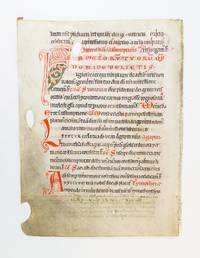
ST17236Germany mid- to late 12th century. 290 x 217 mm. 11 3/8 x 8 1/2". Single column 21 lines in an attractive proto-gothic book hand. <br/> Rubrics in red several one-line initials in red five red initials measuring two to four lines long and with penwork embellishment A LOVELY SEVEN-LINE WHITE-VINE INITIAL outlined in red and with a pale yellow wash along the edge the lower half of the ground filled with green wash. Lower margins with notations in later Medieval hands. ◆A handful of original holes in the vellum no doubt from stretching the skin during processing with the scribe writing around the flaws where necessary a little soiling to lower outside corner one or two negligible spots otherwise IN FINE CONDITION the ink unusually rich and the paint very bright.<br/> <br/> From a Sacramentary a service book that contained the prayers said during Mass subsumed by the Missal in the 13th century this early leaf was once part of an attractive manuscript of very high quality. The very large and superb "F" opens the Mass for the Feast of the Assumption and the other readings here include Masses for Sts. Hippolytus and Cassian celebrated on 13 August; St. Eusabius 14 August; Vigil of the Assumption of the Virgin 14 August; Assumption of the Virgin 15 August; St. Agapitus 18 August; and the beginning of the Mass for Sts. Timothy Hippolytus and Symphorian 22 August. Sister leaves from this same manuscript have previously appeared in Sam Fogg Cat. 16 "Text Manuscripts and Documents 2200BC to 1600AD" 1995 nos. 30 and 31; Maggs Bros. European Bulletin 20 1995 no. 37; Quaritch Cat. 1270 "Bookhands of the Middle Ages VI" 2000 nos. 69 and 70; Sotheby's 6 December 2001 lot 8; and Bloomsbury 6 December 2017 lot 16. The Fogg description notes that similar initials can be seen in French German and Flemish manuscripts of the period "but very few manuscripts have the special characteristics of this one." For example the initials on the sister leaves described by Fogg contain atypically mauve and green as well as an "unusual . . . exterior contoured ground which is not confined by any geometric form." This means there is no line or shape to box in or define the capital's form; rather it appears as if surrounded by an aura or gentle shadow. Our initial contains a green ground only no mauve but the same unusual and attractive yellow aura. It is rare to find Romanesque leaves of this size and caliber in such fine condition and the present leaf with its beautiful regular proto-gothic hand exceptional white-vine initial and several large decorative initials in red is especially desirable. unknown
152966850Lyons: Per Johanem Crespin 1529. BIBLE IN LATIN. Lyons: Per Johanem Crespin 1529.<br> <br> Second Crespin edition reprinted from the 1527 edition. Folio 13 15/16 x 10 inches; 354 x 252 mm. 304 leaves 18 CCLXVIII 18 leaves. Complete with final blank leaf. Gothic type. Text in double columns within rule borders. Title printed in red and black with small woodcut of St. Jerome repeated three times in the text with Jerome's prefaces within a four-part woodcut border showing God the Father and two angels in a tympanum the six days of Creation and the Last Supper. Large six-part Creation woodcut at the beginning of Genesis half-page woodcut of King Solomon at the beginning of Proverbs full-page Nativity woodcut at the beginning of the New Testament and 121 small text woodcuts including twenty-three repetitions: ninety-one Old Testament woodcuts within strip borders including eight repetitions and thirty New Testament woodcuts without borders including fifteen repetitions. Decorative woodcut initials. The Eusebian canons leaves D1-D3 are printed in red and black in a red architectural framework.<br> <br> Contemporary pigskin over wooden boards roll-tooled in blind to a panel design. Lacking clasps. Original index tabs. Binding worn with some loss of pigskin on upper corner of front cover. Title soiled lower margin of first few leaves wormed and frayed with some loss to woodcut title border a few short marginal tears some mostly marginal dampstaining minor worming to lower inner margins a few inkstains slight discoloration throughout. Despite these minor flaws this is a beautiful example of a French woodcut Bible completely unsophisticated. Contemporary ink inscription on back pastedown dated 1534 contemporary ink inscription on the recto of D4 beneath the Nativity cut eighteenth- or nineteenth-century inscription on title: B.V. Maria in Fürstenfeld. Some early underlining and coloring of woodcuts in red. A few early ink marginalia. Housed in a custom quarter brown morocco clamshell case.<br> <br> The illustrations follow the schema of the Sacon Bibles printed in Lyons in 1518 and 1521. Crespin's blocks with the exception of the Creation are close copies of those used in Jacques and Jean Mareschal's Lyons Bibles of 1523-1541 as is the layout of the text within ruled columns. The borders for the Old Testament blocks include a strip with the initials "PBA."<br> <br> Fairfax Murray French 36. Harvard French 66. Not in Brunet Rothschild Darlow and Moule.<br> <br> HBS 66850.<br> <br> $9500. Per Johanem Crespin unknown
152966850Beautiful French Woodcut Bible BIBLE IN LATIN. Textus Biblie. Lyons: Per Johanem Crespin 1529. Second Crespin edition reprinted from the 1527 edition. Folio 13 15/16 x 10 inches; 354 x 252 mm. 304 leaves 18 CCLXVIII 18 leaves. Complete with final blank leaf. Gothic type. Text in double columns within rule borders. Title printed in red and black with small woodcut of St. Jerome repeated three times in the text with JeromeÃs prefaces within a four-part woodcut border showing God the Father and two angels in a tympanum the six days of Creation and the Last Supper. Large six-part Creation woodcut at the beginning of Genesis half-page woodcut of King Solomon at the beginning of Proverbs full-page Nativity woodcut at the beginning of the New Testament and 121 small text woodcuts including twenty-three repetitions: ninety-one Old Testament woodcuts within strip borders including eight repetitions and thirty New Testament woodcuts without borders including fifteen repetitions. Decorative woodcut initials. The Eusebian canons leaves D1-D3 are printed in red and black in a red architectural framework. Contemporary pigskin over wooden boards roll-tooled in blind to a panel design. Lacking clasps. Original index tabs. Binding worn with some loss of pigskin on upper corner of front cover. Title soiled lower margin of first few leaves wormed and frayed with some loss to woodcut title border a few short marginal tears some mostly marginal dampstaining minor worming to lower inner margins a few inkstains slight discoloration throughout. Despite these minor flaws this is a beautiful example of a French woodcut Bible completely unsophisticated. Contemporary ink inscription on back pastedown dated 1534 contemporary ink inscription on the recto of D4 beneath the Nativity cut eighteenth- or nineteenth-century inscription on title: B.V. Maria in F¸rstenfeld. Some early underlining and coloring of woodcuts in red. A few early ink marginalia. Housed in a custom quarter brown morocco clamshell case. The illustrations follow the schema of the Sacon Bibles printed in Lyons in 1518 and 1521. CrespinÃs blocks with the exception of the Creation are close copies of those used in Jacques and Jean MareschalÃs Lyons Bibles of 1523-1541 as is the layout of the text within ruled columns. The borders for the Old Testament blocks include a strip with the initials ìPBA.î Fairfax Murray French 36. Harvard French 66. Not in Brunet Rothschild Darlow and Moule. HBS 66850. $9500 Per Johanem Crespin hardcover books
151056068Augsburg, Johann Otmar für Georg Diemar, 1510. Fol. Mit 6 fast blattgr. Holzschnitten von Hans Burgkmair u. 2 großen Initialen. 210 nn. Bll., Mod. Ldr. im Stil d. Zt. m. Streicheisenlinien u. Kopfgoldschnitt.
154814107Basileae, per Henrichum Petri, 1548. Petit in-folio (290 x 187 mm) de 408 pages mal chiffrées 385 (a6; A-Z6; Aa-Kk6), plein vélin, dos à nerfs, titre doré, triple filet à froid encadrant les plats. Petit manque de peau au premier plat, quelques feuillets légèrement brunis. Ex-libris manuscrit du XVIIIe: Ex bibliotheca Claperoniana au premier contreplat; ex dono sur la page de garde: Charles Freynier, 1825; ancienne collection Michel Slatkine père.
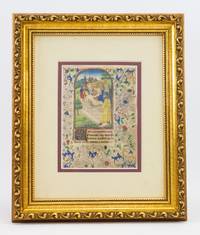
ST19540bSouthern Netherlands Bruges third quarter of 15th century. Matted leaf: 150 x 150 mm. 5 7/8 x 4 3/8". Frame: 307 x 258 mm. 12 x 10 1/4". Single column with four lines below the miniature and the obverse with 17 lines in a batarde hand. <br/> Attractively matted and framed the leaf slightly shifted in the mat revealing top and side edges but in no danger of damage. Rubrics in red four one-line initials and three three-line initials all but one in burnished gold on blue and red ground with white tracery the initial beneath the miniature painted pink on a burnished gold ground and filled with painted ivy vines AN ARCH-TOPPED LARGE MINIATURE DEPICTING THE ENTOMBMENT the body of Christ surrounded by seven other people depicted in an outdoor setting with the turrets of a walled city in the background the miniature in a double frame of gold and pink surrounded by A FULL BORDER composed of hairline vines acanthus colorful flowers and gilt bezants and inhabited by a small bird. Minor soiling and a faint thumb print to borders but IN VERY FINE CONDITION THE MINIATURE BEAUTIFULLY PRESERVED.<br/> <br/> This is a beautifully rendered and deeply touching scene depicting the entombment of the crucified Christ and the pathos experienced by those at his side. Holding the sheet on which the body is lowered into the sarcophagus are on the far left the richly clothed Joseph of Arimathea and on the far right Nicodemus who dons an especially lovely yellow garment with delicate embroidery. Between the two men in the foreground but behind the body are the Virgin Mary who presses the hand of her deceased son to her lips; John the Evangelist whose body is turned toward the Virgin in a gesture of support but whose gaze is focused on the Savior; and Mary Magdalene who holds a small ointment jar. Two other women with halos stand closely behind them consoling one another. The artist has done a masterful job at creating a composition that captures the emotional gravity of the scene: Christ's body gently cradled in a white sheet is on full display with blood still trickling from the wounds on his head and side. Despite there being seven people crowded around him our attention is drawn to the action between Christ and the Virgin who gently grasps his hand with motherly affection and bids him a final farewell. Flickers of different emotions appear on the faces of his followers including pity sorrow stoicism and disbelief--echoing perhaps the viewer's own range of feelings upon viewing this image. The level of detail excellence of composition care seen in the molded bodies and faces and the convincing setting suggest that the artist was quite practiced and that the original manuscript from which the leaf comes was of very high quality. unknown
15546212Lyon: Jean de Tournes 1554. First edition. Octavo 6 3/4 x 4 3/4 inches; 171 x 121 mm. . 16 1152 76 pp bound without the last two blank leaves as in most copiese.g. Mortimer OCLC. The penultimate leaf had only a fleuron at the foot of the page and the final leaf was blank. Arabesque title border and 198 with 1 repeat woodcuts in the text by Bernard Salomon. Title-page with faint early ink "ex-Libris petri ------ at top blank margin. Title-page expertly cleaned some occasional mainly marginal faint foxing otherwise a superb example of this wonderfully illustrated mid sixteenth-century Latin Bible. Bound ca. 1880 by Chambolle-Duru in full brown crushed levant morocco spine with five raised bands lettered in gilt gilt ruled board edges decorative gilt turn-ins marbled endpapers all edge gilt. Armorial bookplate "In Memori: Weiler Bibliotheca Trautner Falkiana" on verso of front free endpaper.<br /> <br /> First De Tournes Latin Bible based on Robert Estienne's text and beautifully illustrated with 198 woodcuts by Bernard Salomon. "Considerable work could be done on Salomon's sources for these cuts. The Expulsion from Paradise suggests Holbein's version; the New Testament shows some dependence on the set owned by Sébastien Gryphius. the Apocalypse blocks are enlarged copies of the fine Janot Apocalypse. But the cumulative effect of Salomon's carefully detailed scenes is that of an individual contribution to Bible illustration. Particularly interesting from the point of view of technique are the night scenes in Exodus and the storm over Noah's ark. In this 1554 Bible the New Testament blocks are printed with arabesque strip borders at the sides. Arabesque and type ornament headpieces." Mortimer Contents include: Old Testament; Psalms; New Testament Epistles Acts; Index Testimoniorum & Index Epistolarum.<br /> <br /> Robert I Estienne 1503-1559 was a French protestant printer and scholar born into a printmaking family. He would take over his family's Paris firm in 1526 where he printed significant works in Latin Greek Hebrew and other languages. His 1531 Thesaurus linguae latinae is considered a major milestone in lexicography. Despite his many commissions for the King religious tensions forced Estienne to flee to Geneva. <br /> <br /> This bible was illustrated by Bernard Salomon c.1508-1561 a French artist who is known for engravings and illustrations. Although little is known about his life his art reveals stylistic influences from Mannerism and the School of Fontainebleau executed in a detailed and small scale. Salomon is known to have collaborated with the printer Jean de Tournes and produced decoration for emblem books bibles and classic texts. Many of his engravings also appear as source material for art objects such as a Faience plate at the MET featuring the Sacrifice of Noah.<br /> <br /> Brunet I 876 & Supplement I 125; Darlow & Moule 6134 note; Mortimer French no. 81. Jean de Tournes unknown
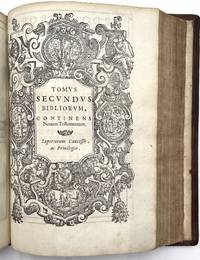
3144Professionally rebacked extremities bumped. Occasional light foxing and browning to some sheets small tear paper flaw to the fore-edge margin of Mi small triangular tear with slight loss to the fore-edge margin of HHiiiii. Generally a very clean and fresh copy. Very good. <p>Sacra Biblia Acri Studio Ac Diligentia Emendata Rerum atque Verborum permultis & perquàmdignis Indicibus aucta. Superiorum Concessu ac Privilegiis. Venice: Apud Iolitos 1588. </p> <br /> <p> Octavo. Two parts in one small quarto volume. 16 679; 199 1 blank 200 indices pp. General and New Testament titles within ornate woodcut borders. Illustrated with 246 woodcuts. Full nineteenth-century blindstamped leather spine with raised bands and title lettered in gilt. All edges stained brown. </p> . unknown
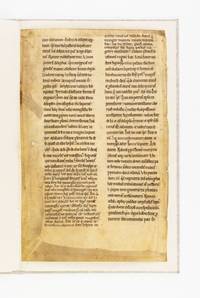
ST17768<p>England second half of 12th century but before 1180. 313 x 198 mm. 12 1/4 x 7 3/4. Double column 32 lines in a lovely late Caroline hand verso with some lines erased and corrected in a smaller hand. <br />Mounted in a fine tan cloth folder between sheets of textured acid-free paper. Front pastedown with book label of the Schøyen Collection with their shelf mark MS 237 written in ink. ◆Recovered from a binding and thus with overall toning and soiling recto somewhat browned from binder's glue but almost entirely confined to three margins and the verso virtually unaffected other trivial imperfections but in surprisingly good condition given its history the very rich ink especially dark and well preserved.<br /><br />This is an exceptionally lovely example of an early English book hand standing at the crossroads of the Caroline and proto-gothic calligraphic traditions. According to Thompson "In the twelfth century the scribes seem to have vied with each other in producing the best types of book-writing of which they were capable with the result that remarkable precision in the formation of the letters was attained and that the century may be named as excelling all others for the beauty of its MSS." "Greek and Latin Paleography" p. 436 The present leaf certainly lives up to this description being notable for its exceptionally neat and legible script written with uncommonly pretty and regular letter forms by a practiced and confident hand. The Caroline tradition is apparent in certain tendencies such as the use of "&" for "et" and the lack of biting curves between letters while a shift toward the proto-gothic can be seen in the vertical and compressed letter forms as well as the increased use of abbreviations and ligatures. Although the present work has often been credited to Haymo of Halberstadt due to a longstanding error in attribution reaching back to the 15th century modern scholarship now recognizes Haimo of Auxerre a monk at the Abbey of Saint-Germain in Auxerre d. ca. 875 as its true author. A prominent theologist and writer during the Caroline Renaissance Haimo produced a number of influential commentaries on various books of the Bible. The provenance on this leaf can be traced back as far as the mid-19th century when it was auctioned at Sotheby's on 21 August 1858 lot 119.2 sold as part of an album containing various leaves and fragments put together by Philip Bliss 1787-1857 registrar of the University of Oxford. It then went into the celebrated collection of Sir Thomas Phillipps 1792-1872 and was eventually sold by the Robinson Brothers on 24 April 1911 lot 390.3. This leaf has previously appeared in Quartich's catalogue 1036 "Bookhands of the Middle Ages" no. 79.5 and was most recently in the collection of Martin Schøyen his MS 237.</p>
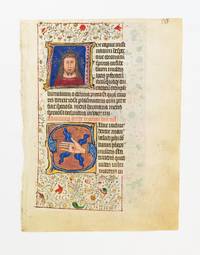
1465ST17243aBruges ca. 1465. 193 x 145 mm. 7 5/8 x 5 3/4". Single column 21 lines in a gothic book hand. <br/> Rubrics in red WITH THREE LARGE HISTORIATED INITIALS: ONE WITH A PORTRAIT OF CHRIST WEARING THE CROWN OF THORNS AND TWO WITH DISEMBODIED HANDS SHOWING THE STIGMATA each initial in pink or blue with white tracery filled with dark pink or blue with thin gilt lines and dots hands with wavy blue rays radiating from behind the appendage all within a thin gilt frame both sides with a three-quarter border consisting of hairline vines gold bezants and a few colorful flowers. ◆Margins with a little light soiling BUT IN FINE CONDITION THE PAINT OF THE INITIALS ESPECIALLY RICH AND WELL PRESERVED.<br/> <br/> From a manuscript probably produced in Bruges for the English market this leaf contains arresting initials that direct the viewer's attention to the wounds endured by Christ during the Passion. According to Roger Wieck Passion Cycle images enjoyed a particular vogue in 15th century Dutch Flemish and English Books of Hours including those that were exported to England. In the present example the strikingly unusual imagery includes a portrait of Christ wearing the Crown of Thorns his gaze fixed directly at the viewer and in separate initials his left and right hands appear disembodied and displaying the stigmata. A sister leaf to the present item features three additional initials showing the wounds of the left and right foot as well as the spear injury to Christ's side depicted as an oval piece of flesh with a laceration across the center. The parent manuscript containing the present leaf sold at Christie's on 15 November 2006 lot 16 the description for which gives us additional information about the book's contents and provenance: it was made for the Use of Sarum included a calendar with the English saint Thomas Becket and Popes Gregory and Silvester with their names crossed out indicating that it was in England through at least the time of the Reformation and contained an early ownership inscription of a woman named Bridget Lowe with a Middle English inscription on the pastedown. Christie's also attributed the parent manuscript to the workshop of William Vrelant with miniatures possibly by his chief assistant the Master of the "Vraie Cronique Descoce." They note that this work is "of higher quality than many of the works that satisfied the English demand for Netherlandish illumination" and that it "demonstrates why Vrelant appealed to the great bibliophiles of the Burgundian Netherlands." Vrelant was the leading purveyor of books of private devotion in Bruges during the third quarter of the 15th century and his prominent position among Flemish illuminators of the time is indicated by the considerable number of manuscripts illustrated in his manner by other miniaturists both in Bruges and in nearby cities in Flanders. Similar examples to the present leaf can be found in intact Books of Hours at the Philadelphia Free Library MS Widener 3 and the Huntington HM 1086--both of which were produced in Flanders or the Netherlands around the same time as the present work--but the present leaf surpasses both of these examples in terms of excellence of the artistic hand and level of detail depicted. unknown
1460ST12839Paris ca. 1460. 153 x 110 mm. 6 x 4 3/8". Single column 14 lines of text in a fine gothic book hand. <br/> One-line initial in burnished gold on a pink and blue ground with white tracery a two-line initial and a three-line initial in pink with white tracery on a ground of burnished gold the center filled with twining blue vines bearing pink and scarlet flowers verso with a rinceau panel border featuring twining hairline stems bearing burnished gold ivy leaves and fruit blue and gold acanthus leaves and flowers recto WITH AN ARCH-TOPPED MINIATURE OF THE HOLY TRINITY SURROUNDED BY THE HEAVENLY HOST this and the accompanying text enclosed by a pink blue and burnished gold bar border on one side and a brushed gold bar border with pink lotus flowers on two sides the whole surrounded by A FULL RINCEAU BORDER DENSE WITH ACANTHUS LEAVES FOLIAGE FRUIT FLOWERS AND TINY GOLD BERRIES on hairline stems. ◆A little paint flaked from the book held by the Trinity a couple of small spots in the margin otherwise in fine condition--clean and smooth with comfortable margins and bright gold.<br/> <br/> The Trinity is shown here seated on a canopied throne with God the Son his hand raised in blessing to the left of the Father. The latter in a towering crown holds a gold orb and the Father and Son together support a large book opened between them. The dove of the Holy Spirit hovers above the book radiating golden beams. The Trinity is flanked on both sides by cherubim and seraphim in rich red and soft yellow. It is the rendering of this angelic ambiance that elevates the level of aesthetic achievement here: both red and yellow celestial beings are given a ghostly appearance as if appearing out of a filmy yellow or a densely red fog. The artistic qualities as a whole suggest that this leaf comes from a manuscript commissioned by a person of significant means. unknown