Bible LatinABAA

26 128 résultats
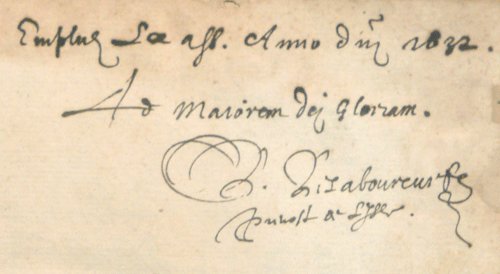
1557254216Basilaea Basel: Nicolaum Bryling Nicolaus Brylinger 1557. Woodcut border and printer's device on title. INCOMPLETE. 8 479 of 500 8 leaves. Lacking ff. 46-56 & 61-70. 1 vols. 8vo. Bound in contemporary blind panel-stamped pigskin over bevelled wooden boards clasps removed binding worn exposing boards on rear cover title page detached contemporary marginalia by Johannes Weneken throughout. Woodcut border and printer's device on title. INCOMPLETE. 8 479 of 500 8 leaves. Lacking ff. 46-56 & 61-70. 1 vols. 8vo. Brylinger published the only 16th century edition of Luther's Bible in Switzerland published one of the earliest Greek and Latin diglot Bibles and published a series of 8vo editions of the Bible with diglot and Greek-only text which was popular with students. Darlow & Moule makes no mention of this or any other Latin-only edition by Brylinger.<br/>Front paste-down endpaper and front free endpaper display extensive annotations in Greek and Latin presumably by Johannes Weneken. The marginal annotations provide a fascinating insight into how this book was used. Not in Darlow & Moule but cf. 4621; Adams 1056; OCLC: 46973017 6 copies only 3 of which in U.S. Nicolaum Bryling [Nicolaus Brylinger] unknown books
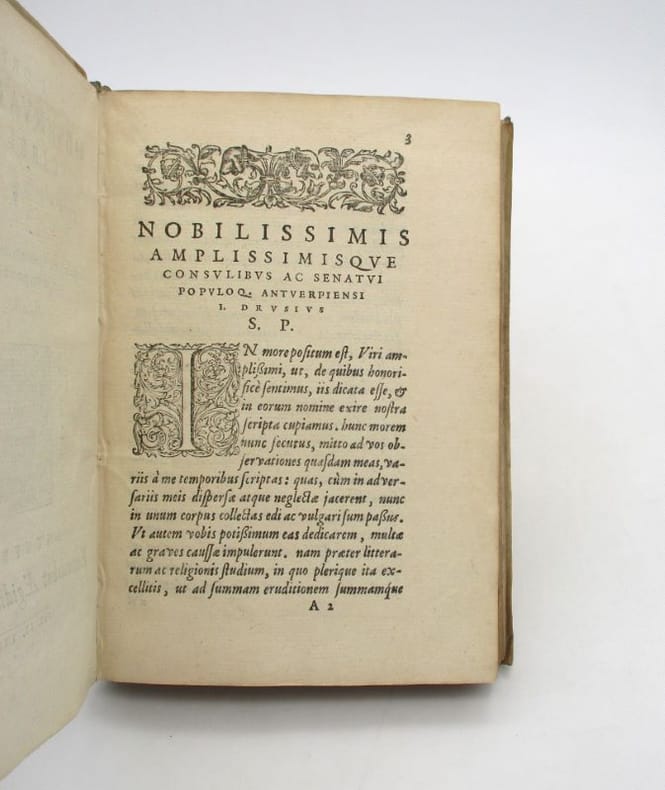
20289Antverpiae excudebat Aegidius Radaeus [Anvers, Gilles van den Rade], 1584. In-8, 285-[15] pp. et [1] f. bl. (A-T8), vélin souple de l'époque, armes dorées de Jean-Auguste Thou au centre de plats, tranchefiles à passe, dos long avec titre doré, tranches jaunes (quelques taches et petites rousseurs éparses, doublures, gardes, 1er et dernier ff. postérieurs).
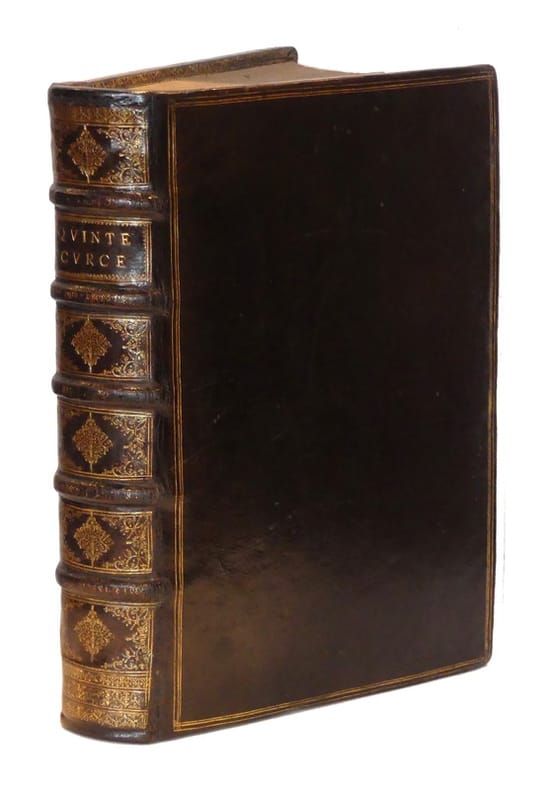
16599060Paris Augustin Courbé 1659 1 In-4 (265 x 185 mm), 20 ff. n. ch., 777 pp., 47 pp. Maroquin brun foncé, triple filet doré en encadrement sur les plats, dos à nerfs orné, roulette sur les coupes et les chasses, tranches dorées, gardes renouvelées, déchirure réparée sans manque p. 769, petites taches sur le frontispice, quelques brunissures suprapaginales aux premiers feuillets (reliure de l’époque).
1587ABC_48453Antwerp: Christoffel Plantin 1587. Contemporary elaborately blind-tooled pigskin over bevelled wooden boards sewn on 4 double supports with the corresponding raised bands on the spine the manuscript title in the first compartment and the original manuscript shelf mark label "H.36" of the Monastery of Buxheim in the fifth compartment both boards with an ornamental roll and a roll with the portraits of Salvater sic! Maria S. Bruno and S. Johannes in a panel design two original brass clasps and catches ornamented with a small star leather tabs and six original bookmarkers plaited into a big knot. 8vo. With a woodcut vignette with Peter and Paul by Peeter van der Borcht on the title page 6 full-page woodcuts ca. 112 x 75 mm by Antoon van Leest after Peeter van der Borcht 6 half-page square woodcuts 55 x 55 mm in border one signed by Antoon van Leest one woodcut 90 x 76 mm by Antoon van Leest after Peeter van der Borcht and 2 smaller oval woodcuts. The work is printed in red and black. Plantin edition of the revised Roman Missal following the directives of the Council of Trent first published in Rome in 1570 by order of pope Pius V 1504-1572 and later approved by Clemens VIII 1536-1605 and Urbanus VIII 1568-1644. The work was quite popular as Plantin published a new missal nearly every year from 1571 onwards. All editions were printed in different sizes and in two issues one with woodcut illustrations and one with engravings. The present copy is the octavo edition with woodcut illustrations and comes from the library of the famous Carthusian monastery of Buxheim Maria Saal near Memmingen Bavaria.The monstery of Buxheim was founded in 1402 and dissolved after the secularisation in 1803. The rich library was auctioned in 1883 by Förster and in 1884 by Ludwig Rosenthal in Munich. The Museum of the Charterhouse Buxheim today is actively studying the history of the library and the present location of its books and manuscripts. The present copy is bound in contemporary pigskin which was likely bound for the monastery itself as the rolls depict Saint Bruno who was the founder of the Carthusian order. The Missal is therefore probably bound in a South-German bindery in the surroundings of the monastery.With an ownership annotation on the title page "Cartusiae Buxheim". The binding is somewhat rubbed and soiled. The leaves are lightly browned some of the leaves are slightly stained especially around the leather tabs. Otherwise in good condition.l Belg. Typ. 6335; Imhof Plantins 1574 Missale Romanum in octavo in: De Gulden Passer 73 1995 pp. 67-82; Nagler I 1459; USTC 406791; Voet 1701 A; Weale-Bohatta no. 1269; not in Haebler. Christoffel Plantin, hardcover
Monumental work on Church History ("Ecclesiastical Annals") covering the period from year 1 till 1571 which the Oratorian Baronius wrote in 1588-1607 to oppose the Lutheran and thus anti-catholic history called the "Magdeburg Centuries", complete in 37 volumes, re-edition edited by Augustin Theiner, together ca. 22.000 pages, 32cm., uniform solid hardcover bindings in black cloth in good condition (spines sunfaded), stamp on title page, text is clean and bright except for some occasional foxing, text in Latin, text is printed in two columns, good set, total weight: 70kg., R107128
2 Vols., folio (377 x 279 mm), limited to 500 copies, commentary volume with text in English:164pp., illustrs., orig. vellum-backed cloth, covers slightly spotted, facsimile volume: 320pp., of coloured facsimiles, full vellum, endpapers slightly spotted, slip-case. The Emperor's Bible (Uppsala, UUB ms C 93; Swedish: kejsarbibeln), also known as Codex Caesareus, Codex Caesareus Upsaliensis or the Goslar Gospels,[1] is an 11th-century illuminated manuscript currently in Uppsala University Library, Sweden. Despite its name, it is not a Bible but a Gospel Book. The book was made in the scriptorium of Echternach Abbey, and is one of four preserved large Gospel Books made there during the 11th century. It was commissioned by Emperor Henry III and donated by him to Goslar Cathedral, where it remained until the Thirty Years' War. It was then lost for about 100 years. The book later appeared again in the possession of Swedish diplomat and civil servant Gustaf Celsing the Elder [sv]. At the death of his son, it was acquired by Uppsala University. The manuscript is richly decorated with miniatures, including full-page depictions of the Four Evangelists, illuminated canon tables and a depiction of the emperor donating the book to the patron saints of Goslar Cathedral. It is written in Carolingian minuscule and is overall well-preserved.
184115Paris, Nicolas-Eloi Lemaire, 1819-1832 92 vol. in-8, demi-basane blonde, dos lisses ornés de filets dorés, pièces de titre et de tomaison bouteille, tranches mouchetées (reliure de l'époque). Des dos insolés ou frottés, rousseurs abondantes, mais bon exemplaire.
1885ABC_488551885. Contemporary gold-tooled dark purple quarter morocco brownish-purple pebble-grain cloth sides with a paper label "3" mounted on the front. Oblong ca. 38 x 27.5 cm. With 20 albumen prints 43 plates engraved and lithographed and 3 drawings. Remarkable album documenting the travels of HMS Calliope 1837-1883 a British warship in the first few years after her launch. The ship first sailed to Madeira and Tenerife after which she crossed the Atlantic Ocean to visit various harbour cities in Brazil Argentina Uruguay and Chile. Many of the illustrations and photographs include handwritten annotations about the ship's journey with the exact dates of when she arrived where. As such the album was likely compiled by someone who sailed on the ship during these years possibly a crew member. The album contains photographs drawings and plates relating to the places the Calliope visited between 1838-1840. It starts with photographs of Madeira and Tenerife like the Loo Rock in the harbour of Madeira locals carrying a tourist down the Pico Grande the town of Güímar in Tenerife and an age-old Dragon Tree. As the ship's next destination was Brazil the album contains a number of photographs and illustrations of Rio de Janeiro as well as a drawing of a picnic at the summit of the Corcovado. The Calliope then sailed to Buenos Aires and Santa Fe arriving in August 1838. This part of the album contains a drawing of a gaucho and 6 beautiful photographs by Samuel Boote 1844-1921 one of the most important photographers working in Argentina in the 19th century. His work shows the interior and exterior of the St. Felicitas Church in Santa Fe as well as daily life in this city. The ship then carried the British ambassador from Argentina to Montevideo arriving in June 1839 before continuing to Valparaíso. The final pages of the album contain a map of Montevideo views of Valparaíso and the mountains nearby and a drawing of a bridge.The plates in the album were taken from other works such as Journal of a voyage to Brazil 1824 by Maria Graham and A history of the Brazil 1821 by James Henderson. The photographs were taken in the 1880s which means the album must have been compiled several decades after this particular voyage of the Calliope. However as some of the annotations mention that a location looked different on the plate than when the Calliope arrived the album must have been compiled by a crew member.The Calliope sailed to China after the visit to Valparaíso to serve in the First Anglo-Chinese War 1839-1842. After she sailed to New Zealand and primarily operated in that region until she was converted into a floating chapel in 1855 and deconstructed in 1883. With the yellow bookseller's label of "A & N.C.S.Ld Stationery Dept. 105 Victoria St. S.W." mounted on the back pastedown. The leaves and plates are somewhat foxed likely lacking a plate or drawing on the recto of leaf 16. Otherwise in good condition. hardcover
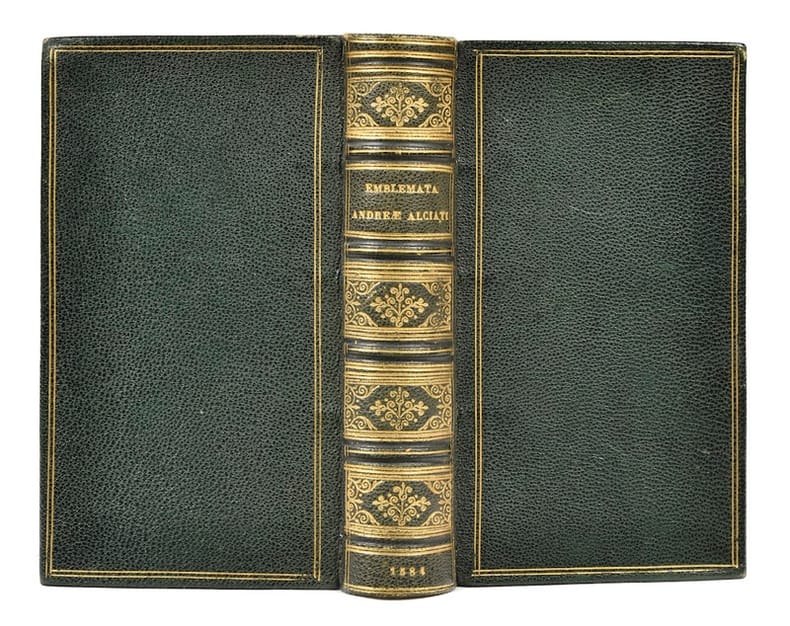
158410643Paris, Jean Richer, 1584. In-12 (134 x 77 mm), 8 ff. n. ch., 301 ff., 1 f. n. ch. Chagrin vert, double filet doré d'encadrement sur les plats, dos à nerfs richement orné, titre, auteur et date dorés, filet doré sur les coupes, tranches rouges, petite tache marginale au verso du feuillet 151 et au recto du feuillet 152, petit manque de papier au coin inférieur du feuillet 198, deux traits d’encre dans la marge au feuillet 217 (reliure du XIXe siècle).
171430785AB(Alle) Antwerpen, Nutius 1627, Meursius 1656-84 (7 Bde), Verdussen 1714. 10 Bände. 2°. 5 SchweinsLdrBde der Zt, 4 PgmtBde der Zt, ein LdrBd der Zt.
15330036011533 Sans lieu [Paris], Venundatur a Joanne Parvo, Petro Gaudoul, & Petro Vidoueo, Bibliopolis iuratis, 1533. In-folio (223 X 315) veau fauve granité, large encadrement de filet à froid sur les plats, dos quatre larges nerfs, caissons ornés d'un fleuron central et de fers d'angles dorés, pièce de titre maroquin brun, dentelle dorée en queue et tête, tranches jaspées en rouge (reliure du XVIIe siècle) ; (1) f. blanc, (16) ff. dont titre, XXXII [32] pages, CCCCCCXXII [622] pages, XL pages, (1) page de marque de l'imprimeur, (22) ff., (1) f. blanc. Reliure habilement restaurée, ors ternis ; taches brunes sur la page de titre et aux derniers feuillets.
Romanarum Antiquitatum Libri Decem Exvariis Scriptoribus Summa fide singularique diligentia collecti, a Ioanne Rosino Bartholomaei F., cum indicibus locupletissimis, [suivi de : ] Notitia Utraque cum Orientis tum Orientis ultra arcadii honoriique Caesarum tempora, illustre vetustatis monumentum, ensemble en 1 vol. in-folio reliure de l'époque anciennement restaurée demi-basane marron, dos à 6 nerfs, Ex Officina Haeredum Petri Pernae, Basileae, 1583 , 12 ff. n. ch., 491 pp. et 32 ff. n. ch. (tables), collation : ()6, ()()6, a8, b-z6, A-O6, P4, Q-Y6, Z8 et Apud Hieronymum Frobenium et Nicolaum Episcopium, Basileae, 1552, 108 ff. n. ch. collation : *8, a-o6, p4, q-r6 avec plus de 100 bois gravés Edition originale pour chacun des deux titres. Le premier ouvrage propose notamment plusieurs illustrations de Rome, dont un plan en double page, une vue des thermes de Dioclétien ou le plan d'un camp romain en double page. Très richement illustré, le second ouvrage propose, en édition originale, un répertoire illustré du personnel de l'administration impériale d'orient et d'occident. With the "Notitia Utraque", in the first complete and illustrated edition of the Notitia dignitatum, a list of high officials of the Roman empire in about 400 A.D. Etat satisfaisant (sans pages de garde, le dernier feuillet débroché, exemplaires collationnés et bien complets, dos abîmé, coupes frottées, travail de vers en marge intérieure sur 3 cahiers, affectant notamment le plan de Rome). Brunet, IV, 1398 ; Adams N 354 Latin
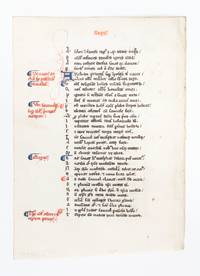
ST18542England ca. 1375. 287 x 198 mm. 11 1/4 x 7 3/4. Single column 32 lines in a small rounded English gothic hand with rubrics in the margins. <br/> Rubrics in red running title in red paragraph marks in red or blue two initials measuring two lines in height and colored blue with red penwork. See: P. E. Beichner "Aurora Petri Rigae Biblia Versificata A Verse Commentary on the Bible." ◆Remnants of mounting tape in top margin of recto but a really excellent specimen the hand very clear the ink especially rich and the vellum extremely clean and quite bright.<br/> <br/> Written in a gothic hand heavily influenced by the English secretarial style this leaf comes from a copy of the "Aurora" a commentary on the Bible in verse form written in the late 12th century by French poet Petrus Riga 1140-1209 a canon of Rheims cathedral. Although little is known about the author's life Riga's text became immensely popular throughout Europe and was routinely studied in Medieval universities. According to Beichner "for those who could read Latin it supplied Scriptural lore in a popular form and it also served as a book of popular theology devotional reading moral instruction and entertainment. Its influence was propagated by teachers preachers and lexicographers by poets and other writers. It was studied imitated translated and quoted. Not only was it widely read in monasteries and convents but it was also recommended reading for the sons of nobles." It is interesting to note that although Riga's work was copied numerous times in the 13th century copies from the later Medieval period such as the present work are uncommonly rare. The parent manuscript containing our leaf was previously in the possession of the Dukes of Westminster and was sold at Sotheby's on 11 July 1966 lot 229 when it was advertised as having 267 leaves missing the first gathering plus 13 other leaves. Bookseller Francis Edwards acquired the manuscript at that sale removed three damaged leaves and sold the remainder. It was thereafter broken up and dispersed. Several sister leaves are now in the collections of Marquette University Lawrence University and the University of South Carolina. unknown
15492307040014Paris: Benoit Prevost for P. Haultin; Apud Petrum Haultinum 1549. Hardcover. Good. Pharmacology: Early printing Greek / Roman Medicine Bound In 19th century polished calf. Gilt spine. Triple gilt ruled covers. All edges gilt. Front hinge starting. Blue marbled end sheets. Woodcut printer's device. Printed in double columns in Greek and Latin. 20 392 leaves. <br> Dioscorides's 1st-century A.D. materia medica remained authoritative into the early modern era. Today the Greek physician is considered the father of pharmacology for his work in herbal medicine. Provenance: From the library of Nicolas Yemeniz 1783-1871 one of the great French bibliophiles of the late 19th-century. "Lugdun" bookplate. Refs: Adams D-657; Durling 1135; Wellcome I 1779. Paris: (Benoit Prevost for) P. Haultin; Apud Petrum Haultinum hardcover
viii + 143 [i.e. 286] + [vii] pp., with one blanco ff. between f.111 and 112, with index, Original 1574-edition, with numerous woodcut initials, 21cm., 19th cy. hardcover binding (spine in leather with gilt title, corners bit bumped, in good condition), marbled endpapers, upper left corner of all pages is lacking some paper (not affecting the text, except for - at some pages - the first word of the repeated chapter name mentioned on top of each page), text is very well readable and clean except for some vague spots at some pages, old ex-libris stamp and ex-dono on title page, [German title: "Durch Gottes segen, newe Speisskammer und Speiskeller in vorstehenden hungers nöten, Landstheuwerungen, und Kriegsslaeufften, sampt anmuetiger Haussapotecken und Kuchenartzney ; dergleichen niemals vorhin publiciert worden". This is a scarce complete edition of this interesting work discussing nutrition during wartime and famine. It contains numerous receipts for making bread, the use of fruit, liquor, etc. The text is written in Latin, but the shouldernotes in the receipts are in German. Ref.: Oberle 67 "Ouvrage rare et très curieux", Vicaire Sp.804f.: "Ouvrage assez rare", Wellcome I,6125], W93823
1574W93823Franckofurti Moeni [Frankfurt am Main], Martinus Lechler 1574 viii + 143 [i.e. 286] + [vii] pp., with one blanco ff. between f.111 and 112, with index, Original 1574-edition, with numerous woodcut initials, 21cm., 19th cy. hardcover binding (spine in leather with gilt title, corners bit bumped, in good condition), marbled endpapers, upper left corner of all pages is lacking some paper (not affecting the text, except for - at some pages - the first word of the repeated chapter name mentioned on top of each page), text is very well readable and clean except for some vague spots at some pages, old ex-libris stamp and ex-dono on title page, [German title: "Durch Gottes segen, newe Speisskammer und Speiskeller in vorstehenden hungers nöten, Landstheuwerungen, und Kriegsslaeufften, sampt anmuetiger Haussapotecken und Kuchenartzney ; dergleichen niemals vorhin publiciert worden". This is a scarce complete edition of this interesting work discussing nutrition during wartime and famine. It contains numerous receipts for making bread, the use of fruit, liquor, etc. The text is written in Latin, but the shouldernotes in the receipts are in German. Ref.: Oberle 67 "Ouvrage rare et très curieux", Vicaire Sp.804f.: "Ouvrage assez rare", Wellcome I,6125], W93823
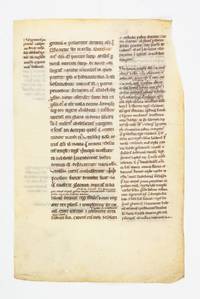
ST17586Abbey of St. Oyan at St.-Claude du Jura France ca. 1175. 245 x 158 mm. 9 3/4 x 6 1/4". Single column of text with two columns of gloss text column with 26 lines in a fine proto-gothic book hand. <br/> Verso with scant remnants of mounting tape in a couple of places along one edge. See Gwara Handlist no. 77. ◆Upper margin of fore edge unevenly trimmed away but no text lost a dozen-and-a-half small round wormholes touching just a couple letters light soiling to edges and other minor imperfections but still IN FINE CONDITION the vellum very clean and the ink dark and legible.<br/> <br/> The most important innovation in biblical scholarship during the 12th century was the development of the "Glossa Ordinaria" to the Bible. Drawing on the whole earlier tradition of biblical exegesis but especially that of Latin patristic writers like Augustine and Jerome scholars working in the French cathedral schools of Laon and Paris systematized this material in an apparatus of marginal and interlinear glosses arranged around the relevant biblical passages. The present leaf showing a particularly beautiful and regular script is a lovely example of one such work. The biblical text appearing in the center column is differentiated by larger lettering and gloss appears interlineally and in a column on either side of the main text all in smaller lettering by the same hand. Scott Gwara notes that the parent manuscript was formerly in the Medieval library of St. Oyan at St.-Claude du Jura a Benedictine monastery founded as the Abbey of Condat around 425 and later known as St. Oyen after an obscure saint who served as Condat's fourth abbot. In the 13th century it was renamed St.-Claude. By the 20th century the manuscript was in the collection of William L. Clements d. 1934 the bulk of which was sold by his estate between 1934-37. The manuscript was then acquired and dismembered by biblioclast Otto Ege around 1939. Gwara notes that the manuscript was incomplete by the time it reached Ege containing only 80 leaves but was "otherwise in excellent condition." The present leaf certainly attests to this assertion being extremely clean bright and with comfortable margins. unknown
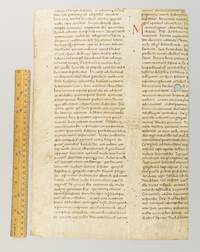
ST12778-0083Italy late 11th or early 12th century. 413 x 285 mm. 16 1/4 x 11 1/8". Double column 47 lines of text in a pleasing early gothic hand. <br/> One two-line initial "M" in red. With a few lines of marginal notes in a later 16th century hand. ◆Probably lacking a line or two at the head as well as half of one column scattered light stains with a few darker stains in one corner touching the text but still legible scattered small wormholes one half-inch hole affecting a few words of text and yet a remarkably clean leaf the remaining text entirely legible.<br/> <br/> The text here in a very good hand is on the death of Saint Martin of Tours. While it is more likely from a Lectionary with the reading for Martinmas November 11 it could be from a separate copy of Sulpicius. The fourth century founder of French monasticism Martin of Tours is celebrated as the Soloman of shawls. One of the most beloved episodes of his early life is a the tale that demonstrates the sensible limits of charity: instead of heedlessly surrendering his cloak to a shivering beggar he encounters he sagely divides it in two so that both he and the object of his benevolence will be warm. The script here has many lingering features of Carolingian minuscule and this fact plus the grand size of the leaf combine to give it very considerable antique beauty. unknown
1579182021579 un volume, reliure plein veau vert petit in-quarto (binding full calfskin in-quarto), reliure tardive (XVIIIème), dos long (spine without raised band), décoration or (gilt decoration) à filets et roulettes or (gilt lines and fillets), fers spéciaux (special blocking stamps), titre frappé or (gilt title), roulette encadrée de part et d'autre d'un filet or en place des nerfs, dos encadré de deux double filets or, entre-nerfs avec fers spéciaux or : "croix fleurie", fleuron branche et fleur en pied, plats décorés d'un triple filet or en encadrement, dos et plats légèrement insolés, roulettes sur les coupes et sur les chasses (fillets decoration on the turn-ins), toutes tranches lisses dorées (all edges gilt), pages de garde en papier peigné caillouté (endpapers with painting paper ),"ex-Libris manuscrit à la mine de plomb : " Au Baron de Wismes, acheté en 1859, 21 rue de Varennes, Il Vient de chez les JACOBSEN à Noirmoutier (Cornil Guilain, Jean Corneille et Auguste Jacobsen (1709-1870) d'une famille originaire de Dunkerque qui construisirent de nombreuses digues et polders, ils descendaient du corsaire Michel Jacobsen), Jost Amman etc Feyrabend Frankfort 1579 signé des initiales Y.W. au crayon violet (Yves de Wismes, Baron), Texte en latin, L'illustration se compose d'une Marque de l'Editeur en bas de la page de titre, gravée sur bois en noir + une gravure Frontispice gravée sur bois en noir + 274 superbes figures sur bois gravées par Jost Amman représentant, face aux armoiries des notables, des sujets de la vie quotidienne : danseurs, musiciens, hommes à cheval, scènes de chasse, marchands, médecins, juges, ainsi que différentes divinités. L'ouvrage comporte une deuxième partie avec des écussons vides et se termine par 7 feuillets contenant à chaque fois quatre blasons vides identiques, sans pagination (123 ff), 1579 Francofurti ad Moenum : apud G. Corvînum, impensis S. Feyerabendii, (1579 Francfort, Sigmond Feyrabend pour G. Gorvin Editeur),
16476532Paris, Simon Piget, 1647. 2 parties en un volume in-4 (225 x 164 mm), 14 ff. n. ch., 230 p.- pp. 231-641, 41 pp. n. ch. Maroquin rouge à la Du Seuil, avec larges fleurons en écoinçons et double filet doré encadrant les plats, dos à nerfs orné, tranches dorées, le feuillet e4 et le dernier feuillet, tous deux blancs, sont en déficit, mouillure sur le premier plat de reliure et mouillure angulaire sur les 8 premiers feuillets, petites rousseurs éparses (reliure de l’époque).
1668002733Londini (Londres), Jacobum Allestry, 1668
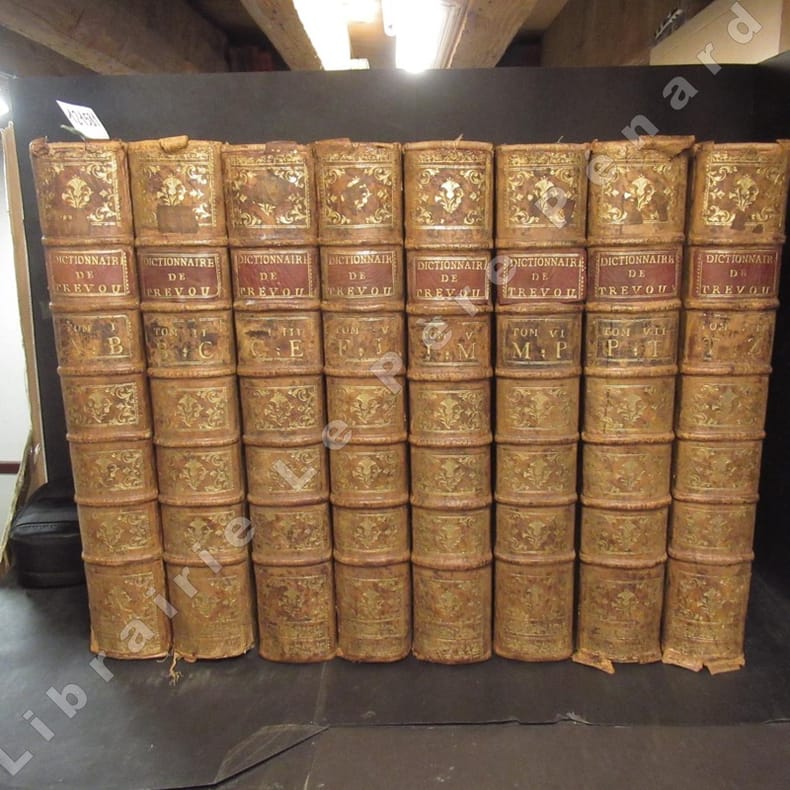
17711215811771 Par La Compagnie des Libraires Associés, à Paris, Avec Approbation et Privilège du Roi - M.DCC.LXXI (1771) - Nouvelle édition, corrigée et considérablement augmentée - Huit volumes in-folio (41,5 x 27), plein veau marbré de l'époque, dos à six nerfs, caissons et fleurons en doré, étiquette de titre sur fond brun, tranches rouges - Textes sur deux colonnes - 996 p. + 1020 p. + 1000 p. + 948 p. + 1023 p. + 1016 p. + 1063 p. + (544 p. + 456 p.) - Le Tome VIII se termine à la page 544 et est poursuivi par "Dictionariul universale Latino-Gallicum" sur 456 pages - A VENIR RÉCUPÉRER SUR PLACE DE PRÉFÉRENCE (poids élevé)
1767111136bailly 1767 4 in-4 A Paris, chez Bailly, rue Saint-Honoré, barriere des Sergens, 1767-1770, 4 volumes in-4 de 260x190 mm environ, Tome 1. 1f.blanc, faux-titre, 3ff. de dédicace gravées, titre en rouge et noir avec vignette, cx-1f. (approbation et privilège)-264 pages, avec les planches numérotése de 1 à 48, 1f.blanc, - Tome 2. 1f.blanc, viij-355 pages, 1f.blanc, Avec les planches numérotées de 49 à 81, - Tome 3. 1f.blanc, viij-360 pages, Avec les planches numérotées de 82 à 118, - Tome 4. 1f.blanc, faux-titre, titre en rouge et noir, 6 (pages d'Explication des vignettes et fleurons de Métamorphoses)-367 pages, 1f.blanc, Avec les planches numérotées de 119 à 140, et une planche : Fin des estampes des Métamorphoses, avec les noms des artistes dans une guirlande de médaillons tenue par un angelot, édition enrichie de 30 vignettes placées à chacun des livres et de 4 fleurons aux titres des 4 volumes, reliures plein granité fauve, dos à nerfs ornés, portant titres et tomaisons dorés sur pièces en maroquin bordeaux, ornés de caissons à fleurons et motifs dorés, plats encadrés d'un triple filet doré, coupes et chasses dorées, gardes de couleurs, tranches dorées. Une coiffe ébréchée, des coins dénudés, début de fente sur un mors, des rousseurs cernes et pages brunies, petits défauts sur le cuir. Texte bilingue Latin avec la traduction en regard.
complete in 28 volumes: 26 volumes + 2 volumes of indices, text in latin, original 1856-1878-edition, Editio nova (second edition, the first of which was printed in 1740-1751 in Venice), 27cm., text printed in 2 columns, all vols. are uniformely bound in hardcover (marbled plates, spine in cloth, with marginal spots), few library stamps, good set [cfr. De Backer & Sommervogel, VII col.1680 no.24, Suarez Franciscus S.J., Grenada 1548 - Lisbon 1617], R67192
1856R67192Parisiis, apud Ludovicum Vivès 1856-1878 complete in 28 volumes: 26 volumes + 2 volumes of indices, text in latin, original 1856-1878-edition, Editio nova (second edition, the first of which was printed in 1740-1751 in Venice), 27cm., text printed in 2 columns, all vols. are uniformely bound in hardcover (marbled plates, spine in cloth, with marginal spots), few library stamps, good set [cfr. De Backer & Sommervogel, VII col.1680 no.24, Suarez Franciscus S.J., Grenada 1548 - Lisbon 1617], R67192