26 128 résultats
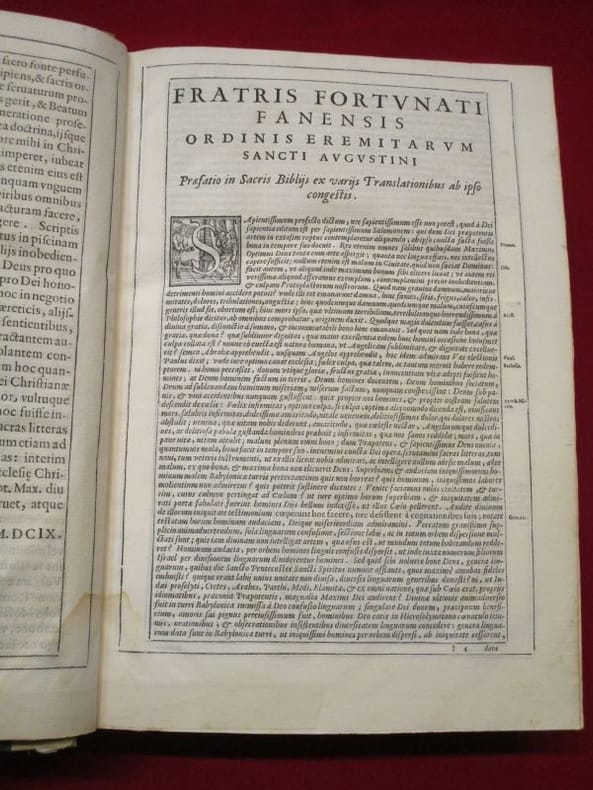
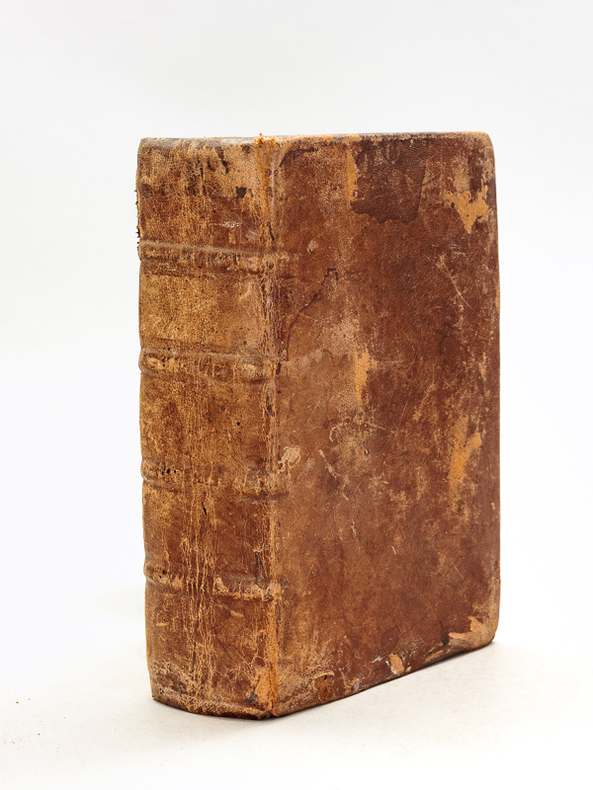
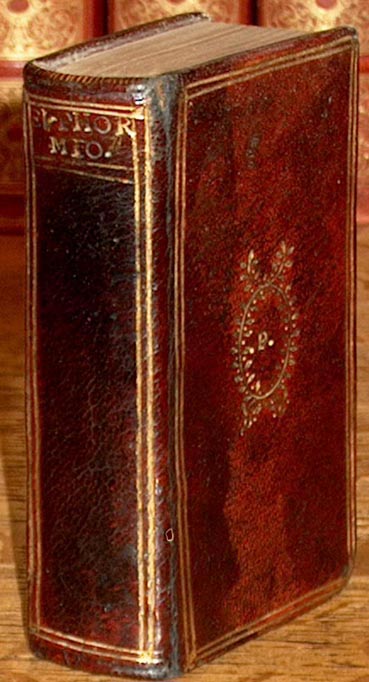
160965442Hac secunda Editione auctus, 1 vol. petit in-8 reliure de l'époque plein vélin, Apud Io. Pillehotte [ Jean Pillehotte ], Lugduni [Lyon ], 1609, 304 pp. et 4 ff. n. ch.
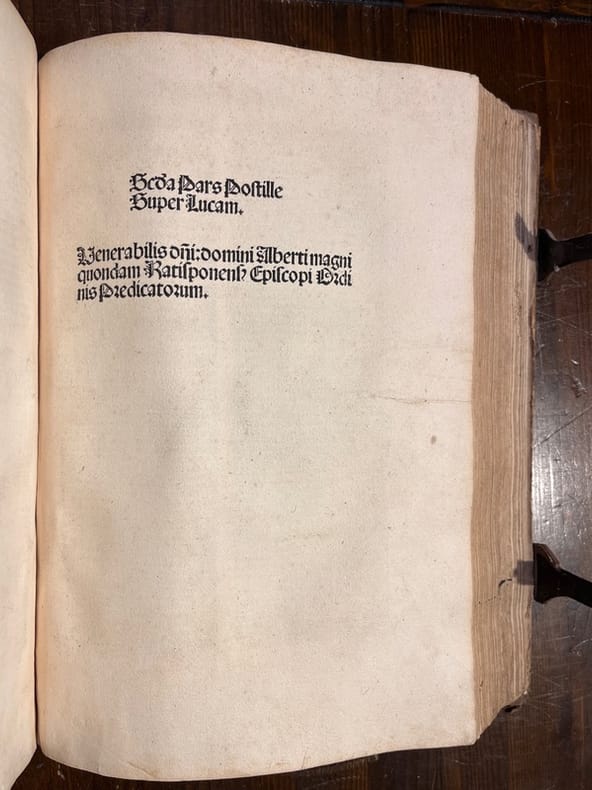
150420871Hagenau, Heinrich Gran für Johann Rynman, 1504. Petit in-folio de [42]; 164; 173 feuillets, plein vélin ivoire estampé à froid sur ais de bois, fermoirs en bronze, dos à nerfs, titre inscrit à l'encre. Nom de possesseur au premier plat.
170813757Hagae Comitum [La Haye], Apud Petrum van Thol, 1708. 2 volumes in-8 de [68]-103-[5]-378; [2]-379 à 855-[167] pages, plein maroquin citron, dos lisse orné de filets et roulette dorée, pièces de titre, de tomaison (et de cote au premier volume) bordeaux, double filets dorés sur les plats, simple sur les coupes, tranches dorées, roulette int. Tampon avec un L couronné répété au début du texte de chaque volume. Coiffes supérieures frottées.
172413756Delphis & Lugdunum Batavorum [Delft ] Leyde], Apud Adrianum Beman [et] Samuelem Luchtmans, 1724. 2 volumes in-4 de [74]-472; [2]-473 à 824-[216] pages, plein maroquin rouge, dos à nerfs ornés de filets et fleurons dorés, triple filets dorés encadrant les plats, double sur les coupes, tranches dorées. Petit manque à une coiffe, quelques petites rousseurs.
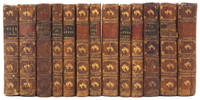
17445955Londini London: Typis J. Brindley 1744. 13 vols 12mo. Title-pages engraved ruled in red throughout. Contemporary red morocco by Brindley’s workshop boards bordered with gilt rules and gilt corner-pieces spines divided by raised bands gilt black morocco labels other compartments tooled centrally in gilt with ‘Golden fleece’ tool marbled endpapers a different pattern in each volume. A little toning in places first gathering of Caesar vol. 2 loose. Bindings rubbed spines dulled some spine ends worn or defective a number of labels lost or chipped several joints cracked but none detached some creasing or cracking to a few spines. Armorial bookplate of Cosmo Gordon Duke of Gordon and more modern Gordon Castle library shelf-labels to pastedowns early shelfmark numbering in ink to head of title-pages. An unusual surviving example of a substantial portion of Brindley’s Latin classics in Brindley’s original trade bindings. This is the first thirteen volumes in the series which was intended to rival the Elzevirs for small format and fine typography and which ultimately reached 24 volumes. Many of them - and all the ones here - were edited by Usher Gahagan d.1749 an Irish scholar of some talent but either poor morals or poor choice of friends; he was arrested with a compatriot in 1748/9 for a plan to file coins and hanged a month later. The series may have gone on longer in his absence had Brindley himself not died in 1759; the last publication in it was a 1760 reissue of the Tacitus of 1754 with Brindley’s successor’s name added to the imprint. Brindley was bookseller and binder to Frederick Prince of Wales entitling him to use the ‘Feathers’ engraving on the title-pages of these volumes. As a binder Brindley also specialised in royal work and used a distinctive dolphin tool in a number of bindings but the ‘Golden fleece’ present on the spines here is another tool regularly used by Brindley especially for copies of his little Latin classics. These were available ready-bound in his shop on New Bond Street and special small shelves to hold them remained in the premises into the 20th century. The elegant variation in endpapers on a set otherwise exactly matchingly bound is an attractive touch. This set represents the complete series as of the end of 1745. A Quintus Curtius followed in 1746 but there was then a pause until after Gahagan’s death with the next volume being the Catullus of 1749. They were probably originally purchased by Cosmo George Gordon 3rd Duke of Gordon 1720-1752 who entered the House of Lords in 1748 and may therefore have been too occupied elsewhere to complete the ongoing series. The full list present is: Horace 1744 ESTC T46227; Virgil 1744 ESTC T139210; Cornelius Nepos 1744 ESTC T83013; Juvenal and Persius 1744 ESTC T123550; Terence 1744 ESTC T137486 - the rarer variant; Julius Caesar 1744 2 vols. ESTC T136731 this the variant state; Sallust 1744 ESTC T133040; Ovid 1745 5 vols. ESTC T99863. Typis J. Brindley hardcover
J.-P. Migne. 1841-1849. In-4 Carré. Relié demi-cuir. Etat passable. Couv. légèrement passée. Dos abîmé. Quelques rousseurs. 1504 + 1176 + 1308 + 1155 + 1028 + 945 + 1484 + 945 + 872 + 1236 + 842 + 992 + 1912 + 1004 + 1260 pages. Tome XL manquant. Texte en latin sur 2 colonnes, chacune étant paginée. Pièces de titre noires et étiquettes de code sur les dos. Auteur, titre, tomaison, fleurons, bandeaux et filets dorés sur les dos. Tranches marbrées. Ex-libris de la Bibliothèque de l'Institut Catholique de Toulouse au dos des 1ers plats. Tampons de bibliothèque en pages de titre. Dos très frottés, avec quelques manques. Quelques dos et plats détachés. Sive Bibliotheca Universalis, Integra, Uniformis, Commoda, Oeconomica, Omnium SS. Patrum, Doctorum Scriptorumque Ecclesiasticorum. Qui ab Aevo Apostolico ad Usque Innocentii III Tempora Floruerunt. Accurante J.-P. Migne. Cum Supplementum (T. XLVII).
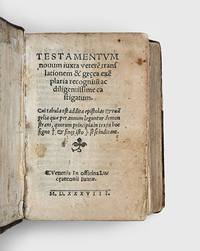
1538165636Venice: by the heirs of Lucantonio Giunti 1538. A miniature edition of the New Testament in the Vulgate from the celebrated Giunta workshop. The printing was begun by Lucantonio Giunta but completed after his death. This is the only book listing both his name and his heirs in the imprint Camerini. Sextodecimo in half sheets 110 x 71 mm. 1-35 A-Z Aa-Bb maltese cross-2maltese cross ; 496 of 497 leaves bound without terminal blank. Contemporary calf covers blocked in bind with cross centrepiece. Spine backing partly lost exposing cords and manuscript backing title browned and contents toned very slight staining towards rear. Still a very good copy. Paolo Camerini Annali dei Giunti 416. unknown
1609115282antonio pinelli 1609 2 in-folio Venetiis (Venise), Antonium Pinellum (Antonio Pinelli), 1609, 2 volumes grands in-4 de 200x290 mm environ, (24) ff. (Titre gravé, Dédicace, divers), 1102 pages, (1) f. (colophon); (4) ff. (Titre gravé, préfaces), 674 pages, (1) f. (colophon), (4) ff. (Titre, préfaces), 326 pages, (34) ff. (Index biblicus). Reliure postérieure, demi-velin à coins, dos lisses ornés de faux nerfs dorés, portant titres dorés sur pièces de cuir rouge, tranches de tête rouges, gardes blanches. De petites taches sur les dos, coupes et coins émoussés, griffures sur les plats, gardes et pages de titres tamponnées, des rousseurs éparses, quelques feuillets avec des traces de mouillures, quelques feuillets restaurés en fin de volume, sinon intérieur propre, bon état général.
156751823Ex Veterib. exemplaribus multo emendatiores, Cum indice copiosissimo, qui etiam locorum communium ac epitomes vicem supplet, 1 vol. in-8 reliure postérieure pleine basane marron, dos muet à 4 nerfs, Apud Andream Wechelum, Paris, 1567, 4 ff., 795 pp. et 16 ff. n. ch. (index et errata)
1967R96475Frankfurt/Main, Minerva 1967 Complete in 7 volumes ; xxxi,415,[ii] + xix,592 + xii,504 + xv,508 + xv,445 + xv,541 + xv,484,[i] pp., re-edition of the original 1900-1908-edition ("Unveränderter Nachdruk"), 27cm., uniform publisher's hardcover bindings in full cloth (gilt lettering on spines, corners slightly bumped, vague spot at lower end of spines), text in Latin, text printed in 2 columns, good condition, text and interior in very good condition, weight: 10kg., rare, R96475
Complete in 7 volumes ; xxxi,415,[ii] + xix,592 + xii,504 + xv,508 + xv,445 + xv,541 + xv,484,[i] pp., re-edition of the original 1900-1908-edition ("Unveränderter Nachdruk"), 27cm., uniform publisher's hardcover bindings in full cloth (gilt lettering on spines, corners slightly bumped, vague spot at lower end of spines), text in Latin, text printed in 2 columns, good condition, text and interior in very good condition, weight: 10kg., rare, R96475
Complete in 12 volumes: xlviii,490 + 429 + 284 + 483 + 510 + 273 + 921 + 640 + 240 + 650 + 507 + 254 pp., 22cm., text in Latin, original softcovers, few foxing (mainly at edges), "Editio nova juxta correctiones annotationesque ipsius Auctoris in Nationali Bibliotheca Parisiensi asservatas", small stamp at verso of title page and on French title page, small loss of paper on frontcover of vol.7, all volumes well protected by extra cristal paper wrappers, good condition, rare, weight: 6kg., [Detailed content: VOLUME I: De Deo in se subsistente, II: De Deo Intelligente et Vcolente, III: De Sanctissimo Trinitatis Mysterio, IV: De Angelis, V: De formatione, et ordinatione Creaturarum corporalium, et de mirando Hominis opificio, VI: De Legibus, VII: De Divini Verbi Incarnatione, VIII: De divino Gratiae beneficio et de Virtutibus, IX: De Sacramentis in genere, X: De Baptismo, De Poenitentia, De extrema Unctione, XI: De Eucharistia et Confirmatione, XII: De Ordine et Matrimonio], R98191
1605T68134Lipsiae, Vögelin 1605 [ et suppellex instructissima verborum, locutionum, rerum, sententiarum, exemplorum, eorumque omnium, quae tum docentibus tum discentibus adminiculo utilissimo esse, atque ad eruditionem negocio facili & expedito comparandam facere possunt. Cum adiuncta in plerisque locis interpretatione Germanica nota, usitata, accommoda & eleganti Addita est & epistola, post dedicatoriam, ad lectorem, in qua ratio ac forma totius operis & ut summo cum fructu quis uti eo possit, modus explicatur], [12] + 752 + 112pp. + [2]pp., 33cm., full contemporary vellum with blindstamped decorations (with few small wormholes), engraved vignette on title page and full page printer's device on last page, text printed in two columns, few wormholes in margin of some pages (not affecting the text), a library stamp and two handwritten ex-libris on title page, bilingual: Latin-German with some Greek references, good copy, [This "Thesaurus" - one of the first bilingual dictionaries - is the principal work of the Lutheran Basil Faber, born in 1520 in Lusetia (Silesia), died in 1575/1576. The first edition dates from 1571. This copy is the seventh edition (1605)], T68134
[… et suppellex instructissima verborum, locutionum, rerum, sententiarum, exemplorum, eorumque omnium, quae tum docentibus tum discentibus adminiculo utilissimo esse, atque ad eruditionem negocio facili & expedito comparandam facere possunt. Cum adiuncta in plerisque locis interpretatione Germanica nota, usitata, accommoda & eleganti… Addita est & epistola, post dedicatoriam, ad lectorem, in qua ratio ac forma totius operis & ut summo cum fructu quis uti eo possit, modus explicatur], [12] + 752 + 112pp. + [2]pp., 33cm., full contemporary vellum with blindstamped decorations (with few small wormholes), engraved vignette on title page and full page printer's device on last page, text printed in two columns, few wormholes in margin of some pages (not affecting the text), a library stamp and two handwritten ex-libris on title page, bilingual: Latin-German with some Greek references, good copy, [This "Thesaurus" - one of the first bilingual dictionaries - is the principal work of the Lutheran Basil Faber, born in 1520 in Lusetia (Silesia), died in 1575/1576. The first edition dates from 1571. This copy is the seventh edition (1605)], T68134
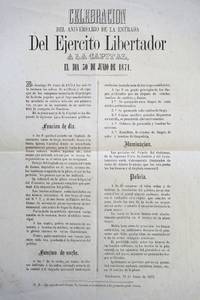
1872List1815Guatemala City 1872. Broadside measuring 17 ¼ x 13 ½ inches. Vertical fold to center some loss and foxing to left upper portion very good plus overall. An unrecorded broadside announcing the first celebration of the Día del Ejército de Guatemala a holiday celebrating the defeat of the dictator Vicente Perna. This broadside also mentions the success of the campaign in Honduras as a reason for the celebration. The text gives an extensive description of the day’s festivities with celebrations including the military band and a puppet theater for children. The rules for the evening include no selling of alcoholic beverages and no one entering the plaza on horseback. The holiday still exists today and became a center of controversy following the Guatemalan Civil War. unknown
1604WRCLIT65625London: Excudebat Valentinus Simsius 1604. 48144149-7364 blank14pp. Blank A1 present Y1-2 not present but pagination continuous errors in numbering in signature 2S final blank not present. Small octavo. Contemporary calf ruled in gilt with gilt devices on each panel and initials 'I.O.' and "T.V.' on front and rear boards rebacked with remnants of original gilt backstrip and label laid down. Small ink spot on A6 occasional marginal discolorations faint tidemark in upper outer quadrant 2b and shallower scattered discolorations along some fore-margins toward end clean marginal tear without loss in 2T3 short repairs to marginal tears in A1 early ink name on A1 and ink identification of "Brydges" on title; title possibly supplied from a slightly smaller copy; yet a good sound copy. First edition of this Latin version of the New Testament translated/edited by John Bridges Bishop of Oxford 1535/6 - 1618. After a career of publications on Church government engagement in pamphlet exchanges and similar matters Bridges began work on this rendering of the text into Latin hexameters in 1599. In this copy leaves L8 M1 and T7 are in their canceled states. The sole edition reported in ESTC and an uncommon edition as well: ESTC locates only nine copies in North America. ESTC S106573. STC 3735. Excudebat Valentinus Simsius hardcover books
177410669Goettingae: Recudi fecit vidua b. Abr. Vandenhoeck 1774. 4to 23 cm. 2 494 pp. <br><br>Signed presentation copy from the Rev. Edward Bouverie Pusey Regius Professor of Hebrew Oxford University dated 1835. Edited by Simon de Magistris. Greek and Latin text printed in parallel columns. Illustrated with an engraving on p. 104 and engravings of Greek coins on p. 194. WorldCat locates only one copy of this edition in U.S. libraries. <br>Â Â Â Â <br>Â Â Â Â Not in Darlow & Moule but see 4760 for the 1773 edition and 4759 for the first edition. Contemporary plain wrappers paper over spine chipped and with lengthwise cracks; binding coming apart with final 14 pages separated. Gift inscription dated 1835 on verso of title-page. Bookplate of a theological seminary on inside of front cover. Some pages unopened. Foxed. Dog-eared. => Uncut mostly unopened copy. Recudi fecit vidua b. Abr. Vandenhoeck unknown books
1910CA01065 volumes: volume 1 Texto: xx607 pages with frontispiece portraits illustrations facsimiles maps and plates; volume 2 Documentos: 552 pages; volume 3 Vida de Ercilla: 337 pages with portraits illustrations and index; volumes 4-5 Illustrations: 512 pages with facsimile titles to the first publications; 559 pages with facsimile signatures plates and index. Folio 15" x 10 3/4" with original wrappers bound in to cloth binding. Compiled and arranged by Jose Toribio Medina. First edition.<br /><br />La Araucana is an epic poem in Spanish about the Spanish conquest of Chile by Alonso de Ercilla; it is also known in English as The Araucaniad. It was considered the national epic of the Kingdom of Chile and one of the most important works of the Spanish Golden Age Siglo de Oro. The poem consists of 37 cantos that are distributed across the poem's three parts. The first part was published in 1569; the second part appeared in 1578 when it was published with the first part; the third part was published with the first and second parts in 1589. The poem shows Ercilla to be a master of the octava real the complicated stanza in which many other Renaissance epics in Castilian were written. A difficult eight-line unit of 11-syllable verses that are linked by a tight rhyme scheme the octava real was a challenge few poets met. It had been adapted from Italian only in the 16th century and it produces resonant serious-sounding verse that is appropriate to epic themes. The work describes the initial phase of the Arauco War which was born as a Spanish conquests attempt not at all comparable in importance to those of Hernán Cortés who helped conquer the Aztec empire and Francisco Pizarro who initiated the overthrow the Inca empire. Contrary to the epic conventions of the time however Ercilla placed the lesser conquests of the Spanish in Chile at the core of his poem because the author was a participant in the conquest and the story is based on his experiences there. On scraps of paper in the lulls of fighting Ercilla jotted down versified octaves about the events of the war and his own part in it. These stanzas he later gathered together and augmented in number to form his epic. It was the first poem of its kind written by a participant in the course of the events narrated and the first to immortalize the beginnings of a modern country. In the minds of the Chilean people La Araucana is a kind of Iliad that exalts the heroism pride and contempt of pain and death of the legendary Araucanian leaders and makes them national heroes today. Thus we see Ercilla appealing to the concept of the "noble savage" which has its origins in classical authors and took on a new lease of life in the renaissance - c.f. Montaigne's essay Des Canibales and was destined to have wide literary currency in European literature two centuries later. He had in fact created a historical poem of the war in Chile which immediately inspired many imitations.<br /><br />La Araucana is deliberately literary and includes fantastical elements reminiscent of medieval stories of chivalry. The narrator is a participant in the story at the time a new development for Spanish literature. Influences include Orlando furioso by Ludovico Ariosto. Also features extended description of the natural landscape. La Araucana's successes—and weaknesses—as a poem stem from the uneasy coexistence of characters and situations drawn from Classical sources primarily Virgil and Lucan both translated into Spanish in the 16th century and Italian Renaissance poets Ludovico Ariosto and Torquato Tasso with material derived from the actions of contemporary Spaniards and Araucanians. The mixture of Classical and Araucanian motifs in La Araucana often strikes the modern reader as unusual but Ercilla's turning native peoples into ancient Greeks Romans or Carthaginians was a common practice of his time. For Ercilla the Araucanians were noble and brave—only lacking as their Classical counterparts did the Christian faith. Caupolicán the Indian warrior and chieftain who is the protagonist of Ercilla's poem has a panoply of Classical heroes behind him. His valour and nobility give La Araucana grandeur as does the poem's exaltation of the vanquished: the defeated Araucanians are the champions in this poem which was written by one of the victors a Spaniard. Ercilla's depiction of Caupolicán elevates La Araucana above the poem's structural defects and prosaic moments which occur toward the end when Ercilla follows Tasso too closely and the narrative strays from the author's lived experience. Ercilla the poet-soldier eventually emerges as the true hero of his own poem and he is the figure that gives the poem unity and strength. The story is considered to be the first or one of the first works of literature in the New World cf. Cabeza de Vaca's Naufragios—Shipwrecked or Castaways for its fantastical/religious elements it is arguable whether that is a "traveler's account" or actual literature; and Bernal Díaz del Castillo's Historia verdadera de la conquista de Nueva España The Conquest of New Spain. La Araucana's more dramatic moments also became a source of plays. But the Renaissance epic is not a genre that has as a whole endured well and today Ercilla is little known and La Araucana is rarely read except by specialists and students of Spanish and Latin American literatures and of course in Chile where it is subject of special attention in the elementary schools education both in language and history. La Araucana makes Chile the only American country that was founded under the lights of an epic poem. <br /><br />Condition:<br /><br />Bound in red cloth with original wrappers bound in. Volume one first 15 pages closed tear at heal repaired back page fore edge repaired. A very good set. Imprenta elzeviriana hardcover
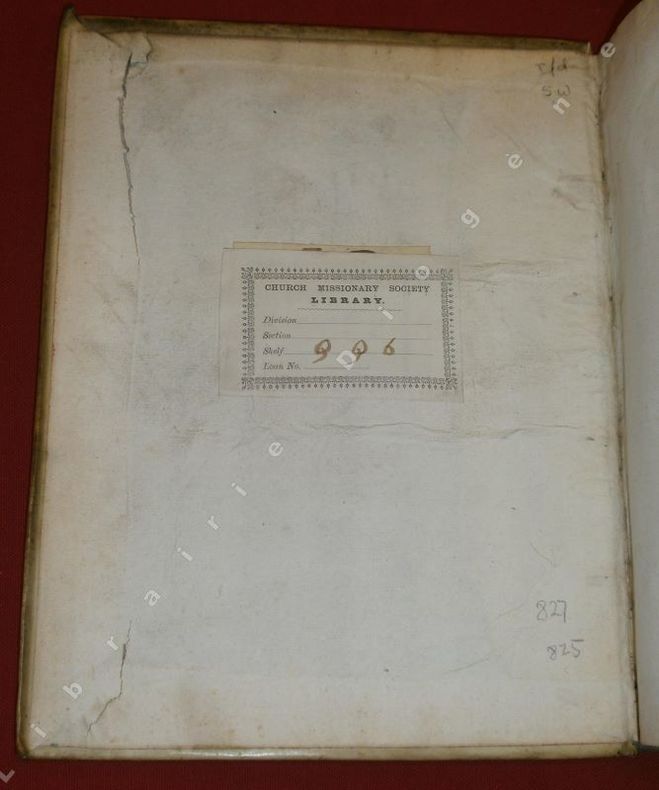
96284Tiguri Helvetiorum,Joannis Heideggeri 1 Co., 1730-1733, 4 volumes in-4 de 265x200 mm environ, Tome I. (2) ff., 1 frontispice, (63) ff; (titre en rouge et noir, dedicatio, praefatio, prefationes, prolegomena, praefatio), 503 pages, (2) ff.,- Tome II : (2) ff., (58) ff. (titre, prolegomena), 670 pages, (2) ff., - Tome III : (2) ff., 1 frontispice, (39) ff. (titre en rouge et noir, prolegomena, praefatio), 440 pages, (2) ff., - Tome IV : (2) ff., (51) ff. (titre, prolegomena, praefatio, postscriptum), 373 pages (2) ff., (reliés en plein vélin crème à recouvrements d'époque, décorés du monogramme de la Church Missionary Society sur les plats et ex-libris de la même sur le premier contreplat, titres à froid sur le dos, tranches rouges. Complet des deux frontispices identiques (tome I et III). Quelques rousseurs légères et mouillures très claires dans les marges, petites traces sur les couvertures, sinon bon état.
17477570BBVenedig, Nicolo Pezzana, 1747. 2°. Bd. 1: Titel mit grosser gest. Vignette, gest. Frontispiz, gest. Kopfstück (von Francesco Zucchi), (18) Bl., 335 S. (recte 670); Bd. 2: VIII S. (1) S. Inhalt, 295 S. (recte 590), S. 296-32, S. 228-337 (recte 218), S. 338-369, S. 370-404 (recte 70), S. 404-474; Bd.3: VIII S., (1) S. Inhalt, 499 S. (recte 998); Bd. 4: Titel: Novum Jesu Christi Testamentum complectens praeter Vulgatam, Guidonis Fabrici è Syriaco, et Benedicti Ariae Montani translationes, insuper Desiderii Erasmis Roterodami auctoris damnati versionem permissam. XV S., 326 S. (recte 652). Halbpgt. d. Zt., rote und grüne Rückenschildchen, mit einfacher Goldprägung. + Wichtig: Für unsere Kunden in der EU erfolgt der Versand alle 14 Tage verzollt ab Deutschland / Postbank-Konto in Deutschland vorhanden + 4 Bde.
1875R118544Parisiis [Paris], Apud Ludovicum Vives 1875-1876 complete in 6 volumes : x,719 + 700 + 901 + xix,746 + xv,776 + xxxi,746 pp., text in Latin, uniform and solid contemporary hardcover bindings (spines in leather, marbled boards in 'tree calf' design, some corners bit bumped), backcover of vol.3 missing some covering paper, decorated endpapers, 28cm., stamp on French title page, text is clean and bright, "Editio novissima recognita cum indice rerum necessario", [cfr. De Backer-Sommervogel, I-252 & VIII-1621-4 (supplement), Alvarez de Paz Jacques S.J., born at Toledo in 1560, teached philosophy and theology in Lima, became Provincial of Peru, died on 17 January 1620 at Potosi], [CONTENT: Tomus I-II: De vita spirituali ejusque perfectione libri quinque, Tomus III-IV: De exterminatione mali et promotione boni libri quinque, V-VI: De inquisitione pacis sive studio orationis libri quinque], weight: 11 kg., R118544
1612001041S.l. s.n. 1612
15741124921574 Genevae (Genève), Apud Eustathium Vignon (Eustache Vignon), 1574, 1 volume in-4 de 180 x 250 mm environ, (12) ff. (page de titre, Epistola, Praefatio), 440 pages, écrit en latin avec un sens de lecture de la gauche vers la droite mais texte imprimé et paginé de la droite vers la gauche. Plein vélin souple d'époque au dos muet, traces de lien. Reliure en état d'usage (quelques taches sur les plats et une étiquette papier collée sur le plat supérieur, un coin plié), tampon de bibliothèque répété, annotations à l'encre pages 40-41-57-59, légères traces de mouillures aux coins d'une dizaine de feuillets, plus importantes sur 7 feuillets (p.195 à 208), discrets trous de vers, déchirure marginale sans atteinte au texte p. 304. Bel état pour cet ouvrage d'érudition rare.
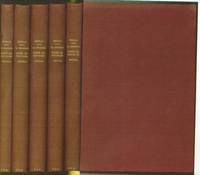
Complete series in 13 volumes: together ca. 9000 pages, text printed in 2 columns, 28cm., uniform 19th cy. hardcover bindings (marbled boards, spines in black leather, gitl title at spines), small stamp, some foxing (text always well readable), text in Latin, good condition, weight is over 20kg., R92276
1932H96670Insulae Liri, ex Offic. Typogr. A. Macioce e Pisani 1932 451pp., with autograph inscription in black ink on first blanco endpaper: "Donum Sanctitatis Suae Pii Papae XI Episcopo Harlemensi J.D.J. Aengenent in audientia illi concessa, die 3a Novembr. 1932", PAPAL BINDING : red full-leather hardcover binding, gilt blind-tooled decorations on boards, papal coat of arms (of Pius XI) on front board, gilt title on spine, gilt tooled decorated doublure margins, all edges gilt, endpapers with flower design, small wormhole on lower end of front joint, few marginal stains on cover, 32cm., text in Latin, text clean and bright, very good condition, [This copy was presented by pope Pius XI to the bishop of Haarlem (Netherlands) Joannes Aengenent, during his audiency on the 3rd of November 1932 (cfr. inscription)], H96670