26 128 résultats
1621R119850Köthen, Cothenis Anhaltinorum 1621 [8] + 843 pp., printer's device of ornamental fleur-de-lis on title page, head pieces, 25x19cm., Text of the New Testament in old Syriac (Peshitta version) with parallel text of Latin translation by Tremellius at the foot of the page as well as a select list of various readings prepared by Martin Trost, The Syriac text is printed in large type, pagination and register read front to back, contemporary full vellum binding (intact except for a minor defect at spine, somewhat soiled), text is clean and bright except for few minor occasional foxing and stains, good condition, cfr. OCLC 247662296, weight: 1.5 kg., R119850
Lutetiae, Rob. Stephani, 1544, 16 hojas incluso mapas de España y Francia y varios grabados en madera intercalados en el texto + 522 págs. + 54 hojas ? (Sigue:) Eutropii Epitome Belli Gallici ex Suetonii Tranquilli monumentis quae desideratur. Lutetiae, Roberti Stephani, 1544, 134 págs. + 9 hojas ? (Sigue:) Iustini ex Trogi Pompeii Historiis externis libri XXXXIII. Parisiis, Rob. Stephani, 1543, 267 págs. + 14 hojas. Las tres obras en un tomo, 17,5 x 11 cm., plena piel de época algo gastada, adornos e hilos dorados en ambas tapas.
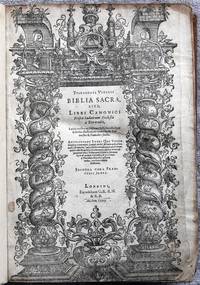
15934599Londini: Excudebant G. Bishop R. Newbery & R. Barker An. Dom. 1593. 1593. 1593 Folio. Collates para4A-P6 2A-2S6 3A-3M6 3N4 4A-4V6 4X4 5A-5L6 5M8 A-2K6 2L4. In six parts each with divisional title page and separate pagination or foliation. The title pages to the Old Testament read "Bibliorum pars secunda -tertia quarta ." and "Libri apocryphi sive appendix Testamenti Veteris .". The divisional titles to part 4 and the Apocrypha are dated 1592. That to the New Testament reads "D.N. Jesu Christi Testamentum Novum ." and bears the imprint "Londini excudebant reg. typograph. Anno salutis humanæ 1592.". Tremellius's and Be`ze's versions of the New Testament are printed in parallel columns. P6 2S6 4X4 and 2L4 are blank. Bound in modern tan goatskin with handmade paper endpapers. Old endpapers preserved. Titlepage laid down with minor loss at lower corner. Some wear to lower blank corners at both ends of the volume evidence of its having been disbound fora considerable time. Occasional unobtrusive ink marka and a few other signs of use but the contents generally clean and crisp. A very good copy. STC 2061.5. Londini: Excudebant G. B[ishop] R. N[ewbery] & R. B[arker], An. Dom. 1593. unknown
1574096271Excusum Londini: by Thomas Vautrollerius per assignationem Francisci Floræ 1574. STC 16427. A revised translation by Walter Haddon of the first prayer book of Edward VI.At foot of title: Cum priuilegio Regiæ Maiestatis. Calendar printed in red and black. Liber Psalmorum Davidis prophetae et regis. ." has separate title page with date 1574 on leaf 2A4r. In this issue leaf 2P3r lacks colophon. Another issue STC 16427 has colophon: Londini excudebat Thomas Vautrollerius. 1574. Book measures 6 x 4 inches. 28 299 leaves engraved title page. Bound in full leather. Professionally rebound not recently retaining most of the leather from the original or early top board calf light rubbed some loss of leather on corner of top board. Generally a very good clean firm binding. Internally small abrasion hole on margin of title page minor repair to inner margin of title page early annotaion in ink partially erased on verso of title some light browning to edges of about 10 pages. Pages in very good clean condition throughout. A very nice copy. Full Leather. Very Good. Small 8vo. by Thomas Vautrollerius] per assignationem Francisci Floræ Hardcover
1725578201 vol. in-4 reliure pleine basane mouchetée de l'époque, dos restauré à 5 nerfs, Apud Joh. et Herm. Verbeek, Lugduni Batavorum [ Leyde ], 1725, 2 ff., 636 pp. et 6 ff. n. ch. avec 47 planches dépliantes (12 pour la physique, 29 pour l'astronomie dont la belle carte de la lune), 6 pour la trigonométrie
1 vol. in-4 reliure pleine basane mouchetée de l'époque, dos restauré à 5 nerfs, Apud Joh. et Herm. Verbeek, Lugduni Batavorum [ Leyde ], 1725, 2 ff., 636 pp. et 6 ff. n. ch. avec 47 planches dépliantes (12 pour la physique, 29 pour l'astronomie dont la belle carte de la lune), 6 pour la trigonométrie Bon exemplaire (restaurations de qualité en dos et plats, qq. petits frott. ou brunissures mais très agréable exemplaire). "Keill's role as propagator of Newtonian philosophy was carried out primarily through his major work, Introductio ad veram physicam [first published in 1701 ], based on the series of experimental lectures on Newtonian natural philosophy he had been giving at Oxford 1694". With a fine map of the moon. DSB, VII, 275-276 Latin
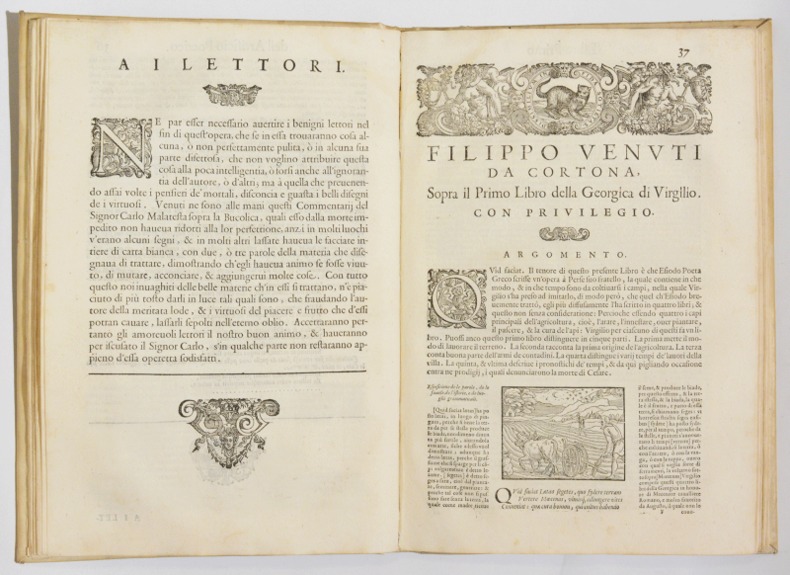
15880048811588 In Venetia [Venise], Appresso gli Heredi di Marchiò Sessa, 1588. Petit in-folio (212 X 304 mm) vélin rigide ivoire à coutures apparentes, lettre «V » peinte et dorée, dans un cadre peint et doré, en tête du dos (reliure de l'époque) ; (1) f. blanc, (100) ff. dont titre. Pointes de taches noires au dos, quelques petits trous de vers sur les mors de la reliure, infime travail de ver dans la marge latérale gauche et petit manque en lisière de la marge de tête du feuillet de titre, petit travail de ver aux trois derniers feuillets avec perte de quelques lettres, tampon encré en grande partie illisible sur le premier feuillet blanc, petite mouillure brune en lisière de la marge latérale des feuillets 38 à 54 avec quelques petits manques de papier ; ex-libris et mention manuscrits à l'encre brune en marge du titre.
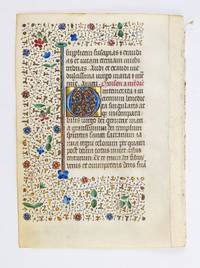
1475ST19653NNorthern France ca. 1475. 155 x 110 mm. 6 x 4 1/4". Single column 16 lines in a gothic book hand. <br/> Rubrics in dark pink ONE EXQUISITE FOUR-LINE INITIAL painted blue with white detailing filled with red and blue vines and leaves on a burnished gold ground with a painted and gilt bar border on one side each end capped with a flower the text surrounded on three sides with a border of acanthus leaves dense rinceaux colorful flowers gold ivy leaves and bezants. A couple negligible imperfections but IN VERY FINE CONDITION<br/> <br/> One of the most popular optional prayers in the 15th century Book of Hours "O Intemerata" "Oh immaculate virgin" is a brief supplication in which the Virgin is glorified for her purity as the "unspotted and forever blessed singular and incomparable Virgin Mary Mother of God." The present leaf is given special emphasis with the presence of a three-quarter rinceaux border surrounding the text and the opening of the prayer is marked by an especially pretty and finely detailed initial that glitters with burnished gold. The leaf is unusually beautiful precisely rendered and in very fine condition. unknown
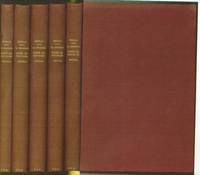
1924R120445Ad Claras Aquas (Quaracchi), Ex typographia collegii S. Bonaventurae 1924-1948 Complete work [tomus I-IV, bound in 5 physical volumes]: xlv,769 + lxiv,801 + lviii,858 + ccclxx + ix,1170pp., title in red and black, 33cm., text printed in 2 columns, small stamp on title page, solid hardcover bindings in half-cloth (spines bit soiled, with a vague trace of a removed small label), decorated endpapers, text in Latin, interior is clean and bright, [full title of the work: Doctoris irrefragabilis Alexandri de Hales ordinis minorum Summa Theologica seu sic ab origine dicta "Summa fratris Alexandri", Tomus I: liber primus. Tomus II: prima pars secundi libri. Tomus III: secunda pars secundi libri. Tomus IV: liber tertius (prolegomena). Tomus IV: liber tertius (textus)], weight: 14kg., R120445
1882R75240Ad Claras Aquas (Quaracchi), Ex typographia Collegii S. Bonaventura 1882-1902 Complete series except for the rare volume 9 (volumes 1, 2, 3, 4, 5, 6, 7, 8, 10 + 1 volume of indices), uniformally bound in cart.cover, leather spine with gilt lettering, some defects on spines, joints of vol.8 split and repaired, few foxing and stamps, copy from the library of the Belgian medievalist Raymond Macken O.F.M. with his signature, good condition, [CONTENTS: Volume 1: Commentaria in quatuor libros sententiarum magistri Petri Lombardi: in primum librum sententiarum, 1882, lxxxvii + 871pp. // Volume 2: Commentaria in quatuor libros sententiarum magistri Petri Lombardi: in secundum librum sententiarum, 1885, 1026pp. // Volume 3: Commentaria in quatuor libros sententiarum magistri Petri Lombardi: in tertium librum sententiarum, 1887, 905pp. // Volume 4: Commentaria in quatuor libros sententiarum magistri Petri Lombardi: in quartum librum sententiarum, 1889, 1067pp. // Volume 5: Opuscula varia theologica, 1891, 606pp. // Volume 6: Commentarii in Sacram scripturam, 1893, 640pp. // Volume 7: Commentarius in evangelium S. Lucae, 1895, xviii, 857pp.with ills. // Volume 8: Opuscula varia ad theologiam mysticam et res ordinis fratrum minorum spectantia, 1898, cxxiv + 757pp. // Volume 10: Operum omnium complementum, 1902, 277pp. // Indices in tomos I-IV operum omnium S. Bonaventurae, 1901, 502pp.], Total weight of this series: 40kg. (extra shipping expenses apply), R75240
Complete series except for the rare volume 9 (volumes 1, 2, 3, 4, 5, 6, 7, 8, 10 + 1 volume of indices), uniformally bound in cart.cover, leather spine with gilt lettering, some defects on spines, joints of vol.8 split and repaired, few foxing and stamps, copy from the library of the Belgian medievalist Raymond Macken O.F.M. with his signature, good condition, [CONTENTS: Volume 1: Commentaria in quatuor libros sententiarum magistri Petri Lombardi: in primum librum sententiarum, 1882, lxxxvii + 871pp. // Volume 2: Commentaria in quatuor libros sententiarum magistri Petri Lombardi: in secundum librum sententiarum, 1885, 1026pp. // Volume 3: Commentaria in quatuor libros sententiarum magistri Petri Lombardi: in tertium librum sententiarum, 1887, 905pp. // Volume 4: Commentaria in quatuor libros sententiarum magistri Petri Lombardi: in quartum librum sententiarum, 1889, 1067pp. // Volume 5: Opuscula varia theologica, 1891, 606pp. // Volume 6: Commentarii in Sacram scripturam, 1893, 640pp. // Volume 7: Commentarius in evangelium S. Lucae, 1895, xviii, 857pp.with ills. // Volume 8: Opuscula varia ad theologiam mysticam et res ordinis fratrum minorum spectantia, 1898, cxxiv + 757pp. // Volume 10: Operum omnium complementum, 1902, 277pp. // Indices in tomos I-IV operum omnium S. Bonaventurae, 1901, 502pp.], Total weight of this series: 40kg. (extra shipping expenses apply), R75240
In folio, pp. (24), 374, (1), all’ultima pagina marca tipografica incisa su legno; con l’aggiunta di due carte manoscritte datate bologna 1553 che contengono un’epistola di Rigus a Francesco Cospo, in cui l’autore della lettera sostiene che la traduzione dell prima opera di Diodoro qui pubblicata sia da ascriversi a Angelo Cospo e non a Bartolomeo, come indica il frontespizio, che infatti è stato corretto a mano dallo stesso. Il grecista bolognese Cospo fu variamente chiamato anche Angelo Bartolomeo. LEgatura in piena pergamena. Al frontespizio piccola lacuna restaurata in corrispondenza di un legno ovale. fori di tarlo alle prime e ultime carte.
1611P1-2E-4Lyon, Antoine de Harsy, 1611. In-8 (172x103mm), reliure d’époque, plein velin, titre manuscrit au dos, texte en latin et Grec sur 2 colonnes, 7ff.n.c.-470pp.-36ff. index. Bon état.
15776089Neufchâtel, Toussaint du Pré, 1577 In-12 (164 x 97 mm), 57 pp. mal chiffrées 58. Veau havane, dos à nerfs orné, pièce de titre en maroquin brun, tranches rouges, un coin usé, fente de quelques millimètres à un mors, petite tache d'encre dans la marge supérieure de la page de titre, quelques rousseurs (reliure du XVIIe siècle).
9210210492New. Brand new and still unused unknown
27909N.p.: S.i. 2009. Original silkscreened poster text printed in black on thin powder gray stock made with coca leaf pulp measuring 49.75cm x 70cm 19.5" x 27.5". Old folds smoothed out small unobtrusve tear at center with faint smudge at upper left corner; very Near Fine / A-. Collaborative work created by Colombian artist Wilson Díaz and San Francisco native Amy Franceschini. In 2009 Franceschini an artist and educator in her own right received an Art Matters grant for support in traveling to Cali Colombia to work with Díaz on a new body of work titled Movement of the Liberation of the Coca Plant MLCP. The two have been involved in creating a number of conceptual works which communicate the various political social and economic powers at play around the conservation and perpetuity of the coca plant from which cocaine is derived. Díaz has been known for incorporating pigment extracted from coca seeds into his works as well creating works on paper made with coca leaf pulp highlighting some of the plants traditional non-illicit uses. S.i. unknown
196787336Santiago: Editorial Cooperativa Lambda 1967. First Edition. Octavo 24cm. Coated card wrappers with French flaps; unpaginated 193pp; illus. Very light wear to covers; internally complete and clean but for a few faint pencil marginal markings by the previous owner the noted poet and translator Nathaniel Tarn. Near Fine. Text entirely in Spanish.<br /> <br /> A collaborative book-length work combining poetry and conceptual imagery; published anonymously but compiled and edited primarily by Chilean avant-garde poet Godofredo Iommi. "Amereida" a composite neologism for "American Aeneid" is a conceptual chronicle of a literal cross-country trek from Tierra del Fuego to Southern Bolivia undertaken in 1965 by a group of like-minded poets architects designers philosophers and artists including Iommi 1925-2001 the architect Alberto Cruz 1917-2013 sculptor Claudio Girola 1923-1994 French philosopher François Fédier 1935-2021 and numerous others. Many of the participants in this first "Travesia Amereida" had originally coalesced around the surrealist group in post-war Paris and were later responsible for modernizing the faculty and curriculum of the College of Architecture at the Universidad Católico de Valparaíso. In 1971 the group founded an intentional community the "Ciudad Abierta" "Open City" in Ritoque Chile some kilometers southwest of Valparaíso; the community is still in existence and the tradition of the "Travesias" continues with annual journeys through the South American wilderness that become stages for performance poetry readings and art installations. La Ciudad Abierta quoting the editorial introduction to the poem in the Oxford Book of Latin American Poetry ".is probably the only site in the world where architecture is conceived as an outgrowth of poetry" OBLAP p.362ff. The current volume nominally the community's founding document is notoriously scarce almost never encountered in commerce; OCLC locates only about a dozen holdings worldwide 8 in North America. Editorial Cooperativa Lambda unknown
9756<p>Small 4to broadside tipped onto a stiff blank leaf. Spanish text. Bound in 1/2 gilt stamped red morocco over matching cloth spine with raised bands covers ruled in gilt. Fine. Later black cloth slipcase. Scarce. Rare broadside of the Latin American struggle for independence. Carrera 1785-1821 principal leader in the early fighting for Chilean independence where his experience in the Napoleonic Wars secured his place as head of the nationalist government; later his arrogance produced dissentions with other leaders and his rivalry with Bernardo O'Higgins led to the defeat of the nationalist forces at Rancagua in 1814.</p> [Santiago, n.p., ca. 1819] hardcover books
1910CA01065 volumes: volume 1 Texto: xx607 pages with frontispiece portraits illustrations facsimiles maps and plates; volume 2 Documentos: 552 pages; volume 3 Vida de Ercilla: 337 pages with portraits illustrations and index; volumes 4-5 Illustrations: 512 pages with facsimile titles to the first publications; 559 pages with facsimile signatures plates and index. Folio 15" x 10 3/4" with original wrappers bound in to cloth binding. Compiled and arranged by Jose Toribio Medina. First edition.<br /><br />La Araucana is an epic poem in Spanish about the Spanish conquest of Chile by Alonso de Ercilla; it is also known in English as The Araucaniad. It was considered the national epic of the Kingdom of Chile and one of the most important works of the Spanish Golden Age Siglo de Oro. The poem consists of 37 cantos that are distributed across the poem's three parts. The first part was published in 1569; the second part appeared in 1578 when it was published with the first part; the third part was published with the first and second parts in 1589. The poem shows Ercilla to be a master of the octava real the complicated stanza in which many other Renaissance epics in Castilian were written. A difficult eight-line unit of 11-syllable verses that are linked by a tight rhyme scheme the octava real was a challenge few poets met. It had been adapted from Italian only in the 16th century and it produces resonant serious-sounding verse that is appropriate to epic themes. The work describes the initial phase of the Arauco War which was born as a Spanish conquests attempt not at all comparable in importance to those of Hernán Cortés who helped conquer the Aztec empire and Francisco Pizarro who initiated the overthrow the Inca empire. Contrary to the epic conventions of the time however Ercilla placed the lesser conquests of the Spanish in Chile at the core of his poem because the author was a participant in the conquest and the story is based on his experiences there. On scraps of paper in the lulls of fighting Ercilla jotted down versified octaves about the events of the war and his own part in it. These stanzas he later gathered together and augmented in number to form his epic. It was the first poem of its kind written by a participant in the course of the events narrated and the first to immortalize the beginnings of a modern country. In the minds of the Chilean people La Araucana is a kind of Iliad that exalts the heroism pride and contempt of pain and death of the legendary Araucanian leaders and makes them national heroes today. Thus we see Ercilla appealing to the concept of the "noble savage" which has its origins in classical authors and took on a new lease of life in the renaissance - c.f. Montaigne's essay Des Canibales and was destined to have wide literary currency in European literature two centuries later. He had in fact created a historical poem of the war in Chile which immediately inspired many imitations.<br /><br />La Araucana is deliberately literary and includes fantastical elements reminiscent of medieval stories of chivalry. The narrator is a participant in the story at the time a new development for Spanish literature. Influences include Orlando furioso by Ludovico Ariosto. Also features extended description of the natural landscape. La Araucana's successes—and weaknesses—as a poem stem from the uneasy coexistence of characters and situations drawn from Classical sources primarily Virgil and Lucan both translated into Spanish in the 16th century and Italian Renaissance poets Ludovico Ariosto and Torquato Tasso with material derived from the actions of contemporary Spaniards and Araucanians. The mixture of Classical and Araucanian motifs in La Araucana often strikes the modern reader as unusual but Ercilla's turning native peoples into ancient Greeks Romans or Carthaginians was a common practice of his time. For Ercilla the Araucanians were noble and brave—only lacking as their Classical counterparts did the Christian faith. Caupolicán the Indian warrior and chieftain who is the protagonist of Ercilla's poem has a panoply of Classical heroes behind him. His valour and nobility give La Araucana grandeur as does the poem's exaltation of the vanquished: the defeated Araucanians are the champions in this poem which was written by one of the victors a Spaniard. Ercilla's depiction of Caupolicán elevates La Araucana above the poem's structural defects and prosaic moments which occur toward the end when Ercilla follows Tasso too closely and the narrative strays from the author's lived experience. Ercilla the poet-soldier eventually emerges as the true hero of his own poem and he is the figure that gives the poem unity and strength. The story is considered to be the first or one of the first works of literature in the New World cf. Cabeza de Vaca's Naufragios—Shipwrecked or Castaways for its fantastical/religious elements it is arguable whether that is a "traveler's account" or actual literature; and Bernal DÃaz del Castillo's Historia verdadera de la conquista de Nueva España The Conquest of New Spain. La Araucana's more dramatic moments also became a source of plays. But the Renaissance epic is not a genre that has as a whole endured well and today Ercilla is little known and La Araucana is rarely read except by specialists and students of Spanish and Latin American literatures and of course in Chile where it is subject of special attention in the elementary schools education both in language and history. La Araucana makes Chile the only American country that was founded under the lights of an epic poem. <br /><br />Condition:<br /><br />Bound in red cloth with original wrappers bound in. Volume one first 15 pages closed tear at heal repaired back page fore edge repaired. A very good set. Imprenta elzeviriana hardcover books
1737655171 vol. petit in-8 reliure de l'époque plein veau marbré, dos à 5 nerf orné, reliure vernissée, toutes tranches marbrées, Apud Christ Frid. Weygand , Helmstadt, 1737, 32-160 pp. et 6 ff. n. ch. avec une planche dépliante ("Abacus numeralis" d'Athanase Kircher).
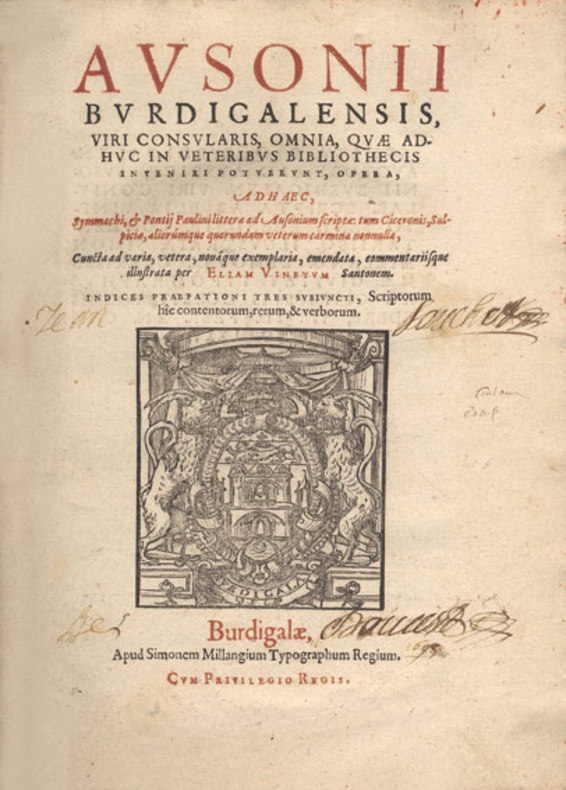
14517Burdigalae (Bordeaux), Simon Millanges, 1575-1580 ; in-4 ; plein veau havane, dos à nerfs décoré de tout petits fleurons à froid, titre manuscrit (reliure de l'époque) ; 394 ff. non chiffrés ; divisé en deux parties : la première des Oeuvres proprement dites de 150 ff. (le dernier avec errata au recto et blanc au verso) et la deuxième, de 244 ff., qui contient les savants commentaires d'Elie Vinet ; titre en rouge et noir, vignette de titre aux grandes armes de Bordeaux, 2 planches dépliantes hors-texte (Palais Tutele et Amphithéâtre de Bordeaux) ; toutes les figures sont gravées sur bois. (signatures :ää-2, A, aaa, ëëë-3 ; ïï-4, öö-4, u.u.-2 ; a-z, A-K-4, dernier feuillet Errata et voblanc, soit 150 ff. ; 2e partie : A-Z, Aa-Zz, AAa-Ppp-4).
167721039Paris F. Muguet 1677 -in-folio plein-veau 2 volumes, reliure d'époque plein veau brun in-folio (binding full calfskin in-folio) (38,5 x 27 cm), dos à nerfs (spine with raised bands), décoré or et à froid (gilt and blind stamping decoration), titre frappé "or" (gilt title) dans un encadrement d'un filet or, tomaison frapée "or" dans un encadrement d'un filet "or" avec rinceaux "or" aux angles, entre-nerfs à fleuron "or" dans un encadrement à filet "or" avec rinceaux "or" aux angles, roulette "or" en place des nerfs avec un filet à froid de part et d'autre, roulette or en tête et en pied, coiffes supérieures du Tome I et II et la coiffe inférieure du Tome I manquantes (head and tail of the spine faded), mors bas fendus au Tome I et mors bas 1er plat du Tome II sur 5 cm, coins écornés (corners dog-eared), toutes tranches lisses (all edges smoothes) jaspées (marbled edges) rouges, TEXTE EN LATIN, orné d'un Titre-frontispice de C. Le Brun gravé sur cuivre par P. Giffart (manquant) + une vignette "aux Armes du Roi" gravées sur bois en noir en bas de la page de titre + grand bandeau et importante lettrine gravée sur cuivre (avec le serpent de Colbert) en tête de la préface + 1 planche dépliante hors-texte gravée sur cuivre en noir (colonne 276 du Tome II + 3 gravures sur cuivre in-texte en demi-page au tome 2 + vignettes sur bois in-texte en noir (monnaies) + nombreux gravures tête de chapitre gravée sur bois en noir par F. CHAUVEAU, lettrines et culs de lampe gravés sur bois en noir, [(66) + 1 ff + 1448 colonnes (pagination à la colonne)] + [ (6) + 1660 colonnes (pagination à la colonne)] pages , 1677 Parisiis : excudebat F. Muguet Editeur,
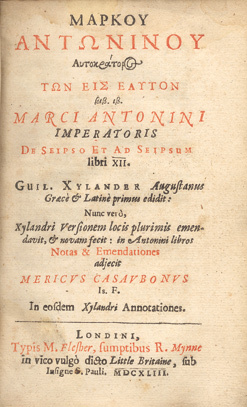
16436506London, Flesher, R. Mynne, 1643 ; petit in-8 ; plein veau glacé havane, dos à nerfs richement décoré et doré, titre doré, double filet doré d'encadrement des plats avec au centre les armes de Louis-Urbain Le Fevre, seigneur de Caumartin, marquis de Saint-Ange, comte de Moret (OHR, 651), roulette sur les coupes (reliure fin du XVIIe - déb. XVIIIe) ; (56), 343, (1 bl.), 148, (4) pp. (bien complet du feuillet blanc qui suit le feuillet de titre).
Complete edition of Cornelius A Lapide's Commentaries on the Bible (21 volumes), together over 13000 pages, 28cm., text in Latin, text printed in 2 columns, uniform modern hardcover bindings (marbled boards, spines in black cloth, small repair at front joint of vol.11 ), few occasional foxing, good condition, [Detailed content: VOLUME 1: In Pentateuchum Mosis, Genesis et Exodus (xvi,cxxxv,765pp.), VOLUME 2: In Pentateuchum Mosis, Leviticus, Numeri et Deuteronomium (xxiii + 610pp.), VOLUME 3: In Josue, Judices, Ruth, in libros Regum I-III (699pp.), VOLUME 4: In librum IV Regum, I et II Paralipomenon, I et II Esdrae, Tobiae, Judith, Esther, I et II Macabaeorum (610pp.), VOLUMES 5-6: in Proverbia Salomonis (xvi,589 + 630pp.), VOLUME 7: In Ecclsesiasten, Canticum canticorum (xix + 615pp), VOLUME 8: In Canticum canticorum et Librum Sapientiae (viii + 714pp., Editio nova 1866), VOLUME 9: In Ecclesiasticum 1-25 (xii + 692pp., Editio nova 1868), VOLUME 10: In Ecclesiasticum 26-51 (664pp.), VOLUME 11: In Isaiam Prophetam (826pp.), VOLUME 12: In Jeremiam, Threnos, Baruch et Ezechielem (926pp.), VOLUME 13: In Danielem, Osee, Joelem, Amos (703pp.), VOLUME 14: In Abdiam, Jonam, Michaeam, Nahum, Hababuc, Sophoniam, Aggaeum, Zachariam, Malachiam (676pp.), VOLUME 15: In SS. Matthaeum et Marcum (x + 775pp.), VOLUME 16: In SS. Lucam et Joannem (vi + 702pp.), VOLUME 17: In Acta Apostolorum (iv + 477pp.), VOLUME 18: Divi Pauli Epistolarum (xx + 686pp., Editio nova 1866), VOLUME 19: In epistolas Divi Pauli (615pp., title page missing), VOLUME 20: Epistolarum Canonicarum (729pp), VOLUME 21: In Apocalypsin S. Joannis (xliii + 460pp)], weight: 32kg., R106917
187281Leyde, Peer Vander Aa, 1693 in-4, [24] ff. n. ch. (titre, dédicace au Grand Duc Côme III, préfaces), 514 pp., [7] ff. n. ch. d'index, avec 18 planches hors-texte, dont un portrait-frontispice, 6 planches de médailles, 3 vues dépliantes et 8 portraits d'Empereurs en médaillon, demi-veau prune, dos lisse orné de filets et guirlandes dorés, ainsi que de larges fleurons et filets à froid, pièce de titre noire, tranches marbrées (rel. du XIXe siècle). Dos légèrement passé, rousseurs, mais bon exemplaire.