SYV, (PEDER PEDERSEN). P.P.Livre Rare Book

19 318 résultats
166356674Kiöbenh(avn), Uden trykker, 1663. Lille 8vo. Samtidigt hellæderbind. Rig rygforgyldning. Forgyldt titelfelt. Skindet krakeleret ved forreste fals således, at bogen er lidt løs, men forpermen sidder stadig fast. Kobberstukket titelblad, der foruden titlen har 11 felter med forskellige fyndord. (10), 200 pp. Titelkobberet med et hul i titellfeltet med tab af nogle bogstaver. Lille hul i de første 2 blade med tab af få bogstaver. De 4 sidste blade med reparation af øverste højre hjørner. De 2 sidste blade med større brunplet. Nogle få spredte brunpletter.
Kolombo (Colombo, Sri Lanka), 1821. 8vo. Original blank blue wrappers. (2),16 pp. Light toning, but a fine copy.
Stockholm, Uppsala, 1878-1988. Indbundet i hpergamentsbd. og hldrbd., 18 bind ialt er heftede. Rygge på enkelte af pergamentsbindene lettere beskadigede.
Kiöbenh(avn), Uden trykker, 1663. Lille 8vo. Samtidigt hellæderbind. Rig rygforgyldning. Forgyldt titelfelt. Skindet krakeleret ved forreste fals således, at bogen er lidt løs, men forpermen sidder stadig fast. Kobberstukket titelblad, der foruden titlen har 11 felter med forskellige fyndord. (10), 200 pp. Titelkobberet med et hul i titellfeltet med tab af nogle bogstaver. Lille hul i de første 2 blade med tab af få bogstaver. De 4 sidste blade med reparation af øverste højre hjørner. De 2 sidste blade med større brunplet. Nogle få spredte brunpletter.
Very Good French Contemporary quarter leather bindings. 4to. (28 x 22 cm). In French, Arabic, Persian, and Ottoman script (Old Turkish with Arabic letters). 3 volumes set: (992 p.; 659 p.; 806 p.). Slight wear and fading on bindings and spines, stains on pages. Overall a good set. First and only edition of this early comprehensive dictionary between multiple Eastern languages of Arabic, Persian and Ottoman Turkish, and French. Handjeri (Hangerli) had begun work on the volumes as early as 1806, upon the request of Armand Charles Guilleminot (1774-1840), a French general during the Napoleonic wars, later ambassador to the Sublime Porte and awarded the Order of St. Anna. He completed the book in 1840 and dedicated it to the Russian Tsar Nicolas I, who had it published at the Russian Imperial press. In the preface of his work, Alexandre Handjeri states that he tried to enrich his dictionary with artistic and technical terms in order to be useful to the travelers and merchants as well as the poets and that his book has distinctive features from previous dictionaries such as Meninsky's dictionary. The book, which was sent to Istanbul for the review of the printing sample, was introduced in Takvîm-i Vekâyi [i.e. the first newspaper published in the Imperial Ottoman] before the first volume was published. Ottoman Sultan Abdülmecid ordered 200 copies in his own name, and also sent a jewel-decorated box to Handjéri as a gift for his service to the Turkish language and culture when the work is published. Handjeri was born in Constantinople, received a thorough education, trained to speak several European languages, as well as Ottoman Turkish and Arabic, and prepared for a high-ranking position in the Danubian Principalities. In his twenties, he married a princess of the Callimachi family. Although coming into conflict with Ottoman officials on several occasions, Handjeri was promoted to the Dragoman of the Porte in 1805 and he maintained the office for the following two years until Sultan Selim III appointed him Prince of Moldavia in place of the deposed Alexander Mourousis. He was nevertheless prevented from reaching his court in Iashi by the Russian occupation of the country, and instead followed the Ottoman Army in their offensive. He was able to gain his throne after the Treaty of Bucharest and played a major part in re-establishing the country's administration. Upon the outbreak of the Greek War of Independence, Handjeri felt threatened by a possible Ottoman move against the Phanariotes. He was allegedly warned by the Russian ambassador to the Porte, Alexander Grigoriyevich Stroganov, that, as a prominent Greek in Istanbul, he risked being assassinated, and so he decided to flee the country. Handjeri and his family (including his two sons, Gregory and Telemach), embarked on a small ship and set sail across the Black Sea, dropping anchor at Odesa (where they were given asylum by Novorossiya's governor, Alexandre Langeron). Soon he moved to Moscow, where he was awarded honors by Emperor Nicolas I. His title was recognized by Russian nobility, and his two sons were appointed Counselors. (Source: Wikipedia).
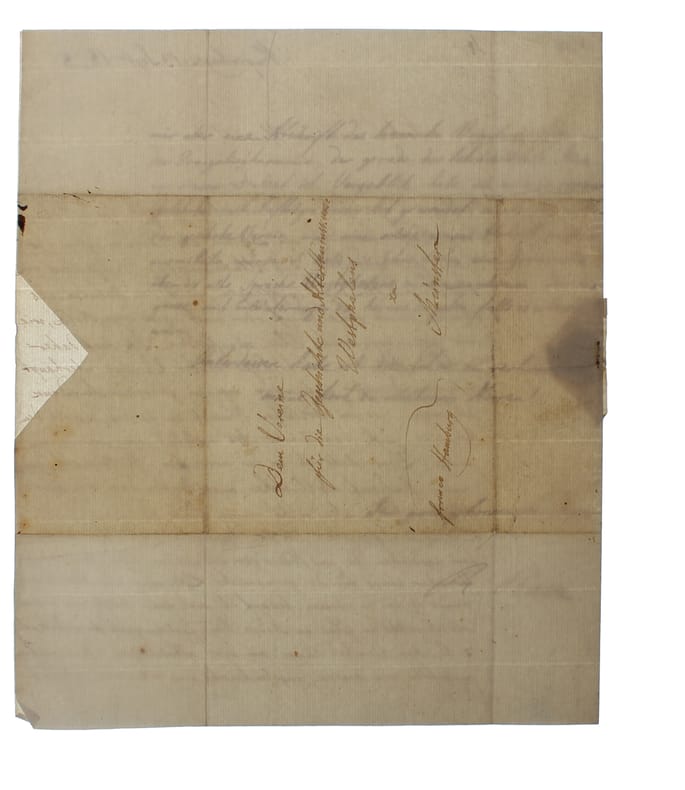
182829131Dated ""Kopenhagen d. 13. Septbr. 1828."" 1 1/2 p. 4to. In German. In the letter Rask expresses great gratitude for having been announced ""Ehrenmitglied [= honorary member] des Vereins für Geschichte und Alterthumskunde Westphalens"""" the membership is effectuated from the 7th of August 1827, and Rask has received the diploma the same day as the letter is written. He describes what a great honor it is for him, and thanks the society many times, expressing his wish to be of use to them. He tells about his love for Scandinavian literature and his membership of the ""nordischen Ges."" and ""isländischen liter. Gesellschaft."" He wishes to live up to the responsibility this diploma gives him, ""[u]m aber etwas für die germanische Literatur oder Alterthums-/ kunde leisten zu können, bedarf ich viel mehr Hilfe von andern/ als ich solche zu geben im Stande bin."" He is currently working on an ""altsächsische Grammatik"", very much similar to his angelsachsische and friesische, but to be able to finish it properly, he is in want of an ""Abschrift des bekannten Bamberger Codex von/ der Evangelienharmonie, der gerade des beträchtlichste Stück von diesem Dialekt ist."" He has, however without luck, tried to get a hold of one and is now asking the society if they can be helpful.
Dated ""Kopenhagen d. 13. Septbr. 1828."" 1 1/2 p. 4to. In German. In the letter Rask expresses great gratitude for having been announced ""Ehrenmitglied [= honorary member] des Vereins für Geschichte und Alterthumskunde Westphalens""" " the membership is effectuated from the 7th of August 1827, and R.R. has received the diploma the same day as the letter is written. He describes what a great honor it is for him, and thanks the society many times, expressing his wish to be of use to them. He tells about his love for Scandinavian literature and his membership of the ""nordischen Ges."" and ""isländischen liter. Gesellschaft."" He wishes to live up to the responsibility this diploma gives him, ""[u]m aber etwas für die germanische Literatur oder Alterthums-/ kunde leisten zu können, bedarf ich viel mehr Hilfe von andern/ als ich solche zu geben im Stande bin."" He is currently working on an ""altsächsische Grammatik"", very much similar to his angelsachsische and friesische, but to be able to finish it properly, he is in want of an ""Abschrift des bekannten Bamberger Codex von/ der Evangelienharmonie, der gerade des beträchtlichste Stück von diesem Dialekt ist."" He has tried to get a hold of one, but without luck, and now asks the society if they can be helpful.
in-4, pp. (8), 700, (12), pergamena coeva, titolo ms. al dorso. Titolo a stampa rossa e nera, impresa tipogr., fregi ed iniziali silografiche ornate, car. tondo. Dedica dello stampatore a Giuseppe Manzoni, ''arciprete di Cologna''. Seconda edizione (la prima Brescia 1577) di opera curiosa ed interessante, assai apprezzata dagli intellettuali del tempo, tradotta in francese da Pierre de Larrivey e pubblicata a Troyes nel 1608. ''L'autore ha diviso i suoi Discorsi in dieci Veglie tenute fra vari amici in Brescia in casa di Ortensio Domizio. Le Veglie V, VI, IX sono curiose per quanto vi è detto sul governo de' maritati, sulla condizione de' maestri e de' pedanti, sugli effetti delle passioni, dell'ira, dell'impazienza, dell'odio, della superbia, ecc. ed entrano di quando in quando in racconti di fatti, detti, ed avvenimenti curiosi'' (Gamba, Novelle ital., n. 32). L'autore (Brescia 1523-1577) fu medico, e letterato, Accademico Occulto di Brescia ed Intronato di Siena, detto il Solingo. Prima di abbandonare la medicina, fu ccusato della morte di numerosi pazienti e corse il pericolo di essere lapidato. Si rifugiò presso l'abate Ascanio Martinengo come lettore di filosofia. Compose numerose "Rime" petrarchesche e cortigianesche (Venezia, 1555), la "Il Dialogo della medicina d'amore" (Brescia, 1566), il "Discorso intorno al disprezzo della morte" (Padova, 1575), e due Canzoni per la battaglia di Lepanto (Venezia, 1572). Bell'esemplare (sul titolo nota di possesso di "mutio fabricius" dell'epoca e traccia di una a penna del 1935). .. Gamba, Novelle ital., n. 32, note. Borromeo, Novellieri ital., I, p. 28-9. Papanti p. 22. Brunet I, 491. DBIt. IV, p. 253-4. Michel-Michel I, 74..
Lyon, chez les Fréres Bruyset, 1732. Dos volúmenes en gran folio; 6 hs., 1656 columnas de texto y 100 columnas de índices + 2 hs., 1570 columnas de texto y 85 columnas de índices. Con un total de 255 viñetas grabadas entre el texto, gran parte de ellas referidas a temas de caza, pesca, agricultura, jardinería y ganadería. Encuadernación uniforme en piel , de la época, con lomeras profusamente ornadas. Noël Chomel fue discípulo de Jean-Baptiste de la Quintinie, jardinero de Luis XIV. Párroco rural y ecónomo del Hôtel-Dieu de Lyon, reunió a lo largo de su vida sus experiencias campestres y domésticas, y publicó a los 76 años, en 1709, este monumental diccionario, traducido a numerosos idiomas, hasta el japonés, pero nunca en español.
Hafniæ, Melchior Martzan, apud Georgium Holst, 1636. 4to. Bound in one fine later (around 1950) hcalf, raised bands, titlelabel with gilt lettering on spine. (20),249,(6) pp. and in the text many illustrations in woodcut. + (Trygveldensi:) (16) pp. and 1 full page illustr. of the stone. First work with browning to titlepage and small tears to margins, no loss. Some scattered brownspots.
[Filologia-Raro] (cm. 23,6) ottima piena pergamena sec. XVII, nervetti e titolo calligrafato al dorso.-- cc. 50, colonne 1268, l' ultima carta con colophon e registro è bianca al verso. Testo su due colonne, magnifica bordura xilografica al frontis raffigurata nel volume "200 decorative title-pages" e citata in "Handbook Renaissance Ornament" tavv. 18-19 dove è attribuita al Taccuini. Bella ed elegantissima edizione della più importante opera del Perottus; essa costituisce un commentario sui libri degli spettacoli ed è un prezioso commento degli epigrammi di Marziale nonchè un lessico ragionato della lingua latina. Sembra che il Perottus avesse rinunciato a terminare il commento di alcuni epigrammi del Marziale perchè saturi di oscenità. L' opera è stampata con singolari e minutissimi caratteri. Alessandro Paganino era in possesso delle matrici e dei punzoni di tipo arabo usati per stampare il Corano. Qualche insignificante macchiolina e lievi tracce di polvere all' inizio e in fine, ma esemplare fresco, bello e nitido ottimamente conservato considerato l' uso pratico cui era destinato. * Sander 5534; * Sandy "Classical Scholarships" II 71; * Baroncelli 24; * Balsamo "Origini del corsivo" pp. 79-101; * Nuovo "Alessandro Paganino" 60; * Choix 12181; * Biblioteca Panizzi 4449; * Brunet IV 506; * Graesse V 205; * Bm. Stc. 499; * Adams P 723.[f49] Libro
15753559FBFrankfurt, von Corvinus für Strada, 1575. 2°. 37 x 25 cm. [12] Blatt, 265 Seiten, [12] Blatt, 35, 207 Seiten. Schweinslederband der Zeit auf fünf Bünden mit handschriftlichem Rückentitel in Tinte. [7 Warenabbildungen]
2 tomi in-folio, pp.(12), 959, 855, buona leg. posteriore m. cuoio e angoli, dorsi a nervi, titoli e fregi oro. Famoso dizionario latino compilato dal frate agostiniano e umanista Ambrogio Calpeino (Bergamo 1435-1510), la cui prima edizione è del 1502. Ristampato varie volte e, quindi, a partire dal 1634, al testo latino vennero aggiunte le versioni ebraica, greca, francese, italiana, tedesca, spagnola e inglese, divenendo un celebre e imponente monumento linguistico. Ottimo esemplare.. Brunet, I, 1473-74..
157757307Wittenberg, [Johann Krafft d. Ä.], 1577. 8°. Mit Holzschn.-Druckermarke a. Titel u. einigen Holzschn.-Initialen. 40 nn. Bll., Mod. Ppbd.
1705621894Hamburg, Liebezeit, 1705-21. 4to. Zusammen über 8100 S. Mit 8 wiederholten gestochenen Frontispizen, 3 gestochenen Titelvignetten (davon 1 wiederholt) u. 2 Kupfertafeln. Verschiedene Pergament d. Zeit (6, verstaubt u. fleckig) u. Interimspappband d. Zeit (1, bestoßen u. fleckig, Rücken am Kopf eingerissen). [3 Warenabbildungen]
15189986[Leipzig, Valentin Schumann], (1518). (40) SS. Mit großem Wappenholzschnitt (Kurfürst Friedrich von Sachsen) am Titel sowie Holzschnittdruckermarke am letzten Bl. recto. Pappband. 4to.
1703PHO-1998Ienae : sumptibus Bielckianis, 1703, in-4 (19,5x16cm), 10ff.-96pp., demi toile postérieure, titre au dos, titre renforcé, rousseur, papier uniformément bruni, mouillure. Texte en hébreu et latin en regard, imprimé sur deux colonnes.
182210646Wien, A. Schmid, 1822. XVI, 390, VI SS. Zeitgenössischer marmorierter Halblederband mit Rückenschildchen und etwas -vergoldung. 8vo.
160525Paris, Imprimerie Royale, 1819 in-4, XX-447 pp., veau aubergine, dos à faux-nerfs orné de larges caissons dorés à volutes dorées et fleurons à froid, monogramme couronné sur une pièce de maroquin rouge, encadrement de roulette à froid, large guirlande dorée et de nouveau roulette intérieure à froid sur les plats avec fleurons d'angle, simple filet doré sur les coupes, tranches marbrées, triple filet doré en encadrement intérieur (Carroll). Dos insolé, coiffes et mors restaurés.
In-8, broché, couverture imprimée de l'éditeur, exemplaire protégé sous chemise et étui, 336 et (1) p. d'errata. Edition originale publiée à titre posthume par deux élèves de l'auteur à partir des cours recueillis à l'université de Genève entre 1907 et 1911. "Monument des sciences humaines, le 'Cours de linguistique générale' publié en 1916 a bouleversé les sciences du langage, mais aussi l'anthropologie, la préhistoire, l'ethnologie, la sociologie, la psychologie ou la psychanalyse, et jusqu'à notre vision de l’être humain. Mettant l'accent sur la dimension relationnelle du langage, conçu fondamentalement comme un instrument de communication, Ferdinand de Saussure y proposait une façon révolutionnaire de penser la langue, une théorie du signe, et annonçait l'avènement d’une discipline nouvelle: la sémiologie" (Jean-Didier Urbain, Payot, 2016). (En Français dans le Texte, 346). Petit accroc à la couverture, pages légèrement jaunies sur les bords. Bon exemplaire, non rogné, tel que paru, protégé sous chemise et étui.
(Frankfurt am Main, Verlag von Johann David Sauerländer, 1870). 8vo. Bound in a very nice recent marbled paper binding with gilt leather title-label to front board. Pp. (217) - 231. The paper is extremely brittle and cracks very easily, thus a few smaller marginal pieces of paper have chipped off, no loss of lettering.
in-8 piccolo (mm 124 x 78), pp. 240, testo italiano in tondo e testo francese a fronte in corsivo, emblema dello stampatore sul titolo, iniziali ornate. Bella legatura posteriore d'amatore, firmata Duru, in pieno marocchino granata, filetti a secco sui piatti, dorso a nervi con titolo oro, dentelle interna, tagli dorati. La traduzione francese è di J. du Peyrat, come indicato nella prima del 1573. La presente è la seconda ediz., assai curata e rara. Il testo italiano del Galateo apparve la prima volta in Firenze presso i Giunti nel 1560. Buon esemplare.. Gamba n.283-284 (altre ediz.). B.M.Sh.T:, p.152 (ediz. 1573)..
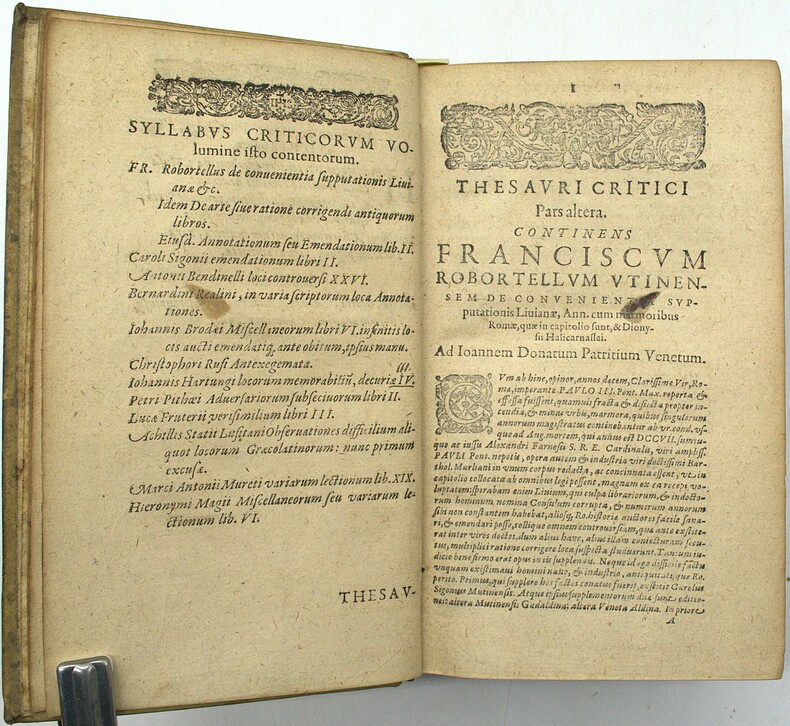
1602PHO-1930Francoforti, E Collegio Paltheniano, sumtibus Ionae Rhodii Bibliopolae, 1602-1634, 7 volumes in-8, vélin époque, dos lisse avec pièce de titre, le 7eme volume est plus petit, ex-libris manuscrit aux titre, rares annotations, papier brunis, rousseurs, travail de ver en marge avec atteinte à quelques lettres tome 2. Tome 1 ; 1602, titre en rouge et noir, 31ff.-1464pp.-23pp., comprend Philippi Beroaldi, Ange Politiani, Robortelli… Tome 2 ; 1604, 22ff.-1443pp.-34ff., Robortelli, Sigonius, Antonio Bendinelli, Johannes Hartung, etc Tome 3 ; 1604, 8ff.-774pp.-46ff.-647pp.-21ff., Paulus Leopardus (Paul Liebaert), Guillaume Canter, etc Tome 4 ; 1604, 4ff.-914pp.-45ff., Aldi Manucci, Jean Brodeau (Ioannis Brodaei), etc Tome 5 avec son supplément ; 1605, 4ff.-408pp.-56ff.-, la première partie est consacré à François Modius, philologue et jurisconsulte belge et Lucas Fruytier , poète des Pays-Bas, le supplément possédant son propre titre, comprend Henri Estienne et Jacobus Nicolaus Loensis: Miscellaneorum epiphillidum libri X. Tome 6 ; 1612, 12ff.-366-1f.-1101pp.-49ff.-3ff. blancs, Comprend Valens Acidalius et Marcellus Donatus, Médecin à Mantoue, botaniste et philosophe Tome 7 ; 1634, Apud Viduam Ionae Rosae, 811pp.-44ff., comprend les écrits de Johann Philipp Wängler, dit Pareus, philologue allemand qui édita le 7eme volume, Georgi Reiteri, Joh. Brantius,
178311773DBNürnberg, Wolfgang Mauritius Endter, 1783 und 1786. 4°. 34 cm. [8] Blatt, 1392 [i. e. 1390] Seiten, [13] Blatt und [10] Blatt, 760 Seiten, [21] Blatt. Pergamentband der Zeit mit von alter Hand geschriebenem Rückentitel. [7 Warenabbildungen] Johann Jacob Speidel, geboren in Stuttgart Anfang des 16. Jahrhunderts, gestorben nach 1666. Rechtsgelehrter und juristi
175213320DBUtrecht, Chez Jacques de Poolsum Libraire, 1752. Klein-8°. 16 x 10,5 cm. Gestochenes Frontispiz, Titelblatt in Rot und Schwarz, [4] Blatt, 297 (1) Seiten, [3 Blatt], gestochenes Frontispiz, Titelblatt in Rot und Schwarz, 287 (1) Seiten, 2 Blatt. Brauner Ganzlederband der Zeit. [3 Warenabbildungen] Äsop, latinisiert Aesopus, war ein antiker griechischer Dichter von Fabeln und Gleichnissen, der wahrscheinlich im 6. Ja