19 315 résultats
2 vol. in-8, pp. (32), 450, (numerosi errori nella paginazione), (1), 22, (2); (16), 450 (rilegato con inversioni da p. 128 a p. 145, ma completo), (30), leg. coeva p. pergam. floscia. Impresa dello stampatore ai titoli, illustrazioni n.t. per il vol. secondo; precedono il testo dediche a papa Giulio III e Ippolito d'Este. Prima edizione di ambedue le parti della Filosofia Naturale del Piccolomini, rare a trovarsi unite, in legature uniformi. Il trattato, diviso in complessivi 8 libri, affronta le principali teorizzazioni della filosofia naturale (definizione di materia, spazio, luogo...). Alessandro Piccolomini (Siena, 1508 -1579) fu vescovo titolare di Patrasso e Coadiutore dell'Arcivescovo di Siena dal 1574, Professore di Filosofia all'Università di Padova dal 1540, filosofo, teorico dell'arte e studioso di lettere classiche, fu astronomo e difensore della teoria tolemaica, autore dell'Orazione in lode delle donne (Roma 1549) e di numerosi trattati astronomici. Opera estremamente rara (legature con macchie, aloni di polvere ai titoli. Nota di possesso coeva al vol. II: "Ioannis Antonii Fabri Maceratensi").. STC 513. Adams P-1117 (seconda parte). Graesse V, 281. Manca a Gamba..
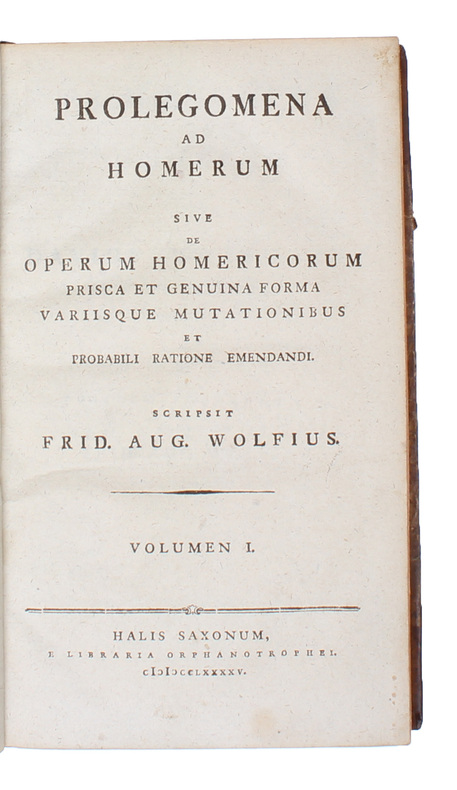
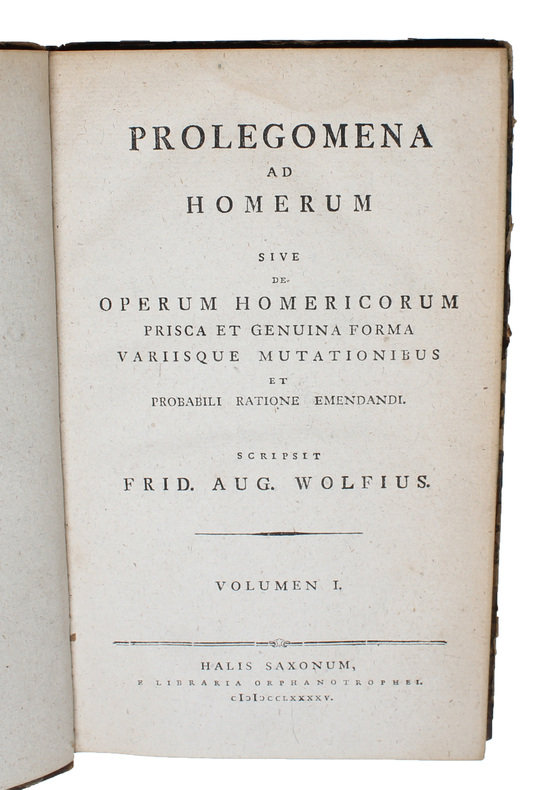
179550015Halis Saxonum (Halle), E Libreria Orphanotrophei, 1795. 8vo. Contemporary half calf with a bit of wear, especially to corners and edges. Gilding to title-label worn off. Paper over boards loosening at edges. Overall fine and tight. A light damp stain to upper margin and a few leaves with some light brownspotting.
179550413Halis Saxonum (Halle), E Libreria Orphanotrophei, 1795. 8vo. Contemporary half calf with five raised bands and gilt title-and tome-labels. Very neatly rebacked. Very nice and clean. An excellent copy. (6), CCLXXX pp.
Halis Saxonum (Halle), E Libreria Orphanotrophei, 1795. 8vo. Contemporary half calf with five raised bands and gilt title-and tome-labels. Very neatly rebacked. Very nice and clean. An excellent copy. (6), CCLXXX pp.
Halis Saxonum (Halle), E Libreria Orphanotrophei, 1795. 8vo. Contemporary half calf with a bit of wear, especially to corners and edges. Gilding to title-label worn off. Paper over boards loosening at edges. Overall fine and tight. A light damp stain to upper margin and a few leaves with some light brownspotting.
in-folio (mm 280x186), ff. (17 su 18 mancando l'ultimo bianco, segn. A4, aa-bb4, cc5), leg. in cartonato rustico antico. Impresa tipogr. al titolo., spazi con lettera-guida per le iniziali, testo nel caratteristico stupendo corsivo dello Janiculo. Seconda edizione con qualche modifica rispetto alla prima (apparsa a Roma nel 1524) di quest'importante e curiosa opera del Trissino (Vicenza 1478 - Roma 1550) sulla riforma dell'ortografia italiana, con la proposta di adottare alcune nuove lettere mutuandole dall'alfabeto greco. La ''Epistola'' è indirizzata al Papa Clemente VII. Al recto del sesto foglio (aa2) iniziano i ''Dubbi grammaticali'', qui in edizione originale, che costituiscono la parte preponderante dell'opera. Gamba 1704: «A questa ristampa è anteposto un Proemio di T. Janiculo, in cui si scrive che l'Epistola è stata in qualche particella dall'Autore fatta più lucida e chiara; il che è verissimo. I Dubbi grammaticali aggiuntivi furono dall'autore scritti per puntellare le sue nuove opinioni contro le censure del Firenzuola, del Liburnio, del Tolomei, e di Lodov. Martelli. Il Trissino restò vinto da' suoi avversari; ma non totalmente, poiché rimasero almeno nella nostra ortografia adottate le differenze da lui suggerite dell'i e dell'u, vocali, dal j e dal v, consonanti». Opera di notevole fascino e molto rara. Esempl. molto bello, a grandi margini su carta forte.. Gamba Test di Lingua, 1704. STC 681. Adams T-951..
191158431[Béziers], 1910-1911. 4to. French manuscript in blue and red ink on paper. 107 pp. With an index and 68 photographs mostly outside the text (37 numbered plates). Original half cloth notebook. Sewn.
160761426[Leyden], Plantin, 1607. 12mo (84 x 134 mm). 384 pp. With wodcut printer's device to title-page and 69 small but elegant woodcuts in the text. Contemporary limp vellum (lacking ties).
1775149027Leipzig, Sommer, 1770-1775. 20,5 x 12 cm. Zus. ca. 11.000 Seiten, Band 1 mit einem gestochenen Portrait von Reiske als Frontispiz. Ganzlederbände der Zeit mit Rückenschild, Rückenvergoldung und vergoldeten Deckelkanten.
9 volumes in-8, plein veau raciné de l'époque, dos ornés de compartiments entièrement garnis d'un décor de résilles, palettes, filets et fers spéciaux, pièces de titre de maroquin rouge et de tomaison en médaillon bronze, tranches jaspées, portrait gravé de Turgot en frontispice. Première édition collective des oeuvres de Turgot, éditée, préfacée et annotée par Dupont de Nemours. Le premier volume, qui renferme dans son intégralité: "Mémoires sur la vie, l'administration et les ouvrages de M. Turgot" par Dupont de Nemours, a été publié trois ans après les huit autres volumes. Il est à l'adresse de l’éditeur Belin, 1811 et contient, en frontispice, un portrait de Turgot gravé par D. Tardieu, d'après l'oeuvre de P. Ducreux. La collection contient l'ensemble des oeuvres du ministre dans tous les domaines de son activité encyclopédique: économie politique, fiscalité et finance, sciences de la vie, philosophie politique, historiographie, linguistique et philologie, géographie et voyages, questions coloniales, etc. Le volume VIII contient les arrêts et les ordonnances prises sous son ministère. Le neuvième, ses traductions de texte de l'antiquité classique et essais d'histoire littéraire. (Einaudi, 5769. Goldsmiths, 20226. Kress, B.5464. Monglond, VII, 1111 et s.). Qqs petites taches et rousseurs éparses. Mors fendillés. Dos "craquelés". Traces de restaurations à la reliure. Bon exemplaire, relié à l'époque.
Very Good Turkish, Ottoman (1500-1928) Original red, black and brown leather bindings. Raised bands to spine, richly gilt in Ottoman script and in traditional style. Bindings are not homogeneous. 4to. (28 x 20 cm). In Ottoman script. 6 volumes set: (16, 4830, 1 p.), ills. Dictionnarie universel d'histoire et de géographie.= Kamusü'l-alâm. Tarih ve cografya lügati ve tabir-i islah ile kaffe-i esami-i hassayi camidir. 6 volumes set. This work is an encyclopedic dictionary giving detailed information about historical-geographical places, works, and people (prophets, saints, poets, scholars, statesmen, philosophers, etc). The largest encyclopedia made in the Ottoman period, the first example in Turkey of encyclopedias made in Europe, namely the first modern encyclopedia, is not translated into today's Turkish language. Extremely rare. Özege 9998. First and Only Edition.
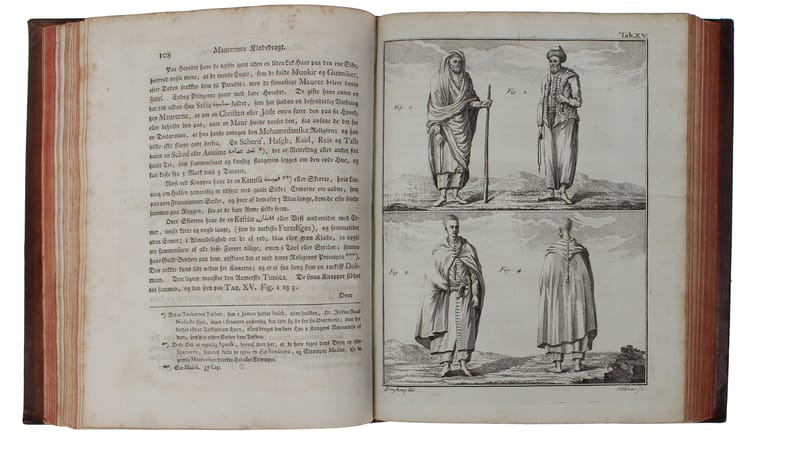
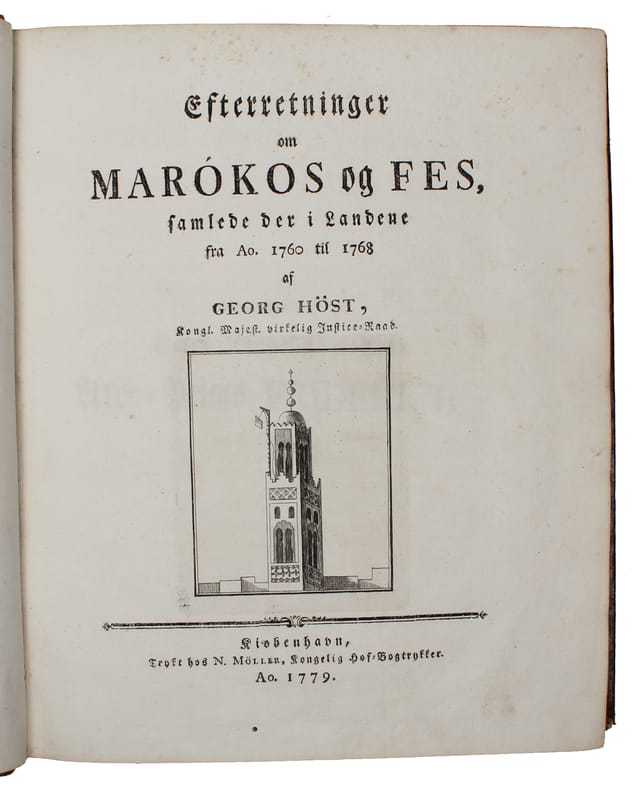
177960334Kiøbenhavn [Copenhagen], N. Möller, 1779. 4to. In contemporary full calf with five raised bands and gilt ornamentation to spine. Wear to extremities and capitals with repairs. Ex-libris pasted on to front free end-paper. Small vague dampstain to lower outer corner, affecting a few leaves. An overall very nice and clean copy. (20), 291, (24) + 34 engraved plates, several of them folded, and 1 frontispiece.
177960862Kiøbenhavn [Copenhagen], N. Möller, 1779. 4to. In contemporary full calf with five raised bands and gilt ornamentation to spine. Light wear to extremities, corners bumped. Previous owner's name to upper margin of front free end-paper. Occassionally leaves split between quires. A few leaves miscoloured. An overall very nice and clean copy. (20), 291, (24) + 34 engraved plates, several of them folded and 1 frontispiece.
Kiøbenhavn [Copenhagen], N. Möller, 1779. 4to. In contemporary full calf with five raised bands and gilt ornamentation to spine. Wear to extremities and capitals with repairs. Ex-libris pasted on to front free end-paper. Small vague dampstain to lower outer corner, affecting a few leaves. An overall very nice and clean copy. (20), 291, (24) + 34 engraved plates, several of them folded, and 1 frontispiece.
Frankfurt am Main, Verlag von Johann David Sauerländer, 1868-69. 8vo. Bound with the general title-pages to both volumes of Rheinishes Museum in a very nice recent marbled paper binding with gilt leather title-label to front board. (Vol. XXIII:) pp. (632) - 653 + (Vol. XXIV:) pp. (181) - 228. The paper is extremely brittle and cracks very easily, thus there are a few smaller marginal tears, no loss of lettering and occassional marginal chipping, far from affecting text.
Very Good Serbo-Croatian Paperback. Roy. 8vo. (23 x 15 cm). In Aljamiado (Serbo-Croatian in Arabic letters), Arabic, and Persian with an introduction in Arabic. The third revised edition of the Waqf Directorate in Sarajevo. 104 p., 4 unnumbered b/w plates. "Ilmihal" [i.e. Catechism] recommended to all who want to know and learn Islamic ceremonies and practice. Learn how to pray, what are basic principles of the Islamic faith, what are the Islamic duties, what are the Islamic holidays, what constitutes proper Islamic behavior, and lots more. This extremely rare catechism book printed in Sarajevo in Croatian with Arabic letters (Aljamiado). This book is one of the late examples of Aljamiado literature beginning in early Andalusia and constitutes one of the rarest examples of the Ottoman book tradition. Aljamiado or Aljamía texts are manuscripts that use the Arabic script for transcribing European languages, especially Romance languages such as Mozarabic, Portuguese, Spanish or Ladino, and Bosnian with its Arebica script. According to Anwar G. Chejne, Aljamiado or Aljamía is "a corruption of the Arabic word ?ajamiyah (in this case it means foreign language) and, generally, the Arabic expression ?ajam and its derivative 'Ajamiyah are applicable to peoples whose ancestry is not of Arabian origin". During the Arab conquest of Persia, the term became a racial pejorative. In linguistic terms, the Aljamía is the use of the Arabic alphabet to transcribe a Romance language. It was used by some people in some areas of Al-Andalus as an everyday communication vehicle, while Arabic was reserved as the language of science, high culture, and religion. The systematic writing of Romance-language texts in Arabic scripts appears to have begun in the fifteenth century, and the overwhelming majority of such texts that can be dated belong to the sixteenth century. A key aljamiado text was the mufti of Segovia's compilation Suma de los principales mandamientos y devediamentos de nuestra santa ley y sunna, of 1462. In later times, Moriscos were banned from using Arabic as a religious language and wrote in Spanish on Islamic subjects. Examples are the Coplas del alhichante de Puey Monzón, narrating a Hajj, or the Poema de Yuçuf on the Biblical Joseph (written in Aragonese). Aljamiado played a very important role in preserving Islam and the Arabic language in the life of the Moriscos. After the fall of the last Muslim kingdom on the Iberian peninsula, the Moriscos (Andalusian Muslims in Granada and other parts of what was once Al-Andalus) were forced to convert to Christianity or leave the peninsula. They were forced to adopt Christian customs and traditions and to attend church services on Sundays. Nevertheless, some of the Moriscos kept their Islamic belief and traditions secretly through the usage of Aljamiado. In 1567, Philip II of Spain issued a royal decree in Spain, which forced Moriscos to abandon using Arabic on all occasions, formal and informal, speaking and writing. Using Arabic in any sense of the word would be regarded as a crime. They were given three years to learn the language of the Christian Spanish, after which they would have to get rid of all Arabic written material. Moriscos translated all prayers and the sayings of their prophet Mohammed into Aljamiado transcriptions of the Spanish language while keeping all Qur'anic verses in the original Arabic. Aljamiado scrolls were circulated amongst the Moriscos. Historians came to know about Aljamiado literature only in the early nineteenth century. Some of the Aljamiado scrolls are kept in the Spanish National Library in Madrid. The word aljamiado is sometimes used for other non-Semitic languages written in Arabic letters. For example, Bosnian and Albanian texts written in Arabic script during the Ottoman period have been referred to as aljamiado. However, many linguists prefer to limit the term to Romance languages, instead of using Arebica to refer to the use of Arabic script for Slavic languages... Not in OCLC.
155530476DBBasel, Henripetri, 1555. Folio. 48 n.n. Bl., 1499 (recte 1503) S., 1 S. Druckermarke. Schweinslederband der Zeit über Holzdeckeln mit handschriftlichem Rückentitel und Rollstempelverzierung. + Wichtig: Für unsere Kunden in der EU erfolgt der Versand alle 14 Tage verzollt ab Deutschland / Postbank-Konto in Deutschland vorhanden +, 30476D
157732458[Genf], Henri Estienne, 1577. (16), 72, 134 SS. Mit Holzschnittdruckermarke am Titel. Pergamentband des 17. Jhs. mit Spuren eines späteren gepr. Rückentitels. Gr.-4to.
150918566(Paris), [Guy Marchant für] Jean Petit, (12. IX. 1509). (10), CCXXV [225], (1) Bll. Mit 2 versch. Holzschnitt-Druckermarken (Petit am Titel, Marchant am letzten Bl. verso) sowie einem ganzseitigen Textholzschnitt. Französischer Lederband um 1680 mit goldgepr. Rückenschildchen und -vergoldung. Dreiseitiger gesprenkelter Rotschnitt. 4to.
15751670Venedig, Giunta, 1575. 4 nn., 18, 537 (recte 523) Bll. Mit Holzschnittdruckermarke am Titel und letzten Blatt verso, zahlr. floralen und figuralen Initialen sowie einigen Zierstücken in Holzschnitt. Pergamentband des 18. Jh. mit goldgepr. Rückenschildchen und übergreifenden Deckelkanten. Folio.
186331826Paris, Michel Lévy Frères, 1863. Bound totally uncut w. the orig. wrappers, also the back, in a near cont. green marbled cardboardbdg. w. red gilt title- and tome-labels to back. Capitals w. traces of use and back a bit faded, but otherwise nice and solid. Wrappers lightly soiled. Woodcut portrait of Renan inserted as frontispiece (not called for). W. half-title (""Histoire des Origines du Christianisme. Livre premier""). A very nice and clean copy, -only a couple of leaves w. very minor brownspotting. (4), LIX, 462 pp. + (1) leaf (colophon).
191638101Lausanne & Paris, 1916. Lex 8vo. Uncut in the orig. printed wrappers. Minor wear w. minor loss to capitals and corner of front wrapper, otherwise an exceptionally nice copy. A few pages w. underlining. Text-illustrations. 336, (1, -errata) pp.
Stuttgart und Tübingen, Cotta, 1827. 4to. In the original patterned paper boards, with contemporary handwritten paper-title to spine and old handwritten library paper-label to lower spine. Wear to extremities and lacking some paper at spine. Stamp to first title-page (general title-page for the wntire year) and stamp to verso of title-page for the front wrapper of the January-issue. A damp stain to the first two leaves, otherwise internally quite good. Bound with the general title-page for the entire year and with some of the original wrappers for the individual months (among these that of January). 1856 colomns (i.e 928 pp.).
Paris, Michel Lévy Frères, 1863. Bound totally uncut w. the orig. wrappers, also the back, in a near cont. green marbled cardboardbdg. w. red gilt title- and tome-labels to back. Capitals w. traces of use and back a bit faded, but otherwise nice and solid. Wrappers lightly soiled. Woodcut portrait of Renan inserted as frontispiece (not called for). W. half-title (""Histoire des Origines du Christianisme. Livre premier""). A very nice and clean copy, -only a couple of leaves w. very minor brownspotting. (4), LIX, 462 pp. + (1) leaf (colophon).
Lausanne & Paris, 1916. Lex 8vo. Uncut in the orig. printed wrappers. Minor wear w. minor loss to capitals and corner of front wrapper, otherwise an exceptionally nice copy. A few pages w. underlining. Text-illustrations. 336, (1, -errata) pp.