Livre Rare Book

19 318 résultats
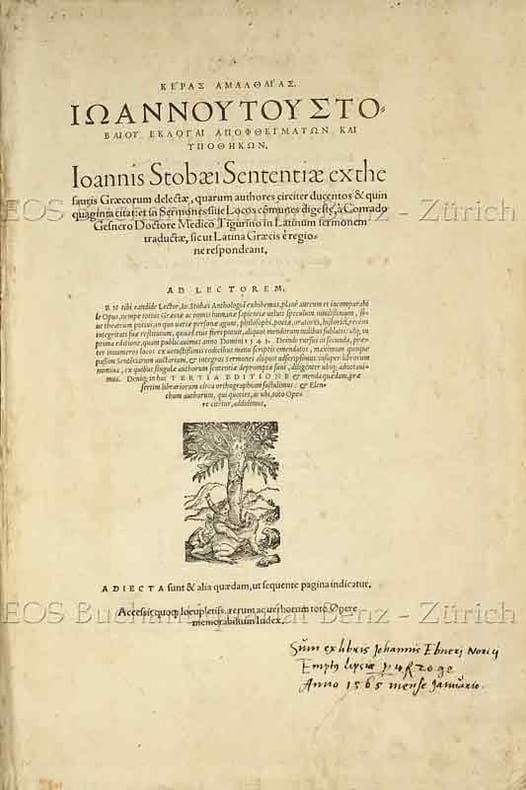
155530476DBBasel, Henripetri, 1555. Folio. 48 n.n. Bl., 1499 (recte 1503) S., 1 S. Druckermarke. Schweinslederband der Zeit über Holzdeckeln mit handschriftlichem Rückentitel und Rollstempelverzierung.
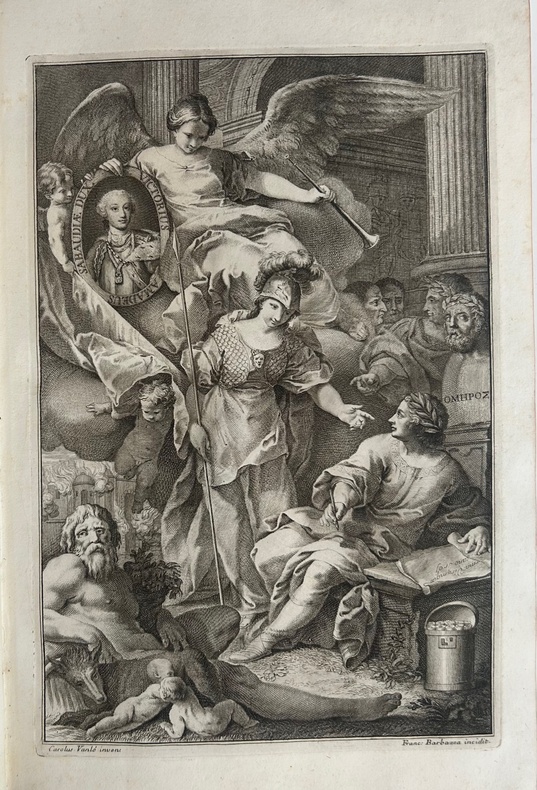
B352221Romae, Joannes Zempel for Monaldini, 1763-1765. 3 volumes folio (420x280 mm). [2], XCII, 211; LX, 336; XXIV, 343 pp. Titles printed in black and red each with engraved vignette, 3 frontispieces, 3 (instead of 2) plates (one map), 144 text illustrations including head and tail pieces, 31 initials, all engraved by Barbazza, Benedetti, Giardoni and others. Contemporary mottled calf, spine gilt, with title and volume labels. Crack to tail of volume I, one corner slightly bumped.
In -8, pp. (4), 400, leg. coeva p. pelle, titolo oro su tassello e ricchi fregi al dorso, tagli rossi. Opera illustrata da un'antiporta allegorico Bell'antiporta allegorica incisa in rame ''Mercure conduit par l'amour, ou invention du langage et de l'ecriture'' incisa da Romanet, una tabella a doppia pagina con gli alfabeti primitivi e una tavola incisa in rame a 4 colori, ripiegata f.t., raffigurante la lingua, la laringe e l'organo della voce descritto in tutte le sue parti, incisa da Jacques-Fabien Gautier D'agoty. Prima edizione separata di questo trattato sull'origine universale della parola e del linguaggio, estratta dal terzo volume del ''Monde primitif, analysé et comparé avec le monde moderne. Bell'esemplare in prima edizione di quest'opera rara e ricercata, la sua importanza è dovuta alla presenza della grande tavola ripiegata a colori incisa da Gautier-Dagoty. L'eccezionalità dell'incisione è dovuta al fatto di essere la prima impressa in quattro colori. Antoine Court de Gebelin, ex pastore protestante nato a Nimes, nel 1771 fu iniziato alla massoneria nella loggia parigina Les Amis Réunis e in seguito nella loggia Le Neuf Soeurs dove, nel 1778, fu testimone dell'iniziazione di Voltaire e altri notevoli personaggi come l'astronomo Lalande, lo scultore Houdon, il naturalista Lacépède, e l'ambasciatore americano in Francia, Benjamin Franklin. Fondò la Sociéte Apollonienne, e fu tra i membri fondatori del Filalete, una fraternità esoterica con legami con la massoneria e la setta mistica Elus Coen.. Brunet, II, col. 1516; Caillet 2664 e Graesse, III, p. 40 (per la seconda edizione del 1816)..
in-8, ff. (4), 134, (2), solida legatura settec. in piena pergamena rigida con unghia, duplice tassello bicolore in pelle con titolo oro al dorso. Impresa tipogr. al titolo, testatine ed inziali silogr., testo in elegante e nitidissimo car. rom. Dedica dell'a. all'omonimo Doge di Venezia. Prima edizione di questo trattato che interessa la filosofia, l'esoterismo (nel libro primo si parla delle ''potenze'' dell'anima) e la psicologia (il quarto libro si occupa dell'intelletto e delle sue funzioni). L'autore (nato ai primi del '500 e morto nel 1581, fratello maggiore del letterato Domenico), di notevole ingegno, fu considerato tra i più grandi filosofi e politici del tempo ed uno dei precursori della moderna scienza psicologica (cfr. Schueling, Bibliogr. des Psycologischen Literatur des 16 Jahrhunderts, 1967, p. 264). Ottimo esempl.. Manca all'Adams. BMC 718..
192942791Prague, Jednota Ceskoslovenskych Matematiku a Fysiku, 1929. 8vo. Uncut and unopened in the original printed wrappers. A bit of minor chipping and bending to extremities. A very nice copy. 118, (2, -blank) pp.
Prague, Jednota Ceskoslovenskych Matematiku a Fysiku, 1929. 8vo. Uncut and unopened in the original printed wrappers. A bit of minor chipping and bending to extremities. A very nice copy. 118, (2, -blank) pp.
Frankfurt am Main, Verlag von Johann David Sauerländer, 1870-73. 8vo. Bound with the general title-pages to both volumes of Rheinishes Museum in a very nice recent marbled paper binding with gilt leather title-label to front board. (Vol. XXV:) pp. (528) - 540 + (Vol. XXVII:) pp. (211) - 249. The paper is extremely brittle and cracks very easily, thus there are a few smaller marginal tears, no loss of lettering. Occassinal light pencil-underlinings in text.
Very Good French Original wrappers. Demy 8vo. (22 x 14 cm). In French. 33, [1] p., tables, and plates. First and only edition of this extremely rare treatise on How Kufic script is applied to print, a brief history of Kufic script, its use in ancient and modern times, examples of writing accompanied by illustrations, typesetting on the keyboard for linotype printing, its use on typewriters, its use in telegraphy (with Arab and international typesettings), etc. Ali Kenan (?-1962), married Emine Nemika Sultan (1888-1969) in 191 and became a groom to the Ottoman palace and the royal family. Only one copy can be traced in OCLC 1065045158, in The British Library, St. Pancras.
Very Good Turkish, Ottoman (1500-1928) Original full brown morocco with traditional flap. Traditional flowers embossing on boards. Roy. 8vo. (23 x 16 cm). In Ottoman script. [3], 503 p. Hegira 1215 = Gregorian 1799. This is a classical and very important annotation in Turkish / Ottoman literature made to Sünbülzade's 'Tuhfe'. A dictionary in verse. 'Tuhfe' was a first books in Mühendishane printing house. After one year later Müderris Abdurrahman printed this annotation to 'Tuhfe'. Müderris Abdurrahman Efendi was the first director of the "Mühendishane Matbaasi" (Mühendishâne-i Berrî Humâyûn), which was opened in Üsküdar, Istanbul in 1797. Abdurrahman Efendi, who was a professor of algebra and geometry, took lessons on the techniques of fortification from the French experts for 10 years before the opening of the Mühendishane Printing House established during the 'Nizam-i Cedid' movements in 1793 and gave engineering courses in the newly established school while managing the Mühendishane Press. "Mühendishane", also known as "Üsküdar Matbaasi" under the direction of Müderris Abdurrahman Efendi has published especially "Cedid Atlas" (New Atlas) and other many important works. This first edition not in OCLC.; This Edition not in Özege; TBTK 1476.; Beydilli: Türk bilim ve matbaacilik tarihinde Mühendishâne Matbaasi ve Kütüphânesi, (1776-1826), pp. 253. First Edition. Extremely rare.
194860465Jerusalem, Bialik Foundation. 1948. Large 4to (325 x 235 mm). In the original printed wrappers. Extremities with light marginal miscolouring and a bit creased. Verso of wrappers with offsetting, otherwise a fine copy. (6), 43 pp. + 13 plates.
188513704Christiania (Oslo), 1885-1985. Lex8vo. Bound up to vol 81 in 52 fine solid hcalf. Vol. 82-100 in clean parts. Incl. Indexes for vol. 1-40 and 41-100.
Christiania (Oslo), 1885-1985. Lex8vo. Bound up to vol 81 in 52 fine solid hcalf. Vol. 82-100 in clean parts. Incl. Indexes for vol. 1-40 and 41-100.
175364629Wien, ex Typographia Trattneriana (Trattner), 1753. Gr.-Fol. (ca. 50 x 35,5 cm). Mit gest. Titelvignette, 6 gest. Vignetten u. Initialen, einem Textkupfer, einem großen Textholzschnitt u. 12 doppelblattgr. Kupferkarten v. Salomon Kleiner. 2 Bll., XIV, 69 (1), XII S., Geheftet (ausgebunden; ohne Einband).
150852091Mailand, Leonhard Pachel [für Giovanni Giacomo da Legnano & fratres], 1. Dezember 1508. Fol. Mit einem großen Titelholzschnitt u. zahlr. Holzschn.-Initialen im Text. 8 nn., 214 num. Bll., Mod. Pgmt. m. handschriftl. Rückentitel u. dreiseitig gespränkeltem Rotschnitt.
16x11. 475p. Anotaciones en guardas. Lomo desprendido. Ed. GERARDI MARCILLO. Enc. Pergamino.
78344Amstelodami - Amsterdam, RBL Jacobi Wetstenii 1746, 413x265mm, reliure plein parchemin de l’époque, dos à 7 nerfs, titre et tomaison calligraphiés à l’encre, plats ornés à froid, tranches jaspées. Première édition de Diodore de Sicile donnée par Pierre Wesseling, dans une reliure de type germanique. Très bel exemplaire.
15593332DB(Am Schluss:) Tiguri, apud Christophorum Frosch., anno 1559. Mense Augusto. Folio. (12) Bl., 632 S., (15) Bl. (letztes leeres Bl. fehlt). Mit zahlreichen figürlichen Holzschnitt-Initialen, Holzschnitt-Druckermarke. Blindgeprägter Schweinslederband der Zeit mit 2 Metallschliessen, Papierrückenschild, maschinengeschrieben.
Very Good French Original handsome leather bindings. Demy 8vo. (22 x 14 cm). In French and Ottoman script. 4 volumes set: ([vi], [2], 784, 125 p., [vi], 1372 p.; [xxx], [2], 1097 p., [vi], 1320 p.). Slight foxing on pages, faded on boards, otherwise a very good set. Ex-libris of Izzet Gündag Kayaoglu. First edition of the complete set of this early dictionary from French to Turkish and from Turkish to French, published in Paris, in London Oriental Translations Committee Printer. Bianchi visited Istanbul at the beginning of the 19th century and prepared dictionary and phrasebooks in Turkish after he had returned to his country. One of his most significant works occurs to be this dictionary. What makes this dictionary noteworthy among other his works is the fact that Turkish words are written together in both Arabic and Latin characters. Turkish words with Arabic letters are written as to stereotyped pronunciation in the work. Therefore, they do not indicate the changes in the language. Bianchi reflects the pronunciation of writing in Turkish letters with Latin characters; and thus, the differences between spelling and pronunciation are highlighted. Thomas-Xavier de Bianchi (1783-1864), born in Paris on June 25, 1783, was the younger brother of the Austrian Field Marshal de Bianchi, Duke of Casalanza. He studied at the Central School of the department of Seine-et-Marne and followed, in Paris, oriental language courses at the College de France and at the Imperial Library under Sylvestre de Sacy. In 1807, he was appointed a pupil at the French school of young people of language in Constantinople, then directed by the scholar Ducaurroy and completed his improvement in Arabic, Persian and Turkish. Sent to Izmir in 1811, he was second there, and then the first dragoman of the Consulate General, and was noted for his dedication during the plague epidemic of 1812. In 1816, he was appointed assistant to the King's secretary-interpreters in Paris and was in charge to accompany the Persian envoy to Louis XVIII in 1819. In 1829, he was sent on a mission to the last day of Algiers, Hussein-pasha. The following year, France intervened in Algeria. He was appointed secretary-interpreter in the title and served as professor of Turkish at the School of Oriental Languages until 1842. After his retirement, he devoted himself to lexicographical and bibliographical work. He was an officer of the Legion of Honor, decorated with the Nichan-Iftikhar, as a member of the Imperial Academy of Constantinople. Tout exemplaire de ce Dictionnaire qui ne serait pas revetu de la signature de l'un des auteurs et editeurs sera repute contrefaçon, et poursuivi cmme tel, en vertu de la loi du 19 juillet 1793. [i.e. Any copy of this Dictionary which does not bear the signature of one of the authors and publishers will be deemed to be counterfeit, and prosecuted as such, under the law of July 19, 1793].
153033891Paris, G. Morrhy, 1530. 320 nicht numerierte Bl. Mit Druckermarke auf dem Titel und am Ende sowie zahlreichen kleinen Holzschnitt-Initialen. Fol. (34 x 23 cm). Holzdeckelband der Zeit mit breitem blindgeprägten Schweinslederrücken und zwei intakten Schließen.
154965737Lyon, Sebastian Gryphius, 1542-1549. 8°. Pgmt. d. Zt. m. blindepr. Deckelfileten, durchzogenen Bünden u. handschriftl. Rückentitel.
161948626Venedig, Nicolo Misserini, 1619. 4°. Mit breiter figürl. gest. Titelbordüre, 2 doppelblattgr. Kupferkarten u. 40 doppelblattgr. Kupfertafeln. 8 Bll., 407 S., 12 Bll., Etw. späterer Pgmt.-Bd. m. durchzogenen Bünden u. handschriftl. Rückentitel.
In-4°, (4cc), 203pp, (5cc), vignetta calcografica al frontespizio, fregio e iniziale xilografica, legatura in piena pergamena rigida. Nel 1637 Inghirami pubblicò gli Etruscarum antiquitatum fragmenta, in cui annunciava la scoperta di importanti documenti, contenenti quasi tutta la storia del popolo etrusco e della sua civiltà, nel suo possedimento di Scornello, vicino a Volterra. L'opera suscitò un vastissimo scalpore in tutta Europa. Si trattava in realtà di un falso clamoroso, come venne quasi subito dimostrato. Inghirami difese la genuinità delle sue scoperte in un ampio Discorso (1645), ma il prefetto della Biblioteca apostolica vaticana Leone Allacci dimostrò in modo inconfutabile la falsità dei documenti nell'opuscolo polemico Animadversiones in antiquitatum etruscarum fragmenta. La scrittura nei testi etruschi andava nella direzione sbagliata, da sinistra a destra. Più importante - e più significativo - era il fatto che i testi latini erano scritti in minuscolo. Attingendo a umanisti precedenti, molti dei quali avevano discusso brevemente o di sfuggita l'argomento, Allacci insisteva sul fatto che i romani avevano sempre redatto i loro testi letterari in maiuscolo. Il breve schizzo della storia dell'antica scrittura latina redatto da Allacci fornì il modello per Mabillon, che lo citò nel suo De re diplomatica (1681). In-4°, (4cc), 203pp, (5cc), the title page with copper engraved vignette, wood engraved frieze and initial, full contemporary vellum binding. In 1637 Curzio Inghirami published the Etruscarum antiquitatum fragmenta, in which he announced the discovery of important documents, containing almost the entire history of the Etruscan people and their civilization, in his possession of Scornello, near Volterra. The work caused a huge turmoil throughout Europe. It was actually a sensational fake, as was almost immediately demonstrated. Inghirami defended the genuineness of his discoveries in an extensive Discorso (1645), but the prefect of the Vatican Apostolic Library Leone Allacci irrefutably demonstrated the falsity of the documents in the polemical pamphlet Animadversiones in antiquitatum etruscarum fragmenta. Writing in Etruscan texts went the wrong way, from left to right. More important - and more significant - was the fact that the Latin texts were written in lower case. Drawing on earlier humanists, many of whom had discussed the subject briefly or in passing, Allacci insisted that Romans had always written their literary texts in capital letters. Allacci's short sketch of the history of ancient Latin writing provided the model for Mabillon, who quoted it in his De re diplomatica (1681).
Due tomi in un volume in folio legato in pergamena, piatti inquadrati da doppio filetto impresso a secco, dorso a sei nervi, sguardie, occhiello, frontespizio in due colori con ampia, bella marca in rame, tavola in rame col ritratto di Marco Aurelio Antonino, 6 carte, 924 colonne (462 pp.), 40 carte del triplice indice riguardanti l'Instrumentum Stylo, l'Adversaria miscellanea e l'Adversaria posthuma; frontespizio del Marci Antonini Imperatoris de rebus suis, datato 1697, 20 carte, 432 pp., 9 carte d'indici, seguono 160 pp. e tre carte d'indici degli Opuscula. Magnifica edizione delle opere del Gataker, notevolissimo il saggio sulla scrittura con riferimenti sia al greco che all'ebraico (sua la dissertazione sulla corretta pronuncia del tetragramma ebraico Jehovah al posto di Jahveh) che è reiterato nelle due Adversaria miscellanea. La maggiore delle opere è sicuramente il De rebus suis di Marco Aurelio Antonino, in greco con a fronte la traslazione latina. Le meditazioni di Marco Aurelio in ottima veste filologica, in magnifica impressione, ottimamente glossate e sostenute da un commento fra i più citati. Restano da presentare gli Opuscula philologica sive dissertationes tres, squisiti nella loro chiarezza analitica. Il volume si presenta in più che bello stato, nella legatura coeva in pergamena (difetti alle cerniere), privo di difetti palesi. Di buona rarità, importante
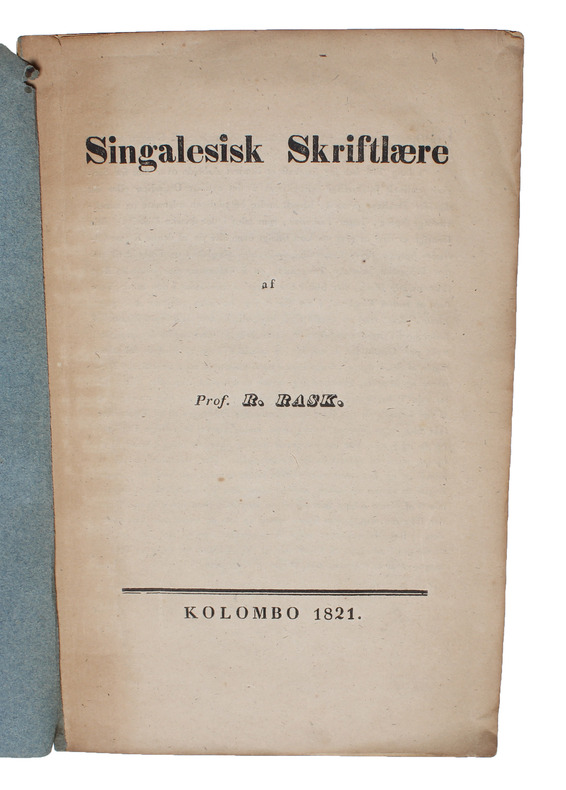
182157139Kolombo (Colombo, Sri Lanka), 1821. 8vo. Original blank blue wrappers. Insignificant wear to edges of wrappers. Light toning, but a fine copy. (2),16 pp.
187813821Stockholm, Uppsala, 1878-1988. Indbundet i hpergamentsbd. og hldrbd., 18 bind ialt er heftede. Rygge på enkelte af pergamentsbindene lettere beskadigede.